System Simulation
Presented by
Amita Gautam
PhD Schollar (FMPE)
Submitted to
Dr. A. K. Verma
Department of Farm Machinery and Power Engineering
SVCAET & Reaserch Station, Faculty of Agril. Engineering
Indira Gandhi Krishi Vishwavidyalaya, Raipur(C.G)
DEPARTMENT OF FARM MACHINERY AND POWER
ENGINEERING
SVCAETRS, FACULTY OF AGRICULTURAL ENGINEERING
INDIRA GANDHI KRISHI VISHWAVIDYALAYA
RAIPUR (CHHATTISGARH)
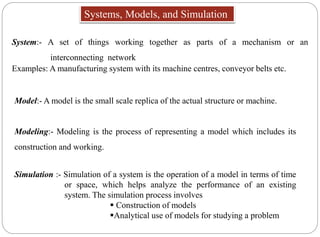
System:- A set of things working together as parts of a mechanism or an
interconnecting network
Examples: A manufacturing system with its machine centres, conveyor belts etc.
Systems, Models, and Simulation
Model:- A model is the small scale replica of the actual structure or machine.
Modeling:- Modeling is the process of representing a model which includes its
construction and working.
Simulation :- Simulation of a system is the operation of a model in terms of time
or space, which helps analyze the performance of an existing
system. The simulation process involves
 Construction of models
Analytical use of models for studying a problem
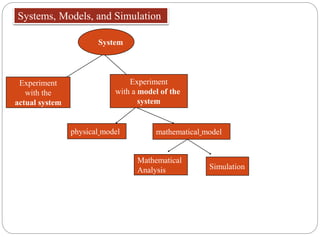
mathematical model
Mathematical
Analysis
physical model
System
Experiment
with the
actual system
Simulation
Experiment
with a model of the
system
Systems, Models, and Simulation
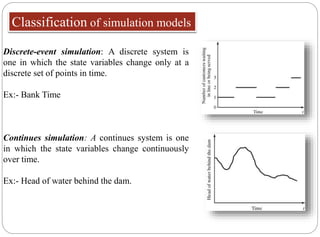
Discrete-event simulation: A discrete system is
one in which the state variables change only at a
discrete set of points in time.
Ex:- Bank Time
Continues simulation: A continues system is one
in which the state variables change continuously
over time.
Ex:- Head of water behind the dam.
Classification of simulation models
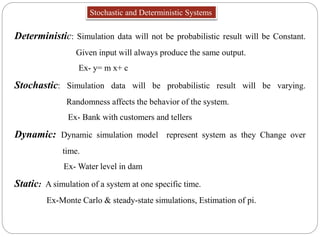
Deterministic: Simulation data will not be probabilistic result will be Constant.
Given input will always produce the same output.
Ex- y= m x+ c
Stochastic: Simulation data will be probabilistic result will be varying.
Randomness affects the behavior of the system.
Ex- Bank with customers and tellers
Dynamic: Dynamic simulation model represent system as they Change over
time.
Ex- Water level in dam
Static: A simulation of a system at one specific time.
Ex-Monte Carlo & steady-state simulations, Estimation of pi.
Stochastic and Deterministic Systems
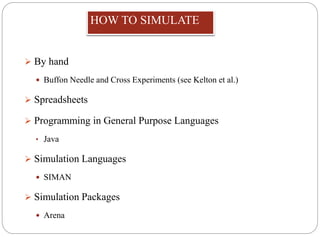
 By hand
 Buffon Needle and Cross Experiments (see Kelton et al.)
 Spreadsheets
 Programming in General Purpose Languages
• Java
 Simulation Languages
 SIMAN
 Simulation Packages
 Arena
HOW TO SIMULATE
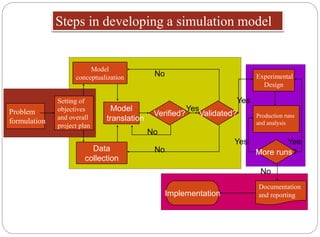
Problem
formulation
Setting of
objectives
and overall
project plan
Model
conceptualization
Data
collection
Model
translation
Verified?
No
Validated?
No
No Experimental
Design
Production runs
and analysis
More runs?
Documentation
and reporting
No
Implementation
Yes
Yes
Yes
Yes
Steps in developing a simulation model
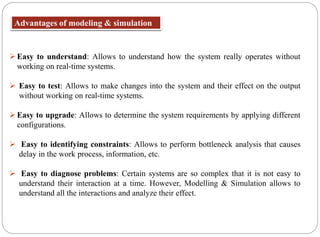
 Easy to understand: Allows to understand how the system really operates without
working on real-time systems.
 Easy to test: Allows to make changes into the system and their effect on the output
without working on real-time systems.
 Easy to upgrade: Allows to determine the system requirements by applying different
configurations.
 Easy to identifying constraints: Allows to perform bottleneck analysis that causes
delay in the work process, information, etc.
 Easy to diagnose problems: Certain systems are so complex that it is not easy to
understand their interaction at a time. However, Modelling & Simulation allows to
understand all the interactions and analyze their effect.
Advantages of modeling & simulation
Designing a model is an art which requires domain knowledge, training and
experience.
Operations are performed on the system using random number, hence
difficult to predict the result.
Simulation requires manpower and it is a time-consuming process.
Simulation results are difficult to translate, it requires experts to understand.
Simulation process is expensive.
Disadvantages of modeling & simulation
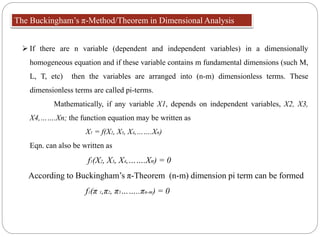
The Buckingham’s π-Method/Theorem in Dimensional Analysis
 If there are n variable (dependent and independent variables) in a dimensionally
homogeneous equation and if these variable contains m fundamental dimensions (such M,
L, T, etc) then the variables are arranged into (n-m) dimensionless terms. These
dimensionless terms are called pi-terms.
Mathematically, if any variable X1, depends on independent variables, X2, X3,
X4,…….Xn; the function equation may be written as
X1 = f(X2, X3, X4,…….Xn)
Eqn. can also be written as
f1(X2, X3, X4,…….Xn) = 0
According to Buckingham’s π-Theorem (n-m) dimension pi term can be formed
f1(π 1,π2, π3……..πn-m) = 0
Than it is written in π-term . In which number of π-term is equal to (n-m). Hence eqn.
becomes as
Let X2, X3, X4 are the repeating variable if m = 3
Then pi term can be written as
a1 b1 c1
π 1 = X2. X3. X4 . X1
a2 b2 c2
π 2 = X2. X3. X4 . X5
an-m bn-m cm
π n-m = X2. X3. X4 . Xn
Each equation is solved by principle of homogeneity. And finale answer of pi is obtained .
Thank you

2. System Simulation modeling unit i

  • 1.
    System Simulation Presented by AmitaGautam PhD Schollar (FMPE) Submitted to Dr. A. K. Verma Department of Farm Machinery and Power Engineering SVCAET & Reaserch Station, Faculty of Agril. Engineering Indira Gandhi Krishi Vishwavidyalaya, Raipur(C.G) DEPARTMENT OF FARM MACHINERY AND POWER ENGINEERING SVCAETRS, FACULTY OF AGRICULTURAL ENGINEERING INDIRA GANDHI KRISHI VISHWAVIDYALAYA RAIPUR (CHHATTISGARH)
  • 2.
    System:- A setof things working together as parts of a mechanism or an interconnecting network Examples: A manufacturing system with its machine centres, conveyor belts etc. Systems, Models, and Simulation Model:- A model is the small scale replica of the actual structure or machine. Modeling:- Modeling is the process of representing a model which includes its construction and working. Simulation :- Simulation of a system is the operation of a model in terms of time or space, which helps analyze the performance of an existing system. The simulation process involves  Construction of models Analytical use of models for studying a problem
  • 3.
    mathematical model Mathematical Analysis physical model System Experiment withthe actual system Simulation Experiment with a model of the system Systems, Models, and Simulation
  • 4.
    Discrete-event simulation: Adiscrete system is one in which the state variables change only at a discrete set of points in time. Ex:- Bank Time Continues simulation: A continues system is one in which the state variables change continuously over time. Ex:- Head of water behind the dam. Classification of simulation models
  • 5.
    Deterministic: Simulation datawill not be probabilistic result will be Constant. Given input will always produce the same output. Ex- y= m x+ c Stochastic: Simulation data will be probabilistic result will be varying. Randomness affects the behavior of the system. Ex- Bank with customers and tellers Dynamic: Dynamic simulation model represent system as they Change over time. Ex- Water level in dam Static: A simulation of a system at one specific time. Ex-Monte Carlo & steady-state simulations, Estimation of pi. Stochastic and Deterministic Systems
  • 6.
     By hand Buffon Needle and Cross Experiments (see Kelton et al.)  Spreadsheets  Programming in General Purpose Languages • Java  Simulation Languages  SIMAN  Simulation Packages  Arena HOW TO SIMULATE
  • 7.
    Problem formulation Setting of objectives and overall projectplan Model conceptualization Data collection Model translation Verified? No Validated? No No Experimental Design Production runs and analysis More runs? Documentation and reporting No Implementation Yes Yes Yes Yes Steps in developing a simulation model
  • 8.
     Easy tounderstand: Allows to understand how the system really operates without working on real-time systems.  Easy to test: Allows to make changes into the system and their effect on the output without working on real-time systems.  Easy to upgrade: Allows to determine the system requirements by applying different configurations.  Easy to identifying constraints: Allows to perform bottleneck analysis that causes delay in the work process, information, etc.  Easy to diagnose problems: Certain systems are so complex that it is not easy to understand their interaction at a time. However, Modelling & Simulation allows to understand all the interactions and analyze their effect. Advantages of modeling & simulation
  • 9.
    Designing a modelis an art which requires domain knowledge, training and experience. Operations are performed on the system using random number, hence difficult to predict the result. Simulation requires manpower and it is a time-consuming process. Simulation results are difficult to translate, it requires experts to understand. Simulation process is expensive. Disadvantages of modeling & simulation
  • 10.
    The Buckingham’s π-Method/Theoremin Dimensional Analysis  If there are n variable (dependent and independent variables) in a dimensionally homogeneous equation and if these variable contains m fundamental dimensions (such M, L, T, etc) then the variables are arranged into (n-m) dimensionless terms. These dimensionless terms are called pi-terms. Mathematically, if any variable X1, depends on independent variables, X2, X3, X4,…….Xn; the function equation may be written as X1 = f(X2, X3, X4,…….Xn) Eqn. can also be written as f1(X2, X3, X4,…….Xn) = 0 According to Buckingham’s π-Theorem (n-m) dimension pi term can be formed f1(π 1,π2, π3……..πn-m) = 0
  • 11.
    Than it iswritten in π-term . In which number of π-term is equal to (n-m). Hence eqn. becomes as Let X2, X3, X4 are the repeating variable if m = 3 Then pi term can be written as a1 b1 c1 π 1 = X2. X3. X4 . X1 a2 b2 c2 π 2 = X2. X3. X4 . X5 an-m bn-m cm π n-m = X2. X3. X4 . Xn Each equation is solved by principle of homogeneity. And finale answer of pi is obtained .
  • 15.