Engineering Analysis and Design
(Modelling and Simulation)
Course Code: CO-207
Unit 1
1
Contents of Unit-1
Definition of System
Types of system: continuous and discrete
Modelling process and definition of a model
The nature of simulation
Simulation model - static, dynamic, deterministic
stochastic continuous, discrete models.
2
Introduction to System
 System is defined as a set of ideas or rules for organizing something; a particular way
of doing something
 A system is a collection of elements or components that are organized for a common
purpose. For Example :
 A computer system consists of hardware components that have been carefully
chosen so that they work well together and software components or programs
that run in the computer.
 All of nature and the universe can be said to be a system. We've coined a word,
ecosystem, for the systems on Earth that affect life systems.
 In Terms of Simulation and Modelling :
 A systems is defined as a group of objects that are joined together in some
regular interaction towards the accomplishment of some purpose. For
Example:
An Automobile Factory : Machine, component parts and workers operate
jointly along Assembly line. 3
4
 A system is defined to be a collection of entities e.g. people or
machines that act and interact together toward the
accomplishment of some logical end. [ Schimidt and Taylor(1970)].
 In practice, what is meant by “the system” depends on the
objectives of a particular study.
 The collection of entities that comprise a system for one study
might be only a subset of the overall system for another.
Introduction to System (cont.)
5
 If one wants to study a bank to determine the number of tellers
needed to provide adequate service for customers who want just to
cash a check or make a savings deposit, the system can be defined to
be that portion of the bank consisting of the tellers and the customers
waiting in line or being served.
 If, on the other hand, the loan officer and the safe-deposit boxes are to
be included, the definition of the system must be expanded in an
obvious way
Introduction to System(cont.)
6
Introduction to System (cont.)
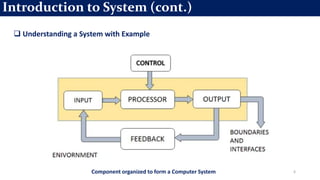
 Understanding a System with Example
Component organized to form a Computer System
7
Components of System
 Entity: An entity is an object of interest in a system. Ex: In the factory
system, departments, orders, parts and products are The entities.
 Attribute: An attribute denotes the property of an entity. Ex:
Quantities for each order, type of part, or number of machines in a
Department are attributes of factory system.
 Activity: Any process causing changes in a system is called as an
activity. Ex: Manufacturing process of the department.
 State of the System: The state of a system is defined as the collection
of variables necessary to describe a system at any time, relative to
the objective of study. In other words, state of the system mean a
description of all the entities, attributes and activities as they exist at
one point in time.
 Event :An event is defined as an instantaneous occurrence that may change the
state of the system.
 Endogenous System: The term endogenous is used to describe activities and
events occurring within a system. Ex: Drawing cash in a bank.
 Exogenous System: The term exogenous is used to describe activities and events
in the environment that affect the system. Ex: Arrival of customers.
 Closed System: A system for which there is no exogenous activity and event is
said to be a closed. Ex: Water in an insulated flask.
 Open system: A system for which there is exogenous activity and event is said to
be a open. Ex: Bank system.
8
Components of system (cont.)
9
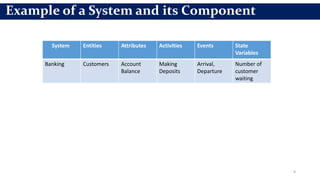
Example of a System and its Component
System Entities Attributes Activities Events State
Variables
Banking Customers Account
Balance
Making
Deposits
Arrival,
Departure
Number of
customer
waiting
10
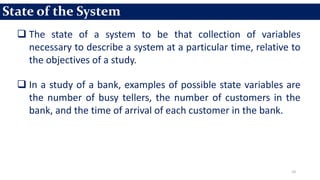
 The state of a system to be that collection of variables
necessary to describe a system at a particular time, relative to
the objectives of a study.
 In a study of a bank, examples of possible state variables are
the number of busy tellers, the number of customers in the
bank, and the time of arrival of each customer in the bank.
State of the System
11
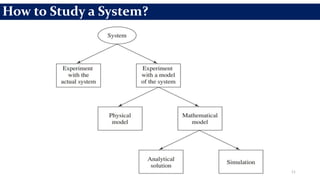
How to Study a System?
12
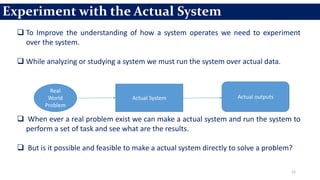
 To Improve the understanding of how a system operates we need to experiment
over the system.
 While analyzing or studying a system we must run the system over actual data.
 When ever a real problem exist we can make a actual system and run the system to
perform a set of task and see what are the results.
 But is it possible and feasible to make a actual system directly to solve a problem?
Experiment with the Actual System
Real
World
Problem
Actual System Actual outputs
13
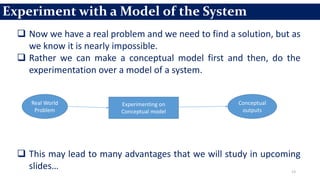
 Now we have a real problem and we need to find a solution, but as
we know it is nearly impossible.
 Rather we can make a conceptual model first and then, do the
experimentation over a model of a system.
 This may lead to many advantages that we will study in upcoming
slides…
Experiment with a Model of the System
Real World
Problem
Experimenting on
Conceptual model
Conceptual
outputs
14
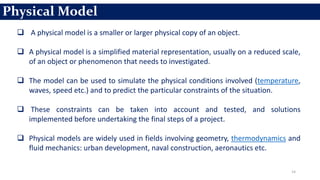
 A physical model is a smaller or larger physical copy of an object.
 A physical model is a simplified material representation, usually on a reduced scale,
of an object or phenomenon that needs to investigated.
 The model can be used to simulate the physical conditions involved (temperature,
waves, speed etc.) and to predict the particular constraints of the situation.
 These constraints can be taken into account and tested, and solutions
implemented before undertaking the final steps of a project.
 Physical models are widely used in fields involving geometry, thermodynamics and
fluid mechanics: urban development, naval construction, aeronautics etc.
Physical Model
15
 A mathematical model is a description of a system using mathematical concepts
and language.
 The process of developing a mathematical model is termed mathematical
modeling.
 Mathematical modeling is the art of translating problems from an application area
into tractable mathematical formulations whose theoretical and numerical analysis
provides insight, answers, and guidance useful for the originating application.
Mathematical modeling:
 is indispensable in many applications
 is successful in many further applications
 gives precision and direction for problem solution
 enables a thorough understanding of the system modeled
 prepares the way for better design or control of a system
Mathematical Model
16
 An analytical solution involves framing the problem in a well-understood form and
calculating the exact solution.
 Analytical solutions, also called closed-form solutions, are mathematical solutions
in the form of math expressions.
 Transparency: Because analytical solutions are presented as math expressions, they
offer a clear view into how variables and interactions between variables affect the
result.
 Efficiency: Algorithms and models expressed with analytical solutions are often more
efficient than equivalent numeric implementations. For example, to compute the
solution of an ordinary differential equation for different values of its parametric inputs,
it is often faster, more accurate, and more convenient to evaluate an analytical solution
than to perform numerical integration.
Analytical Solution
17
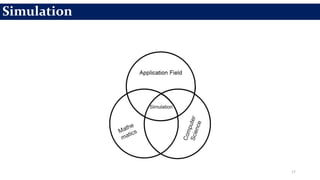
Simulation
18
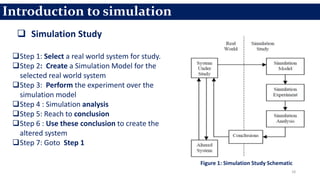
Introduction to simulation
 Simulation Study
Figure 1: Simulation Study Schematic
Step 1: Select a real world system for study.
Step 2: Create a Simulation Model for the
selected real world system
Step 3: Perform the experiment over the
simulation model
Step 4 : Simulation analysis
Step 5: Reach to conclusion
Step 6 : Use these conclusion to create the
altered system
Step 7: Goto Step 1
19
Definition of Simulation
 A simulation is the imitation (Duplication) of the operation of real-world
process or system over time.
Generation of artificial history and observation of that observation history.
 A model construct a conceptual framework that describes a system.
 The behaviour of a system that evolves over time is studied by developing
a simulation model
 The model takes a set of expressed assumptions:- Mathematical, logical-
Symbolic relationship between the entities
1940’s: Monte Carlo method is developed by physicists working on Manhattan
project to study neutron scattering. Researchers include John von Neumann, Stanis
law Ulan, Edward Teller, Herman Kahn
1950’s: First special-purpose simulation languages developed (e.g. IMSCRIPT by
Harry Markowitz at RAND Institute)
1970’s: Research initiated on mathematical foundations of simulation
1980’s: PC-based simulation software developed, graphical user interfaces, object-
oriented programming
1990’s: Web-based simulation, fancy animated graphics, simulation-based
optimization, Markov-chain Monte Carlo methods Simulation has become ever
more prominent as a method for studying complex systems in which uncertainty is
present. In various surveys, simulation has been found to be the most frequently
used tool of Operation Research practitioners. Simulation is an interdisciplinary
subject, using ideas and techniques from Statistics, Probability, Number Theory, and
Computer Science. 20
History of Simulation
21
A model can be used to investigate a wide verity of "what if" questions about real-world
system.
 Potential changes to the system can be simulated and predicate their impact on
the system.
 Find adequate parameters before implementation.
 So simulation can be used as- Analysis tool for predicating the effect of changes-
Design tool to predicate the performance of new system. It is better Implementation.
Goal of Modelling and Simulation
22
When Simulation is the Appropriate Tool
 Simulation enable the study of internal interaction of a subsystem with complex system
 Informational, organizational and environmental changes can be simulated and find
their effects
 A simulation model help us to gain knowledge about improvement of system.
 Finding important input parameters with changing simulation inputs.
 Simulation can be used with new design and policies before implementation.
 Simulating different capabilities for a machine can help determine the requirement.
 Simulation models designed for training make learning possible without the cost
disruption.
 A plan simulation can be visualized with animated simulation
 The modern system (factory, wafer fabrication plant, service organization) is too complex
that its internal interaction can be treated only by simulation
23
Advantages of Simulation
New policies, operating procedures, information flows can be explored without
disrupting ongoing operation of the real system.
 New hardware designs, physical layouts, transportation systems and ... can be tested
without committing resources for their acquisition.
Time can be compressed or expanded to allow for a speed up or slow-down of the
phenomenon( clock is self-control).Insight can be obtained about interaction of variables
and important variables to the performance.
Bottleneck analysis can be performed to discover where work in process, the system is
delayed.
A simulation study can help in understanding how the system operates.
Model building requires special training. Vendors of simulation software have
been actively developing packages that contain models that only need input
(templates).
 Simulation results can be difficult to interpret.
 Simulation provides only estimates of solution, only solves one parameter at a
time, can take a large amount of development and/or computer time
24
Disadvantages of Simulation
 Provides only individual, not general solutions
 Manpower and time-consuming
 Computing memory and time-intensive
 Difficult so experts are required
 Hard to interpret results
 Expensive
25
Difficulties of Simulation
 Manufacturing Applications
 Semiconductor Manufacturing
 Construction Engineering and project management
Military application
Logistics, Supply chain and distribution application
Transportation modes and Traffic
 Business Process Simulation Health Care
 Automated Material Handling System (AMHS)(Test beds for functional testing of
control-system software)
Risk analysis (Insurance, portfolio,...)
Computer Simulation(CPU, Memory,...)
Network simulation (Internet backbone, LAN(Switch/Router), Wireless, PSTN (call
center),...)
26
Areas of Application
Study internals of a complex system e.g. biological system
 Optimize an existing design e.g. routing algorithms,
assembly line
 Examine effect of environmental changes e.g. weather
forecasting
 System is dangerous or destructive e.g. atom bomb, atomic
reactor, missile launching
 Study importance of variables
 Verify analytic solutions (theories)
 Test new designs or policies
 Impossible to observe/influence/build the system
27
When to Use Simulation
 When it allows inspection of system internals that might not otherwise be
observable
 Observation of the simulation gives insights into system behavior
 System parameters can be adjusted in the simulation model allowing
assessment of their sensitivity (scale of impact on overall system behavior)
 Simulation verifies analysis of a complex system, or can be used as a teaching
tool to provide insight into analytical techniques
A simulator can be used for instruction, avoiding tying up or damaging an
expensive, actual system (e.g., a flight simulation vs. use of multimillion dollar
aircraft)
28
When to Use Simulation (cont.)
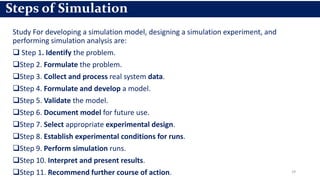
Study For developing a simulation model, designing a simulation experiment, and
performing simulation analysis are:
 Step 1. Identify the problem.
Step 2. Formulate the problem.
Step 3. Collect and process real system data.
Step 4. Formulate and develop a model.
Step 5. Validate the model.
Step 6. Document model for future use.
Step 7. Select appropriate experimental design.
Step 8. Establish experimental conditions for runs.
Step 9. Perform simulation runs.
Step 10. Interpret and present results.
Step 11. Recommend further course of action. 29
Steps of Simulation
30
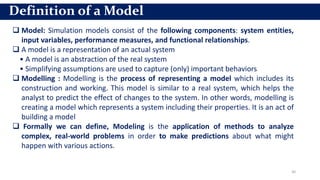
Definition of a Model
 Model: Simulation models consist of the following components: system entities,
input variables, performance measures, and functional relationships.
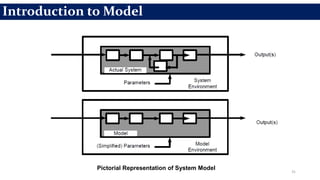
 A model is a representation of an actual system
• A model is an abstraction of the real system
• Simplifying assumptions are used to capture (only) important behaviors
 Modelling : Modelling is the process of representing a model which includes its
construction and working. This model is similar to a real system, which helps the
analyst to predict the effect of changes to the system. In other words, modelling is
creating a model which represents a system including their properties. It is an act of
building a model
 Formally we can define, Modeling is the application of methods to analyze
complex, real-world problems in order to make predictions about what might
happen with various actions.
31
Introduction to Model
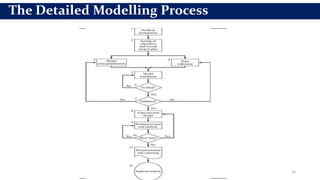
Pictorial Representation of System Model
32
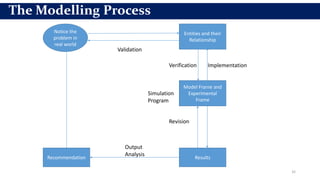
Notice the
problem in
real world
Entities and their
Relationship
Model Frame and
Experimental
Frame
Results
Recommendation
Validation
Output
Analysis
Implementation
Simulation
Program
Revision
Verification
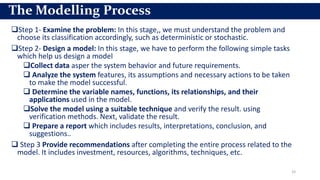
The Modelling Process
Step 1- Examine the problem: In this stage,, we must understand the problem and
choose its classification accordingly, such as deterministic or stochastic.
Step 2- Design a model: In this stage, we have to perform the following simple tasks
which help us design a model
Collect data asper the system behavior and future requirements.
 Analyze the system features, its assumptions and necessary actions to be taken
to make the model successful.
 Determine the variable names, functions, its relationships, and their
applications used in the model.
Solve the model using a suitable technique and verify the result. using
verification methods. Next, validate the result.
 Prepare a report which includes results, interpretations, conclusion, and
suggestions..
 Step 3 Provide recommendations after completing the entire process related to the
model. It includes investment, resources, algorithms, techniques, etc.
33
The Modelling Process
34
The Detailed Modelling Process
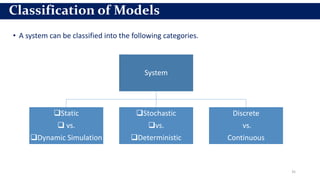
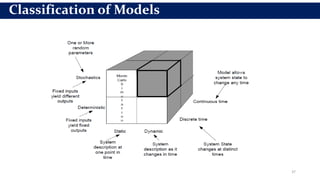
• A system can be classified into the following categories.
35
Classification of Models
System
Static
 vs.
Dynamic Simulation
Stochastic
vs.
Deterministic
Discrete
vs.
Continuous
36
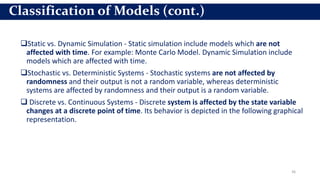
Static vs. Dynamic Simulation - Static simulation include models which are not
affected with time. For example: Monte Carlo Model. Dynamic Simulation include
models which are affected with time.
Stochastic vs. Deterministic Systems - Stochastic systems are not affected by
randomness and their output is not a random variable, whereas deterministic
systems are affected by randomness and their output is a random variable.
 Discrete vs. Continuous Systems - Discrete system is affected by the state variable
changes at a discrete point of time. Its behavior is depicted in the following graphical
representation.
Classification of Models (cont.)
37
Classification of Models
38
Static vs. Dynamic-event simulation
 We can also classify models as static or dynamic.
 In a static model, we do not consider time, so that the model is comparable to a snapshot or a
map.
 For example, a model of the weight of a salamander as being proportional to the cube of its
length has variables for weight and length, but not for time.
 By contrast, in a dynamic model, time changes, so that such a model is comparable to an
animated cartoon or a movie.
 For example, the number of salamanders in an area undergoing development changes with time;
and, hence, a model of such a population is dynamic.
 Many of the models we consider in this text are dynamic and employ a static component as part
of the dynamic model.
 Definitions A static model does not consider time, while a dynamic model changes with time.
 Static: A simulation of a system at one specific time, or a simulation in which time is not a
relevant parameter for example, Monte Carlo & steady-state simulations.
 Dynamic: A simulation representing a system evolving over time for examples, the majority of
simulation problems.
39
Deterministic Vs. Stochastic- Event Simulation Model
A system exhibits probabilistic or stochastic behavior if an element of chance exists.
Otherwise, it exhibits deterministic behavior.
 A probabilistic or stochastic model exhibits random effects, while a deterministic
model does not.
 Deterministic: Randomness does not affect the behavior of the system.
The output of the system is not a random variable.
 Stochastic: Randomness affects the behavior of the system. The output of the system is
a random variable
40
Discrete vs. Continuous Event Simulation Model
 When time changes continuously and smoothly, the model is continuous.
 If time changes in incremental steps, the model is discrete.
 A discrete model is analogous to a movie.
 A sequence of frames moves so quickly that the viewer perceives motion. However, in
a live play, the action is continuous.
 Just as a discrete sequence of movie frames represents the continuous motion of
actors, we often develop discrete computer models of continuous situations .
 Definitions In a continuous model, time changes continuously, while in a discrete
model time changes in incremental steps.
 Continuous: State variables change continuously as a function of time (Fig 1) and
generally analytical method like deductive mathematical reasoning is used to define
and solve the system.
 State Variable (S.V.) = f (t)
41
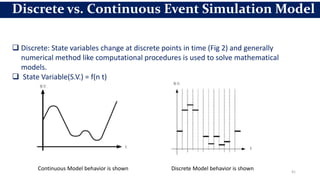
 Discrete: State variables change at discrete points in time (Fig 2) and generally
numerical method like computational procedures is used to solve mathematical
models.
 State Variable(S.V.) = f(n t)
Continuous Model behavior is shown Discrete Model behavior is shown
Discrete vs. Continuous Event Simulation Model
42
Examples of Different Systems
 Queue length at a cash machine: Stochastic, Discrete Time, Discrete System
 The motion of the planets: Deterministic, Continuous Time, Discrete System
 Logic circuit in a computer: Deterministic, Discrete Time, Discrete System
 Flow of air around a car: Deterministic, Continuous Time, Continuous System
 Closing prices of the 30 DAX shares: Stochastic, Discrete Time, Discrete System

Unit-1 Mod-Sim.ppt

  • 1.
    Engineering Analysis andDesign (Modelling and Simulation) Course Code: CO-207 Unit 1 1
  • 2.
    Contents of Unit-1 Definitionof System Types of system: continuous and discrete Modelling process and definition of a model The nature of simulation Simulation model - static, dynamic, deterministic stochastic continuous, discrete models. 2
  • 3.
    Introduction to System System is defined as a set of ideas or rules for organizing something; a particular way of doing something  A system is a collection of elements or components that are organized for a common purpose. For Example :  A computer system consists of hardware components that have been carefully chosen so that they work well together and software components or programs that run in the computer.  All of nature and the universe can be said to be a system. We've coined a word, ecosystem, for the systems on Earth that affect life systems.  In Terms of Simulation and Modelling :  A systems is defined as a group of objects that are joined together in some regular interaction towards the accomplishment of some purpose. For Example: An Automobile Factory : Machine, component parts and workers operate jointly along Assembly line. 3
  • 4.
    4  A systemis defined to be a collection of entities e.g. people or machines that act and interact together toward the accomplishment of some logical end. [ Schimidt and Taylor(1970)].  In practice, what is meant by “the system” depends on the objectives of a particular study.  The collection of entities that comprise a system for one study might be only a subset of the overall system for another. Introduction to System (cont.)
  • 5.
    5  If onewants to study a bank to determine the number of tellers needed to provide adequate service for customers who want just to cash a check or make a savings deposit, the system can be defined to be that portion of the bank consisting of the tellers and the customers waiting in line or being served.  If, on the other hand, the loan officer and the safe-deposit boxes are to be included, the definition of the system must be expanded in an obvious way Introduction to System(cont.)
  • 6.
    6 Introduction to System(cont.)  Understanding a System with Example Component organized to form a Computer System
  • 7.
    7 Components of System Entity: An entity is an object of interest in a system. Ex: In the factory system, departments, orders, parts and products are The entities.  Attribute: An attribute denotes the property of an entity. Ex: Quantities for each order, type of part, or number of machines in a Department are attributes of factory system.  Activity: Any process causing changes in a system is called as an activity. Ex: Manufacturing process of the department.  State of the System: The state of a system is defined as the collection of variables necessary to describe a system at any time, relative to the objective of study. In other words, state of the system mean a description of all the entities, attributes and activities as they exist at one point in time.
  • 8.
     Event :Anevent is defined as an instantaneous occurrence that may change the state of the system.  Endogenous System: The term endogenous is used to describe activities and events occurring within a system. Ex: Drawing cash in a bank.  Exogenous System: The term exogenous is used to describe activities and events in the environment that affect the system. Ex: Arrival of customers.  Closed System: A system for which there is no exogenous activity and event is said to be a closed. Ex: Water in an insulated flask.  Open system: A system for which there is exogenous activity and event is said to be a open. Ex: Bank system. 8 Components of system (cont.)
  • 9.
    9 Example of aSystem and its Component System Entities Attributes Activities Events State Variables Banking Customers Account Balance Making Deposits Arrival, Departure Number of customer waiting
  • 10.
    10  The stateof a system to be that collection of variables necessary to describe a system at a particular time, relative to the objectives of a study.  In a study of a bank, examples of possible state variables are the number of busy tellers, the number of customers in the bank, and the time of arrival of each customer in the bank. State of the System
  • 11.
    11 How to Studya System?
  • 12.
    12  To Improvethe understanding of how a system operates we need to experiment over the system.  While analyzing or studying a system we must run the system over actual data.  When ever a real problem exist we can make a actual system and run the system to perform a set of task and see what are the results.  But is it possible and feasible to make a actual system directly to solve a problem? Experiment with the Actual System Real World Problem Actual System Actual outputs
  • 13.
    13  Now wehave a real problem and we need to find a solution, but as we know it is nearly impossible.  Rather we can make a conceptual model first and then, do the experimentation over a model of a system.  This may lead to many advantages that we will study in upcoming slides… Experiment with a Model of the System Real World Problem Experimenting on Conceptual model Conceptual outputs
  • 14.
    14  A physicalmodel is a smaller or larger physical copy of an object.  A physical model is a simplified material representation, usually on a reduced scale, of an object or phenomenon that needs to investigated.  The model can be used to simulate the physical conditions involved (temperature, waves, speed etc.) and to predict the particular constraints of the situation.  These constraints can be taken into account and tested, and solutions implemented before undertaking the final steps of a project.  Physical models are widely used in fields involving geometry, thermodynamics and fluid mechanics: urban development, naval construction, aeronautics etc. Physical Model
  • 15.
    15  A mathematicalmodel is a description of a system using mathematical concepts and language.  The process of developing a mathematical model is termed mathematical modeling.  Mathematical modeling is the art of translating problems from an application area into tractable mathematical formulations whose theoretical and numerical analysis provides insight, answers, and guidance useful for the originating application. Mathematical modeling:  is indispensable in many applications  is successful in many further applications  gives precision and direction for problem solution  enables a thorough understanding of the system modeled  prepares the way for better design or control of a system Mathematical Model
  • 16.
    16  An analyticalsolution involves framing the problem in a well-understood form and calculating the exact solution.  Analytical solutions, also called closed-form solutions, are mathematical solutions in the form of math expressions.  Transparency: Because analytical solutions are presented as math expressions, they offer a clear view into how variables and interactions between variables affect the result.  Efficiency: Algorithms and models expressed with analytical solutions are often more efficient than equivalent numeric implementations. For example, to compute the solution of an ordinary differential equation for different values of its parametric inputs, it is often faster, more accurate, and more convenient to evaluate an analytical solution than to perform numerical integration. Analytical Solution
  • 17.
  • 18.
    18 Introduction to simulation Simulation Study Figure 1: Simulation Study Schematic Step 1: Select a real world system for study. Step 2: Create a Simulation Model for the selected real world system Step 3: Perform the experiment over the simulation model Step 4 : Simulation analysis Step 5: Reach to conclusion Step 6 : Use these conclusion to create the altered system Step 7: Goto Step 1
  • 19.
    19 Definition of Simulation A simulation is the imitation (Duplication) of the operation of real-world process or system over time. Generation of artificial history and observation of that observation history.  A model construct a conceptual framework that describes a system.  The behaviour of a system that evolves over time is studied by developing a simulation model  The model takes a set of expressed assumptions:- Mathematical, logical- Symbolic relationship between the entities
  • 20.
    1940’s: Monte Carlomethod is developed by physicists working on Manhattan project to study neutron scattering. Researchers include John von Neumann, Stanis law Ulan, Edward Teller, Herman Kahn 1950’s: First special-purpose simulation languages developed (e.g. IMSCRIPT by Harry Markowitz at RAND Institute) 1970’s: Research initiated on mathematical foundations of simulation 1980’s: PC-based simulation software developed, graphical user interfaces, object- oriented programming 1990’s: Web-based simulation, fancy animated graphics, simulation-based optimization, Markov-chain Monte Carlo methods Simulation has become ever more prominent as a method for studying complex systems in which uncertainty is present. In various surveys, simulation has been found to be the most frequently used tool of Operation Research practitioners. Simulation is an interdisciplinary subject, using ideas and techniques from Statistics, Probability, Number Theory, and Computer Science. 20 History of Simulation
  • 21.
    21 A model canbe used to investigate a wide verity of "what if" questions about real-world system.  Potential changes to the system can be simulated and predicate their impact on the system.  Find adequate parameters before implementation.  So simulation can be used as- Analysis tool for predicating the effect of changes- Design tool to predicate the performance of new system. It is better Implementation. Goal of Modelling and Simulation
  • 22.
    22 When Simulation isthe Appropriate Tool  Simulation enable the study of internal interaction of a subsystem with complex system  Informational, organizational and environmental changes can be simulated and find their effects  A simulation model help us to gain knowledge about improvement of system.  Finding important input parameters with changing simulation inputs.  Simulation can be used with new design and policies before implementation.  Simulating different capabilities for a machine can help determine the requirement.  Simulation models designed for training make learning possible without the cost disruption.  A plan simulation can be visualized with animated simulation  The modern system (factory, wafer fabrication plant, service organization) is too complex that its internal interaction can be treated only by simulation
  • 23.
    23 Advantages of Simulation Newpolicies, operating procedures, information flows can be explored without disrupting ongoing operation of the real system.  New hardware designs, physical layouts, transportation systems and ... can be tested without committing resources for their acquisition. Time can be compressed or expanded to allow for a speed up or slow-down of the phenomenon( clock is self-control).Insight can be obtained about interaction of variables and important variables to the performance. Bottleneck analysis can be performed to discover where work in process, the system is delayed. A simulation study can help in understanding how the system operates.
  • 24.
    Model building requiresspecial training. Vendors of simulation software have been actively developing packages that contain models that only need input (templates).  Simulation results can be difficult to interpret.  Simulation provides only estimates of solution, only solves one parameter at a time, can take a large amount of development and/or computer time 24 Disadvantages of Simulation
  • 25.
     Provides onlyindividual, not general solutions  Manpower and time-consuming  Computing memory and time-intensive  Difficult so experts are required  Hard to interpret results  Expensive 25 Difficulties of Simulation
  • 26.
     Manufacturing Applications Semiconductor Manufacturing  Construction Engineering and project management Military application Logistics, Supply chain and distribution application Transportation modes and Traffic  Business Process Simulation Health Care  Automated Material Handling System (AMHS)(Test beds for functional testing of control-system software) Risk analysis (Insurance, portfolio,...) Computer Simulation(CPU, Memory,...) Network simulation (Internet backbone, LAN(Switch/Router), Wireless, PSTN (call center),...) 26 Areas of Application
  • 27.
    Study internals ofa complex system e.g. biological system  Optimize an existing design e.g. routing algorithms, assembly line  Examine effect of environmental changes e.g. weather forecasting  System is dangerous or destructive e.g. atom bomb, atomic reactor, missile launching  Study importance of variables  Verify analytic solutions (theories)  Test new designs or policies  Impossible to observe/influence/build the system 27 When to Use Simulation
  • 28.
     When itallows inspection of system internals that might not otherwise be observable  Observation of the simulation gives insights into system behavior  System parameters can be adjusted in the simulation model allowing assessment of their sensitivity (scale of impact on overall system behavior)  Simulation verifies analysis of a complex system, or can be used as a teaching tool to provide insight into analytical techniques A simulator can be used for instruction, avoiding tying up or damaging an expensive, actual system (e.g., a flight simulation vs. use of multimillion dollar aircraft) 28 When to Use Simulation (cont.)
  • 29.
    Study For developinga simulation model, designing a simulation experiment, and performing simulation analysis are:  Step 1. Identify the problem. Step 2. Formulate the problem. Step 3. Collect and process real system data. Step 4. Formulate and develop a model. Step 5. Validate the model. Step 6. Document model for future use. Step 7. Select appropriate experimental design. Step 8. Establish experimental conditions for runs. Step 9. Perform simulation runs. Step 10. Interpret and present results. Step 11. Recommend further course of action. 29 Steps of Simulation
  • 30.
    30 Definition of aModel  Model: Simulation models consist of the following components: system entities, input variables, performance measures, and functional relationships.  A model is a representation of an actual system • A model is an abstraction of the real system • Simplifying assumptions are used to capture (only) important behaviors  Modelling : Modelling is the process of representing a model which includes its construction and working. This model is similar to a real system, which helps the analyst to predict the effect of changes to the system. In other words, modelling is creating a model which represents a system including their properties. It is an act of building a model  Formally we can define, Modeling is the application of methods to analyze complex, real-world problems in order to make predictions about what might happen with various actions.
  • 31.
    31 Introduction to Model PictorialRepresentation of System Model
  • 32.
    32 Notice the problem in realworld Entities and their Relationship Model Frame and Experimental Frame Results Recommendation Validation Output Analysis Implementation Simulation Program Revision Verification The Modelling Process
  • 33.
    Step 1- Examinethe problem: In this stage,, we must understand the problem and choose its classification accordingly, such as deterministic or stochastic. Step 2- Design a model: In this stage, we have to perform the following simple tasks which help us design a model Collect data asper the system behavior and future requirements.  Analyze the system features, its assumptions and necessary actions to be taken to make the model successful.  Determine the variable names, functions, its relationships, and their applications used in the model. Solve the model using a suitable technique and verify the result. using verification methods. Next, validate the result.  Prepare a report which includes results, interpretations, conclusion, and suggestions..  Step 3 Provide recommendations after completing the entire process related to the model. It includes investment, resources, algorithms, techniques, etc. 33 The Modelling Process
  • 34.
  • 35.
    • A systemcan be classified into the following categories. 35 Classification of Models System Static  vs. Dynamic Simulation Stochastic vs. Deterministic Discrete vs. Continuous
  • 36.
    36 Static vs. DynamicSimulation - Static simulation include models which are not affected with time. For example: Monte Carlo Model. Dynamic Simulation include models which are affected with time. Stochastic vs. Deterministic Systems - Stochastic systems are not affected by randomness and their output is not a random variable, whereas deterministic systems are affected by randomness and their output is a random variable.  Discrete vs. Continuous Systems - Discrete system is affected by the state variable changes at a discrete point of time. Its behavior is depicted in the following graphical representation. Classification of Models (cont.)
  • 37.
  • 38.
    38 Static vs. Dynamic-eventsimulation  We can also classify models as static or dynamic.  In a static model, we do not consider time, so that the model is comparable to a snapshot or a map.  For example, a model of the weight of a salamander as being proportional to the cube of its length has variables for weight and length, but not for time.  By contrast, in a dynamic model, time changes, so that such a model is comparable to an animated cartoon or a movie.  For example, the number of salamanders in an area undergoing development changes with time; and, hence, a model of such a population is dynamic.  Many of the models we consider in this text are dynamic and employ a static component as part of the dynamic model.  Definitions A static model does not consider time, while a dynamic model changes with time.  Static: A simulation of a system at one specific time, or a simulation in which time is not a relevant parameter for example, Monte Carlo & steady-state simulations.  Dynamic: A simulation representing a system evolving over time for examples, the majority of simulation problems.
  • 39.
    39 Deterministic Vs. Stochastic-Event Simulation Model A system exhibits probabilistic or stochastic behavior if an element of chance exists. Otherwise, it exhibits deterministic behavior.  A probabilistic or stochastic model exhibits random effects, while a deterministic model does not.  Deterministic: Randomness does not affect the behavior of the system. The output of the system is not a random variable.  Stochastic: Randomness affects the behavior of the system. The output of the system is a random variable
  • 40.
    40 Discrete vs. ContinuousEvent Simulation Model  When time changes continuously and smoothly, the model is continuous.  If time changes in incremental steps, the model is discrete.  A discrete model is analogous to a movie.  A sequence of frames moves so quickly that the viewer perceives motion. However, in a live play, the action is continuous.  Just as a discrete sequence of movie frames represents the continuous motion of actors, we often develop discrete computer models of continuous situations .  Definitions In a continuous model, time changes continuously, while in a discrete model time changes in incremental steps.  Continuous: State variables change continuously as a function of time (Fig 1) and generally analytical method like deductive mathematical reasoning is used to define and solve the system.  State Variable (S.V.) = f (t)
  • 41.
    41  Discrete: Statevariables change at discrete points in time (Fig 2) and generally numerical method like computational procedures is used to solve mathematical models.  State Variable(S.V.) = f(n t) Continuous Model behavior is shown Discrete Model behavior is shown Discrete vs. Continuous Event Simulation Model
  • 42.
    42 Examples of DifferentSystems  Queue length at a cash machine: Stochastic, Discrete Time, Discrete System  The motion of the planets: Deterministic, Continuous Time, Discrete System  Logic circuit in a computer: Deterministic, Discrete Time, Discrete System  Flow of air around a car: Deterministic, Continuous Time, Continuous System  Closing prices of the 30 DAX shares: Stochastic, Discrete Time, Discrete System