12/4/2020 Saeed Lectures - FUNDAMENTAL NURSING First Term Lecture 2 Nursing Process 1
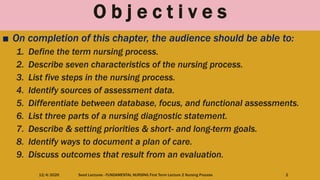
O b j e c t i v e s
■ On completion of this chapter, the audience should be able to:
1. Define the term nursing process.
2. Describe seven characteristics of the nursing process.
3. List five steps in the nursing process.
4. Identify sources of assessment data.
5. Differentiate between database, focus, and functional assessments.
6. List three parts of a nursing diagnostic statement.
7. Describe & setting priorities & short- and long-term goals.
8. Identify ways to document a plan of care.
9. Discuss outcomes that result from an evaluation.
12/4/2020 Seed Lectures - FUNDAMENTAL NURSING First Term Lecture 2 Nursing Process 2
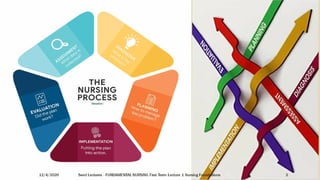
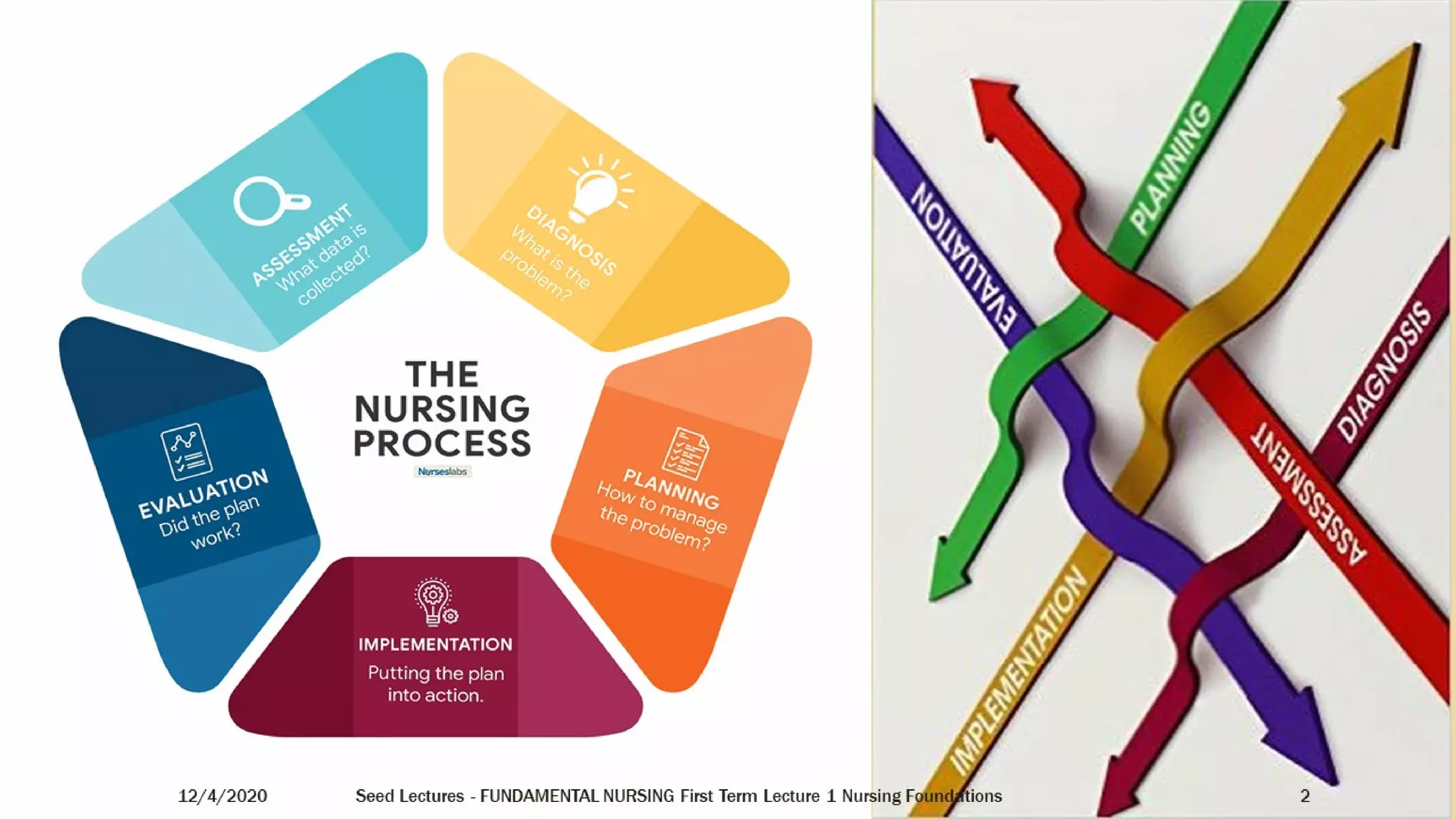
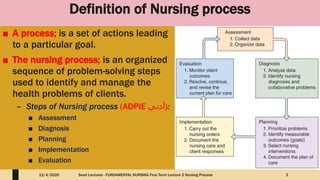
Definition of Nursing process
■ A process; is a set of actions leading
to a particular goal.
■ The nursing process; is an organized
sequence of problem-solving steps
used to identify and manage the
health problems of clients.
– Steps of Nursing process (ADPIE ‫:)أدبي‬
■ Assessment
■ Diagnosis
■ Planning
■ Implementation
■ Evaluation
12/4/2020 Seed Lectures - FUNDAMENTAL NURSING First Term Lecture 2 Nursing Process 3
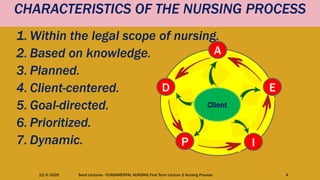
CHARACTERISTICS OF THE NURSING PROCESS
1. Within the legal scope of nursing.
2. Based on knowledge.
3. Planned.
4. Client-centered.
5. Goal-directed.
6. Prioritized.
7. Dynamic.
12/4/2020 Seed Lectures - FUNDAMENTAL NURSING First Term Lecture 2 Nursing Process 4
D
A
E
IP
Client
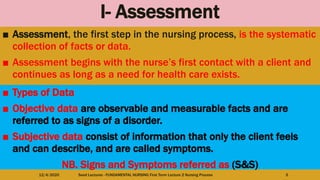
I- Assessment
■ Assessment, the first step in the nursing process, is the systematic
collection of facts or data.
■ Assessment begins with the nurse’s first contact with a client and
continues as long as a need for health care exists.
12/4/2020 Seed Lectures - FUNDAMENTAL NURSING First Term Lecture 2 Nursing Process 5
■ Types of Data
■ Objective data are observable and measurable facts and are
referred to as signs of a disorder.
■ Subjective data consist of information that only the client feels
and can describe, and are called symptoms.
NB. Signs and Symptoms referred as (S&S)
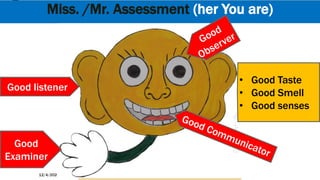
Miss. /Mr. Assessment (her You are)
12/4/2020 Seed Lectures - FUNDAMENTAL NURSING First Term Lecture 1 Nursing Foundations 6
Good listener
Good
Examiner
• Good Taste
• Good Smell
• Good senses
Nursing Definitions
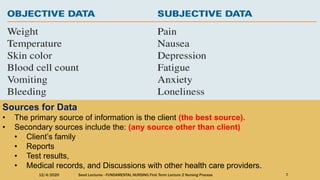
Sources for Data
• The primary source of information is the client (the best source).
• Secondary sources include the: (any source other than client)
• Client’s family
• Reports
• Test results,
• Medical records, and Discussions with other health care providers.
12/4/2020 Seed Lectures - FUNDAMENTAL NURSING First Term Lecture 2 Nursing Process 7
Types of Assessments
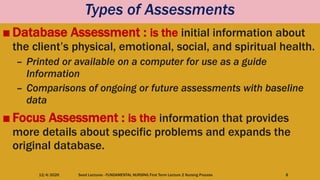
■ Database Assessment : is the initial information about
the client’s physical, emotional, social, and spiritual health.
– Printed or available on a computer for use as a guide
Information
– Comparisons of ongoing or future assessments with baseline
data
■ Focus Assessment : is the information that provides
more details about specific problems and expands the
original database.
12/4/2020 Seed Lectures - FUNDAMENTAL NURSING First Term Lecture 2 Nursing Process 8
Types of Assessments cont.
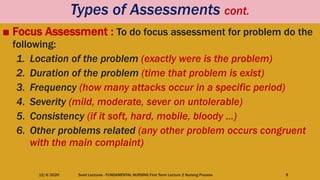
■ Focus Assessment : To do focus assessment for problem do the
following:
1. Location of the problem (exactly were is the problem)
2. Duration of the problem (time that problem is exist)
3. Frequency (how many attacks occur in a specific period)
4. Severity (mild, moderate, sever on untolerable)
5. Consistency (if it soft, hard, mobile, bloody …)
6. Other problems related (any other problem occurs congruent
with the main complaint)
12/4/2020 Seed Lectures - FUNDAMENTAL NURSING First Term Lecture 2 Nursing Process 9
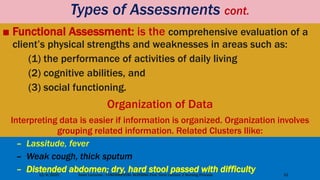
– Lassitude, fever
– Weak cough, thick sputum
– Distended abdomen; dry, hard stool passed with difficulty
Types of Assessments cont.
■ Functional Assessment: is the comprehensive evaluation of a
client’s physical strengths and weaknesses in areas such as:
(1) the performance of activities of daily living
(2) cognitive abilities, and
(3) social functioning.
Organization of Data
Interpreting data is easier if information is organized. Organization involves
grouping related information. Related Clusters llike:
12/4/2020 Seed Lectures - FUNDAMENTAL NURSING First Term Lecture 2 Nursing Process 10
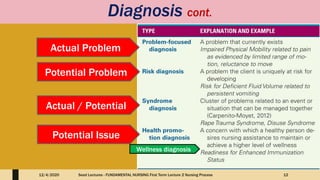
II- Diagnosis
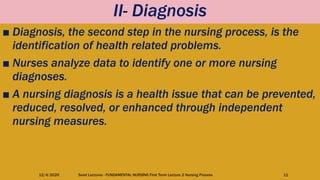
■ Diagnosis, the second step in the nursing process, is the
identification of health related problems.
■ Nurses analyze data to identify one or more nursing
diagnoses.
■ A nursing diagnosis is a health issue that can be prevented,
reduced, resolved, or enhanced through independent
nursing measures.
12/4/2020 Seed Lectures - FUNDAMENTAL NURSING First Term Lecture 2 Nursing Process 11
Diagnosis cont.
12/4/2020 Seed Lectures - FUNDAMENTAL NURSING First Term Lecture 2 Nursing Process 12
Actual Problem
Potential Problem
Potential Issue
Actual / Potential
Wellness diagnosis
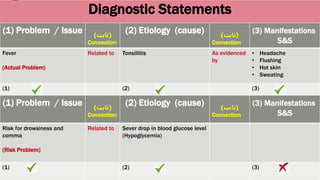
Diagnostic Statements
(3) Manifestations
S&S
(‫ثابت‬)
Connection
(2) Etiology (cause)(‫ثابت‬)
Connection
(1) Problem / Issue
• Headache
• Flushing
• Hot skin
• Sweating
As evidenced
by
TonsillitisRelated toFever
(Actual Problem)
(3)(2)(1)
12/4/2020 Seed Lectures - FUNDAMENTAL NURSING First Term Lecture 2 Nursing Process 13
(3) Manifestations
S&S
(‫ثابت‬)
Connection
(2) Etiology (cause)(‫ثابت‬)
Connection
(1) Problem / Issue
Sever drop in blood glucose level
(Hypoglycemia)
Related toRisk for drowsiness and
comma
(Risk Problem)
(3)(2)(1)
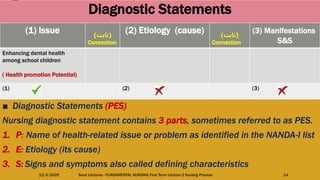
■ Diagnostic Statements (PES)
Nursing diagnostic statement contains 3 parts, sometimes referred to as PES.
1. P: Name of health-related issue or problem as identified in the NANDA-I list
2. E: Etiology (its cause)
3. S: Signs and symptoms also called defining characteristics
Diagnostic Statements
(3) Manifestations
S&S
(‫ثابت‬)
Connection
(2) Etiology (cause)(‫ثابت‬)
Connection
(1) Issue
Enhancing dental health
among school children
( Health promotion Potential)
(3)(2)(1)
12/4/2020 Seed Lectures - FUNDAMENTAL NURSING First Term Lecture 2 Nursing Process 14
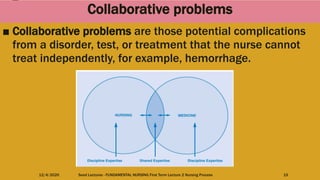
Collaborative problems
■ Collaborative problems are those potential complications
from a disorder, test, or treatment that the nurse cannot
treat independently, for example, hemorrhage.
12/4/2020 Seed Lectures - FUNDAMENTAL NURSING First Term Lecture 2 Nursing Process 15
III- Planning
■ The third step in the nursing process is planning through:
1. Setting Priorities; the process of prioritizing nursing
diagnoses and collaborative problems,
2. Identifying measurable expected outcomes,
3. Selecting appropriate interventions, and
4. Documenting the plan of care.
■ Whenever possible, the nurse consults the client while
developing and revising the plan.
12/4/2020 Seed Lectures - FUNDAMENTAL NURSING First Term Lecture 2 Nursing Process 16
Setting Priorities
– Since many clients’ problems take time to resolve, it is
important to determine which problems require the most
immediate attention.
– Prioritization involves ranking, from those that are most serious
or immediate to those of lesser importance.
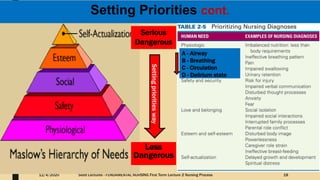
– There is more than one way to determine priorities. One
method nurses frequently use is Maslow’s Hierarchy of Human
Needs
12/4/2020 Seed Lectures - FUNDAMENTAL NURSING First Term Lecture 2 Nursing Process 17
Setting Priorities cont.
12/4/2020 Seed Lectures - FUNDAMENTAL NURSING First Term Lecture 2 Nursing Process 18
A - Airway
B - Breathing
C - Circulation
D - Delirium state
Less
Dangerous
Serious
Dangerous
Settingprioritiesway
Establishing Outcome Criteria
– Outcome criteria, sometimes called goals
– Statement contains objective evidence for verifying that the client has
improved.
■ Short-Term Goals; Nurses use short-term goals (outcomes achievable in seconds,
minutes, hours, or days to 1 week) EG.
– The client will have a bowel movement in 2 days (specify date)
■ Long-Term Goals; Nurses generally identify long-term goals (outcomes that take weeks or
months to accomplish) EG.
– For the client with a stroke is the return of full or partial function to a paralyzed limb.
12/4/2020 Seed Lectures - FUNDAMENTAL NURSING First Term Lecture 2 Nursing Process 19
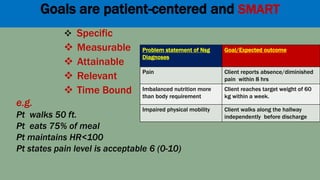
Goals are patient-centered and SMART
 Specific
 Measurable
 Attainable
 Relevant
 Time Bound
e.g.
Pt walks 50 ft.
Pt eats 75% of meal
Pt maintains HR<100
Pt states pain level is acceptable 6 (0-10)
Problem statement of Nsg
Diagnoses
Goal/Expected outcome
Pain Client reports absence/diminished
pain within 8 hrs
Imbalanced nutrition more
than body requirement
Client reaches target weight of 60
kg within a week.
Impaired physical mobility Client walks along the hallway
independently before discharge
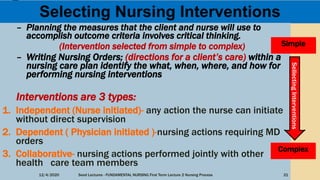
Selecting Nursing Interventions
– Planning the measures that the client and nurse will use to
accomplish outcome criteria involves critical thinking.
(Intervention selected from simple to complex)
– Writing Nursing Orders; (directions for a client’s care) within a
nursing care plan identify the what, when, where, and how for
performing nursing interventions
Interventions are 3 types:
1. Independent (Nurse initiated)- any action the nurse can initiate
without direct supervision
2. Dependent ( Physician initiated )-nursing actions requiring MD
orders
3. Collaborative- nursing actions performed jointly with other
health care team members
12/4/2020 Seed Lectures - FUNDAMENTAL NURSING First Term Lecture 2 Nursing Process 21
Simple
Complex
SellectingInterventions
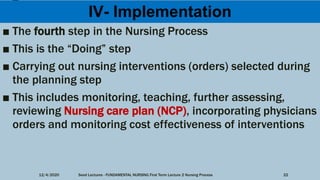
IV- Implementation
■ The fourth step in the Nursing Process
■ This is the “Doing” step
■ Carrying out nursing interventions (orders) selected during
the planning step
■ This includes monitoring, teaching, further assessing,
reviewing Nursing care plan (NCP), incorporating physicians
orders and monitoring cost effectiveness of interventions
12/4/2020 Seed Lectures - FUNDAMENTAL NURSING First Term Lecture 2 Nursing Process 22
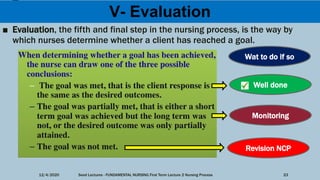
V- Evaluation
■ Evaluation, the fifth and final step in the nursing process, is the way by
which nurses determine whether a client has reached a goal.
12/4/2020 Seed Lectures - FUNDAMENTAL NURSING First Term Lecture 2 Nursing Process 23
Wat to do if so
Well done
Monitoring
Revision NCP
EvaluationImplementation /InterventionGoal / expected
out comes
Diagnosis
After one and a half
hour if
• Temp is 37.7 our
work is well
• Temp still high
revise the plan and
may need
re-planning
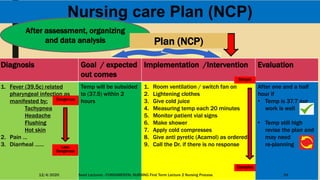
1. Room ventilation / switch fan on
2. Lightening clothes
3. Give cold juice
4. Measuring temp each 20 minutes
5. Monitor patient vial signs
6. Make shower
7. Apply cold compresses
8. Give anti pyretic (Acamol) as ordered
9. Call the Dr. if there is no response
Temp will be subsided
to (37.5) within 2
hours
1. Fever (39.5c) related
pharyngeal infection as
manifested by;
Tachypnea
Headache
Flushing
Hot skin
2. Pain …
3. Diarrheal ……
Nursing care Plan (NCP)
12/4/2020 Seed Lectures - FUNDAMENTAL NURSING First Term Lecture 2 Nursing Process 24
After assessment, organizing
and data analysis
Simple
Complex
Dangerous
Less
Dangerous
Plan (NCP)
12/4/2020 Seed Lectures - FUNDAMENTAL NURSING First Term Lecture 2 Nursing Process 25

2 nursing process

  • 1.
    12/4/2020 Saeed Lectures- FUNDAMENTAL NURSING First Term Lecture 2 Nursing Process 1
  • 2.
    O b je c t i v e s ■ On completion of this chapter, the audience should be able to: 1. Define the term nursing process. 2. Describe seven characteristics of the nursing process. 3. List five steps in the nursing process. 4. Identify sources of assessment data. 5. Differentiate between database, focus, and functional assessments. 6. List three parts of a nursing diagnostic statement. 7. Describe & setting priorities & short- and long-term goals. 8. Identify ways to document a plan of care. 9. Discuss outcomes that result from an evaluation. 12/4/2020 Seed Lectures - FUNDAMENTAL NURSING First Term Lecture 2 Nursing Process 2
  • 3.
    Definition of Nursingprocess ■ A process; is a set of actions leading to a particular goal. ■ The nursing process; is an organized sequence of problem-solving steps used to identify and manage the health problems of clients. – Steps of Nursing process (ADPIE ‫:)أدبي‬ ■ Assessment ■ Diagnosis ■ Planning ■ Implementation ■ Evaluation 12/4/2020 Seed Lectures - FUNDAMENTAL NURSING First Term Lecture 2 Nursing Process 3
  • 4.
    CHARACTERISTICS OF THENURSING PROCESS 1. Within the legal scope of nursing. 2. Based on knowledge. 3. Planned. 4. Client-centered. 5. Goal-directed. 6. Prioritized. 7. Dynamic. 12/4/2020 Seed Lectures - FUNDAMENTAL NURSING First Term Lecture 2 Nursing Process 4 D A E IP Client
  • 5.
    I- Assessment ■ Assessment,the first step in the nursing process, is the systematic collection of facts or data. ■ Assessment begins with the nurse’s first contact with a client and continues as long as a need for health care exists. 12/4/2020 Seed Lectures - FUNDAMENTAL NURSING First Term Lecture 2 Nursing Process 5 ■ Types of Data ■ Objective data are observable and measurable facts and are referred to as signs of a disorder. ■ Subjective data consist of information that only the client feels and can describe, and are called symptoms. NB. Signs and Symptoms referred as (S&S)
  • 6.
    Miss. /Mr. Assessment(her You are) 12/4/2020 Seed Lectures - FUNDAMENTAL NURSING First Term Lecture 1 Nursing Foundations 6 Good listener Good Examiner • Good Taste • Good Smell • Good senses
  • 7.
    Nursing Definitions Sources forData • The primary source of information is the client (the best source). • Secondary sources include the: (any source other than client) • Client’s family • Reports • Test results, • Medical records, and Discussions with other health care providers. 12/4/2020 Seed Lectures - FUNDAMENTAL NURSING First Term Lecture 2 Nursing Process 7
  • 8.
    Types of Assessments ■Database Assessment : is the initial information about the client’s physical, emotional, social, and spiritual health. – Printed or available on a computer for use as a guide Information – Comparisons of ongoing or future assessments with baseline data ■ Focus Assessment : is the information that provides more details about specific problems and expands the original database. 12/4/2020 Seed Lectures - FUNDAMENTAL NURSING First Term Lecture 2 Nursing Process 8
  • 9.
    Types of Assessmentscont. ■ Focus Assessment : To do focus assessment for problem do the following: 1. Location of the problem (exactly were is the problem) 2. Duration of the problem (time that problem is exist) 3. Frequency (how many attacks occur in a specific period) 4. Severity (mild, moderate, sever on untolerable) 5. Consistency (if it soft, hard, mobile, bloody …) 6. Other problems related (any other problem occurs congruent with the main complaint) 12/4/2020 Seed Lectures - FUNDAMENTAL NURSING First Term Lecture 2 Nursing Process 9
  • 10.
    – Lassitude, fever –Weak cough, thick sputum – Distended abdomen; dry, hard stool passed with difficulty Types of Assessments cont. ■ Functional Assessment: is the comprehensive evaluation of a client’s physical strengths and weaknesses in areas such as: (1) the performance of activities of daily living (2) cognitive abilities, and (3) social functioning. Organization of Data Interpreting data is easier if information is organized. Organization involves grouping related information. Related Clusters llike: 12/4/2020 Seed Lectures - FUNDAMENTAL NURSING First Term Lecture 2 Nursing Process 10
  • 11.
    II- Diagnosis ■ Diagnosis,the second step in the nursing process, is the identification of health related problems. ■ Nurses analyze data to identify one or more nursing diagnoses. ■ A nursing diagnosis is a health issue that can be prevented, reduced, resolved, or enhanced through independent nursing measures. 12/4/2020 Seed Lectures - FUNDAMENTAL NURSING First Term Lecture 2 Nursing Process 11
  • 12.
    Diagnosis cont. 12/4/2020 SeedLectures - FUNDAMENTAL NURSING First Term Lecture 2 Nursing Process 12 Actual Problem Potential Problem Potential Issue Actual / Potential Wellness diagnosis
  • 13.
    Diagnostic Statements (3) Manifestations S&S (‫ثابت‬) Connection (2)Etiology (cause)(‫ثابت‬) Connection (1) Problem / Issue • Headache • Flushing • Hot skin • Sweating As evidenced by TonsillitisRelated toFever (Actual Problem) (3)(2)(1) 12/4/2020 Seed Lectures - FUNDAMENTAL NURSING First Term Lecture 2 Nursing Process 13 (3) Manifestations S&S (‫ثابت‬) Connection (2) Etiology (cause)(‫ثابت‬) Connection (1) Problem / Issue Sever drop in blood glucose level (Hypoglycemia) Related toRisk for drowsiness and comma (Risk Problem) (3)(2)(1)
  • 14.
    ■ Diagnostic Statements(PES) Nursing diagnostic statement contains 3 parts, sometimes referred to as PES. 1. P: Name of health-related issue or problem as identified in the NANDA-I list 2. E: Etiology (its cause) 3. S: Signs and symptoms also called defining characteristics Diagnostic Statements (3) Manifestations S&S (‫ثابت‬) Connection (2) Etiology (cause)(‫ثابت‬) Connection (1) Issue Enhancing dental health among school children ( Health promotion Potential) (3)(2)(1) 12/4/2020 Seed Lectures - FUNDAMENTAL NURSING First Term Lecture 2 Nursing Process 14
  • 15.
    Collaborative problems ■ Collaborativeproblems are those potential complications from a disorder, test, or treatment that the nurse cannot treat independently, for example, hemorrhage. 12/4/2020 Seed Lectures - FUNDAMENTAL NURSING First Term Lecture 2 Nursing Process 15
  • 16.
    III- Planning ■ Thethird step in the nursing process is planning through: 1. Setting Priorities; the process of prioritizing nursing diagnoses and collaborative problems, 2. Identifying measurable expected outcomes, 3. Selecting appropriate interventions, and 4. Documenting the plan of care. ■ Whenever possible, the nurse consults the client while developing and revising the plan. 12/4/2020 Seed Lectures - FUNDAMENTAL NURSING First Term Lecture 2 Nursing Process 16
  • 17.
    Setting Priorities – Sincemany clients’ problems take time to resolve, it is important to determine which problems require the most immediate attention. – Prioritization involves ranking, from those that are most serious or immediate to those of lesser importance. – There is more than one way to determine priorities. One method nurses frequently use is Maslow’s Hierarchy of Human Needs 12/4/2020 Seed Lectures - FUNDAMENTAL NURSING First Term Lecture 2 Nursing Process 17
  • 18.
    Setting Priorities cont. 12/4/2020Seed Lectures - FUNDAMENTAL NURSING First Term Lecture 2 Nursing Process 18 A - Airway B - Breathing C - Circulation D - Delirium state Less Dangerous Serious Dangerous Settingprioritiesway
  • 19.
    Establishing Outcome Criteria –Outcome criteria, sometimes called goals – Statement contains objective evidence for verifying that the client has improved. ■ Short-Term Goals; Nurses use short-term goals (outcomes achievable in seconds, minutes, hours, or days to 1 week) EG. – The client will have a bowel movement in 2 days (specify date) ■ Long-Term Goals; Nurses generally identify long-term goals (outcomes that take weeks or months to accomplish) EG. – For the client with a stroke is the return of full or partial function to a paralyzed limb. 12/4/2020 Seed Lectures - FUNDAMENTAL NURSING First Term Lecture 2 Nursing Process 19
  • 20.
    Goals are patient-centeredand SMART  Specific  Measurable  Attainable  Relevant  Time Bound e.g. Pt walks 50 ft. Pt eats 75% of meal Pt maintains HR<100 Pt states pain level is acceptable 6 (0-10) Problem statement of Nsg Diagnoses Goal/Expected outcome Pain Client reports absence/diminished pain within 8 hrs Imbalanced nutrition more than body requirement Client reaches target weight of 60 kg within a week. Impaired physical mobility Client walks along the hallway independently before discharge
  • 21.
    Selecting Nursing Interventions –Planning the measures that the client and nurse will use to accomplish outcome criteria involves critical thinking. (Intervention selected from simple to complex) – Writing Nursing Orders; (directions for a client’s care) within a nursing care plan identify the what, when, where, and how for performing nursing interventions Interventions are 3 types: 1. Independent (Nurse initiated)- any action the nurse can initiate without direct supervision 2. Dependent ( Physician initiated )-nursing actions requiring MD orders 3. Collaborative- nursing actions performed jointly with other health care team members 12/4/2020 Seed Lectures - FUNDAMENTAL NURSING First Term Lecture 2 Nursing Process 21 Simple Complex SellectingInterventions
  • 22.
    IV- Implementation ■ Thefourth step in the Nursing Process ■ This is the “Doing” step ■ Carrying out nursing interventions (orders) selected during the planning step ■ This includes monitoring, teaching, further assessing, reviewing Nursing care plan (NCP), incorporating physicians orders and monitoring cost effectiveness of interventions 12/4/2020 Seed Lectures - FUNDAMENTAL NURSING First Term Lecture 2 Nursing Process 22
  • 23.
    V- Evaluation ■ Evaluation,the fifth and final step in the nursing process, is the way by which nurses determine whether a client has reached a goal. 12/4/2020 Seed Lectures - FUNDAMENTAL NURSING First Term Lecture 2 Nursing Process 23 Wat to do if so Well done Monitoring Revision NCP
  • 24.
    EvaluationImplementation /InterventionGoal /expected out comes Diagnosis After one and a half hour if • Temp is 37.7 our work is well • Temp still high revise the plan and may need re-planning 1. Room ventilation / switch fan on 2. Lightening clothes 3. Give cold juice 4. Measuring temp each 20 minutes 5. Monitor patient vial signs 6. Make shower 7. Apply cold compresses 8. Give anti pyretic (Acamol) as ordered 9. Call the Dr. if there is no response Temp will be subsided to (37.5) within 2 hours 1. Fever (39.5c) related pharyngeal infection as manifested by; Tachypnea Headache Flushing Hot skin 2. Pain … 3. Diarrheal …… Nursing care Plan (NCP) 12/4/2020 Seed Lectures - FUNDAMENTAL NURSING First Term Lecture 2 Nursing Process 24 After assessment, organizing and data analysis Simple Complex Dangerous Less Dangerous Plan (NCP)
  • 25.
    12/4/2020 Seed Lectures- FUNDAMENTAL NURSING First Term Lecture 2 Nursing Process 25