NARRATIVE
DEFINITION OF NARRATIVE
• A narrative is a storyline with causes and connected events
occurring in time and space.
• Narratives do not have to be just in films. For example,
even our dreams are narratives, they are connected events
placed together to make a story
• For a story to be a narrative we must be able to establish
causal and temporal relations between the events.
• Between each event in the narrative, there will be
temporal, spatial and thematic links throughout
• Their main role is story telling
• There will be a story with represented events, characters (if
necessary), and actions, where the audience can interpret
their diegesis based on this
BORDWELL &
THOMPSON
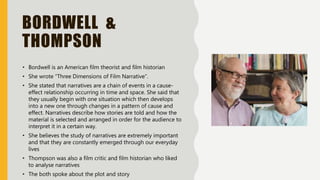
• Bordwell is an American film theorist and film historian
• She wrote “Three Dimensions of Film Narrative”.
• She stated that narratives are a chain of events in a cause-
effect relationship occurring in time and space. She said that
they usually begin with one situation which then develops
into a new one through changes in a pattern of cause and
effect. Narratives describe how stories are told and how the
material is selected and arranged in order for the audience to
interpret it in a certain way.
• She believes the study of narratives are extremely important
and that they are constantly emerged through our everyday
lives
• Thompson was also a film critic and film historian who liked
to analyse narratives
• The both spoke about the plot and story
PLOT AND STORY
• They drew a distinction on the two aspects of the narrative, the plot and
the story
• The story is the entire narrative, everything visibly present in the film
before us. This is just in the basic chronological order. This includes the
character's back story
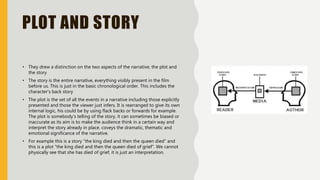
• The plot is the set of all the events in a narrative including those explicitly
presented and those the viewer just infers. It is rearranged to give its own
internal logic, his could be by using flack backs or forwards for example.
The plot is somebody’s telling of the story, it can sometimes be biased or
inaccurate as its aim is to make the audience think in a certain way and
interpret the story already in place. coveys the dramatic, thematic and
emotional significance of the narrative.
• For example this is a story “the king died and then the queen died” and
this is a plot “the king died and then the queen died of grief”. We cannot
physically see that she has died of grief, it is just an interpretation.
WHY WE NEED
NARRATIVES
Narratives are in place so that we can deliver the story in
visual and dialogue
It lays out what order and how the story should be told
It allows the audience to understand the protagonist by
prioritising their perspective
It allows the pace of text and order of events to be
established
It delivers hidden messages of a story and allows the
audience to interpret different meanings and ideas
STRUCTURE
• Narratives structure is very flexible, here are some structure techniques:
• Narratives can be linear or non linear. Linear narratives simply just have a beginning middle and end and
non-linear have flash forwards and flashbacks, they are a lot more complex.
• They can also be multi-stranded, this is where the story refers to multiple other stories and films throughout.
• An ‘unrestricted narrative’ is when the viewers have more knowledge of the character’s than they do
themselves, for example in a mystery film, the audience may know who the killer is whilst the character is still
finding out by showing us scenes that the character is not aware of.
• In a narrative, there is usually a focaliser, this is the main character that the story revolves around. Their
perspective is followed the whole time.
• An ellipsis is the compression of time within a film, this is so that the film is shorter. For example, if the film is
about a character’s life story and we watch them grow up, the film will be 1-3 hours instead of 12 years for
example.
• The end of the narrative is called ‘closure’, when the focaliser reaches their resolution. Many narratives end in
different ways. Some have a high degree while other’s are more open-ended and sometimes left on a cliff
hanger to let the audience have their own interpretation
• Feature film’s structure varies a lot. For example Hollywood films are usually built on the basic structure of
character, desire and conflict
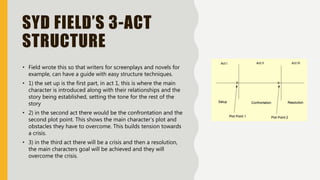
SYD FIELD’S 3-ACT
STRUCTURE
• Field wrote this so that writers for screenplays and novels for
example, can have a guide with easy structure techniques.
• 1) the set up is the first part, in act 1, this is where the main
character is introduced along with their relationships and the
story being established, setting the tone for the rest of the
story
• 2) in the second act there would be the confrontation and the
second plot point. This shows the main character’s plot and
obstacles they have to overcome. This builds tension towards
a crisis.
• 3) in the third act there will be a crisis and then a resolution,
the main characters goal will be achieved and they will
overcome the crisis.
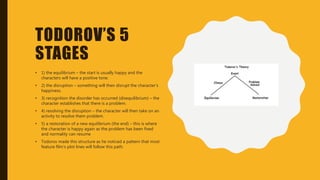
TODOROV’S 5
STAGES
• 1) the equilibrium – the start is usually happy and the
characters will have a positive tone.
• 2) the disruption – something will then disrupt the character’s
happiness.
• 3) recognition the disorder has occurred (disequilibrium) – the
character establishes that there is a problem.
• 4) resolving the disruption – the character will then take on an
activity to resolve them problem.
• 5) a restoration of a new equilibrium (the end) – this is where
the character is happy again as the problem has been fixed
and normality can resume
• Todorov made this structure as he noticed a pattern that most
feature film’s plot lines will follow this path.
JOSEPH CAMPBELL'S
HERO JOURNEY
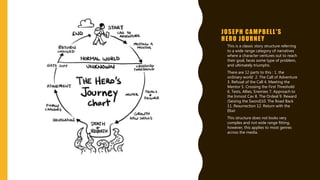
• This is a classic story structure referring
to a wide range category of narratives
where a character ventures out to reach
their goal, faces some type of problem,
and ultimately triumphs.
• There are 12 parts to this : 1. the
ordinary world 2. The Call of Adventure
3. Refusal of the Call 4. Meeting the
Mentor 5. Crossing the First Threshold
6. Tests, Allies, Enemies 7. Approach to
the Inmost Cav 8. The Ordeal 9. Reward
(Seizing the Sword)10. The Road Back
11. Resurrection 12. Return with the
Elixir
• This structure does not looks very
complex and not wide range fitting,
however, this applies to most genres
across the media.
ROLE OF CHARACTERS WITHIN A
NARRATIVE• Protagonist - this is the main character which the narrative will follow. All the other roles are designed to fir around their
relation to the protagonist. Examples are: harry potter, Indiana jones, a lot of films will even be named after the protagonist.
• Antagonist - usually the antagonist is the evil character, they are usually the protagonist’s rival. Examples are: Voldemort,
Olaf and Regina George.
• Deuteragonist – they are not as important as the antagonist and the protagonist, they are the protagonist’s side kick, they
often bring emotion to the narrative. Examples are: Hermione and Ron.
• Tertiary characters – they are random characters that aren’t too important to the story line but they are characters the
antagonist and the protagonist may meet along the storyline. An example would be somebody the protagonist sits next to
in class.
• Love interest – there is usually love involved somewhere in the narrative, this character will play the other role for the
protagonist, antagonist or the deuteragonist to fall in love with.
• Confidant – a best friend, love interest or a mentor
• Foil character – this character clashes with the protagonist giving the audience a better idea of what they are really like.
• Dynamic/changing character – they are a character that often results in being a better or worse person. For example:
scrooge a static character is the one which stays the same throughout. For example: Sherlock Holmes
• Stock character – they are not seen often but their role ends up playing an important role in making the audience feel at
home.
• Symbolic character – they represent something larger and more important, they are quite subtle. For example: Alan
• Round character – they change a lot throughout the narrative and they have a full back story.
PROPP’S CHARACTER FUNCTIONS
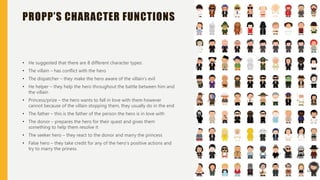
• He suggested that there are 8 different character types:
• The villain – has conflict with the hero
• The dispatcher – they make the hero aware of the villain’s evil
• He helper – they help the hero throughout the battle between him and
the villain
• Princess/prize – the hero wants to fall in love with them however
cannot because of the villain stopping them, they usually do in the end
• The father – this is the father of the person the hero is in love with
• The donor – prepares the hero for their quest and gives them
something to help them resolve it
• The seeker hero – they react to the donor and marry the princess
• False hero – they take credit for any of the hero’s positive actions and
try to marry the priness
LEVI STRAUSS’ BINARY OPPOSITES
• He stated that all characters have opposites to thicken the
plot and further the narrative.
• For example: a hero and a villain, human and alien, youth
and age, silence and noise
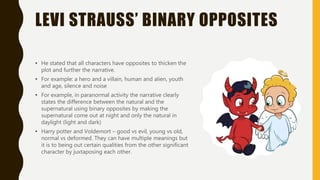
• For example, in paranormal activity the narrative clearly
states the difference between the natural and the
supernatural using binary opposites by making the
supernatural come out at night and only the natural in
daylight (light and dark)
• Harry potter and Voldemort – good vs evil, young vs old,
normal vs deformed. They can have multiple meanings but
it is to being out certain qualities from the other significant
character by juxtaposing each other.
THEMES WITHIN GENRES
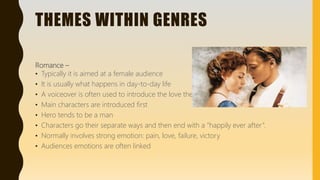
Romance –
• Typically it is aimed at a female audience
• It is usually what happens in day-to-day life
• A voiceover is often used to introduce the love theme
• Main characters are introduced first
• Hero tends to be a man
• Characters go their separate ways and then end with a “happily ever after”.
• Normally involves strong emotion: pain, love, failure, victory
• Audiences emotions are often linked
THEMES WITHIN GENRES
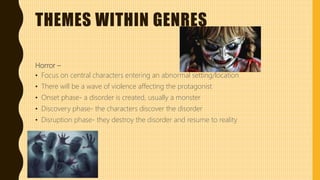
Horror –
• Focus on central characters entering an abnormal setting/location
• There will be a wave of violence affecting the protagonist
• Onset phase- a disorder is created, usually a monster
• Discovery phase- the characters discover the disorder
• Disruption phase- they destroy the disorder and resume to reality
THEMES WITHIN GENRES
Comedy –
• Normally set in suburban places e.g. : high school, bars
• Scenes are usually well lit
• Lots of close ups and mid shots
• Light and modern colours are usually used throughout giving it a “normal life” effect
• Always more than one protagonist, a villain, person in charge, and the person the
protagonist meets
• Themes: drugs, drinking, violence, friendship and conflict

2) narrative done

  • 1.
  • 2.
    DEFINITION OF NARRATIVE •A narrative is a storyline with causes and connected events occurring in time and space. • Narratives do not have to be just in films. For example, even our dreams are narratives, they are connected events placed together to make a story • For a story to be a narrative we must be able to establish causal and temporal relations between the events. • Between each event in the narrative, there will be temporal, spatial and thematic links throughout • Their main role is story telling • There will be a story with represented events, characters (if necessary), and actions, where the audience can interpret their diegesis based on this
  • 3.
    BORDWELL & THOMPSON • Bordwellis an American film theorist and film historian • She wrote “Three Dimensions of Film Narrative”. • She stated that narratives are a chain of events in a cause- effect relationship occurring in time and space. She said that they usually begin with one situation which then develops into a new one through changes in a pattern of cause and effect. Narratives describe how stories are told and how the material is selected and arranged in order for the audience to interpret it in a certain way. • She believes the study of narratives are extremely important and that they are constantly emerged through our everyday lives • Thompson was also a film critic and film historian who liked to analyse narratives • The both spoke about the plot and story
  • 4.
    PLOT AND STORY •They drew a distinction on the two aspects of the narrative, the plot and the story • The story is the entire narrative, everything visibly present in the film before us. This is just in the basic chronological order. This includes the character's back story • The plot is the set of all the events in a narrative including those explicitly presented and those the viewer just infers. It is rearranged to give its own internal logic, his could be by using flack backs or forwards for example. The plot is somebody’s telling of the story, it can sometimes be biased or inaccurate as its aim is to make the audience think in a certain way and interpret the story already in place. coveys the dramatic, thematic and emotional significance of the narrative. • For example this is a story “the king died and then the queen died” and this is a plot “the king died and then the queen died of grief”. We cannot physically see that she has died of grief, it is just an interpretation.
  • 5.
    WHY WE NEED NARRATIVES Narrativesare in place so that we can deliver the story in visual and dialogue It lays out what order and how the story should be told It allows the audience to understand the protagonist by prioritising their perspective It allows the pace of text and order of events to be established It delivers hidden messages of a story and allows the audience to interpret different meanings and ideas
  • 6.
    STRUCTURE • Narratives structureis very flexible, here are some structure techniques: • Narratives can be linear or non linear. Linear narratives simply just have a beginning middle and end and non-linear have flash forwards and flashbacks, they are a lot more complex. • They can also be multi-stranded, this is where the story refers to multiple other stories and films throughout. • An ‘unrestricted narrative’ is when the viewers have more knowledge of the character’s than they do themselves, for example in a mystery film, the audience may know who the killer is whilst the character is still finding out by showing us scenes that the character is not aware of. • In a narrative, there is usually a focaliser, this is the main character that the story revolves around. Their perspective is followed the whole time. • An ellipsis is the compression of time within a film, this is so that the film is shorter. For example, if the film is about a character’s life story and we watch them grow up, the film will be 1-3 hours instead of 12 years for example. • The end of the narrative is called ‘closure’, when the focaliser reaches their resolution. Many narratives end in different ways. Some have a high degree while other’s are more open-ended and sometimes left on a cliff hanger to let the audience have their own interpretation • Feature film’s structure varies a lot. For example Hollywood films are usually built on the basic structure of character, desire and conflict
  • 7.
    SYD FIELD’S 3-ACT STRUCTURE •Field wrote this so that writers for screenplays and novels for example, can have a guide with easy structure techniques. • 1) the set up is the first part, in act 1, this is where the main character is introduced along with their relationships and the story being established, setting the tone for the rest of the story • 2) in the second act there would be the confrontation and the second plot point. This shows the main character’s plot and obstacles they have to overcome. This builds tension towards a crisis. • 3) in the third act there will be a crisis and then a resolution, the main characters goal will be achieved and they will overcome the crisis.
  • 8.
    TODOROV’S 5 STAGES • 1)the equilibrium – the start is usually happy and the characters will have a positive tone. • 2) the disruption – something will then disrupt the character’s happiness. • 3) recognition the disorder has occurred (disequilibrium) – the character establishes that there is a problem. • 4) resolving the disruption – the character will then take on an activity to resolve them problem. • 5) a restoration of a new equilibrium (the end) – this is where the character is happy again as the problem has been fixed and normality can resume • Todorov made this structure as he noticed a pattern that most feature film’s plot lines will follow this path.
  • 9.
    JOSEPH CAMPBELL'S HERO JOURNEY •This is a classic story structure referring to a wide range category of narratives where a character ventures out to reach their goal, faces some type of problem, and ultimately triumphs. • There are 12 parts to this : 1. the ordinary world 2. The Call of Adventure 3. Refusal of the Call 4. Meeting the Mentor 5. Crossing the First Threshold 6. Tests, Allies, Enemies 7. Approach to the Inmost Cav 8. The Ordeal 9. Reward (Seizing the Sword)10. The Road Back 11. Resurrection 12. Return with the Elixir • This structure does not looks very complex and not wide range fitting, however, this applies to most genres across the media.
  • 10.
    ROLE OF CHARACTERSWITHIN A NARRATIVE• Protagonist - this is the main character which the narrative will follow. All the other roles are designed to fir around their relation to the protagonist. Examples are: harry potter, Indiana jones, a lot of films will even be named after the protagonist. • Antagonist - usually the antagonist is the evil character, they are usually the protagonist’s rival. Examples are: Voldemort, Olaf and Regina George. • Deuteragonist – they are not as important as the antagonist and the protagonist, they are the protagonist’s side kick, they often bring emotion to the narrative. Examples are: Hermione and Ron. • Tertiary characters – they are random characters that aren’t too important to the story line but they are characters the antagonist and the protagonist may meet along the storyline. An example would be somebody the protagonist sits next to in class. • Love interest – there is usually love involved somewhere in the narrative, this character will play the other role for the protagonist, antagonist or the deuteragonist to fall in love with. • Confidant – a best friend, love interest or a mentor • Foil character – this character clashes with the protagonist giving the audience a better idea of what they are really like. • Dynamic/changing character – they are a character that often results in being a better or worse person. For example: scrooge a static character is the one which stays the same throughout. For example: Sherlock Holmes • Stock character – they are not seen often but their role ends up playing an important role in making the audience feel at home. • Symbolic character – they represent something larger and more important, they are quite subtle. For example: Alan • Round character – they change a lot throughout the narrative and they have a full back story.
  • 11.
    PROPP’S CHARACTER FUNCTIONS •He suggested that there are 8 different character types: • The villain – has conflict with the hero • The dispatcher – they make the hero aware of the villain’s evil • He helper – they help the hero throughout the battle between him and the villain • Princess/prize – the hero wants to fall in love with them however cannot because of the villain stopping them, they usually do in the end • The father – this is the father of the person the hero is in love with • The donor – prepares the hero for their quest and gives them something to help them resolve it • The seeker hero – they react to the donor and marry the princess • False hero – they take credit for any of the hero’s positive actions and try to marry the priness
  • 12.
    LEVI STRAUSS’ BINARYOPPOSITES • He stated that all characters have opposites to thicken the plot and further the narrative. • For example: a hero and a villain, human and alien, youth and age, silence and noise • For example, in paranormal activity the narrative clearly states the difference between the natural and the supernatural using binary opposites by making the supernatural come out at night and only the natural in daylight (light and dark) • Harry potter and Voldemort – good vs evil, young vs old, normal vs deformed. They can have multiple meanings but it is to being out certain qualities from the other significant character by juxtaposing each other.
  • 13.
    THEMES WITHIN GENRES Romance– • Typically it is aimed at a female audience • It is usually what happens in day-to-day life • A voiceover is often used to introduce the love theme • Main characters are introduced first • Hero tends to be a man • Characters go their separate ways and then end with a “happily ever after”. • Normally involves strong emotion: pain, love, failure, victory • Audiences emotions are often linked
  • 14.
    THEMES WITHIN GENRES Horror– • Focus on central characters entering an abnormal setting/location • There will be a wave of violence affecting the protagonist • Onset phase- a disorder is created, usually a monster • Discovery phase- the characters discover the disorder • Disruption phase- they destroy the disorder and resume to reality
  • 15.
    THEMES WITHIN GENRES Comedy– • Normally set in suburban places e.g. : high school, bars • Scenes are usually well lit • Lots of close ups and mid shots • Light and modern colours are usually used throughout giving it a “normal life” effect • Always more than one protagonist, a villain, person in charge, and the person the protagonist meets • Themes: drugs, drinking, violence, friendship and conflict