Narrative
BY LEWIS GLAYSHER
What is Narrative?
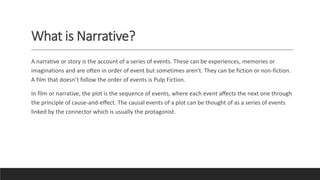
A narrative or story is the account of a series of events. These can be experiences, memories or
imaginations and are often in order of event but sometimes aren't. They can be fiction or non-fiction.
A film that doesn’t follow the order of events is Pulp Fiction.
In film or narrative, the plot is the sequence of events, where each event affects the next one through
the principle of cause-and-effect. The causal events of a plot can be thought of as a series of events
linked by the connector which is usually the protagonist.
Story Telling
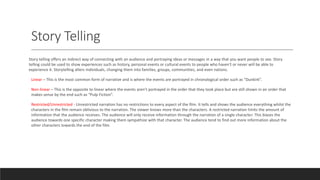
Story telling offers an indirect way of connecting with an audience and portraying ideas or messages in a way that you want people to see. Story
telling could be used to show experiences such as history, personal events or cultural events to people who haven't or never will be able to
experience it. Storytelling alters individuals, changing them into families, groups, communities, and even nations.
Linear – This is the most common form of narrative and is where the events are portrayed in chronological order such as “Dunkirk”.
Non-linear – This is the opposite to linear where the events aren’t portrayed in the order that they took place but are still shown in an order that
makes sense by the end such as “Pulp Fiction”.
Restricted/Unrestricted - Unrestricted narration has no restrictions to every aspect of the film. It tells and shows the audience everything whilst the
characters in the film remain oblivious to the narration. The viewer knows more than the characters. A restricted narration limits the amount of
information that the audience receives. The audience will only receive information through the narration of a single character. This biases the
audience towards one specific character making them sympathize with that character. The audience tend to find out more information about the
other characters towards the end of the film.
Story Telling
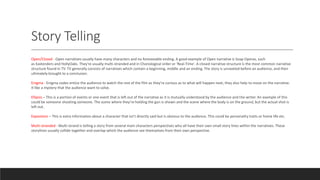
Open/Closed - Open narratives usually have many characters and no foreseeable ending. A good example of Open narrative is Soap Operas, such
as Eastenders and HollyOaks. They're usually multi-stranded and in Chonological order or 'Real-Time'. A closed narrative structure is the most common narrative
structure found in TV. TV generally consists of narratives which contain a beginning, middle and an ending. The story is unraveled before an audience, and then
ultimately brought to a conclusion.
Enigma - Enigma codes entice the audience to watch the rest of the film as they're curious as to what will happen next; they also help to move on the narrative.
It like a mystery that the audience want to solve.
Ellipsis – This is a portion of events or one event that is left out of the narrative as it is mutually understood by the audience and the writer. An example of this
could be someone shooting someone. The scene where they’re holding the gun is shown and the scene where the body is on the ground, but the actual shot is
left out.
Exposition – This is extra information about a character that isn't directly said but is obvious to the audience. This could be personality traits or home life etc.
Multi-stranded - Multi-strand is telling a story from several main characters perspectives who all have their own small story lines within the narratives. These
storylines usually collide together and overlap which the audience see themselves from their own perspective.
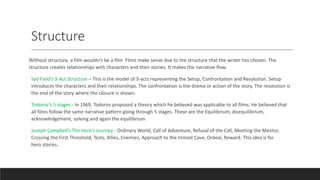
Structure
Without structure, a film wouldn’t be a film. Films make sense due to the structure that the writer has chosen. The
structure creates relationships with characters and their stories. It makes the narrative flow.
Syd Field’s 3-Act Structure – This is the model of 3-acts representing the Setup, Confrontation and Resolution. Setup
introduces the characters and their relationships. The confrontation is the drama or action of the story. The resolution is
the end of the story where the closure is shown.
Todorov’s 5 stages - In 1969, Todorov proposed a theory which he believed was applicable to all films. He believed that
all films follow the same narrative pattern going through 5 stages. These are the Equilibrium, disequilibrium,
acknowledgement, solving and again the equilibrium.
Joseph Campbell’s The Hero’s Journey - Ordinary World, Call of Adventure, Refusal of the Call, Meeting the Mentor,
Crossing the First Threshold, Tests, Allies, Enemies, Approach to the Inmost Cave, Ordeal, Reward. This idea is for
hero stories.
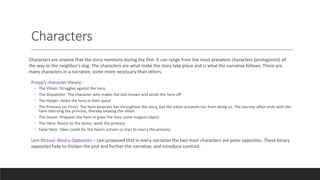
Characters
Characters are anyone that the story mentions during the film. It can range from the most prevalent characters (protagonist) all
the way to the neighbor's dog. The characters are what make the story take place and is what the narrative follows. There are
many characters in a narrative, some more necessary than others.
Propp’s character theory -
◦ The Villain: Struggles against the hero
◦ The Dispatcher: The character who makes the lack known and sends the hero off
◦ The Helper: Helps the hero in their quest
◦ The Princess (or Prize): The hero deserves her throughout the story, but the villain prevents her from doing so. The journey often ends with the
hero marrying the princess, thereby beating the villain
◦ The Donor: Prepares the hero or gives the hero some magical object
◦ The Hero: Reacts to the donor, weds the princess
◦ False Hero: Takes credit for the hero’s actions or tries to marry the princess
Levi-Strauss' Binary Opposites – Levi proposed that in every narrative the two main characters are polar opposites. These binary
opposites help to thicken the plot and further the narrative; and introduce contrast.
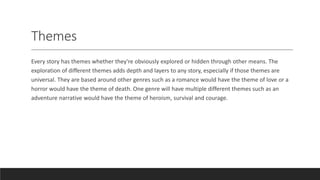
Themes
Every story has themes whether they're obviously explored or hidden through other means. The
exploration of different themes adds depth and layers to any story, especially if those themes are
universal. They are based around other genres such as a romance would have the theme of love or a
horror would have the theme of death. One genre will have multiple different themes such as an
adventure narrative would have the theme of heroism, survival and courage.

What is narrative

  • 1.
  • 2.
    What is Narrative? Anarrative or story is the account of a series of events. These can be experiences, memories or imaginations and are often in order of event but sometimes aren't. They can be fiction or non-fiction. A film that doesn’t follow the order of events is Pulp Fiction. In film or narrative, the plot is the sequence of events, where each event affects the next one through the principle of cause-and-effect. The causal events of a plot can be thought of as a series of events linked by the connector which is usually the protagonist.
  • 3.
    Story Telling Story tellingoffers an indirect way of connecting with an audience and portraying ideas or messages in a way that you want people to see. Story telling could be used to show experiences such as history, personal events or cultural events to people who haven't or never will be able to experience it. Storytelling alters individuals, changing them into families, groups, communities, and even nations. Linear – This is the most common form of narrative and is where the events are portrayed in chronological order such as “Dunkirk”. Non-linear – This is the opposite to linear where the events aren’t portrayed in the order that they took place but are still shown in an order that makes sense by the end such as “Pulp Fiction”. Restricted/Unrestricted - Unrestricted narration has no restrictions to every aspect of the film. It tells and shows the audience everything whilst the characters in the film remain oblivious to the narration. The viewer knows more than the characters. A restricted narration limits the amount of information that the audience receives. The audience will only receive information through the narration of a single character. This biases the audience towards one specific character making them sympathize with that character. The audience tend to find out more information about the other characters towards the end of the film.
  • 4.
    Story Telling Open/Closed -Open narratives usually have many characters and no foreseeable ending. A good example of Open narrative is Soap Operas, such as Eastenders and HollyOaks. They're usually multi-stranded and in Chonological order or 'Real-Time'. A closed narrative structure is the most common narrative structure found in TV. TV generally consists of narratives which contain a beginning, middle and an ending. The story is unraveled before an audience, and then ultimately brought to a conclusion. Enigma - Enigma codes entice the audience to watch the rest of the film as they're curious as to what will happen next; they also help to move on the narrative. It like a mystery that the audience want to solve. Ellipsis – This is a portion of events or one event that is left out of the narrative as it is mutually understood by the audience and the writer. An example of this could be someone shooting someone. The scene where they’re holding the gun is shown and the scene where the body is on the ground, but the actual shot is left out. Exposition – This is extra information about a character that isn't directly said but is obvious to the audience. This could be personality traits or home life etc. Multi-stranded - Multi-strand is telling a story from several main characters perspectives who all have their own small story lines within the narratives. These storylines usually collide together and overlap which the audience see themselves from their own perspective.
  • 5.
    Structure Without structure, afilm wouldn’t be a film. Films make sense due to the structure that the writer has chosen. The structure creates relationships with characters and their stories. It makes the narrative flow. Syd Field’s 3-Act Structure – This is the model of 3-acts representing the Setup, Confrontation and Resolution. Setup introduces the characters and their relationships. The confrontation is the drama or action of the story. The resolution is the end of the story where the closure is shown. Todorov’s 5 stages - In 1969, Todorov proposed a theory which he believed was applicable to all films. He believed that all films follow the same narrative pattern going through 5 stages. These are the Equilibrium, disequilibrium, acknowledgement, solving and again the equilibrium. Joseph Campbell’s The Hero’s Journey - Ordinary World, Call of Adventure, Refusal of the Call, Meeting the Mentor, Crossing the First Threshold, Tests, Allies, Enemies, Approach to the Inmost Cave, Ordeal, Reward. This idea is for hero stories.
  • 6.
    Characters Characters are anyonethat the story mentions during the film. It can range from the most prevalent characters (protagonist) all the way to the neighbor's dog. The characters are what make the story take place and is what the narrative follows. There are many characters in a narrative, some more necessary than others. Propp’s character theory - ◦ The Villain: Struggles against the hero ◦ The Dispatcher: The character who makes the lack known and sends the hero off ◦ The Helper: Helps the hero in their quest ◦ The Princess (or Prize): The hero deserves her throughout the story, but the villain prevents her from doing so. The journey often ends with the hero marrying the princess, thereby beating the villain ◦ The Donor: Prepares the hero or gives the hero some magical object ◦ The Hero: Reacts to the donor, weds the princess ◦ False Hero: Takes credit for the hero’s actions or tries to marry the princess Levi-Strauss' Binary Opposites – Levi proposed that in every narrative the two main characters are polar opposites. These binary opposites help to thicken the plot and further the narrative; and introduce contrast.
  • 7.
    Themes Every story hasthemes whether they're obviously explored or hidden through other means. The exploration of different themes adds depth and layers to any story, especially if those themes are universal. They are based around other genres such as a romance would have the theme of love or a horror would have the theme of death. One genre will have multiple different themes such as an adventure narrative would have the theme of heroism, survival and courage.