Economy between the world
wars.
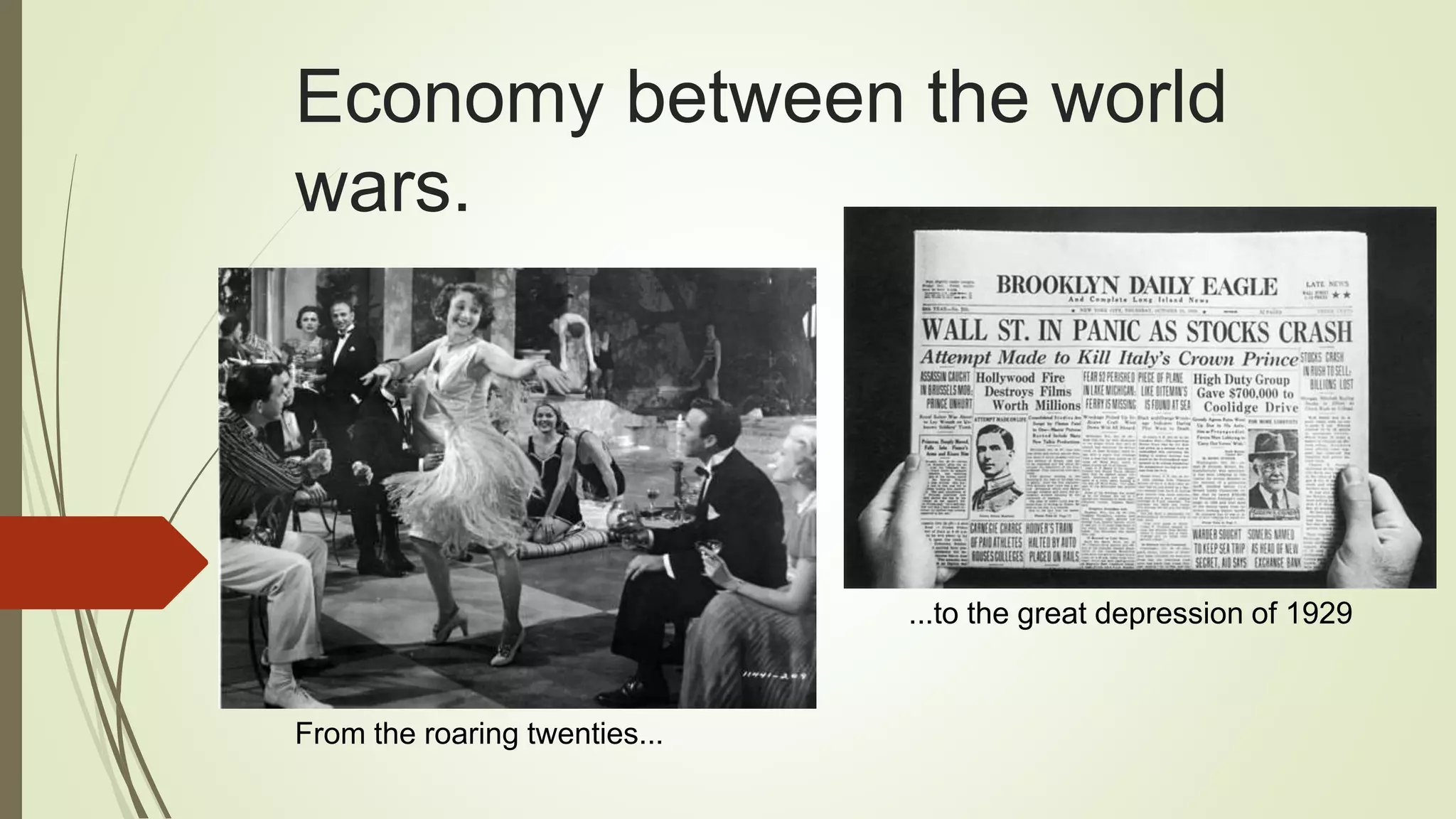
From the roaring twenties...
...to the great depression of 1929
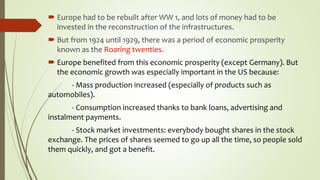
 Europe had to be rebuilt after WW 1, and lots of money had to be
invested in the reconstruction of the infrastructures.
 But from 1924 until 1929, there was a period of economic prosperity
known as the Roaring twenties.
 Europe benefited from this economic prosperity (except Germany). But
the economic growth was especially important in the US because:
- Mass production increased (especially of products such as
automobiles).
- Consumption increased thanks to bank loans, advertising and
instalment payments.
- Stock market investments: everybody bought shares in the stock
exchange. The prices of shares seemed to go up all the time, so people sold
them quickly, and got a benefit.
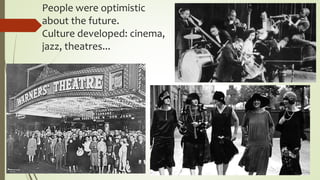
People were optimistic
about the future.
Culture developed: cinema,
jazz, theatres...
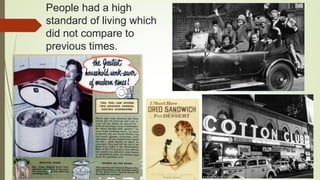
People had a high
standard of living which
did not compare to
previous times.
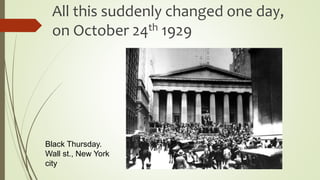
All this suddenly changed one day,
on October 24th 1929
Black Thursday.
Wall st., New York
city
In 1929, the economic boom led to an excess of production.
Stocks of products could not be sold in the US or overseas.
By the end of the 1920’s, Europe had recuperated, and
European countries reduced the consumption of products
manufactured in the US. This affected the American
economy.
American companies had to lower their prices dramatically if
they wanted to sell their products, and these companies
suffered major losses.
Therefore, the real economic situation of many companies
did not correspond to the high value of the companies in the
stock markets.
People started to sell their shares, and they started to be
distrustful.
 Everybody wanted to sell their
shares, and this made the prices of
the shares go lower and lower.
 People panicked. Nobody bought
the shares as people thought they
would continue dropping.
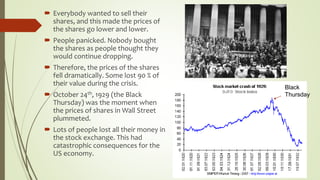
 Therefore, the prices of the shares
fell dramatically. Some lost 90 % of
their value during the crisis.
 October 24th, 1929 (the Black
Thursday) was the moment when
the prices of shares in Wall Street
plummeted.
 Lots of people lost all their money in
the stock exchange. This had
catastrophic consequences for the
US economy.
Black
Thursday
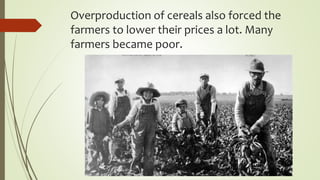
Overproduction of cereals also forced the
farmers to lower their prices a lot. Many
farmers became poor.
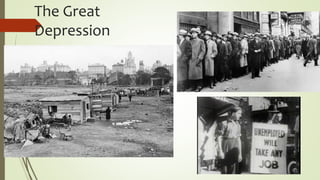
The Great
Depression
In the US, the stock market crash had important
consequences
 Millions of people lost their savings because they had invested them
on buying shares. As a consequence, demand of products
plummeted. Many companies had to close down, and unemployment
rose significantly.
 People had borrowed money from the banks to buy products (cars,
electronics, etc.) before the stock market crash, and now they could
not return the money. As a consequence, many banks were in
trouble.
 Everybody went to the banks to recuperate the money in their bank
accounts, but banks could not give it back because they had invested
it in buying shares.
 Banks had no money, so there was a lack of credit which paralysed
the US economy.
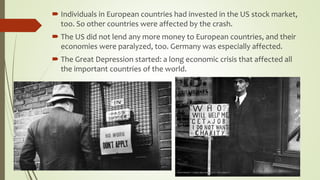
 Individuals in European countries had invested in the US stock market,
too. So other countries were affected by the crash.
 The US did not lend any more money to European countries, and their
economies were paralyzed, too. Germany was especially affected.
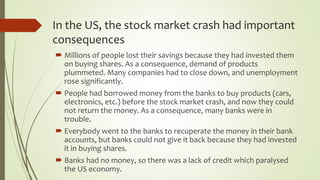
 The Great Depression started: a long economic crisis that affected all
the important countries of the world.
Consequences of the Great depression
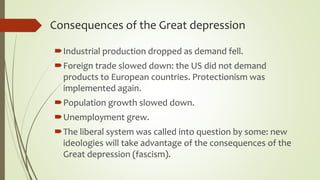
Industrial production dropped as demand fell.
Foreign trade slowed down: the US did not demand
products to European countries. Protectionism was
implemented again.
Population growth slowed down.
Unemployment grew.
The liberal system was called into question by some: new
ideologies will take advantage of the consequences of the
Great depression (fascism).
Solutions to the Great depression
 Autarchy: the country should produce everything it needed, foreign
trade should be limited, protectionism.
 The New Deal: Keynes (an American economist) suggested that the US
government should intervene in the economy by:
- promoting public works (basically roads). Thus, unemployment
would be reduced, and people would have money now to buy products.
- subsidies: money given by the government to farmers so that they
reduce their productions. Thus, prices would be more stable.
- granting unemployment benefits. People who were unemployed
would receive money from the government, and that money would
increase the demand of products, so the economy would grow again.
- forcing banks to give credit at low interest rates.
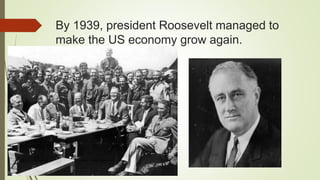
By 1939, president Roosevelt managed to
make the US economy grow again.

2. Economy between the world wars

  • 1.
    Economy between theworld wars. From the roaring twenties... ...to the great depression of 1929
  • 2.
     Europe hadto be rebuilt after WW 1, and lots of money had to be invested in the reconstruction of the infrastructures.  But from 1924 until 1929, there was a period of economic prosperity known as the Roaring twenties.  Europe benefited from this economic prosperity (except Germany). But the economic growth was especially important in the US because: - Mass production increased (especially of products such as automobiles). - Consumption increased thanks to bank loans, advertising and instalment payments. - Stock market investments: everybody bought shares in the stock exchange. The prices of shares seemed to go up all the time, so people sold them quickly, and got a benefit.
  • 3.
    People were optimistic aboutthe future. Culture developed: cinema, jazz, theatres...
  • 4.
    People had ahigh standard of living which did not compare to previous times.
  • 5.
    All this suddenlychanged one day, on October 24th 1929 Black Thursday. Wall st., New York city
  • 6.
    In 1929, theeconomic boom led to an excess of production. Stocks of products could not be sold in the US or overseas. By the end of the 1920’s, Europe had recuperated, and European countries reduced the consumption of products manufactured in the US. This affected the American economy. American companies had to lower their prices dramatically if they wanted to sell their products, and these companies suffered major losses. Therefore, the real economic situation of many companies did not correspond to the high value of the companies in the stock markets. People started to sell their shares, and they started to be distrustful.
  • 7.
     Everybody wantedto sell their shares, and this made the prices of the shares go lower and lower.  People panicked. Nobody bought the shares as people thought they would continue dropping.  Therefore, the prices of the shares fell dramatically. Some lost 90 % of their value during the crisis.  October 24th, 1929 (the Black Thursday) was the moment when the prices of shares in Wall Street plummeted.  Lots of people lost all their money in the stock exchange. This had catastrophic consequences for the US economy. Black Thursday
  • 8.
    Overproduction of cerealsalso forced the farmers to lower their prices a lot. Many farmers became poor.
  • 9.
  • 10.
    In the US,the stock market crash had important consequences  Millions of people lost their savings because they had invested them on buying shares. As a consequence, demand of products plummeted. Many companies had to close down, and unemployment rose significantly.  People had borrowed money from the banks to buy products (cars, electronics, etc.) before the stock market crash, and now they could not return the money. As a consequence, many banks were in trouble.  Everybody went to the banks to recuperate the money in their bank accounts, but banks could not give it back because they had invested it in buying shares.  Banks had no money, so there was a lack of credit which paralysed the US economy.
  • 11.
     Individuals inEuropean countries had invested in the US stock market, too. So other countries were affected by the crash.  The US did not lend any more money to European countries, and their economies were paralyzed, too. Germany was especially affected.  The Great Depression started: a long economic crisis that affected all the important countries of the world.
  • 12.
    Consequences of theGreat depression Industrial production dropped as demand fell. Foreign trade slowed down: the US did not demand products to European countries. Protectionism was implemented again. Population growth slowed down. Unemployment grew. The liberal system was called into question by some: new ideologies will take advantage of the consequences of the Great depression (fascism).
  • 13.
    Solutions to theGreat depression  Autarchy: the country should produce everything it needed, foreign trade should be limited, protectionism.  The New Deal: Keynes (an American economist) suggested that the US government should intervene in the economy by: - promoting public works (basically roads). Thus, unemployment would be reduced, and people would have money now to buy products. - subsidies: money given by the government to farmers so that they reduce their productions. Thus, prices would be more stable. - granting unemployment benefits. People who were unemployed would receive money from the government, and that money would increase the demand of products, so the economy would grow again. - forcing banks to give credit at low interest rates.
  • 14.
    By 1939, presidentRoosevelt managed to make the US economy grow again.