PHYSICOCHEMICAL
PARAMETERS
Presented by,
Mrs. Karthika.S, M.Pharm, PhD,
Dept of Pharma.Chem,
SVCP,Ayriur,
Pondicherry.
SOLUBILITY
SOLUBILITY
• Solubility is the ability of a substance to dissolve in
a solvent. Solubility of a substance in a solvent
depends on the nature of the solute and the
solvent, and their interactions involved.
• It is expressed by molarity, molality and
percentage.
• Generally, polar solvents dissolve polar solute and
nonpolar solvents dissolve nonpolar solutes and
semipolar solvents acts as intermediate.
• Electrolytes have appreciable solubility and their
solubility depends largely on the electrostatic forces
of attraction and repulsion.
• All biochemical reactions are based on the
solubility of a particular drug molecules in an
aqueous phase or on macromolecules usually
body.
• A highly important physical property of all
physiologically and pharmacologically important
drug molecule is their solubility in body’s
aqueous and non aqueous environment,
because the solution form of the drug can
interact with cellular and subcellular structures
that carry receptors, triggering the
pharmacological reactions.
• In each compartments, the degree of solubility
will get differs.
• The proportion of concentrations at equilibrium
is called as partition coefficient. Most of the
drugs exhibits solubility to some extent in both
water and lipid environments.
• Solubility is a function of many molecular
parameters, as
 Ionization
 Size and molecular structure
 Stereo chemistry
 Electronic structure
• All the above parameters are involved in the
interaction between the solvent and the solute.
• For eg, H2O, forms hydrogen bonds with ions or
nonpolar compounds through –OH,-SH,-NH
and –C=O groups or lone pair of electrons of O
and N atoms.
• The interaction of non polar drugs with lipids is
based on hydrophobic interactions. eg, the
solubility with pharmacological activity.
1. Local anaesthetic activity of Para amino benzoic
acid (PABA) esters partially depends on their
lipid solubility
2. In the homogeneous series beginning with n-
butanol and ending with n-octanol , the
bactericidal activity changes with molecular
weight.
3. n-Butanol and n-Pentanol are active against
Staphylococcus aureus.
4. Higher members of this series fail to kill the
bacteria since the necessary concentration
cannot be reached due to the lack of solubility in
water.
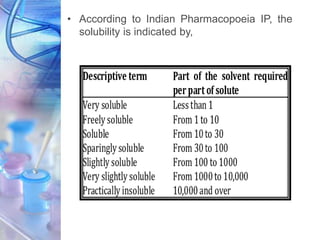
• According to Indian Pharmacopoeia IP, the
solubility is indicated by,
FACTORS AFFECTING SOLUBILITY OF
DRUGS
The factors affecting solubility of drugs
are classified as;
i. Solute related (Nature of solute)
Size, shape, melting point..
ii. Solvent related (Nature of solvent)
Polarity, pH..
iii. Environmental related
Temperature, pressure
iv. Formulation related
Surfactants, common ion effect and
other electrolytes effect
APPICATION OF SOLUBILITY
1. The solubility of the drugs in GI fluids is
important for better absorption of drugs. If the
aqueous solubility of drug is more than 1%
good absorption of drug will take place.
2. The action of drug also depends on the poor
aqueous solubility.
3. The release and absorption of drug from an
ointment or intramuscular injection depends on
the degree of saturation of the drug in the
particular solvents.
4. Solubility of the drug provides information about
the intermolecular forces of interaction, which is
useful for finding out the drug-receptor
interaction.
5. Solubility is for purification purpose of drugs.
PARTITION COEFFICIENT
• The ability of a drug to dissolve in a lipid phase
when an aqueous phase is also present, often
referred to as lipophilicity.
• The lipophilicity can be characterized by partition
coefficient.
• Partition coefficient can be defined as the
equilibrium constant of drug concentrations for “un-
ionizable” molecules in the two phases.
[DRUG] lipid
[DRUG] water
P =
• For “ionizable” molecules (acids, bases, salts),
where alpha (α) is the degree of ionization in
aqueous solution. It is basically a constitutive
property.
[DRUG] lipid
P =
1-α [DRUG] water
• Naturally, the partition coefficient is one of the
several physicochemical parameters influencing
drug transport and distribution.
• The contribution of each functional groups and
their structural arrangement help to determine
the lipophilic or hydrophilic character of the
molecule.
• It majorly influence drug transport
characteristics; the way in which the drugs reach
the site of action from the site of application (e.g.
injection site, gastrointestinal tract, and so forth).
• Since the blood distributes drugs, they must
penetrate and transverse many cells to reach
the site of action.
FACTORS AFFECTING PARTITION
COEFFICIENT
1) pH
2) Co solvents
3) Surfactant
4) Complexation
IMPORTANCE OF PARTITION COEFFICIENT
 It is generally used in combination with the Pka
to predict the distribution of drug in biological
system.
 The factor such as absorption, excretion &
penetration of the CNS may be related to the log
P value of drug.
 The drug should be designed with the lowest
possible.
 Log P, to reduce toxicity, nonspecific binding &
bioavailability.
IONIZATION OF DRUG
 The accumulation of an ionized drug in a
compartment of the body is known as “ion trapping”.
 The ionization of a drug is depends on its pKa and
the pH.
 The pKa is the negative Logarithm of Ka. The Ka is
the acidity constant of a compound, its tendency to
release a proton.
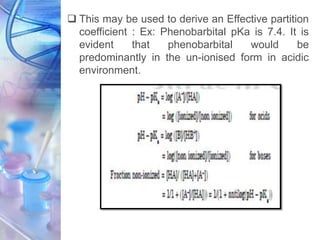
 The ratio of ionized/ non ionized drug may be
determined by the Henderson- Hasselbalch
relationship.
 This may be used to derive an Effective partition
coefficient : Ex: Phenobarbital pKa is 7.4. It is
evident that phenobarbital would be
predominantly in the un-ionised form in acidic
environment.
IMPORTANCE OF IONIZATION OF DRUGS
1) The lower the pH relative to the pKa
greater is the fraction of protonated drug
(protonated drug may be charged or uncharged)
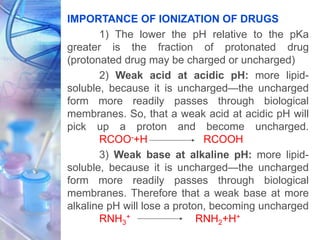
2) Weak acid at acidic pH: more lipid-
soluble, because it is uncharged—the uncharged
form more readily passes through biological
membranes. So, that a weak acid at acidic pH will
pick up a proton and become uncharged.
RCOO-+H RCOOH
3) Weak base at alkaline pH: more lipid-
soluble, because it is uncharged—the uncharged
form more readily passes through biological
membranes. Therefore that a weak base at more
alkaline pH will lose a proton, becoming uncharged
RNH3
+ RNH2+H+
PROTEIN BINDING
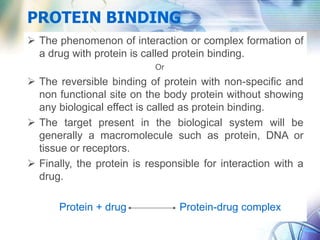
 The phenomenon of interaction or complex formation of
a drug with protein is called protein binding.
Or
 The reversible binding of protein with non-specific and
non functional site on the body protein without showing
any biological effect is called as protein binding.
 The target present in the biological system will be
generally a macromolecule such as protein, DNA or
tissue or receptors.
 Finally, the protein is responsible for interaction with a
drug.
Protein + drug Protein-drug complex
 Protein binding is of two types,
1. Intracellular binding
2. Extracellular binding
 The biological activity of a drug depends on
affinity between drug and protein.
 Extensive binding between drug and protein
may prolong the biological action of drug.
 Highly protein bound drug has a longer duration
of a action and lowers volume of distribution.
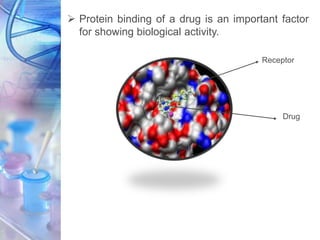
 Protein binding of a drug is an important factor
for showing biological activity.
Receptor
Drug
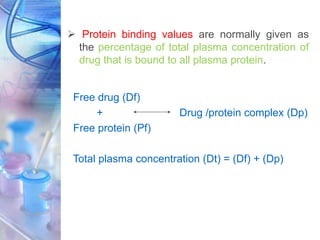
 Protein binding values are normally given as
the percentage of total plasma concentration of
drug that is bound to all plasma protein.
Free drug (Df)
+ Drug /protein complex (Dp)
Free protein (Pf)
Total plasma concentration (Dt) = (Df) + (Dp)
HYDROGEN BONDING
 Hydrogen bonding is a bond between H atom and
electronegative atoms, in which Hydrogen atom serve
to hold two other atoms together
 The atom capable of forming hydrogen bond have
atleast one unshared pair of electrons.
eg: F,O,N
 The compounds that form hydrogen bonding are
soluble in water
 Hydrogen bonding is of two types:
1) Intermolecular hydrogen bonding
2) Intramolecular hydrogen bonding
 Intermolecular Hydrogen bonding:
Hydrogen bonding occurs between two or
more molecules.
 Intramolecular Hydrogen bonding:
Hydrogen bonding occurs within the
molecules.
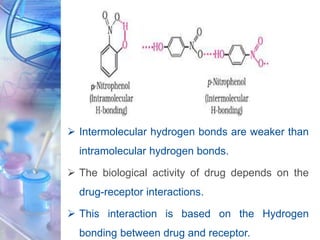
 Intermolecular hydrogen bonds are weaker than
intramolecular hydrogen bonds.
 The biological activity of drug depends on the
drug-receptor interactions.
 This interaction is based on the Hydrogen
bonding between drug and receptor.
p
COMPLEXATION or CHELATION
 Complexes or coordination compounds result from a
Donor-acceptor mechanism (donating-accepting
electron or, rather, an electron pair) or Lewis acid-base
reaction (donating-accepting protons).
 Any non-metallic atom or ion, whether free or contained
in a neutral molecule or in an ionic compound, that can
donate an electron pair, may serve as the donor.
 The acceptor, or constituent that accept the pair of
electrons, can be a metallic ion or sometimes also a
neutral molecule.
In addition to “coordinate covalence” (i.e., bonds
formed by the classical electron donor-acceptor
mechanism), intramolecular forces can also be
involved in the formation of complexes.
Complexes may be divided broadly into two
classes depending on whether the acceptor
compound is a metal ion or an organic molecule.
The compounds that are obtained by donating
electrons to metal ion with the formation of a ring
structure are called chelates.
 The compounds capable of forming a ring
structure with a metal atom are termed as
Ligands.
 Most of the metals are capable of forming
chelates or complexes (if the metal is not in a
ring, the compound is called a metal complex),
but the chelating property is restricted to atoms
like N, O and S, which are electron donating.
APPLICATIONS OF CHELATION
The phenomenon of chelation ís significantly
involved in biological system and to some extent in
explaining drug action.
1) Dimercaprol is a chelating agent. It is an
effective antidote for organic arsenical,
Lewisite, but can also be used for treatment of
poisoning due to antimony, gold and mercury.
2) Penicillamine is an effective antidote for the
treatment of copper poisoning because it forms
water-soluble product with copper and other
metal ions.
APPLICATIONS OF CHELATION
3) 8-hydroxyquinoline and its analogs act as
antibacterial and antifungal agents by
complexing with iron or copper.
BIO-ISOSTERISM
 Bio-isosterism is defined as compounds or groups that
possess near or equal molecular shapes and volumes,
approximately the same distribution of electron and
which exhibit similar physical properties.
 They are classified into two types.,
i) Classical bio-isosteres
ii) Non classical bio-isosteres.
1.Classical Bio-isosteres: They have similarities
of shape and electronic configuration of atoms,
groups and molecules which they replace.
The classical bio-isosteres may be,
A). Univalent atoms and groups:
i) Cl, Br, I
ii) CH3, NH2, -OH, -SH
B).Bivalent atoms and groups:
i) R-O-R,R-NH-R, R-S-R, RCH2R
ii) –CONHR, -COOR, -COSR
C).Trivalent atoms and groups:
i)-CH=, -N=
ii) –p=, -AS=
D).Tetravalent atoms and groups:
=C=, =N=, =P=
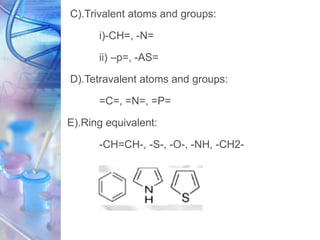
E).Ring equivalent:
-CH=CH-, -S-, -O-, -NH, -CH2-
Application of Classical Bioisosteres in drug
design:
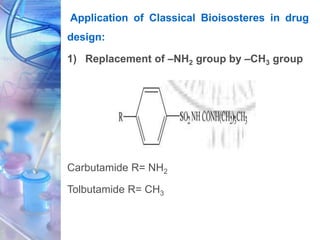
1) Replacement of –NH2 group by –CH3 group
Carbutamide R= NH2
Tolbutamide R= CH3
Application of Classical Bio-isosteres in drug
design:
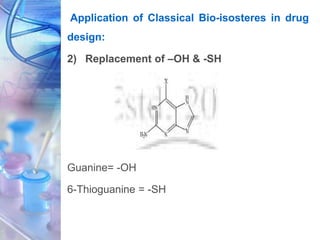
2) Replacement of –OH & -SH
Guanine= -OH
6-Thioguanine = -SH
1.Non Classical Bio-isosteres: They do not obey
the stearic and electronic definition of classical
isosteres.
Non-classical bio-isosteres are functional groups
with dissimilar valence electron configuration.
Specific characteristics are,
a) Electronic properties
b) Physicochemical property of molecule
c) Spatial arrangement
d) Functional moiety for biological activity.
Examples:
 Halogens Cl, F, Br, CN
 Ether -S-, -O
 Carbonyl group
 Hydroxyl group –OH, -NHSO2R, CH2OH
 Catechol
STEREOCHEMISTRY OF DRUGS
 Stereochemistry involve the study of three dimensional nature of
molecules. It is study of the chiral molecules.
 Stereochemistry plays a major role in the pharmacological
properties because;
1. Any change in stereo specificity of the drug will affect its
pharmacological activity
2. The isomeric pairs have different physical properties (log p,
pKa etc.) and thus differ in pharmacological activity. The isomer which
have same bond connectivity but different arrangement of groups or
atoms in the space are termed stereoisomer.
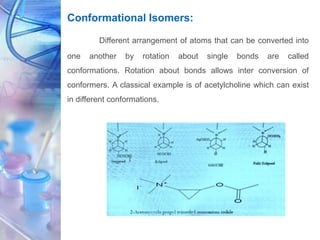
Conformational Isomers:
Different arrangement of atoms that can be converted into
one another by rotation about single bonds are called
conformations. Rotation about bonds allows inter conversion of
conformers. A classical example is of acetylcholine which can exist
in different conformations.
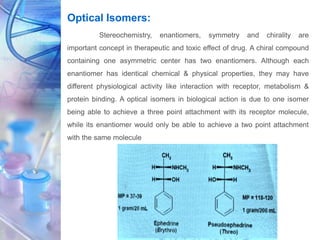
Optical Isomers:
Stereochemistry, enantiomers, symmetry and chirality are
important concept in therapeutic and toxic effect of drug. A chiral compound
containing one asymmetric center has two enantiomers. Although each
enantiomer has identical chemical & physical properties, they may have
different physiological activity like interaction with receptor, metabolism &
protein binding. A optical isomers in biological action is due to one isomer
being able to achieve a three point attachment with its receptor molecule,
while its enantiomer would only be able to achieve a two point attachment
with the same molecule
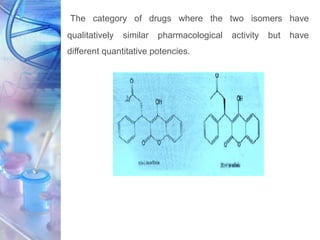
The category of drugs where the two isomers have
qualitatively similar pharmacological activity but have
different quantitative potencies.
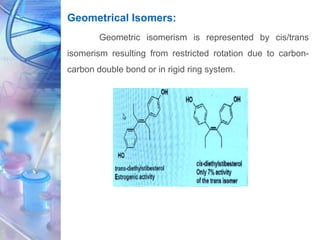
Geometrical Isomers:
Geometric isomerism is represented by cis/trans
isomerism resulting from restricted rotation due to carbon-
carbon double bond or in rigid ring system.
THANK YOU

Physicochemical parameters in relation to Biological activities

  • 1.
    PHYSICOCHEMICAL PARAMETERS Presented by, Mrs. Karthika.S,M.Pharm, PhD, Dept of Pharma.Chem, SVCP,Ayriur, Pondicherry.
  • 2.
  • 3.
    SOLUBILITY • Solubility isthe ability of a substance to dissolve in a solvent. Solubility of a substance in a solvent depends on the nature of the solute and the solvent, and their interactions involved. • It is expressed by molarity, molality and percentage. • Generally, polar solvents dissolve polar solute and nonpolar solvents dissolve nonpolar solutes and semipolar solvents acts as intermediate. • Electrolytes have appreciable solubility and their solubility depends largely on the electrostatic forces of attraction and repulsion.
  • 4.
    • All biochemicalreactions are based on the solubility of a particular drug molecules in an aqueous phase or on macromolecules usually body. • A highly important physical property of all physiologically and pharmacologically important drug molecule is their solubility in body’s aqueous and non aqueous environment, because the solution form of the drug can interact with cellular and subcellular structures that carry receptors, triggering the pharmacological reactions. • In each compartments, the degree of solubility will get differs.
  • 5.
    • The proportionof concentrations at equilibrium is called as partition coefficient. Most of the drugs exhibits solubility to some extent in both water and lipid environments. • Solubility is a function of many molecular parameters, as  Ionization  Size and molecular structure  Stereo chemistry  Electronic structure • All the above parameters are involved in the interaction between the solvent and the solute. • For eg, H2O, forms hydrogen bonds with ions or nonpolar compounds through –OH,-SH,-NH and –C=O groups or lone pair of electrons of O and N atoms.
  • 6.
    • The interactionof non polar drugs with lipids is based on hydrophobic interactions. eg, the solubility with pharmacological activity. 1. Local anaesthetic activity of Para amino benzoic acid (PABA) esters partially depends on their lipid solubility 2. In the homogeneous series beginning with n- butanol and ending with n-octanol , the bactericidal activity changes with molecular weight. 3. n-Butanol and n-Pentanol are active against Staphylococcus aureus. 4. Higher members of this series fail to kill the bacteria since the necessary concentration cannot be reached due to the lack of solubility in water.
  • 7.
    • According toIndian Pharmacopoeia IP, the solubility is indicated by,
  • 8.
    FACTORS AFFECTING SOLUBILITYOF DRUGS The factors affecting solubility of drugs are classified as; i. Solute related (Nature of solute) Size, shape, melting point.. ii. Solvent related (Nature of solvent) Polarity, pH.. iii. Environmental related Temperature, pressure iv. Formulation related Surfactants, common ion effect and other electrolytes effect
  • 9.
    APPICATION OF SOLUBILITY 1.The solubility of the drugs in GI fluids is important for better absorption of drugs. If the aqueous solubility of drug is more than 1% good absorption of drug will take place. 2. The action of drug also depends on the poor aqueous solubility. 3. The release and absorption of drug from an ointment or intramuscular injection depends on the degree of saturation of the drug in the particular solvents. 4. Solubility of the drug provides information about the intermolecular forces of interaction, which is useful for finding out the drug-receptor interaction. 5. Solubility is for purification purpose of drugs.
  • 10.
    PARTITION COEFFICIENT • Theability of a drug to dissolve in a lipid phase when an aqueous phase is also present, often referred to as lipophilicity. • The lipophilicity can be characterized by partition coefficient. • Partition coefficient can be defined as the equilibrium constant of drug concentrations for “un- ionizable” molecules in the two phases. [DRUG] lipid [DRUG] water P =
  • 11.
    • For “ionizable”molecules (acids, bases, salts), where alpha (α) is the degree of ionization in aqueous solution. It is basically a constitutive property. [DRUG] lipid P = 1-α [DRUG] water • Naturally, the partition coefficient is one of the several physicochemical parameters influencing drug transport and distribution. • The contribution of each functional groups and their structural arrangement help to determine the lipophilic or hydrophilic character of the molecule.
  • 12.
    • It majorlyinfluence drug transport characteristics; the way in which the drugs reach the site of action from the site of application (e.g. injection site, gastrointestinal tract, and so forth). • Since the blood distributes drugs, they must penetrate and transverse many cells to reach the site of action. FACTORS AFFECTING PARTITION COEFFICIENT 1) pH 2) Co solvents 3) Surfactant 4) Complexation
  • 13.
    IMPORTANCE OF PARTITIONCOEFFICIENT  It is generally used in combination with the Pka to predict the distribution of drug in biological system.  The factor such as absorption, excretion & penetration of the CNS may be related to the log P value of drug.  The drug should be designed with the lowest possible.  Log P, to reduce toxicity, nonspecific binding & bioavailability.
  • 14.
    IONIZATION OF DRUG The accumulation of an ionized drug in a compartment of the body is known as “ion trapping”.  The ionization of a drug is depends on its pKa and the pH.  The pKa is the negative Logarithm of Ka. The Ka is the acidity constant of a compound, its tendency to release a proton.  The ratio of ionized/ non ionized drug may be determined by the Henderson- Hasselbalch relationship.
  • 15.
     This maybe used to derive an Effective partition coefficient : Ex: Phenobarbital pKa is 7.4. It is evident that phenobarbital would be predominantly in the un-ionised form in acidic environment.
  • 16.
    IMPORTANCE OF IONIZATIONOF DRUGS 1) The lower the pH relative to the pKa greater is the fraction of protonated drug (protonated drug may be charged or uncharged) 2) Weak acid at acidic pH: more lipid- soluble, because it is uncharged—the uncharged form more readily passes through biological membranes. So, that a weak acid at acidic pH will pick up a proton and become uncharged. RCOO-+H RCOOH 3) Weak base at alkaline pH: more lipid- soluble, because it is uncharged—the uncharged form more readily passes through biological membranes. Therefore that a weak base at more alkaline pH will lose a proton, becoming uncharged RNH3 + RNH2+H+
  • 17.
    PROTEIN BINDING  Thephenomenon of interaction or complex formation of a drug with protein is called protein binding. Or  The reversible binding of protein with non-specific and non functional site on the body protein without showing any biological effect is called as protein binding.  The target present in the biological system will be generally a macromolecule such as protein, DNA or tissue or receptors.  Finally, the protein is responsible for interaction with a drug. Protein + drug Protein-drug complex
  • 18.
     Protein bindingis of two types, 1. Intracellular binding 2. Extracellular binding  The biological activity of a drug depends on affinity between drug and protein.  Extensive binding between drug and protein may prolong the biological action of drug.  Highly protein bound drug has a longer duration of a action and lowers volume of distribution.
  • 19.
     Protein bindingof a drug is an important factor for showing biological activity. Receptor Drug
  • 20.
     Protein bindingvalues are normally given as the percentage of total plasma concentration of drug that is bound to all plasma protein. Free drug (Df) + Drug /protein complex (Dp) Free protein (Pf) Total plasma concentration (Dt) = (Df) + (Dp)
  • 21.
    HYDROGEN BONDING  Hydrogenbonding is a bond between H atom and electronegative atoms, in which Hydrogen atom serve to hold two other atoms together  The atom capable of forming hydrogen bond have atleast one unshared pair of electrons. eg: F,O,N  The compounds that form hydrogen bonding are soluble in water
  • 22.
     Hydrogen bondingis of two types: 1) Intermolecular hydrogen bonding 2) Intramolecular hydrogen bonding  Intermolecular Hydrogen bonding: Hydrogen bonding occurs between two or more molecules.  Intramolecular Hydrogen bonding: Hydrogen bonding occurs within the molecules.
  • 23.
     Intermolecular hydrogenbonds are weaker than intramolecular hydrogen bonds.  The biological activity of drug depends on the drug-receptor interactions.  This interaction is based on the Hydrogen bonding between drug and receptor. p
  • 24.
    COMPLEXATION or CHELATION Complexes or coordination compounds result from a Donor-acceptor mechanism (donating-accepting electron or, rather, an electron pair) or Lewis acid-base reaction (donating-accepting protons).  Any non-metallic atom or ion, whether free or contained in a neutral molecule or in an ionic compound, that can donate an electron pair, may serve as the donor.  The acceptor, or constituent that accept the pair of electrons, can be a metallic ion or sometimes also a neutral molecule.
  • 25.
    In addition to“coordinate covalence” (i.e., bonds formed by the classical electron donor-acceptor mechanism), intramolecular forces can also be involved in the formation of complexes. Complexes may be divided broadly into two classes depending on whether the acceptor compound is a metal ion or an organic molecule. The compounds that are obtained by donating electrons to metal ion with the formation of a ring structure are called chelates.
  • 26.
     The compoundscapable of forming a ring structure with a metal atom are termed as Ligands.  Most of the metals are capable of forming chelates or complexes (if the metal is not in a ring, the compound is called a metal complex), but the chelating property is restricted to atoms like N, O and S, which are electron donating.
  • 27.
    APPLICATIONS OF CHELATION Thephenomenon of chelation ís significantly involved in biological system and to some extent in explaining drug action. 1) Dimercaprol is a chelating agent. It is an effective antidote for organic arsenical, Lewisite, but can also be used for treatment of poisoning due to antimony, gold and mercury. 2) Penicillamine is an effective antidote for the treatment of copper poisoning because it forms water-soluble product with copper and other metal ions.
  • 28.
    APPLICATIONS OF CHELATION 3)8-hydroxyquinoline and its analogs act as antibacterial and antifungal agents by complexing with iron or copper.
  • 29.
    BIO-ISOSTERISM  Bio-isosterism isdefined as compounds or groups that possess near or equal molecular shapes and volumes, approximately the same distribution of electron and which exhibit similar physical properties.  They are classified into two types., i) Classical bio-isosteres ii) Non classical bio-isosteres.
  • 30.
    1.Classical Bio-isosteres: Theyhave similarities of shape and electronic configuration of atoms, groups and molecules which they replace. The classical bio-isosteres may be, A). Univalent atoms and groups: i) Cl, Br, I ii) CH3, NH2, -OH, -SH B).Bivalent atoms and groups: i) R-O-R,R-NH-R, R-S-R, RCH2R ii) –CONHR, -COOR, -COSR
  • 31.
    C).Trivalent atoms andgroups: i)-CH=, -N= ii) –p=, -AS= D).Tetravalent atoms and groups: =C=, =N=, =P= E).Ring equivalent: -CH=CH-, -S-, -O-, -NH, -CH2-
  • 32.
    Application of ClassicalBioisosteres in drug design: 1) Replacement of –NH2 group by –CH3 group Carbutamide R= NH2 Tolbutamide R= CH3
  • 33.
    Application of ClassicalBio-isosteres in drug design: 2) Replacement of –OH & -SH Guanine= -OH 6-Thioguanine = -SH
  • 34.
    1.Non Classical Bio-isosteres:They do not obey the stearic and electronic definition of classical isosteres. Non-classical bio-isosteres are functional groups with dissimilar valence electron configuration. Specific characteristics are, a) Electronic properties b) Physicochemical property of molecule c) Spatial arrangement d) Functional moiety for biological activity.
  • 35.
    Examples:  Halogens Cl,F, Br, CN  Ether -S-, -O  Carbonyl group  Hydroxyl group –OH, -NHSO2R, CH2OH  Catechol
  • 36.
    STEREOCHEMISTRY OF DRUGS Stereochemistry involve the study of three dimensional nature of molecules. It is study of the chiral molecules.  Stereochemistry plays a major role in the pharmacological properties because; 1. Any change in stereo specificity of the drug will affect its pharmacological activity 2. The isomeric pairs have different physical properties (log p, pKa etc.) and thus differ in pharmacological activity. The isomer which have same bond connectivity but different arrangement of groups or atoms in the space are termed stereoisomer.
  • 37.
    Conformational Isomers: Different arrangementof atoms that can be converted into one another by rotation about single bonds are called conformations. Rotation about bonds allows inter conversion of conformers. A classical example is of acetylcholine which can exist in different conformations.
  • 38.
    Optical Isomers: Stereochemistry, enantiomers,symmetry and chirality are important concept in therapeutic and toxic effect of drug. A chiral compound containing one asymmetric center has two enantiomers. Although each enantiomer has identical chemical & physical properties, they may have different physiological activity like interaction with receptor, metabolism & protein binding. A optical isomers in biological action is due to one isomer being able to achieve a three point attachment with its receptor molecule, while its enantiomer would only be able to achieve a two point attachment with the same molecule
  • 39.
    The category ofdrugs where the two isomers have qualitatively similar pharmacological activity but have different quantitative potencies.
  • 40.
    Geometrical Isomers: Geometric isomerismis represented by cis/trans isomerism resulting from restricted rotation due to carbon- carbon double bond or in rigid ring system.
  • 41.