Making Walkability Happen: Practice wisdom, derived principles and ideas for action 
M. Katherine Kraft, Ph.D. 
September 9, 2014
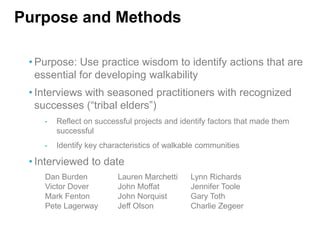
•Purpose: Use practice wisdom to identify actions that are essential for developing walkability 
•Interviews with seasoned practitioners with recognized successes (“tribal elders”) 
-Reflect on successful projects and identify factors that made them successful 
-Identify key characteristics of walkable communities 
•Interviewed to date 
Purpose and Methods 
Dan Burden 
Victor Dover 
Mark Fenton 
Pete Lagerway 
Lauren Marchetti 
John Moffat 
John Norquist 
Jeff Olson 
Lynn Richards 
Jennifer Toole 
Gary Toth 
Charlie Zegeer
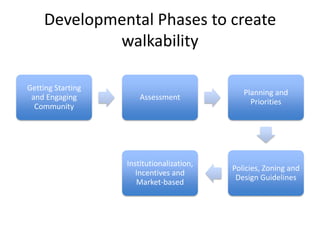
Developmental Phases to create walkability 
Getting Starting and Engaging Community 
Assessment 
Planning and Priorities 
Policies, Zoning and Design Guidelines 
Institutionalization, Incentives and Market-based
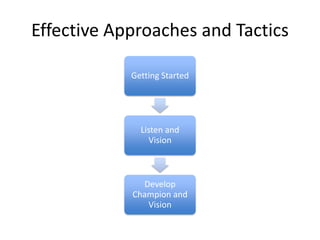
Effective Approaches and Tactics 
Getting Started 
Listen and Vision 
Develop Champion and Vision
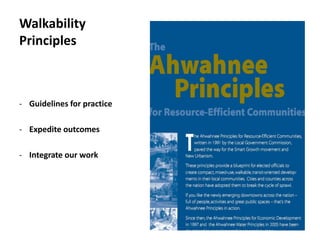
Walkability Principles 
-Guidelines for practice 
-Expedite outcomes 
-Integrate our work
Defining Walkability 
•The extent to which the built and social environment is safe, convenient, and attractive to people living, shopping, enjoying or spending time in an area on foot. 
•“We want to build a place that people love.” 
•“The places we love were not created as a solution to a traffic problem, they were created to bring joy to humanity.”
What we learned – general observations 
Optimistic 
“The wind is behind our sails, our task is to figure out how to use it.” 
Top down, decide, announce and defend no longer works 
“..most successful community change agents are those that listen and inspire.”
What we learned – ideas and actions 
Process: How you work with communities 
Project: Necessary features/elements 
Policies: How we sustain them
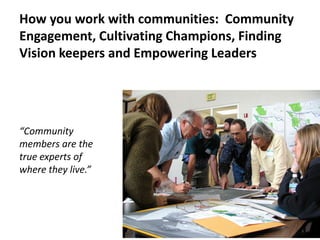
How you work with communities: Community Engagement, Cultivating Champions, Finding Vision keepers and Empowering Leaders 
“Community members are the true experts of where they live.”
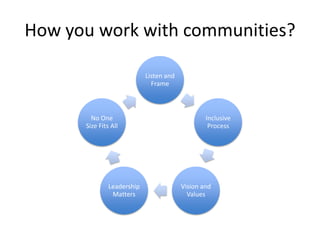
How you work with communities? 
Listen and Frame 
Inclusive Process 
Vision and Values 
Leadership Matters 
No One Size Fits All
Listen and Frame 
Listen to the community and respect the local community traditions and norms 
“Make no assumption about what the answer should be.” 
“Understand the real community concerns and frame the issue in a way that addresses these concerns.” 
“Get a good grounding in the social context of the place.”
An Inclusive Process is Vital 
•“A multi-disciplinary team is useful, do not stay in one sector, broaden thinking.”
Vision and Values 
Talk about the community vision and values – describe the place in 50 years and 100 years into the future 
“One should not do anything in a place if it doesn’t advance the community vision.” 
“Best advice is focus on community building and placemaking, then walkability and livability will follow.”
Leadership Matters 
Empower a champion, Find a Vision Keeper 
“Make it somebody’s job.” 
“I think it really comes down to leadership. Leadership in two areas, one that represents political will, and a project champion – someone that feels strongly. Having that one person who lives, breathes this; is more important than political will. “
No One Size Fits All 
No single policy solution – No silver bullet 
“ Each community has its own traditions, its own culture, its coming from a place already, ….Acknowledge that every single community is going to have a slightly different starting point..respect that and build off of that instead of trying to one size fits all. “
Projects 
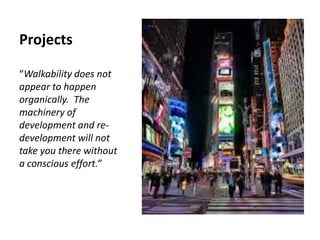
“Walkability does not appear to happen organically. The machinery of development and re- development will not take you there without a conscious effort.”
Gateway Projects 
•Use temporary and lighter, quicker, cheaper projects to show what is possible. 
•“We have a mismatch between how people really want to live and the rules and regulations that guide development and land use.”
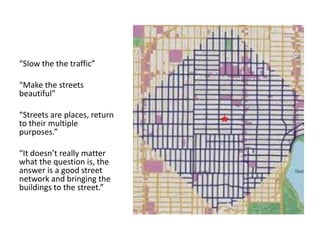
“Slow the the traffic” 
“Make the streets beautiful” 
“Streets are places, return to their multiple purposes.” 
“It doesn’t really matter what the question is, the answer is a good street network and bringing the buildings to the street.”
Policies and Incentives 
•Change the incentive structure so that we move away from auto dependency 
•The rules and the money have to steer the community toward healthier designs
In the words of our elders… 
“It is not technical….we need the real essence of a social movement, to begin to function like a movement and support one another. Hundreds of advocacy groups pushing own little niche, try to create a broader movement.”
Process Principles: Big Idea 
•Engage everyone possible, and find champions to push it forward, and eventually create collective community ownership of the vision and the process to get there.
Project Principles: Big Idea 
•Mixed land use, an active transportation network, and human scale design that is appealing, safe, and universally accessible are central to walkable, livable places 
–Gateway Projects 
–Job descriptions
Policy Principles: Big Idea 
•The rules and the money have to steer the community toward healthier designs 
–zoning ordinance must require and reward compact, mixed-use development 
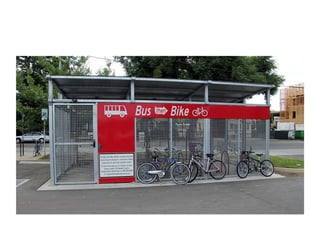
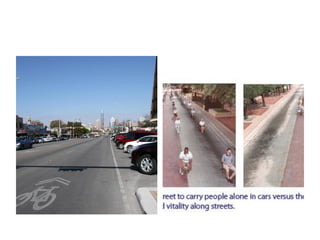
– Roadway design guidelines must fully reflect Complete Streets principles and should create a transportation hierarchy of walking, cycling, transit, and motorized vehicles, in that order 
–MPO funding scoring for projects should emphasize the active transportation modes
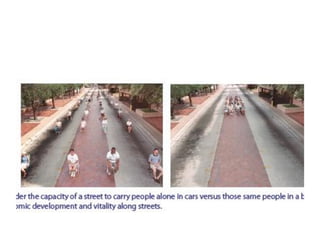
–Transportation plans and forecasts can not just focus on motor vehicle Level of Service and projections, but must also consider pedestrian, bicycle, and transit Levels of Service 
–Parking policies must require that parking “pay for itself”
Core Principles of Walkable Places and Lessons Learned in Fostering Them

Core Principles of Walkable Places and Lessons Learned in Fostering Them

  • 2.
    Making Walkability Happen:Practice wisdom, derived principles and ideas for action M. Katherine Kraft, Ph.D. September 9, 2014
  • 3.
    •Purpose: Use practicewisdom to identify actions that are essential for developing walkability •Interviews with seasoned practitioners with recognized successes (“tribal elders”) -Reflect on successful projects and identify factors that made them successful -Identify key characteristics of walkable communities •Interviewed to date Purpose and Methods Dan Burden Victor Dover Mark Fenton Pete Lagerway Lauren Marchetti John Moffat John Norquist Jeff Olson Lynn Richards Jennifer Toole Gary Toth Charlie Zegeer
  • 4.
    Developmental Phases tocreate walkability Getting Starting and Engaging Community Assessment Planning and Priorities Policies, Zoning and Design Guidelines Institutionalization, Incentives and Market-based
  • 5.
    Effective Approaches andTactics Getting Started Listen and Vision Develop Champion and Vision
  • 6.
    Walkability Principles -Guidelinesfor practice -Expedite outcomes -Integrate our work
  • 7.
    Defining Walkability •Theextent to which the built and social environment is safe, convenient, and attractive to people living, shopping, enjoying or spending time in an area on foot. •“We want to build a place that people love.” •“The places we love were not created as a solution to a traffic problem, they were created to bring joy to humanity.”
  • 8.
    What we learned– general observations Optimistic “The wind is behind our sails, our task is to figure out how to use it.” Top down, decide, announce and defend no longer works “..most successful community change agents are those that listen and inspire.”
  • 9.
    What we learned– ideas and actions Process: How you work with communities Project: Necessary features/elements Policies: How we sustain them
  • 10.
    How you workwith communities: Community Engagement, Cultivating Champions, Finding Vision keepers and Empowering Leaders “Community members are the true experts of where they live.”
  • 11.
    How you workwith communities? Listen and Frame Inclusive Process Vision and Values Leadership Matters No One Size Fits All
  • 12.
    Listen and Frame Listen to the community and respect the local community traditions and norms “Make no assumption about what the answer should be.” “Understand the real community concerns and frame the issue in a way that addresses these concerns.” “Get a good grounding in the social context of the place.”
  • 13.
    An Inclusive Processis Vital •“A multi-disciplinary team is useful, do not stay in one sector, broaden thinking.”
  • 14.
    Vision and Values Talk about the community vision and values – describe the place in 50 years and 100 years into the future “One should not do anything in a place if it doesn’t advance the community vision.” “Best advice is focus on community building and placemaking, then walkability and livability will follow.”
  • 15.
    Leadership Matters Empowera champion, Find a Vision Keeper “Make it somebody’s job.” “I think it really comes down to leadership. Leadership in two areas, one that represents political will, and a project champion – someone that feels strongly. Having that one person who lives, breathes this; is more important than political will. “
  • 16.
    No One SizeFits All No single policy solution – No silver bullet “ Each community has its own traditions, its own culture, its coming from a place already, ….Acknowledge that every single community is going to have a slightly different starting point..respect that and build off of that instead of trying to one size fits all. “
  • 17.
    Projects “Walkability doesnot appear to happen organically. The machinery of development and re- development will not take you there without a conscious effort.”
  • 18.
    Gateway Projects •Usetemporary and lighter, quicker, cheaper projects to show what is possible. •“We have a mismatch between how people really want to live and the rules and regulations that guide development and land use.”
  • 19.
    “Slow the thetraffic” “Make the streets beautiful” “Streets are places, return to their multiple purposes.” “It doesn’t really matter what the question is, the answer is a good street network and bringing the buildings to the street.”
  • 20.
    Policies and Incentives •Change the incentive structure so that we move away from auto dependency •The rules and the money have to steer the community toward healthier designs
  • 21.
    In the wordsof our elders… “It is not technical….we need the real essence of a social movement, to begin to function like a movement and support one another. Hundreds of advocacy groups pushing own little niche, try to create a broader movement.”
  • 22.
    Process Principles: BigIdea •Engage everyone possible, and find champions to push it forward, and eventually create collective community ownership of the vision and the process to get there.
  • 23.
    Project Principles: BigIdea •Mixed land use, an active transportation network, and human scale design that is appealing, safe, and universally accessible are central to walkable, livable places –Gateway Projects –Job descriptions
  • 24.
    Policy Principles: BigIdea •The rules and the money have to steer the community toward healthier designs –zoning ordinance must require and reward compact, mixed-use development – Roadway design guidelines must fully reflect Complete Streets principles and should create a transportation hierarchy of walking, cycling, transit, and motorized vehicles, in that order –MPO funding scoring for projects should emphasize the active transportation modes
  • 25.
    –Transportation plans andforecasts can not just focus on motor vehicle Level of Service and projections, but must also consider pedestrian, bicycle, and transit Levels of Service –Parking policies must require that parking “pay for itself”