David Kendrick, EdD
Carol Roehrs, PhD, RN, CNE
Li Wang, PhD
QQQQQQQQQQQQQQQQQQQQQQQQQQQQ


           Q
QM trainings
CETL workshops
Cohorts
Peer review certification
Faculty development presentations
Research
Publication & presentation – provost support
Faculty to Faculty
Self review


                 Informal review


Full QM certified review
School of Nursing
How to provide efficient and effective ways to
 implement the QM program at UNC?

Issues –
  -formal or informal review
  -number of QM faculty peer/staff experts
  -instructional design resources
  -time for faculty
  -experience teaching online
Experiences of participants learning the QM
 model and employing the rubric

Differences in course self-review scores versus
 different levels of QM training

Incorporating recommended changes into their
  courses without additional assistance with
  instructional design
Mixed methods

Descriptive and Qualitative design --
 to gather information about the faculty
 experience with:

     QM training
     Course review & UNC peer feedback
     Updating their courses
     QM formal review feedback
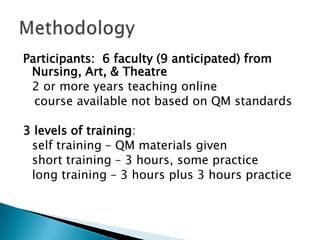
Participants: 6 faculty (9 anticipated) from
 Nursing, Art, & Theatre
 2 or more years teaching online
  course available not based on QM standards

3 levels of training:
 self training – QM materials given
 short training – 3 hours, some practice
 long training – 3 hours plus 3 hours practice
1.    Learn to use QM rubric for course
2.    Review one course (UNC peer review also)
3.    Receive feedback (self and informal review)
4.    Update the course
5.    Formal QM review of updated course
6.    Receive feedback from official review
    [No help from instructional designer until study
     over; if desired, got help until course passed
     official review & was certified]
Participant /   Group                 Possible influences
UNC reviewer
agreement
62.25%          Self training


72.5%           Short training        Most experienced online instructors


70%             Long training


                                Similarity of rubric scores between participant
                                and peer reviewer = learning
                                1 of 6 certified in study; 2 more after
                                study
   Majority of participants were able to
    assess their courses with 60-70%
    accuracy.

   Majority of participants were able to
    make needed changes sufficient to
    reach or approach level required by
    QM course certification.
Assessed by content evaluation of comments
 in 3 online discussion groups.

After QM training
After self-review of courses
After receiving UNC peer feedback
After updating their courses
After receiving QM official feedback
At the end of study
The rubric was very helpful since it “assisted
 the review process by identifying specific
 criteria expected within the course.”

The QM system is geared toward the typical 3
 credit didactic course that is online. There
 should be some other approach for courses
 that are quite different in nature.
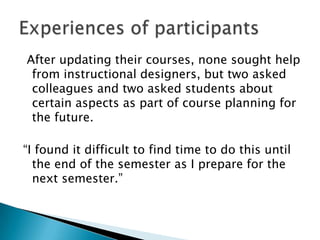
After updating their courses, none sought help
 from instructional designers, but two asked
 colleagues and two asked students about
 certain aspects as part of course planning for
 the future.

“I found it difficult to find time to do this until
  the end of the semester as I prepare for the
  next semester.”
Time


Support
David Kendrick
Center for the Enhancement of Teaching & Learning
          University of Northern Colorado
             David.kendrick@unco.edu
                  970-351-2888


           Carol Roehrs
        School of Nursing
 University of Northern Colorado
     carol.roehrs@unco.edu
         970-351-1699

2011.pk kendrick

  • 1.
    David Kendrick, EdD CarolRoehrs, PhD, RN, CNE Li Wang, PhD
  • 2.
  • 3.
    QM trainings CETL workshops Cohorts Peerreview certification Faculty development presentations Research Publication & presentation – provost support
  • 4.
  • 5.
    Self review Informal review Full QM certified review
  • 6.
  • 7.
    How to provideefficient and effective ways to implement the QM program at UNC? Issues – -formal or informal review -number of QM faculty peer/staff experts -instructional design resources -time for faculty -experience teaching online
  • 8.
    Experiences of participantslearning the QM model and employing the rubric Differences in course self-review scores versus different levels of QM training Incorporating recommended changes into their courses without additional assistance with instructional design
  • 9.
    Mixed methods Descriptive andQualitative design -- to gather information about the faculty experience with: QM training Course review & UNC peer feedback Updating their courses QM formal review feedback
  • 10.
    Participants: 6 faculty(9 anticipated) from Nursing, Art, & Theatre 2 or more years teaching online course available not based on QM standards 3 levels of training: self training – QM materials given short training – 3 hours, some practice long training – 3 hours plus 3 hours practice
  • 11.
    1. Learn to use QM rubric for course 2. Review one course (UNC peer review also) 3. Receive feedback (self and informal review) 4. Update the course 5. Formal QM review of updated course 6. Receive feedback from official review  [No help from instructional designer until study over; if desired, got help until course passed official review & was certified]
  • 12.
    Participant / Group Possible influences UNC reviewer agreement 62.25% Self training 72.5% Short training Most experienced online instructors 70% Long training Similarity of rubric scores between participant and peer reviewer = learning 1 of 6 certified in study; 2 more after study
  • 13.
    Majority of participants were able to assess their courses with 60-70% accuracy.  Majority of participants were able to make needed changes sufficient to reach or approach level required by QM course certification.
  • 14.
    Assessed by contentevaluation of comments in 3 online discussion groups. After QM training After self-review of courses After receiving UNC peer feedback After updating their courses After receiving QM official feedback At the end of study
  • 15.
    The rubric wasvery helpful since it “assisted the review process by identifying specific criteria expected within the course.” The QM system is geared toward the typical 3 credit didactic course that is online. There should be some other approach for courses that are quite different in nature.
  • 16.
    After updating theircourses, none sought help from instructional designers, but two asked colleagues and two asked students about certain aspects as part of course planning for the future. “I found it difficult to find time to do this until the end of the semester as I prepare for the next semester.”
  • 17.
  • 18.
    David Kendrick Center forthe Enhancement of Teaching & Learning University of Northern Colorado David.kendrick@unco.edu 970-351-2888 Carol Roehrs School of Nursing University of Northern Colorado carol.roehrs@unco.edu 970-351-1699