New Mexico State University
“Every course a quality course.”
A Professional Development Program for Faculty
Teaching Blended and Online
The Online Course Improvement Program (OCIP)
Program Background
• Partnership with Associated Students of New Mexico State
University and College of Extended Learning.
• OCIP began Fall 2009
• Program launch January 2010
• Started with 11 One Year Plus Fellows (1-Y+)
• Feb - June 2010 hosted 15 PD events
Program Goals
1. Assist faculty in enhanced web course design and delivery while
reducing student's textbook cost.
2. Provide faculty instructional design services with a framework that
supports peer interaction and best practices for online learning.
3. Facilitate participation in national digital content consortiums and
relevant communities.
4. Create and support a culture of quality for online courses taught at
NMSU.
5. Develop a scalable, customized professional development model.
Role of Quality Matters
 Quality Matters (QM) is the theoretical and organizational framework
for the program.
 Employs QM's continuous improvement approach.
 Professional development online course and monthly PD activities are
thematically organized around the QM Rubric Standards
• PD follows a predictable learning cycle.
• QM thematic alignment of PD events- LTOT, workshop and/or
webinar aligned to the 1Y+ PD course as much as possible
Sept Oct Nov Dec Jan Feb Mar Apr
QM1 QM2 QM3 QM4 QM5 QM6 QM7 QM8
Professional Development
Blended Approach
• Using the best delivery methodologies available to meet the learning objectives for the
professional development curriculum.
• Combination of synchronous, asynchronous, face-to-face, online, and hybrid offerings
• Adobe Connect
• Skype
• PBworks(wiki)
• Google Docs
• Program website
• Mentoring
• LMS Canvas
Multiple Benefits
• Supports a variety of services and resources available in different
formats.
• Allows for delivery of services beyond main campus faculty that
includes community college campus and non-NMSU participants.
• Increased faculty engagement due to flexibility of access
• Participants can receive professional development credit
• Recorded webinar archives and resources are also posted online
for anytime viewing.
Services
• Program services available to a global audience include:
▪ OCIP Resource Center (http://bit.ly/pQM0ZO)
▪ OCIP webinars
• Some program services are only available to NMSU faculty:
▪ Formal and informal course reviews with QM Rubric
▪ Let's Talk Online Teaching (LTOT) sessions
▪ Open Labs
▪ Workshops and Presentations
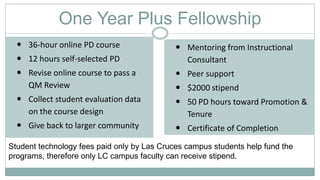
One Year Plus Fellowship
 36-hour online PD course
 12 hours self-selected PD
 Revise online course to pass a
QM Review
 Collect student evaluation data
on the course design
 Give back to larger community
 Mentoring from Instructional
Consultant
 Peer support
 $2000 stipend
 50 PD hours toward Promotion &
Tenure
 Certificate of Completion
Student technology fees paid only by Las Cruces campus students help fund the
programs, therefore only LC campus faculty can receive stipend.
83% Completion Rate for
1Yr+ Fellowship
Cohorts Applications
Received
Applicants
Accepted
Completions
Cohort 1
Year 2009-2010
(Began January)
17 15 8
Cohort 2
Year 2010-2011
19 15 12
Cohort 3
Year 2011-2012
20 15 12
Cohort 4
Year 2012-2013
30 22 18
Cohort 5
Year 2013-2014
27 14 11
Cohort 6
Year 2014-2015
24 15 14
Cohort 7
Year 2014-2015
18 12 TBA
83% 83%
100% 100% 100%
0
20
40
60
80
100
Met Learning
Outcomes
Engaged in
Program
PD was
Challenging
Relevance of
Content
Application of
Content
OCIP Self Evaluation of Participation
QM1- Getting Started
“A start here is so simple and helpful for students.” (Y3)
“QM1 changed my life. 150 students and only one question about
where to find something.” (Y5)
QM and Organization
“I think my class is so much better organized; it’s easier
to navigate for the students. They know what to do
from the very beginning.” (Y2)
“The OCIP Fellowship forced me to reexamine the way I
structure online, not with respect to technology, but
rather with access to and organization of content and
the various ways to foster student interaction and
engagement.” (Y4)
QM2 Learning Objectives
“Objectives started me getting to think about my past evaluations. I used to
think the student did not try hard enough. I now know it might be me.”
(Y3)
“For both my face to face class and online, I think the biggest impact has
been really paying attention to the learning objectives…then, aligning the
activities and the assessments… which I had not done at all before.” (Y6)
QM and Alignment
“In addition, my face-to-face classes are now benefiting from my new
understanding of course organization and alignment.” (Y1)
“I now ensure my activities are aligned to my learning objectives. I know now,
thanks to OCIP, how important it is to provide students the guidance on what they
were learning and why they were learning it through clearly stated objectives and
course goals.” (Y4)
Transfer to Face-to-face Courses
“The OCIP course changed how I teach both online and face-to-face….Having the
model of quality courses really helped me work through the steps and make
meaningful changes to my courses. All online and hybrid courses that I teach and
coordinate are influenced OCIP.” (Y1 & Y2)
“I don't have any true 100% face to face anymore. There are things in my face-to-
face classes that I realized are better done online as a result of the things that I
learned in OCIP.” (Y1)
“I feel more confident in my face-to-face teaching techniques due to what I have
learned in OCIP.” (Y4)
Faculty Student Perspective
“Being in the student role was eye-opening and strength of program.” (Y1)
“I’m clearly thinking more about course design from the students’ point of view”.
(Y4)
“I got a much stronger sense of students’ needs from an online course”. (Y4)
“...one thing that I’m doing more is taking the perspective of the student and
thinking about my course design from their perspective and how I need to
organize and spell things out and make things super clear.” (Y5)
What Students Are Saying
“The layout of this class is wonderful.”
“This class is the best online course I have ever
taken.”
“I liked the interaction between my peers and the
availability of course material.”
What We Have Learned
• Learning from student perspective
• Using Quality Matters framework
• Positive “ripple” effect
• Peer/Mentor support
• Culture of quality is a process
Then and Now: Growing OCIP
 Expanded program offerings with the
New2Online Program and Course Development
Summer Institute.
 Partnering with the College of Business and
Master of Social Work cohort focusing on online
degree programs.
Then and Now: Growing OCIP
• Annual IIQ Celebration
• QM System-wide Subscription and Group
• Peer Reviewer Group
• Looking to address PD for Online Teaching
• Insuring Quality - Provost’s Focus Expanding Online
Degree Programs
QUESTIONS??
Thank you for attending!

a_faculty_pd_program_ocip_nmsu.pptx

  • 1.
    New Mexico StateUniversity “Every course a quality course.” A Professional Development Program for Faculty Teaching Blended and Online The Online Course Improvement Program (OCIP)
  • 2.
    Program Background • Partnershipwith Associated Students of New Mexico State University and College of Extended Learning. • OCIP began Fall 2009 • Program launch January 2010 • Started with 11 One Year Plus Fellows (1-Y+) • Feb - June 2010 hosted 15 PD events
  • 3.
    Program Goals 1. Assistfaculty in enhanced web course design and delivery while reducing student's textbook cost. 2. Provide faculty instructional design services with a framework that supports peer interaction and best practices for online learning. 3. Facilitate participation in national digital content consortiums and relevant communities. 4. Create and support a culture of quality for online courses taught at NMSU. 5. Develop a scalable, customized professional development model.
  • 4.
    Role of QualityMatters  Quality Matters (QM) is the theoretical and organizational framework for the program.  Employs QM's continuous improvement approach.  Professional development online course and monthly PD activities are thematically organized around the QM Rubric Standards
  • 5.
    • PD followsa predictable learning cycle. • QM thematic alignment of PD events- LTOT, workshop and/or webinar aligned to the 1Y+ PD course as much as possible Sept Oct Nov Dec Jan Feb Mar Apr QM1 QM2 QM3 QM4 QM5 QM6 QM7 QM8 Professional Development
  • 6.
    Blended Approach • Usingthe best delivery methodologies available to meet the learning objectives for the professional development curriculum. • Combination of synchronous, asynchronous, face-to-face, online, and hybrid offerings • Adobe Connect • Skype • PBworks(wiki) • Google Docs • Program website • Mentoring • LMS Canvas
  • 7.
    Multiple Benefits • Supportsa variety of services and resources available in different formats. • Allows for delivery of services beyond main campus faculty that includes community college campus and non-NMSU participants. • Increased faculty engagement due to flexibility of access • Participants can receive professional development credit • Recorded webinar archives and resources are also posted online for anytime viewing.
  • 8.
    Services • Program servicesavailable to a global audience include: ▪ OCIP Resource Center (http://bit.ly/pQM0ZO) ▪ OCIP webinars • Some program services are only available to NMSU faculty: ▪ Formal and informal course reviews with QM Rubric ▪ Let's Talk Online Teaching (LTOT) sessions ▪ Open Labs ▪ Workshops and Presentations
  • 9.
    One Year PlusFellowship  36-hour online PD course  12 hours self-selected PD  Revise online course to pass a QM Review  Collect student evaluation data on the course design  Give back to larger community  Mentoring from Instructional Consultant  Peer support  $2000 stipend  50 PD hours toward Promotion & Tenure  Certificate of Completion Student technology fees paid only by Las Cruces campus students help fund the programs, therefore only LC campus faculty can receive stipend.
  • 10.
    83% Completion Ratefor 1Yr+ Fellowship Cohorts Applications Received Applicants Accepted Completions Cohort 1 Year 2009-2010 (Began January) 17 15 8 Cohort 2 Year 2010-2011 19 15 12 Cohort 3 Year 2011-2012 20 15 12 Cohort 4 Year 2012-2013 30 22 18 Cohort 5 Year 2013-2014 27 14 11 Cohort 6 Year 2014-2015 24 15 14 Cohort 7 Year 2014-2015 18 12 TBA
  • 11.
    83% 83% 100% 100%100% 0 20 40 60 80 100 Met Learning Outcomes Engaged in Program PD was Challenging Relevance of Content Application of Content OCIP Self Evaluation of Participation
  • 12.
    QM1- Getting Started “Astart here is so simple and helpful for students.” (Y3) “QM1 changed my life. 150 students and only one question about where to find something.” (Y5)
  • 13.
    QM and Organization “Ithink my class is so much better organized; it’s easier to navigate for the students. They know what to do from the very beginning.” (Y2) “The OCIP Fellowship forced me to reexamine the way I structure online, not with respect to technology, but rather with access to and organization of content and the various ways to foster student interaction and engagement.” (Y4)
  • 14.
    QM2 Learning Objectives “Objectivesstarted me getting to think about my past evaluations. I used to think the student did not try hard enough. I now know it might be me.” (Y3) “For both my face to face class and online, I think the biggest impact has been really paying attention to the learning objectives…then, aligning the activities and the assessments… which I had not done at all before.” (Y6)
  • 15.
    QM and Alignment “Inaddition, my face-to-face classes are now benefiting from my new understanding of course organization and alignment.” (Y1) “I now ensure my activities are aligned to my learning objectives. I know now, thanks to OCIP, how important it is to provide students the guidance on what they were learning and why they were learning it through clearly stated objectives and course goals.” (Y4)
  • 16.
    Transfer to Face-to-faceCourses “The OCIP course changed how I teach both online and face-to-face….Having the model of quality courses really helped me work through the steps and make meaningful changes to my courses. All online and hybrid courses that I teach and coordinate are influenced OCIP.” (Y1 & Y2) “I don't have any true 100% face to face anymore. There are things in my face-to- face classes that I realized are better done online as a result of the things that I learned in OCIP.” (Y1) “I feel more confident in my face-to-face teaching techniques due to what I have learned in OCIP.” (Y4)
  • 17.
    Faculty Student Perspective “Beingin the student role was eye-opening and strength of program.” (Y1) “I’m clearly thinking more about course design from the students’ point of view”. (Y4) “I got a much stronger sense of students’ needs from an online course”. (Y4) “...one thing that I’m doing more is taking the perspective of the student and thinking about my course design from their perspective and how I need to organize and spell things out and make things super clear.” (Y5)
  • 18.
    What Students AreSaying “The layout of this class is wonderful.” “This class is the best online course I have ever taken.” “I liked the interaction between my peers and the availability of course material.”
  • 19.
    What We HaveLearned • Learning from student perspective • Using Quality Matters framework • Positive “ripple” effect • Peer/Mentor support • Culture of quality is a process
  • 20.
    Then and Now:Growing OCIP  Expanded program offerings with the New2Online Program and Course Development Summer Institute.  Partnering with the College of Business and Master of Social Work cohort focusing on online degree programs.
  • 21.
    Then and Now:Growing OCIP • Annual IIQ Celebration • QM System-wide Subscription and Group • Peer Reviewer Group • Looking to address PD for Online Teaching • Insuring Quality - Provost’s Focus Expanding Online Degree Programs
  • 22.