1. Kinematics
1. Introduction to Physics
2. Scalars & vectors
3. Position & displacement
4. Velocity
5. Aceleration
6. Linear motions
7. Circular motion
© www.shutterstock.com
© Patricio Gómez Lesarri
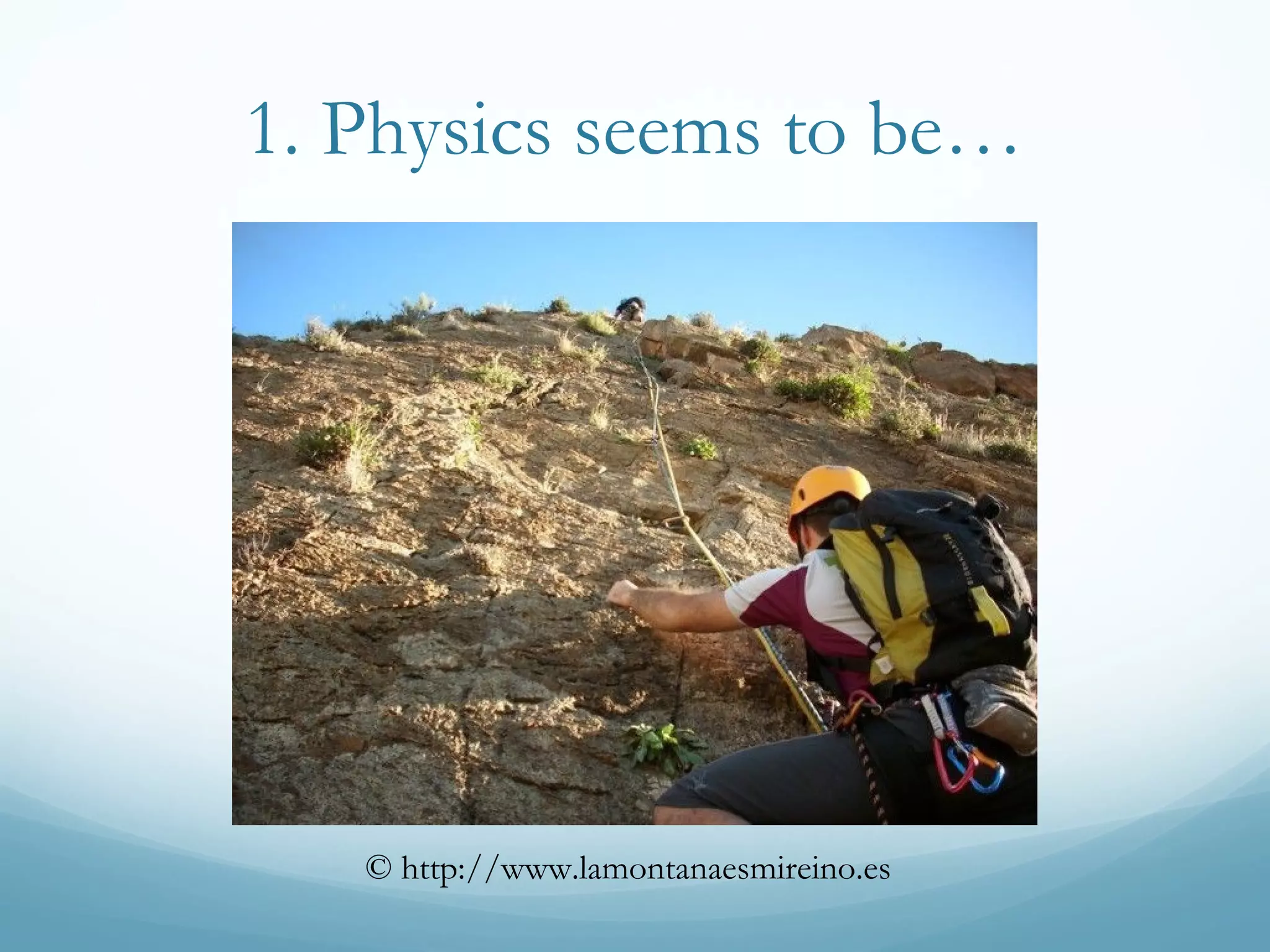
1. Physics seems to be…
© http://www.lamontanaesmireino.es
… but it could be…
© http://www.fuentedesomave.com
1. Physics
 Same laws explain 42 orders og
magnitude
 http://apod.nasa.gov/apod/ap12031
2.html
2. Physical quantity
o Definition
o Uncertainty: objects
cannot be measured as
accurate as you want
o “A measurement
without knowing its
uncertainty is
meaningless” W.
Lewin
© www.sc.ehu.es
2. SI de unidades
Powers of ten
Fundamental quantities
Derived quantities
© https://en.wikipedia.org/
2. Scalars & vectors
 Scalar: fully determined by its
magnitude
 Vector: determined by its
magnitude and direction
© www.maplesoft.com
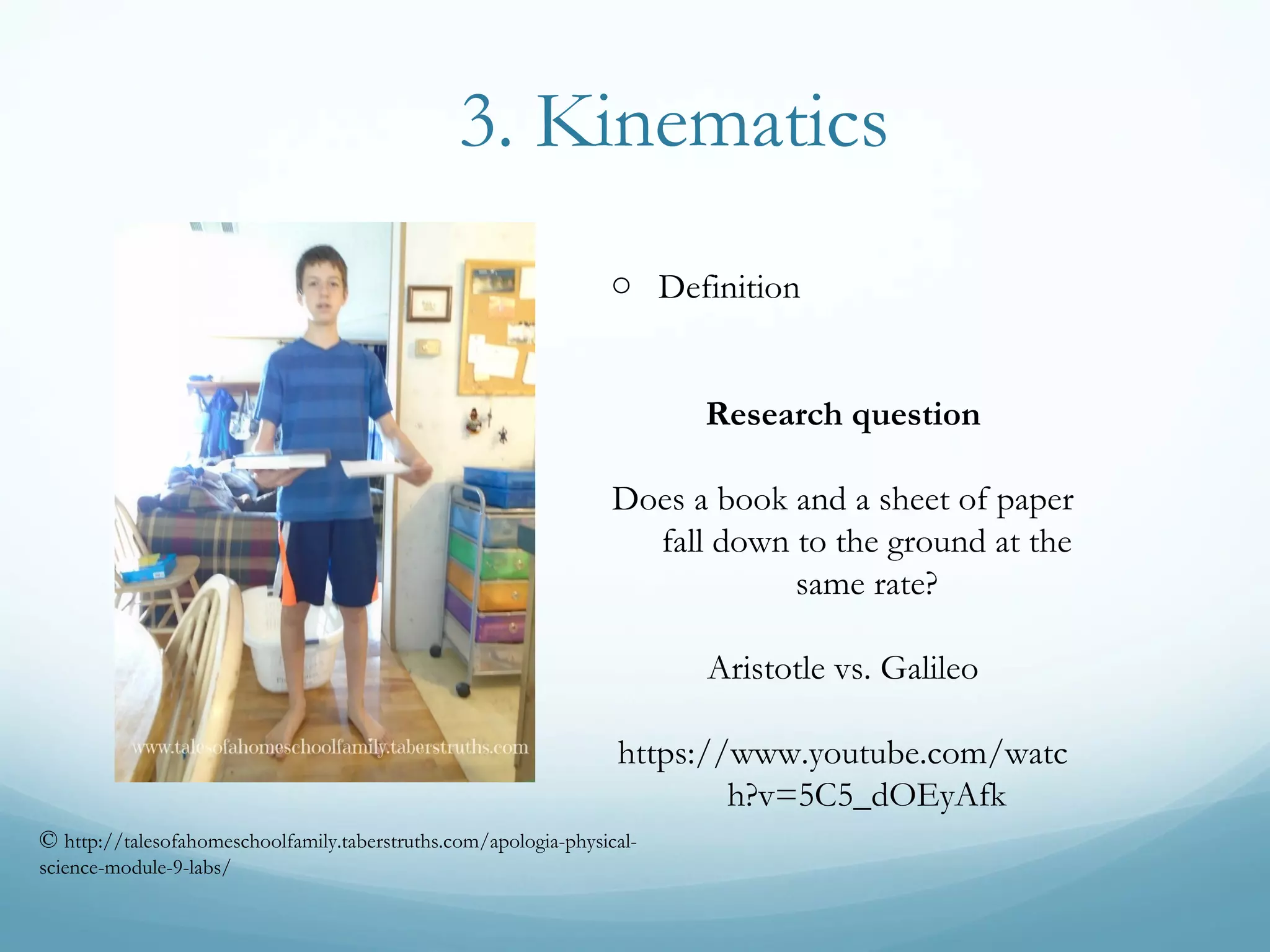
3. Kinematics
o Definition
Research question
Does a book and a sheet of paper
fall down to the ground at the
same rate?
Aristotle vs. Galileo
https://www.youtube.com/watc
h?v=5C5_dOEyAfk
© http://talesofahomeschoolfamily.taberstruths.com/apologia-physical-
science-module-9-labs/
3. Position & displacement
Where are you?
Frame of reference
Position: distance from the origin of our
frame of reference to our placement GPS (m)
Displacement: distance from our initial
position to the final one (m)
Distance vs. displacement
© vignette.wikia.nocookie.net
© demo.webassign.net/
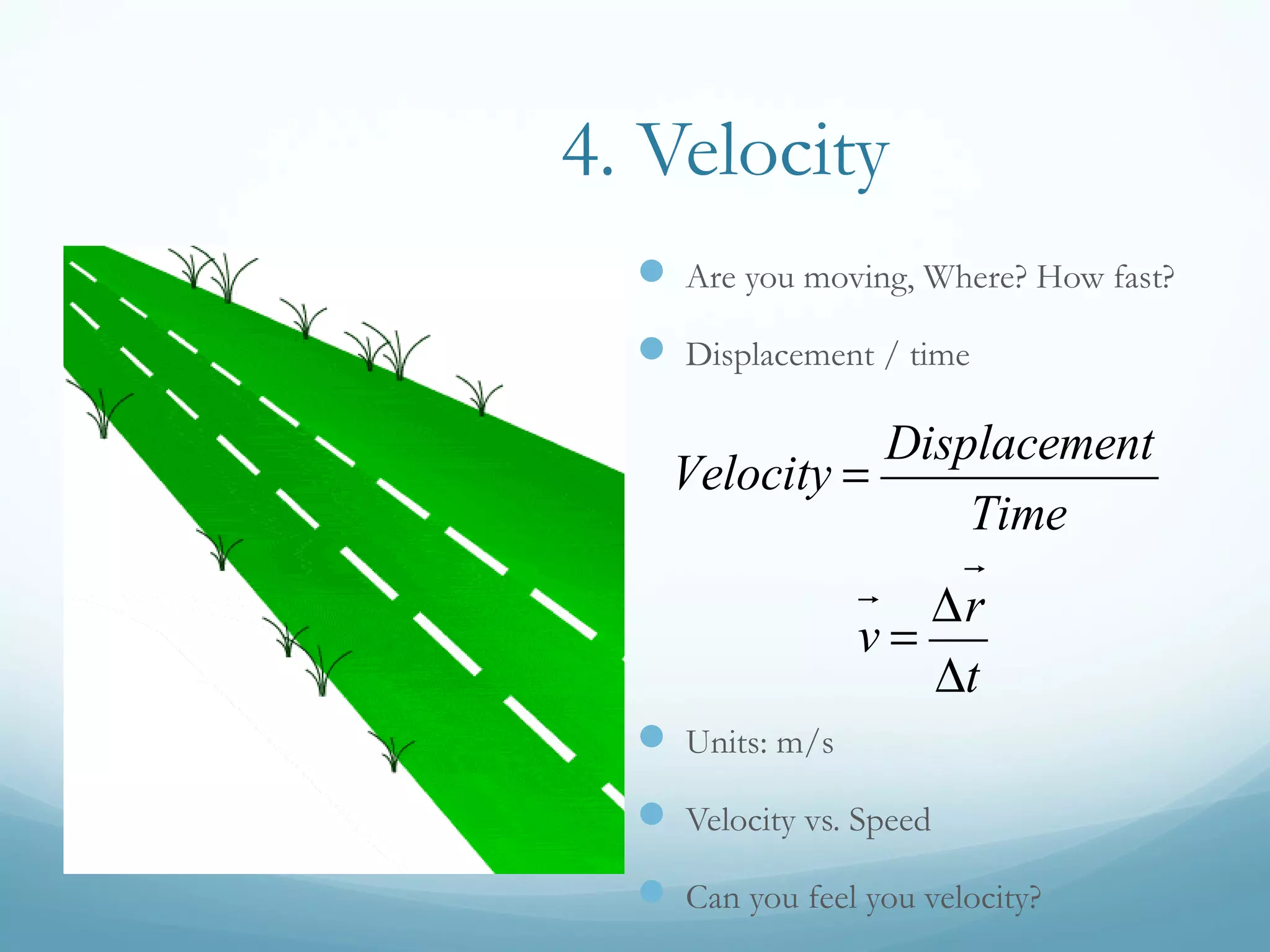
4. Velocity
 Are you moving, Where? How fast?
 Displacement / time
 Units: m/s
 Velocity vs. Speed
 Can you feel you velocity?
v

=
∆r

∆t
Velocity =
Displacement
Time
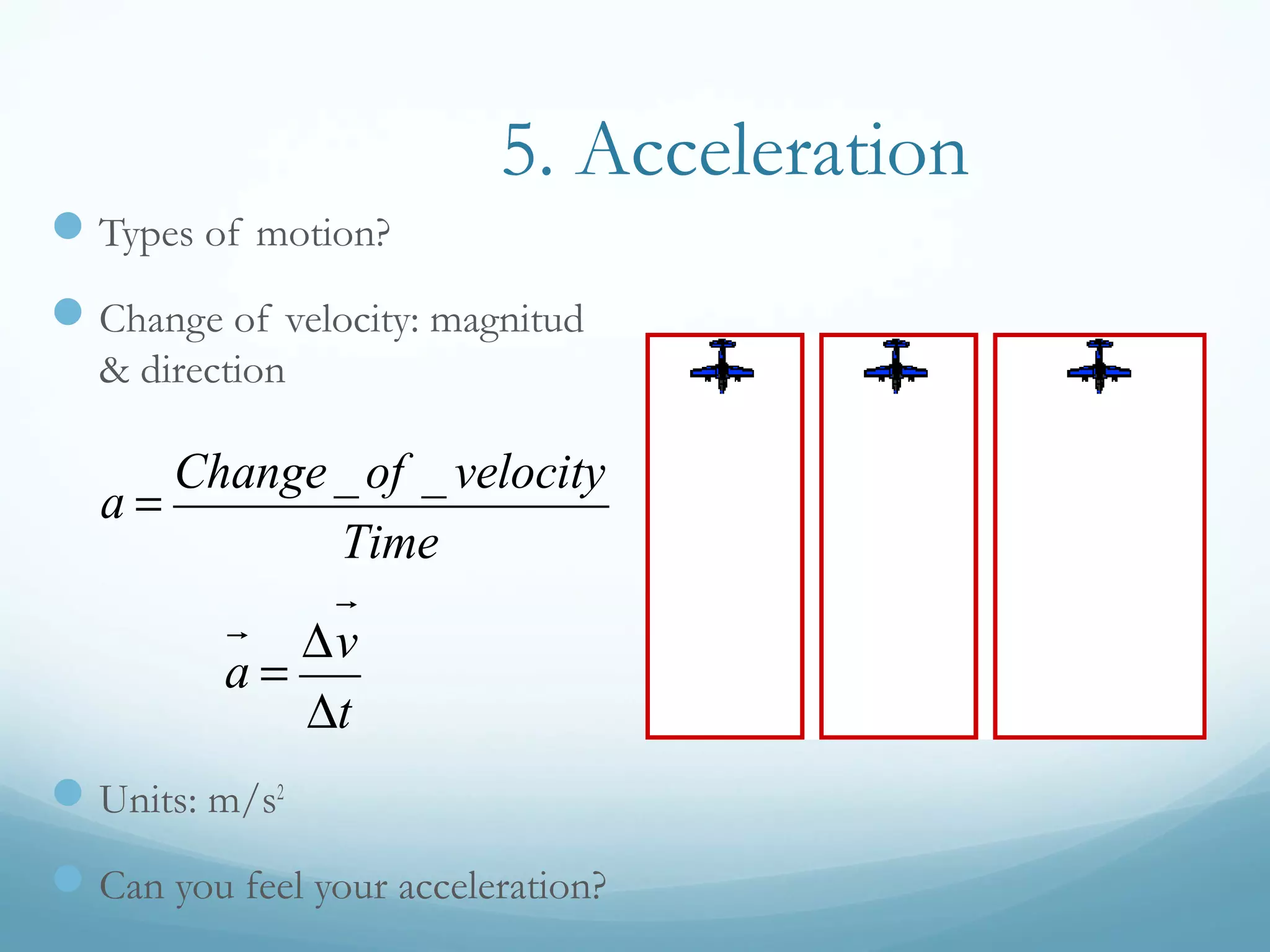
5. Acceleration
Types of motion?
Change of velocity: magnitud
& direction
Units: m/s2
Can you feel your acceleration?
a =
Change_of _ velocity
Time
a

=
∆v

∆t
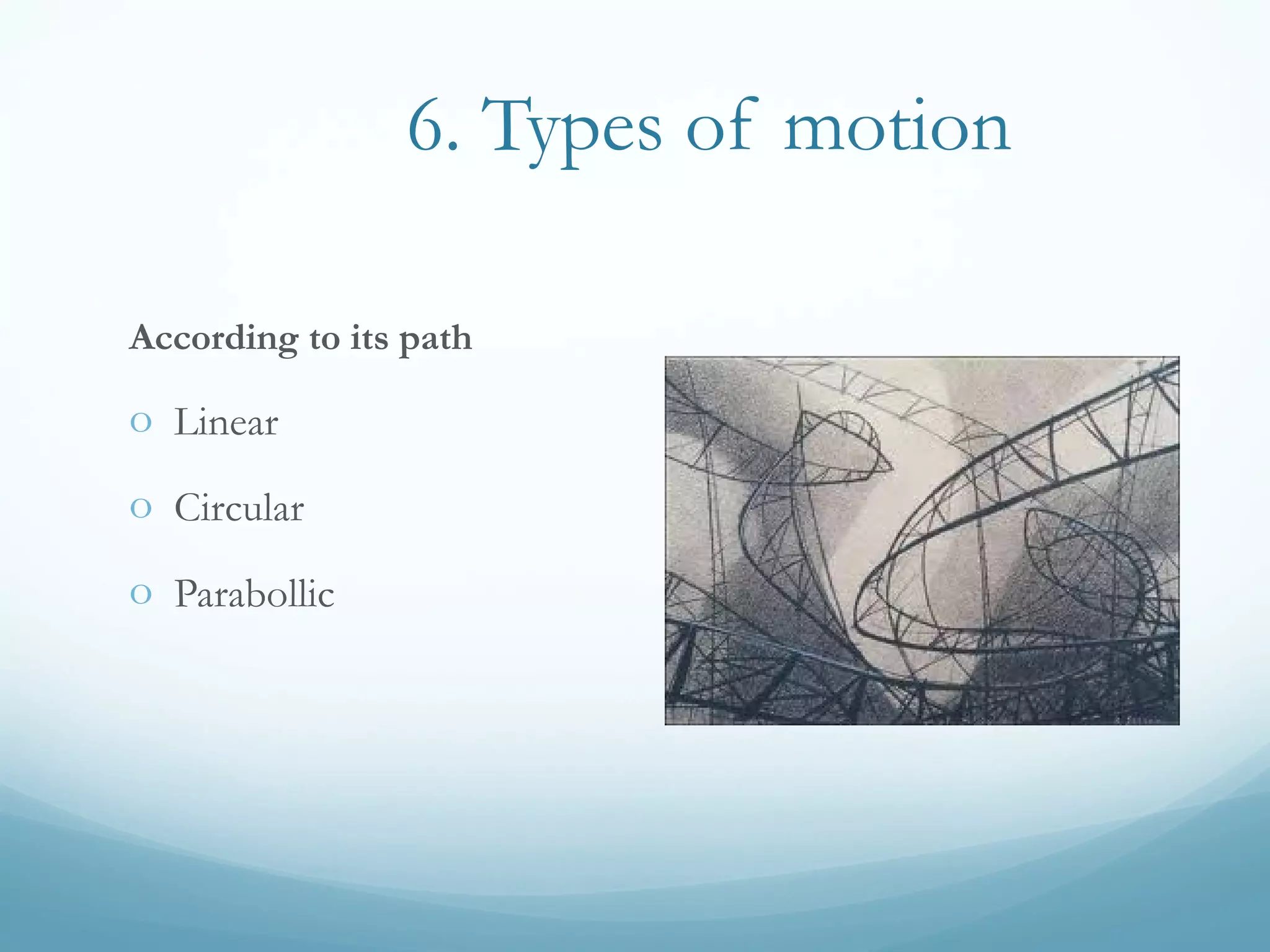
6. Types of motion
According to its path
o Linear
o Circular
o Parabollic
6. Uniform Linear Motion
No acceleration
o Same direction
o Same speed
Equation
s = so
+ v.t
© www.physicsclassroom.com
6. Linear Uniformly Accelerated Motion
o Same direction
o Uniform change of speed
Equations
s = so
+ vo
.t + ½ a.t2
v = vo
+ a.t
v2
= vo
2
+ 2.a.s
© www.physicsclassroom.com
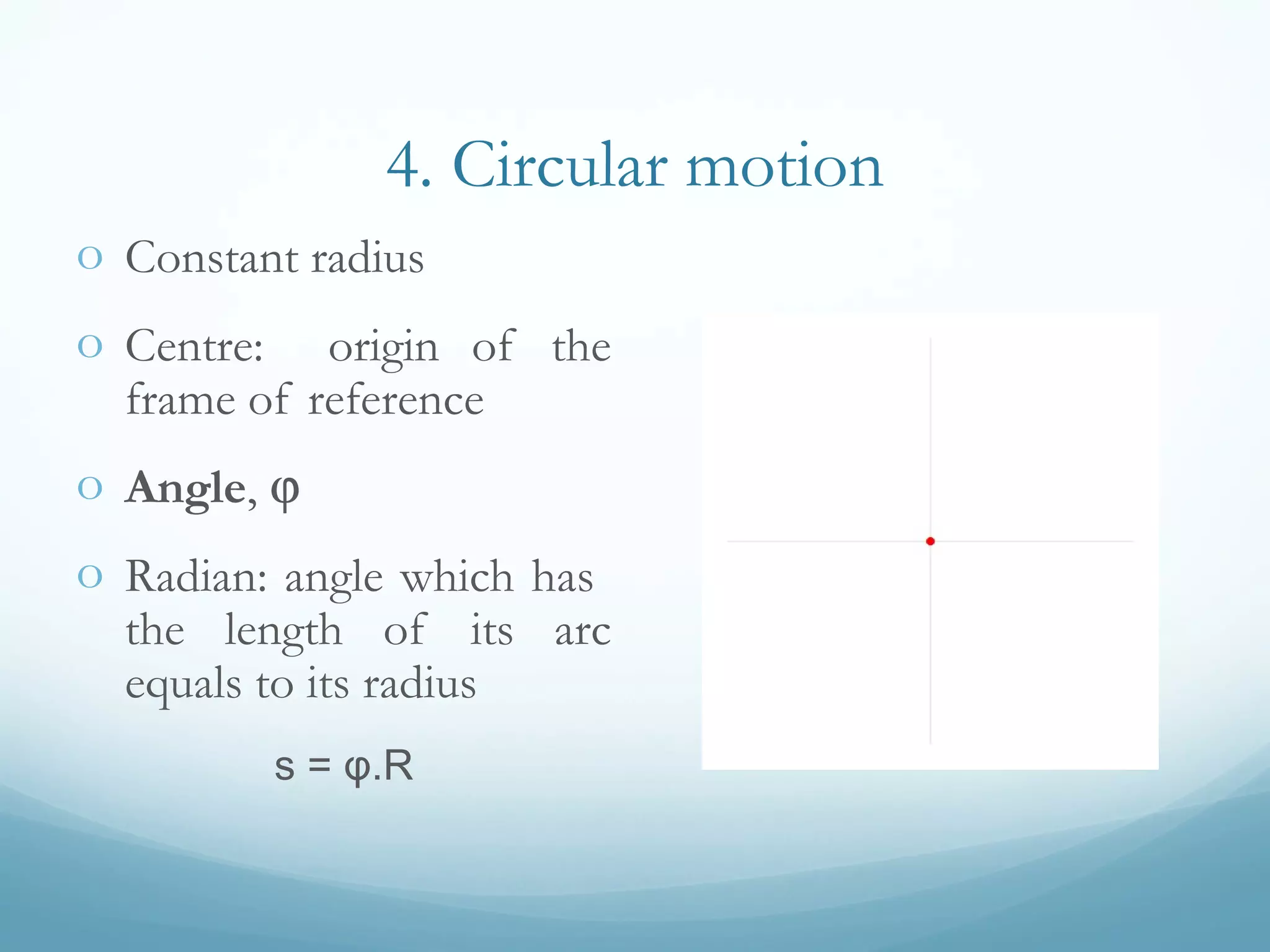
4. Circular motion
o Constant radius
o Centre: origin of the
frame of reference
o Angle, ϕ
o Radian: angle which has
the length of its arc
equals to its radius
s = φ.R
4. Uniform circular motion
o Same rate, covering the
same angle per unit of time
o Angular speed
d
dt
ϕ
ω =
ϕ = ϕo +ω.t
s =ϕ.R v = ω.R
7. Period & frequency
o Period: time taken for a body to complete a whole
circumpherence T (seconds)
o Frequency: number of revolutions per unit of time.
Recyprocal of period. ν Hertz (Hz) equivale a s-1
.
2
2
T
π
ω πν= =
1
T
ν
=
7. Circular motion
 Change of direction: centripetal
acceleration.
 Video
1https://www.youtube.com/watch?
t=69&v=UbjV9Ny-Tk4
 Video 2:
https://www.youtube.com/watch?
v=WkYh1qEuf-I
 Roundabout:
https://www.youtube.com/watch?
v=gLP0WSG-vas
 Rotation of a glass of water:
https://www.youtube.com/watch?
v=L6-kn2tB-9E
© http://fisica.laguia2000.com
2
n
v
a
R
=
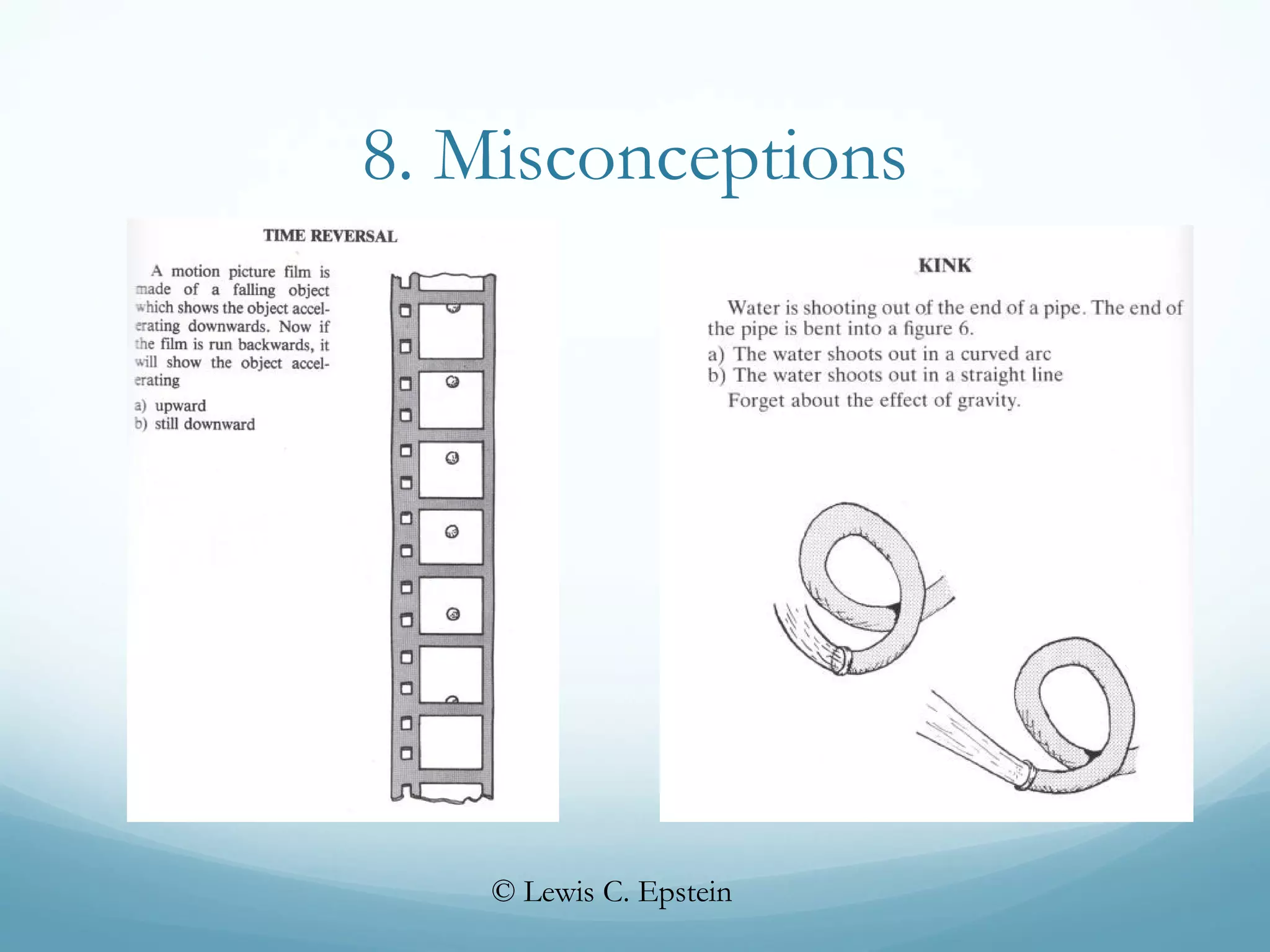
8. Misconceptions
© Lewis C. Epstein
8. Misconceptions
© Lewis C. Epstein

1kinematics

  • 1.
    1. Kinematics 1. Introductionto Physics 2. Scalars & vectors 3. Position & displacement 4. Velocity 5. Aceleration 6. Linear motions 7. Circular motion © www.shutterstock.com © Patricio Gómez Lesarri
  • 2.
    1. Physics seemsto be… © http://www.lamontanaesmireino.es
  • 3.
    … but itcould be… © http://www.fuentedesomave.com
  • 4.
    1. Physics  Samelaws explain 42 orders og magnitude  http://apod.nasa.gov/apod/ap12031 2.html
  • 5.
    2. Physical quantity oDefinition o Uncertainty: objects cannot be measured as accurate as you want o “A measurement without knowing its uncertainty is meaningless” W. Lewin © www.sc.ehu.es
  • 6.
    2. SI deunidades Powers of ten Fundamental quantities Derived quantities © https://en.wikipedia.org/
  • 7.
    2. Scalars &vectors  Scalar: fully determined by its magnitude  Vector: determined by its magnitude and direction © www.maplesoft.com
  • 8.
    3. Kinematics o Definition Researchquestion Does a book and a sheet of paper fall down to the ground at the same rate? Aristotle vs. Galileo https://www.youtube.com/watc h?v=5C5_dOEyAfk © http://talesofahomeschoolfamily.taberstruths.com/apologia-physical- science-module-9-labs/
  • 9.
    3. Position &displacement Where are you? Frame of reference Position: distance from the origin of our frame of reference to our placement GPS (m) Displacement: distance from our initial position to the final one (m) Distance vs. displacement © vignette.wikia.nocookie.net © demo.webassign.net/
  • 10.
    4. Velocity  Areyou moving, Where? How fast?  Displacement / time  Units: m/s  Velocity vs. Speed  Can you feel you velocity? v  = ∆r  ∆t Velocity = Displacement Time
  • 11.
    5. Acceleration Types ofmotion? Change of velocity: magnitud & direction Units: m/s2 Can you feel your acceleration? a = Change_of _ velocity Time a  = ∆v  ∆t
  • 12.
    6. Types ofmotion According to its path o Linear o Circular o Parabollic
  • 13.
    6. Uniform LinearMotion No acceleration o Same direction o Same speed Equation s = so + v.t © www.physicsclassroom.com
  • 14.
    6. Linear UniformlyAccelerated Motion o Same direction o Uniform change of speed Equations s = so + vo .t + ½ a.t2 v = vo + a.t v2 = vo 2 + 2.a.s © www.physicsclassroom.com
  • 15.
    4. Circular motion oConstant radius o Centre: origin of the frame of reference o Angle, ϕ o Radian: angle which has the length of its arc equals to its radius s = φ.R
  • 16.
    4. Uniform circularmotion o Same rate, covering the same angle per unit of time o Angular speed d dt ϕ ω = ϕ = ϕo +ω.t s =ϕ.R v = ω.R
  • 17.
    7. Period &frequency o Period: time taken for a body to complete a whole circumpherence T (seconds) o Frequency: number of revolutions per unit of time. Recyprocal of period. ν Hertz (Hz) equivale a s-1 . 2 2 T π ω πν= = 1 T ν =
  • 18.
    7. Circular motion Change of direction: centripetal acceleration.  Video 1https://www.youtube.com/watch? t=69&v=UbjV9Ny-Tk4  Video 2: https://www.youtube.com/watch? v=WkYh1qEuf-I  Roundabout: https://www.youtube.com/watch? v=gLP0WSG-vas  Rotation of a glass of water: https://www.youtube.com/watch? v=L6-kn2tB-9E © http://fisica.laguia2000.com 2 n v a R =
  • 19.
  • 20.