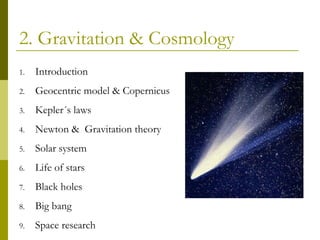
2. Gravitation & Cosmology
1. Introduction
2. Geocentric model & Copernicus
3. Kepler´s laws
4. Newton & Gravitation theory
5. Solar system
6. Life of stars
7. Black holes
8. Big bang
9. Space research
1. Introduction
o Motion of stars
o Motion of planets: retrogradation
1. Greek Astronomy
Eudoxus of Cnidus
( IV BC)
o Spheres
o Central position of Earth
1. Greek Astronomy
Ptolemy (II AC)
o Almagest
o Retrogradation
o Epicycles & deferents
1. Greek Astronomy
2. Heliocentric model
Copernicus (1473-1543)
o 1514: “Comentariolus”
heliocentruc
o 1543: “De revolutionibus
orbis coelestium”
2. Heliocentric model
Galileo (1564-1642)
o 1609: Telescope
o 1610: “Sidereus nuncius”
o 1616: Banned by Inquisition
o 1632: “Diálogos sobre los dos
sistemas”
o 1633: Emprisoned
3. Kepler´s laws
32
.rkT =
Johannes Kepler
(1571-1630)
o T. Brahe assistant
o First Law: orbits law
o Second Law: areal velocity
o Third Law:
4. Gravitation theory
Isaac Newton (1643-1733)
“Two bodies are attracted by a
force proportional to their masses
and inversely proportional to the
squared distance between them”
2
.
.
M m
F G
r
=
4. Gravitation consequences
o Gravity force
o Planets motions (Kepler´s laws)
o First Unification of Physics
o Tides prediction
o New planets prediction
5. Solar system
o Sun
o 8 planets & 172 bodies
o Ecliptic
o Orbits
5. Inner planets
5. Outer planets
5. Other bodies
o Dwarf planets: Ceres,
Pluto & Charon, Eris,
Makemake, Haumea
o Comets
o Asteroids, asteroid belt,
Kuiper belt
6. Stellar evolution
o Nebula: gas cloud (mainly
hydrogen)
o Gravitational contraction.
o Protostar. Fusion reaction
6. Stellar evolution
o Red giant , white dwarf
o Red supergiant,
supernova, black holes
7. Black holes
o Body with such a gravitational attraction, that light
cannot be spread
o Huge mass and small size
8. Cosmology
Science which studies
formation, evolution and
state of the universe
8. Edwin Hubble (1889-1953)
o Redshift of star spectra
o Hubble´s law (1929)
V = Ho. d
o Expansion of the
universe
8. Big bang
o Primeval atom hypothesis
(G. LeMaitre, 1927)
o Radiation stage: photons,
quarks, leptons
o Inflation: fast expansion
o Hadrons formation
o Nucleosinthesis
o Stars & galaxies formation
8. Experimental evidence
o Redshift. Edwin Hubble (1924)
o Microwave background radiation
A. Penzias, R. Wilson (1964).
Nobel prize 1978
o Helium and hydrogen composition
8. Dark matter
o No visible matter, identified
by gravitational measurements
© http://www-sk.icrr.u-tokyo.ac.jp
8. Dark energy
o Type of energy , opposite to
gravitational attraction,
required to explain the
accelerated expansion of the
universe
9. Space research
o 1957: First satellite: Sputnik
o 1961: Firs astronaut: Yuri
Gagarin
o 1965: Mariner programme
to Venus
o 1969: Apolo XI on the
Moon
o 1976: Vicking I & II to
Mars
o 1980: Voyager I & II Solar
system
9. Satellites
o Geostationary, polar...
o Communications,
metheorological
o Geolocation: GPS, Galileo
o Research: COBE, Soho,
Hubble

3gravitation

  • 1.
    2. Gravitation &Cosmology 1. Introduction 2. Geocentric model & Copernicus 3. Kepler´s laws 4. Newton & Gravitation theory 5. Solar system 6. Life of stars 7. Black holes 8. Big bang 9. Space research
  • 2.
    1. Introduction o Motionof stars o Motion of planets: retrogradation
  • 3.
    1. Greek Astronomy Eudoxusof Cnidus ( IV BC) o Spheres o Central position of Earth
  • 4.
    1. Greek Astronomy Ptolemy(II AC) o Almagest o Retrogradation o Epicycles & deferents
  • 5.
  • 6.
    2. Heliocentric model Copernicus(1473-1543) o 1514: “Comentariolus” heliocentruc o 1543: “De revolutionibus orbis coelestium”
  • 7.
    2. Heliocentric model Galileo(1564-1642) o 1609: Telescope o 1610: “Sidereus nuncius” o 1616: Banned by Inquisition o 1632: “Diálogos sobre los dos sistemas” o 1633: Emprisoned
  • 8.
    3. Kepler´s laws 32 .rkT= Johannes Kepler (1571-1630) o T. Brahe assistant o First Law: orbits law o Second Law: areal velocity o Third Law:
  • 9.
    4. Gravitation theory IsaacNewton (1643-1733) “Two bodies are attracted by a force proportional to their masses and inversely proportional to the squared distance between them” 2 . . M m F G r =
  • 10.
    4. Gravitation consequences oGravity force o Planets motions (Kepler´s laws) o First Unification of Physics o Tides prediction o New planets prediction
  • 11.
    5. Solar system oSun o 8 planets & 172 bodies o Ecliptic o Orbits
  • 12.
  • 13.
  • 14.
    5. Other bodies oDwarf planets: Ceres, Pluto & Charon, Eris, Makemake, Haumea o Comets o Asteroids, asteroid belt, Kuiper belt
  • 15.
    6. Stellar evolution oNebula: gas cloud (mainly hydrogen) o Gravitational contraction. o Protostar. Fusion reaction
  • 16.
    6. Stellar evolution oRed giant , white dwarf o Red supergiant, supernova, black holes
  • 17.
    7. Black holes oBody with such a gravitational attraction, that light cannot be spread o Huge mass and small size
  • 18.
    8. Cosmology Science whichstudies formation, evolution and state of the universe
  • 19.
    8. Edwin Hubble(1889-1953) o Redshift of star spectra o Hubble´s law (1929) V = Ho. d o Expansion of the universe
  • 20.
    8. Big bang oPrimeval atom hypothesis (G. LeMaitre, 1927) o Radiation stage: photons, quarks, leptons o Inflation: fast expansion o Hadrons formation o Nucleosinthesis o Stars & galaxies formation
  • 21.
    8. Experimental evidence oRedshift. Edwin Hubble (1924) o Microwave background radiation A. Penzias, R. Wilson (1964). Nobel prize 1978 o Helium and hydrogen composition
  • 22.
    8. Dark matter oNo visible matter, identified by gravitational measurements © http://www-sk.icrr.u-tokyo.ac.jp
  • 23.
    8. Dark energy oType of energy , opposite to gravitational attraction, required to explain the accelerated expansion of the universe
  • 24.
    9. Space research o1957: First satellite: Sputnik o 1961: Firs astronaut: Yuri Gagarin o 1965: Mariner programme to Venus o 1969: Apolo XI on the Moon o 1976: Vicking I & II to Mars o 1980: Voyager I & II Solar system
  • 25.
    9. Satellites o Geostationary,polar... o Communications, metheorological o Geolocation: GPS, Galileo o Research: COBE, Soho, Hubble