Done By: Stanley Yuan Dae Koon Lim Joel Koh James Wong
Agenda How Photo-voltaic (PV) cells work How Solar PV cells are made Solar PV Applications Efficiencies Economics Facts & Trends Advantages vs. Disadvantages
What are Solar Cells Thin wafers of silicon Similar to computer chips Much bigger Much cheaper Silicon is in abundance Made from sand Non-toxic, safe Light carries energy into cell Cells convert sunlight energy into electric current, however they do not store energy Sunlight is its source of “fuel”
Definitions Cells- basic photovoltaic device that is the building block for PV modules Module- a group of PV cells connected in series and encapsulated in an environmentally protective laminate Panel- a group of modules that is the basic building block of a PV array Array- a group of panels that comprises the complete PV generating unit
Some interesting facts on Solar The sunlight that reaches the earth is about 200,000 times the total electrical energy generated by humans everyday The first working solar cell was invented by Charles Fritts in 1883 and operated at 1% efficiency The word photovoltaic, the term for a solar cell, comes from the Greek word for light, which is combined with the name Volta, the last name of the scientist after whom the measurement unit volt is named after. All together the word photovoltaic means electricity from light Every minute, enough solar energy reaches the Earth to meet global energy demands for a year!
How it works Solar energy is harnessed and used through a process using photovoltaic cells. These cells or panels are usually made up of two types of silicon Sunlight is made up of negative and positive layers, which creates an electrical field When the protons hit the surface of the solar cell, the electrons from the light rays are freed, pass to the bottom of the cell and flows through to power appliances The flow of electrons is also known as electricity
How it works To complete the PV module, several layers are added. A - Cover Glass B - Antireflective Coating C - Contact Grid D - N-type Silicon E - P-type Silicon F - Back Contact Here is an example of how a home can be wired to run on Solar PV power
Cross section of a PV cell
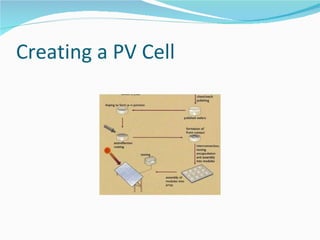
How Solar Cells are made Materials Crystalline Silicon Gallium Arsenide (which are more expensive) Steps Grown into large single-crystal  ingots Sawed into thin wafers 2 wafers are bonded together (p-n junction) Wafers grouped into panels or arrays
Creating Silicon wafers
Creating a PV Cell
Solar PV system Cells Building block of PV system Typically generates 1.5-3 watts of power Modules 36 cells connected together have enough voltage to charge 12 volt batteries and run pumps and motors Aka Panels Made up of multiple cells Arrays Made up of multiple modules Costs about $5-$6/watt However, a typical system costs about $8/watt
Types of mounted arrays Standoff-Mounted Arrays Rack-and Pole-Mounted Arrays California Patio Cover
Solar PV Applications Spacecraft
Solar PV Applications Residential
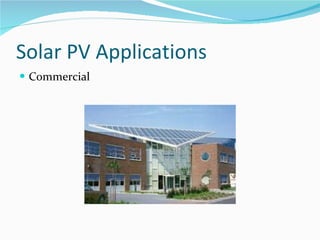
Solar PV Applications Commercial
Large Scale Solar Power  PV-generated electricity still costs more than electricity generated by conventional plants in most places, and regulatory agencies require most utilities to supply the lowest-cost electricity. Output dependent on weather Mostly used in Southwest Solar furnace project in California Dish collector focuses heat to drive generator 150 MW solar power facility in California – the world’s largest
Solar Cell Efficiencies Typical module efficiencies ~12% Screen printed multi-crystalline solar cells Efficiency range ~6-30% 6% for amorphous silicon-based PV cells 20% for best commercial cells 30% for multi junction research cells Typical power of 120W/m2
Solar Panel Efficiency ~1 kW/m2 (sunny day) ~20% efficiency – 200W/m2 electricity Daylight and weather in northern latitudes 100 W/m2 in winter; 250 W/m2 in summer Or 20 to 50 W/m2 from solar cells Value of electricity generated at $0.08/hWh $0.10/m2/day or $83,000 km2/day
World’s Largest PV Solar Plants
World Solar Power Production
Current energy demand in the world Around 0.1% of primary energy demand  Solar electric installations totalled 200MW in 1999, 280MW in 2000 and 340MW by 2001 and 427MW in 2002. 
The growth rate is among the fastest in energy sources.  Most of the growth is driven by the growth in Germany, Japan, and USA.  From IEA
Advantages Non polluting: no noise, harmful or unpleasant emmisions or smells Reliable: most solar panels have a 25 year warranty and even longer life expectancy Solar modules over their lifetime produce more power per gram of material than nuclear power but without the problem of large volumes of environmentally hazardous material Solar panels produce more power within 5 years than the power consumed in their production Solar power is a renewable energy source. It cannot be used up thus is effective in reducing the usage of fossil fuels Save more money in the long run
Disadvantages We are unable to utilize the power of the sun at night or cloudy days Solar panels are expensive to buy and hard to set up
Production and Disposal Concerns Production - Worker Health and Safety ・ Amorphous silicon -Silane, an explosive gas, is used in making amorphous silicon. Toxic gases such as phosphine and diborane are used to electronically "dope" the material. 
 ・ Copper indium diselenide -Toxic hydrogen selenide is sometimes used to make copper indium diselenide, a thin-film PV material. 
 ・ Cadmium telluride -Cadmium and its compounds, which are used in making cadmium telluride PV cells, can be toxic at high levels of lung exposure.  Disposal ・ Module lifespan typically around 30 years ・ Some material classified as hazardous waste ・ Recycling process not yet perfected
Why not? Expensive for Consumers and Producers Two years output needed to just equal the amount of energy used in production Large land areas needed to produce energy on a power plant scale Limited by intermittence.  Stable grids require traditional generating facilities or costly backup to ensure uninterrupted supply. Due to PV efficiency and low market demand, technological progression is slow.  Environmental concerns in production and disposal Lack of subsidies and tax credits (In the U.S.)
Cost Analysis US retail module price = ~$5/W (2005) Installation cost = ~$3.50/W (2005) Cost for a 4 kW system= ~$17,000 (2006) Without subsidies Typical payback period is ~24 years (warranty)
Cost Precise calculation of solar electricity costs depend on the location and the cost of finance available to the owner of the solar installation With the best PV electricity prices (in the sunniest locations) approaching 30 cents/kWh and the highest tariffs now exceeding 20 cents/kWh Funding programs that bridge this gap are causing rapid growth in sales of solar PV, especially in Japan and Germany. 
House of the Future? This zero-energy house in the Netherlands has 30m2 of PV panels for power generation and 12m2 of solar collectors for water and space heating
Solar PV Dependencies Location, Location, Location! Latitude Lower latitudes are better than higher latitudes Weather Clear sunny skies are better than cloudy skies However the temperature is not important Direction solar arrays face South is preferred, east and west are acceptable However, solar panels are more effective if they are arranged like trees Absence of shade Trees, flatirons, etc
Emerging PV Technologies Cells made from gallium arsenide Molecular beam epitaxy 35% more efficiency has been observed Non-silicon panels using carbon nanotubes Quantum dots embedded in special plastics May achieve 30% efficiencies in time Polymer (organic plastics) solar cells Suffer rapid degration to date
Thin film Solar Cells Use less than 1% of silicon required to make wafers Silicon vapour deposited on a glass substrate Amorphous crystalline structure Many small crystals vs. one large crystal
New roof integrated PV products Flexible PV Cells
Thank YOU!!

Solar panels

  • 1.
    Done By: StanleyYuan Dae Koon Lim Joel Koh James Wong
  • 2.
    Agenda How Photo-voltaic(PV) cells work How Solar PV cells are made Solar PV Applications Efficiencies Economics Facts & Trends Advantages vs. Disadvantages
  • 3.
    What are SolarCells Thin wafers of silicon Similar to computer chips Much bigger Much cheaper Silicon is in abundance Made from sand Non-toxic, safe Light carries energy into cell Cells convert sunlight energy into electric current, however they do not store energy Sunlight is its source of “fuel”
  • 4.
    Definitions Cells- basicphotovoltaic device that is the building block for PV modules Module- a group of PV cells connected in series and encapsulated in an environmentally protective laminate Panel- a group of modules that is the basic building block of a PV array Array- a group of panels that comprises the complete PV generating unit
  • 5.
    Some interesting factson Solar The sunlight that reaches the earth is about 200,000 times the total electrical energy generated by humans everyday The first working solar cell was invented by Charles Fritts in 1883 and operated at 1% efficiency The word photovoltaic, the term for a solar cell, comes from the Greek word for light, which is combined with the name Volta, the last name of the scientist after whom the measurement unit volt is named after. All together the word photovoltaic means electricity from light Every minute, enough solar energy reaches the Earth to meet global energy demands for a year!
  • 6.
    How it worksSolar energy is harnessed and used through a process using photovoltaic cells. These cells or panels are usually made up of two types of silicon Sunlight is made up of negative and positive layers, which creates an electrical field When the protons hit the surface of the solar cell, the electrons from the light rays are freed, pass to the bottom of the cell and flows through to power appliances The flow of electrons is also known as electricity
  • 7.
    How it worksTo complete the PV module, several layers are added. A - Cover Glass B - Antireflective Coating C - Contact Grid D - N-type Silicon E - P-type Silicon F - Back Contact Here is an example of how a home can be wired to run on Solar PV power
  • 8.
  • 9.
    How Solar Cellsare made Materials Crystalline Silicon Gallium Arsenide (which are more expensive) Steps Grown into large single-crystal ingots Sawed into thin wafers 2 wafers are bonded together (p-n junction) Wafers grouped into panels or arrays
  • 10.
  • 11.
  • 12.
    Solar PV systemCells Building block of PV system Typically generates 1.5-3 watts of power Modules 36 cells connected together have enough voltage to charge 12 volt batteries and run pumps and motors Aka Panels Made up of multiple cells Arrays Made up of multiple modules Costs about $5-$6/watt However, a typical system costs about $8/watt
  • 13.
    Types of mountedarrays Standoff-Mounted Arrays Rack-and Pole-Mounted Arrays California Patio Cover
  • 14.
  • 15.
  • 16.
  • 17.
    Large Scale SolarPower PV-generated electricity still costs more than electricity generated by conventional plants in most places, and regulatory agencies require most utilities to supply the lowest-cost electricity. Output dependent on weather Mostly used in Southwest Solar furnace project in California Dish collector focuses heat to drive generator 150 MW solar power facility in California – the world’s largest
  • 18.
    Solar Cell EfficienciesTypical module efficiencies ~12% Screen printed multi-crystalline solar cells Efficiency range ~6-30% 6% for amorphous silicon-based PV cells 20% for best commercial cells 30% for multi junction research cells Typical power of 120W/m2
  • 19.
    Solar Panel Efficiency~1 kW/m2 (sunny day) ~20% efficiency – 200W/m2 electricity Daylight and weather in northern latitudes 100 W/m2 in winter; 250 W/m2 in summer Or 20 to 50 W/m2 from solar cells Value of electricity generated at $0.08/hWh $0.10/m2/day or $83,000 km2/day
  • 20.
  • 21.
  • 22.
    Current energy demandin the world Around 0.1% of primary energy demand Solar electric installations totalled 200MW in 1999, 280MW in 2000 and 340MW by 2001 and 427MW in 2002. 
  • 23.
    The growth rateis among the fastest in energy sources. Most of the growth is driven by the growth in Germany, Japan, and USA. From IEA
  • 24.
    Advantages Non polluting:no noise, harmful or unpleasant emmisions or smells Reliable: most solar panels have a 25 year warranty and even longer life expectancy Solar modules over their lifetime produce more power per gram of material than nuclear power but without the problem of large volumes of environmentally hazardous material Solar panels produce more power within 5 years than the power consumed in their production Solar power is a renewable energy source. It cannot be used up thus is effective in reducing the usage of fossil fuels Save more money in the long run
  • 25.
    Disadvantages We areunable to utilize the power of the sun at night or cloudy days Solar panels are expensive to buy and hard to set up
  • 26.
    Production and DisposalConcerns Production - Worker Health and Safety ・ Amorphous silicon -Silane, an explosive gas, is used in making amorphous silicon. Toxic gases such as phosphine and diborane are used to electronically "dope" the material. 
 ・ Copper indium diselenide -Toxic hydrogen selenide is sometimes used to make copper indium diselenide, a thin-film PV material. 
 ・ Cadmium telluride -Cadmium and its compounds, which are used in making cadmium telluride PV cells, can be toxic at high levels of lung exposure. Disposal ・ Module lifespan typically around 30 years ・ Some material classified as hazardous waste ・ Recycling process not yet perfected
  • 27.
    Why not? Expensivefor Consumers and Producers Two years output needed to just equal the amount of energy used in production Large land areas needed to produce energy on a power plant scale Limited by intermittence. Stable grids require traditional generating facilities or costly backup to ensure uninterrupted supply. Due to PV efficiency and low market demand, technological progression is slow. Environmental concerns in production and disposal Lack of subsidies and tax credits (In the U.S.)
  • 28.
    Cost Analysis USretail module price = ~$5/W (2005) Installation cost = ~$3.50/W (2005) Cost for a 4 kW system= ~$17,000 (2006) Without subsidies Typical payback period is ~24 years (warranty)
  • 29.
    Cost Precise calculationof solar electricity costs depend on the location and the cost of finance available to the owner of the solar installation With the best PV electricity prices (in the sunniest locations) approaching 30 cents/kWh and the highest tariffs now exceeding 20 cents/kWh Funding programs that bridge this gap are causing rapid growth in sales of solar PV, especially in Japan and Germany. 
  • 30.
    House of theFuture? This zero-energy house in the Netherlands has 30m2 of PV panels for power generation and 12m2 of solar collectors for water and space heating
  • 31.
    Solar PV DependenciesLocation, Location, Location! Latitude Lower latitudes are better than higher latitudes Weather Clear sunny skies are better than cloudy skies However the temperature is not important Direction solar arrays face South is preferred, east and west are acceptable However, solar panels are more effective if they are arranged like trees Absence of shade Trees, flatirons, etc
  • 32.
    Emerging PV TechnologiesCells made from gallium arsenide Molecular beam epitaxy 35% more efficiency has been observed Non-silicon panels using carbon nanotubes Quantum dots embedded in special plastics May achieve 30% efficiencies in time Polymer (organic plastics) solar cells Suffer rapid degration to date
  • 33.
    Thin film SolarCells Use less than 1% of silicon required to make wafers Silicon vapour deposited on a glass substrate Amorphous crystalline structure Many small crystals vs. one large crystal
  • 34.
    New roof integratedPV products Flexible PV Cells
  • 35.