Meaning, Objectives and Importance,
Communication Process
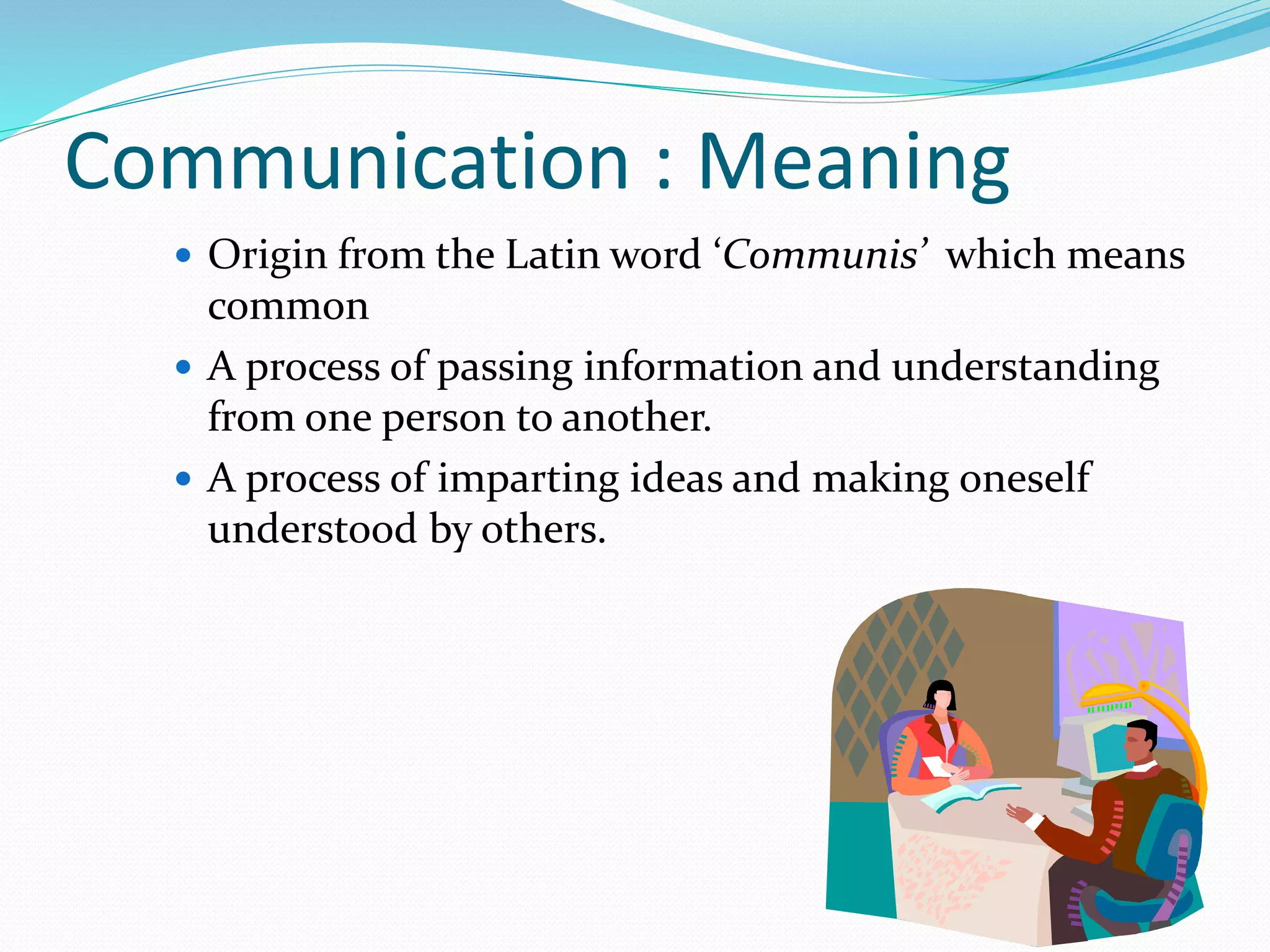
Communication : Meaning
 Origin from the Latin word ‘Communis’ which means
common
 A process of passing information and understanding
from one person to another.
 A process of imparting ideas and making oneself
understood by others.
Communication in organisations
Internal External
Formal Planned communication
among insiders ( letters,
reports, memos, email) that
follows the company’s chain
of command.
Planned communication with
outsiders( letters, reports,
memos, speeches, websites and
news release)
Informal Casual communication
among employees ( e-mail,
face-to-face conversations
and phone calls) that do not
follow company’s chain of
command.
Casual communication with
suppliers, customers, investors
and other outsiders(face-to-face
conversations, e-mail and phone
calls )
Objectives
Receiver Understanding
Receiver Response
Favourable relationship
Organisational Goodwill
Importance of Communication
 Coordination & Co-operation
 Smooth Working
 Effective Decision-Making
 Managerial Efficiency & Productivity
 Effective Leadership
Communication Process
 Phases of the Communication Process:
 Transmission phase in which information is
shared by two or more people.
 Feedback phase in which a common
understanding is assured.
Communication Process Contd..
 Sender – person wishing to share information with
some other person
 Message – what information to communicate
 Encoding – sender translates the idea into message
into and decides the form ( words, facial expressions,
tone, style ) depending upon the idea and audience
involved
 Medium – the communication channel through
which an encoded message is transmitted to a receiver
 Face-to-face exchange
 Telephonic conversation
 Letters , memos and e-mails
Communication Process Contd..
 Receiver – person or group for which the message is
intended
 Decoding - critical point where the receiver
interprets and tries to make sense of the message
 Feedback - Receiver decides what message to send to
the original sender.
 It is initiated by the receiver
 It eliminates misunderstandings
 It ensures that messages are correctly interpreted
Communication Process Contd..
 Noise – refers to anything that hampers any stage of
the communication process

1.communication

  • 1.
    Meaning, Objectives andImportance, Communication Process
  • 2.
    Communication : Meaning Origin from the Latin word ‘Communis’ which means common  A process of passing information and understanding from one person to another.  A process of imparting ideas and making oneself understood by others.
  • 3.
    Communication in organisations InternalExternal Formal Planned communication among insiders ( letters, reports, memos, email) that follows the company’s chain of command. Planned communication with outsiders( letters, reports, memos, speeches, websites and news release) Informal Casual communication among employees ( e-mail, face-to-face conversations and phone calls) that do not follow company’s chain of command. Casual communication with suppliers, customers, investors and other outsiders(face-to-face conversations, e-mail and phone calls )
  • 4.
  • 5.
    Importance of Communication Coordination & Co-operation  Smooth Working  Effective Decision-Making  Managerial Efficiency & Productivity  Effective Leadership
  • 6.
    Communication Process  Phasesof the Communication Process:  Transmission phase in which information is shared by two or more people.  Feedback phase in which a common understanding is assured.
  • 8.
    Communication Process Contd.. Sender – person wishing to share information with some other person  Message – what information to communicate  Encoding – sender translates the idea into message into and decides the form ( words, facial expressions, tone, style ) depending upon the idea and audience involved  Medium – the communication channel through which an encoded message is transmitted to a receiver  Face-to-face exchange  Telephonic conversation  Letters , memos and e-mails
  • 9.
    Communication Process Contd.. Receiver – person or group for which the message is intended  Decoding - critical point where the receiver interprets and tries to make sense of the message  Feedback - Receiver decides what message to send to the original sender.  It is initiated by the receiver  It eliminates misunderstandings  It ensures that messages are correctly interpreted
  • 10.
    Communication Process Contd.. Noise – refers to anything that hampers any stage of the communication process