Communication
skills
By Aditi Shah
Laxmi Institute of Tech.
Branch : Electronics and
communication.
Topic 1 : Process and Parts
of communication.
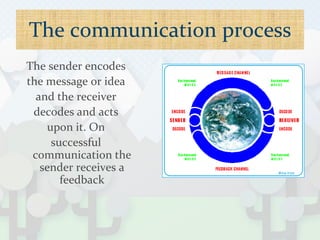
The communication process
The sender encodes
the message or idea
and the receiver
decodes and acts
upon it. On
successful
communication the
sender receives a
feedback
Modes of communication
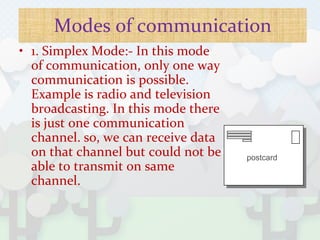
• 1. Simplex Mode:- In this mode
of communication, only one way
communication is possible.
Example is radio and television
broadcasting. In this mode there
is just one communication
channel. so, we can receive data
on that channel but could not be
able to transmit on same
channel.
postcard
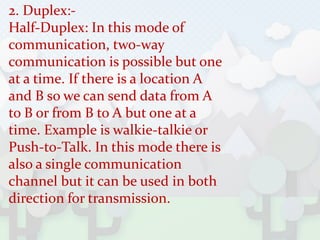
2. Duplex:-
Half-Duplex: In this mode of
communication, two-way
communication is possible but one
at a time. If there is a location A
and B so we can send data from A
to B or from B to A but one at a
time. Example is walkie-talkie or
Push-to-Talk. In this mode there is
also a single communication
channel but it can be used in both
direction for transmission.
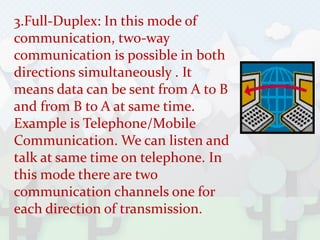
3.Full-Duplex: In this mode of
communication, two-way
communication is possible in both
directions simultaneously . It
means data can be sent from A to B
and from B to A at same time.
Example is Telephone/Mobile
Communication. We can listen and
talk at same time on telephone. In
this mode there are two
communication channels one for
each direction of transmission.
Essentials for effective
communication
a) Common communication environment
b) Cooperation between receiver and sender
c) Selection of proper channel
d) Correct encoding and decoding
e) Desired response
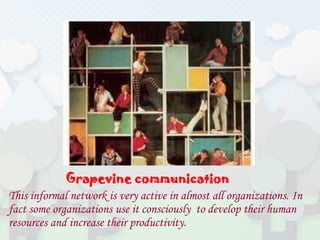
Grapevine communication
This informal network is very active in almost all organizations. In
fact some organizations use it consciously to develop their human
resources and increase their productivity.
General and technical
communication
General
communication
 Informal
 Not for specific purpose
and people
 No set of pattern
 Technical words and
graphics are not used
 Contains a general
message
Technical
communication
 Formal in style and
approach
 Always for specific
purpose and people
 Follows a set pattern
 Uses graphics and
technical words
 Contains a technical
message
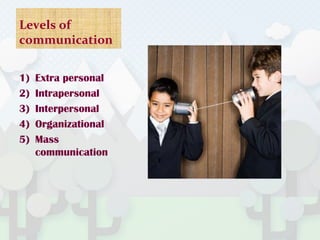
Levels of
communication
1) Extra personal
2) Intrapersonal
3) Interpersonal
4) Organizational
5) Mass
communication
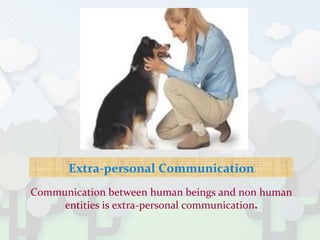
Extra-personal Communication
Communication between human beings and non human
entities is extra-personal communication.
the animals who live with you are more than
child substitutes, more than "pets" kept for our
amusement or our personal companionship.
All animals are, in fact, sentient beings -
conscious and intelligent, with life purposes
and goals. They are aware of themselves and of
their situations. They are capable of feeling the
entire range of emotions we so arrogantly have
labeled "human". They make life choices. They
often express unconditional love for the
humans who are part of their families.
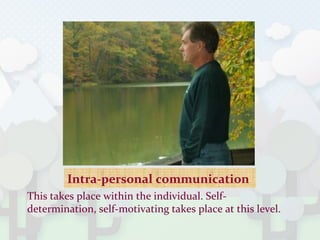
Intra-personal communication
This takes place within the individual. Self-
determination, self-motivating takes place at this level.
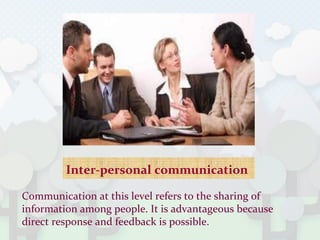
Inter-personal communication
Communication at this level refers to the sharing of
information among people. It is advantageous because
direct response and feedback is possible.
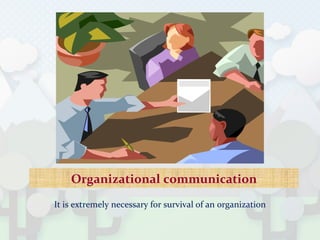
Organizational communication
It is extremely necessary for survival of an organization
Mass Communication
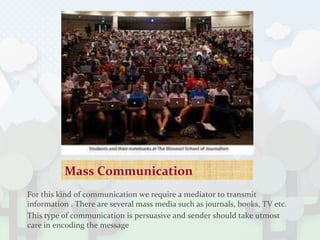
For this kind of communication we require a mediator to transmit
information . There are several mass media such as journals, books, TV etc.
This type of communication is persuasive and sender should take utmost
care in encoding the message
Barriers to effective communication
1)Material or Physical Barrier: This is the main hurdle or barrier in
effective communication at workplace. This barrier in the company
comprises large working area which is physically estranged from each
other. Other things due to which physical barrier rises may be the
organizational environment or noise coming from back.
2)Linguistic Barrier: Different language and vocabulary is another barrier
in communication. Language is vague in nature and its words are
symbols which hardly represent only one meaning. It is the language
only that plays vital role in every field so it should be kept in mind
that proper language and words are used. In today’s world if you send
your message to another person in his language then it will be more
effective and in this way the communication can be made effectively.
3)Cultural Barrier: This communication barrier arise when two people of
any organization belongs to different culture, place or religion. There are
many other factors of cultural barrier like age, social position, mental
difference or thinking behavior, economic status, political views, values
and rules, ethics or standards, motives and priorities.
4)Emotional barrier:
a)Sudden reactions: Many times while communicating, a listener makes comment
or criticizes the message sender without waiting for the sentence to be completed.
b)Unfair assumptions: Never make wrong assumptions of the message as it
creates great confusion.
c)Being overconfident about self knowledge.
It is important to remove barrier to effective communication in order to streamline
and smoothen the whole process.
Presented by: Aditi K. Shah
But this is not the end……… to be continued
with newer section: Types of interviews
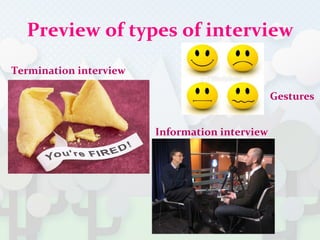
Preview of types of interview
Termination interview
Information interview
Gestures

The most important skill-Communication

  • 1.
  • 2.
    Laxmi Institute ofTech. Branch : Electronics and communication. Topic 1 : Process and Parts of communication.
  • 3.
    The communication process Thesender encodes the message or idea and the receiver decodes and acts upon it. On successful communication the sender receives a feedback
  • 4.
    Modes of communication •1. Simplex Mode:- In this mode of communication, only one way communication is possible. Example is radio and television broadcasting. In this mode there is just one communication channel. so, we can receive data on that channel but could not be able to transmit on same channel. postcard
  • 5.
    2. Duplex:- Half-Duplex: Inthis mode of communication, two-way communication is possible but one at a time. If there is a location A and B so we can send data from A to B or from B to A but one at a time. Example is walkie-talkie or Push-to-Talk. In this mode there is also a single communication channel but it can be used in both direction for transmission.
  • 6.
    3.Full-Duplex: In thismode of communication, two-way communication is possible in both directions simultaneously . It means data can be sent from A to B and from B to A at same time. Example is Telephone/Mobile Communication. We can listen and talk at same time on telephone. In this mode there are two communication channels one for each direction of transmission.
  • 7.
    Essentials for effective communication a)Common communication environment b) Cooperation between receiver and sender c) Selection of proper channel d) Correct encoding and decoding e) Desired response
  • 8.
    Grapevine communication This informalnetwork is very active in almost all organizations. In fact some organizations use it consciously to develop their human resources and increase their productivity.
  • 9.
    General and technical communication General communication Informal  Not for specific purpose and people  No set of pattern  Technical words and graphics are not used  Contains a general message Technical communication  Formal in style and approach  Always for specific purpose and people  Follows a set pattern  Uses graphics and technical words  Contains a technical message
  • 10.
    Levels of communication 1) Extrapersonal 2) Intrapersonal 3) Interpersonal 4) Organizational 5) Mass communication
  • 11.
    Extra-personal Communication Communication betweenhuman beings and non human entities is extra-personal communication.
  • 12.
    the animals wholive with you are more than child substitutes, more than "pets" kept for our amusement or our personal companionship. All animals are, in fact, sentient beings - conscious and intelligent, with life purposes and goals. They are aware of themselves and of their situations. They are capable of feeling the entire range of emotions we so arrogantly have labeled "human". They make life choices. They often express unconditional love for the humans who are part of their families.
  • 13.
    Intra-personal communication This takesplace within the individual. Self- determination, self-motivating takes place at this level.
  • 14.
    Inter-personal communication Communication atthis level refers to the sharing of information among people. It is advantageous because direct response and feedback is possible.
  • 15.
    Organizational communication It isextremely necessary for survival of an organization
  • 16.
    Mass Communication For thiskind of communication we require a mediator to transmit information . There are several mass media such as journals, books, TV etc. This type of communication is persuasive and sender should take utmost care in encoding the message
  • 17.
    Barriers to effectivecommunication 1)Material or Physical Barrier: This is the main hurdle or barrier in effective communication at workplace. This barrier in the company comprises large working area which is physically estranged from each other. Other things due to which physical barrier rises may be the organizational environment or noise coming from back. 2)Linguistic Barrier: Different language and vocabulary is another barrier in communication. Language is vague in nature and its words are symbols which hardly represent only one meaning. It is the language only that plays vital role in every field so it should be kept in mind that proper language and words are used. In today’s world if you send your message to another person in his language then it will be more effective and in this way the communication can be made effectively.
  • 18.
    3)Cultural Barrier: Thiscommunication barrier arise when two people of any organization belongs to different culture, place or religion. There are many other factors of cultural barrier like age, social position, mental difference or thinking behavior, economic status, political views, values and rules, ethics or standards, motives and priorities. 4)Emotional barrier: a)Sudden reactions: Many times while communicating, a listener makes comment or criticizes the message sender without waiting for the sentence to be completed. b)Unfair assumptions: Never make wrong assumptions of the message as it creates great confusion. c)Being overconfident about self knowledge. It is important to remove barrier to effective communication in order to streamline and smoothen the whole process.
  • 19.
    Presented by: AditiK. Shah But this is not the end……… to be continued with newer section: Types of interviews
  • 20.
    Preview of typesof interview Termination interview Information interview Gestures