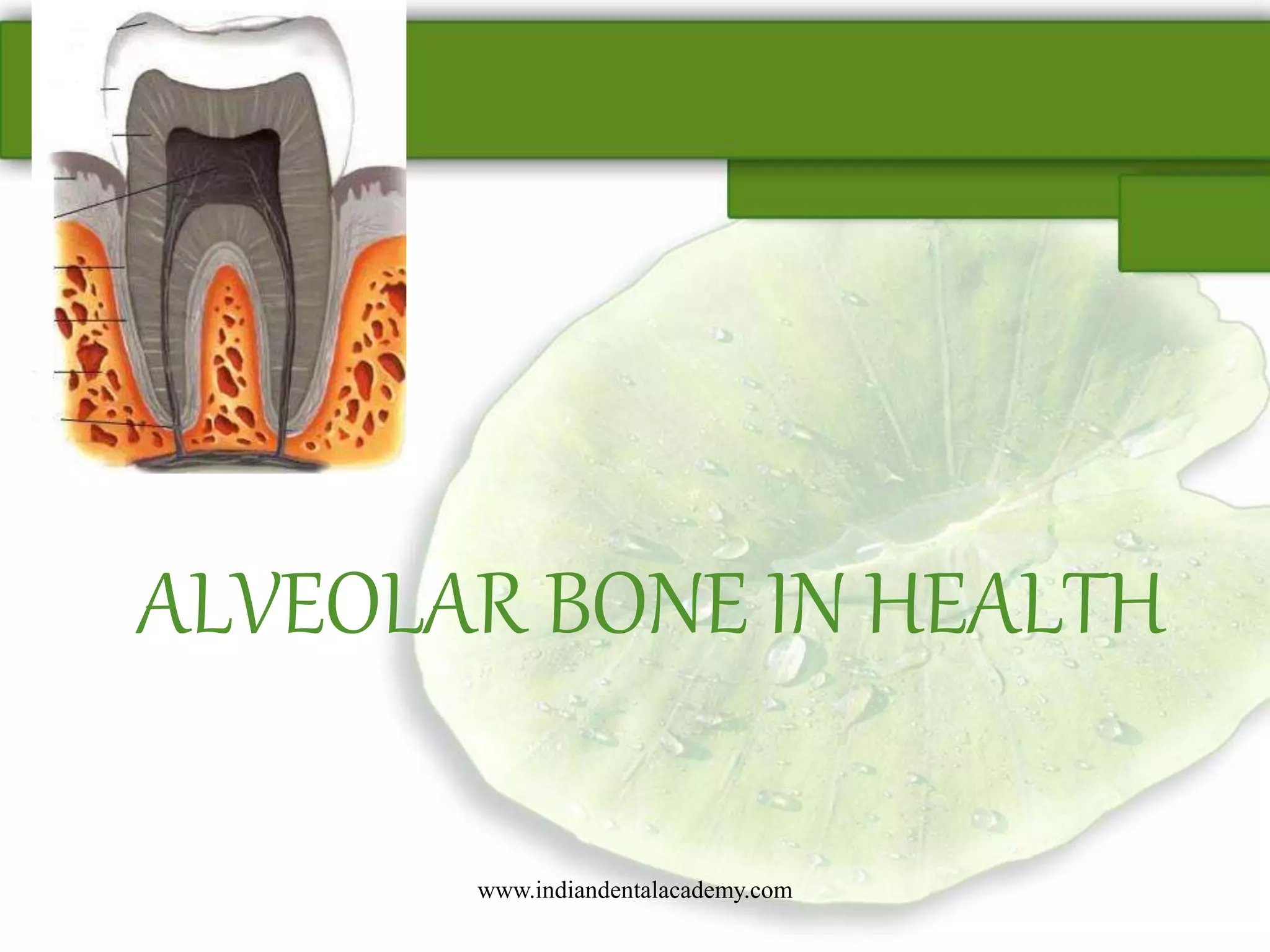
ALVEOLAR BONE IN HEALTH
www.indiandentalacademy.com
“Bone is defined as a hard, rigid form of
connective tissue constituting most of the
skeleton of vertebrates, composed chiefly of
calcium salts”
“Alveolus is defined as the cavity or socket
of the jaw in to which the roots of the teeth
are embedded”
www.indiandentalacademy.com
Development and growth of
bone
• The process of bone formation is called
osteogenesis.
• 3 phases :
-Primary osteoid tissue
-Secondary osteoid tissue
-Calcificationwww.indiandentalacademy.com
Osteogenesis occurs by two
mechanisms:
1. Endochondral
2. Intramembranous
www.indiandentalacademy.com
ENDOCHONDRAL /INDIRECT BONE FORMATION
• Bone formation is preceded by formation of
cartilage which is later replaced by bone
(Horton,1990)
• Head of mandible, ends of long bones,
vertebrae, ribs and base of skull.
www.indiandentalacademy.com
ENDOCHONDRAL / INDIRECT BONE
FORMATION
www.indiandentalacademy.com
INTRA MEMBRANOUS / DIRECT BONE
FORMATION
• Bone develops directly
within the soft tissue
• Maxilla and Body of
mandible
www.indiandentalacademy.com
Functional adaptation of bone.
- Wolffs law of
transformation.(Julius Wolff)
- Osteophytes.
Reaction of bone to pressure and
tension.(Schwartz 1932)
www.indiandentalacademy.com
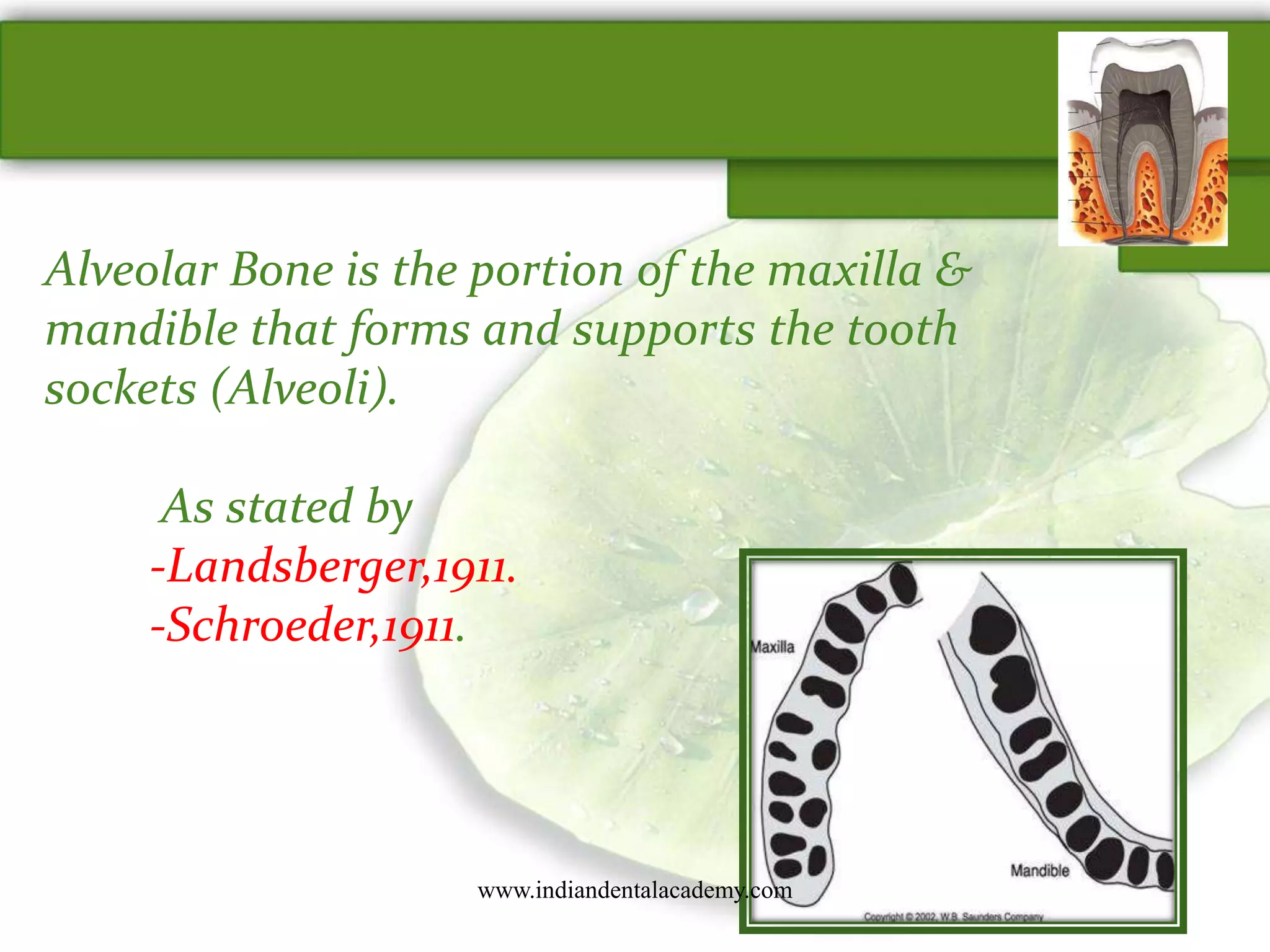
Alveolar Bone is the portion of the maxilla &
mandible that forms and supports the tooth
sockets (Alveoli).
As stated by
-Landsberger,1911.
-Schroeder,1911.
www.indiandentalacademy.com
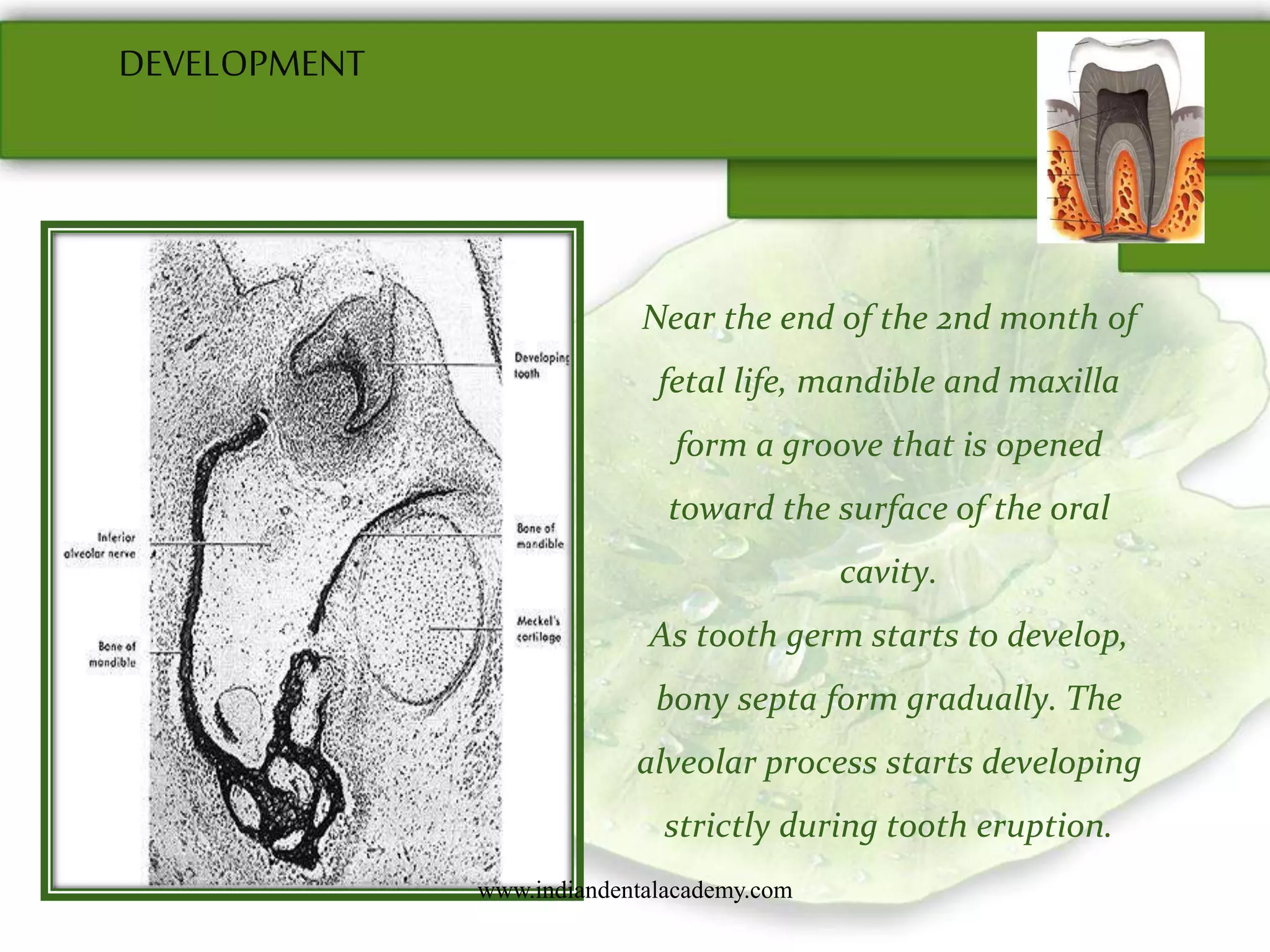
Near the end of the 2nd month of
fetal life, mandible and maxilla
form a groove that is opened
toward the surface of the oral
cavity.
As tooth germ starts to develop,
bony septa form gradually. The
alveolar process starts developing
strictly during tooth eruption.
DEVELOPMENT
www.indiandentalacademy.com
The parts of the alveolar bone
1.Alveolar bone proper.
2. Supporting alveolar bone
 Cortical plates
 Spongy bone
www.indiandentalacademy.com
Alveolar Bone Proper
• The thin lamella of bone that surrounds the root of the
tooth and gives attachment to the principal fibers of the
PDL.
• Bundle bone {Stein and weinmann,1925}
www.indiandentalacademy.com
• Histologically –Cribriform plate or Lamina
cribrosa.
• Radiologically-Lamina dura.
(Goldman,1957)
www.indiandentalacademy.com
SUPPORTING ALVEOLAR BONE
Surrounds the alveolar bone
proper and gives additional
support.
It consists of
•cortical plates
•spongiosa
www.indiandentalacademy.com
Cortical Plates
• Consists of compact bone and forms the outer &
inner plates of the alveolar processes
• They are thinner in Maxilla than in Mandible
• In Maxilla, outer cortical plate is perforated by
many small openings through which blood &
lymph vessels pass
• Thickest in molar & premolar region of lower jaw
esp. on the buccal aspectwww.indiandentalacademy.com
Spongy / Cancellous Bone
• Spongy bone fills the area between the cortical plates and
the alveolar bone proper
• More common in Maxilla
• Found mainly in the inter-radicular & inter-dental spaces
and in limited amounts facially or lingually except in the
palate
• In the region of the anterior teeth of both jaws no spongy
bone is found and the cortical plate is fused with the
alveolar bone proper www.indiandentalacademy.com
INTERDENTAL SEPTUM
 Consists of cancellous bone bordered by the socket wall cribriform plates of
neighboring teeth and the facial and lingual cortical plates.
 Cribriform plate carries the nutrient canals Zuckerkandl & Hirschfield.
The alveolar crest is 0.75 and 1.49 mm
below the level of the CEJ.
(Gargiulo et al,1961)
www.indiandentalacademy.com
Gross Bone Histology
Histologically the mature or adult bones, whether
compact or trabecular are composed of microscopic
layers or lamellae.
Three types of layering are recognized:
• Circumferential
• Concentric
• Interstitial
www.indiandentalacademy.com
1. Circumferential: Encloses the entire adult
bone, forming its outer perimeter
2. Concentric: Makes up the bulk of compact
bone & forms the basic metabolic unit of bone -
the Osteon
osteocyte
Haversian canal
canaliculi
www.indiandentalacademy.com
In the center of each is a canal – “The Haversian
Canal” and each canal houses a capillary
Adjacent haversian canals are interconnected by
Volkmann canals. They contain blood vessels
thus creating rich vascular network throughout
compact bone
www.indiandentalacademy.com
3. Interstitial:
They are interspersed between adjacent concentric lamellae
and fill the spaces between them. They are actually
preexisting concentric lamellae and can take a multitude of
shapes
www.indiandentalacademy.com
Periosteum
• It is the connective tissue membrane that surrounds the
outer aspect of compact bone
• It has 2 layers- Outer & Inner
• Outer consists (fibrous)of dense irregular connective
tissue.
• Inner layer (cambian) is next to bone surface. It consists of
bone cells,their precursors and rich micro-vascular supply
www.indiandentalacademy.com
Endosteum
• It is the cellular membrane that surrounds the
internal surface of compact and cancellous bone
• The periosteal surface of bone is more active in
bone formation than the endosteal one
www.indiandentalacademy.com
Bone Cells
• Two cell lineages are present in bone each with specific
functions:
1. Osteogenic Cells: They form and maintain bone. They have a
variable morphology and include:
• Osteoprogenitors
• Preosteoblasts
• Osteoblasts
• Osteocytes
• Bone lining cells
2. Osteoclasts: Are bone resorbing & remodeling cellswww.indiandentalacademy.com
Osteoprogenitor cells
 The determined osteoprogenitor cells are responsible for
bone formation during embryogenesis.
 The inducible osteoprogenitor cells like pericytes arrive at
the injury focus about 3 to 5 days after injury .
www.indiandentalacademy.com
Osteoblasts
• They are mononucleated cells, derived from mesenchymal stem
cells
• Ultra structure is characteristic of any actively secreting cell
with prominent Golgi apparatus, RER, mitochondria, nucleoli
and many secretory vesicles & vacuoles
• Are responsible for bone matrix synthesis and subsequent
mineralization of both collagenous & non-collagenous matrix of
bone
www.indiandentalacademy.com
• The major constituents of this matrix are Type I & V
Collagen
• Are plump, cuboidal cells (when very active) or slightly
flattened cells
• The pre-osteoblasts & osteoblasts exhibit high level of
alkaline phosphatase on the outer surface of their plasma
membrane
• This enzyme is used as a cytochemical marker to
distinguish pre-osteoblasts from fibroblasts
www.indiandentalacademy.com
Osteocytes
• Osteoblasts secrete the organic matrix of bone and is at
first devoid of mineral salts. At this stage it stains pink with
H&E stain and is called Osteoid tissue
• As Osteoblasts form bone some of the Osteoblasts get
entrapped within the matrix they secrete and are called as
Osteocytes
• The more rapid the bone volume, the more osteocytes are
present per unit volume.
www.indiandentalacademy.com
• Space in matrix occupied by an osteocyte is called
as Osteocytic lacunae
• Narrow extensions of lacunae form cannaliculi
that have radiating osteocytic processes
www.indiandentalacademy.com
Osteoclasts
• Are Bone resorbing cells
• Large, multi nucleated but can be small and mono nuclear
• Circulating monocytes are the precursor cells
• In a light microscope they appear to occupy bays in bone or
hollowed out depressions called as Howship’s Lacunae
• Cytoplasm exhibits numerous mitochondria and lysosomes,
abundant golgi saccules, free ribosomes but little RER
www.indiandentalacademy.com
• Ruffled or striated border is a part of plasma membrane
lying adjacent to bone that is being resorbed – and is raised
in characteristic folds
• Clear zone is the zone of specialized membrane that
separates the ruffled membrane border from the rest of the
plasma membrane
• It is devoid of organelles
www.indiandentalacademy.com
Chemical Composition of Bone
67% Inorganic 33% Organic
(Hydroxyapatite)
28% Collagen10%
Non Collagenous
proteins
BONE
Calcium and Phosphate with
hydroxyl, carbonate, citrate and
other trace ions like Na, Mg &
Fl.
Mineral salts are in the form of
hydroxyapatite crystals that
make approx. 2/3 rd of the
total bone structure
Type I collagen
(90%)
• Osteocalcin
• Osteonectin
• Bone Morphogenic proteins (BMP)
• Phosphoproteins
• Proteoglycans
• Bone sialoprotein
• Osteopontin
• Growth factors & Serum proteins
www.indiandentalacademy.com
MATRIX
ORGANIC MATRIX
• Collagen(28%)
- Type I (Rao et al ,1979)
- Type V (Bronckers et al,1986),
- Type III (Wang et al,1980) &
- Type XII collagen are also present
www.indiandentalacademy.com
Non-collagenous Proteins – 10%
• GAG’s : chondroitin sulfate,
dermatan sulfate
keratan sulfate
heparin sulfate
• Lysyl oxidase & TRAMP
Categorised as GAGs and Glycoproteins
www.indiandentalacademy.com
PROTEOGLYCANS
BIGLYCAN
DECORIN
www.indiandentalacademy.com
• Glycoproteins:
osteonectin
thrombospondin
osteopontin
bone sialoprotein
osteocalcin
www.indiandentalacademy.com
OSTEOCALCIN (bone gla protein )
• First non collageneous bone protein to be characterized.
• 15% of non collagenous protein
• Role in mineral maturation and bone resorption
• Acts as a chemo attractant to osteoclast precursors
(Mundy et al,1983)
www.indiandentalacademy.com
BONE SIALOPROTEIN
• Bone sialoproteins I & II (Franzen et al,1985)
• Expressed in alveolar bone (Chen et al,1991)
• Glutamic acid is predominant in Bone sialoprotein
• Play role in . hydroxyapatite binding
. cell attachment
. activation of cell signaling pathways
www.indiandentalacademy.com
OSTEOPONTIN
Osteopontin plays a role in bone resorption by inhibiting
hydroxyapatite crystal growth (Golberg et al,1995)
Mediates cell attachment
Aspartate is predominant
www.indiandentalacademy.com
SPARC/OSTEONECTIN
• SPARC comprises 25% of the non-collagenous proteins.
• Calcium-binding glycoprotein,interacts with
extracellular matrix molecules (Sodek et al,1992)
• Associated with rapidly remodelling tissues
www.indiandentalacademy.com
INORGANIC MATRIX
• Constitutes 2/3rd of the bone matrix
• Composed of calcium, phosphate ,hydroxyl, carbonate, citrate
(Glimcher,1990)
• Trace amounts of sodium , magnesium , fluorine
• Mineral salts in the form of hydroxyapatite crystals
www.indiandentalacademy.com
Blood Supply
Arterial Supply:
Derived from inferior and superior alveolar arteries to
the mandible and maxilla
Venous drainage
Accompanies the arterial supply. Arterio-venous
anastomoses seen mostly in apical & inter-radicular
regions
Lymphatic drainage:
Lymphatic channels pass through alveolar bone to inf.
dental canal in mand. Or inf.orbital canal in maxilla
then to submaxillary lymph nodes.www.indiandentalacademy.com
Bone Remodeling
• Bone is constantly undergoing remodelling in
which resorption of bone is followed by a phase of
formation.
• In adults-Balance (Frost,1964)
• Involves sequential, coupled actions by osteoclasts
and osteoblasts
• It does not change the shape and size of bone
• It removes a portion of old bone & replaces it with
new bone
www.indiandentalacademy.com
• It affects the height, contour and density of bone.
• Basic multicellular units (FROST,1991)
• Bone turn over (Charles et al,1987; Erickson et
al,1986)
• SITES
-adjacent to the PDL
-periosteum of the facial and lingual
plates
-endosteum of the marrow spaces
www.indiandentalacademy.com
Regulation Of Bone Remodeling
• Complex process involving hormones and local factors,
which affects cells of both osteoblast and osteoclast cell
lineage and exert their influence on the:
-replication of undifferentiated cells
-recruitment of cells
-the differentiated functions of cells
www.indiandentalacademy.com
Hormones that regulate bone remodelling
• Polypeptide hormones
• Parathyroid hormone
• Calcitonin
• Insulin
• Growth hormones
• 1,25 dihydroxyvitamin D3
• Glucocorticoids
• Sex steroids
• Thyroid hormones
www.indiandentalacademy.com
Growth factors that regulate bone
remodelling
• Insulin like growth factor 1,2 (Lean et al,1996)
• Transforming growth factor-b 1,2 (Martin and
Ng,1994)
• Fibroblast growth factors
• Platelet derived growth factors
• Cytokines
• Tumor necrosing factor
• Colony stimulating factor
www.indiandentalacademy.com
ROLE OF PARATHYROID HORMONE
• Bone contains 99% of body’s Ca ions & is a major source of
Ca release when Ca level in blood falls
Dec. in blood Ca is mediated by receptors on chief cells of
Parathyroid gland
Releases parathyroid hormone which stimulates osteoblasts
to release interleukin 1 & 6
www.indiandentalacademy.com
• Stimulates monocytes to migrate in to bone area
• Leukemia inhibiting factor secreted by osteoblasts
coalesces with monocytes in to multinucleated osteoclasts
• Resorbs bone releasing Ca ions from blood
• Breakdown of collagen from organic matrix releases
osteogenic substrates
• Stimulates differentiation of osteoblasts which ultimately
deposit bone
• This interdependency of osteoblasts & osteoclasts in
remodeling is called coupling (Parfitt,1982)www.indiandentalacademy.com
Vitamin D and bone physiology
• Features observed in vit.D defeciency.
-Dec. absorption of Ca and Phosphorus.
-Blood Ca – Normal
-Blood phosphorus-Depressed
-Increased excretion of phosphorus
-Enlarged Parathyroid glands
-Prevention of calcification of osseous
structures.
www.indiandentalacademy.com
Parathyroid hormone and
Vit D
www.indiandentalacademy.com
BONE RESORPTION
Recruitmentand dissemination
ofosteoclastprogenitorcells
Suda et al 1996 cell cellinteraction
Proliferateand differentiateintoosteoclasts
Melkelet al 1992 proteolytic enzymes
Preparationofbonesurface
Lakkaorpeietal 1991 VITRONECTINFACTOR
www.indiandentalacademy.com
Recognition of extra cellular
Bone matrix proteins
Osteoclast polarization [Clear zone, Ruffledborder ]
Martin and Ng 1994 Local factors
Fuller et al1991 Osteoblast
Osteoclast activation
Laotiala1994 H + ions
Hill et al 1993 Proteolyticenzymes
Bone resorption
Arrest of osteoclast activitywww.indiandentalacademy.com
FACTORS ASSOCIATED WITH BONE
RESORPTION
• Interleukin 1
• Interleukin 6
• Tumor necrosis factor and Lymphotoxin
• Gamma interferon
• Colony stimulating factor
• Prostaglandins
• Sex steroids
www.indiandentalacademy.com
BONE FORMATION
Proliferationofmesenchymalcells
Osteoblast precursor cells
Chemotactic attraction to site
Differentiation to mature osteoblast
Formation of matrix
Mineralization www.indiandentalacademy.com
Factors associated with bone
formation
• Platelet derived growth factor
• Heparin derived growth factor
• Acidic and Basic fibroblast growth factors
• Insulin like growth factors
• Transforming growth factors
• Bone morphogenic proteins
www.indiandentalacademy.com
Stage 1- Activation: Pre-Osteoclasts are
stimulated and differentiate under the
influence of cytokines and growth factors
into mature active Osteoclasts
Stage 2 - Resorption: Osteoclasts digest
mineral matrix (old bone)
Stage 3 - Reversal: End of resorption
Stage 4- Formation: Osteoblasts
synthesize new bone matrix
Stage 5- Quiescence: Osteoblasts become
resting bone lining cells on the newly
formed bone surface www.indiandentalacademy.com
www.indiandentalacademy.com
BONE TURNOVER (Charles et al,1987;
Erickson et al,1986)
AMT. OF
RESORPTION
AMT. OF
FORMATION
BONE
ACTIVATION
FREQUENCY
www.indiandentalacademy.com
• Rapidly growing children -30-100%
• Cortical bone-5% per year
• Trabecular bone-15% per year
www.indiandentalacademy.com
BONE HEALING
• Healing of bone tissue includes both regeneration
and repair depending on the type of injury.
Healing of a wound has 4 phases:
a)Blood clotting
b)Wound cleansing
c)Tissue formation
d)Tissue modelling and remodelling
www.indiandentalacademy.com
OSSEOUS TOPOGRAPHY
www.indiandentalacademy.com
FENESTRATION AND DEHISCENCE
www.indiandentalacademy.com
CONCLUSION
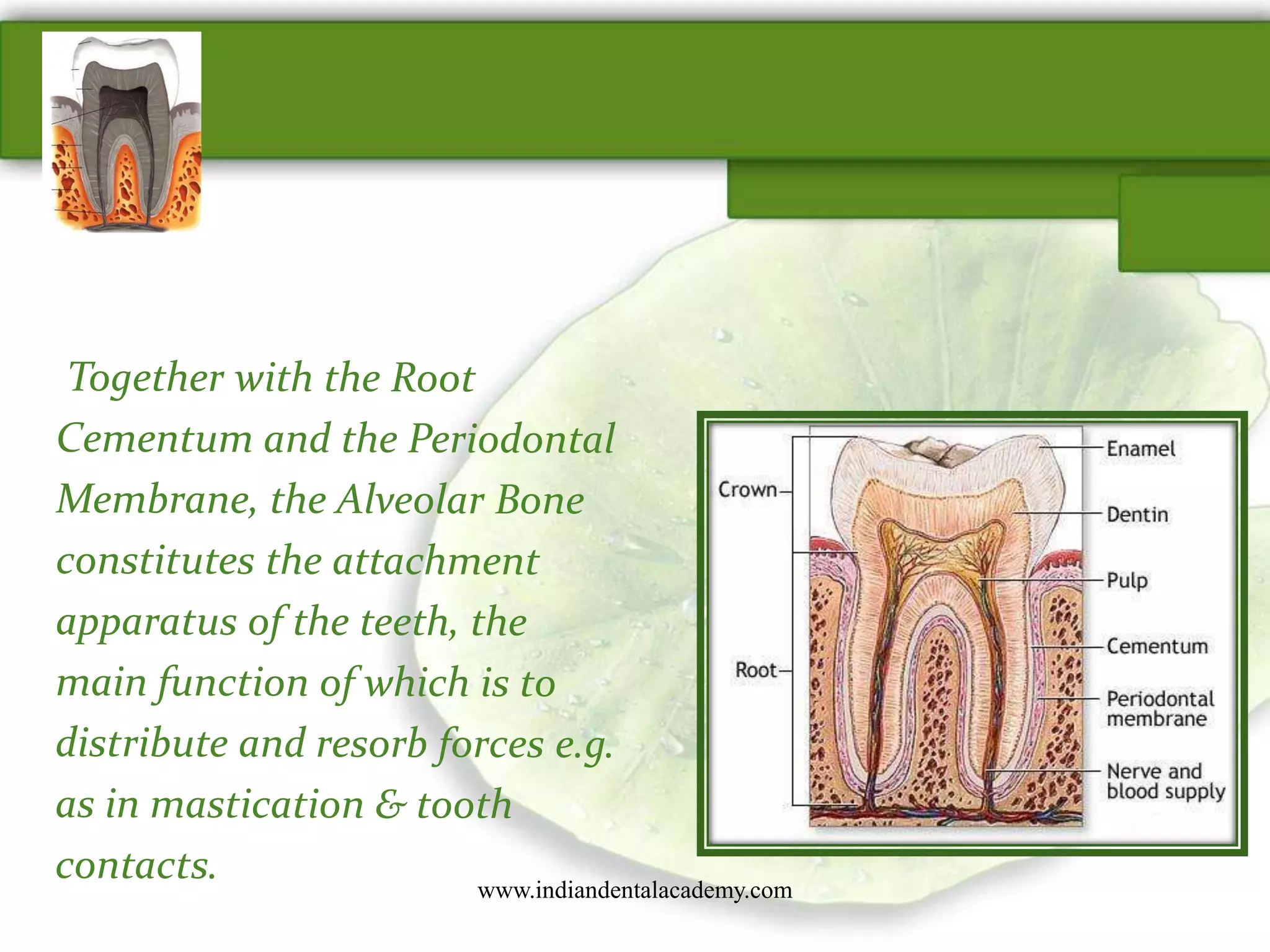
Together with the root cementum and the
periodontal ligament ,the alveolar bone
constitutes the attachment apparatus of the
teeth.
So , it is mandatory to know the basic biology
of this very important structure.
www.indiandentalacademy.com

alveolar process

  • 1.
    ALVEOLAR BONE INHEALTH www.indiandentalacademy.com
  • 2.
    “Bone is definedas a hard, rigid form of connective tissue constituting most of the skeleton of vertebrates, composed chiefly of calcium salts” “Alveolus is defined as the cavity or socket of the jaw in to which the roots of the teeth are embedded” www.indiandentalacademy.com
  • 3.
    Development and growthof bone • The process of bone formation is called osteogenesis. • 3 phases : -Primary osteoid tissue -Secondary osteoid tissue -Calcificationwww.indiandentalacademy.com
  • 4.
    Osteogenesis occurs bytwo mechanisms: 1. Endochondral 2. Intramembranous www.indiandentalacademy.com
  • 5.
    ENDOCHONDRAL /INDIRECT BONEFORMATION • Bone formation is preceded by formation of cartilage which is later replaced by bone (Horton,1990) • Head of mandible, ends of long bones, vertebrae, ribs and base of skull. www.indiandentalacademy.com
  • 6.
    ENDOCHONDRAL / INDIRECTBONE FORMATION www.indiandentalacademy.com
  • 7.
    INTRA MEMBRANOUS /DIRECT BONE FORMATION • Bone develops directly within the soft tissue • Maxilla and Body of mandible www.indiandentalacademy.com
  • 8.
    Functional adaptation ofbone. - Wolffs law of transformation.(Julius Wolff) - Osteophytes. Reaction of bone to pressure and tension.(Schwartz 1932) www.indiandentalacademy.com
  • 9.
  • 10.
    Alveolar Bone isthe portion of the maxilla & mandible that forms and supports the tooth sockets (Alveoli). As stated by -Landsberger,1911. -Schroeder,1911. www.indiandentalacademy.com
  • 11.
    Near the endof the 2nd month of fetal life, mandible and maxilla form a groove that is opened toward the surface of the oral cavity. As tooth germ starts to develop, bony septa form gradually. The alveolar process starts developing strictly during tooth eruption. DEVELOPMENT www.indiandentalacademy.com
  • 12.
    The parts ofthe alveolar bone 1.Alveolar bone proper. 2. Supporting alveolar bone  Cortical plates  Spongy bone www.indiandentalacademy.com
  • 13.
    Alveolar Bone Proper •The thin lamella of bone that surrounds the root of the tooth and gives attachment to the principal fibers of the PDL. • Bundle bone {Stein and weinmann,1925} www.indiandentalacademy.com
  • 14.
    • Histologically –Cribriformplate or Lamina cribrosa. • Radiologically-Lamina dura. (Goldman,1957) www.indiandentalacademy.com
  • 15.
    SUPPORTING ALVEOLAR BONE Surroundsthe alveolar bone proper and gives additional support. It consists of •cortical plates •spongiosa www.indiandentalacademy.com
  • 16.
    Cortical Plates • Consistsof compact bone and forms the outer & inner plates of the alveolar processes • They are thinner in Maxilla than in Mandible • In Maxilla, outer cortical plate is perforated by many small openings through which blood & lymph vessels pass • Thickest in molar & premolar region of lower jaw esp. on the buccal aspectwww.indiandentalacademy.com
  • 17.
    Spongy / CancellousBone • Spongy bone fills the area between the cortical plates and the alveolar bone proper • More common in Maxilla • Found mainly in the inter-radicular & inter-dental spaces and in limited amounts facially or lingually except in the palate • In the region of the anterior teeth of both jaws no spongy bone is found and the cortical plate is fused with the alveolar bone proper www.indiandentalacademy.com
  • 18.
    INTERDENTAL SEPTUM  Consistsof cancellous bone bordered by the socket wall cribriform plates of neighboring teeth and the facial and lingual cortical plates.  Cribriform plate carries the nutrient canals Zuckerkandl & Hirschfield. The alveolar crest is 0.75 and 1.49 mm below the level of the CEJ. (Gargiulo et al,1961) www.indiandentalacademy.com
  • 19.
    Gross Bone Histology Histologicallythe mature or adult bones, whether compact or trabecular are composed of microscopic layers or lamellae. Three types of layering are recognized: • Circumferential • Concentric • Interstitial www.indiandentalacademy.com
  • 20.
    1. Circumferential: Enclosesthe entire adult bone, forming its outer perimeter 2. Concentric: Makes up the bulk of compact bone & forms the basic metabolic unit of bone - the Osteon osteocyte Haversian canal canaliculi www.indiandentalacademy.com
  • 21.
    In the centerof each is a canal – “The Haversian Canal” and each canal houses a capillary Adjacent haversian canals are interconnected by Volkmann canals. They contain blood vessels thus creating rich vascular network throughout compact bone www.indiandentalacademy.com
  • 22.
    3. Interstitial: They areinterspersed between adjacent concentric lamellae and fill the spaces between them. They are actually preexisting concentric lamellae and can take a multitude of shapes www.indiandentalacademy.com
  • 23.
    Periosteum • It isthe connective tissue membrane that surrounds the outer aspect of compact bone • It has 2 layers- Outer & Inner • Outer consists (fibrous)of dense irregular connective tissue. • Inner layer (cambian) is next to bone surface. It consists of bone cells,their precursors and rich micro-vascular supply www.indiandentalacademy.com
  • 24.
    Endosteum • It isthe cellular membrane that surrounds the internal surface of compact and cancellous bone • The periosteal surface of bone is more active in bone formation than the endosteal one www.indiandentalacademy.com
  • 25.
  • 26.
    Bone Cells • Twocell lineages are present in bone each with specific functions: 1. Osteogenic Cells: They form and maintain bone. They have a variable morphology and include: • Osteoprogenitors • Preosteoblasts • Osteoblasts • Osteocytes • Bone lining cells 2. Osteoclasts: Are bone resorbing & remodeling cellswww.indiandentalacademy.com
  • 27.
    Osteoprogenitor cells  Thedetermined osteoprogenitor cells are responsible for bone formation during embryogenesis.  The inducible osteoprogenitor cells like pericytes arrive at the injury focus about 3 to 5 days after injury . www.indiandentalacademy.com
  • 28.
  • 29.
    Osteoblasts • They aremononucleated cells, derived from mesenchymal stem cells • Ultra structure is characteristic of any actively secreting cell with prominent Golgi apparatus, RER, mitochondria, nucleoli and many secretory vesicles & vacuoles • Are responsible for bone matrix synthesis and subsequent mineralization of both collagenous & non-collagenous matrix of bone www.indiandentalacademy.com
  • 30.
    • The majorconstituents of this matrix are Type I & V Collagen • Are plump, cuboidal cells (when very active) or slightly flattened cells • The pre-osteoblasts & osteoblasts exhibit high level of alkaline phosphatase on the outer surface of their plasma membrane • This enzyme is used as a cytochemical marker to distinguish pre-osteoblasts from fibroblasts www.indiandentalacademy.com
  • 31.
    Osteocytes • Osteoblasts secretethe organic matrix of bone and is at first devoid of mineral salts. At this stage it stains pink with H&E stain and is called Osteoid tissue • As Osteoblasts form bone some of the Osteoblasts get entrapped within the matrix they secrete and are called as Osteocytes • The more rapid the bone volume, the more osteocytes are present per unit volume. www.indiandentalacademy.com
  • 32.
    • Space inmatrix occupied by an osteocyte is called as Osteocytic lacunae • Narrow extensions of lacunae form cannaliculi that have radiating osteocytic processes www.indiandentalacademy.com
  • 33.
    Osteoclasts • Are Boneresorbing cells • Large, multi nucleated but can be small and mono nuclear • Circulating monocytes are the precursor cells • In a light microscope they appear to occupy bays in bone or hollowed out depressions called as Howship’s Lacunae • Cytoplasm exhibits numerous mitochondria and lysosomes, abundant golgi saccules, free ribosomes but little RER www.indiandentalacademy.com
  • 34.
    • Ruffled orstriated border is a part of plasma membrane lying adjacent to bone that is being resorbed – and is raised in characteristic folds • Clear zone is the zone of specialized membrane that separates the ruffled membrane border from the rest of the plasma membrane • It is devoid of organelles www.indiandentalacademy.com
  • 35.
    Chemical Composition ofBone 67% Inorganic 33% Organic (Hydroxyapatite) 28% Collagen10% Non Collagenous proteins BONE Calcium and Phosphate with hydroxyl, carbonate, citrate and other trace ions like Na, Mg & Fl. Mineral salts are in the form of hydroxyapatite crystals that make approx. 2/3 rd of the total bone structure Type I collagen (90%) • Osteocalcin • Osteonectin • Bone Morphogenic proteins (BMP) • Phosphoproteins • Proteoglycans • Bone sialoprotein • Osteopontin • Growth factors & Serum proteins www.indiandentalacademy.com
  • 36.
    MATRIX ORGANIC MATRIX • Collagen(28%) -Type I (Rao et al ,1979) - Type V (Bronckers et al,1986), - Type III (Wang et al,1980) & - Type XII collagen are also present www.indiandentalacademy.com
  • 37.
    Non-collagenous Proteins –10% • GAG’s : chondroitin sulfate, dermatan sulfate keratan sulfate heparin sulfate • Lysyl oxidase & TRAMP Categorised as GAGs and Glycoproteins www.indiandentalacademy.com
  • 38.
  • 39.
  • 40.
    OSTEOCALCIN (bone glaprotein ) • First non collageneous bone protein to be characterized. • 15% of non collagenous protein • Role in mineral maturation and bone resorption • Acts as a chemo attractant to osteoclast precursors (Mundy et al,1983) www.indiandentalacademy.com
  • 41.
    BONE SIALOPROTEIN • Bonesialoproteins I & II (Franzen et al,1985) • Expressed in alveolar bone (Chen et al,1991) • Glutamic acid is predominant in Bone sialoprotein • Play role in . hydroxyapatite binding . cell attachment . activation of cell signaling pathways www.indiandentalacademy.com
  • 42.
    OSTEOPONTIN Osteopontin plays arole in bone resorption by inhibiting hydroxyapatite crystal growth (Golberg et al,1995) Mediates cell attachment Aspartate is predominant www.indiandentalacademy.com
  • 43.
    SPARC/OSTEONECTIN • SPARC comprises25% of the non-collagenous proteins. • Calcium-binding glycoprotein,interacts with extracellular matrix molecules (Sodek et al,1992) • Associated with rapidly remodelling tissues www.indiandentalacademy.com
  • 44.
    INORGANIC MATRIX • Constitutes2/3rd of the bone matrix • Composed of calcium, phosphate ,hydroxyl, carbonate, citrate (Glimcher,1990) • Trace amounts of sodium , magnesium , fluorine • Mineral salts in the form of hydroxyapatite crystals www.indiandentalacademy.com
  • 45.
    Blood Supply Arterial Supply: Derivedfrom inferior and superior alveolar arteries to the mandible and maxilla Venous drainage Accompanies the arterial supply. Arterio-venous anastomoses seen mostly in apical & inter-radicular regions Lymphatic drainage: Lymphatic channels pass through alveolar bone to inf. dental canal in mand. Or inf.orbital canal in maxilla then to submaxillary lymph nodes.www.indiandentalacademy.com
  • 46.
    Bone Remodeling • Boneis constantly undergoing remodelling in which resorption of bone is followed by a phase of formation. • In adults-Balance (Frost,1964) • Involves sequential, coupled actions by osteoclasts and osteoblasts • It does not change the shape and size of bone • It removes a portion of old bone & replaces it with new bone www.indiandentalacademy.com
  • 47.
    • It affectsthe height, contour and density of bone. • Basic multicellular units (FROST,1991) • Bone turn over (Charles et al,1987; Erickson et al,1986) • SITES -adjacent to the PDL -periosteum of the facial and lingual plates -endosteum of the marrow spaces www.indiandentalacademy.com
  • 48.
    Regulation Of BoneRemodeling • Complex process involving hormones and local factors, which affects cells of both osteoblast and osteoclast cell lineage and exert their influence on the: -replication of undifferentiated cells -recruitment of cells -the differentiated functions of cells www.indiandentalacademy.com
  • 49.
    Hormones that regulatebone remodelling • Polypeptide hormones • Parathyroid hormone • Calcitonin • Insulin • Growth hormones • 1,25 dihydroxyvitamin D3 • Glucocorticoids • Sex steroids • Thyroid hormones www.indiandentalacademy.com
  • 50.
    Growth factors thatregulate bone remodelling • Insulin like growth factor 1,2 (Lean et al,1996) • Transforming growth factor-b 1,2 (Martin and Ng,1994) • Fibroblast growth factors • Platelet derived growth factors • Cytokines • Tumor necrosing factor • Colony stimulating factor www.indiandentalacademy.com
  • 51.
    ROLE OF PARATHYROIDHORMONE • Bone contains 99% of body’s Ca ions & is a major source of Ca release when Ca level in blood falls Dec. in blood Ca is mediated by receptors on chief cells of Parathyroid gland Releases parathyroid hormone which stimulates osteoblasts to release interleukin 1 & 6 www.indiandentalacademy.com
  • 52.
    • Stimulates monocytesto migrate in to bone area • Leukemia inhibiting factor secreted by osteoblasts coalesces with monocytes in to multinucleated osteoclasts • Resorbs bone releasing Ca ions from blood • Breakdown of collagen from organic matrix releases osteogenic substrates • Stimulates differentiation of osteoblasts which ultimately deposit bone • This interdependency of osteoblasts & osteoclasts in remodeling is called coupling (Parfitt,1982)www.indiandentalacademy.com
  • 53.
    Vitamin D andbone physiology • Features observed in vit.D defeciency. -Dec. absorption of Ca and Phosphorus. -Blood Ca – Normal -Blood phosphorus-Depressed -Increased excretion of phosphorus -Enlarged Parathyroid glands -Prevention of calcification of osseous structures. www.indiandentalacademy.com
  • 54.
    Parathyroid hormone and VitD www.indiandentalacademy.com
  • 55.
    BONE RESORPTION Recruitmentand dissemination ofosteoclastprogenitorcells Sudaet al 1996 cell cellinteraction Proliferateand differentiateintoosteoclasts Melkelet al 1992 proteolytic enzymes Preparationofbonesurface Lakkaorpeietal 1991 VITRONECTINFACTOR www.indiandentalacademy.com
  • 56.
    Recognition of extracellular Bone matrix proteins Osteoclast polarization [Clear zone, Ruffledborder ] Martin and Ng 1994 Local factors Fuller et al1991 Osteoblast Osteoclast activation Laotiala1994 H + ions Hill et al 1993 Proteolyticenzymes Bone resorption Arrest of osteoclast activitywww.indiandentalacademy.com
  • 57.
    FACTORS ASSOCIATED WITHBONE RESORPTION • Interleukin 1 • Interleukin 6 • Tumor necrosis factor and Lymphotoxin • Gamma interferon • Colony stimulating factor • Prostaglandins • Sex steroids www.indiandentalacademy.com
  • 58.
    BONE FORMATION Proliferationofmesenchymalcells Osteoblast precursorcells Chemotactic attraction to site Differentiation to mature osteoblast Formation of matrix Mineralization www.indiandentalacademy.com
  • 59.
    Factors associated withbone formation • Platelet derived growth factor • Heparin derived growth factor • Acidic and Basic fibroblast growth factors • Insulin like growth factors • Transforming growth factors • Bone morphogenic proteins www.indiandentalacademy.com
  • 60.
    Stage 1- Activation:Pre-Osteoclasts are stimulated and differentiate under the influence of cytokines and growth factors into mature active Osteoclasts Stage 2 - Resorption: Osteoclasts digest mineral matrix (old bone) Stage 3 - Reversal: End of resorption Stage 4- Formation: Osteoblasts synthesize new bone matrix Stage 5- Quiescence: Osteoblasts become resting bone lining cells on the newly formed bone surface www.indiandentalacademy.com
  • 61.
  • 62.
    BONE TURNOVER (Charleset al,1987; Erickson et al,1986) AMT. OF RESORPTION AMT. OF FORMATION BONE ACTIVATION FREQUENCY www.indiandentalacademy.com
  • 63.
    • Rapidly growingchildren -30-100% • Cortical bone-5% per year • Trabecular bone-15% per year www.indiandentalacademy.com
  • 64.
    BONE HEALING • Healingof bone tissue includes both regeneration and repair depending on the type of injury. Healing of a wound has 4 phases: a)Blood clotting b)Wound cleansing c)Tissue formation d)Tissue modelling and remodelling www.indiandentalacademy.com
  • 65.
  • 66.
  • 67.
  • 68.
    CONCLUSION Together with theroot cementum and the periodontal ligament ,the alveolar bone constitutes the attachment apparatus of the teeth. So , it is mandatory to know the basic biology of this very important structure. www.indiandentalacademy.com
  • 69.