ALVEOLAR BONE AND
ITS RELEVANCE IN PROSTHODONTICS.
Guided by:
Dr. S M Gundawar Dr. U M Radke Dr. N A Pande
Professor & Guide HOD & Professor Professor
Dr. S Deshmukh Dr. T.K. Mowade Dr. Rajlakshmi Banerjee
Reader Reader Reader
Presented by:-
Dr. Richa Sahai
I MDS
CONTENTS
 Definitions
 Functions & Composition of bone
 Classification of bone
 Anatomy and Development of Alveolar Bone
 Histological Structure
 Influence of systemic diseases, vitamins, hormones & drugs
on the alveolar bone
 Sequelae of tooth loss
 Residual Ridge resorption and classification
 Alveolar Bone from Prosthodontic point of view
 Pathological Fate of Alveolar Bone and its implications In
prosthodontics
 Conclusion
DEFINITIONS
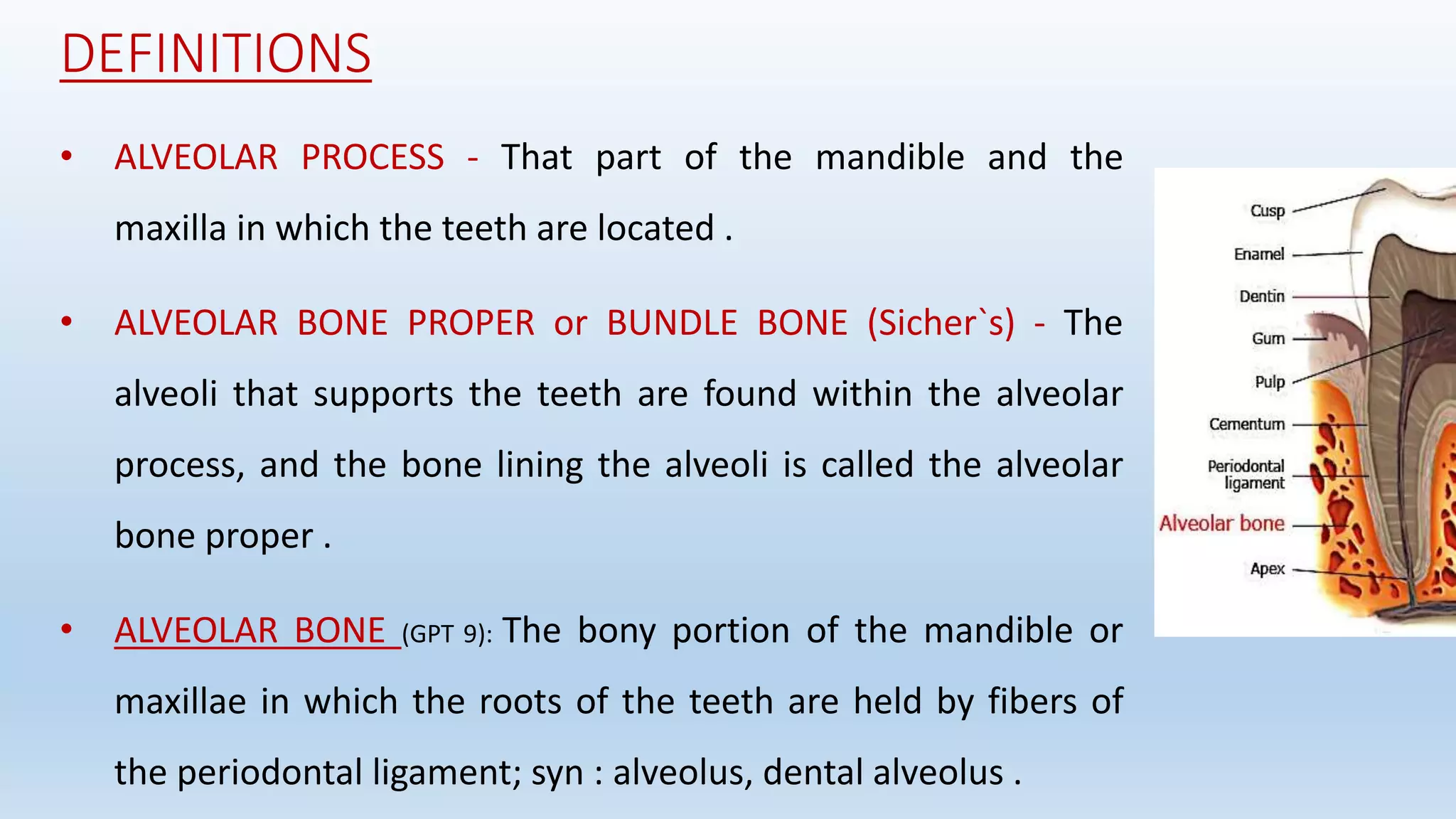
• ALVEOLAR PROCESS - That part of the mandible and the
maxilla in which the teeth are located .
• ALVEOLAR BONE PROPER or BUNDLE BONE (Sicher`s) - The
alveoli that supports the teeth are found within the alveolar
process, and the bone lining the alveoli is called the alveolar
bone proper .
• ALVEOLAR BONE (GPT 9): The bony portion of the mandible or
maxillae in which the roots of the teeth are held by fibers of
the periodontal ligament; syn : alveolus, dental alveolus .
• Basal bone - The osseous part of the maxillae or the mandible exclusive of the
alveolar process. (GPT 8)
• Cancellous bone - The reticular, spongy or the lattice like portion of the bone.
(GPT 8)
• Alveolar crest - Also called as the residual ridge crest. It is the most coronal
portion of the residual ridge. (GPT 8)
• Alveolar resorption - It is a term used for the diminishing quantity and the
quality of the residual ridge after the teeth are removed. (GPT 8)
• Alveolus or Alveoli - One of the cavities or the sockets within the alveolar
process of the maxilla or the mandible in which the attachment complex held
the roots of the tooth after the tooth’ removal.
Functions of bone -
Composition
CELLS OF BONE
 Osteoblasts
 Osteocytes
 Osteoclasts
 uninucleated cells that synthesize both
collagenous and noncollagenous bone
protein.
 Responsible for mineralization .
 Derived from a multipotent mesenchymal
cell.
 Exhibit high levels of alkaline phosphate on
the outer surface of their plasma
membranes.
1. Osteoblasts
 The number of osteoblasts that become osteocytes varies
depending on the rapidity of bone formation  The more rapid
the formation, the more osteocytes are present per unit volume.
 Embryonic bone and repair bone have more osteocytes than
lamellar bone.
 Gradually lose most of their matrix synthesizing machinery and
become reduced in size .
2. Osteocytes
 Multinucleated , much larger cells.
 Generally seen in a cluster rather than singly.
 It is characterized by acid phosphatase within its
cytoplasmic vesicles and vacuoles  distinguishes
it from other giant cells and macrophages.
 Typically osteoclasts are found against the bone
surface occupying shallow, hollowed out
depressions, called Howship’s lacunae.
3. OSTEOCLASTS
CLASSIFICATION OF BONE
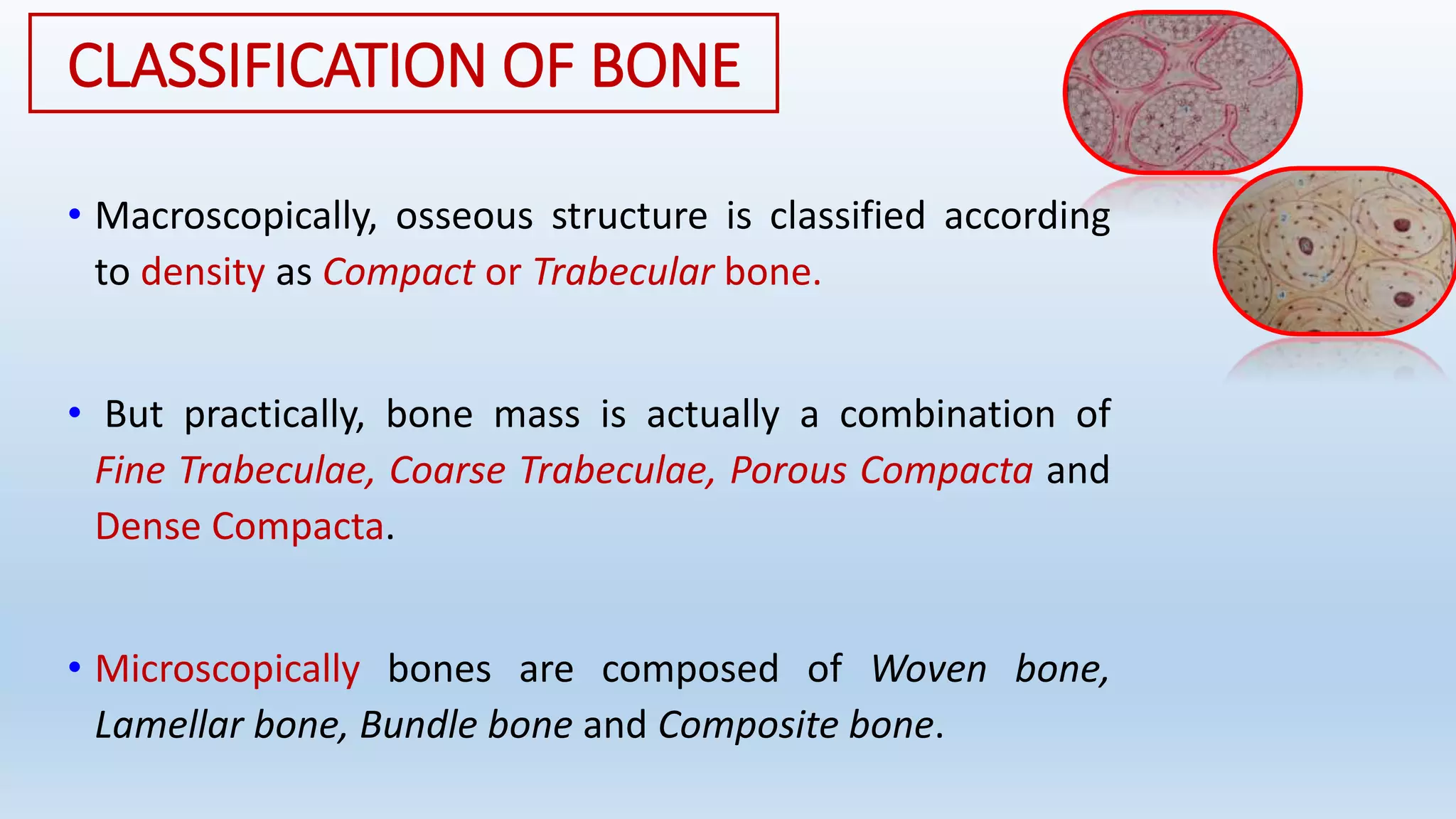
• Macroscopically, osseous structure is classified according
to density as Compact or Trabecular bone.
• But practically, bone mass is actually a combination of
Fine Trabeculae, Coarse Trabeculae, Porous Compacta and
Dense Compacta.
• Microscopically bones are composed of Woven bone,
Lamellar bone, Bundle bone and Composite bone.
1. Woven bone
• Highly cellular.
• Formed rapidly (30-50 µm/ day or more) in
response to growth or injury.
• Low mineral content.
• Random fiber orientation and minimal strength.
• Stabilize unloaded Endosseous implants during
initial healing.
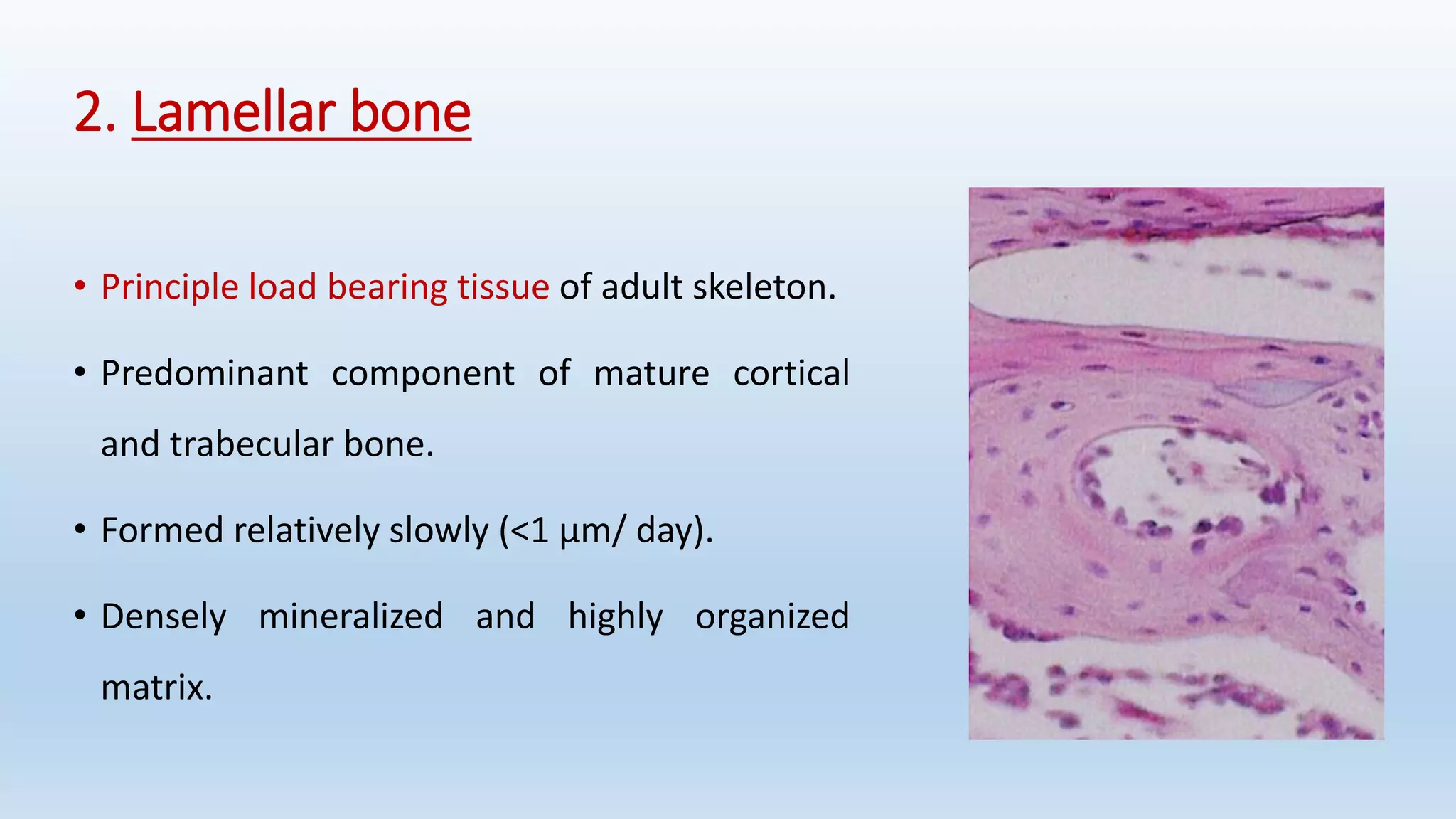
2. Lamellar bone
• Principle load bearing tissue of adult skeleton.
• Predominant component of mature cortical
and trabecular bone.
• Formed relatively slowly (<1 µm/ day).
• Densely mineralized and highly organized
matrix.
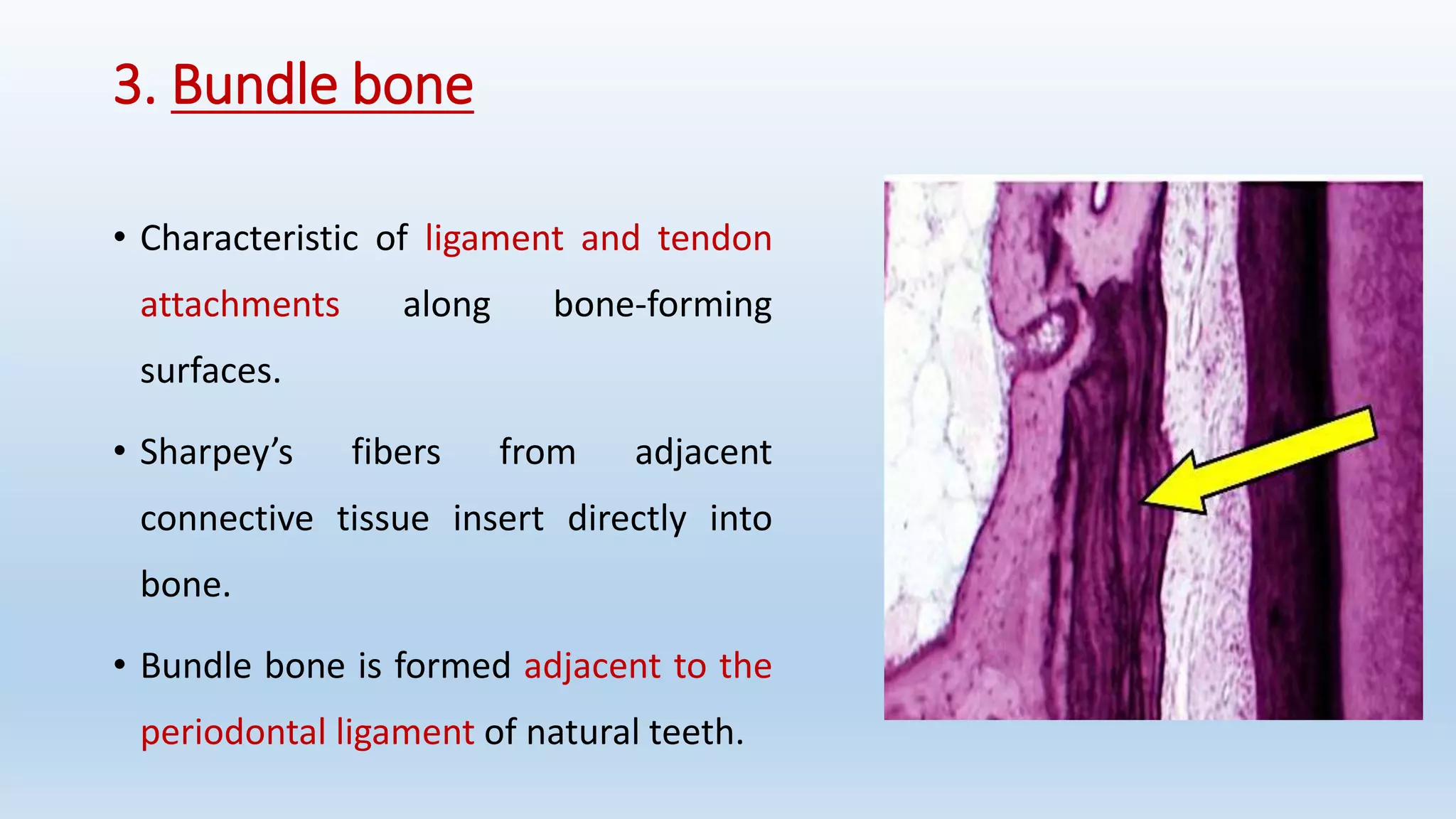
3. Bundle bone
• Characteristic of ligament and tendon
attachments along bone-forming
surfaces.
• Sharpey’s fibers from adjacent
connective tissue insert directly into
bone.
• Bundle bone is formed adjacent to the
periodontal ligament of natural teeth.
4. Composite bone
• High quality lamellar bone deposited on a woven bone matrix.
• Got adequate strength for load bearing.
• Important in achieving stabilization of an implant during the
rigid integration process.
16
Functions of the alveolar bone
1. As a unit to distribute and resorb functional forces.
2. As a mineralizing supporting tissue for teeth.
3. Provides attachment to muscles.
4. Provides framework for bone marrow.
5. Skeletal functions. – Support & Protection
6. Reservoir of minerals. (calcium)
7. Works in conjunction with lungs and Kidneys to help maintain the
body’s PH balance through the production of additional phosphates and
carbonates.
8. Helps in nerve muscle electrical change conduction.
17
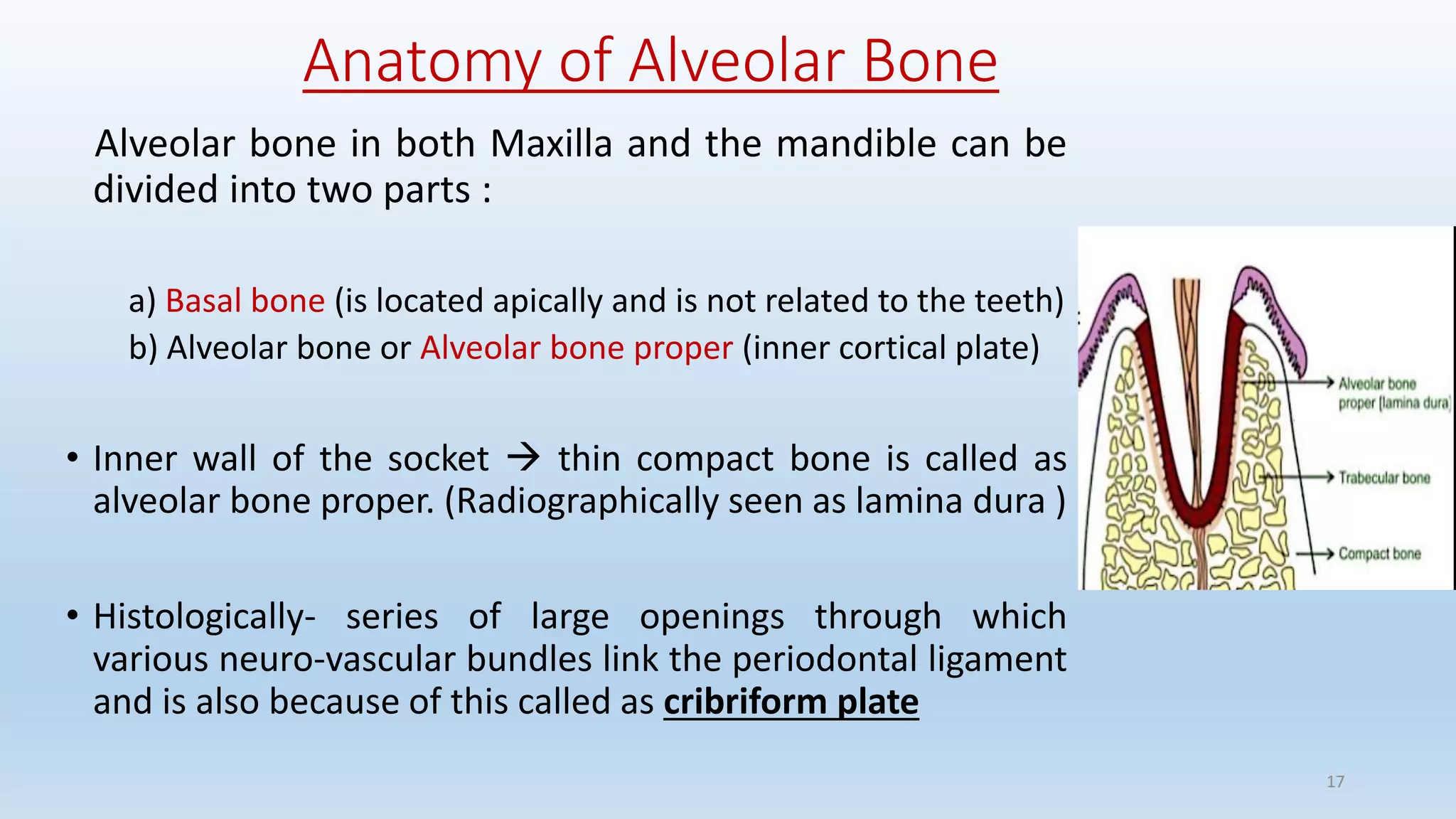
Anatomy of Alveolar Bone
Alveolar bone in both Maxilla and the mandible can be
divided into two parts :
a) Basal bone (is located apically and is not related to the teeth)
b) Alveolar bone or Alveolar bone proper (inner cortical plate)
• Inner wall of the socket  thin compact bone is called as
alveolar bone proper. (Radiographically seen as lamina dura )
• Histologically- series of large openings through which
various neuro-vascular bundles link the periodontal ligament
and is also because of this called as cribriform plate
18
SUPPORTING ALVEOLAR BONE:
Surrounds the alveolar bone proper
and provides additional support.
It consists of :-
A. OUTER CORTICAL PLATE:
An external plate of cortical bone
formed by the Haversian bone and
compact bone lamellae.
B. CANCELLOUS TRABECULAE
(spongy bone) :
sandwiched between outer and inner
cortical plates.
19
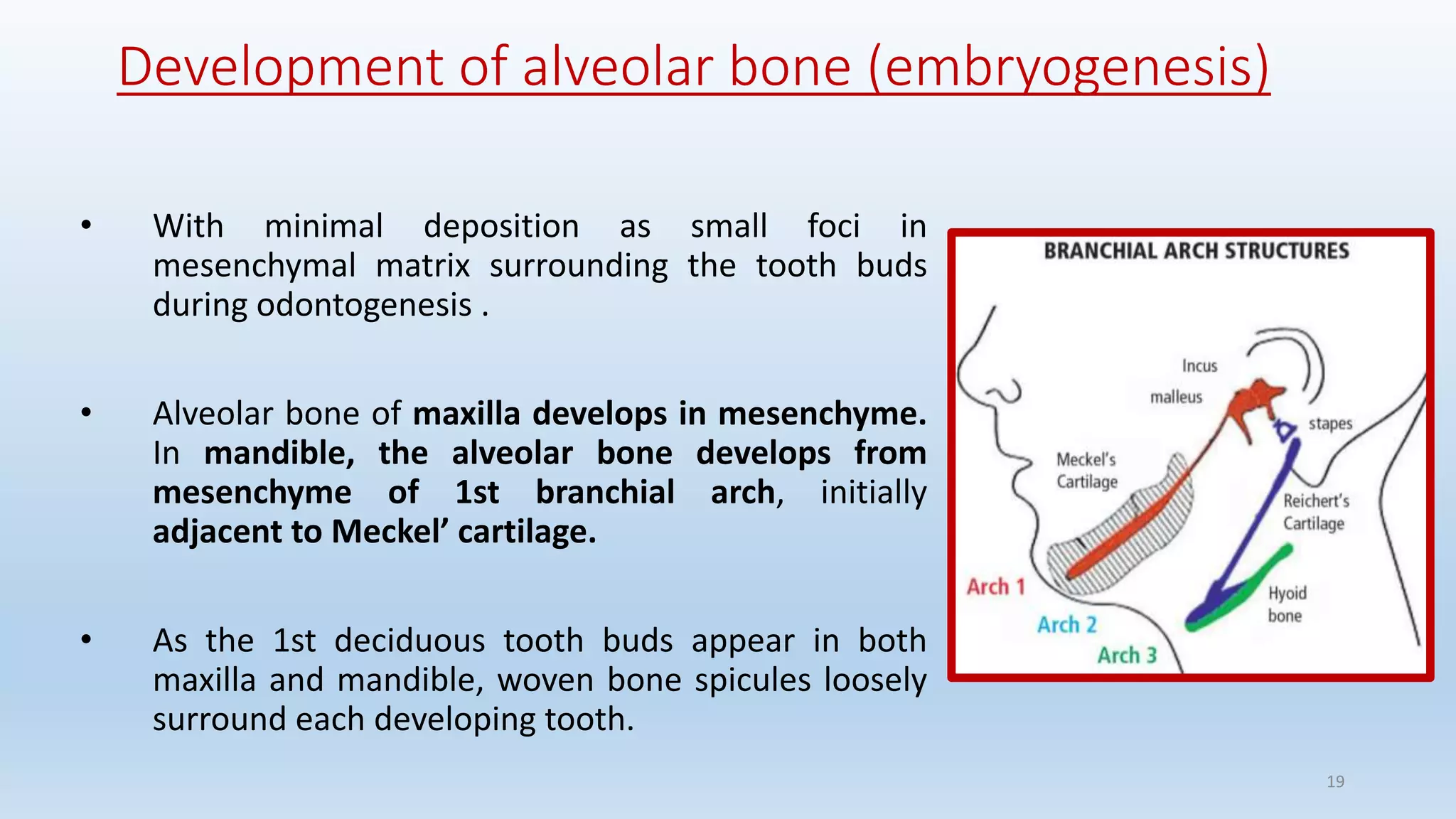
Development of alveolar bone (embryogenesis)
• With minimal deposition as small foci in
mesenchymal matrix surrounding the tooth buds
during odontogenesis .
• Alveolar bone of maxilla develops in mesenchyme.
In mandible, the alveolar bone develops from
mesenchyme of 1st branchial arch, initially
adjacent to Meckel’ cartilage.
• As the 1st deciduous tooth buds appear in both
maxilla and mandible, woven bone spicules loosely
surround each developing tooth.
20
• Growth of each deciduous and later permanent tooth is
accompanied by growth of trabeculae of alveolar bone.
• Trabeculae of woven bone grow and anastomose, extending
from the developing maxilla and mandible proper to form the
alveolar process.
• Process of forming calcifying extracellular matrix begins in the
center of spherule of aggregated osteoblasts, collagens,
proteoglycans and matrix vesicles secreted by osteoblasts.
• The 1st sign of hydroxyapatite calcification is seen within the
matrix vesicle
21
• As the woven bone grows into trabeculae, osteoblasts
are trapped in the growing calcified matrix (as
osteocytes).
• On the trabecular surfaces of woven bone, collagen is
secreted in oriented sheets that calcify by epitaxy
from the hydroxyapatite crystals in the woven bone.
• The successive layers of collagen of, each sheet
oriented in different planes, gives the bone LEAF-ON-
LEAFLET appearance called lamellar bone.
22
• Shortly after 1st woven bone has formed, osteoclasts are found
on the surfaces of both woven and lamellar bone, they begin
process of resorption and with osteoblast, remodeling the bone
into its proper shape at each stage of development.
• Both alveolar bone and basal bone develop from ecto-
mesenchyme.
• Mandibular basal bone begins mineralization at the exit of the
mental nerve from the mental foramen, whereas the maxillary
bone begins at the exit of the infraorbital nerve at the
infraorbital foramen.
Microscopic (Histology) structure
Bone is composed of basic units called lamellae which are thin plates of bone.
Each lamellae has : 1) Gelatinous matrix
2) Ground substance of collagen fibers
3) Calcium salts deposited in matrix.
Lamellae are placed one above another with small
spaces between them  called LACUNAE.
- These are arranged as concentric plates around a
small central canal.
- Such a collection of lamellae is called a HAVERSIAN
SYSTEM OR OSTEONE (cylinder of bone, oriented in
long axis of bone.
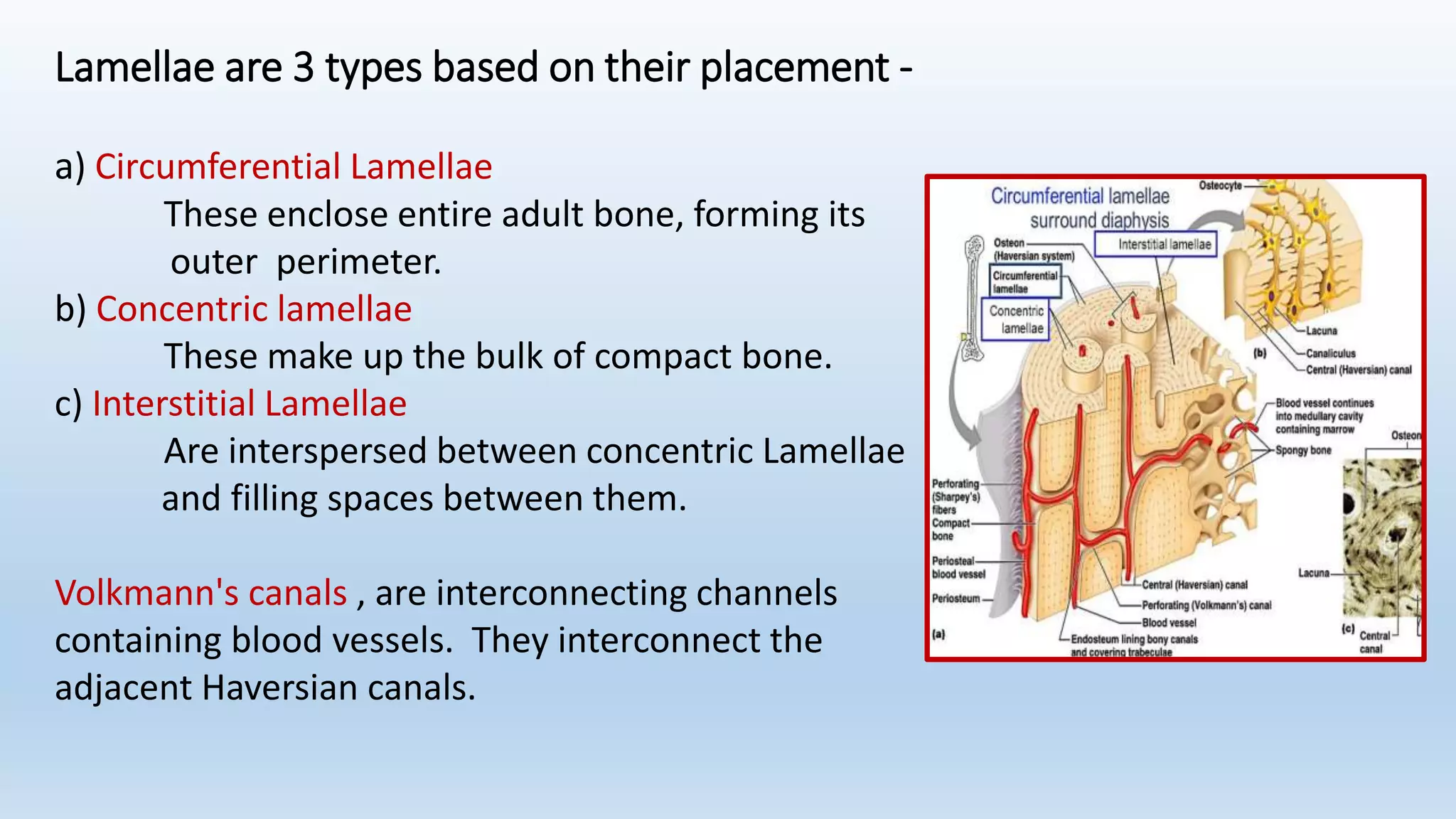
Lamellae are 3 types based on their placement -
a) Circumferential Lamellae
These enclose entire adult bone, forming its
outer perimeter.
b) Concentric lamellae
These make up the bulk of compact bone.
c) Interstitial Lamellae
Are interspersed between concentric Lamellae
and filling spaces between them.
Volkmann's canals , are interconnecting channels
containing blood vessels. They interconnect the
adjacent Haversian canals.
Influence of systemic diseases
• Protein deficiency – loss of alveolar bone due to inhibition of normal bone
forming activity.
• Acute starvation results in osteoporosis and reduction in height of alveolar
bone.
• In hyperpitutarism (acromegaly) - over growth of alveolar bone  increase
in size of dental arch.
• Ridge resorption  associated with hyperparathyroidism and
Von Recklinghausen's disease (VRD) due to increased bone loss.
• Radiological findings of hyperparathyroidism -- alveolar osteoporosis with
closely meshed trabeculae, widening of PDL space and loss of lamina dura.
• Complete loss of lamina dura in Paget's disease, Fibrous dysplasia,
osteomalasia.
• Diabetes mellitus  rapid alveolar bone loss.
• In acute, sub acute leukemia marrow of alveolar bone exhibits
localized areas of necrosis, thrombosis of blood vessels, leukocytic
infiltration and replacement of fatty marrow with fibrous tissue.
• In agranulocytosis  osteoporosis of alveolar bone with
osteoclastic resorption, necrosis of alveolar bone and hemorrhage
in the marrow occur.
• Mercury and benzene intoxication  destruction of alveolar bone.
• Other chemicals ( phosphorous, arsenic and chromium)  necrosis
of alveolar bone.
Effect of hormones
• PTH has direct action on adult bone  responsible for maintenance
of normal blood calcium levels.
• In alveolar bone, PTH liberates both calcium and phosphate.
• Circulating PTH is high  osteoporosis  resorption of alveolar ridge.
• Decreased PTH level  increase formation of bone  resorption of alveolar
bone is reduced.
Calcitonin – It has antagonist action compared to PTH.
Estrogen : deficiency causes increased bone resorption activity.
Osteoporosis is predominant side effect of menopause  due to decrease
of estrogen production.
Effects of vitamins on alveolar bone :
• Hypervitaminosis D - generalized resorption changes in bone including
alveolar bone.
• Avitaminosis D - decreased concentration of blood phosphate and
retarded calcification.
• Hypovitaminosis A - overall bone growth retardation and in later stages
endochondral bone growth ceases entirely.
• Hypovitaminosis C – SCURVY  causes failure of collagen production in
bone.
Effects of Drugs on alveolar bone :
• Generalized decrease in alveolar bone mass  chronic corticosteroid
therapy, anticonvulsant therapy, long term high dose heparin therapy and
alcoholism.
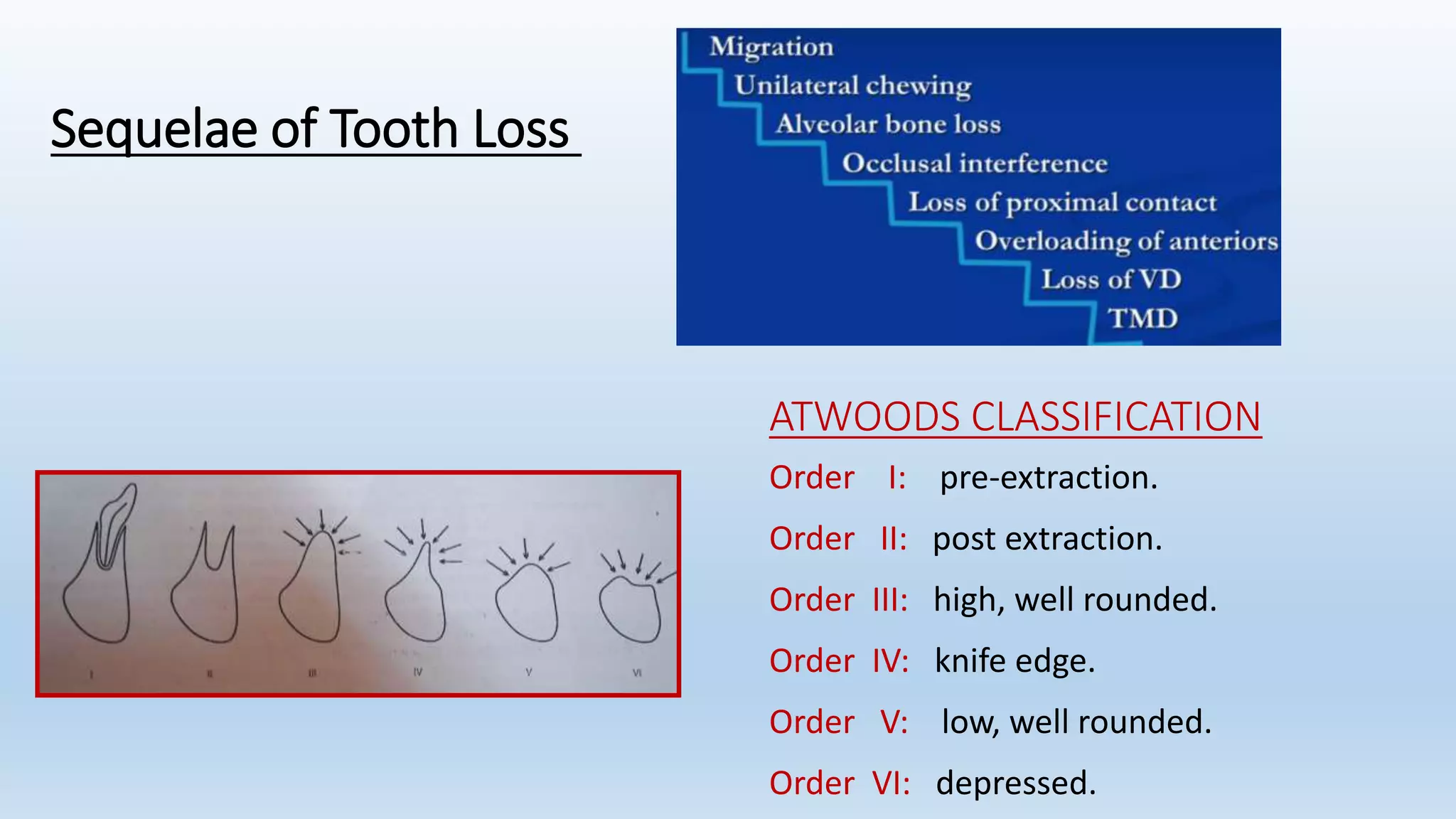
ATWOODS CLASSIFICATION
Order I: pre-extraction.
Order II: post extraction.
Order III: high, well rounded.
Order IV: knife edge.
Order V: low, well rounded.
Order VI: depressed.
Sequelae of Tooth Loss
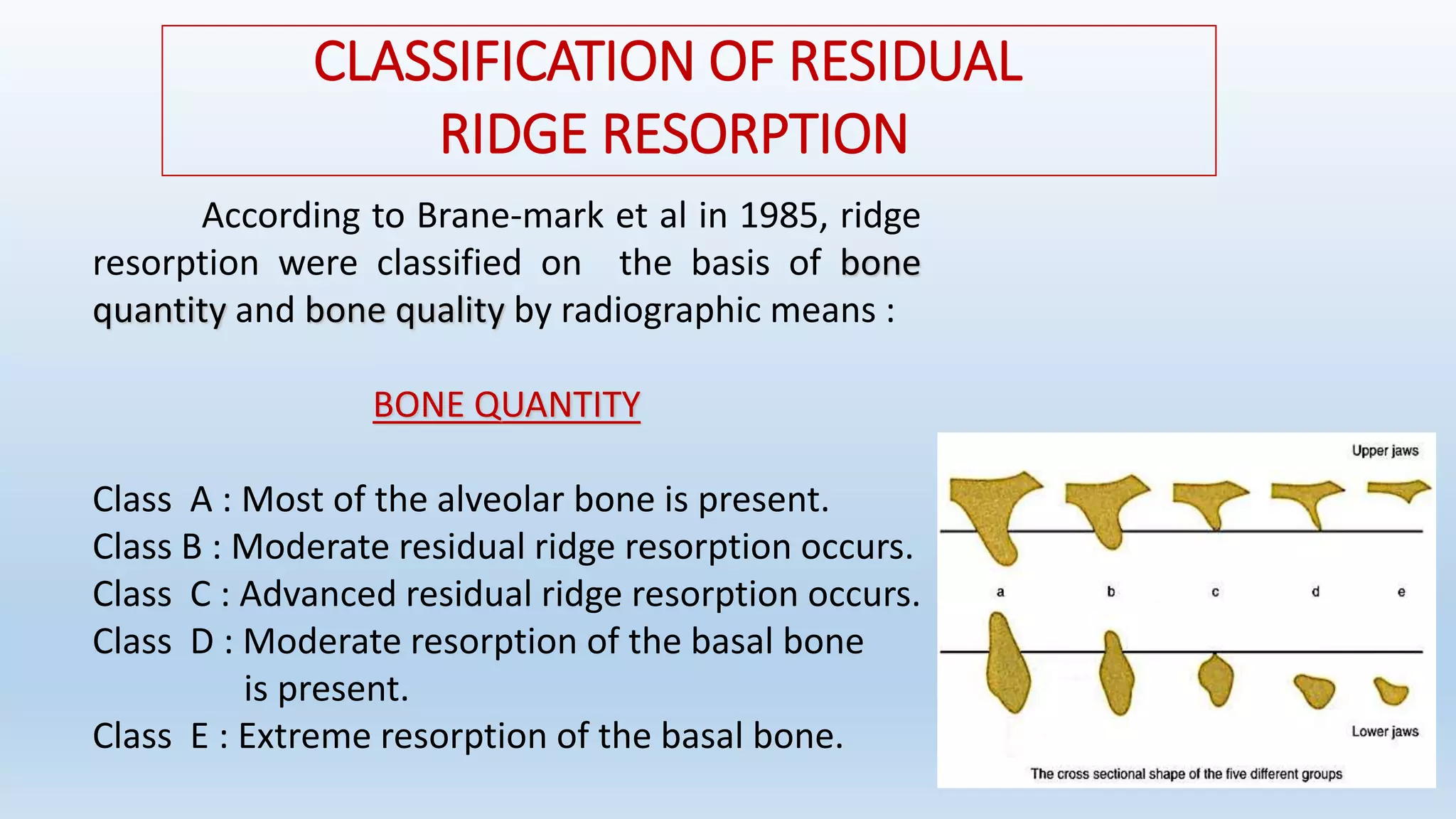
According to Brane-mark et al in 1985, ridge
resorption were classified on the basis of bone
quantity and bone quality by radiographic means :
BONE QUANTITY
Class A : Most of the alveolar bone is present.
Class B : Moderate residual ridge resorption occurs.
Class C : Advanced residual ridge resorption occurs.
Class D : Moderate resorption of the basal bone
is present.
Class E : Extreme resorption of the basal bone.
CLASSIFICATION OF RESIDUAL
RIDGE RESORPTION
BONE QUALITY
Class 1: Almost the entire jaw is composed of
homogenous compact bone.
Class 2: A thick layer of compact bone surrounds a core of
dense trabecular bone.
Class 3: A thin layer of cortical bone surrounds a core of
dense trabecular bone.
Class 4: A thin layer of cortical bone surrounds a core of
low density trabecular bone.
ALVEOLAR BONE - COMPLETE DENTURE
POINT OF VIEW
EDENTULOUS INTRAORAL BONY CHANGES
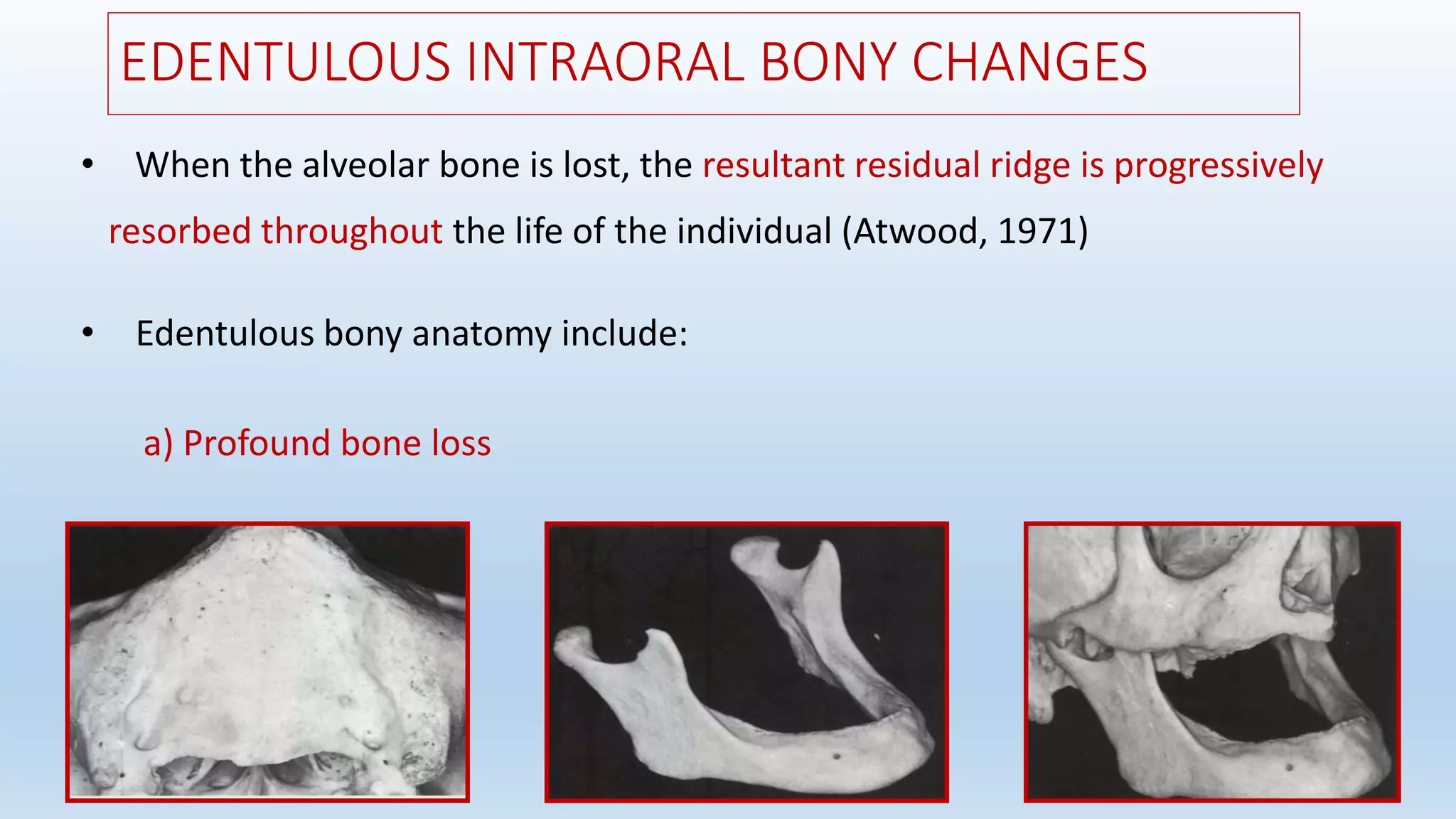
• When the alveolar bone is lost, the resultant residual ridge is progressively
resorbed throughout the life of the individual (Atwood, 1971)
• Edentulous bony anatomy include:
a) Profound bone loss
b) Slow, progressive thinning of the jaw bones
c) Remodeling changes –
occur in the mandible that account for the typical edentulous facial
anatomy.
 The overall length of the mandible does not decrease but may in fact
increase as new bone is added to the mental protuberance, thus
accentuating the chin point.
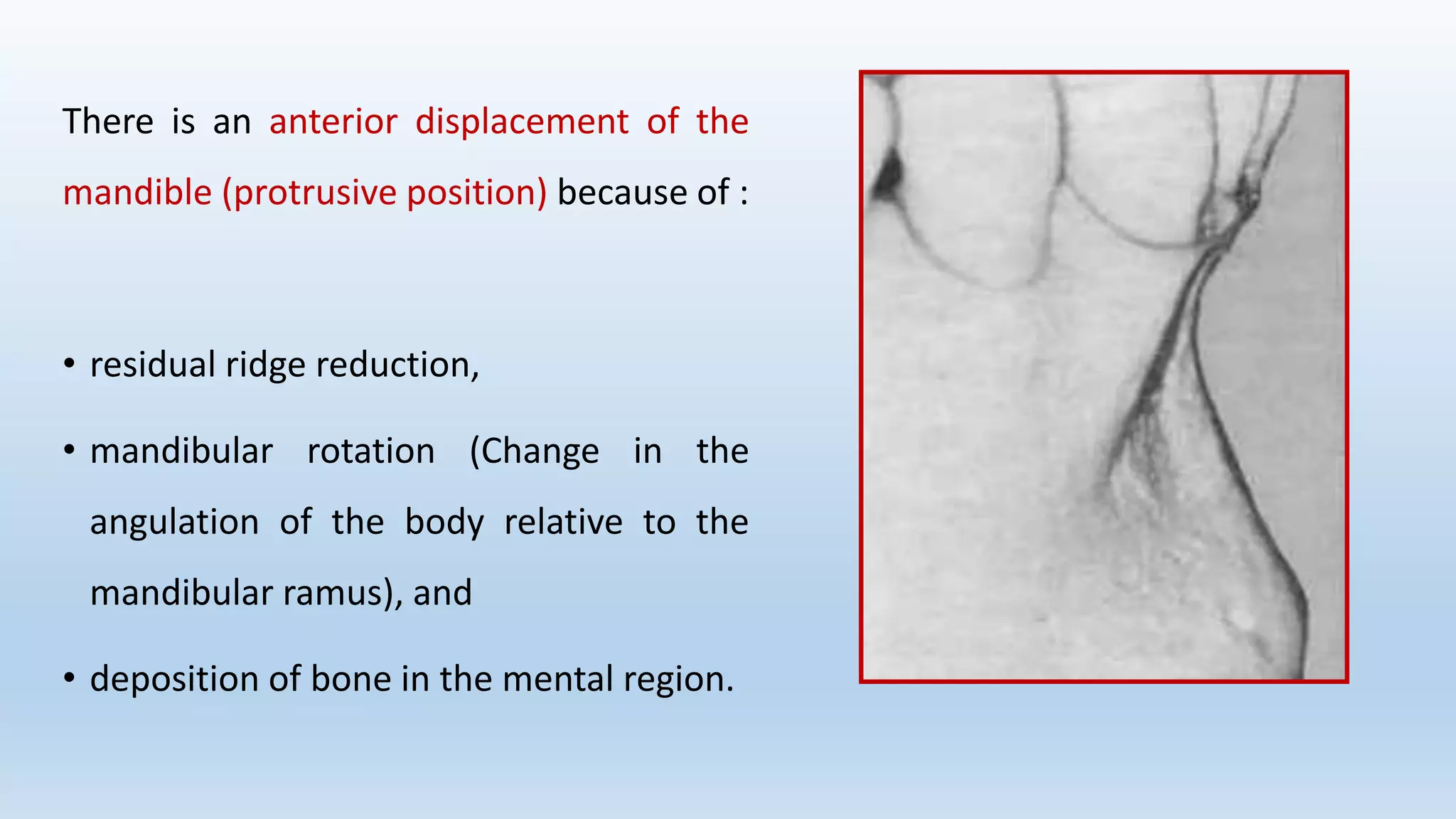
There is an anterior displacement of the
mandible (protrusive position) because of :
• residual ridge reduction,
• mandibular rotation (Change in the
angulation of the body relative to the
mandibular ramus), and
• deposition of bone in the mental region.
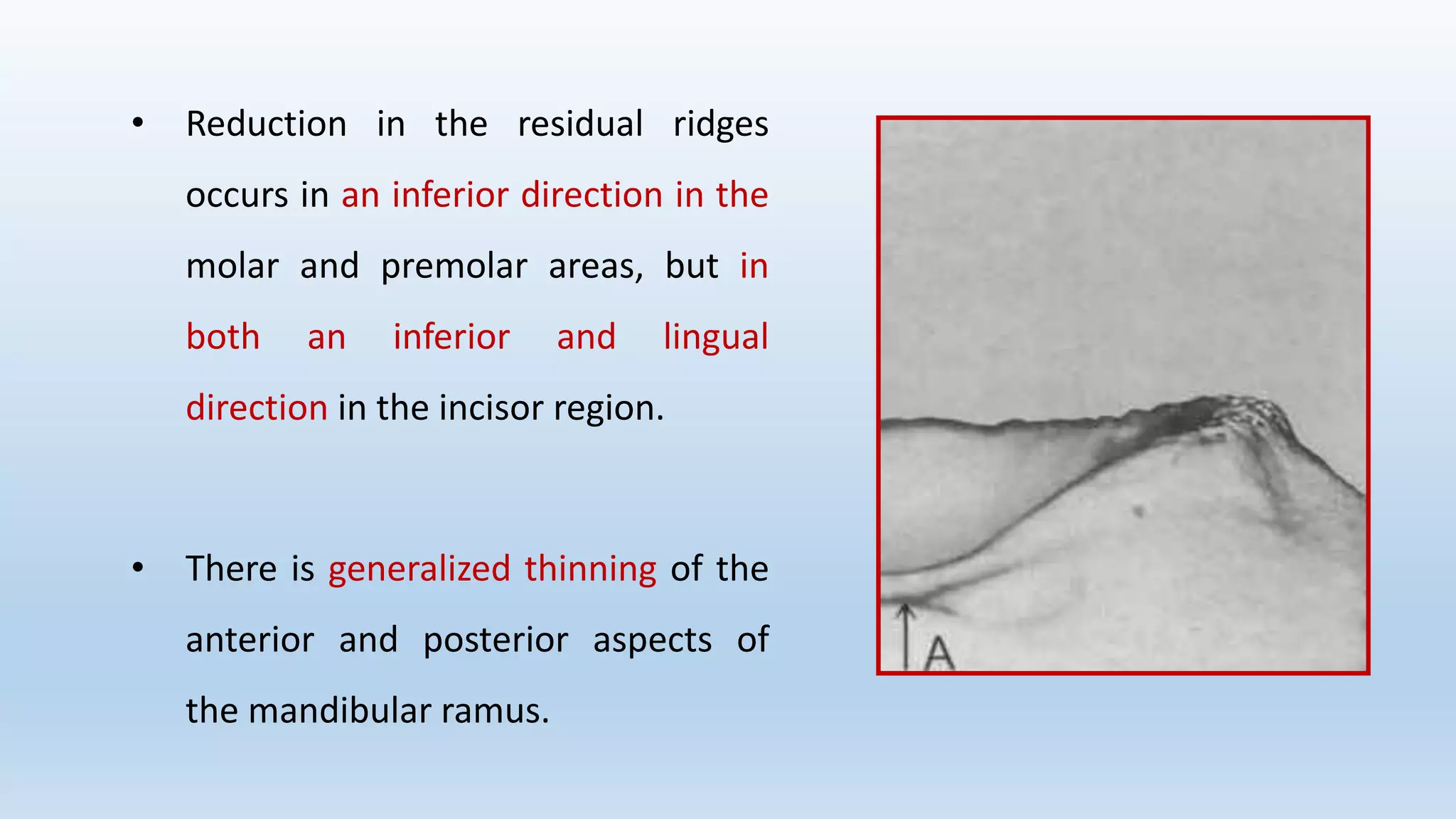
• Reduction in the residual ridges
occurs in an inferior direction in the
molar and premolar areas, but in
both an inferior and lingual
direction in the incisor region.
• There is generalized thinning of the
anterior and posterior aspects of
the mandibular ramus.
ALVEOLAR RIDGES
1. Developmental Structure: The individuals variation in bone
size and its degree of calcification.
2. The size of the natural teeth: The teeth like the bone show
wide variation in size.
Large teeth are usually supported by bulky ridges, small
teeth by narrow ones.
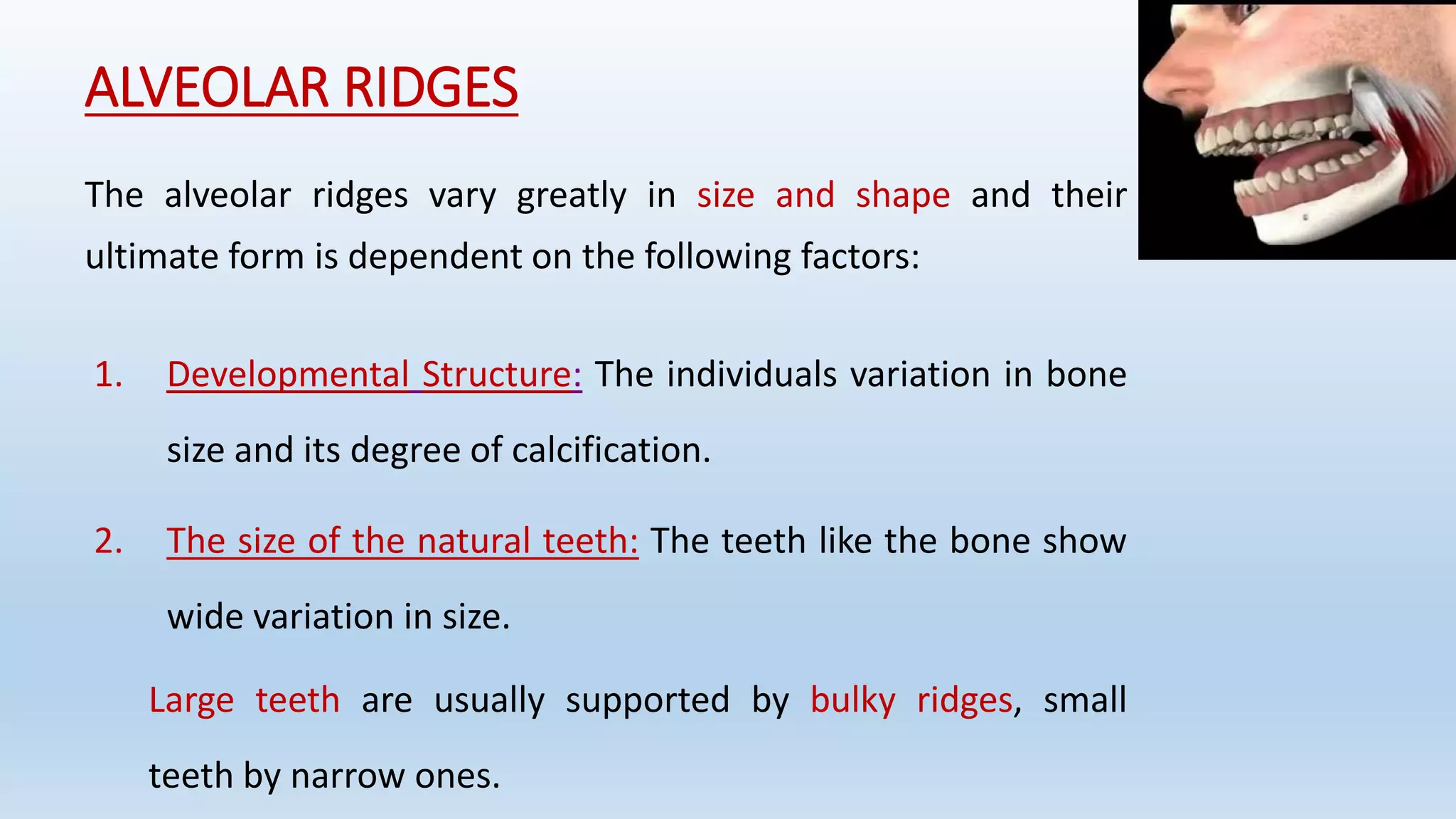
The alveolar ridges vary greatly in size and shape and their
ultimate form is dependent on the following factors:
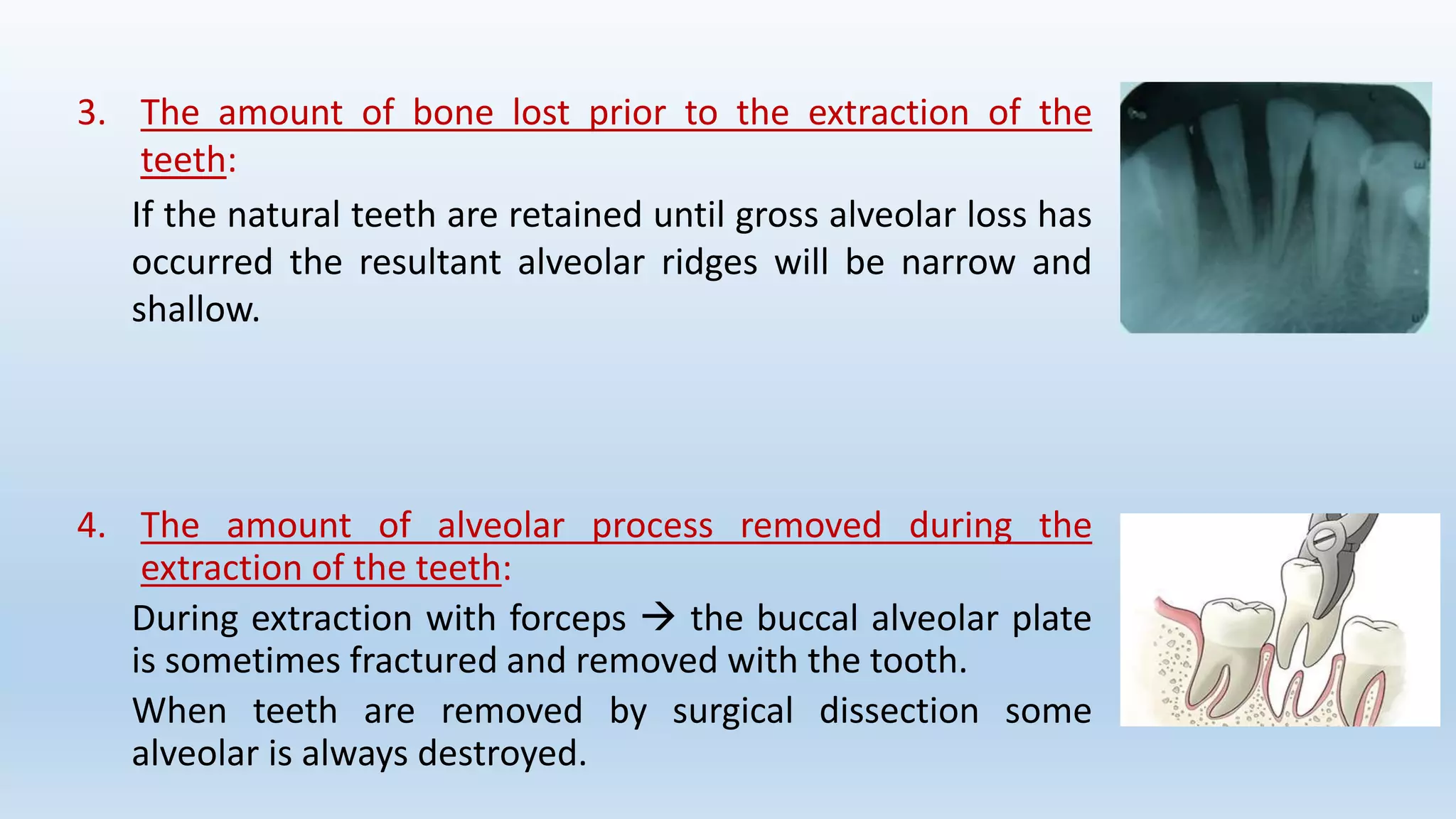
3. The amount of bone lost prior to the extraction of the
teeth:
If the natural teeth are retained until gross alveolar loss has
occurred the resultant alveolar ridges will be narrow and
shallow.
4. The amount of alveolar process removed during the
extraction of the teeth:
During extraction with forceps  the buccal alveolar plate
is sometimes fractured and removed with the tooth.
When teeth are removed by surgical dissection some
alveolar is always destroyed.
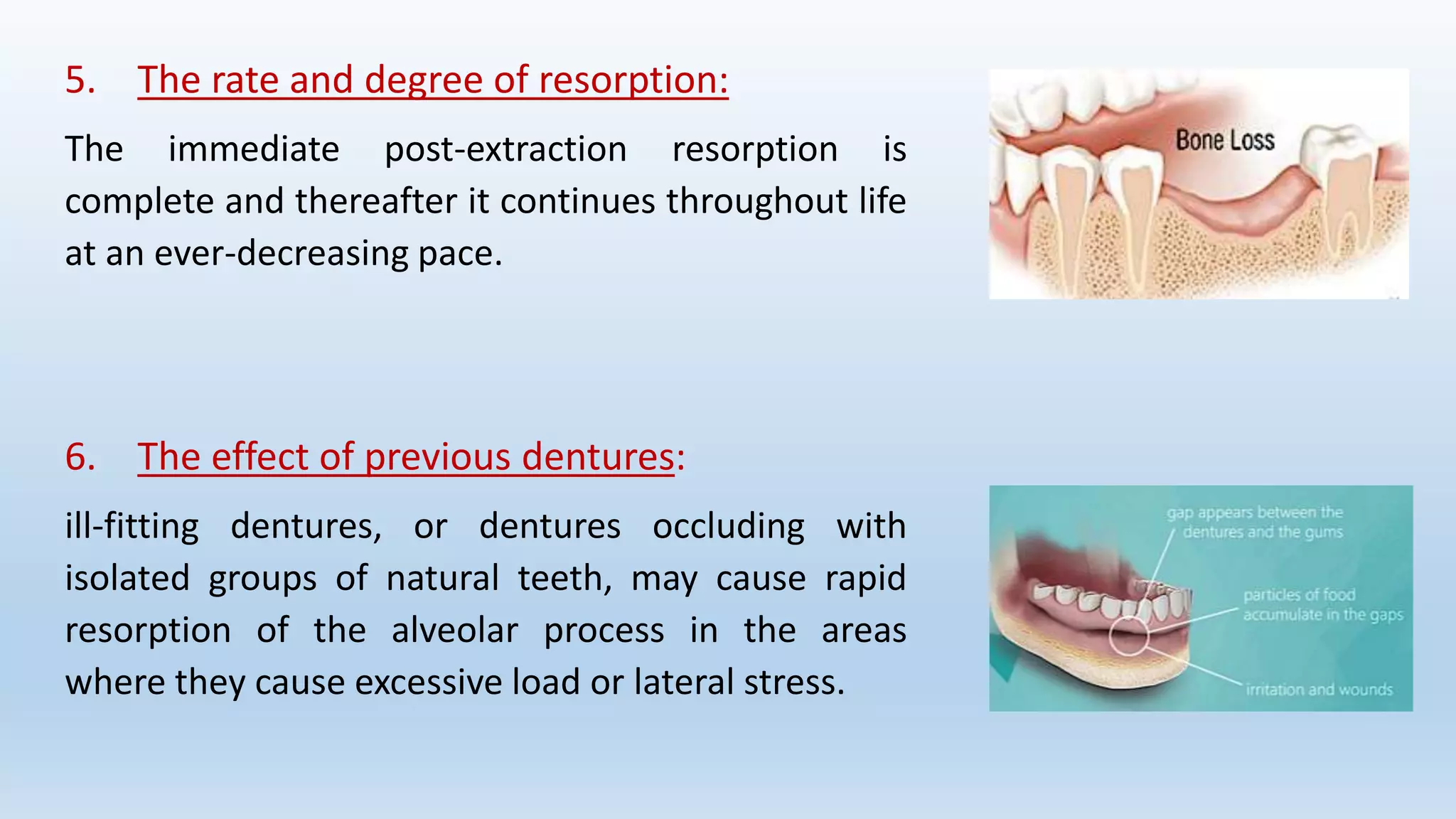
5. The rate and degree of resorption:
The immediate post-extraction resorption is
complete and thereafter it continues throughout life
at an ever-decreasing pace.
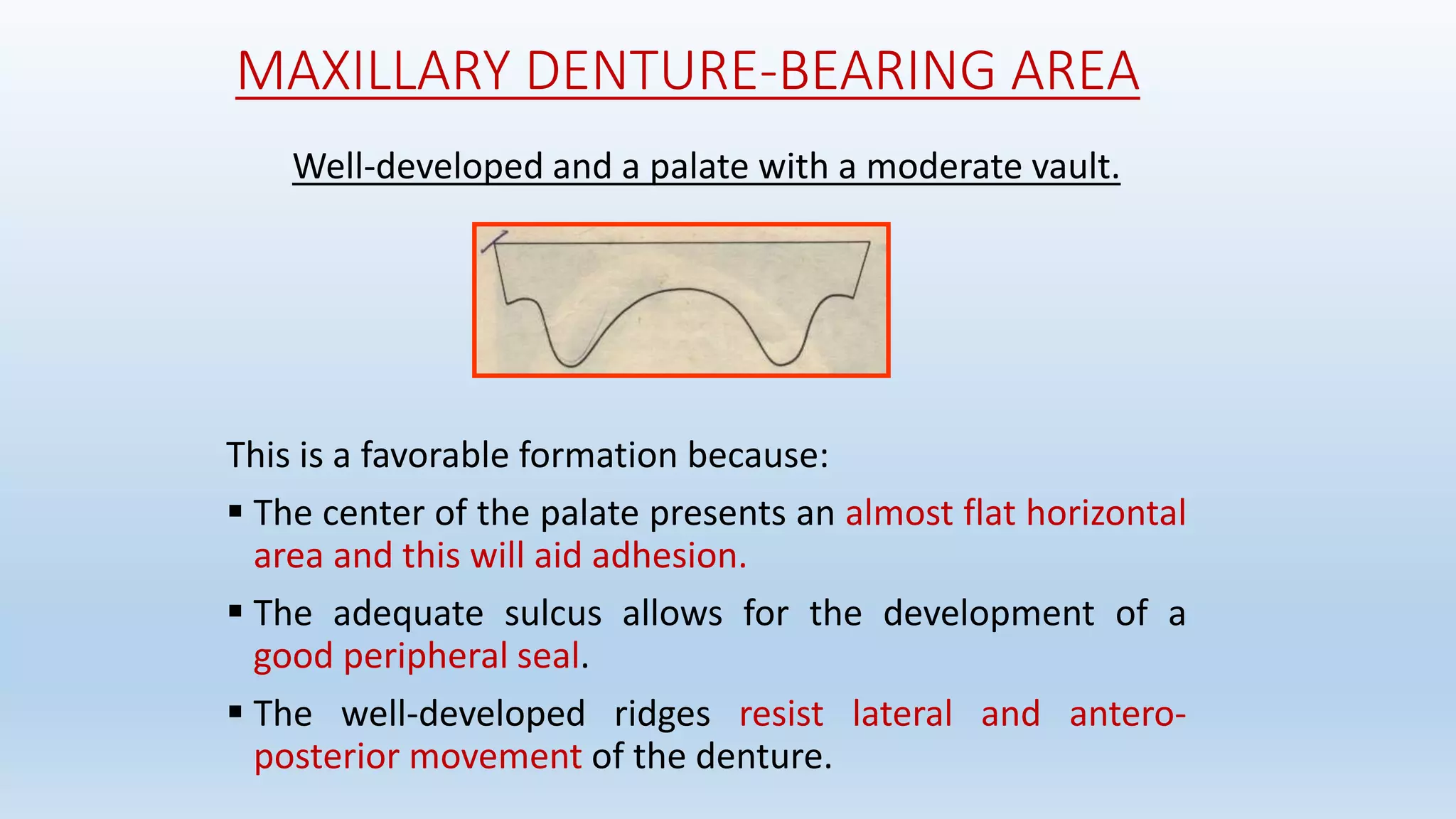
6. The effect of previous dentures:
ill-fitting dentures, or dentures occluding with
isolated groups of natural teeth, may cause rapid
resorption of the alveolar process in the areas
where they cause excessive load or lateral stress.
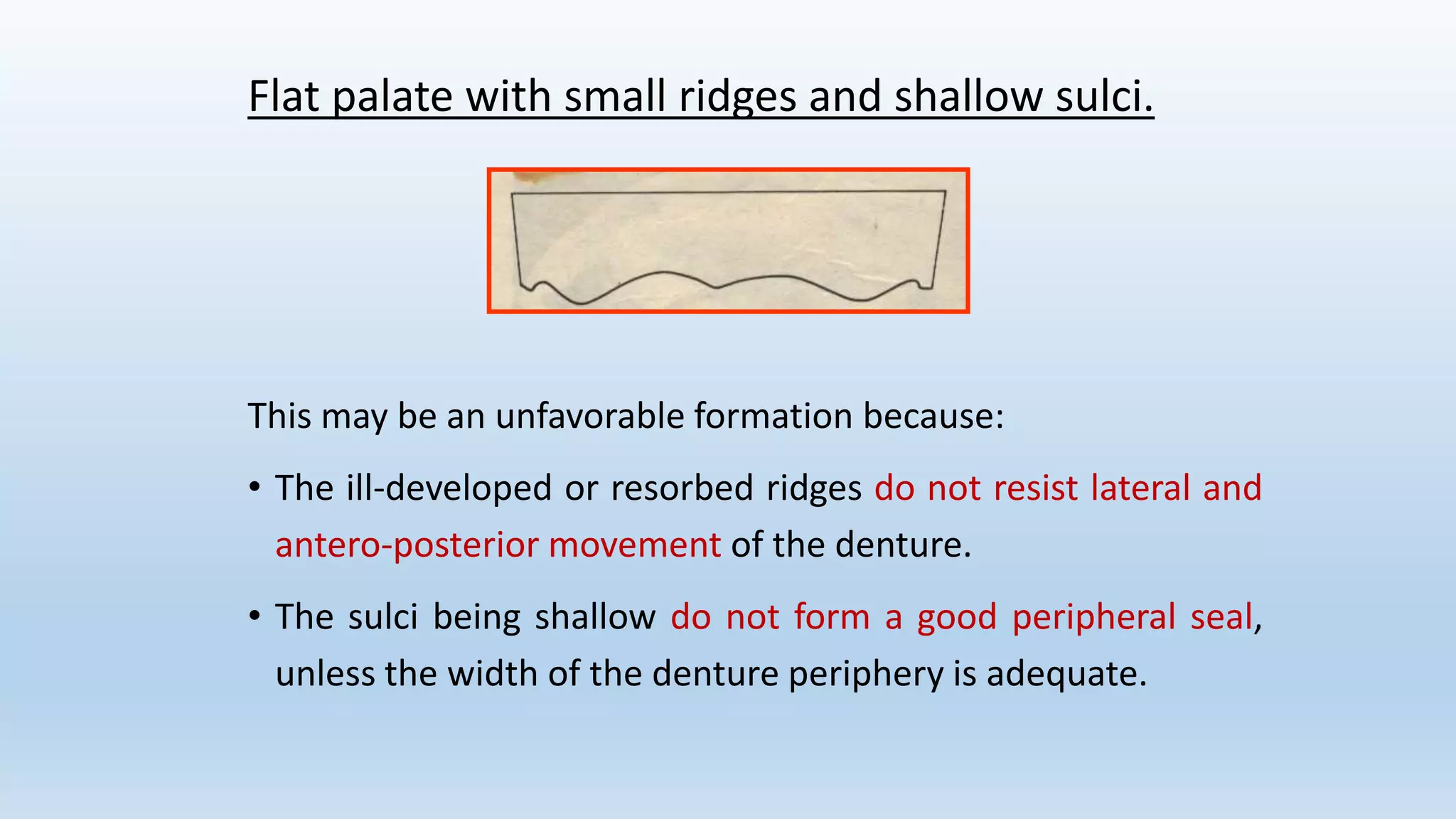
MAXILLARY DENTURE-BEARING AREA
Well-developed and a palate with a moderate vault.
This is a favorable formation because:
 The center of the palate presents an almost flat horizontal
area and this will aid adhesion.
 The adequate sulcus allows for the development of a
good peripheral seal.
 The well-developed ridges resist lateral and antero-
posterior movement of the denture.
High V-shaped palate usually associated with thick bulky
ridges.
This may be an unfavorable formation because:
• The forces of adhesion and cohesion are not at right angles to the
surface when counteracting the normal displacing forces of gravity
and so peripheral seal is essential.
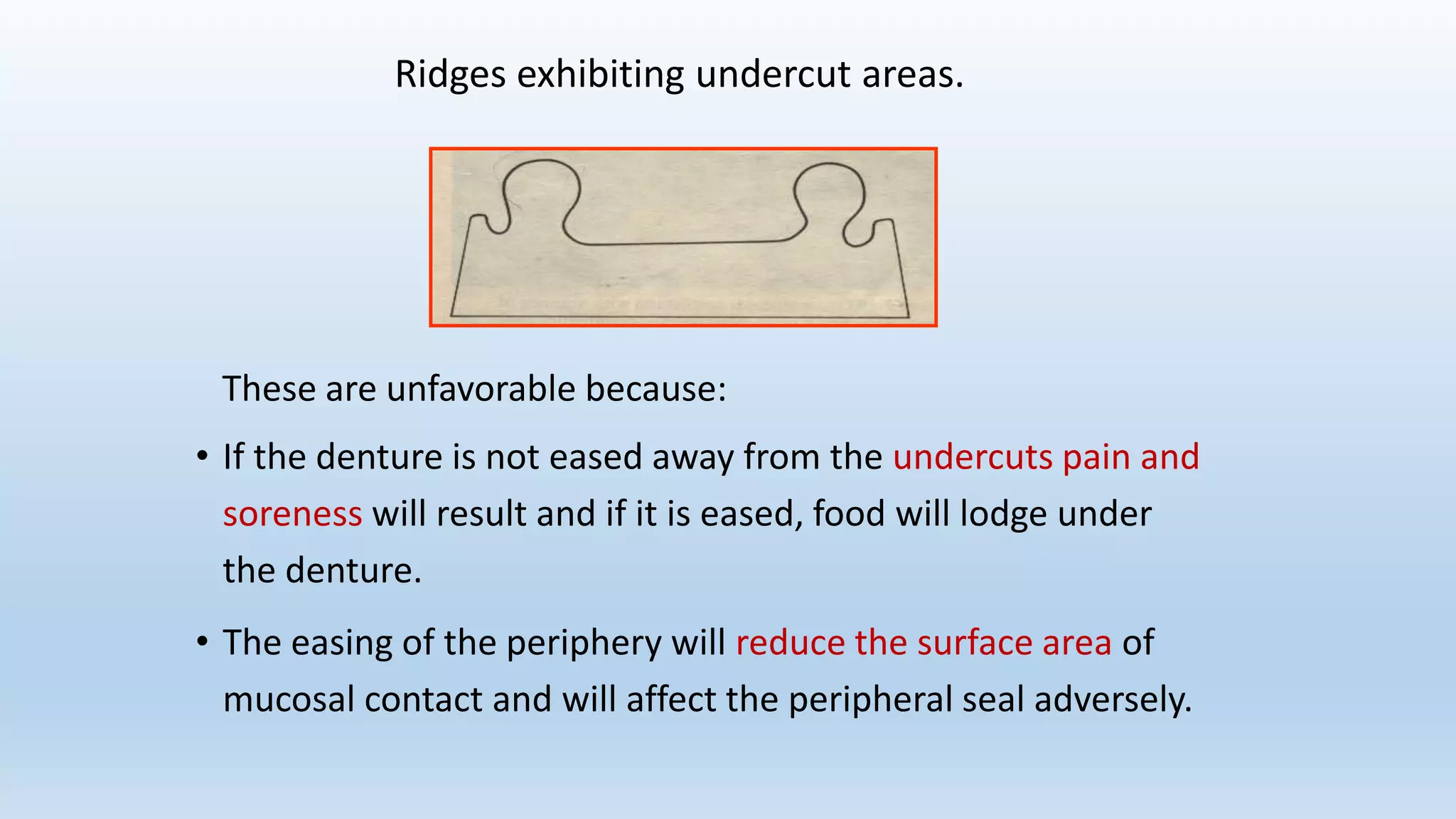
Flat palate with small ridges and shallow sulci.
This may be an unfavorable formation because:
• The ill-developed or resorbed ridges do not resist lateral and
antero-posterior movement of the denture.
• The sulci being shallow do not form a good peripheral seal,
unless the width of the denture periphery is adequate.
Ridges exhibiting undercut areas.
These are unfavorable because:
• Frequently the flanges of the denture need to be
trimmed in order to be able to insert it and this may
reduce the effectiveness of the peripheral seal.
MANDIBULAR DENTURE-BEARING AREA
Broad and well developed ridges.
This is a favorable formation because:
• It provides a large area on which to rest the denture and
prevents lateral and anteroposterior movement.
• The surface presented for adhesion is large.
• The lingual, labial and buccal sulci are satisfactory for developing
a close peripheral seal.
Ridges exhibiting undercut areas.
These are unfavorable because:
• If the denture is not eased away from the undercuts pain and
soreness will result and if it is eased, food will lodge under
the denture.
• The easing of the periphery will reduce the surface area of
mucosal contact and will affect the peripheral seal adversely.
Well developed but narrow or knife like ridges
These are unfavorable because:
• The pressure of the denture during clenching and
mastication on the sharp ridge will cause pain.
• Adhesive and cohesive forces are negligible.
Flat and atrophic ridges.
These are unfavorable because:
• No resistance is offered to anteroposterior or lateral
movements.
• Frequently found to have resorbed to the level of
attachments of the mylohyoid, genioglossus and
buccinators muscles and if the denture base is made
sufficiently narrow not to encroach on these structures,
its area is too small for the denture to function correctly.
DIETARY GUIDELINES FOR PATIENTS AT RISK OF LOSING BONE
• Maintain a high daily calcium intake.
• Obtain four servings of low fat dairy foods or obtain equivalent amounts
of calcium from green gram, canned fish.
• Take calcium supplements if dietary intake is low.
• Prevent negative calcium balance -
 Limit daily alcohol (2 glasses) and caffeine (2 cups) intake
 Consume about 6 ounces of protein from meat, poultry and fish
 Use small amounts of processed foods high in sodium
• Obtain 4000 I.U of Vitamin D daily - Spend 15 minutes in the sun 3 times a
week or choose a multivitamin or calcium supplement that contains 4000
I.U of Vitamin D.
ALVEOLAR BONE – FIXED PARTIAL
DENTURE POINT OF VIEW
• Unfortunately, any deficiency or potential problem that may arise
during the fabrication of a pontic is often identified only after the
teeth have been prepared or even when the master cast is ready to
be sent to the laboratory.
• Proper preparation includes a careful analysis of the critical
dimensions of the edentulous areas:
• Mesiodistal width.
• Buccolingual diameter.
• Occlusocervical distance.
• Location of the residual ridge.
• An ideally shaped ridge  smooth, regular surface of
attached gingiva, which facilitates maintenance of a plaque-
free environment.
• Its height and width allow placement of a pontic that
appears to emerge from the ridge and mimics the appearance
of the neighboring teeth.
• Facially, it must be free of frenum attachment and of
adequate facial height to sustain the appearance of
interdental papillae.
Residual Ridge Contour
Siebert has classified residual ridge deformities into three categories:
1. Class I defects- faciolingual loss of tissue width with normal ridge height
2. Class II defects- loss of ridge height with normal ridge width.
3. Class III defects- a combination of loss in both dimensions.
Surgical Modification
1. Roll technique uses soft tissue from the lingual side of
the edentulous site. The epithelium is removed, and
the tissue is thinned and rolled back, thereby
thickening the facial aspect of the residual ridge.
2. Interpositional graft is a wedge-shaped connective tissue
graft which is inserted into a pouch preparation on the
facial aspect of the residual ridge.
3. Pouches may be prepared in the facial aspect of the residual
ridge, into which sub-epithelial or submucosal grafts may be
inserted.
ALVEOLAR BONE –
IMPLANTOLOGY POINT OF VIEW
AVAILABLE BONE
Available bone describes the amount of bone in the edentulous
area considered for implantation and is measured in:
• Height.
• Width.
• Length
• Angulation.
• Crown-Implant body ratio.
AVAILABLE BONE HEIGHT
• The height of available bone is measured from –
the crest of the edentulous ridge to the opposing
Landmark (such as maxillary sinus, mandibular canal,
maxillary nares, inferior border of the mandible,
maxillary canine eminence region etc.)
• The more dense bone may accommodate a shorter
implant.
• The minimum bone height for a predictable long-
term endosteal implant survival is 10mm.
AVAILABLE BONE WIDTH
• Width is measured between the facial and lingual
plates at the crest of the potential implant site.
• The crest is supported by a wider base.
• The root form implants of 4.0 mm crestal diameter
usually require more than 5.0 mm of bone width to
ensure sufficient bone thickness and blood supply
around the implant for predictable survival.
• These dimensions provide more than 0.5 mm bone
on each side of the implant at the crest.
AVAILABLE BONE LENGTH
• The mesio-distal length of available bone in an
edentulous area is often limited by adjacent teeth or
implants.
• The root form implants of 4.0 mm crestal diameter
usually require a minimum mesio-distal length of 7
mm.
AVAILABLE BONE ANGULATION
• Ideally the bone angulation should be such that
the long axis of the implant can be placed
parallel to the long axis of the Prosthodontic
restoration.
• In edentulous areas with wide ridge, and wider
root form implants a modification up to 30
degrees can be achieved.
CROWN-IMPLANT BODY RATIO
• The crown height is measured from the
occlusal or incisal plane to the crest of
the ridge
• the endosteal implant height from the
crest of the ridge to its apex.
• The greater the crown height, the
greater the lever arm with more lateral
forces.
MISCH BONE DENSITY CLASSIFICATION
D1 Dense cortical bone
D2 Thick dense to porous cortical bone on crest and
coarse trabecular bone within
D3 Thin porous cortical bone on crest and fine
trabecular bone within
D4 Fine trabecular bone
D5 Immature, non mineralized bone
ANATOMIC LOCATION OF BONE DENSITY
TYPES (% OCCURRENCE)
BONE ANT:
MAXILLA
POST:
MAXILLA
ANT:
MANDIBLE
POST:
MANDIBLE
D1 0 0 6 3
D2 25 10 66 50
D3 65 50 25 46
D4 10 40 3 1
RADIOGRAPHIC BONE DENSITY
• CT scan can determine bone density precisely.
• Each CT image has pixels and each pixel has a CT number (Housefield unit).
• Higher the Housefield unit, denser the tissue.
D1 >1250 Housefield units
D2 850-1250 Housefield units
D3 350-850 Housefield units
D4 150-350 Housefield units
D5 < 150 Housefield units
FATE OF ALVEOLAR
BONE
PATHOLOGICAL
CHERUBISM
• Extensive maxillary involvement may stretch the skin
to expose the sclera.
• Marked enlargement of maxilla and the mandible
and multiple missing teeth.
Prosthodontic Treatment :
• use of implants may be restricted in these patients.
• an overdenture may represent an alternative treatment
option.
Hyckel P, Berndt A, Schleier P, Clement JH, Beensen V, Peters H, et al. Cherubism – new hypotheses on pathogenesis and
therapeutic consequences. J Craniomaxillofac Surg 2005;33:61-8.
FIBROUS DYSPLASIA
• Painless enlargement of the affected bone.
Treatment :
• Primary treatment for fibrous dysplasia depends on the size of the lesion.
• Trimming and surface contouring of the affected bone.
• Curettage of bony cavities and packing with bone chips remain the
recommended treatments.
Prosthetic management :
• Fabrication of an immediate surgical obturator followed by interim
obturator to permit early rehabilitation of physiological, cosmetic and
psychological deficiencies;
• and later, definitive obturators are fabricated after complete healing has
taken place.
Laney WR. Maxillofacial prosthetics. Vol 4. 1st edn. Massachusetts: PSG Publishing Company, 1979:86–92.
OSTEOSARCOMA
• Swelling, pain, loosening of teeth, paresthesia are common complaints.
Treatment :
• Wide radical resection is the treatment of choice for osteosarcoma of jaws
with clearance margins of 1.5–2 cm.
• Surgery and adjuvant chemotherapy and radiotherapy may be required
sometimes.
• Hemimandibulectomy is common and subtotal inferior maxillectomy for
selected malignancies located on the alveolar ridge, palate and involving
the antral floor .
Maxillofacial rehabilitation of a 7-year- old boy with osteosarcoma of the mandible using a free fibula flap and
implant-supported prosthesis: A clinical report
Prosthetic Treatment :
• Reconstruction if good prognosis and radicality with free flaps .
• Surgical obturators are those that are placed at the time of
surgery.
• Post-surgical obturators are those prostheses which are placed
immediately after packing removal, used until tissue contracture
is minimal, and prior to definitive obturator placement.
• Maxillofacial rehabilitation using dental implants (cases of
hemi-mandilectomy involving borders )
• Guide flange prosthesis if associated with any deviation .
Bennett JH, Evans AW, Speight PM. Osteosarcoma of the jaws: A 30-year retrospective review. Oral
Surg Oral Med Oral Pathol Oral Radiol Endod 2000; 90 : 323-333.
OSTEITIS DEFORMANS (Paget’s Disease)
• Progressive, symmetric maxillary enlargement that may reach
massive proportions.
• Replacement of normal bone with highly vascularized , low
density bone .
Treatment :
• Diminished bone quality  relative contraindication to the use
of dental implants .
• Palatal expansions  bone contouring
Laney WR. Maxillofacial prosthetics. Vol 4. 1st edn. Massachusetts: PSG Publishing Company, 1979:86–92.
OSTEOPETROSIS
Marked increase in bone density & Bone marrow is replaced by
dense bone.
Treatment :
• Avoid dental extraction  chances of bone infection and fracture are more.
• If patient is partially or completely edentulous only removable type of
prosthesis is advisable as bones are hypo-calcified and maintenance of oral
hygiene is easy with removable prosthesis.
Veena Jain et al.Clinical considerations for prosthodontic rehabilitation of intermediate form of osteopetrosis: A report of two
cases. J Oral Biol Craniofac Res. 2012 May-Aug; 2(2): 126–130.
OSTEOPOROSIS
• Osteoporosis has been defined by WHO in 1994 as “a
disease characterized by low bone mass and micro
architectural deterioration of bone tissue leading to
enlarged bone fragility and a consequent increase in
fracture risk”
• The osteoporotic bones will become weak and are prone to
fractures.
• Osteoporosis means “porous bone” is a “silent disease”.
• Healthy bone microscopically appears like a honeycomb
but, in osteoporotic patients the spaces are much bigger.
• The osteoporotic bone will have less density or mass .
Treatment :
• Reducing the stresses on the bone by modifying the treatment plan with
specific precautions is considered in these patients .
Fabricating the Removable dentures :
• The main area of focus should be on reduction of the forces on residual
ridge.
• Mucostatic or open mouth impression techniques, selective pressure
impression technique, should be employed to reduce mechanical forces
while impression making,.
• semi anatomic or non anatomic teeth with narrow buccolingual width
should be selected.
• Optimal use of soft liners, extended tissue intervals by keeping the
dentures out of mouth for 10 hours a day can be advised.
Fabricating the fixed dentures :
• The fabrication of FPD should follow treatment of osteoporosis rather
than preceding it since fabricating fixed partial denture in
periodontally compromised abutments it may accelerate the bone
loss in osteoporotic patients
• Refer patient for bone density screenings .
Von Wowern N. General and oral aspects of osteoporosis: a review. Clin Oral Investig. 2001;5:71–
82. [PubMed]
Osteoradionecrosis
• Osteoradionecrosis (ORN) is a condition of nonvital
bone in a site of radiation injury.
• ORN can be spontaneous, but it most commonly
results from tissue injury.
• The absence of reserve reparative capacity is a result
of the prior radiation injury.
• Not unrealistic to expect reduced tissue tolerance to function with
removable prostheses
• decreased potential for Osseo integration of dental implants .
• conservative prosthodontic intervention for tissue-borne prostheses is
recommended for patients with active osteonecrosis, regardless of the
predisposing factors.
Treatment :
Marx RE. Osteoradionecrosis: a new concept of its pathophysiology. J Oral Maxillofac Surg 1983;41:283-8.
Exostosis
• A benign, localized, peripheral overgrowth of bone of
unknown etiology.
• It may be a nodular, flat or pedunculated protuberance
located on the jawbones’ alveolar surfaces .
Treatment :
• Does not necessitate any surgical intervention unless in the event of
tissue trauma, periodontal or prosthodontic complications.
• chiseled off of the jaw or removed by bone-burr cutting/smoothing
through the base of the bony lump.
Chew CL, Tan PH (1984) Torus palatinus. A clinical study. Aust Dent J 29: 245-248.
Prosthetic management :
• Boksman and Carson  new approach to taking impressions of exostosis, torus
mandibularis, torus palatinus and mal-positioned teeth, which incorporates the
use of a disposable heat moldable tray.
• Removable dentures -- maxillary Closed Horse shoe , horse shoe , A-P Palatal
strap & mandibular  it is mandatory to remove the tori or labial bar .
• Ezzat AKH et al suggested the Butterfly design for the mandibular tori in the
partially edentulous arch .
CONCLUSION
• Understanding of the alveolar bone is very important from a
prosthodontic point of view as the bone forms the
foundation for both removable and fixed prosthesis.
• Hence, a proper knowledge of bone development, anatomy,
physiology and pathology helps us to clearly understand the
various patterns and changes the bone may present to us.
• All this may eventually be used in clinical application and
help us to give a better prosthesis for the patient.
REFERENCES
1. Human Oral Embryology and Histology. I. A. Mjor & O. Fejerskov.
2. A Color Atlas and Textbook Of Oral Anatomy.B.K.B. Berkovitz.
3. Dental Histology & Embryology. A. N. Radhakrishnan.
4. Essentials of Complete Denture Prosthodontics (2nd edition)
Sheldon Winkler.
5. Contemporary Implant Dentistry (2nd edition) Carl E. Misch.
6. Clinical Removable Partial Prosthodontics (2nd edition) Kenneth L.
Stewart.
7. Fundamentals of Fixed Prosthodontics (3rd edition) Herbert T.
Shillingburg.
8. Dyer MRY, Ball J. Alveolar crest recession in the edentulous. Br Dent J
1980;149:290-2.
10. Glickman, I. : The Periodontal Structures and Removable Partial
Denture Prosthesis, J.A.D.A 37: 311-316, 1948.
11. Hyckel P, Berndt A, Schleier P, Clement JH, Beensen V, Peters H, et al.
Cherubism – new hypotheses on pathogenesis and therapeutic
consequences. J Craniomaxillofac Surg 2005;33:61-8.
12. Laney WR. Maxillofacial prosthetics. Vol 4. 1st edn. Massachusetts: PSG
Publishing Company, 1979:86–92.
13. Maxillofacial rehabilitation of a 7-year- old boy with osteosarcoma of
the mandible using a free fibula flap and implant-supported prosthesis:
A clinical report
14. Chew CL, Tan PH (1984) Torus palatinus. A clinical study. Aust Dent J 29:
245-248.
Alveolar bone in prosthodontics

Alveolar bone in prosthodontics

  • 1.
    ALVEOLAR BONE AND ITSRELEVANCE IN PROSTHODONTICS. Guided by: Dr. S M Gundawar Dr. U M Radke Dr. N A Pande Professor & Guide HOD & Professor Professor Dr. S Deshmukh Dr. T.K. Mowade Dr. Rajlakshmi Banerjee Reader Reader Reader Presented by:- Dr. Richa Sahai I MDS
  • 2.
    CONTENTS  Definitions  Functions& Composition of bone  Classification of bone  Anatomy and Development of Alveolar Bone  Histological Structure  Influence of systemic diseases, vitamins, hormones & drugs on the alveolar bone  Sequelae of tooth loss  Residual Ridge resorption and classification  Alveolar Bone from Prosthodontic point of view  Pathological Fate of Alveolar Bone and its implications In prosthodontics  Conclusion
  • 3.
    DEFINITIONS • ALVEOLAR PROCESS- That part of the mandible and the maxilla in which the teeth are located . • ALVEOLAR BONE PROPER or BUNDLE BONE (Sicher`s) - The alveoli that supports the teeth are found within the alveolar process, and the bone lining the alveoli is called the alveolar bone proper . • ALVEOLAR BONE (GPT 9): The bony portion of the mandible or maxillae in which the roots of the teeth are held by fibers of the periodontal ligament; syn : alveolus, dental alveolus .
  • 4.
    • Basal bone- The osseous part of the maxillae or the mandible exclusive of the alveolar process. (GPT 8) • Cancellous bone - The reticular, spongy or the lattice like portion of the bone. (GPT 8) • Alveolar crest - Also called as the residual ridge crest. It is the most coronal portion of the residual ridge. (GPT 8) • Alveolar resorption - It is a term used for the diminishing quantity and the quality of the residual ridge after the teeth are removed. (GPT 8) • Alveolus or Alveoli - One of the cavities or the sockets within the alveolar process of the maxilla or the mandible in which the attachment complex held the roots of the tooth after the tooth’ removal.
  • 5.
  • 6.
  • 7.
    CELLS OF BONE Osteoblasts  Osteocytes  Osteoclasts
  • 8.
     uninucleated cellsthat synthesize both collagenous and noncollagenous bone protein.  Responsible for mineralization .  Derived from a multipotent mesenchymal cell.  Exhibit high levels of alkaline phosphate on the outer surface of their plasma membranes. 1. Osteoblasts
  • 9.
     The numberof osteoblasts that become osteocytes varies depending on the rapidity of bone formation  The more rapid the formation, the more osteocytes are present per unit volume.  Embryonic bone and repair bone have more osteocytes than lamellar bone.  Gradually lose most of their matrix synthesizing machinery and become reduced in size . 2. Osteocytes
  • 10.
     Multinucleated ,much larger cells.  Generally seen in a cluster rather than singly.  It is characterized by acid phosphatase within its cytoplasmic vesicles and vacuoles  distinguishes it from other giant cells and macrophages.  Typically osteoclasts are found against the bone surface occupying shallow, hollowed out depressions, called Howship’s lacunae. 3. OSTEOCLASTS
  • 11.
    CLASSIFICATION OF BONE •Macroscopically, osseous structure is classified according to density as Compact or Trabecular bone. • But practically, bone mass is actually a combination of Fine Trabeculae, Coarse Trabeculae, Porous Compacta and Dense Compacta. • Microscopically bones are composed of Woven bone, Lamellar bone, Bundle bone and Composite bone.
  • 12.
    1. Woven bone •Highly cellular. • Formed rapidly (30-50 µm/ day or more) in response to growth or injury. • Low mineral content. • Random fiber orientation and minimal strength. • Stabilize unloaded Endosseous implants during initial healing.
  • 13.
    2. Lamellar bone •Principle load bearing tissue of adult skeleton. • Predominant component of mature cortical and trabecular bone. • Formed relatively slowly (<1 µm/ day). • Densely mineralized and highly organized matrix.
  • 14.
    3. Bundle bone •Characteristic of ligament and tendon attachments along bone-forming surfaces. • Sharpey’s fibers from adjacent connective tissue insert directly into bone. • Bundle bone is formed adjacent to the periodontal ligament of natural teeth.
  • 15.
    4. Composite bone •High quality lamellar bone deposited on a woven bone matrix. • Got adequate strength for load bearing. • Important in achieving stabilization of an implant during the rigid integration process.
  • 16.
    16 Functions of thealveolar bone 1. As a unit to distribute and resorb functional forces. 2. As a mineralizing supporting tissue for teeth. 3. Provides attachment to muscles. 4. Provides framework for bone marrow. 5. Skeletal functions. – Support & Protection 6. Reservoir of minerals. (calcium) 7. Works in conjunction with lungs and Kidneys to help maintain the body’s PH balance through the production of additional phosphates and carbonates. 8. Helps in nerve muscle electrical change conduction.
  • 17.
    17 Anatomy of AlveolarBone Alveolar bone in both Maxilla and the mandible can be divided into two parts : a) Basal bone (is located apically and is not related to the teeth) b) Alveolar bone or Alveolar bone proper (inner cortical plate) • Inner wall of the socket  thin compact bone is called as alveolar bone proper. (Radiographically seen as lamina dura ) • Histologically- series of large openings through which various neuro-vascular bundles link the periodontal ligament and is also because of this called as cribriform plate
  • 18.
    18 SUPPORTING ALVEOLAR BONE: Surroundsthe alveolar bone proper and provides additional support. It consists of :- A. OUTER CORTICAL PLATE: An external plate of cortical bone formed by the Haversian bone and compact bone lamellae. B. CANCELLOUS TRABECULAE (spongy bone) : sandwiched between outer and inner cortical plates.
  • 19.
    19 Development of alveolarbone (embryogenesis) • With minimal deposition as small foci in mesenchymal matrix surrounding the tooth buds during odontogenesis . • Alveolar bone of maxilla develops in mesenchyme. In mandible, the alveolar bone develops from mesenchyme of 1st branchial arch, initially adjacent to Meckel’ cartilage. • As the 1st deciduous tooth buds appear in both maxilla and mandible, woven bone spicules loosely surround each developing tooth.
  • 20.
    20 • Growth ofeach deciduous and later permanent tooth is accompanied by growth of trabeculae of alveolar bone. • Trabeculae of woven bone grow and anastomose, extending from the developing maxilla and mandible proper to form the alveolar process. • Process of forming calcifying extracellular matrix begins in the center of spherule of aggregated osteoblasts, collagens, proteoglycans and matrix vesicles secreted by osteoblasts. • The 1st sign of hydroxyapatite calcification is seen within the matrix vesicle
  • 21.
    21 • As thewoven bone grows into trabeculae, osteoblasts are trapped in the growing calcified matrix (as osteocytes). • On the trabecular surfaces of woven bone, collagen is secreted in oriented sheets that calcify by epitaxy from the hydroxyapatite crystals in the woven bone. • The successive layers of collagen of, each sheet oriented in different planes, gives the bone LEAF-ON- LEAFLET appearance called lamellar bone.
  • 22.
    22 • Shortly after1st woven bone has formed, osteoclasts are found on the surfaces of both woven and lamellar bone, they begin process of resorption and with osteoblast, remodeling the bone into its proper shape at each stage of development. • Both alveolar bone and basal bone develop from ecto- mesenchyme. • Mandibular basal bone begins mineralization at the exit of the mental nerve from the mental foramen, whereas the maxillary bone begins at the exit of the infraorbital nerve at the infraorbital foramen.
  • 24.
    Microscopic (Histology) structure Boneis composed of basic units called lamellae which are thin plates of bone. Each lamellae has : 1) Gelatinous matrix 2) Ground substance of collagen fibers 3) Calcium salts deposited in matrix. Lamellae are placed one above another with small spaces between them  called LACUNAE. - These are arranged as concentric plates around a small central canal. - Such a collection of lamellae is called a HAVERSIAN SYSTEM OR OSTEONE (cylinder of bone, oriented in long axis of bone.
  • 25.
    Lamellae are 3types based on their placement - a) Circumferential Lamellae These enclose entire adult bone, forming its outer perimeter. b) Concentric lamellae These make up the bulk of compact bone. c) Interstitial Lamellae Are interspersed between concentric Lamellae and filling spaces between them. Volkmann's canals , are interconnecting channels containing blood vessels. They interconnect the adjacent Haversian canals.
  • 26.
    Influence of systemicdiseases • Protein deficiency – loss of alveolar bone due to inhibition of normal bone forming activity. • Acute starvation results in osteoporosis and reduction in height of alveolar bone. • In hyperpitutarism (acromegaly) - over growth of alveolar bone  increase in size of dental arch. • Ridge resorption  associated with hyperparathyroidism and Von Recklinghausen's disease (VRD) due to increased bone loss. • Radiological findings of hyperparathyroidism -- alveolar osteoporosis with closely meshed trabeculae, widening of PDL space and loss of lamina dura. • Complete loss of lamina dura in Paget's disease, Fibrous dysplasia, osteomalasia.
  • 27.
    • Diabetes mellitus rapid alveolar bone loss. • In acute, sub acute leukemia marrow of alveolar bone exhibits localized areas of necrosis, thrombosis of blood vessels, leukocytic infiltration and replacement of fatty marrow with fibrous tissue. • In agranulocytosis  osteoporosis of alveolar bone with osteoclastic resorption, necrosis of alveolar bone and hemorrhage in the marrow occur. • Mercury and benzene intoxication  destruction of alveolar bone. • Other chemicals ( phosphorous, arsenic and chromium)  necrosis of alveolar bone.
  • 28.
    Effect of hormones •PTH has direct action on adult bone  responsible for maintenance of normal blood calcium levels. • In alveolar bone, PTH liberates both calcium and phosphate. • Circulating PTH is high  osteoporosis  resorption of alveolar ridge. • Decreased PTH level  increase formation of bone  resorption of alveolar bone is reduced. Calcitonin – It has antagonist action compared to PTH. Estrogen : deficiency causes increased bone resorption activity. Osteoporosis is predominant side effect of menopause  due to decrease of estrogen production.
  • 29.
    Effects of vitaminson alveolar bone : • Hypervitaminosis D - generalized resorption changes in bone including alveolar bone. • Avitaminosis D - decreased concentration of blood phosphate and retarded calcification. • Hypovitaminosis A - overall bone growth retardation and in later stages endochondral bone growth ceases entirely. • Hypovitaminosis C – SCURVY  causes failure of collagen production in bone. Effects of Drugs on alveolar bone : • Generalized decrease in alveolar bone mass  chronic corticosteroid therapy, anticonvulsant therapy, long term high dose heparin therapy and alcoholism.
  • 30.
    ATWOODS CLASSIFICATION Order I:pre-extraction. Order II: post extraction. Order III: high, well rounded. Order IV: knife edge. Order V: low, well rounded. Order VI: depressed. Sequelae of Tooth Loss
  • 31.
    According to Brane-market al in 1985, ridge resorption were classified on the basis of bone quantity and bone quality by radiographic means : BONE QUANTITY Class A : Most of the alveolar bone is present. Class B : Moderate residual ridge resorption occurs. Class C : Advanced residual ridge resorption occurs. Class D : Moderate resorption of the basal bone is present. Class E : Extreme resorption of the basal bone. CLASSIFICATION OF RESIDUAL RIDGE RESORPTION
  • 32.
    BONE QUALITY Class 1:Almost the entire jaw is composed of homogenous compact bone. Class 2: A thick layer of compact bone surrounds a core of dense trabecular bone. Class 3: A thin layer of cortical bone surrounds a core of dense trabecular bone. Class 4: A thin layer of cortical bone surrounds a core of low density trabecular bone.
  • 33.
    ALVEOLAR BONE -COMPLETE DENTURE POINT OF VIEW
  • 34.
    EDENTULOUS INTRAORAL BONYCHANGES • When the alveolar bone is lost, the resultant residual ridge is progressively resorbed throughout the life of the individual (Atwood, 1971) • Edentulous bony anatomy include: a) Profound bone loss
  • 35.
    b) Slow, progressivethinning of the jaw bones
  • 36.
    c) Remodeling changes– occur in the mandible that account for the typical edentulous facial anatomy.  The overall length of the mandible does not decrease but may in fact increase as new bone is added to the mental protuberance, thus accentuating the chin point.
  • 37.
    There is ananterior displacement of the mandible (protrusive position) because of : • residual ridge reduction, • mandibular rotation (Change in the angulation of the body relative to the mandibular ramus), and • deposition of bone in the mental region.
  • 38.
    • Reduction inthe residual ridges occurs in an inferior direction in the molar and premolar areas, but in both an inferior and lingual direction in the incisor region. • There is generalized thinning of the anterior and posterior aspects of the mandibular ramus.
  • 39.
    ALVEOLAR RIDGES 1. DevelopmentalStructure: The individuals variation in bone size and its degree of calcification. 2. The size of the natural teeth: The teeth like the bone show wide variation in size. Large teeth are usually supported by bulky ridges, small teeth by narrow ones. The alveolar ridges vary greatly in size and shape and their ultimate form is dependent on the following factors:
  • 40.
    3. The amountof bone lost prior to the extraction of the teeth: If the natural teeth are retained until gross alveolar loss has occurred the resultant alveolar ridges will be narrow and shallow. 4. The amount of alveolar process removed during the extraction of the teeth: During extraction with forceps  the buccal alveolar plate is sometimes fractured and removed with the tooth. When teeth are removed by surgical dissection some alveolar is always destroyed.
  • 41.
    5. The rateand degree of resorption: The immediate post-extraction resorption is complete and thereafter it continues throughout life at an ever-decreasing pace. 6. The effect of previous dentures: ill-fitting dentures, or dentures occluding with isolated groups of natural teeth, may cause rapid resorption of the alveolar process in the areas where they cause excessive load or lateral stress.
  • 42.
    MAXILLARY DENTURE-BEARING AREA Well-developedand a palate with a moderate vault. This is a favorable formation because:  The center of the palate presents an almost flat horizontal area and this will aid adhesion.  The adequate sulcus allows for the development of a good peripheral seal.  The well-developed ridges resist lateral and antero- posterior movement of the denture.
  • 43.
    High V-shaped palateusually associated with thick bulky ridges. This may be an unfavorable formation because: • The forces of adhesion and cohesion are not at right angles to the surface when counteracting the normal displacing forces of gravity and so peripheral seal is essential.
  • 44.
    Flat palate withsmall ridges and shallow sulci. This may be an unfavorable formation because: • The ill-developed or resorbed ridges do not resist lateral and antero-posterior movement of the denture. • The sulci being shallow do not form a good peripheral seal, unless the width of the denture periphery is adequate.
  • 45.
    Ridges exhibiting undercutareas. These are unfavorable because: • Frequently the flanges of the denture need to be trimmed in order to be able to insert it and this may reduce the effectiveness of the peripheral seal.
  • 46.
    MANDIBULAR DENTURE-BEARING AREA Broadand well developed ridges. This is a favorable formation because: • It provides a large area on which to rest the denture and prevents lateral and anteroposterior movement. • The surface presented for adhesion is large. • The lingual, labial and buccal sulci are satisfactory for developing a close peripheral seal.
  • 47.
    Ridges exhibiting undercutareas. These are unfavorable because: • If the denture is not eased away from the undercuts pain and soreness will result and if it is eased, food will lodge under the denture. • The easing of the periphery will reduce the surface area of mucosal contact and will affect the peripheral seal adversely.
  • 48.
    Well developed butnarrow or knife like ridges These are unfavorable because: • The pressure of the denture during clenching and mastication on the sharp ridge will cause pain. • Adhesive and cohesive forces are negligible.
  • 49.
    Flat and atrophicridges. These are unfavorable because: • No resistance is offered to anteroposterior or lateral movements. • Frequently found to have resorbed to the level of attachments of the mylohyoid, genioglossus and buccinators muscles and if the denture base is made sufficiently narrow not to encroach on these structures, its area is too small for the denture to function correctly.
  • 50.
    DIETARY GUIDELINES FORPATIENTS AT RISK OF LOSING BONE • Maintain a high daily calcium intake. • Obtain four servings of low fat dairy foods or obtain equivalent amounts of calcium from green gram, canned fish. • Take calcium supplements if dietary intake is low. • Prevent negative calcium balance -  Limit daily alcohol (2 glasses) and caffeine (2 cups) intake  Consume about 6 ounces of protein from meat, poultry and fish  Use small amounts of processed foods high in sodium • Obtain 4000 I.U of Vitamin D daily - Spend 15 minutes in the sun 3 times a week or choose a multivitamin or calcium supplement that contains 4000 I.U of Vitamin D.
  • 51.
    ALVEOLAR BONE –FIXED PARTIAL DENTURE POINT OF VIEW
  • 52.
    • Unfortunately, anydeficiency or potential problem that may arise during the fabrication of a pontic is often identified only after the teeth have been prepared or even when the master cast is ready to be sent to the laboratory. • Proper preparation includes a careful analysis of the critical dimensions of the edentulous areas: • Mesiodistal width. • Buccolingual diameter. • Occlusocervical distance. • Location of the residual ridge.
  • 53.
    • An ideallyshaped ridge  smooth, regular surface of attached gingiva, which facilitates maintenance of a plaque- free environment. • Its height and width allow placement of a pontic that appears to emerge from the ridge and mimics the appearance of the neighboring teeth. • Facially, it must be free of frenum attachment and of adequate facial height to sustain the appearance of interdental papillae. Residual Ridge Contour
  • 54.
    Siebert has classifiedresidual ridge deformities into three categories: 1. Class I defects- faciolingual loss of tissue width with normal ridge height 2. Class II defects- loss of ridge height with normal ridge width. 3. Class III defects- a combination of loss in both dimensions.
  • 55.
    Surgical Modification 1. Rolltechnique uses soft tissue from the lingual side of the edentulous site. The epithelium is removed, and the tissue is thinned and rolled back, thereby thickening the facial aspect of the residual ridge. 2. Interpositional graft is a wedge-shaped connective tissue graft which is inserted into a pouch preparation on the facial aspect of the residual ridge.
  • 56.
    3. Pouches maybe prepared in the facial aspect of the residual ridge, into which sub-epithelial or submucosal grafts may be inserted.
  • 57.
  • 58.
    AVAILABLE BONE Available bonedescribes the amount of bone in the edentulous area considered for implantation and is measured in: • Height. • Width. • Length • Angulation. • Crown-Implant body ratio.
  • 59.
    AVAILABLE BONE HEIGHT •The height of available bone is measured from – the crest of the edentulous ridge to the opposing Landmark (such as maxillary sinus, mandibular canal, maxillary nares, inferior border of the mandible, maxillary canine eminence region etc.) • The more dense bone may accommodate a shorter implant. • The minimum bone height for a predictable long- term endosteal implant survival is 10mm.
  • 60.
    AVAILABLE BONE WIDTH •Width is measured between the facial and lingual plates at the crest of the potential implant site. • The crest is supported by a wider base. • The root form implants of 4.0 mm crestal diameter usually require more than 5.0 mm of bone width to ensure sufficient bone thickness and blood supply around the implant for predictable survival. • These dimensions provide more than 0.5 mm bone on each side of the implant at the crest.
  • 61.
    AVAILABLE BONE LENGTH •The mesio-distal length of available bone in an edentulous area is often limited by adjacent teeth or implants. • The root form implants of 4.0 mm crestal diameter usually require a minimum mesio-distal length of 7 mm.
  • 62.
    AVAILABLE BONE ANGULATION •Ideally the bone angulation should be such that the long axis of the implant can be placed parallel to the long axis of the Prosthodontic restoration. • In edentulous areas with wide ridge, and wider root form implants a modification up to 30 degrees can be achieved.
  • 63.
    CROWN-IMPLANT BODY RATIO •The crown height is measured from the occlusal or incisal plane to the crest of the ridge • the endosteal implant height from the crest of the ridge to its apex. • The greater the crown height, the greater the lever arm with more lateral forces.
  • 64.
    MISCH BONE DENSITYCLASSIFICATION D1 Dense cortical bone D2 Thick dense to porous cortical bone on crest and coarse trabecular bone within D3 Thin porous cortical bone on crest and fine trabecular bone within D4 Fine trabecular bone D5 Immature, non mineralized bone
  • 65.
    ANATOMIC LOCATION OFBONE DENSITY TYPES (% OCCURRENCE) BONE ANT: MAXILLA POST: MAXILLA ANT: MANDIBLE POST: MANDIBLE D1 0 0 6 3 D2 25 10 66 50 D3 65 50 25 46 D4 10 40 3 1
  • 66.
    RADIOGRAPHIC BONE DENSITY •CT scan can determine bone density precisely. • Each CT image has pixels and each pixel has a CT number (Housefield unit). • Higher the Housefield unit, denser the tissue. D1 >1250 Housefield units D2 850-1250 Housefield units D3 350-850 Housefield units D4 150-350 Housefield units D5 < 150 Housefield units
  • 67.
  • 68.
    CHERUBISM • Extensive maxillaryinvolvement may stretch the skin to expose the sclera. • Marked enlargement of maxilla and the mandible and multiple missing teeth. Prosthodontic Treatment : • use of implants may be restricted in these patients. • an overdenture may represent an alternative treatment option. Hyckel P, Berndt A, Schleier P, Clement JH, Beensen V, Peters H, et al. Cherubism – new hypotheses on pathogenesis and therapeutic consequences. J Craniomaxillofac Surg 2005;33:61-8.
  • 69.
    FIBROUS DYSPLASIA • Painlessenlargement of the affected bone. Treatment : • Primary treatment for fibrous dysplasia depends on the size of the lesion. • Trimming and surface contouring of the affected bone. • Curettage of bony cavities and packing with bone chips remain the recommended treatments. Prosthetic management : • Fabrication of an immediate surgical obturator followed by interim obturator to permit early rehabilitation of physiological, cosmetic and psychological deficiencies; • and later, definitive obturators are fabricated after complete healing has taken place. Laney WR. Maxillofacial prosthetics. Vol 4. 1st edn. Massachusetts: PSG Publishing Company, 1979:86–92.
  • 70.
    OSTEOSARCOMA • Swelling, pain,loosening of teeth, paresthesia are common complaints. Treatment : • Wide radical resection is the treatment of choice for osteosarcoma of jaws with clearance margins of 1.5–2 cm. • Surgery and adjuvant chemotherapy and radiotherapy may be required sometimes. • Hemimandibulectomy is common and subtotal inferior maxillectomy for selected malignancies located on the alveolar ridge, palate and involving the antral floor . Maxillofacial rehabilitation of a 7-year- old boy with osteosarcoma of the mandible using a free fibula flap and implant-supported prosthesis: A clinical report
  • 71.
    Prosthetic Treatment : •Reconstruction if good prognosis and radicality with free flaps . • Surgical obturators are those that are placed at the time of surgery. • Post-surgical obturators are those prostheses which are placed immediately after packing removal, used until tissue contracture is minimal, and prior to definitive obturator placement. • Maxillofacial rehabilitation using dental implants (cases of hemi-mandilectomy involving borders ) • Guide flange prosthesis if associated with any deviation . Bennett JH, Evans AW, Speight PM. Osteosarcoma of the jaws: A 30-year retrospective review. Oral Surg Oral Med Oral Pathol Oral Radiol Endod 2000; 90 : 323-333.
  • 72.
    OSTEITIS DEFORMANS (Paget’sDisease) • Progressive, symmetric maxillary enlargement that may reach massive proportions. • Replacement of normal bone with highly vascularized , low density bone . Treatment : • Diminished bone quality  relative contraindication to the use of dental implants . • Palatal expansions  bone contouring Laney WR. Maxillofacial prosthetics. Vol 4. 1st edn. Massachusetts: PSG Publishing Company, 1979:86–92.
  • 73.
    OSTEOPETROSIS Marked increase inbone density & Bone marrow is replaced by dense bone. Treatment : • Avoid dental extraction  chances of bone infection and fracture are more. • If patient is partially or completely edentulous only removable type of prosthesis is advisable as bones are hypo-calcified and maintenance of oral hygiene is easy with removable prosthesis. Veena Jain et al.Clinical considerations for prosthodontic rehabilitation of intermediate form of osteopetrosis: A report of two cases. J Oral Biol Craniofac Res. 2012 May-Aug; 2(2): 126–130.
  • 74.
    OSTEOPOROSIS • Osteoporosis hasbeen defined by WHO in 1994 as “a disease characterized by low bone mass and micro architectural deterioration of bone tissue leading to enlarged bone fragility and a consequent increase in fracture risk” • The osteoporotic bones will become weak and are prone to fractures. • Osteoporosis means “porous bone” is a “silent disease”. • Healthy bone microscopically appears like a honeycomb but, in osteoporotic patients the spaces are much bigger. • The osteoporotic bone will have less density or mass .
  • 75.
    Treatment : • Reducingthe stresses on the bone by modifying the treatment plan with specific precautions is considered in these patients . Fabricating the Removable dentures : • The main area of focus should be on reduction of the forces on residual ridge. • Mucostatic or open mouth impression techniques, selective pressure impression technique, should be employed to reduce mechanical forces while impression making,. • semi anatomic or non anatomic teeth with narrow buccolingual width should be selected. • Optimal use of soft liners, extended tissue intervals by keeping the dentures out of mouth for 10 hours a day can be advised.
  • 76.
    Fabricating the fixeddentures : • The fabrication of FPD should follow treatment of osteoporosis rather than preceding it since fabricating fixed partial denture in periodontally compromised abutments it may accelerate the bone loss in osteoporotic patients • Refer patient for bone density screenings . Von Wowern N. General and oral aspects of osteoporosis: a review. Clin Oral Investig. 2001;5:71– 82. [PubMed]
  • 77.
    Osteoradionecrosis • Osteoradionecrosis (ORN)is a condition of nonvital bone in a site of radiation injury. • ORN can be spontaneous, but it most commonly results from tissue injury. • The absence of reserve reparative capacity is a result of the prior radiation injury. • Not unrealistic to expect reduced tissue tolerance to function with removable prostheses • decreased potential for Osseo integration of dental implants . • conservative prosthodontic intervention for tissue-borne prostheses is recommended for patients with active osteonecrosis, regardless of the predisposing factors. Treatment :
  • 78.
    Marx RE. Osteoradionecrosis:a new concept of its pathophysiology. J Oral Maxillofac Surg 1983;41:283-8.
  • 79.
    Exostosis • A benign,localized, peripheral overgrowth of bone of unknown etiology. • It may be a nodular, flat or pedunculated protuberance located on the jawbones’ alveolar surfaces . Treatment : • Does not necessitate any surgical intervention unless in the event of tissue trauma, periodontal or prosthodontic complications. • chiseled off of the jaw or removed by bone-burr cutting/smoothing through the base of the bony lump. Chew CL, Tan PH (1984) Torus palatinus. A clinical study. Aust Dent J 29: 245-248.
  • 80.
    Prosthetic management : •Boksman and Carson  new approach to taking impressions of exostosis, torus mandibularis, torus palatinus and mal-positioned teeth, which incorporates the use of a disposable heat moldable tray. • Removable dentures -- maxillary Closed Horse shoe , horse shoe , A-P Palatal strap & mandibular  it is mandatory to remove the tori or labial bar . • Ezzat AKH et al suggested the Butterfly design for the mandibular tori in the partially edentulous arch .
  • 81.
    CONCLUSION • Understanding ofthe alveolar bone is very important from a prosthodontic point of view as the bone forms the foundation for both removable and fixed prosthesis. • Hence, a proper knowledge of bone development, anatomy, physiology and pathology helps us to clearly understand the various patterns and changes the bone may present to us. • All this may eventually be used in clinical application and help us to give a better prosthesis for the patient.
  • 82.
    REFERENCES 1. Human OralEmbryology and Histology. I. A. Mjor & O. Fejerskov. 2. A Color Atlas and Textbook Of Oral Anatomy.B.K.B. Berkovitz. 3. Dental Histology & Embryology. A. N. Radhakrishnan. 4. Essentials of Complete Denture Prosthodontics (2nd edition) Sheldon Winkler. 5. Contemporary Implant Dentistry (2nd edition) Carl E. Misch. 6. Clinical Removable Partial Prosthodontics (2nd edition) Kenneth L. Stewart. 7. Fundamentals of Fixed Prosthodontics (3rd edition) Herbert T. Shillingburg. 8. Dyer MRY, Ball J. Alveolar crest recession in the edentulous. Br Dent J 1980;149:290-2.
  • 83.
    10. Glickman, I.: The Periodontal Structures and Removable Partial Denture Prosthesis, J.A.D.A 37: 311-316, 1948. 11. Hyckel P, Berndt A, Schleier P, Clement JH, Beensen V, Peters H, et al. Cherubism – new hypotheses on pathogenesis and therapeutic consequences. J Craniomaxillofac Surg 2005;33:61-8. 12. Laney WR. Maxillofacial prosthetics. Vol 4. 1st edn. Massachusetts: PSG Publishing Company, 1979:86–92. 13. Maxillofacial rehabilitation of a 7-year- old boy with osteosarcoma of the mandible using a free fibula flap and implant-supported prosthesis: A clinical report 14. Chew CL, Tan PH (1984) Torus palatinus. A clinical study. Aust Dent J 29: 245-248.

Editor's Notes

  • #7 Collagen – osteiod – type I collagen & type 5 collagen . Non collagenous - osteocalcin, osteopontin, bone sialoprotein , osteonectin .
  • #9 Bone generating cells . “B” – building .
  • #10 Start . These are Mature bone cells , spider shaped , and maintains bone tissue .. As osteoblasts secrete bone matrix, some of them become entrapped in lacunae and are then called osteocytes. . AFTER - The space in the matrix occupied by an osteocyte is called the osteocytic lacuna. LAST- . Narrow extensions of these or canaliculi, that form radiating osteocytic processes maintain contact with adjacent osteocytes and osteoblasts . Failure of any part of this inter connecting system result in hyper mineralization (sclerosis) and death of the bone.
  • #11 Bone destroying cells. “C” – CHEWING 2 - Identified under the light microscopy, as singly .
  • #12 each bone has a unique form and function.
  • #13 Woven or fibrous bone
  • #16  Alveolar Bone forms the bony sockets of the jaw bones in which the roots of the natural teeth are suspended by the attachment of the periodontal ligament fibers (“Gomphosis” - Greek “Bolting together). Some alveolar bone is formed during tooth development, but the majority of alveolar bone formation occurs during tooth eruption. The presence of alveolar bone in the jaw bones is totally dependent on the roots of the natural teeth; without the teeth the alveolar bone need not exist.
  • #20 Start - Starts to form early in fetal life.
  • #25  these Lacunae contain osteocytes.
  • #28 Hypophoshatasia, an inherited disease Hypophoshatasia  premature loss of alveolar bone surrounding deciduous incisors .
  • #29 1st point -- normal blood calcium levels 10-11 mg% . PTH parathyroid hormone is probably the most important of hormones in so far as RRR is concerned. 2nd point -- When PTH is active, calcium and phosphate ions move from alveolar bone to plasma. But it is not known whether PTH acts directly or through osteoclasts.
  • #30 SCURVY  causes failure of collagen production in bone. Production of osteoid is deficient and hence calcification is restricted.
  • #36 Start - The loss of teeth means not only the loss of the clinical crown but also the supporting tissues, the periodontal ligament and alveolar bone. 2nd start - It is critical to successful dental practice that the dentist understands the anatomy of the mouth in both the dentulous and edentulous states and the results of that transition in the individual.
  • #42 3. start- Periodontal disease is a chronic inflammation of the supporting structures of the teeth and results in the destruction of the alveolar process. 4. Middle The commonest sites for this occurrence are the upper and lower canine and first molar regions.
  • #43 5. Start. During the first six weeks after the extraction of the teeth the rate of resorption is rapid. During the second six weeks it is fast but begins to slow down. At the end of three months, on average,
  • #51 End - When the area is increased to encroach on the muscles they may move the dentures when they contract.
  • #54 Start - The edentulous areas where a fixed prosthesis is to be provided may be overlooked during the treatment planning phase.
  • #55 Start - The contour of the edentulous ridge should be carefully evaluated during the treatment planning phase.
  • #56 Loss of residual ridge contour may lead to : unaesthetic open gingival embrasures (“Black triangles”), food impaction, and percolation of saliva during speech.
  • #57 Start- Although residual ridge width may be augmented with hard tissue grafts, this is usually not indicated unless the edentulous site is to receive an implant.
  • #61 After 1 . The minimum height of the available bone for endosteal implants is in part related to the density of the bone.
  • #67 D1 – dense cortical bone
  • #70 It is a rare, inherited developmental abnormality disorder characterized by – abnormal bone tissue in the lower part of the face .   that causes bilateral enlargement of the maxilla and/or mandible. Beginning in early childhood, both the lower jaw (the mandible) and the upper jaw (the maxilla) become enlarged as bone is replaced with painless, cyst-like growths. Implants - extensive bone resorption and leave only a fenestrated shell of cortical bone
  • #71 - non-neoplastic hamartomatous developmental fibro-osseous lesion of bone.
  • #72 1 - Osteosarcoma (OS) is the most common malignant tumor of bones . OS of head and neck Most instances occur in the second to third decades of life. They are more common in the mandible and have a predilection to women . Head and neck osteosarcomas have a presumably lower metastatic potential Lower border mandible resection – involving the lower border - Superficial lesion – normal denture
  • #74 Cotton wool appearance . Hat size increases . Large tongue . since there is palatal expansion – bone contouring is done and later given obturators contraindication to the use of dental implants, as it interferes with achievement of osseointegration. 
  • #75 Osteopetrosis is a rare autosomal hereditary disorder characterized by abnormal functioning of osteoclasts, which leads to delayed wound healing Hence chances of infection are increased even after minor surgical procedures. 
  • #76 Start - Osteoporosis is a systemic disease in the elderly. Osteoporosis shows a decrease in the skeletal mass without alteration in the chemical composition of bone.
  • #78 Humphries et al., conducted a study on bone resorption of mandibular alveolar bone in elderly edentulous adults and they concluded that women above 50 years with osteoporosis required new dentures three times more frequently than women of same age.
  • #80 osteonecrosis of the jaws is a relatively infrequent condition that is commonly associated with the second-ary effects of radiation therapy for the treatment of head and neck cancer . Decisions regarding continued use of a current prosthesis, fabrication of a new prosthesis, or per- forming any invasive surgical procedures are based on clinical judgment tempered by the presenting conditions, medical profile, and patient needs.
  • #83 medically compromised female patient suffering from big sized bilateral torus mandibularis is to wear removable prosthesis without making surgery to remove it . The weakness of the design as it lacks to any lingual major connector overcome by thick strong labial bar. the butterfly design was constructed with no lingual major connector, only the saddles extend to the most distal part of the ligual sulci forming a butterfly shape.