Alveolar bone1
Part I2BONE
Bone Tissue2 Types of bone tissue:Compact (Cortical) boneSpongy (Cancellous) boneBone tissueis a specialized form of connective tissue and is the main element of the skeletal tissues.is composed of cells and an extracellular matrix in which fibers are embedded.is unlike other connective tissues in that the extracellular matrix becomes calcified.http://en.wikipedia.org/wiki/Bone_tissue3
Functions of Bonehttp://en.wikipedia.org/wiki/HaematopoiesisSupport: provides framework that supports and anchors all soft organs.Protection: skull and vertebrae surround soft tissue of the nervous system, and the rib cage protects vital thoracic organs.Movement: skeletal muscles use the bones as levers to move the body.Storage: fat stored in the interior of the bones. Bone matrix serves as a storehouse for various minerals.Blood Cell Formation: hematopoiesis occurs within the marrow cavities of the bones.4
Classification of BoneBone may be classified in several ways:5
endochondral boneWhere bone is preceded by a cartilagenous model that is eventually replaced by bone In a process termed endochondral ossification.intramembranous boneWhere bone forms directly w/in a vascular, fibrous membrane.6
CHEMICAL PROPERTIES of Bone“Oral Anatomy, Histology, and Embryology”60 % Inorganic materialis formed from carbonated hydroxyapatite. 25 % Organic materialmainly composed of Type I collagen.The organic part is also composed of various growth factors:glycosaminoglycans, osteocalcin, osteonectin, bone sialo protein, osteopontin and Cell Attachment Factor.715% WaterOrganic Matrix of the boneBone is formed by the hardening of the matrix, entrapping the cells. When these cells become entrapped from osteoblasts they become osteocytes.The organic matrix of bone is about:90% collagen10% non-collagenous proteins.8
Non-collagenous Proteins of Boneare a heterogeneous group which vary from entrapped serum protein to glycoproteinsplay a role in mineralization.The main non-collagenous proteins comprise the:ProteoglycansGlycoproteinsBone Gla-containing proteinsSerum proteins9
collagen.Contributes towards the important biomechanical properties of tissue in terms of resisting loads and providing necessary resilience that prevents fractures.The dominant collagen in bone is Type I.Intrinsic collagencollagen as secreted by osteoblasts.Extrinsic collagenCollagen formed by adjacent fibroblasts.10
Sharpey’s fibersSharpey's fibers are the terminal ends of principal fibers (of the periodontal ligament) that insert into the cementum and into the periosteum of the alveolar bone.A study on rats suggests that the three-dimensional structure of Sharpey's fibers intensifies the continuity between the periodontal ligament fiber and the alveolar bone (tooth socket), and acts as a buffer medium against stress.11
Cell types in boneOsteoblastsare mononucleate cells that are responsible for bone formationOsteocytesWhen osteoblasts become trapped in the matrix they secrete, they become osteocytes.Bone-lining cellsAre inactive osteoblasts that cover all of the available bone surface and function as a barrier for certain ionsOsteoprogenitor cellsrelatively undifferentiated cells found on or near all of the free surfaces of bone, which, under certain circumstances, undergo division and transform into osteoblasts or coalesce to give rise to osteoclasts.Osteoclastsis a type of bone cell that removes bone tissue by removing its mineralized matrix and breaking up the organic bone12
RESORPTION AND FORMATION OF BONE DURING REMODELLINGResorptionReversalFormationResting13
OssificationAlso called Osteogenesisis the natural process of bone formationThere are two processes resulting in the formation of normal, healthy bone tissue:Endochondral (Intracartilaginous) Bone OssificationThe formation of bone in which a cartilage template is gradually replaced by a bone matrix, as in the formation of long bones or in osteoarthritic ossification of synovial cartilage.Intramembranous Bone Ossificationthe development of bone from tissue or membrane, as in the formation of the skull.http://en.wikipedia.org/wiki/Ossification14
SuturalBone Growthvariable and irregularly shaped bones in the sutures between the bones of the skull. 15
Alveolar Bone
ALVEOLAR BONEhttp://www.answers.com/topic/alveolar-bone#ixzz12ko9kyTQAlso called as alveolar processThe specialized bone structure that contains the alveoli or sockets of the teeth and supports the teeth.If the teeth are lost the alveolar process disappearsIt is composed mainly of two parts:alveolar bone properSupporting bone
Alveolar Bone
Development of Alveolar Bone
Development of Alveolar BoneAlveolar bone develops from the dental follicleThe ectomesenchymal cells of the dental follicle differentiate into osteoblasts and lay down the matrix called osteoidSome osteoblasts become embedded in the matrix and are called  osteocytes
Near the end of the 2nd month of fetal life, mandible and maxilla form a groove that is opened toward the surface of the oral cavityAs tooth germs start to develop, bony septa form gradually. The alveolar process starts developing strictly during tooth eruption.
Gross Morphology of BoneMorphology -is a branch of bioscience dealing with the study of the form and structure of organisms and their specific structural
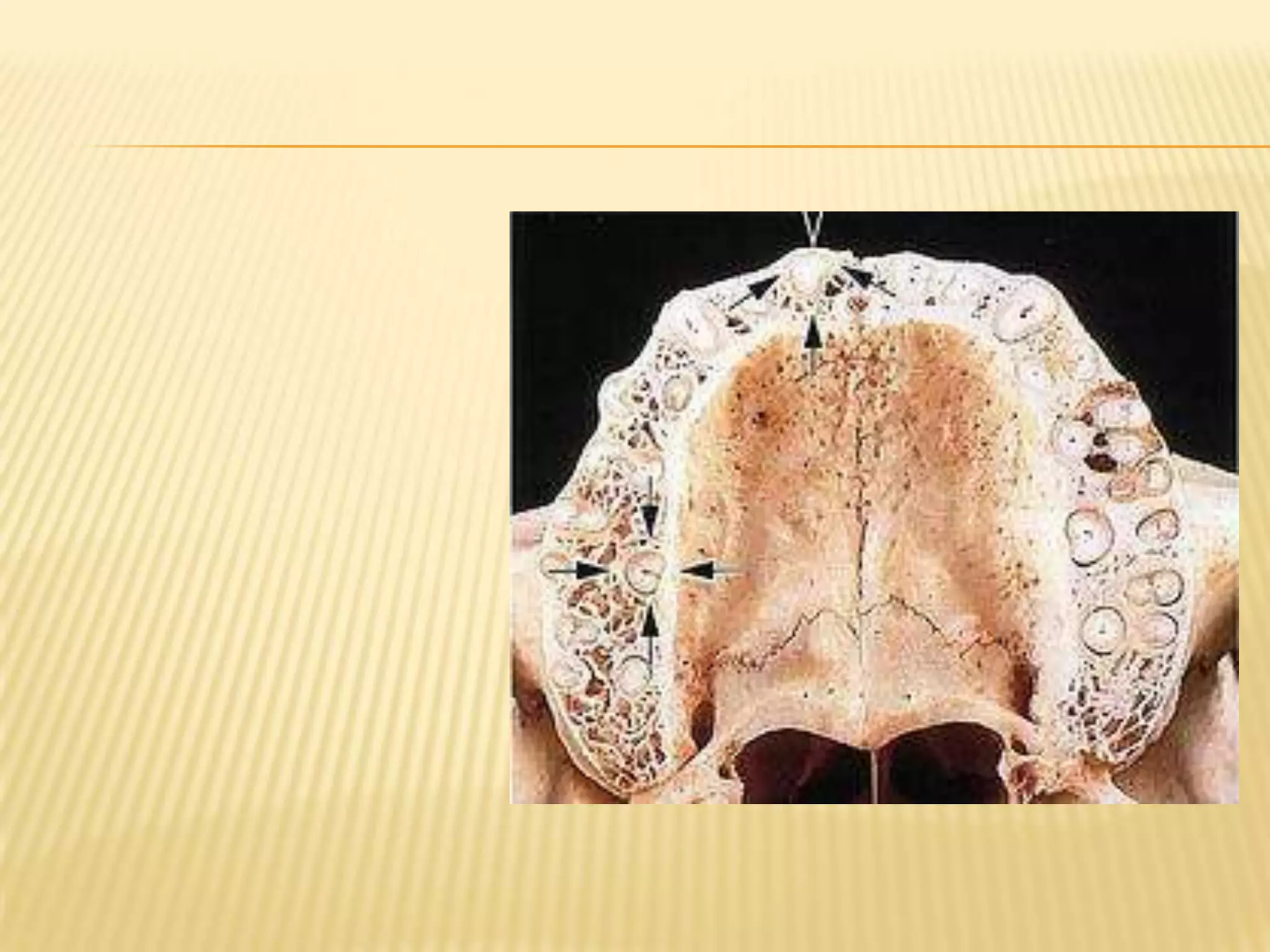
Alveolar SocketAlso called Dental alveolusare sockets in the jaws in which the roots of teeth are held in the alveolar process with the periodontal ligament.Alveolar socket of the second premolar tooth in a bovine maxillary bone.
Interdental Septa“Septa” – in Latin, it means “fence” or “wall”Are plates of bone that separate each individual sockets from one another.Interradicular SeptaAre thin plates of bone that separate the roots of multi-rooted teeth
Cribriform Platealso called as  bundle boneIs the compact layer of  bone lining the tooth socket (alveolar socket)Reflects the sieve-like appearance produced by numerous Volkmann’s canals passing from the alveolar bone to the PDL (periodontal ligament).Numerous Sharpey’s Fiber pass through it.
Alveolar processis the thickened ridge of bone that contains the tooth sockets on bones that bear teeth. The alveolar process contains a region of compact bone adjacent to the periodontal ligament called Lamina dura.Maxilla and MandibleAre the tooth-bearing bones
Lamina Durathis part which is attached to the cementum of the roots by the periodontal ligament.Is the bone lining the alveolusIn clinical radiographs, it commonly appears as a dense white line.Lamina DuraRadiographic appearance of alveolar bone proper as ‘Lamina Dura’
Functions of the bone
Functions of Alveolar boneProtectionAlveolar bone forms and protects the sockets for the teeth.AttachmentIt gives the attachment to the periodontal ligament fibers, which are the principle fibers. These fibers which enter the bone are regarded as Sharpey’s fibers.SupportIt supports the tooth roots on the facial and on the palatal/lingual sides.Shock-absorberIt helps absorb the forces placed upon the tooth by disseminating the force to underlying tissues.
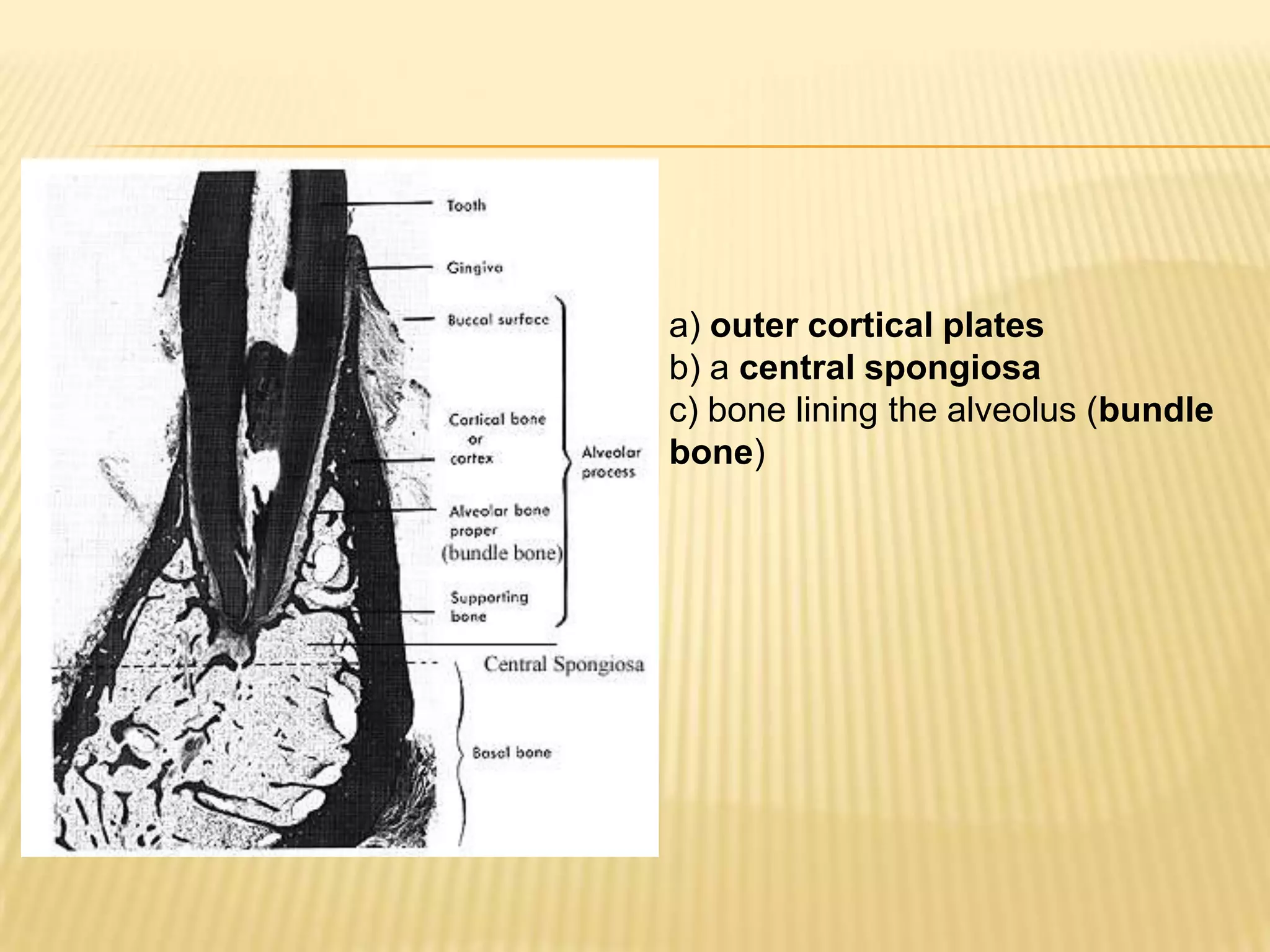
Structure of the Alveolar Bonehttp://www.google.com.ph/imgres?q=cortical+plate+of+alveolar+bone&num=10&um=1&hl=tl&biw=1018&bih=414&tbm=isch&tbnid=WKjYn2hOmQJweM%3A&imgrefurl=http%3A%2F%2Fwww.medicine.uiowa.edu%2Fanatomy%2Fdental%2Foralhist%2FOHWIN%2Funit2%2F_ii-01.html&docid=VZHNS3piimFp2M&w=300&h=452&ei=x1WATpi2BoTBiQf3_-W3Dg&zoom=1&iact=hc&vpx=89&vpy=48&dur=483&hovh=100&hovw=64&tx=101&ty=176&sqi=2&page=1&tbnh=100&tbnw=64&start=0&ndsp=12&ved=1t%3A429%2Cr%3A0%2Cs%3A0Cortical PlateSpongiosa / Spongy Bone
a) outer cortical platesb) a central spongiosac) bone lining the alveolus (bundle bone)
Cortical PlateOuter bony plate of varying thickness, which is the outside wall of the maxilla and mandible, covered with periosteumContinuous with the lamina cribriformis at the orifice of the alveoli – alveolar crestConsists of haversian systems (osteons) and interstitial lamellaeThicker in the mandible than maxillaGenerally greater on the lingual than on the buccal/facial
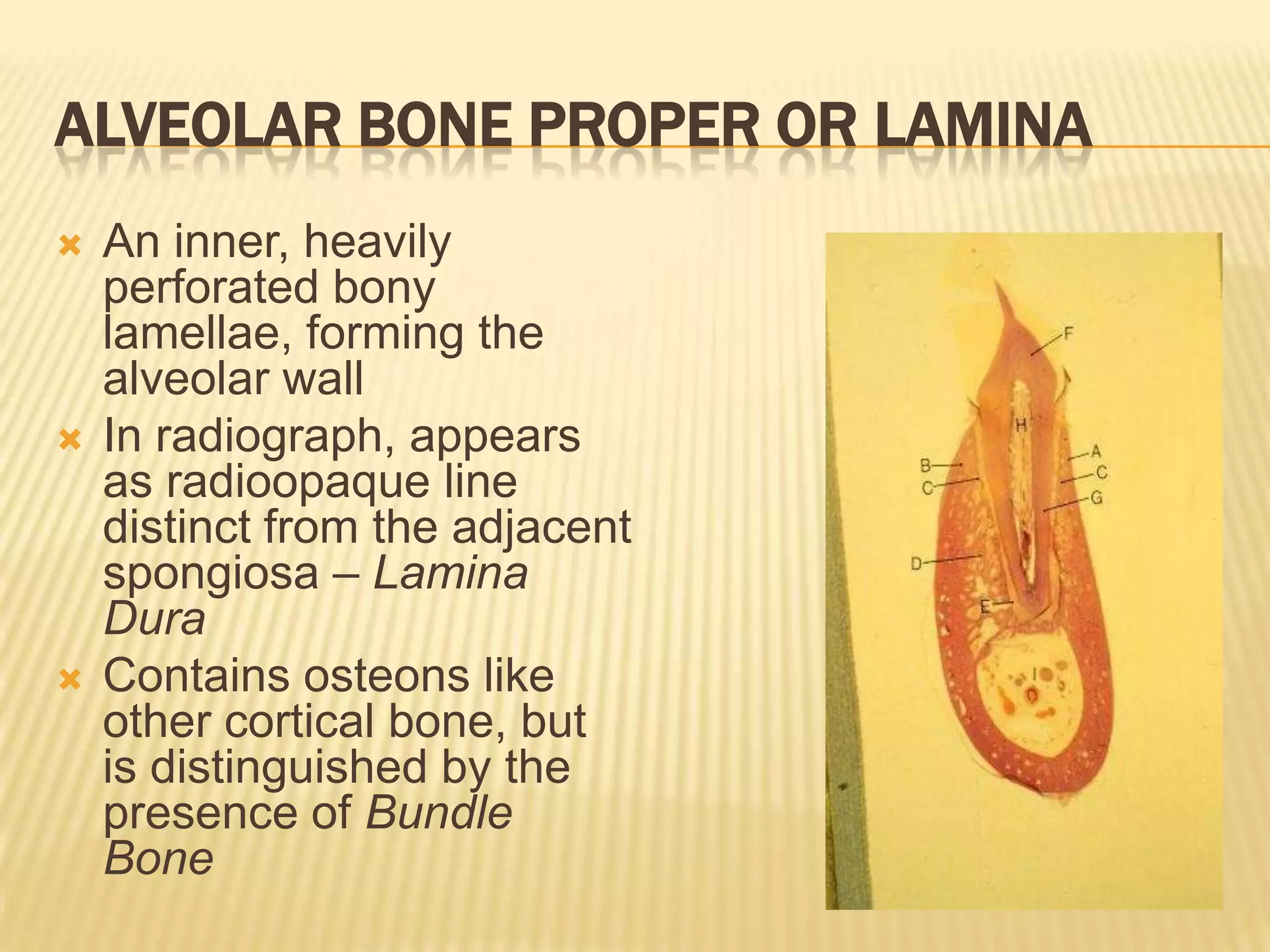
Alveolar Bone Proper or LaminaAn inner, heavily perforated bony lamellae, forming the alveolar wallIn radiograph, appears as radioopaque line distinct from the adjacent spongiosa – Lamina DuraContains osteons like other cortical bone, but is distinguished by the presence of Bundle Bone
SpongiosaAre spongy (or cancellous/trabecullar) bone between the 2 bony plates and between the lamina cribriformis of adjacent teeth or rootsConsists of delicate trabeculae, between which are marrow spaces, filled mostly with fatty marrowRegions of maxillary tuberosity and the angle of mandible, erythropoietic …
VascuLAR Supply of ALVEOLAR BONE
Vascular Supply of Alveolar ProcessAlveolar process of the maxillaAnterior and posterior alveolar arteries (branch from the maxilla and infraorbital arteries)Alveolar process of the mandibleInferior alveolar arteries (internal)Periosteal branches of submental and buccal arteries (external)
Periodontal disease
PeriodonTal diseasehttp://en.wikipedia.org/wiki/Periodontal_diseasePeriodontal disease is a type of disease that affects one or more of the periodontal tissues:Alveolar bonePeriodontal ligamentCementumGingivaWhile many different diseases affect the tooth-supporting structures, plaque-induced inflammatory lesions make up the vast majority of periodontal diseases and have traditionally been divided into two categories:gingivitis orperiodontitis
Histological Arrangement of Mature BoneMature bone is composed of:Compact boneSpongy Bonehttp://www.physioweb.org/skeletal/bone_tissue.html40
41
Compact BoneAlso called as Cortical boneAs its name implies. . .“cortical” bone forms the cortex or outer shell of most bones.“compact” bone is much denser than cancellous bone. Furthermore, it is harder, stronger and stiffer than cancellous bone. The primary anatomical and functional unit of cortical bone is the osteon.3Distinct Layering of Compact Bone:Circumferential lamellaConcentric lamellaInterstitial lamellaFunctions:facilitates to support the whole bodyprotect organsprovide levers for movementstore and release chemical elements, mainly calcium.http://en.wikipedia.org/wiki/Bone_tissue42
3 Distinct Layering of Compact Bone:Circumferential Lamellaeenclose the entire adult bone, forming its outer perimeterConcentric Lamellaemake up the bulk of compact bone and form the basic metabolic unit of bone, the osteonInterstitial Lamellaeinterspersed between adjacent concentric lamellae and fill the spaces between them43
44
Spongy BoneAlso called Cancellous bone orTrabecular boneCompared to compact bone, cancellous bone has a higher surface area but is less dense, softer, weaker, and less stiff.Cancellous bone is highly vascular and frequently contains red red bone marrow where hematopoeisis occurs.The primary anatomical and functional unit of cancellous bone is the trabecula.45
Alveolar Bone

Alveolar Bone

  • 1.
  • 2.
  • 3.
    Bone Tissue2 Typesof bone tissue:Compact (Cortical) boneSpongy (Cancellous) boneBone tissueis a specialized form of connective tissue and is the main element of the skeletal tissues.is composed of cells and an extracellular matrix in which fibers are embedded.is unlike other connective tissues in that the extracellular matrix becomes calcified.http://en.wikipedia.org/wiki/Bone_tissue3
  • 4.
    Functions of Bonehttp://en.wikipedia.org/wiki/HaematopoiesisSupport:provides framework that supports and anchors all soft organs.Protection: skull and vertebrae surround soft tissue of the nervous system, and the rib cage protects vital thoracic organs.Movement: skeletal muscles use the bones as levers to move the body.Storage: fat stored in the interior of the bones. Bone matrix serves as a storehouse for various minerals.Blood Cell Formation: hematopoiesis occurs within the marrow cavities of the bones.4
  • 5.
    Classification of BoneBonemay be classified in several ways:5
  • 6.
    endochondral boneWhere boneis preceded by a cartilagenous model that is eventually replaced by bone In a process termed endochondral ossification.intramembranous boneWhere bone forms directly w/in a vascular, fibrous membrane.6
  • 7.
    CHEMICAL PROPERTIES ofBone“Oral Anatomy, Histology, and Embryology”60 % Inorganic materialis formed from carbonated hydroxyapatite. 25 % Organic materialmainly composed of Type I collagen.The organic part is also composed of various growth factors:glycosaminoglycans, osteocalcin, osteonectin, bone sialo protein, osteopontin and Cell Attachment Factor.715% WaterOrganic Matrix of the boneBone is formed by the hardening of the matrix, entrapping the cells. When these cells become entrapped from osteoblasts they become osteocytes.The organic matrix of bone is about:90% collagen10% non-collagenous proteins.8
  • 8.
    Non-collagenous Proteins ofBoneare a heterogeneous group which vary from entrapped serum protein to glycoproteinsplay a role in mineralization.The main non-collagenous proteins comprise the:ProteoglycansGlycoproteinsBone Gla-containing proteinsSerum proteins9
  • 9.
    collagen.Contributes towards theimportant biomechanical properties of tissue in terms of resisting loads and providing necessary resilience that prevents fractures.The dominant collagen in bone is Type I.Intrinsic collagencollagen as secreted by osteoblasts.Extrinsic collagenCollagen formed by adjacent fibroblasts.10
  • 10.
    Sharpey’s fibersSharpey's fibersare the terminal ends of principal fibers (of the periodontal ligament) that insert into the cementum and into the periosteum of the alveolar bone.A study on rats suggests that the three-dimensional structure of Sharpey's fibers intensifies the continuity between the periodontal ligament fiber and the alveolar bone (tooth socket), and acts as a buffer medium against stress.11
  • 11.
    Cell types inboneOsteoblastsare mononucleate cells that are responsible for bone formationOsteocytesWhen osteoblasts become trapped in the matrix they secrete, they become osteocytes.Bone-lining cellsAre inactive osteoblasts that cover all of the available bone surface and function as a barrier for certain ionsOsteoprogenitor cellsrelatively undifferentiated cells found on or near all of the free surfaces of bone, which, under certain circumstances, undergo division and transform into osteoblasts or coalesce to give rise to osteoclasts.Osteoclastsis a type of bone cell that removes bone tissue by removing its mineralized matrix and breaking up the organic bone12
  • 12.
    RESORPTION AND FORMATIONOF BONE DURING REMODELLINGResorptionReversalFormationResting13
  • 13.
    OssificationAlso called Osteogenesisisthe natural process of bone formationThere are two processes resulting in the formation of normal, healthy bone tissue:Endochondral (Intracartilaginous) Bone OssificationThe formation of bone in which a cartilage template is gradually replaced by a bone matrix, as in the formation of long bones or in osteoarthritic ossification of synovial cartilage.Intramembranous Bone Ossificationthe development of bone from tissue or membrane, as in the formation of the skull.http://en.wikipedia.org/wiki/Ossification14
  • 14.
    SuturalBone Growthvariable andirregularly shaped bones in the sutures between the bones of the skull. 15
  • 15.
  • 16.
    ALVEOLAR BONEhttp://www.answers.com/topic/alveolar-bone#ixzz12ko9kyTQAlso calledas alveolar processThe specialized bone structure that contains the alveoli or sockets of the teeth and supports the teeth.If the teeth are lost the alveolar process disappearsIt is composed mainly of two parts:alveolar bone properSupporting bone
  • 17.
  • 18.
  • 19.
    Development of AlveolarBoneAlveolar bone develops from the dental follicleThe ectomesenchymal cells of the dental follicle differentiate into osteoblasts and lay down the matrix called osteoidSome osteoblasts become embedded in the matrix and are called osteocytes
  • 20.
    Near the endof the 2nd month of fetal life, mandible and maxilla form a groove that is opened toward the surface of the oral cavityAs tooth germs start to develop, bony septa form gradually. The alveolar process starts developing strictly during tooth eruption.
  • 21.
    Gross Morphology ofBoneMorphology -is a branch of bioscience dealing with the study of the form and structure of organisms and their specific structural
  • 23.
    Alveolar SocketAlso calledDental alveolusare sockets in the jaws in which the roots of teeth are held in the alveolar process with the periodontal ligament.Alveolar socket of the second premolar tooth in a bovine maxillary bone.
  • 24.
    Interdental Septa“Septa” –in Latin, it means “fence” or “wall”Are plates of bone that separate each individual sockets from one another.Interradicular SeptaAre thin plates of bone that separate the roots of multi-rooted teeth
  • 25.
    Cribriform Platealso calledas bundle boneIs the compact layer of bone lining the tooth socket (alveolar socket)Reflects the sieve-like appearance produced by numerous Volkmann’s canals passing from the alveolar bone to the PDL (periodontal ligament).Numerous Sharpey’s Fiber pass through it.
  • 26.
    Alveolar processis thethickened ridge of bone that contains the tooth sockets on bones that bear teeth. The alveolar process contains a region of compact bone adjacent to the periodontal ligament called Lamina dura.Maxilla and MandibleAre the tooth-bearing bones
  • 27.
    Lamina Durathis partwhich is attached to the cementum of the roots by the periodontal ligament.Is the bone lining the alveolusIn clinical radiographs, it commonly appears as a dense white line.Lamina DuraRadiographic appearance of alveolar bone proper as ‘Lamina Dura’
  • 28.
  • 29.
    Functions of AlveolarboneProtectionAlveolar bone forms and protects the sockets for the teeth.AttachmentIt gives the attachment to the periodontal ligament fibers, which are the principle fibers. These fibers which enter the bone are regarded as Sharpey’s fibers.SupportIt supports the tooth roots on the facial and on the palatal/lingual sides.Shock-absorberIt helps absorb the forces placed upon the tooth by disseminating the force to underlying tissues.
  • 30.
    Structure of theAlveolar Bonehttp://www.google.com.ph/imgres?q=cortical+plate+of+alveolar+bone&num=10&um=1&hl=tl&biw=1018&bih=414&tbm=isch&tbnid=WKjYn2hOmQJweM%3A&imgrefurl=http%3A%2F%2Fwww.medicine.uiowa.edu%2Fanatomy%2Fdental%2Foralhist%2FOHWIN%2Funit2%2F_ii-01.html&docid=VZHNS3piimFp2M&w=300&h=452&ei=x1WATpi2BoTBiQf3_-W3Dg&zoom=1&iact=hc&vpx=89&vpy=48&dur=483&hovh=100&hovw=64&tx=101&ty=176&sqi=2&page=1&tbnh=100&tbnw=64&start=0&ndsp=12&ved=1t%3A429%2Cr%3A0%2Cs%3A0Cortical PlateSpongiosa / Spongy Bone
  • 31.
    a) outer corticalplatesb) a central spongiosac) bone lining the alveolus (bundle bone)
  • 32.
    Cortical PlateOuter bonyplate of varying thickness, which is the outside wall of the maxilla and mandible, covered with periosteumContinuous with the lamina cribriformis at the orifice of the alveoli – alveolar crestConsists of haversian systems (osteons) and interstitial lamellaeThicker in the mandible than maxillaGenerally greater on the lingual than on the buccal/facial
  • 33.
    Alveolar Bone Properor LaminaAn inner, heavily perforated bony lamellae, forming the alveolar wallIn radiograph, appears as radioopaque line distinct from the adjacent spongiosa – Lamina DuraContains osteons like other cortical bone, but is distinguished by the presence of Bundle Bone
  • 34.
    SpongiosaAre spongy (orcancellous/trabecullar) bone between the 2 bony plates and between the lamina cribriformis of adjacent teeth or rootsConsists of delicate trabeculae, between which are marrow spaces, filled mostly with fatty marrowRegions of maxillary tuberosity and the angle of mandible, erythropoietic …
  • 35.
    VascuLAR Supply ofALVEOLAR BONE
  • 36.
    Vascular Supply ofAlveolar ProcessAlveolar process of the maxillaAnterior and posterior alveolar arteries (branch from the maxilla and infraorbital arteries)Alveolar process of the mandibleInferior alveolar arteries (internal)Periosteal branches of submental and buccal arteries (external)
  • 37.
  • 38.
    PeriodonTal diseasehttp://en.wikipedia.org/wiki/Periodontal_diseasePeriodontal diseaseis a type of disease that affects one or more of the periodontal tissues:Alveolar bonePeriodontal ligamentCementumGingivaWhile many different diseases affect the tooth-supporting structures, plaque-induced inflammatory lesions make up the vast majority of periodontal diseases and have traditionally been divided into two categories:gingivitis orperiodontitis
  • 39.
    Histological Arrangement ofMature BoneMature bone is composed of:Compact boneSpongy Bonehttp://www.physioweb.org/skeletal/bone_tissue.html40
  • 40.
  • 41.
    Compact BoneAlso calledas Cortical boneAs its name implies. . .“cortical” bone forms the cortex or outer shell of most bones.“compact” bone is much denser than cancellous bone. Furthermore, it is harder, stronger and stiffer than cancellous bone. The primary anatomical and functional unit of cortical bone is the osteon.3Distinct Layering of Compact Bone:Circumferential lamellaConcentric lamellaInterstitial lamellaFunctions:facilitates to support the whole bodyprotect organsprovide levers for movementstore and release chemical elements, mainly calcium.http://en.wikipedia.org/wiki/Bone_tissue42
  • 42.
    3 Distinct Layeringof Compact Bone:Circumferential Lamellaeenclose the entire adult bone, forming its outer perimeterConcentric Lamellaemake up the bulk of compact bone and form the basic metabolic unit of bone, the osteonInterstitial Lamellaeinterspersed between adjacent concentric lamellae and fill the spaces between them43
  • 43.
  • 44.
    Spongy BoneAlso calledCancellous bone orTrabecular boneCompared to compact bone, cancellous bone has a higher surface area but is less dense, softer, weaker, and less stiff.Cancellous bone is highly vascular and frequently contains red red bone marrow where hematopoeisis occurs.The primary anatomical and functional unit of cancellous bone is the trabecula.45