Lesson Outline1. Introductionto Phenomenology (10 minutes)Activity:
Begin by asking students to share their understanding of phenomenology and any prior knowledge they
have about hermeneutics.
Content:
Briefly introduce phenomenology as the study of structures of consciousness and the lived experience.
Explain how hermeneutical phenomenology specifically focuses on interpretation and understanding,
extending phenomenology into the realm of meaning.
2. Key Concepts and Definitions (15 minutes)
Content:
Hermeneutics: The art and science of interpretation, originally used in the context of interpreting sacred
texts.
Phenomenology:
A philosophical approach that seeks to uncover the essence of experiences by setting aside assumptions.
Hermeneutical Phenomenology: A blend of the two, pioneered by philosophers such as Heidegger and
Gadamer, which posits that all experience is shaped by interpretative understanding.
Activity: Present definitions on the board and discuss how these concepts interrelate.
Have students ask questions about any unclear terms.
3.
3. Key Philosophersand Texts (15 minutes)
Content:Martin Heidegger:
Explain Heidegger’s view that understanding is fundamental to being, and how he moved phenomenology towards
hermeneutics in Being and Time.
Hans-Georg Gadamer:
Discuss Gadamer’s Truth and Method, where he argues that understanding is not just a method but a fundamental way of
being in the world.
Paul Ricoeur (optional):
Briefly introduce Ricoeur’s work on narrative and interpretation, which bridges hermeneutics and phenomenology in new
ways.
Activity:
Provide students with short excerpts or summaries of Heidegger’s and Gadamer’s works. Have students read and discuss
the implications of one or two quotes.
4. Hermeneutical Circle and the Role of Preconceptions (10 minutes)
Content:
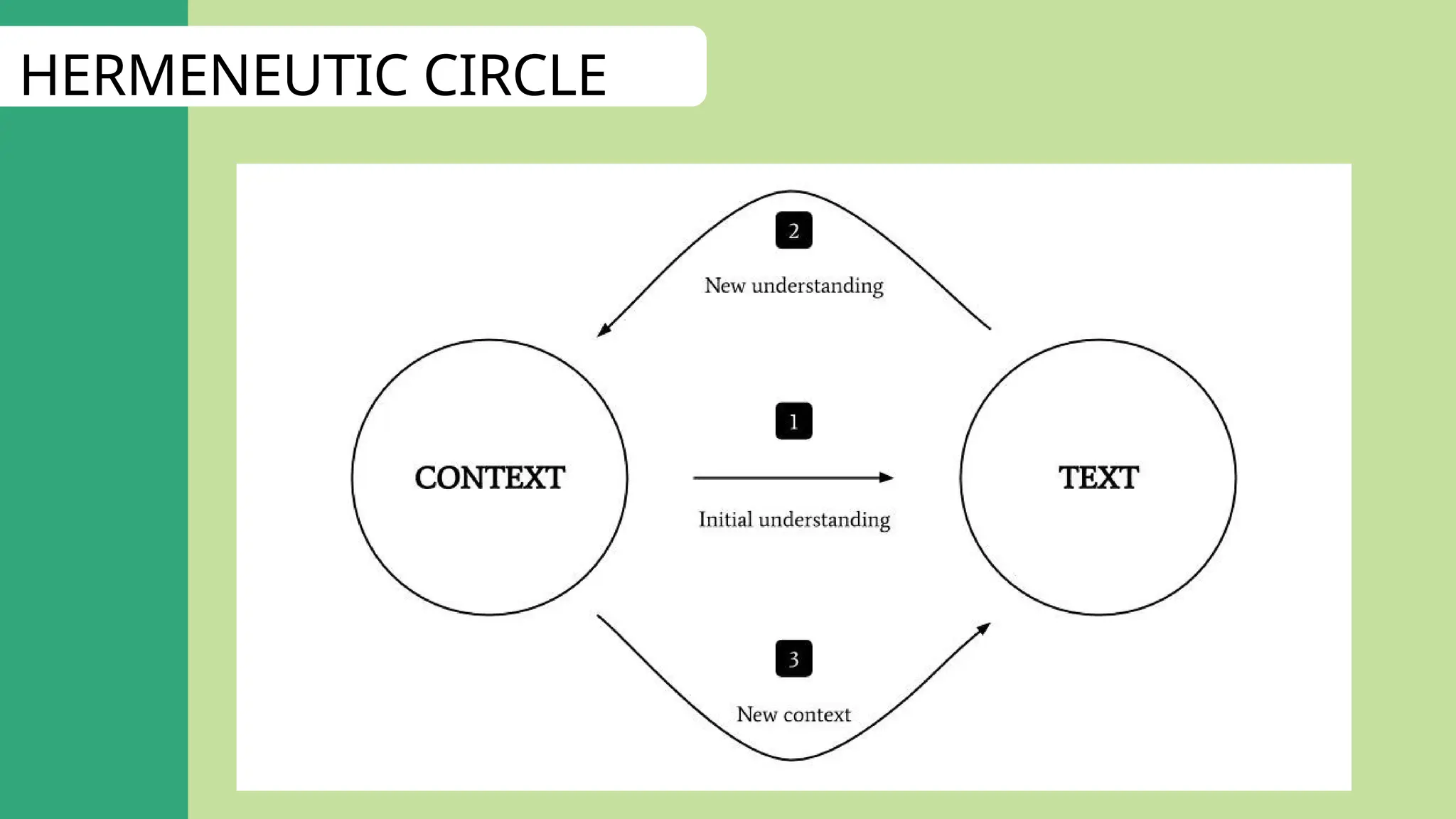
Explain the Hermeneutical Circle, the idea that understanding is a circular process, where one's preconceptions affect
interpretation, and interpretation, in turn, refines understanding.
Discuss preconceptions and historical context in interpretation—how one's background influences their understanding of
phenomena.
Activity:
Draw the Hermeneutical Circle on the board to illustrate the iterative process.
Ask students to reflect on a time when their understanding of a concept changed based on new information or
perspective.
4.
5. Applications ofHermeneutical Phenomenology (10-15 minutes)
Content:
Discuss how hermeneutical phenomenology is applied in fields like psychology, sociology, and
literary studies.
Use examples such as interpreting social behavior, understanding narratives, or analyzing
cultural texts to show the practical applications of this approach.
Activity:
Divide students into small groups and assign each group a short text, narrative, or case study.
Ask them to discuss how they might interpret it using a hermeneutical phenomenological
approach, focusing on the role of context, preconceptions, and iterative understanding.6.
Discussion and Critical Analysis (10-15 minutes)Content: Summarize key points and open a
discussion about the implications of hermeneutical phenomenology for modern research and
understanding.Questions for Discussion:How does the hermeneutical approach challenge
traditional scientific methods?Can true objectivity be achieved if all understanding is
interpretative?What are the limitations of hermeneutical phenomenology in research?Activity:
Encourage students to share their thoughts on these questions and discuss any remaining
doubts or confusions about the approach.
5.
Activity:
Divide students intosmall groups and assign each group a short text, narrative, or case study.
Ask them to discuss how they might interpret it using a hermeneutical phenomenological approach, focusing on the role of context,
preconceptions, and iterative understanding.
6. Discussion and Critical Analysis (10-15 minutes)
Content:
Summarize key points and open a discussion about the implications of hermeneutical phenomenology for modern research and
understanding.Questions for Discussion:How does the hermeneutical approach challenge traditional scientific methods?
Can true objectivity be achieved if all understanding is interpretative?
What are the limitations of hermeneutical phenomenology in research?
Activity:
Encourage students to share their thoughts on these questions and discuss any remaining doubts or confusions about the approach.
6.
WHAT IS HERMENEUTICAL
PHENOMENOLOGY?
isa philosophy of and a method for
interpreting human experiences as a
means to understand the question
what is to be human.
7.
PHENOMENOLOGY AS DEVELOPEDBY
EDMUND HUSSERL
is an inquiry on how human mind can
grasp the true nature of things as
experienced in the world.
Phenomenological perspective tells
us to
remove our preconceved ideas in
order to
arrive at a pure description of our
experiences.
8.
PHENOMENOLOGY AS DEVELOPEDBY
MARTIN HEIDEGGER
states that human are born in a
particular historical period, country,
community, and background.
Hermeneutic circle- the process
wherein
one's influences affect his or her
experiences of the world.
IMPORTANT THEORIST
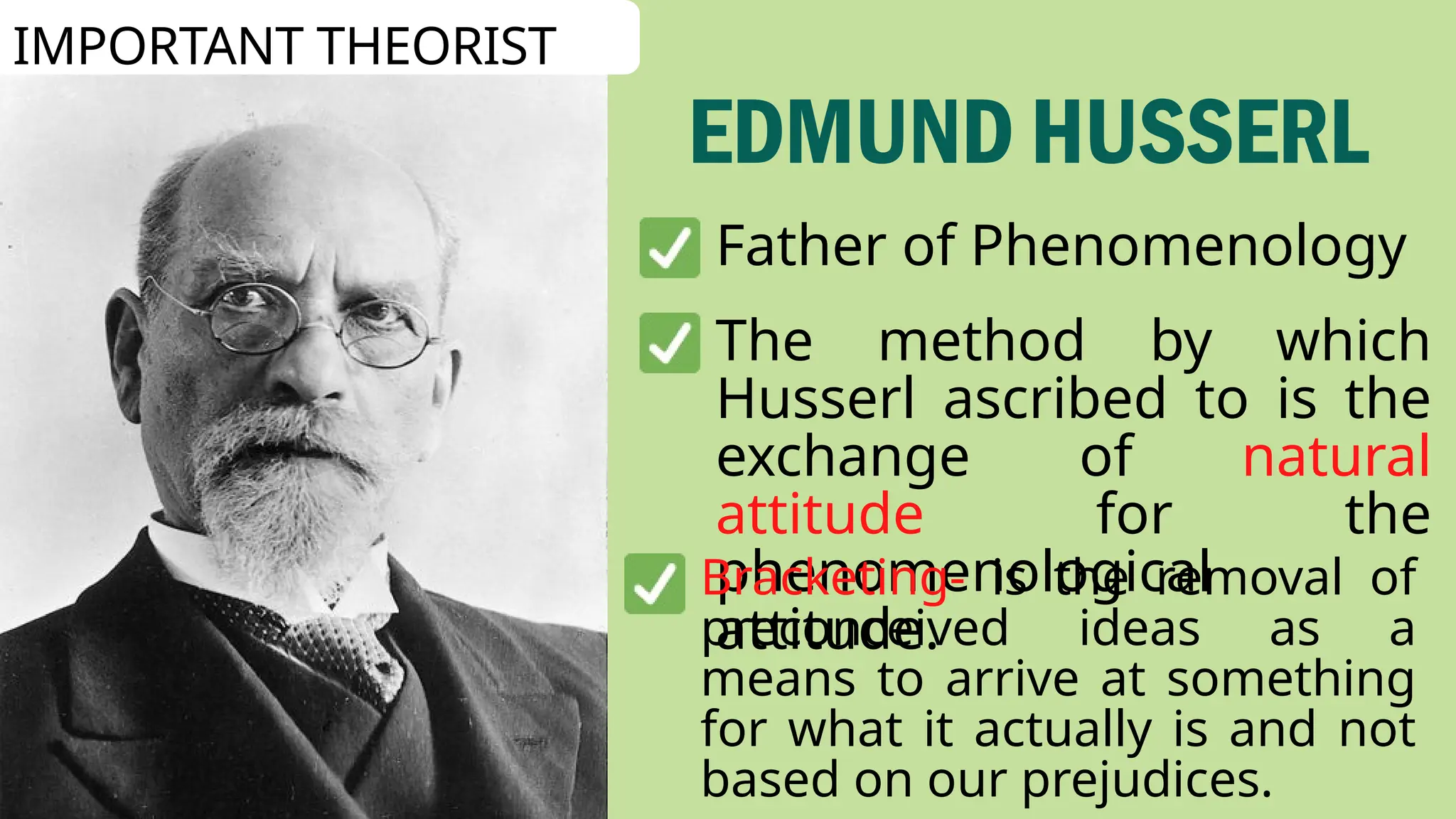
EDMUND HUSSERL
Fatherof Phenomenology
The method by which
Husserl ascribed to is the
exchange of natural
attitude for the
phenomenological
attitude.
Bracketing- is the removal of
preconceived ideas as a
means to arrive at something
for what it actually is and not
based on our prejudices.
IMPORTANT THEORIST
He arguedthat it is historical
tradition that enables people
to understand one another
and interpret text.
Hermeunitics is the study of
an interpretation of texts;
biblical scholars term this as
exegesis.
Language is the site where a
fusion of horizons takes
place.
HANS-GEORG GADAMER
13.
IMPORTANT THEORIST
He furtherelaborated on
man being-in-the-world by
giving particular attention to
the body.
A running theme in his
philosophy is perception,
which he said transpires
even before reflection or
judgement.
MAURICE MERLEAU- PONTY
14.
IMPORTANT THEORIST
Popularized thephilosophy
of existentialism.
Existence and essence are
the two philosophical terms
that are central to his
existential thought.
JEAN PAUL SARTRE