JOSEPH L. PANTONIAL
Subject Teacher
Key Concepts and Ideas of
Filipino Thinkers in the Social
Sciences
JOSE RIZAL (Refomist)
• One of the most renowned social thinkers is our national hero Jose
Rizal, he dedicated his life through his writings the Noli Me
Tangere and El Filibusterismo and social teachings found in his
writings and depositions.
• Using his skill in writing through the La Liga Filipina he
encouraged every Filipino not to be enslaved but to believe in
sovereignty in their own country and raise consciousness from
fanaticism, docility, inferiority, and hopelessness towards freedom.
The Filipino Social Thinkers
ANDRES BONIFACIO (Revolutionist)
• Founder of the revolutionary society.
• He authored essays such as “Ang Dapat Mabatid ng
mga Tagalog” and the poem “Pag-ibig sa Tinubuang
Lupa”, these literary works encourage Filipinos to
show patriotism and love for their country.
The Filipino Social Thinkers
EMILIO JACINTO (Revolutionist)
• Also known as a Revolutionist, patronized the
ideals of “free reign of reason, of the freedom to
think and do”.
• Jacinto was committed to the ideals of the liberty,
equality, and brotherhood.
The Filipino Social Thinkers
MANUEL L. QUEZON (Political Philosopher)
• Believed in the democratization of education for
all social classes – a free education from
elementary to high school.
• Envisioned a government that exercises equality
of wealth.
The Filipino Social Thinkers
APOLINARIO MABINI (Political Philosopher)
• Known as "The Sublime Paralytic" and "The Brains
of the Revolution"
• A brilliant thinker who used his pen in the service of
the Filipino people's struggle for freedom.
• In his political writings “El Verdadero Decalogo”,
“Ordenanzas de la Revucion” and “Programa de la
Republica Filipina”, his social philosophies are
depicted.
The Filipino Social Thinkers
RENATO CONSTANTINO (Nationalist)
• He defined Nationalism as an expression of reality
that “we have a country of our own, which must be
kept our own.”
• He suggested a “bottom-up” economic approach
instead of a “trickle-down” approach, which will give
freedom to small and medium enterprises to boost
their capacity in investing in industrial growth.
The Filipino Social Thinkers
CAMILO OSIAS
• He advocated that the educational system must
contribute towards the achievement of the goals of
education by inculcating in the minds and hearts of
the youth the value of preserving the patrimony of
the country and promoting the general welfare of the
people.
The Filipino Social Thinkers
RAFAEL PALMA
• He believes in Academic Freedom and
advocated that “Education must produce
individuals who are both useful to themselves
and to society.”
The Filipino Social Thinkers
JORGE BOCOBO
• He believes in Academic Freedom and
advocated that “Education must produce
individuals who are both useful to themselves
and to society.”
SIGMUND
FREUD
An Austrian
Neurologist and
founder of
Psychoanalysis
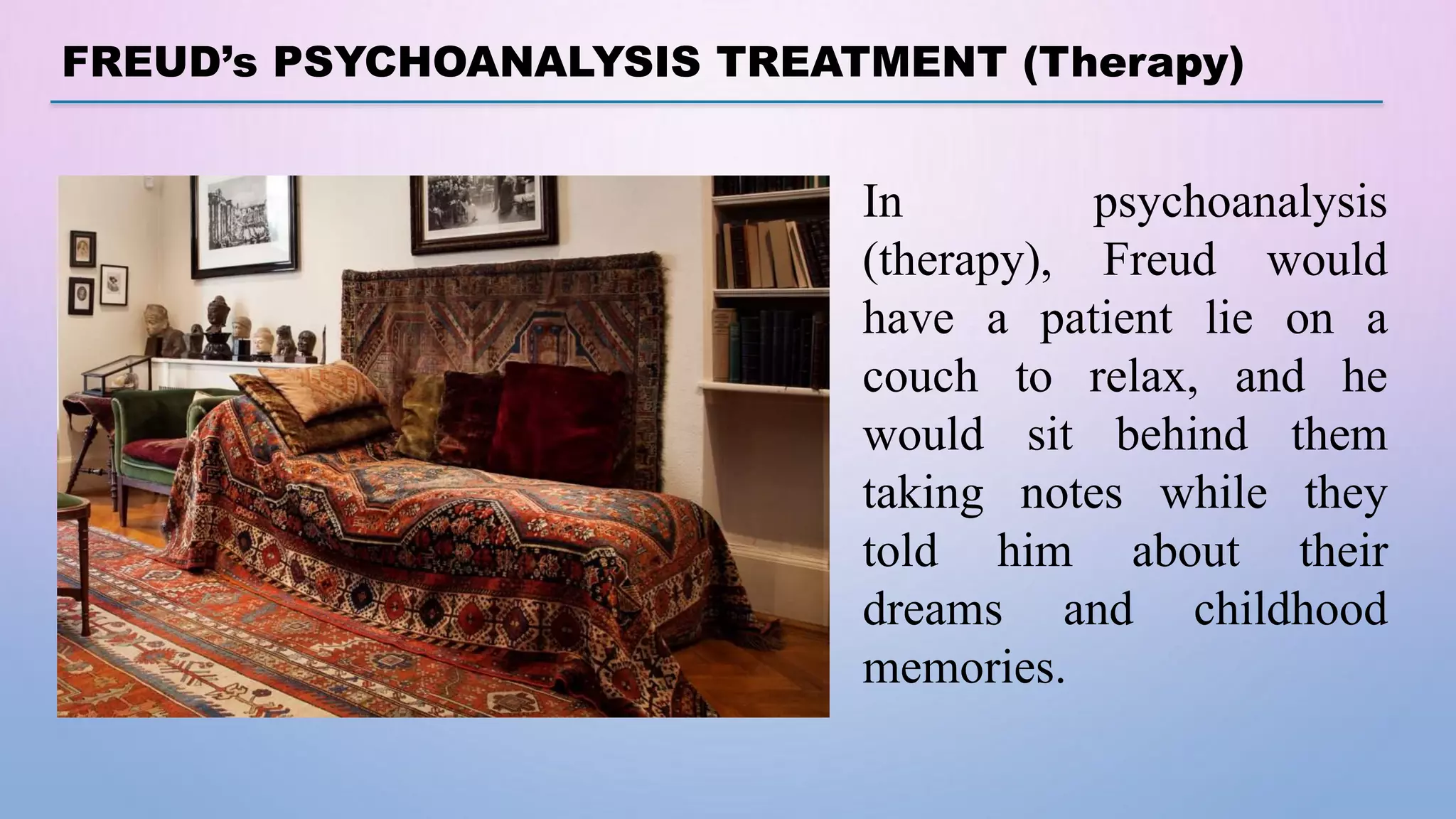
In psychoanalysis
(therapy), Freud would
have a patient lie on a
couch to relax, and he
would sit behind them
taking notes while they
told him about their
dreams and childhood
memories.
FREUD’s PSYCHOANALYSIS TREATMENT (Therapy)
PSYCHOANALYSIS
The psychoanalyst uses various techniques as
encouragement for the client to develop insights
into their behavior and the meanings of
symptoms, including ink blots, parapraxes, free
association, interpretation (including dream
analysis), resistance analysis, and transference
analysis.
FREUD’s STRUCTURE OF PERSONALITY
According to Freud, our personality develops
from the interactions among what he
proposed as the three fundamental structures
of the human mind:
Id
Superego
Ego
Driven by the unconscious energy and silently
influencing our DECISIONS and BEHAVIORS.
FREUD’s STRUCTURE OF PERSONALITY
Demonstrating the toxic needs or wants and how
those needs are met. If the need or want is not met,
the person will experience anxiety, anger, or even
tension.
Id
Example:
The baby was crying because it is hungry. It cried
until it was fed.
Concerned with the instant satisfaction of basic
physical needs and urges.
FREUD’s STRUCTURE OF PERSONALITY
• Operating on the reality principle
within the conscious realm.
• Decision Maker
• Realistically seeking to satisfy
desires
Ego
Example:
• Works for reason
• Something is good as long as there is no harm
FREUD’s STRUCTURE OF PERSONALITY
• Concerned with social rules and
morals. (conscience)
• It develops as a child learns what
their culture considers right and
wrong.
Superego
Example:
• Works for reason
• Something is good as long as there is no harm
• What are the concepts and principles of
psychoanalysis?
• How do these concepts and principles apply
to society as major social science ideas?
DEFENSE MECHANISM
• RATIONALIZATION
• INTELLECTUALIZATION
• REACTION FORMATION
• ACTING OUT
• PROJECTION
• DISSOCIATION
• COMPARTMENTALIZATION
• DISPLACEMENT
• REGRESSION
• SUBLIMATION
• COMPENSATION
• REPRESSION
• SUPPRESSION
• SPLITTING
• USING HUMOR
DEFENSE MECHANISM
• Rationalization – involves explaining an unacceptable behavior
or feeling in a rational or logical manner, avoiding the true
reasons for the behavior.
Example:
1.A person who is turned down for a date might rationalize the
situation by saying they were not attracted to the other person
anyway.
2.A student might rationalize a poor exam score by blaming the
instructor rather than admitting their own lack of preparation.
DEFENSE MECHANISM
• Intellectualization – involves a person using reason and logic to
avoid uncomfortable or anxiety-provoking emotions.
Intellectualization can be a useful way of explaining and
understanding negative events.
Example:
If person A is rude to person B, person B may think about the possible reasons
for person A’s behavior.
However, intellectualization can cause people to downplay the importance of their own
feelings and focus instead on treating all difficult situations as problems that need to be
solved. This can stop a person from learning how to deal with their own difficult emotions.
DEFENSE MECHANISM
• Reaction formation – changing unwanted emotions or feelings.
It is a way of protecting the mind from uncomfortable thoughts or
desires. Often expressed in an exaggerated or showy way
Example: 1. A person may experience normal feelings of sadness or
disappointment after a relationship breaks down. If they feel that these
emotions are unacceptable, they may publicly act as if they are happy or
unconcerned.
2. A young boy bullies a young girl because, on a subconscious level, he's
attracted to her.
DEFENSE MECHANISM
• Acting out – carrying out extreme behavior. Performing an
extreme behavior in order to express thoughts or feelings the
person feels incapable of otherwise expressing.
Example: Instead of saying “I'm angry with you,” a person who acts out may
instead throw a book at the person, or punch a hole through a wall.
DEFENSE MECHANISM
• Projection – transferring the drive or behavior that causes anxiety
to others.
Examples:
• If you have a strong dislike for someone, you might instead believe
that they do not like you.
• A spouse may be angry at their significant other for not listening,
when in fact it is the angry spouse who does not listen.
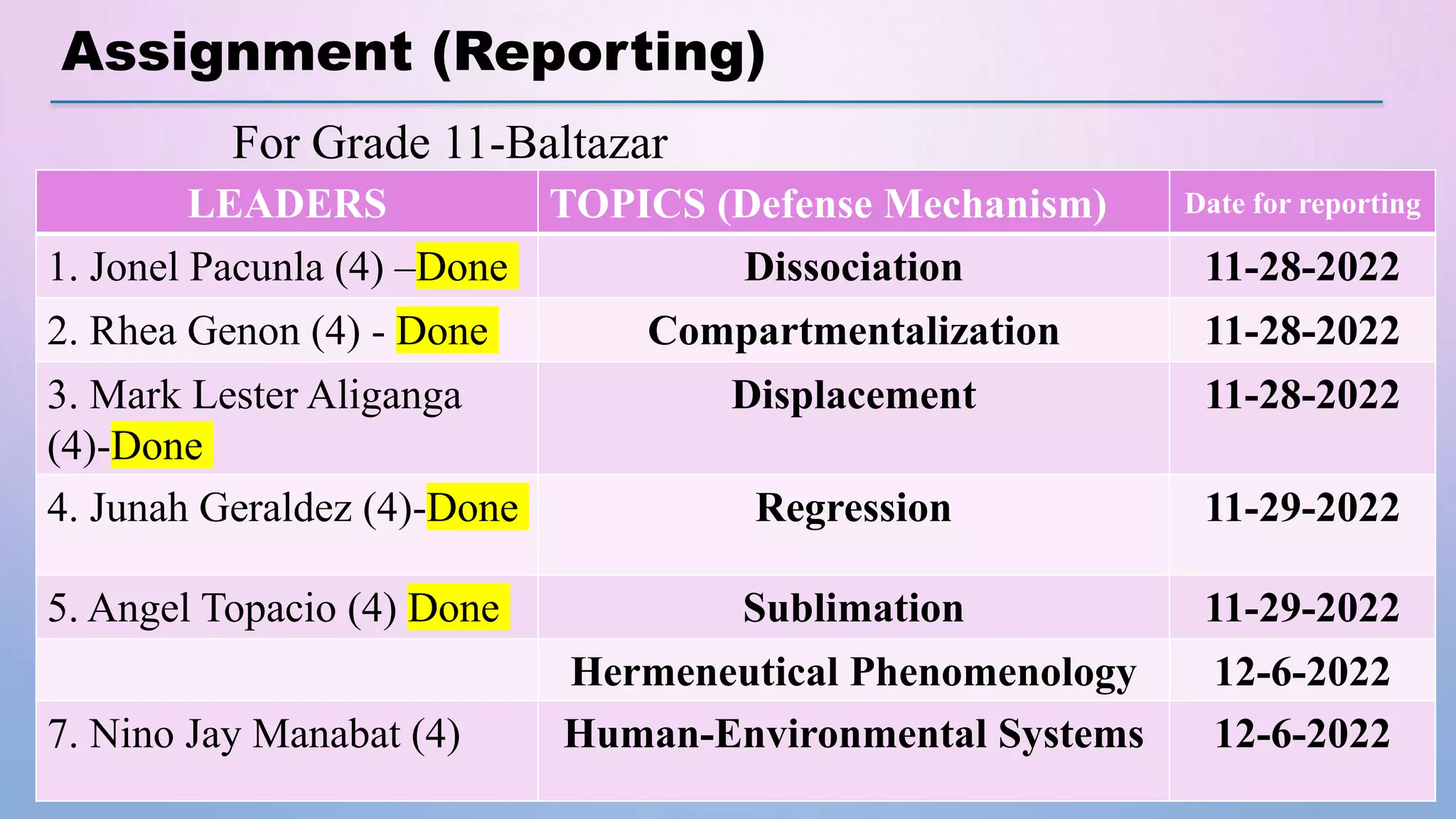
Assignment (Reporting)
For Grade 11-Baltazar
LEADERS TOPICS (Defense Mechanism) Date for reporting
1. Jonel Pacunla (4) –Done Dissociation 11-28-2022
2. Rhea Genon (4) - Done Compartmentalization 11-28-2022
3. Mark Lester Aliganga
(4)-Done
Displacement 11-28-2022
4. Junah Geraldez (4)-Done Regression 11-29-2022
5. Angel Topacio (4) Done Sublimation 11-29-2022
Hermeneutical Phenomenology 12-6-2022
7. Nino Jay Manabat (4) Human-Environmental Systems 12-6-2022
Assignment (Reporting)
For Grade 11-Romulo
LEADERS TOPICS Date
1. Jemar Barnayha (3)-Done Compensation 11-29-2022
2. Jolieto Aliganga (3)-Done Repression 12-1-2022
3. Ronnel Gallardo (3) Suppression 12-1-2022
4. John Paul Canlubo (4) - Done Splitting 12-1-2022
5. Romeo Alimento Jr. (4) Using Humor 12-5-2022
6. Remark Dakay (4)-Done Rational Choice 12-5-2022
7. Christian Paul Tapang (4) Institutionalism 12-5-2022
8. Jerome Alinsunod (4) Feminist Theory 12-6-2022
DEFENSE MECHANISM
• Dissociation – Separating of the memories one can’t deal with or
doesn’t want.
Examples:
• A doctor’s parents pressured her into her profession, even though
she dreamed of being an athlete. She dissociates by daydreaming
about athleticism instead of acknowledging the career turmoil she
is experiencing.
DEFENSE MECHANISM
• Compartmentalization – Separating part of oneself from
awareness of other parts.
- a defense mechanism used to avoid the
anxiety that arises from the clash of contradictory values of
emotions.
Examples:
• A manager can think of himself as nurturing and sensitive at home,
but a hard-nosed tough guy at work.
DEFENSE MECHANISM
• Displacement – transferring of negative emotion from one person
or thing to another.
Examples:
• A person who is angry at their boss may “take out” their anger on a
family member by shouting at them.
DEFENSE MECHANISM
• Regression – seeking the safety of an earlier development stage
Examples:
An adult suffers a nasty spider bite as a child and develops an
intense phobia of spiders later in life without any recollection of
the experience as a child. Because the memory of the spider bite is
repressed, he or she may not understand where the phobia originates.
DEFENSE MECHANISM
• Sublimation – diverting intolerable impulse to a socially
desirable one. Involves channeling unwanted or unacceptable
urges into an admissible or productive outlet.
Examples:
A woman who recently went through a breakup may channel her
emotions into a home improvement project.
DEFENSE MECHANISM
• Compensation – balancing apparent weakness by accentuating the
strength.
-Is a strategy whereby one covers up, consciously or
unconsciously, weaknesses, frustrations, desires, or feelings of
inadequacy or incompetence in one life area through the gratification
or (drive towards) excellence in another area.
Examples:
Trying to hide shortcomings, putting excessive focus on minor
accomplishments, talking negatively about other people's abilities,
and always making negative assumptions about others
DEFENSE MECHANISM
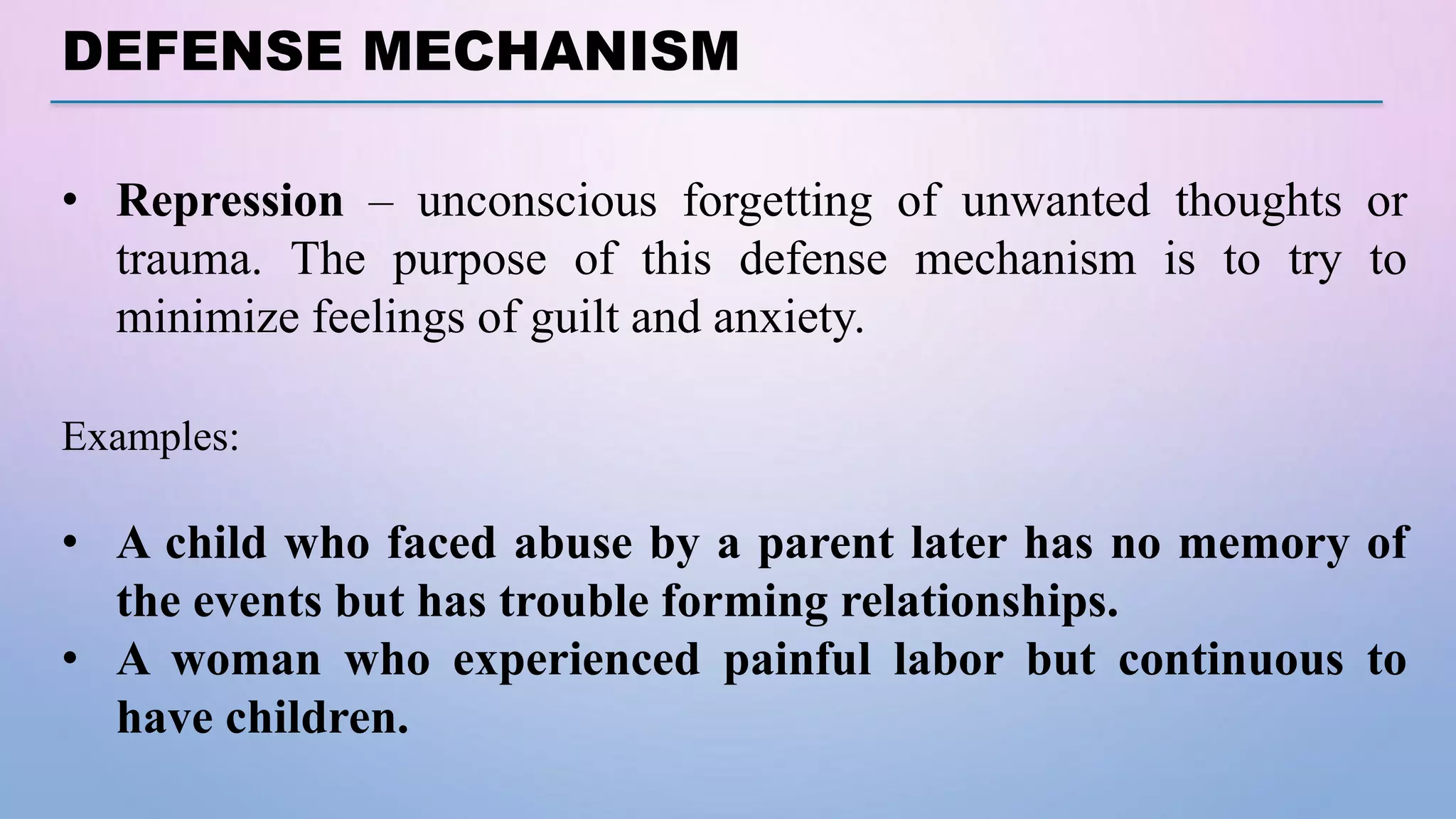
• Repression – unconscious forgetting of unwanted thoughts or
trauma. The purpose of this defense mechanism is to try to
minimize feelings of guilt and anxiety.
Examples:
• A child who faced abuse by a parent later has no memory of
the events but has trouble forming relationships.
• A woman who experienced painful labor but continuous to
have children.
DEFENSE MECHANISM
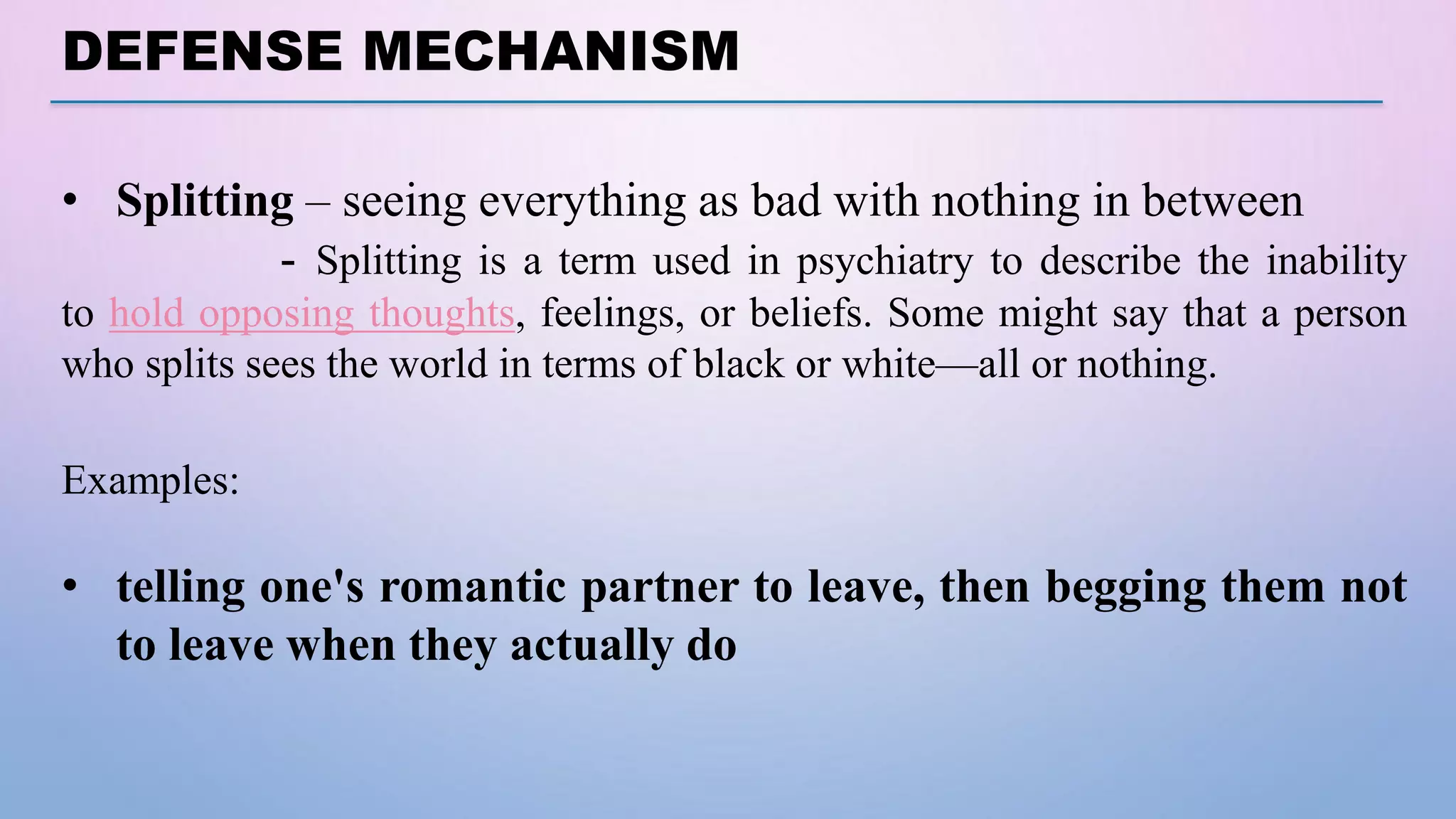
• Splitting – seeing everything as bad with nothing in between
- Splitting is a term used in psychiatry to describe the inability
to hold opposing thoughts, feelings, or beliefs. Some might say that a person
who splits sees the world in terms of black or white—all or nothing.
Examples:
• telling one's romantic partner to leave, then begging them not
to leave when they actually do
DEFENSE MECHANISM
• Using Humor – directing funny aspects of a painful situation.
Humor just feels good; it distracts us from our problems,
promotes a lighter perspective, and serves as a great defense
mechanism.
DEFENSE MECHANISM
• Suppression – conscious type of forgetting to escape from the
problem.
Examples:
• During the therapy session, Miriam refuses to recall her feelings
toward her late husband. She actively works against these
memories through a variety of techniques (e.g., ignoring them,
changing the topic, or just refusing). When pushed, she tells her
therapist that quite simply, she ‘cannot go there.’

PSYCHOANALYSIS.pptx

  • 1.
  • 2.
    Key Concepts andIdeas of Filipino Thinkers in the Social Sciences
  • 3.
    JOSE RIZAL (Refomist) •One of the most renowned social thinkers is our national hero Jose Rizal, he dedicated his life through his writings the Noli Me Tangere and El Filibusterismo and social teachings found in his writings and depositions. • Using his skill in writing through the La Liga Filipina he encouraged every Filipino not to be enslaved but to believe in sovereignty in their own country and raise consciousness from fanaticism, docility, inferiority, and hopelessness towards freedom. The Filipino Social Thinkers
  • 4.
    The Filipino SocialThinkers ANDRES BONIFACIO (Revolutionist) • Founder of the revolutionary society. • He authored essays such as “Ang Dapat Mabatid ng mga Tagalog” and the poem “Pag-ibig sa Tinubuang Lupa”, these literary works encourage Filipinos to show patriotism and love for their country.
  • 5.
    The Filipino SocialThinkers EMILIO JACINTO (Revolutionist) • Also known as a Revolutionist, patronized the ideals of “free reign of reason, of the freedom to think and do”. • Jacinto was committed to the ideals of the liberty, equality, and brotherhood.
  • 6.
    The Filipino SocialThinkers MANUEL L. QUEZON (Political Philosopher) • Believed in the democratization of education for all social classes – a free education from elementary to high school. • Envisioned a government that exercises equality of wealth.
  • 7.
    The Filipino SocialThinkers APOLINARIO MABINI (Political Philosopher) • Known as "The Sublime Paralytic" and "The Brains of the Revolution" • A brilliant thinker who used his pen in the service of the Filipino people's struggle for freedom. • In his political writings “El Verdadero Decalogo”, “Ordenanzas de la Revucion” and “Programa de la Republica Filipina”, his social philosophies are depicted.
  • 8.
    The Filipino SocialThinkers RENATO CONSTANTINO (Nationalist) • He defined Nationalism as an expression of reality that “we have a country of our own, which must be kept our own.” • He suggested a “bottom-up” economic approach instead of a “trickle-down” approach, which will give freedom to small and medium enterprises to boost their capacity in investing in industrial growth.
  • 9.
    The Filipino SocialThinkers CAMILO OSIAS • He advocated that the educational system must contribute towards the achievement of the goals of education by inculcating in the minds and hearts of the youth the value of preserving the patrimony of the country and promoting the general welfare of the people.
  • 10.
    The Filipino SocialThinkers RAFAEL PALMA • He believes in Academic Freedom and advocated that “Education must produce individuals who are both useful to themselves and to society.”
  • 11.
    The Filipino SocialThinkers JORGE BOCOBO • He believes in Academic Freedom and advocated that “Education must produce individuals who are both useful to themselves and to society.”
  • 12.
  • 13.
    In psychoanalysis (therapy), Freudwould have a patient lie on a couch to relax, and he would sit behind them taking notes while they told him about their dreams and childhood memories. FREUD’s PSYCHOANALYSIS TREATMENT (Therapy)
  • 14.
    PSYCHOANALYSIS The psychoanalyst usesvarious techniques as encouragement for the client to develop insights into their behavior and the meanings of symptoms, including ink blots, parapraxes, free association, interpretation (including dream analysis), resistance analysis, and transference analysis.
  • 15.
    FREUD’s STRUCTURE OFPERSONALITY According to Freud, our personality develops from the interactions among what he proposed as the three fundamental structures of the human mind: Id Superego Ego Driven by the unconscious energy and silently influencing our DECISIONS and BEHAVIORS.
  • 16.
    FREUD’s STRUCTURE OFPERSONALITY Demonstrating the toxic needs or wants and how those needs are met. If the need or want is not met, the person will experience anxiety, anger, or even tension. Id Example: The baby was crying because it is hungry. It cried until it was fed. Concerned with the instant satisfaction of basic physical needs and urges.
  • 17.
    FREUD’s STRUCTURE OFPERSONALITY • Operating on the reality principle within the conscious realm. • Decision Maker • Realistically seeking to satisfy desires Ego Example: • Works for reason • Something is good as long as there is no harm
  • 18.
    FREUD’s STRUCTURE OFPERSONALITY • Concerned with social rules and morals. (conscience) • It develops as a child learns what their culture considers right and wrong. Superego Example: • Works for reason • Something is good as long as there is no harm
  • 19.
    • What arethe concepts and principles of psychoanalysis? • How do these concepts and principles apply to society as major social science ideas?
  • 20.
    DEFENSE MECHANISM • RATIONALIZATION •INTELLECTUALIZATION • REACTION FORMATION • ACTING OUT • PROJECTION • DISSOCIATION • COMPARTMENTALIZATION • DISPLACEMENT • REGRESSION • SUBLIMATION • COMPENSATION • REPRESSION • SUPPRESSION • SPLITTING • USING HUMOR
  • 21.
    DEFENSE MECHANISM • Rationalization– involves explaining an unacceptable behavior or feeling in a rational or logical manner, avoiding the true reasons for the behavior. Example: 1.A person who is turned down for a date might rationalize the situation by saying they were not attracted to the other person anyway. 2.A student might rationalize a poor exam score by blaming the instructor rather than admitting their own lack of preparation.
  • 22.
    DEFENSE MECHANISM • Intellectualization– involves a person using reason and logic to avoid uncomfortable or anxiety-provoking emotions. Intellectualization can be a useful way of explaining and understanding negative events. Example: If person A is rude to person B, person B may think about the possible reasons for person A’s behavior. However, intellectualization can cause people to downplay the importance of their own feelings and focus instead on treating all difficult situations as problems that need to be solved. This can stop a person from learning how to deal with their own difficult emotions.
  • 23.
    DEFENSE MECHANISM • Reactionformation – changing unwanted emotions or feelings. It is a way of protecting the mind from uncomfortable thoughts or desires. Often expressed in an exaggerated or showy way Example: 1. A person may experience normal feelings of sadness or disappointment after a relationship breaks down. If they feel that these emotions are unacceptable, they may publicly act as if they are happy or unconcerned. 2. A young boy bullies a young girl because, on a subconscious level, he's attracted to her.
  • 24.
    DEFENSE MECHANISM • Actingout – carrying out extreme behavior. Performing an extreme behavior in order to express thoughts or feelings the person feels incapable of otherwise expressing. Example: Instead of saying “I'm angry with you,” a person who acts out may instead throw a book at the person, or punch a hole through a wall.
  • 25.
    DEFENSE MECHANISM • Projection– transferring the drive or behavior that causes anxiety to others. Examples: • If you have a strong dislike for someone, you might instead believe that they do not like you. • A spouse may be angry at their significant other for not listening, when in fact it is the angry spouse who does not listen.
  • 26.
    Assignment (Reporting) For Grade11-Baltazar LEADERS TOPICS (Defense Mechanism) Date for reporting 1. Jonel Pacunla (4) –Done Dissociation 11-28-2022 2. Rhea Genon (4) - Done Compartmentalization 11-28-2022 3. Mark Lester Aliganga (4)-Done Displacement 11-28-2022 4. Junah Geraldez (4)-Done Regression 11-29-2022 5. Angel Topacio (4) Done Sublimation 11-29-2022 Hermeneutical Phenomenology 12-6-2022 7. Nino Jay Manabat (4) Human-Environmental Systems 12-6-2022
  • 27.
    Assignment (Reporting) For Grade11-Romulo LEADERS TOPICS Date 1. Jemar Barnayha (3)-Done Compensation 11-29-2022 2. Jolieto Aliganga (3)-Done Repression 12-1-2022 3. Ronnel Gallardo (3) Suppression 12-1-2022 4. John Paul Canlubo (4) - Done Splitting 12-1-2022 5. Romeo Alimento Jr. (4) Using Humor 12-5-2022 6. Remark Dakay (4)-Done Rational Choice 12-5-2022 7. Christian Paul Tapang (4) Institutionalism 12-5-2022 8. Jerome Alinsunod (4) Feminist Theory 12-6-2022
  • 28.
    DEFENSE MECHANISM • Dissociation– Separating of the memories one can’t deal with or doesn’t want. Examples: • A doctor’s parents pressured her into her profession, even though she dreamed of being an athlete. She dissociates by daydreaming about athleticism instead of acknowledging the career turmoil she is experiencing.
  • 29.
    DEFENSE MECHANISM • Compartmentalization– Separating part of oneself from awareness of other parts. - a defense mechanism used to avoid the anxiety that arises from the clash of contradictory values of emotions. Examples: • A manager can think of himself as nurturing and sensitive at home, but a hard-nosed tough guy at work.
  • 30.
    DEFENSE MECHANISM • Displacement– transferring of negative emotion from one person or thing to another. Examples: • A person who is angry at their boss may “take out” their anger on a family member by shouting at them.
  • 31.
    DEFENSE MECHANISM • Regression– seeking the safety of an earlier development stage Examples: An adult suffers a nasty spider bite as a child and develops an intense phobia of spiders later in life without any recollection of the experience as a child. Because the memory of the spider bite is repressed, he or she may not understand where the phobia originates.
  • 32.
    DEFENSE MECHANISM • Sublimation– diverting intolerable impulse to a socially desirable one. Involves channeling unwanted or unacceptable urges into an admissible or productive outlet. Examples: A woman who recently went through a breakup may channel her emotions into a home improvement project.
  • 33.
    DEFENSE MECHANISM • Compensation– balancing apparent weakness by accentuating the strength. -Is a strategy whereby one covers up, consciously or unconsciously, weaknesses, frustrations, desires, or feelings of inadequacy or incompetence in one life area through the gratification or (drive towards) excellence in another area. Examples: Trying to hide shortcomings, putting excessive focus on minor accomplishments, talking negatively about other people's abilities, and always making negative assumptions about others
  • 34.
    DEFENSE MECHANISM • Repression– unconscious forgetting of unwanted thoughts or trauma. The purpose of this defense mechanism is to try to minimize feelings of guilt and anxiety. Examples: • A child who faced abuse by a parent later has no memory of the events but has trouble forming relationships. • A woman who experienced painful labor but continuous to have children.
  • 35.
    DEFENSE MECHANISM • Splitting– seeing everything as bad with nothing in between - Splitting is a term used in psychiatry to describe the inability to hold opposing thoughts, feelings, or beliefs. Some might say that a person who splits sees the world in terms of black or white—all or nothing. Examples: • telling one's romantic partner to leave, then begging them not to leave when they actually do
  • 36.
    DEFENSE MECHANISM • UsingHumor – directing funny aspects of a painful situation. Humor just feels good; it distracts us from our problems, promotes a lighter perspective, and serves as a great defense mechanism.
  • 37.
    DEFENSE MECHANISM • Suppression– conscious type of forgetting to escape from the problem. Examples: • During the therapy session, Miriam refuses to recall her feelings toward her late husband. She actively works against these memories through a variety of techniques (e.g., ignoring them, changing the topic, or just refusing). When pushed, she tells her therapist that quite simply, she ‘cannot go there.’