DISCIPLINE AND
IDEAS IN THE
SOCIAL SCIENCE
EXPECTATIONS:
Apply the social science ideas and its importance
in examining sociocultural, economic and political
conditions.
At the end of the lesson, you should be able to:
1. Identify the different social science ideas;
2. 2. Explain clearly the different social science
ideas and its Importance; and
3. 3. Apply the different social science ideas and its
Importance in examining socio cultural, economic
and political conditions in a given social issues.
The Basic Concepts
And Principles of the
Major Social Science
Ideas
NOW LET’S TALK ABOUT THE BASIC CONCEPTS AND PRINCIPLES OF
THE MAJOR SOCIAL SOCIAL SCIENCE IDEAS WE HAVE;
•FEMINIST THEORY
•HERMENEUTICAL PHENOMENOLOGY
•HUMAN-ENVIRONMENT SYSTEMS
WHAT IS FEMINIST THEORY?
Feminism or feminist theory is a range of
political movements, ideologies, and social
movements that share a common goal which
is to define and advance political, economic,
personal, and social rights for women.
This includes seeking to establish
equal opportunities for women in
education and employment.
3 waves of Feminist
Theory
• First Wave
• Second Wave
• Third Wave
•The first wave of feminism highlighted many issues
associated to women such as marriage, property
rights, and right to vote. The two foundations
linked to this are
the women’s rights and women’s suffrage.
Women’s Rights – include the right to live free from
violence, slavery, and discrimination; to be
educated; to own property; to vote; and to earn a
fair and equal wage.
Women’s Suffrage - is the right of women to
•The second wave of feminism started in the
1960s, focusing on addressing social, cultural,
and political
inequalities faced by women. It emphasized
women’s
economic participation, education, and
involvement in
civil rights and radical issues. This period
heightened awareness of sexual discrimination,
leading to increased advocacy for sexual liberation
•The third wave of feminism, which began in
the 1960s and gained prominence in the
21st century, focused on language and
gender
, as well as discrimination in
publishing. It addressed multiculturalism,
competition, and criticized the dominance
of white feminism. Emerging in the
1980s, it highlighted issues of class, race,
culture,
and sexuality, reflecting diverse women’s
TYPE OF FEMINIST THEORY
•LIBERAL FEMINISM
•SOCIALIST FEMINISM
•RADICAL FEMINISM
LIBERAL FEMINISM
Liberal feminism is an individualistic form of
feminist theory, which focuses on women’s ability to
maintain their equality through their own actions
and choices.
Liberal feminists argue that society holds the false
belief that women are, by nature, less intellectually
and physically capable than men.
SOCIALIST FEMINISM
Socialist feminism is a branch of feminism that focuses upon
both the public and private spheres of a woman’s life and argues
that liberation can only be achieved by working to end both the
economic and cultural sources of women’s oppression.
Socialist feminism is a two-pronged theory that broadens Marxist
feminism’s argument for the role of capitalism in the oppression of
women and radical feminism’s theory of the role of gender and the
patriarchy.
RADICAL FEMINISM
Radical feminism is a perspective within
feminism that calls for a radical reordering
of society in which male supremacy is
eliminated in all social and economic
contexts.
FOUR BASIC PRINCIPLES OF FEMINIST
THEORY
:
• Working to increase equality – Feminist thought links ideas to action,
insisting we should push for change toward gender equality and not
just talk about it.
• Expanding human choice – Feminists believe that both men and
women should have the freedom to develop their human
interests and talents, even if those interests and talents conflict
with the status. For example, if a woman wants to be a
mechanic, she should have the right. And opportunity to do so.
• Eliminating gender stratification – Feminists oppose laws and cultural
norms that limit income, educational and job opportunities for
women.
MARY WOLLSTONECRAFT
(1759-1797)
A British writer, philosopher
,
and
advocate of women’s rights.
Wollstonecraft is regarded as
one of the founding feminist
philosophers, and feminists
often cite both her life and
her works as important
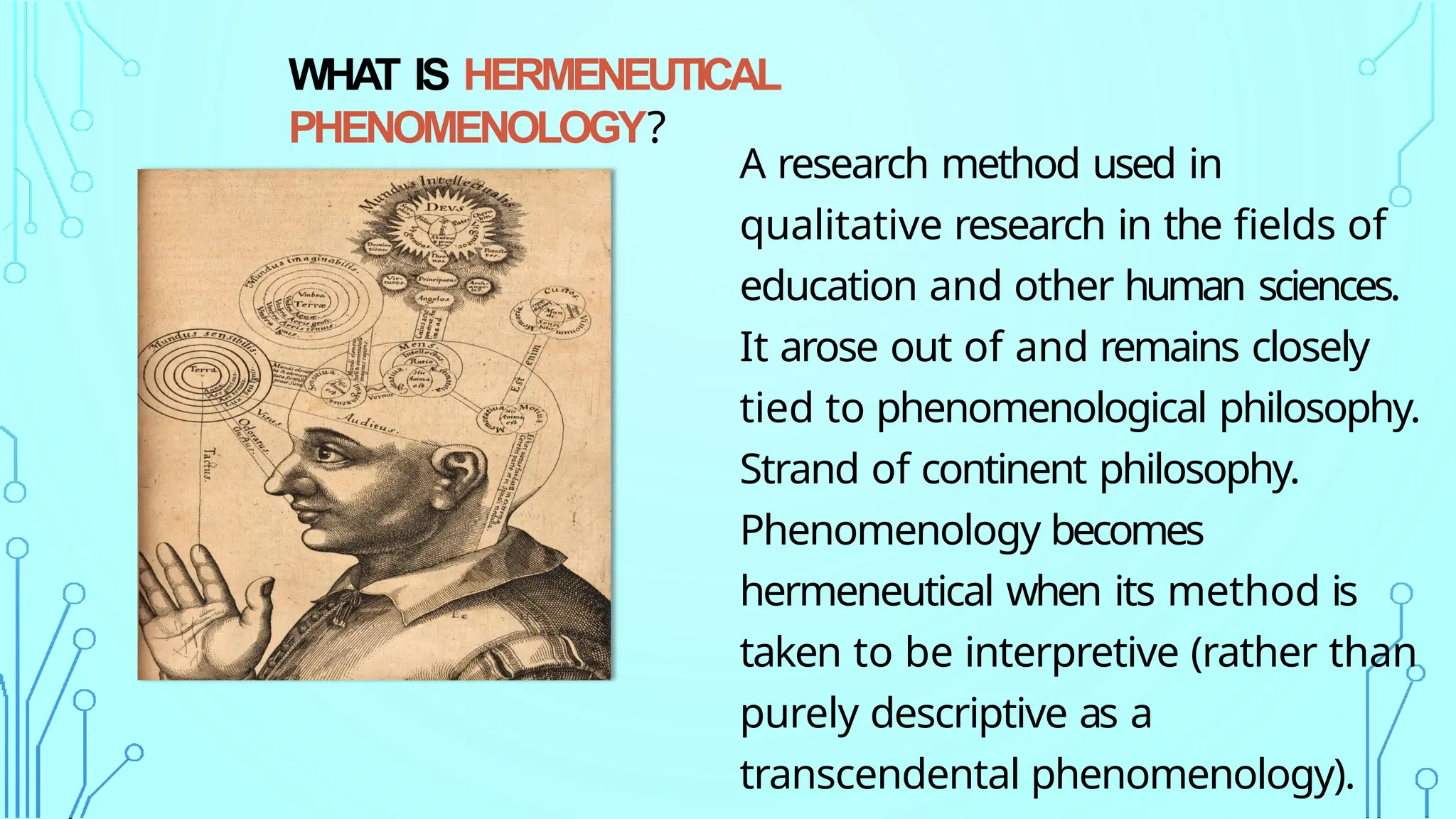
WHAT IS HERMENEUTICAL
PHENOMENOLOGY?
A research method used in
qualitative research in the fields of
education and other human sciences.
It arose out of and remains closely
tied to phenomenological philosophy.
Strand of continent philosophy.
Phenomenology becomes
hermeneutical when its method is
taken to be interpretive (rather than
purely descriptive as a
transcendental phenomenology).
Hermeneutics
-the study of literary texts, scholars frequently adhere to a set of
rules or a specific system on which to base their interpretation.
-the interpretation of nonliterary texts, such as art or philosophy,
may also
require adherence to such a method.
-the specific rules used to interpret and understand. Collectively as
hermeneutics
Phenomenology
-Refers to a person’s perception of the meaning of a n event, as
opposed to the
event as exist externally to (outside of) that person (Alfornon
MARTIN
HEIDEGGER (1889-
1976)
• A German philosopher who
is best known for
contributions to
phenomenology,
hermeneutics, and
existentialism. His work
covers topics including
technology, Immanuel Kant,
EDMUND
HUSSERL(1859-
1938)
• An Austrian-German
philosopher and
mathematician who
established the school
of phenomenology.
HANS-GEORG GADAMER
(1900-2002)
• A German philosopher of
the continental tradition,
best known for his 1960
magnum opus on
hermeneutics, Truth and
Method (Wahrheit und
Methode).
PRINCIPLES OF HERMENEUTICAL
PHENOMENOLOGY
• A belief in the importance and primacy of subjective
consciousness
• An understanding of consciousness as active – as meaning-
bestowing
• Essential structures to consciousness of which we gain direct
knowledge by a kind of reflection
WHAT IS HUMAN-ENVIRONMENT SYSTEMS?
• Also known as CHANS (coupled human
and
natural system).
• Dynamical two-way interactions
between human systems e.g.
economic, social) and natural (e.g.,
hydrologic, atmospheric, biological,
geological) systems. Social and natural
systems are inseparable.
• Tackle broader investigations into the
complex nature of reciprocating
interactions and feedbacks humans on
H
u
m
a
n
-have the capacity to interact with their
environment.
Envir
onment
-a complex of many variables which surrounds
m
a
n as well asthe living organisms
System
-It ma
y be described as a complex of interacting
components
together with the relationships among them that
KEY CONCEPTS
Sense of Place
- Refers to the development of meaning or association with a given
location
Mental M
a
p
- Refers to the mental representation of things and people of a given
location
Primary Landscape
- Are the themes, attachments, memories and emotions w
e hold for
places create a sense of place for us is the world
Spatial Distribution
-Refers to the distribution of anything that exists on earth that can be
m
a
p out and observe through the spatial processes
The social science ideas and its
importance in examining socio-
cultural, economic, and political
conditions
THE IMPORTANCE OF FEMINIST THEORY IN
EXAMINING SOCIOCULTURAL
•Socio-cultural Conditions - cultural feminism, the view
that
there is a “female nature or female essence,
attempts to revalue and redefine attributes
ascribed to femaleness. It is also used to describe
theories that commend innate
differences between women and men (Wikipedia
2020).
THE IMPORTANCE OF FEMINIST THEORY IN
EXAMINING ECONOMIC
•Economic Conditions - feminist economists study both paid
and unpaid care work. They argue that traditional
analysis of economics often ignores the value of household
unpaid work. Feminist economists have argued that
unpaid domestic work is as valuable as paid work, so
measures of economic success should include unpaid
work. (Blackwell 2018).
THE IMPORTANCE OF FEMINIST THEORY IN
EXAMINING POLITICAL
•Political Conditions - Feminist political theory is a diverse
subfield of feminist theory working towards three main
goals: T
o understand and critique the role of gender in
how political theory is conventionally construed. T
o
reframe and re-articulate conventional political theory in
light of feminist issues (especially gender equality). T
o
support political science presuming and pursuing gender
equality. (Wikipedia 2020).
THE IMPORTANCE OF HERMENEUTICAL PHENOMENOLOGY IN
EXAMINING SOCIOCULTURAL
•Socio-cultural Conditions - the interpretive paradigm and
hermeneutic phenomenological design are the most
popular methods used in international
cross-cultural research in healthcare, nurse education
and nursing practice. Their inherent appeal is that they
help researchers to explore experiences. (Research Gate
2018).
THE IMPORTANCE OF HERMENEUTICAL
PHENOMENOLOGY IN EXAMINING ECONOMIC
•Economic Conditions – Austrian economists use
praxeology, a method that emphasizes
interpretation in
economics. This approach, along with other
methodologies, suggests that neoclassical
economics
requires significant reform to incorporate a
more interpretive perspective.
THE IMPORTANCE OF HERMENEUTICAL
PHENOMENOLOGY IN EXAMINING POLITICAL
•Political Conditions - are shifting as contemporary political
practices increasingly focus on the practical aspects of social
theory rather than just abstract concepts or macro-level
sociological processes. Dallmayr (1984) notes a shift in social
and political thought from epistemology to practical
concerns. This movement towards practice is prompting
researchers to question the epistemological
foundations of their disciplines.
THE IMPORTANCE OF HUMAN ENVIRONMENT
SYSTEMS IN EXAMINING SOCIOCULTURAL
• Socio-cultural Conditions – beliefs, attitudes, and values related to
material possessions and the relation of humanity and nature are often
seen as lying at the root of environmental degradation. Such attitudes
and beliefs probably have their greatest independent effects over the
long-term, on the time scale of human generations or more. Within
single lifetimes, attitudes and beliefs can have significant influence on
resource-using behavior
, even when social structural and economic
variables are held constant. (Paul C. Stern, Oran R.Young, and Daniel
Druckman 1992).
THE IMPORTANCE OF HUMAN ENVIRONMENT
SYSTEMS IN EXAMINING ECONOMIC
•Economic Conditions –global economic activity is causing
widespread environmental changes. Concerns about
further economic growth are linked to its impact on
the environment. The level of environmental stress from
economic growth depends on factors like production
patterns, population, resources, political organization,
and development policies.
THE IMPORTANCE OF HUMAN ENVIRONMENT
SYSTEMS IN EXAMINING POLITICAL
• Political Conditions –the global environment is influenced by market
actions, governmental policies, and the international political economy.
Market imperfections affect environmental management, while
government structures and policies can either intentionally or
unintentionally impact the environment. Additionally, the global
economic system can exacerbate environmental issues,especially in
developing countries. The outcomes are shaped by national policies
and the actions of economic actors.

Feminist Theory, Hermeneutical Phenomenology and Human-Environment System.pptx

  • 1.
    DISCIPLINE AND IDEAS INTHE SOCIAL SCIENCE
  • 2.
    EXPECTATIONS: Apply the socialscience ideas and its importance in examining sociocultural, economic and political conditions. At the end of the lesson, you should be able to: 1. Identify the different social science ideas; 2. 2. Explain clearly the different social science ideas and its Importance; and 3. 3. Apply the different social science ideas and its Importance in examining socio cultural, economic and political conditions in a given social issues.
  • 3.
    The Basic Concepts AndPrinciples of the Major Social Science Ideas
  • 4.
    NOW LET’S TALKABOUT THE BASIC CONCEPTS AND PRINCIPLES OF THE MAJOR SOCIAL SOCIAL SCIENCE IDEAS WE HAVE; •FEMINIST THEORY •HERMENEUTICAL PHENOMENOLOGY •HUMAN-ENVIRONMENT SYSTEMS
  • 5.
    WHAT IS FEMINISTTHEORY? Feminism or feminist theory is a range of political movements, ideologies, and social movements that share a common goal which is to define and advance political, economic, personal, and social rights for women. This includes seeking to establish equal opportunities for women in education and employment.
  • 6.
    3 waves ofFeminist Theory • First Wave • Second Wave • Third Wave
  • 7.
    •The first waveof feminism highlighted many issues associated to women such as marriage, property rights, and right to vote. The two foundations linked to this are the women’s rights and women’s suffrage. Women’s Rights – include the right to live free from violence, slavery, and discrimination; to be educated; to own property; to vote; and to earn a fair and equal wage. Women’s Suffrage - is the right of women to
  • 8.
    •The second waveof feminism started in the 1960s, focusing on addressing social, cultural, and political inequalities faced by women. It emphasized women’s economic participation, education, and involvement in civil rights and radical issues. This period heightened awareness of sexual discrimination, leading to increased advocacy for sexual liberation
  • 9.
    •The third waveof feminism, which began in the 1960s and gained prominence in the 21st century, focused on language and gender , as well as discrimination in publishing. It addressed multiculturalism, competition, and criticized the dominance of white feminism. Emerging in the 1980s, it highlighted issues of class, race, culture, and sexuality, reflecting diverse women’s
  • 10.
    TYPE OF FEMINISTTHEORY •LIBERAL FEMINISM •SOCIALIST FEMINISM •RADICAL FEMINISM
  • 11.
    LIBERAL FEMINISM Liberal feminismis an individualistic form of feminist theory, which focuses on women’s ability to maintain their equality through their own actions and choices. Liberal feminists argue that society holds the false belief that women are, by nature, less intellectually and physically capable than men.
  • 12.
    SOCIALIST FEMINISM Socialist feminismis a branch of feminism that focuses upon both the public and private spheres of a woman’s life and argues that liberation can only be achieved by working to end both the economic and cultural sources of women’s oppression. Socialist feminism is a two-pronged theory that broadens Marxist feminism’s argument for the role of capitalism in the oppression of women and radical feminism’s theory of the role of gender and the patriarchy.
  • 13.
    RADICAL FEMINISM Radical feminismis a perspective within feminism that calls for a radical reordering of society in which male supremacy is eliminated in all social and economic contexts.
  • 14.
    FOUR BASIC PRINCIPLESOF FEMINIST THEORY : • Working to increase equality – Feminist thought links ideas to action, insisting we should push for change toward gender equality and not just talk about it. • Expanding human choice – Feminists believe that both men and women should have the freedom to develop their human interests and talents, even if those interests and talents conflict with the status. For example, if a woman wants to be a mechanic, she should have the right. And opportunity to do so. • Eliminating gender stratification – Feminists oppose laws and cultural norms that limit income, educational and job opportunities for women.
  • 15.
    MARY WOLLSTONECRAFT (1759-1797) A Britishwriter, philosopher , and advocate of women’s rights. Wollstonecraft is regarded as one of the founding feminist philosophers, and feminists often cite both her life and her works as important
  • 16.
    WHAT IS HERMENEUTICAL PHENOMENOLOGY? Aresearch method used in qualitative research in the fields of education and other human sciences. It arose out of and remains closely tied to phenomenological philosophy. Strand of continent philosophy. Phenomenology becomes hermeneutical when its method is taken to be interpretive (rather than purely descriptive as a transcendental phenomenology).
  • 17.
    Hermeneutics -the study ofliterary texts, scholars frequently adhere to a set of rules or a specific system on which to base their interpretation. -the interpretation of nonliterary texts, such as art or philosophy, may also require adherence to such a method. -the specific rules used to interpret and understand. Collectively as hermeneutics Phenomenology -Refers to a person’s perception of the meaning of a n event, as opposed to the event as exist externally to (outside of) that person (Alfornon
  • 18.
    MARTIN HEIDEGGER (1889- 1976) • AGerman philosopher who is best known for contributions to phenomenology, hermeneutics, and existentialism. His work covers topics including technology, Immanuel Kant,
  • 19.
    EDMUND HUSSERL(1859- 1938) • An Austrian-German philosopherand mathematician who established the school of phenomenology.
  • 20.
    HANS-GEORG GADAMER (1900-2002) • AGerman philosopher of the continental tradition, best known for his 1960 magnum opus on hermeneutics, Truth and Method (Wahrheit und Methode).
  • 21.
    PRINCIPLES OF HERMENEUTICAL PHENOMENOLOGY •A belief in the importance and primacy of subjective consciousness • An understanding of consciousness as active – as meaning- bestowing • Essential structures to consciousness of which we gain direct knowledge by a kind of reflection
  • 22.
    WHAT IS HUMAN-ENVIRONMENTSYSTEMS? • Also known as CHANS (coupled human and natural system). • Dynamical two-way interactions between human systems e.g. economic, social) and natural (e.g., hydrologic, atmospheric, biological, geological) systems. Social and natural systems are inseparable. • Tackle broader investigations into the complex nature of reciprocating interactions and feedbacks humans on
  • 23.
    H u m a n -have the capacityto interact with their environment. Envir onment -a complex of many variables which surrounds m a n as well asthe living organisms System -It ma y be described as a complex of interacting components together with the relationships among them that
  • 24.
    KEY CONCEPTS Sense ofPlace - Refers to the development of meaning or association with a given location Mental M a p - Refers to the mental representation of things and people of a given location Primary Landscape - Are the themes, attachments, memories and emotions w e hold for places create a sense of place for us is the world Spatial Distribution -Refers to the distribution of anything that exists on earth that can be m a p out and observe through the spatial processes
  • 25.
    The social scienceideas and its importance in examining socio- cultural, economic, and political conditions
  • 26.
    THE IMPORTANCE OFFEMINIST THEORY IN EXAMINING SOCIOCULTURAL •Socio-cultural Conditions - cultural feminism, the view that there is a “female nature or female essence, attempts to revalue and redefine attributes ascribed to femaleness. It is also used to describe theories that commend innate differences between women and men (Wikipedia 2020).
  • 27.
    THE IMPORTANCE OFFEMINIST THEORY IN EXAMINING ECONOMIC •Economic Conditions - feminist economists study both paid and unpaid care work. They argue that traditional analysis of economics often ignores the value of household unpaid work. Feminist economists have argued that unpaid domestic work is as valuable as paid work, so measures of economic success should include unpaid work. (Blackwell 2018).
  • 28.
    THE IMPORTANCE OFFEMINIST THEORY IN EXAMINING POLITICAL •Political Conditions - Feminist political theory is a diverse subfield of feminist theory working towards three main goals: T o understand and critique the role of gender in how political theory is conventionally construed. T o reframe and re-articulate conventional political theory in light of feminist issues (especially gender equality). T o support political science presuming and pursuing gender equality. (Wikipedia 2020).
  • 29.
    THE IMPORTANCE OFHERMENEUTICAL PHENOMENOLOGY IN EXAMINING SOCIOCULTURAL •Socio-cultural Conditions - the interpretive paradigm and hermeneutic phenomenological design are the most popular methods used in international cross-cultural research in healthcare, nurse education and nursing practice. Their inherent appeal is that they help researchers to explore experiences. (Research Gate 2018).
  • 30.
    THE IMPORTANCE OFHERMENEUTICAL PHENOMENOLOGY IN EXAMINING ECONOMIC •Economic Conditions – Austrian economists use praxeology, a method that emphasizes interpretation in economics. This approach, along with other methodologies, suggests that neoclassical economics requires significant reform to incorporate a more interpretive perspective.
  • 31.
    THE IMPORTANCE OFHERMENEUTICAL PHENOMENOLOGY IN EXAMINING POLITICAL •Political Conditions - are shifting as contemporary political practices increasingly focus on the practical aspects of social theory rather than just abstract concepts or macro-level sociological processes. Dallmayr (1984) notes a shift in social and political thought from epistemology to practical concerns. This movement towards practice is prompting researchers to question the epistemological foundations of their disciplines.
  • 32.
    THE IMPORTANCE OFHUMAN ENVIRONMENT SYSTEMS IN EXAMINING SOCIOCULTURAL • Socio-cultural Conditions – beliefs, attitudes, and values related to material possessions and the relation of humanity and nature are often seen as lying at the root of environmental degradation. Such attitudes and beliefs probably have their greatest independent effects over the long-term, on the time scale of human generations or more. Within single lifetimes, attitudes and beliefs can have significant influence on resource-using behavior , even when social structural and economic variables are held constant. (Paul C. Stern, Oran R.Young, and Daniel Druckman 1992).
  • 33.
    THE IMPORTANCE OFHUMAN ENVIRONMENT SYSTEMS IN EXAMINING ECONOMIC •Economic Conditions –global economic activity is causing widespread environmental changes. Concerns about further economic growth are linked to its impact on the environment. The level of environmental stress from economic growth depends on factors like production patterns, population, resources, political organization, and development policies.
  • 34.
    THE IMPORTANCE OFHUMAN ENVIRONMENT SYSTEMS IN EXAMINING POLITICAL • Political Conditions –the global environment is influenced by market actions, governmental policies, and the international political economy. Market imperfections affect environmental management, while government structures and policies can either intentionally or unintentionally impact the environment. Additionally, the global economic system can exacerbate environmental issues,especially in developing countries. The outcomes are shaped by national policies and the actions of economic actors.