WiMax Solutions
Division
WiMAX Network Architecture
Kuo-Hui Li, PhD
WiMAX Solutions Division
Intel Mobility Group
June 05, 2006
Slide2 WiMax Solutions
Division
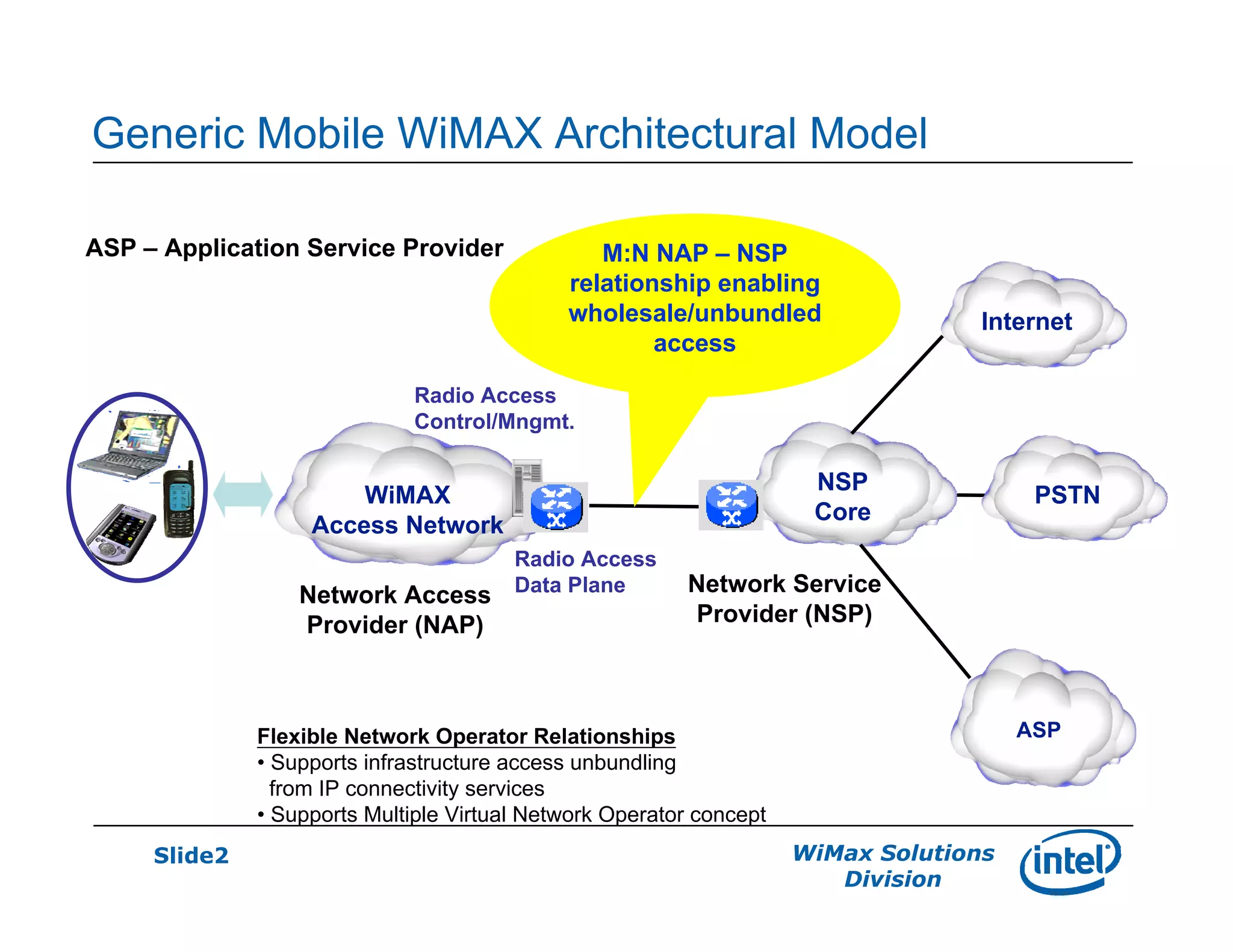
Internet
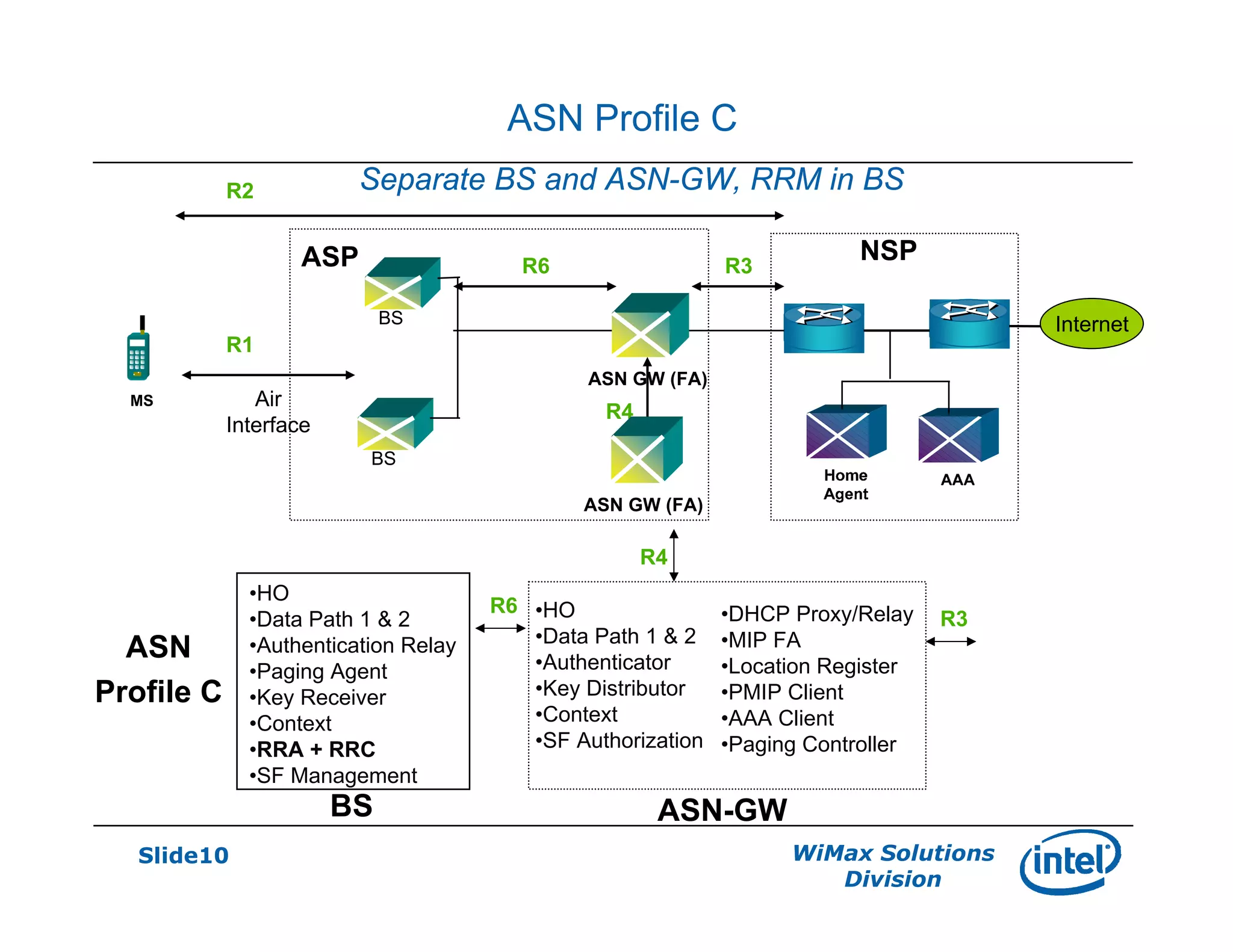
Radio Access
Control/Mngmt.
WiMAX
Access Network
Radio Access
Data Plane
NSP
Core
PSTN
ASP
Network Access
Provider (NAP)
Network Service
Provider (NSP)
M:N NAP – NSP
relationship enabling
wholesale/unbundled
access
Generic Mobile WiMAX Architectural Model
ASP – Application Service Provider
Flexible Network Operator Relationships
• Supports infrastructure access unbundling
from IP connectivity services
• Supports Multiple Virtual Network Operator concept
Slide3 WiMax Solutions
Division
Key Architecture Features
• All IP radio access and core transport network
Based on IEEE* 802.16/e and IETF protocols
• Support for all usage models (fixed to fully
mobile)
• Access to incumbent core networks via
interworking functions
• Open interfaces both within the RAN, and
between the RAN and the core network
• Support for voice, data and multimedia services
with appropriate QoS
Slide4 WiMax Solutions
Division
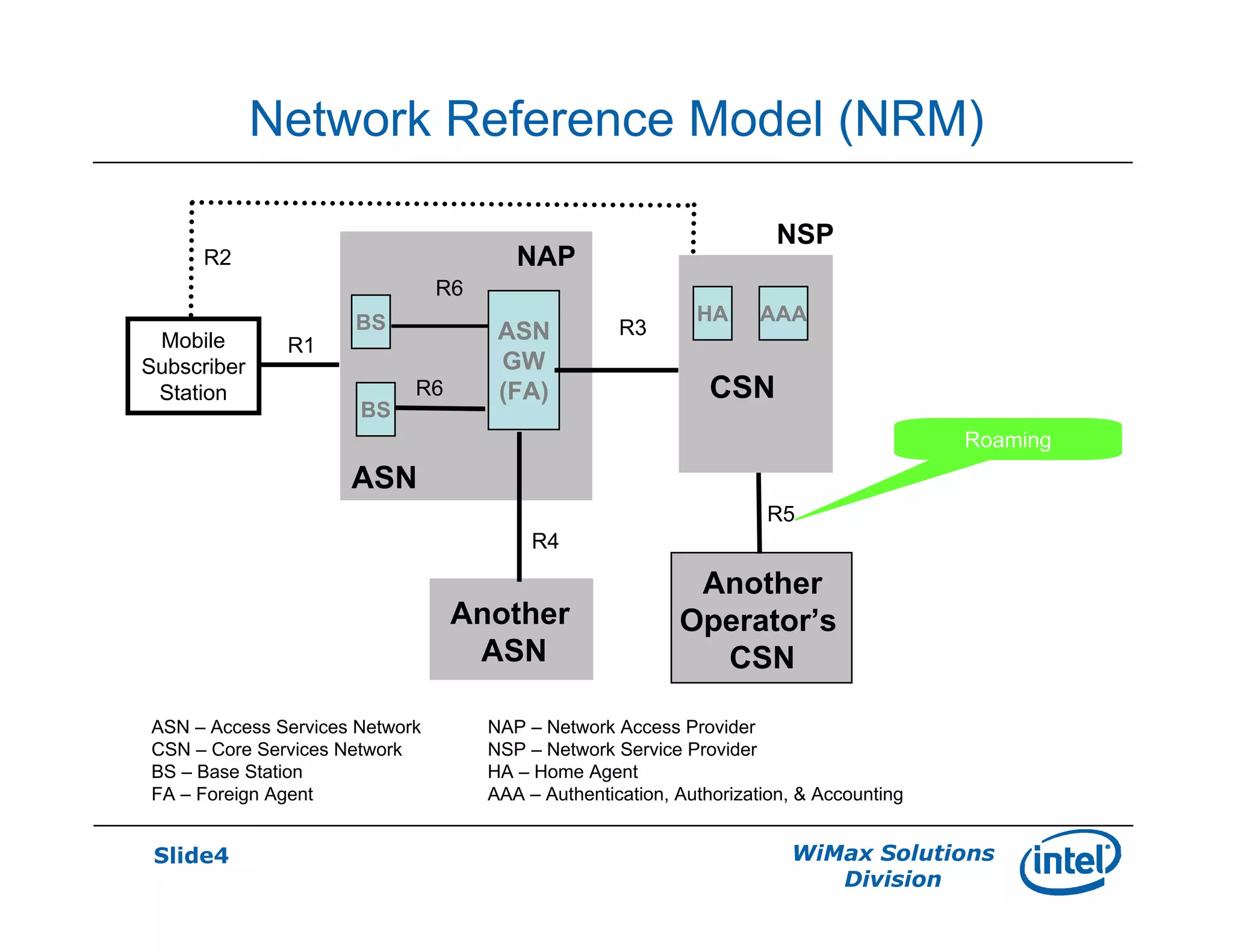
Network Reference Model (NRM)
BS
BS
Mobile
Subscriber
Station
ASN
ASN
GW
(FA)R6 CSN
NSP
R1
R3
Another
ASN
R4
R2
Another
Operator’s
CSN
R5
Roaming
R6
HA AAA
NAP
ASN – Access Services Network NAP – Network Access Provider
CSN – Core Services Network NSP – Network Service Provider
BS – Base Station HA – Home Agent
FA – Foreign Agent AAA – Authentication, Authorization, & Accounting
Slide5 WiMax Solutions
Division
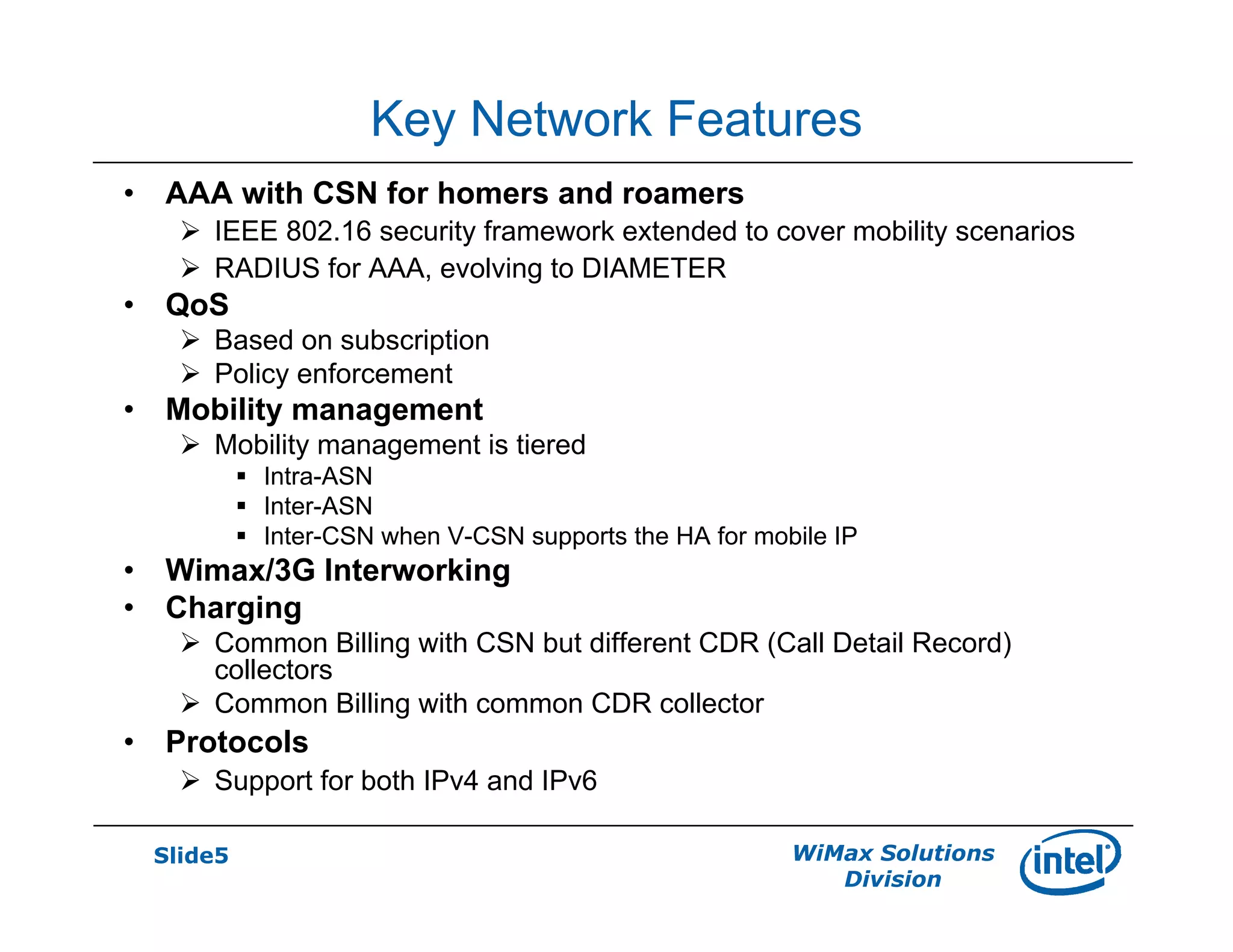
Key Network Features
• AAA with CSN for homers and roamers
IEEE 802.16 security framework extended to cover mobility scenarios
RADIUS for AAA, evolving to DIAMETER
• QoS
Based on subscription
Policy enforcement
• Mobility management
Mobility management is tiered
Intra-ASN
Inter-ASN
Inter-CSN when V-CSN supports the HA for mobile IP
• Wimax/3G Interworking
• Charging
Common Billing with CSN but different CDR (Call Detail Record)
collectors
Common Billing with common CDR collector
• Protocols
Support for both IPv4 and IPv6
Slide6 WiMax Solutions
Division
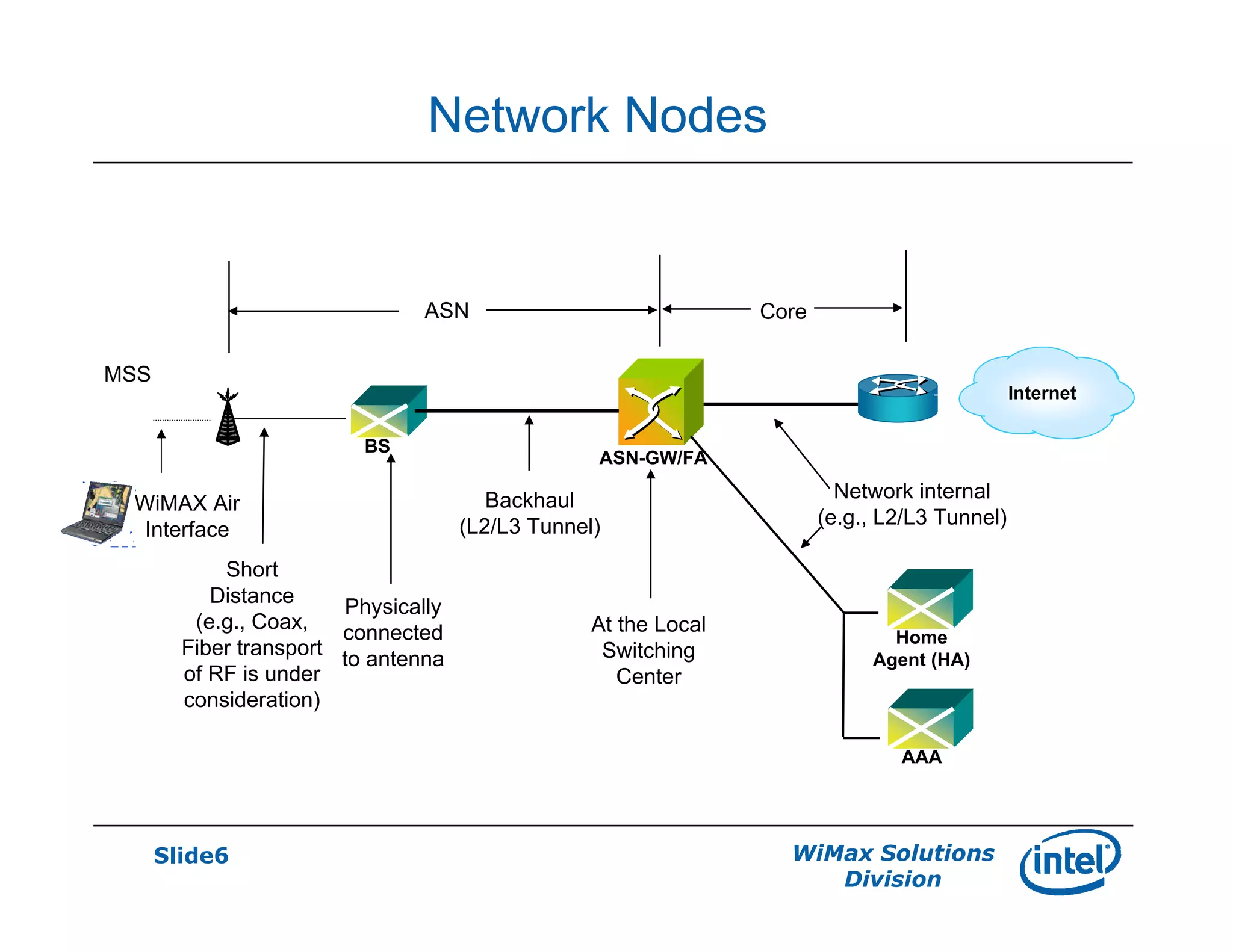
Network Nodes
BS
Internet
Short
Distance
(e.g., Coax,
Fiber transport
of RF is under
consideration)
Backhaul
(L2/L3 Tunnel)
ASN-GW/FA
Network internal
(e.g., L2/L3 Tunnel)
ASN Core
Physically
connected
to antenna
At the Local
Switching
Center
WiMAX Air
Interface
MSS
Home
Agent (HA)
AAA
Slide7 WiMax Solutions
Division
ASN Profiles
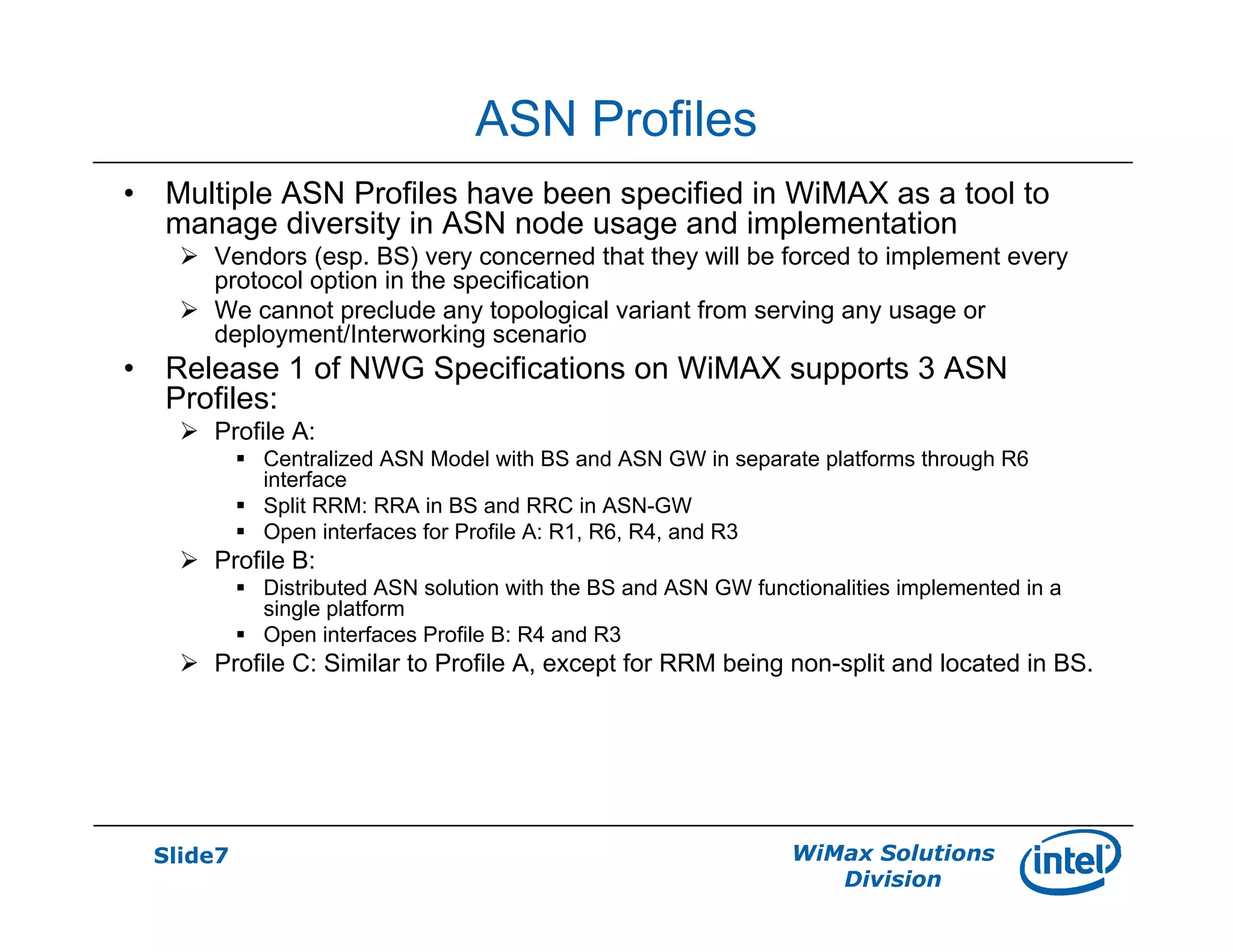
• Multiple ASN Profiles have been specified in WiMAX as a tool to
manage diversity in ASN node usage and implementation
Vendors (esp. BS) very concerned that they will be forced to implement every
protocol option in the specification
We cannot preclude any topological variant from serving any usage or
deployment/Interworking scenario
• Release 1 of NWG Specifications on WiMAX supports 3 ASN
Profiles:
Profile A:
Centralized ASN Model with BS and ASN GW in separate platforms through R6
interface
Split RRM: RRA in BS and RRC in ASN-GW
Open interfaces for Profile A: R1, R6, R4, and R3
Profile B:
Distributed ASN solution with the BS and ASN GW functionalities implemented in a
single platform
Open interfaces Profile B: R4 and R3
Profile C: Similar to Profile A, except for RRM being non-split and located in BS.
Slide8 WiMax Solutions
Division
ASN Profile A
NSP
Air
Interface
MS
BS
BS
R1
R4
R2
R3
ASN
Profile A
R4
R3
Internet
R6
ASN GW (FA)
ASP
R6
ASN GW (FA)
BS ASN-GW
•HO
•Data Path 1 & 2
•Authentication Relay
•Paging Agent
•Key Receiver
•Context
•RRA
•SF Management
•HO
•Data Path 1 & 2
•Authenticator
•Key Distributor
•Context
•RRC
•SF Authorization
•DHCP Proxy/Relay
•MIP FA
•Location Register
•PMIP Client
•AAA Client
•Paging Controller
Separate BS and ASN-GW, Split RRM
Slide9 WiMax Solutions
Division
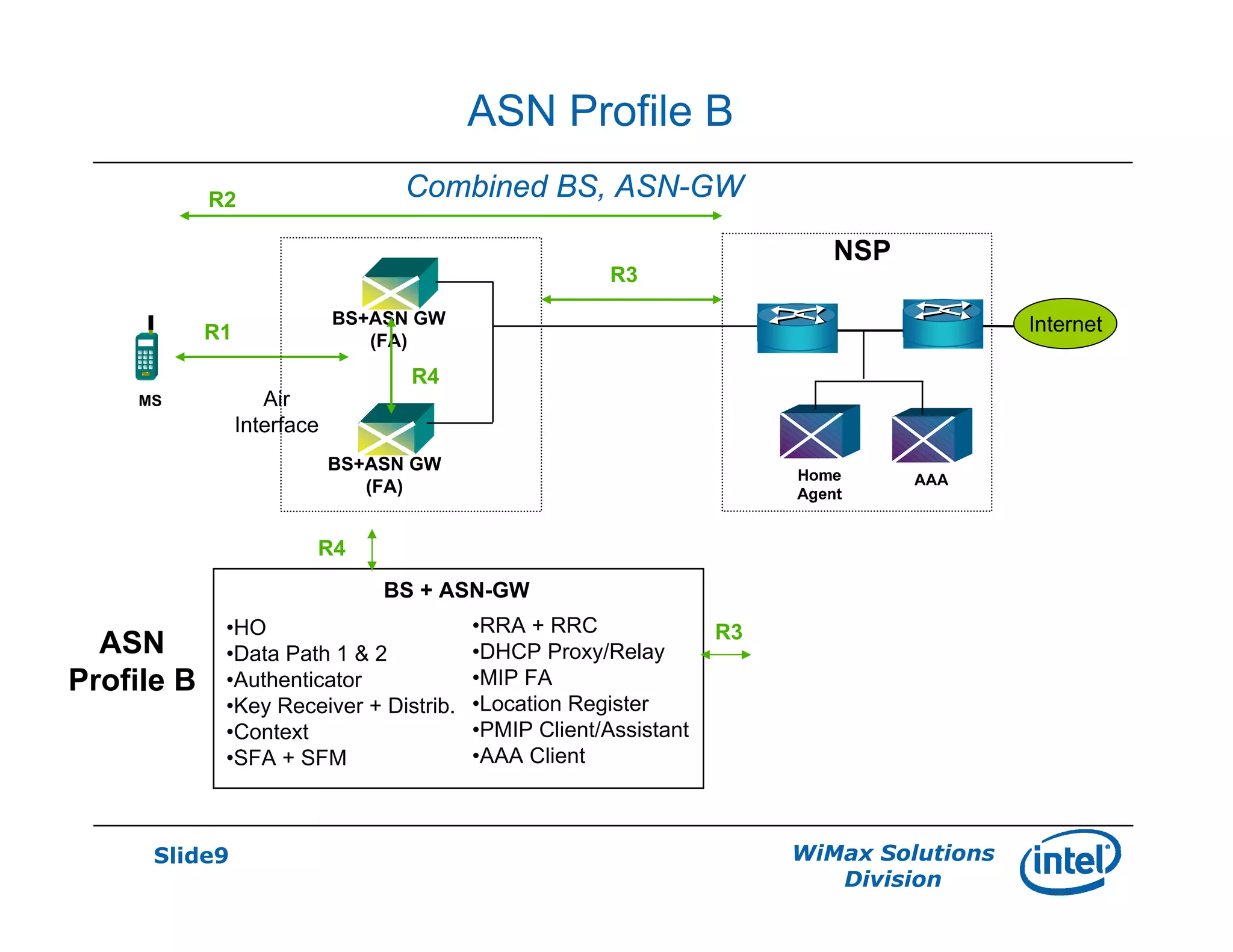
ASN Profile B
Air
Interface
MS
BS+ASN GW
(FA)
BS+ASN GW
(FA)
R1
R4
R2
ASN
Profile B
BS + ASN-GW
•HO
•Data Path 1 & 2
•Authenticator
•Key Receiver + Distrib.
•Context
•SFA + SFM
•RRA + RRC
•DHCP Proxy/Relay
•MIP FA
•Location Register
•PMIP Client/Assistant
•AAA Client
R4
R3
NSP
R3
Internet
Combined BS, ASN-GW
Slide10 WiMax Solutions
Division
ASN Profile C
NSP
Air
Interface
MS
BS
BS
R1
R4
R2
R3
ASN
Profile C
R4
R3
Internet
R6
ASN GW (FA)
ASP
R6
ASN GW (FA)
BS ASN-GW
•HO
•Data Path 1 & 2
•Authentication Relay
•Paging Agent
•Key Receiver
•Context
•RRA + RRC
•SF Management
•HO
•Data Path 1 & 2
•Authenticator
•Key Distributor
•Context
•SF Authorization
•DHCP Proxy/Relay
•MIP FA
•Location Register
•PMIP Client
•AAA Client
•Paging Controller
Separate BS and ASN-GW, RRM in BS
Slide11 WiMax Solutions
Division
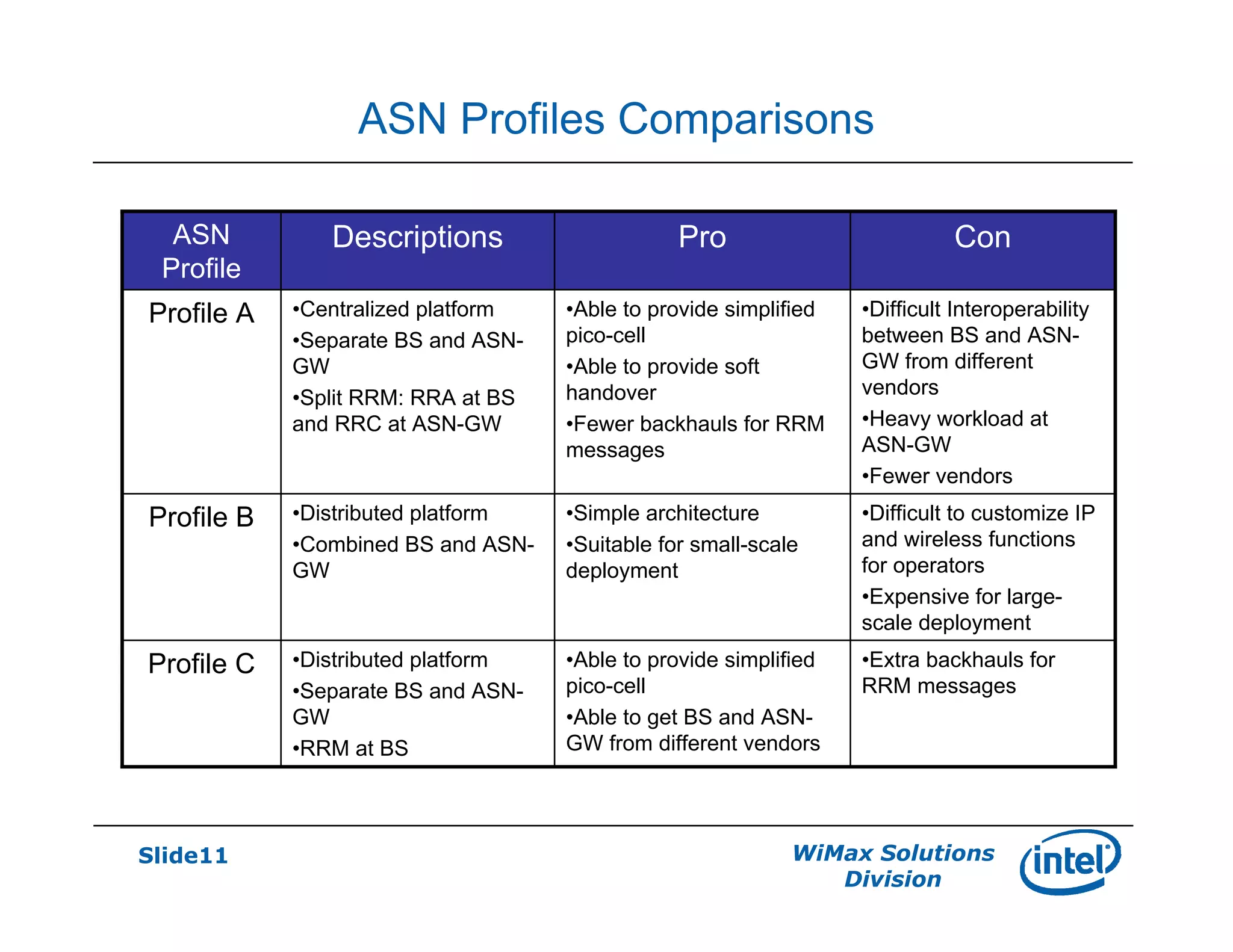
ASN Profiles Comparisons
•Distributed platform
•Separate BS and ASN-
GW
•RRM at BS
•Distributed platform
•Combined BS and ASN-
GW
•Centralized platform
•Separate BS and ASN-
GW
•Split RRM: RRA at BS
and RRC at ASN-GW
Descriptions
•Extra backhauls for
RRM messages
•Able to provide simplified
pico-cell
•Able to get BS and ASN-
GW from different vendors
Profile C
•Difficult to customize IP
and wireless functions
for operators
•Expensive for large-
scale deployment
•Simple architecture
•Suitable for small-scale
deployment
Profile B
•Difficult Interoperability
between BS and ASN-
GW from different
vendors
•Heavy workload at
ASN-GW
•Fewer vendors
•Able to provide simplified
pico-cell
•Able to provide soft
handover
•Fewer backhauls for RRM
messages
Profile A
ConProASN
Profile
Slide12 WiMax Solutions
Division
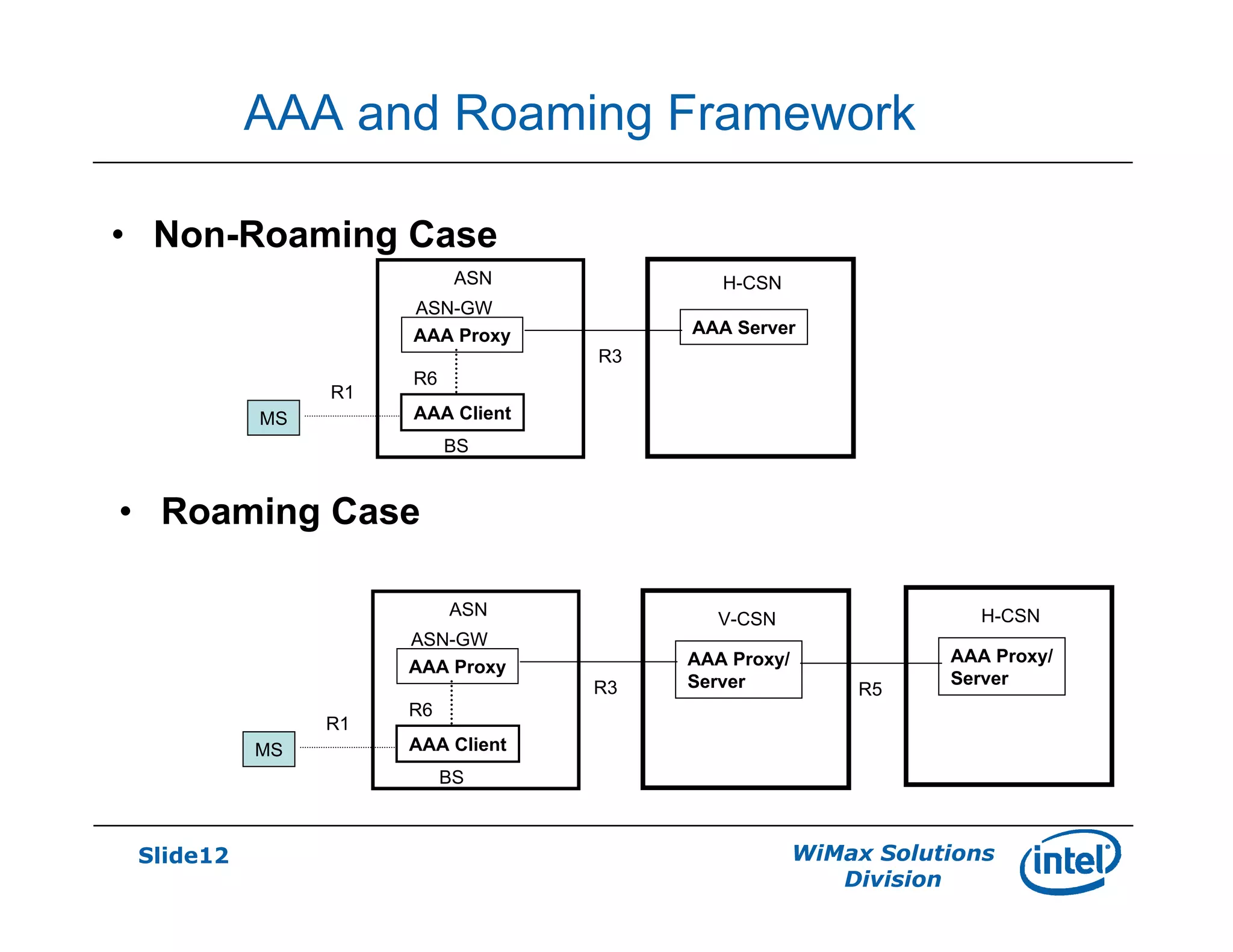
AAA and Roaming Framework
• Non-Roaming Case
MS AAA Client
AAA Proxy
R1
BS
ASN-GW
ASN
R6
H-CSN
R3
AAA Server
MS AAA Client
AAA Proxy
R1
BS
ASN-GW
ASN
R6
V-CSN
R3
AAA Proxy/
Server
H-CSN
AAA Proxy/
Server
R5
• Roaming Case
Slide13 WiMax Solutions
Division
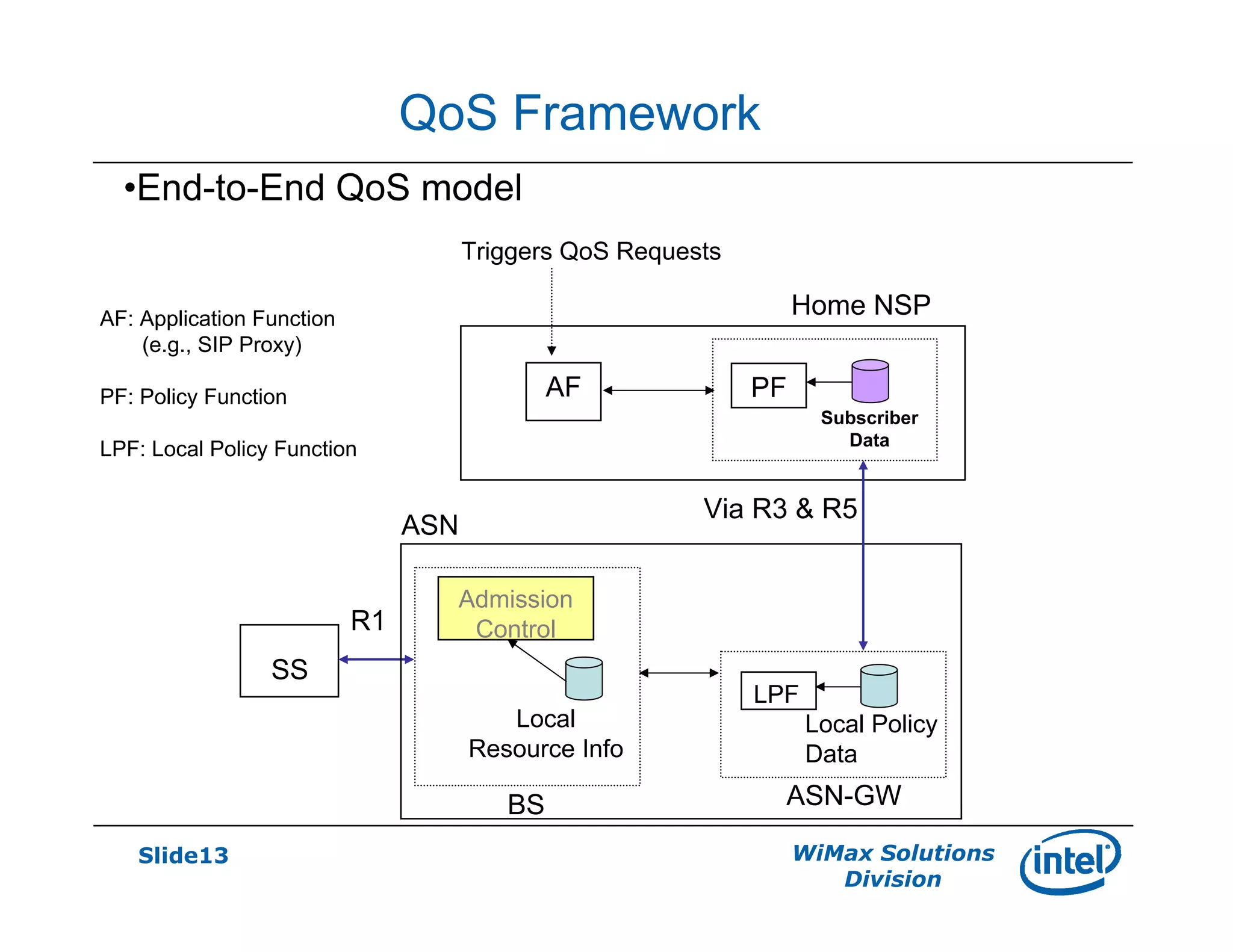
QoS Framework
•End-to-End QoS model
SS
Admission
Control
BS
LPF
Local Policy
Data
ASN
PF
Subscriber
Data
Home NSP
Via R3 & R5
R1
Local
Resource Info
ASN-GW
AF
Triggers QoS Requests
AF: Application Function
(e.g., SIP Proxy)
PF: Policy Function
LPF: Local Policy Function
Slide14 WiMax Solutions
Division
Mobility Framework
• Mobile IP based
Proxy mobile IP
Client unaware of MIP
Standard RFC methods implemented in network
only
Client mobile IP
As per standard RFC
Coexistence
Support for both MIP-aware and other clients
Slide15 WiMax Solutions
Division
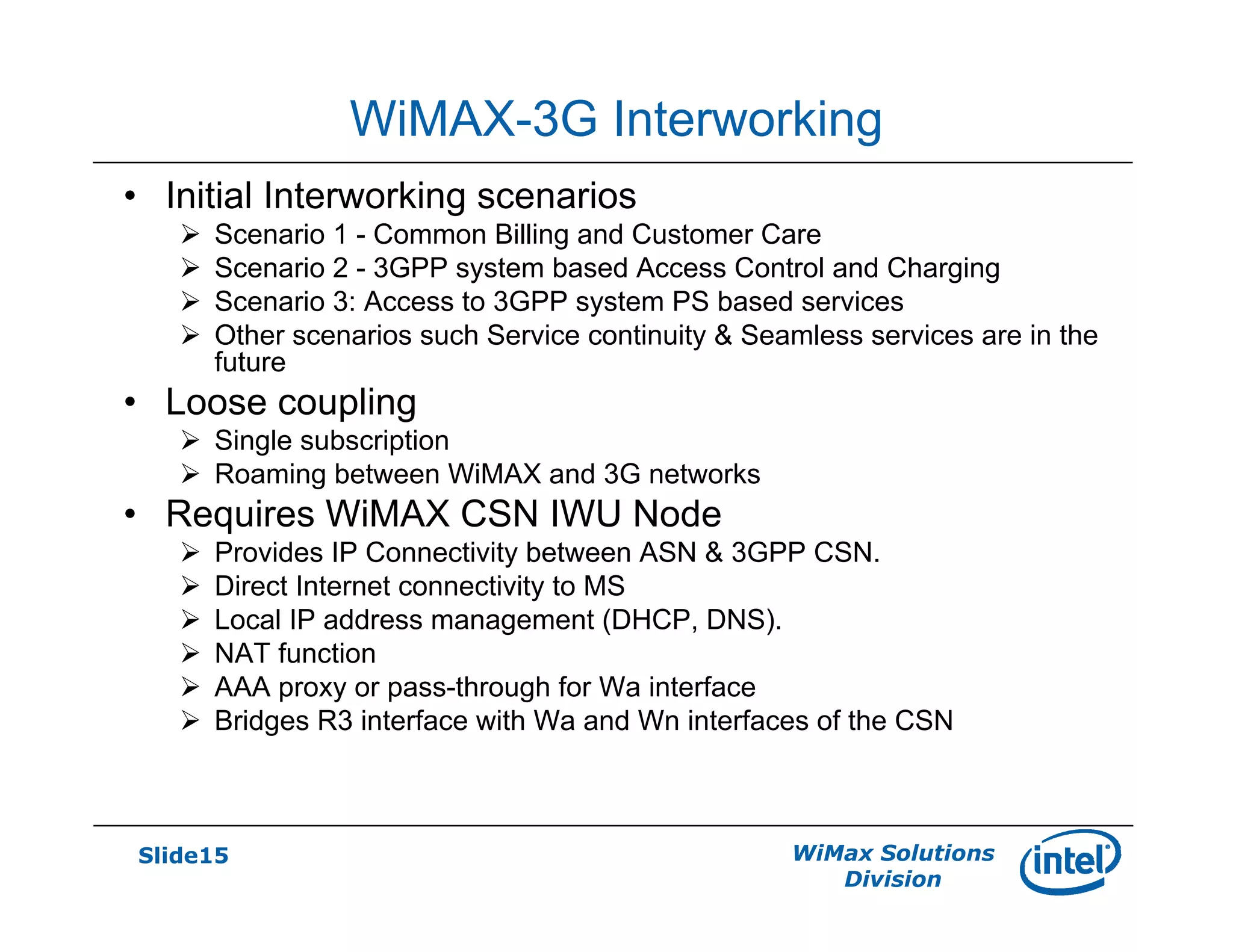
WiMAX-3G Interworking
• Initial Interworking scenarios
Scenario 1 - Common Billing and Customer Care
Scenario 2 - 3GPP system based Access Control and Charging
Scenario 3: Access to 3GPP system PS based services
Other scenarios such Service continuity & Seamless services are in the
future
• Loose coupling
Single subscription
Roaming between WiMAX and 3G networks
• Requires WiMAX CSN IWU Node
Provides IP Connectivity between ASN & 3GPP CSN.
Direct Internet connectivity to MS
Local IP address management (DHCP, DNS).
NAT function
AAA proxy or pass-through for Wa interface
Bridges R3 interface with Wa and Wn interfaces of the CSN
Slide16 WiMax Solutions
Division
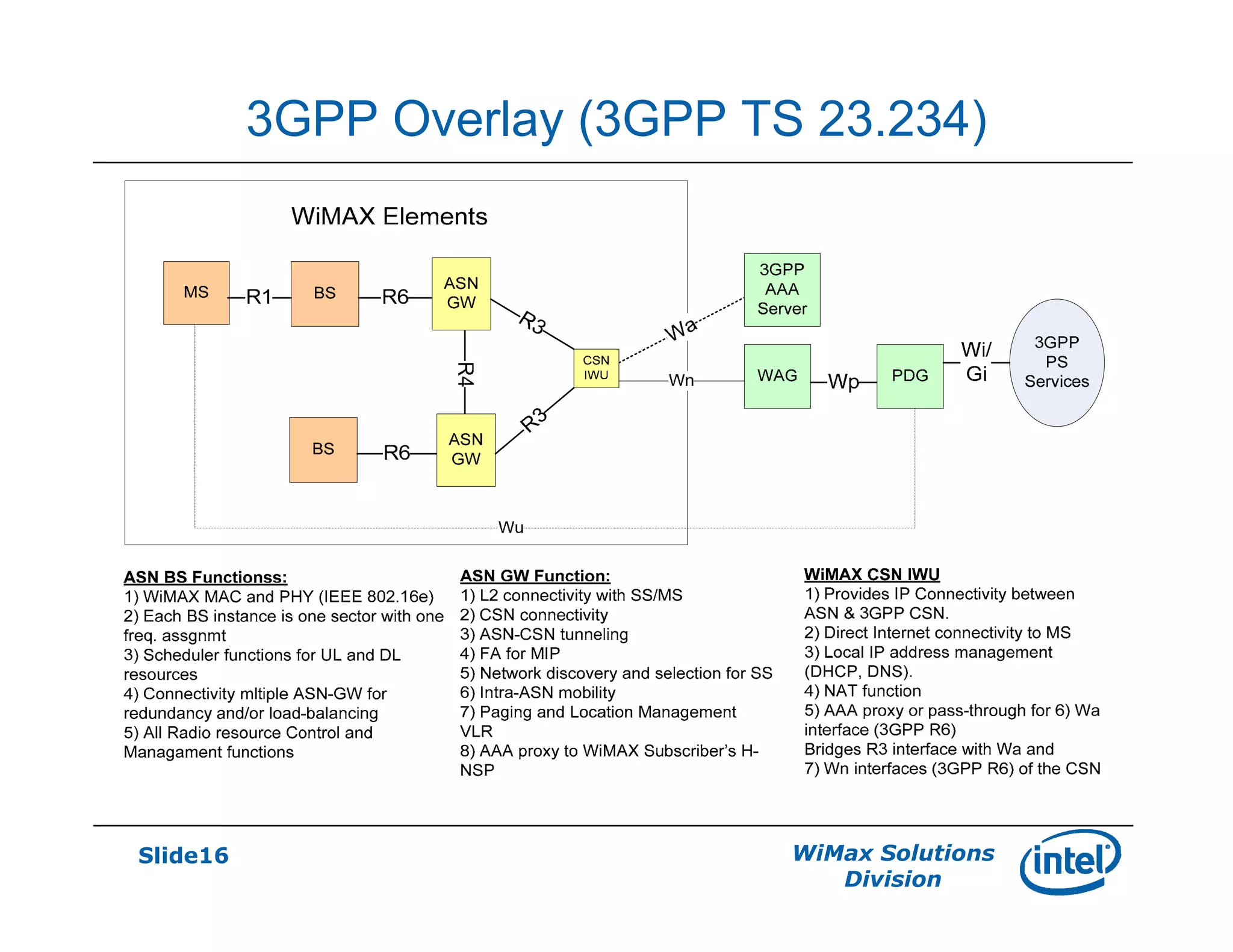
3GPP Overlay (3GPP TS 23.234)
Slide17 WiMax Solutions
Division
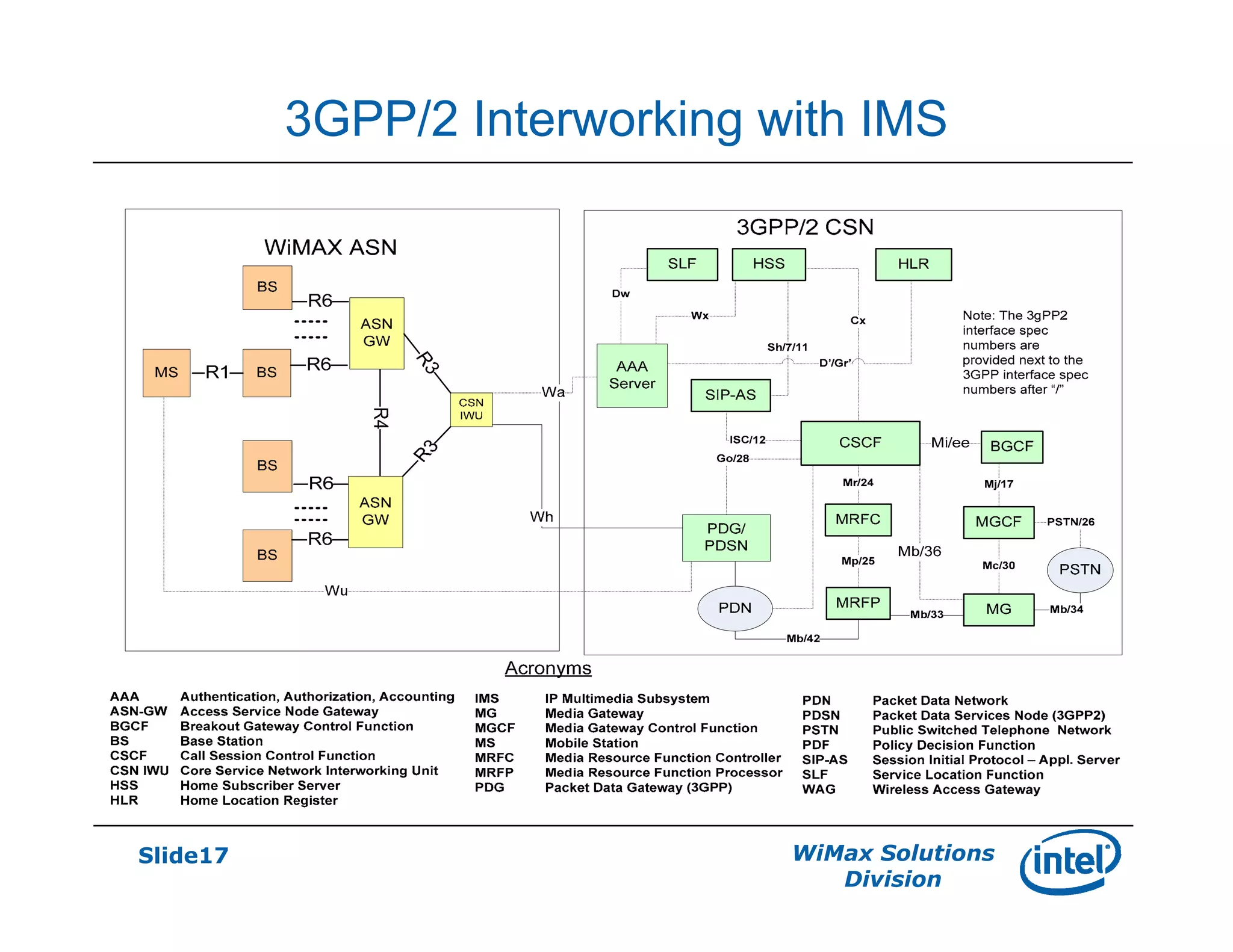
3GPP/2 Interworking with IMS

19427661 wi max-network-architecture

  • 1.
    WiMax Solutions Division WiMAX NetworkArchitecture Kuo-Hui Li, PhD WiMAX Solutions Division Intel Mobility Group June 05, 2006
  • 2.
    Slide2 WiMax Solutions Division Internet RadioAccess Control/Mngmt. WiMAX Access Network Radio Access Data Plane NSP Core PSTN ASP Network Access Provider (NAP) Network Service Provider (NSP) M:N NAP – NSP relationship enabling wholesale/unbundled access Generic Mobile WiMAX Architectural Model ASP – Application Service Provider Flexible Network Operator Relationships • Supports infrastructure access unbundling from IP connectivity services • Supports Multiple Virtual Network Operator concept
  • 3.
    Slide3 WiMax Solutions Division KeyArchitecture Features • All IP radio access and core transport network Based on IEEE* 802.16/e and IETF protocols • Support for all usage models (fixed to fully mobile) • Access to incumbent core networks via interworking functions • Open interfaces both within the RAN, and between the RAN and the core network • Support for voice, data and multimedia services with appropriate QoS
  • 4.
    Slide4 WiMax Solutions Division NetworkReference Model (NRM) BS BS Mobile Subscriber Station ASN ASN GW (FA)R6 CSN NSP R1 R3 Another ASN R4 R2 Another Operator’s CSN R5 Roaming R6 HA AAA NAP ASN – Access Services Network NAP – Network Access Provider CSN – Core Services Network NSP – Network Service Provider BS – Base Station HA – Home Agent FA – Foreign Agent AAA – Authentication, Authorization, & Accounting
  • 5.
    Slide5 WiMax Solutions Division KeyNetwork Features • AAA with CSN for homers and roamers IEEE 802.16 security framework extended to cover mobility scenarios RADIUS for AAA, evolving to DIAMETER • QoS Based on subscription Policy enforcement • Mobility management Mobility management is tiered Intra-ASN Inter-ASN Inter-CSN when V-CSN supports the HA for mobile IP • Wimax/3G Interworking • Charging Common Billing with CSN but different CDR (Call Detail Record) collectors Common Billing with common CDR collector • Protocols Support for both IPv4 and IPv6
  • 6.
    Slide6 WiMax Solutions Division NetworkNodes BS Internet Short Distance (e.g., Coax, Fiber transport of RF is under consideration) Backhaul (L2/L3 Tunnel) ASN-GW/FA Network internal (e.g., L2/L3 Tunnel) ASN Core Physically connected to antenna At the Local Switching Center WiMAX Air Interface MSS Home Agent (HA) AAA
  • 7.
    Slide7 WiMax Solutions Division ASNProfiles • Multiple ASN Profiles have been specified in WiMAX as a tool to manage diversity in ASN node usage and implementation Vendors (esp. BS) very concerned that they will be forced to implement every protocol option in the specification We cannot preclude any topological variant from serving any usage or deployment/Interworking scenario • Release 1 of NWG Specifications on WiMAX supports 3 ASN Profiles: Profile A: Centralized ASN Model with BS and ASN GW in separate platforms through R6 interface Split RRM: RRA in BS and RRC in ASN-GW Open interfaces for Profile A: R1, R6, R4, and R3 Profile B: Distributed ASN solution with the BS and ASN GW functionalities implemented in a single platform Open interfaces Profile B: R4 and R3 Profile C: Similar to Profile A, except for RRM being non-split and located in BS.
  • 8.
    Slide8 WiMax Solutions Division ASNProfile A NSP Air Interface MS BS BS R1 R4 R2 R3 ASN Profile A R4 R3 Internet R6 ASN GW (FA) ASP R6 ASN GW (FA) BS ASN-GW •HO •Data Path 1 & 2 •Authentication Relay •Paging Agent •Key Receiver •Context •RRA •SF Management •HO •Data Path 1 & 2 •Authenticator •Key Distributor •Context •RRC •SF Authorization •DHCP Proxy/Relay •MIP FA •Location Register •PMIP Client •AAA Client •Paging Controller Separate BS and ASN-GW, Split RRM
  • 9.
    Slide9 WiMax Solutions Division ASNProfile B Air Interface MS BS+ASN GW (FA) BS+ASN GW (FA) R1 R4 R2 ASN Profile B BS + ASN-GW •HO •Data Path 1 & 2 •Authenticator •Key Receiver + Distrib. •Context •SFA + SFM •RRA + RRC •DHCP Proxy/Relay •MIP FA •Location Register •PMIP Client/Assistant •AAA Client R4 R3 NSP R3 Internet Combined BS, ASN-GW
  • 10.
    Slide10 WiMax Solutions Division ASNProfile C NSP Air Interface MS BS BS R1 R4 R2 R3 ASN Profile C R4 R3 Internet R6 ASN GW (FA) ASP R6 ASN GW (FA) BS ASN-GW •HO •Data Path 1 & 2 •Authentication Relay •Paging Agent •Key Receiver •Context •RRA + RRC •SF Management •HO •Data Path 1 & 2 •Authenticator •Key Distributor •Context •SF Authorization •DHCP Proxy/Relay •MIP FA •Location Register •PMIP Client •AAA Client •Paging Controller Separate BS and ASN-GW, RRM in BS
  • 11.
    Slide11 WiMax Solutions Division ASNProfiles Comparisons •Distributed platform •Separate BS and ASN- GW •RRM at BS •Distributed platform •Combined BS and ASN- GW •Centralized platform •Separate BS and ASN- GW •Split RRM: RRA at BS and RRC at ASN-GW Descriptions •Extra backhauls for RRM messages •Able to provide simplified pico-cell •Able to get BS and ASN- GW from different vendors Profile C •Difficult to customize IP and wireless functions for operators •Expensive for large- scale deployment •Simple architecture •Suitable for small-scale deployment Profile B •Difficult Interoperability between BS and ASN- GW from different vendors •Heavy workload at ASN-GW •Fewer vendors •Able to provide simplified pico-cell •Able to provide soft handover •Fewer backhauls for RRM messages Profile A ConProASN Profile
  • 12.
    Slide12 WiMax Solutions Division AAAand Roaming Framework • Non-Roaming Case MS AAA Client AAA Proxy R1 BS ASN-GW ASN R6 H-CSN R3 AAA Server MS AAA Client AAA Proxy R1 BS ASN-GW ASN R6 V-CSN R3 AAA Proxy/ Server H-CSN AAA Proxy/ Server R5 • Roaming Case
  • 13.
    Slide13 WiMax Solutions Division QoSFramework •End-to-End QoS model SS Admission Control BS LPF Local Policy Data ASN PF Subscriber Data Home NSP Via R3 & R5 R1 Local Resource Info ASN-GW AF Triggers QoS Requests AF: Application Function (e.g., SIP Proxy) PF: Policy Function LPF: Local Policy Function
  • 14.
    Slide14 WiMax Solutions Division MobilityFramework • Mobile IP based Proxy mobile IP Client unaware of MIP Standard RFC methods implemented in network only Client mobile IP As per standard RFC Coexistence Support for both MIP-aware and other clients
  • 15.
    Slide15 WiMax Solutions Division WiMAX-3GInterworking • Initial Interworking scenarios Scenario 1 - Common Billing and Customer Care Scenario 2 - 3GPP system based Access Control and Charging Scenario 3: Access to 3GPP system PS based services Other scenarios such Service continuity & Seamless services are in the future • Loose coupling Single subscription Roaming between WiMAX and 3G networks • Requires WiMAX CSN IWU Node Provides IP Connectivity between ASN & 3GPP CSN. Direct Internet connectivity to MS Local IP address management (DHCP, DNS). NAT function AAA proxy or pass-through for Wa interface Bridges R3 interface with Wa and Wn interfaces of the CSN
  • 16.
    Slide16 WiMax Solutions Division 3GPPOverlay (3GPP TS 23.234)
  • 17.