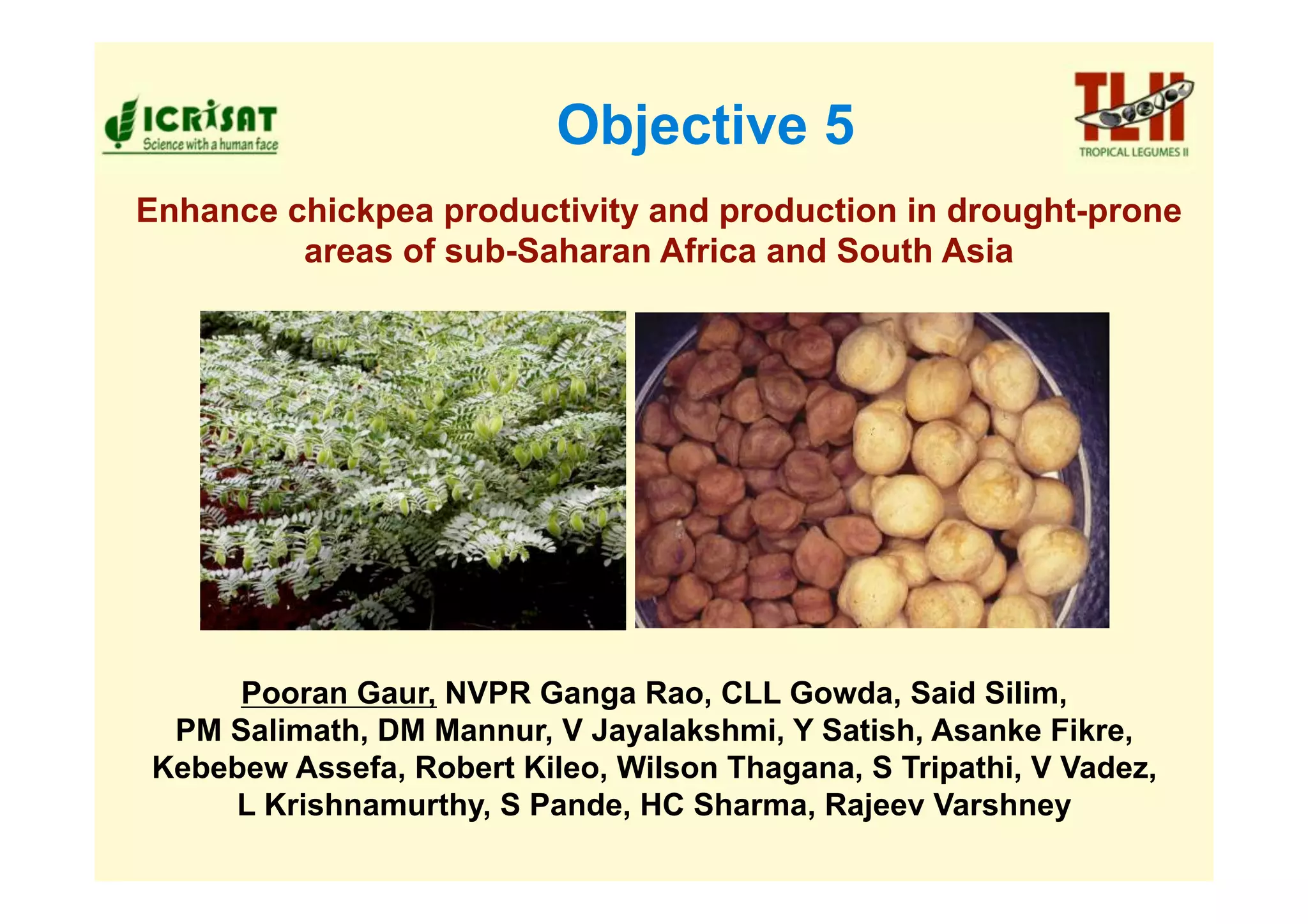
Objective 5
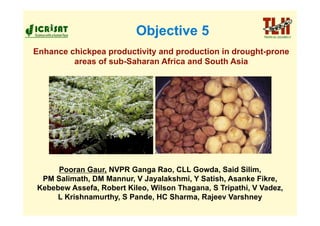
Enhance chickpea productivity and production in drought-prone
         areas of sub-Saharan Africa and South Asia


     Pooran Gaur, NVPR Ganga Rao, CLL Gowda, Said Silim,
 PM Salimath, DM Mannur, V Jayalakshmi, Y Satish, Asanke Fikre,
Kebebew Assefa, Robert Kileo, Wilson Thagana, S Tripathi, V Vadez,
    L Krishnamurthy, S Pande, HC Sharma, Rajeev Varshney
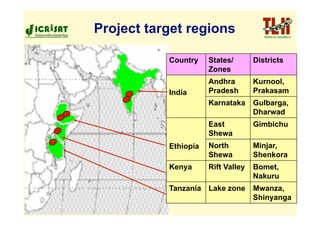
Project target regions

           Country    States/       Districts
                      Zones
                      Andhra        Kurnool,
           India      Pradesh       Prakasam
                      Karnataka     Gulbarga,
                                    Dharwad
                      East          Gimbichu
                      Shewa
           Ethiopia   North         Minjar,
                      Shewa         Shenkora
           Kenya      Rift Valley   Bomet,
                                    Nakuru
           Tanzania Lake zone       Mwanza,
                                    Shinyanga
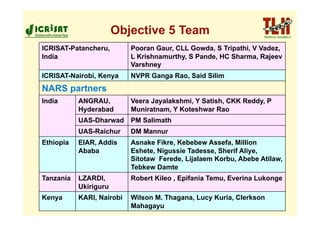
Objective 5 Team
ICRISAT-Patancheru,        Pooran Gaur, CLL Gowda, S Tripathi, V Vadez,
India                      L Krishnamurthy, S Pande, HC Sharma, Rajeev
                           Varshney
ICRISAT-Nairobi, Kenya     NVPR Ganga Rao, Said Silim
NARS partners
India      ANGRAU,         Veera Jayalakshmi, Y Satish, CKK Reddy, P
           Hyderabad       Muniratnam, Y Koteshwar Rao
           UAS-Dharwad PM Salimath
           UAS-Raichur     DM Mannur
Ethiopia   EIAR, Addis     Asnake Fikre, Kebebew Assefa, Million
           Ababa           Eshete, Nigussie Tadesse, Sherif Aliye,
                           Sitotaw Ferede, Lijalaem Korbu, Abebe Atilaw,
                           Tebkew Damte
Tanzania   LZARDI,         Robert Kileo , Epifania Temu, Everina Lukonge
           Ukiriguru
Kenya      KARI, Nairobi   Wilson M. Thagana, Lucy Kuria, Clerkson
                           Mahagayu
Activity 1
Identify and enhance adoption of farmer
and market preferred chickpea cultivars
          in water-limited areas
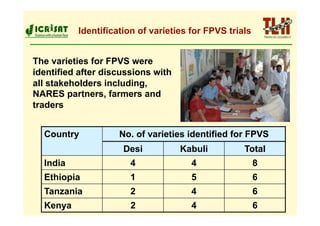
Identification of varieties for FPVS trials


The varieties for FPVS were
identified after discussions with
all stakeholders including,
NARES partners, farmers and
traders


  Country           No. of varieties identified for FPVS
                     Desi           Kabuli         Total
  India                4              4                 8
  Ethiopia             1              5                 6
  Tanzania             2              4                 6
  Kenya                2              4                 6
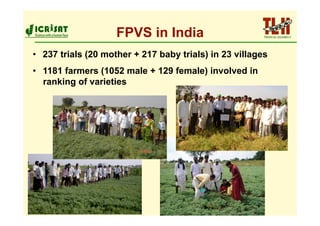
FPVS in India
•  237 trials (20 mother + 217 baby trials) in 23 villages
•  1181 farmers (1052 male + 129 female) involved in
   ranking of varieties
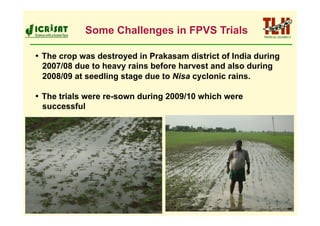
Some Challenges in FPVS Trials

•  The crop was destroyed in Prakasam district of India during
   2007/08 due to heavy rains before harvest and also during
   2008/09 at seedling stage due to Nisa cyclonic rains.

•  The trials were re-sown during 2009/10 which were
   successful
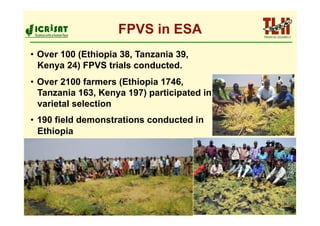
FPVS in ESA
•  Over 100 (Ethiopia 38, Tanzania 39,
   Kenya 24) FPVS trials conducted.
•  Over 2100 farmers (Ethiopia 1746,
   Tanzania 163, Kenya 197) participated in
   varietal selection
•  190 field demonstrations conducted in
   Ethiopia
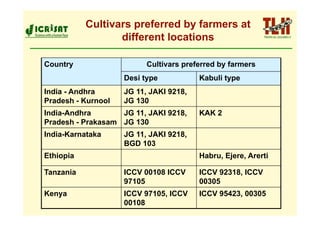
Cultivars preferred by farmers at
                  different locations

Country                   Cultivars preferred by farmers
                    Desi type           Kabuli type
India - Andhra      JG 11, JAKI 9218,
Pradesh - Kurnool   JG 130
India-Andhra       JG 11, JAKI 9218,    KAK 2
Pradesh - Prakasam JG 130
India-Karnataka     JG 11, JAKI 9218,
                    BGD 103
Ethiopia                                Habru, Ejere, Arerti

Tanzania            ICCV 00108 ICCV     ICCV 92318, ICCV
                    97105               00305
Kenya               ICCV 97105, ICCV    ICCV 95423, 00305
                    00108
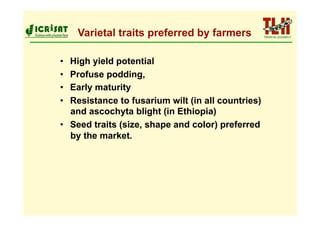
Varietal traits preferred by farmers

•  High yield potential
•  Profuse podding,
•  Early maturity
•  Resistance to fusarium wilt (in all countries)
   and ascochyta blight (in Ethiopia)
•  Seed traits (size, shape and color) preferred
   by the market.
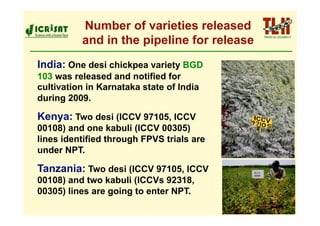
Number of varieties released
          and in the pipeline for release
India: One desi chickpea variety BGD
103 was released and notified for
cultivation in Karnataka state of India
during 2009.

Kenya: Two desi (ICCV 97105, ICCV
00108) and one kabuli (ICCV 00305)
lines identified through FPVS trials are
under NPT.

Tanzania: Two desi (ICCV 97105, ICCV
00108) and two kabuli (ICCVs 92318,
00305) lines are going to enter NPT.
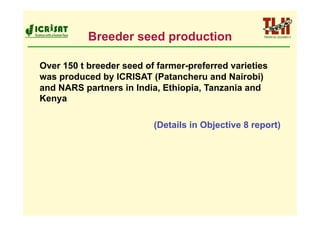
Breeder seed production

Over 150 t breeder seed of farmer-preferred varieties
was produced by ICRISAT (Patancheru and Nairobi)
and NARS partners in India, Ethiopia, Tanzania and
Kenya

                          (Details in Objective 8 report)
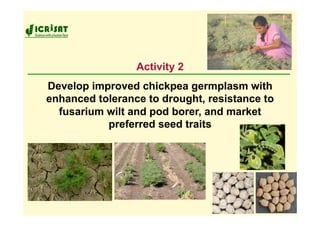
Activity 2
Develop improved chickpea germplasm with
enhanced tolerance to drought, resistance to
  fusarium wilt and pod borer, and market
           preferred seed traits
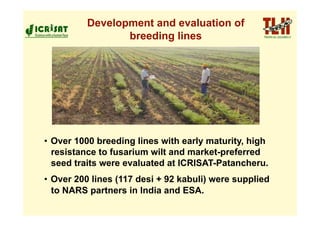
Development and evaluation of
                 breeding lines


•  Over 1000 breeding lines with early maturity, high
   resistance to fusarium wilt and market-preferred
   seed traits were evaluated at ICRISAT-Patancheru.
•  Over 200 lines (117 desi + 92 kabuli) were supplied
   to NARS partners in India and ESA.
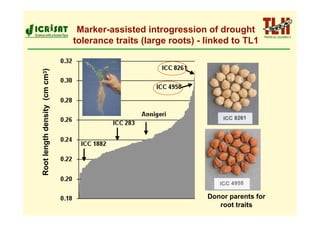
Marker-assisted introgression of drought
                               tolerance traits (large roots) - linked to TL1
Root length density (cm cm3)


                                                                Donor parents for
                                                                   root traits
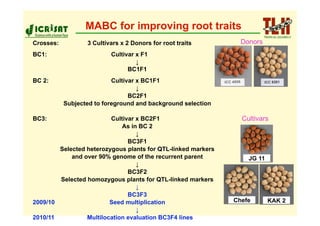
MABC for improving root traits
Crosses:          3 Cultivars x 2 Donors for root traits        Donors
BC1:                      Cultivar x F1
                                   ↓
                                BC1F1
BC 2:                      Cultivar x BC1F1
                                    ↓
                                 BC2F1
           Subjected to foreground and background selection

BC3:                     Cultivar x BC2F1                       Cultivars
                             As in BC 2
                                  ↓
                               BC3F1
        Selected heterozygous plants for QTL-linked markers
            and over 90% genome of the recurrent parent           JG 11
                                  ↓
                               BC3F2
        Selected homozygous plants for QTL-linked markers
                                  ↓
                               BC3F3
2009/10                  Seed multiplication                  Chefe       KAK 2
                                  ↓
2010/11          Multilocation evaluation BC3F4 lines
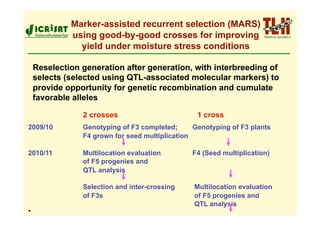
Marker-assisted recurrent selection (MARS)
              using good-by-good crosses for improving
                yield under moisture stress conditions

     Reselection generation after generation, with interbreeding of
     selects (selected using QTL-associated molecular markers) to
     provide opportunity for genetic recombination and cumulate
     favorable alleles

                 2 crosses                         1 cross
2009/10          Genotyping of F3 completed;      Genotyping of F3 plants
                 F4 grown for seed multiplication

2010/11          Multilocation evaluation        F4 (Seed multiplication)
                 of F5 progenies and
                 QTL analysis

                 Selection and inter-crossing     Multilocation evaluation
                 of F3s                           of F5 progenies and
                                                  QTL analysis
• 
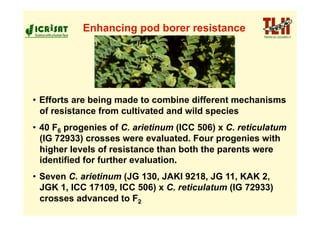
Enhancing pod borer resistance


•  Efforts are being made to combine different mechanisms
   of resistance from cultivated and wild species
•  40 F6 progenies of C. arietinum (ICC 506) x C. reticulatum
   (IG 72933) crosses were evaluated. Four progenies with
   higher levels of resistance than both the parents were
   identified for further evaluation.
•  Seven C. arietinum (JG 130, JAKI 9218, JG 11, KAK 2,
   JGK 1, ICC 17109, ICC 506) x C. reticulatum (IG 72933)
   crosses advanced to F2
Activity 3

  Enhance capacity of NARS in chickpea
improvement research and development and
  provide training to farmers in improved
     chickpea production technology
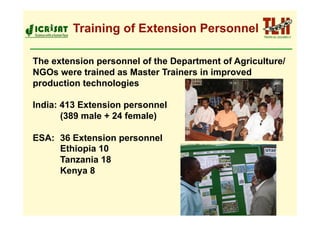
Training of Extension Personnel

The extension personnel of the Department of Agriculture/
NGOs were trained as Master Trainers in improved
production technologies

India: 413 Extension personnel
       (389 male + 24 female)

ESA: 36 Extension personnel
     Ethiopia 10
     Tanzania 18
     Kenya 8
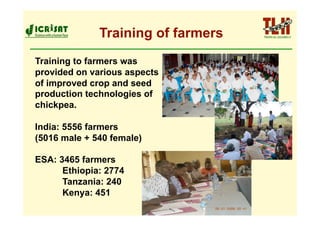
Training of farmers
Training to farmers was
provided on various aspects
of improved crop and seed
production technologies of
chickpea.

India: 5556 farmers
(5016 male + 540 female)

ESA: 3465 farmers
      Ethiopia: 2774
      Tanzania: 240
      Kenya: 451
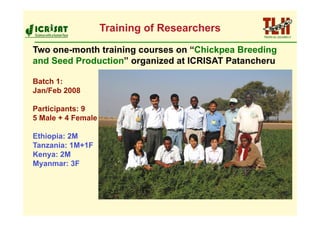
Training of Researchers
Two one-month training courses on “Chickpea Breeding
and Seed Production” organized at ICRISAT Patancheru

Batch 1:
Jan/Feb 2008

Participants: 9
5 Male + 4 Female

Ethiopia: 2M
Tanzania: 1M+1F
Kenya: 2M
Myanmar: 3F
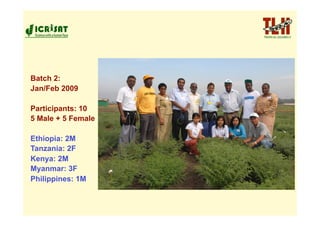
Batch 2:
Jan/Feb 2009

Participants: 10
5 Male + 5 Female

Ethiopia: 2M
Tanzania: 2F
Kenya: 2M
Myanmar: 3F
Philippines: 1M
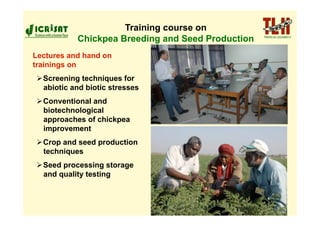
Training course on
           Chickpea Breeding and Seed Production
Lectures and hand on
trainings on
 Screening techniques for
  abiotic and biotic stresses
 Conventional and
  biotechnological
  approaches of chickpea
  improvement
 Crop and seed production
  techniques
 Seed processing storage
  and quality testing
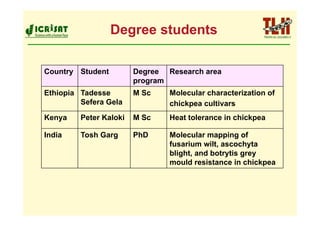
Degree students

Country Student         Degree Research area
                        program
Ethiopia Tadesse        M Sc    Molecular characterization of
         Sefera Gela            chickpea cultivars
Kenya    Peter Kaloki   M Sc    Heat tolerance in chickpea

India    Tosh Garg      PhD     Molecular mapping of
                                fusarium wilt, ascochyta
                                blight, and botrytis grey
                                mould resistance in chickpea
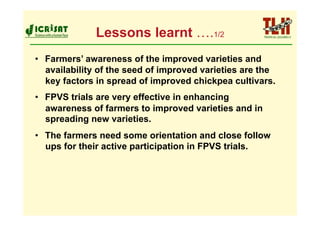
Lessons learnt ….1/2
•  Farmers’ awareness of the improved varieties and
   availability of the seed of improved varieties are the
   key factors in spread of improved chickpea cultivars.
•  FPVS trials are very effective in enhancing
   awareness of farmers to improved varieties and in
   spreading new varieties.
•  The farmers need some orientation and close follow
   ups for their active participation in FPVS trials.
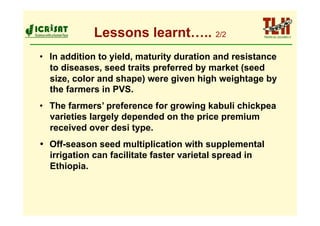
Lessons learnt….. 2/2
•  In addition to yield, maturity duration and resistance
   to diseases, seed traits preferred by market (seed
   size, color and shape) were given high weightage by
   the farmers in PVS.
•  The farmers’ preference for growing kabuli chickpea
   varieties largely depended on the price premium
   received over desi type.
•  Off-season seed multiplication with supplemental
   irrigation can facilitate faster varietal spread in
   Ethiopia.
Vision for Phase II

•  Expansion of activities to new districts/states/zones/
   regions in the countries of phase I
•  Possible expansion of activities to other countries
   like Malawi and Mozambique.
•  Further strengthen of seed system based on the
   experiences of phase I.
•  Evaluation of breeding materials generated through
   genomic approaches (MABC &MARS) under TL I
   along with breeding material generated under TL II in
   target environments.
18 Pooran Gaur Objective5 Chickpea

  • 1.
    Objective 5 Enhance chickpeaproductivity and production in drought-prone areas of sub-Saharan Africa and South Asia Pooran Gaur, NVPR Ganga Rao, CLL Gowda, Said Silim, PM Salimath, DM Mannur, V Jayalakshmi, Y Satish, Asanke Fikre, Kebebew Assefa, Robert Kileo, Wilson Thagana, S Tripathi, V Vadez, L Krishnamurthy, S Pande, HC Sharma, Rajeev Varshney
  • 2.
    Project target regions Country States/ Districts Zones Andhra Kurnool, India Pradesh Prakasam Karnataka Gulbarga, Dharwad East Gimbichu Shewa Ethiopia North Minjar, Shewa Shenkora Kenya Rift Valley Bomet, Nakuru Tanzania Lake zone Mwanza, Shinyanga
  • 3.
    Objective 5 Team ICRISAT-Patancheru, Pooran Gaur, CLL Gowda, S Tripathi, V Vadez, India L Krishnamurthy, S Pande, HC Sharma, Rajeev Varshney ICRISAT-Nairobi, Kenya NVPR Ganga Rao, Said Silim NARS partners India ANGRAU, Veera Jayalakshmi, Y Satish, CKK Reddy, P Hyderabad Muniratnam, Y Koteshwar Rao UAS-Dharwad PM Salimath UAS-Raichur DM Mannur Ethiopia EIAR, Addis Asnake Fikre, Kebebew Assefa, Million Ababa Eshete, Nigussie Tadesse, Sherif Aliye, Sitotaw Ferede, Lijalaem Korbu, Abebe Atilaw, Tebkew Damte Tanzania LZARDI, Robert Kileo , Epifania Temu, Everina Lukonge Ukiriguru Kenya KARI, Nairobi Wilson M. Thagana, Lucy Kuria, Clerkson Mahagayu
  • 4.
    Activity 1 Identify andenhance adoption of farmer and market preferred chickpea cultivars in water-limited areas
  • 5.
    Identification of varietiesfor FPVS trials The varieties for FPVS were identified after discussions with all stakeholders including, NARES partners, farmers and traders Country No. of varieties identified for FPVS Desi Kabuli Total India 4 4 8 Ethiopia 1 5 6 Tanzania 2 4 6 Kenya 2 4 6
  • 6.
    FPVS in India • 237 trials (20 mother + 217 baby trials) in 23 villages •  1181 farmers (1052 male + 129 female) involved in ranking of varieties
  • 7.
    Some Challenges inFPVS Trials •  The crop was destroyed in Prakasam district of India during 2007/08 due to heavy rains before harvest and also during 2008/09 at seedling stage due to Nisa cyclonic rains. •  The trials were re-sown during 2009/10 which were successful
  • 8.
    FPVS in ESA • Over 100 (Ethiopia 38, Tanzania 39, Kenya 24) FPVS trials conducted. •  Over 2100 farmers (Ethiopia 1746, Tanzania 163, Kenya 197) participated in varietal selection •  190 field demonstrations conducted in Ethiopia
  • 9.
    Cultivars preferred byfarmers at different locations Country Cultivars preferred by farmers Desi type Kabuli type India - Andhra JG 11, JAKI 9218, Pradesh - Kurnool JG 130 India-Andhra JG 11, JAKI 9218, KAK 2 Pradesh - Prakasam JG 130 India-Karnataka JG 11, JAKI 9218, BGD 103 Ethiopia Habru, Ejere, Arerti Tanzania ICCV 00108 ICCV ICCV 92318, ICCV 97105 00305 Kenya ICCV 97105, ICCV ICCV 95423, 00305 00108
  • 10.
    Varietal traits preferredby farmers •  High yield potential •  Profuse podding, •  Early maturity •  Resistance to fusarium wilt (in all countries) and ascochyta blight (in Ethiopia) •  Seed traits (size, shape and color) preferred by the market.
  • 11.
    Number of varietiesreleased and in the pipeline for release India: One desi chickpea variety BGD 103 was released and notified for cultivation in Karnataka state of India during 2009. Kenya: Two desi (ICCV 97105, ICCV 00108) and one kabuli (ICCV 00305) lines identified through FPVS trials are under NPT. Tanzania: Two desi (ICCV 97105, ICCV 00108) and two kabuli (ICCVs 92318, 00305) lines are going to enter NPT.
  • 12.
    Breeder seed production Over150 t breeder seed of farmer-preferred varieties was produced by ICRISAT (Patancheru and Nairobi) and NARS partners in India, Ethiopia, Tanzania and Kenya (Details in Objective 8 report)
  • 13.
    Activity 2 Develop improvedchickpea germplasm with enhanced tolerance to drought, resistance to fusarium wilt and pod borer, and market preferred seed traits
  • 14.
    Development and evaluationof breeding lines •  Over 1000 breeding lines with early maturity, high resistance to fusarium wilt and market-preferred seed traits were evaluated at ICRISAT-Patancheru. •  Over 200 lines (117 desi + 92 kabuli) were supplied to NARS partners in India and ESA.
  • 15.
    Marker-assisted introgression ofdrought tolerance traits (large roots) - linked to TL1 Root length density (cm cm3) Donor parents for root traits
  • 16.
    MABC for improvingroot traits Crosses: 3 Cultivars x 2 Donors for root traits Donors BC1: Cultivar x F1 ↓ BC1F1 BC 2: Cultivar x BC1F1 ↓ BC2F1 Subjected to foreground and background selection BC3: Cultivar x BC2F1 Cultivars As in BC 2 ↓ BC3F1 Selected heterozygous plants for QTL-linked markers and over 90% genome of the recurrent parent JG 11 ↓ BC3F2 Selected homozygous plants for QTL-linked markers ↓ BC3F3 2009/10 Seed multiplication Chefe KAK 2 ↓ 2010/11 Multilocation evaluation BC3F4 lines
  • 17.
    Marker-assisted recurrent selection(MARS) using good-by-good crosses for improving yield under moisture stress conditions Reselection generation after generation, with interbreeding of selects (selected using QTL-associated molecular markers) to provide opportunity for genetic recombination and cumulate favorable alleles 2 crosses 1 cross 2009/10 Genotyping of F3 completed; Genotyping of F3 plants F4 grown for seed multiplication 2010/11 Multilocation evaluation F4 (Seed multiplication) of F5 progenies and QTL analysis Selection and inter-crossing Multilocation evaluation of F3s of F5 progenies and QTL analysis • 
  • 18.
    Enhancing pod borerresistance •  Efforts are being made to combine different mechanisms of resistance from cultivated and wild species •  40 F6 progenies of C. arietinum (ICC 506) x C. reticulatum (IG 72933) crosses were evaluated. Four progenies with higher levels of resistance than both the parents were identified for further evaluation. •  Seven C. arietinum (JG 130, JAKI 9218, JG 11, KAK 2, JGK 1, ICC 17109, ICC 506) x C. reticulatum (IG 72933) crosses advanced to F2
  • 19.
    Activity 3 Enhance capacity of NARS in chickpea improvement research and development and provide training to farmers in improved chickpea production technology
  • 20.
    Training of ExtensionPersonnel The extension personnel of the Department of Agriculture/ NGOs were trained as Master Trainers in improved production technologies India: 413 Extension personnel (389 male + 24 female) ESA: 36 Extension personnel Ethiopia 10 Tanzania 18 Kenya 8
  • 21.
    Training of farmers Trainingto farmers was provided on various aspects of improved crop and seed production technologies of chickpea. India: 5556 farmers (5016 male + 540 female) ESA: 3465 farmers Ethiopia: 2774 Tanzania: 240 Kenya: 451
  • 22.
    Training of Researchers Twoone-month training courses on “Chickpea Breeding and Seed Production” organized at ICRISAT Patancheru Batch 1: Jan/Feb 2008 Participants: 9 5 Male + 4 Female Ethiopia: 2M Tanzania: 1M+1F Kenya: 2M Myanmar: 3F
  • 23.
    Batch 2: Jan/Feb 2009 Participants:10 5 Male + 5 Female Ethiopia: 2M Tanzania: 2F Kenya: 2M Myanmar: 3F Philippines: 1M
  • 24.
    Training course on Chickpea Breeding and Seed Production Lectures and hand on trainings on  Screening techniques for abiotic and biotic stresses  Conventional and biotechnological approaches of chickpea improvement  Crop and seed production techniques  Seed processing storage and quality testing
  • 25.
    Degree students Country Student Degree Research area program Ethiopia Tadesse M Sc Molecular characterization of Sefera Gela chickpea cultivars Kenya Peter Kaloki M Sc Heat tolerance in chickpea India Tosh Garg PhD Molecular mapping of fusarium wilt, ascochyta blight, and botrytis grey mould resistance in chickpea
  • 26.
    Lessons learnt ….1/2 • Farmers’ awareness of the improved varieties and availability of the seed of improved varieties are the key factors in spread of improved chickpea cultivars. •  FPVS trials are very effective in enhancing awareness of farmers to improved varieties and in spreading new varieties. •  The farmers need some orientation and close follow ups for their active participation in FPVS trials.
  • 27.
    Lessons learnt….. 2/2 • In addition to yield, maturity duration and resistance to diseases, seed traits preferred by market (seed size, color and shape) were given high weightage by the farmers in PVS. •  The farmers’ preference for growing kabuli chickpea varieties largely depended on the price premium received over desi type. •  Off-season seed multiplication with supplemental irrigation can facilitate faster varietal spread in Ethiopia.
  • 29.
    Vision for PhaseII •  Expansion of activities to new districts/states/zones/ regions in the countries of phase I •  Possible expansion of activities to other countries like Malawi and Mozambique. •  Further strengthen of seed system based on the experiences of phase I. •  Evaluation of breeding materials generated through genomic approaches (MABC &MARS) under TL I along with breeding material generated under TL II in target environments.