Farming Systems and Food Security in Sub-Saharan Africa: Priorities for Science and Policy
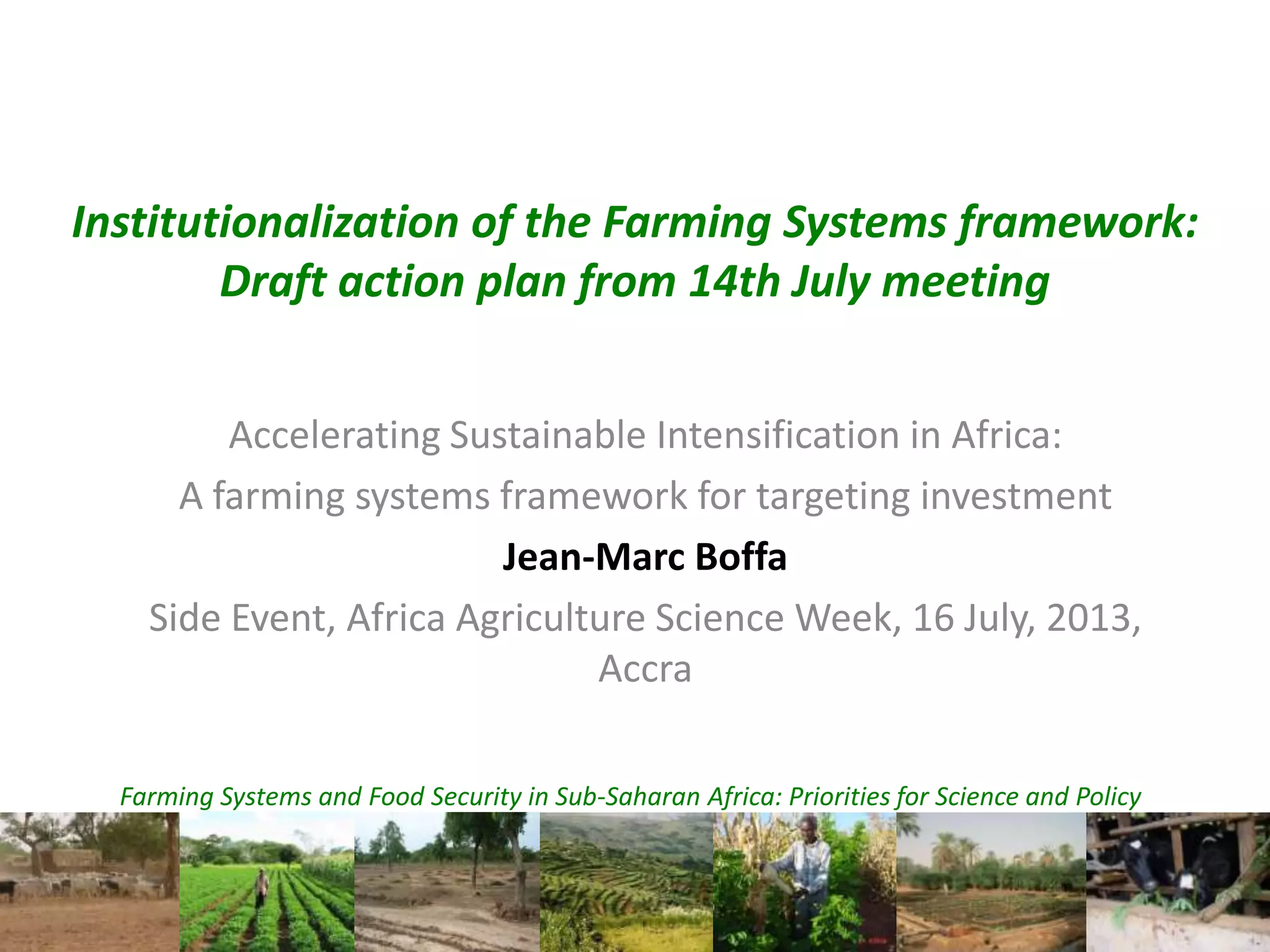
Institutionalization of the Farming Systems framework:
Draft action plan from 14th July meeting
Accelerating Sustainable Intensification in Africa:
A farming systems framework for targeting investment
Jean-Marc Boffa
Side Event, Africa Agriculture Science Week, 16 July, 2013,
Accra
Farming Systems and Food Security in Sub-Saharan Africa: Priorities for Science and Policy
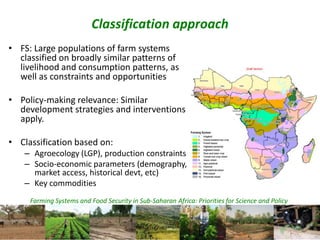
Classification approach
• FS: Large populations of farm systems
classified on broadly similar patterns of
livelihood and consumption patterns, as
well as constraints and opportunities
• Policy-making relevance: Similar
development strategies and interventions
apply.
• Classification based on:
– Agroecology (LGP), production constraints
– Socio-economic parameters (demography,
market access, historical devt, etc)
– Key commodities
Farming Systems and Food Security in Sub-Saharan Africa: Priorities for Science and Policy
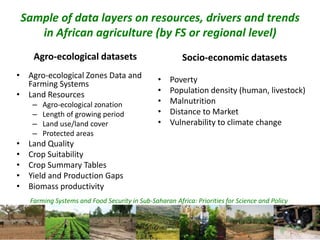
Sample of data layers on resources, drivers and trends
in African agriculture (by FS or regional level)
Agro-ecological datasets
• Agro-ecological Zones Data and
Farming Systems
• Land Resources
– Agro-ecological zonation
– Length of growing period
– Land use/land cover
– Protected areas
• Land Quality
• Crop Suitability
• Crop Summary Tables
• Yield and Production Gaps
• Biomass productivity
Socio-economic datasets
• Poverty
• Population density (human, livestock)
• Malnutrition
• Distance to Market
• Vulnerability to climate change
Farming Systems and Food Security in Sub-Saharan Africa: Priorities for Science and Policy
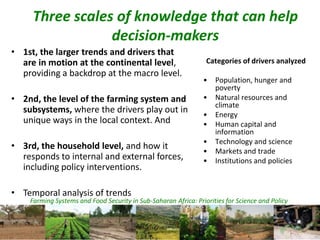
Three scales of knowledge that can help
decision-makers
• 1st, the larger trends and drivers that
are in motion at the continental level,
providing a backdrop at the macro level.
• 2nd, the level of the farming system and
subsystems, where the drivers play out in
unique ways in the local context. And
• 3rd, the household level, and how it
responds to internal and external forces,
including policy interventions.
• Temporal analysis of trends
Categories of drivers analyzed
• Population, hunger and
poverty
• Natural resources and
climate
• Energy
• Human capital and
information
• Technology and science
• Markets and trade
• Institutions and policies
Farming Systems and Food Security in Sub-Saharan Africa: Priorities for Science and Policy
Project objectives
1. Transform continental spatial data sets and
maps of farming systems, food security and
key drivers, into a web-based platform in
collaboration with FAO, in order to make
these data readily available to worldwide
audiences.
Farming Systems and Food Security in Sub-Saharan Africa: Priorities for Science and Policy
Project objectives
2. Strengthen awareness of the farming
systems analytical results and data sets by a
wide range of professional communities in
Africa and beyond including policymakers,
researchers, development specialists, and
teachers and students for use in their respective
endeavours.
Farming Systems and Food Security in Sub-Saharan Africa: Priorities for Science and Policy
Project objectives
3. Develop a strategic and programmatic framework
– that deploys and extends the farming systems
perspectives and analyses developed by the
project, orientates target users on their application
in addressing a wide range of policy and research
challenges in African agriculture, and
– builds awareness and capacity in this area at the
regional level through NEPAD/CAADP, FARA, the
CGIAR, and at the national level contributing to the
achievement of the goals of the Dublin Process
Farming Systems and Food Security in Sub-Saharan Africa: Priorities for Science and Policy
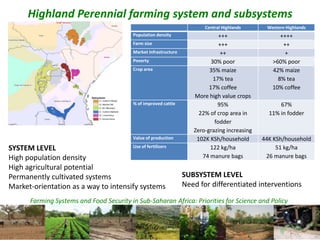
Highland Perennial farming system and subsystems
Central Highlands Western Highlands
Population density +++ ++++
Farm size +++ ++
Market infrastructure ++ +
Poverty 30% poor >60% poor
Crop area 35% maize
17% tea
17% coffee
More high value crops
42% maize
8% tea
10% coffee
% of improved cattle 95%
22% of crop area in
fodder
Zero-grazing increasing
67%
11% in fodder
Value of production 102K KSh/household 44K KSh/household
Use of fertilizers 122 kg/ha
74 manure bags
51 kg/ha
26 manure bags
SYSTEM LEVEL
High population density
High agricultural potential
Permanently cultivated systems
Market-orientation as a way to intensify systems
SUBSYSTEM LEVEL
Need for differentiated interventions
Farming Systems and Food Security in Sub-Saharan Africa: Priorities for Science and Policy
Applications in science, policy and
investment planning
Value addition at regional scale
• Differentiating strategic priorities and target investment
according to farming systems to optimize (capital-scarce)
investment and enhance returns
• Regional spillover of commodity-based technologies
/approaches and transboundary ecosystem management
• Provide potential framework for appropriate indicators for
monitoring progress (CAADP, Dublin process
At national scale
• Finetune information and knowledge to ensure relevance to
national level processes
• Provide access and strengthen capacity of national-level
planners and experts to use FS outputs
Farming Systems and Food Security in Sub-Saharan Africa: Priorities for Science and Policy
Potential for linking continental and national
farming system frameworks
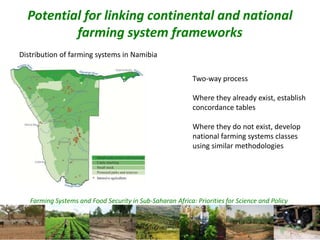
Distribution of farming systems in Namibia
Two-way process
Where they already exist, establish
concordance tables
Where they do not exist, develop
national farming systems classes
using similar methodologies
Farming Systems and Food Security in Sub-Saharan Africa: Priorities for Science and Policy
Applications in science, policy and
investment planning cont’d
• Develop an agenda with CAADP and develop training
program in key countries toward using FS frameworks
and databases and utilize feedback for adapting and
enhancing relevance of knowledge base and materials
• Inventory of national frameworks in pilot countries and
analyze concordance with regional framework
• Incorporate FS framework into the Africa Agriculture
Science Agenda (targeting, priority setting)
• Explore further integration of FS framework into
• 3 system CRPs
• Sub-regional organizations
(CORAF, ASARECA, CCARDESA)
Farming Systems and Food Security in Sub-Saharan Africa: Priorities for Science and Policy
• THANK YOU!

Institutionalization of the Farming Systems framework: Draft action plan from 14th July meeting

  • 1.
    Farming Systems andFood Security in Sub-Saharan Africa: Priorities for Science and Policy Institutionalization of the Farming Systems framework: Draft action plan from 14th July meeting Accelerating Sustainable Intensification in Africa: A farming systems framework for targeting investment Jean-Marc Boffa Side Event, Africa Agriculture Science Week, 16 July, 2013, Accra
  • 2.
    Farming Systems andFood Security in Sub-Saharan Africa: Priorities for Science and Policy Classification approach • FS: Large populations of farm systems classified on broadly similar patterns of livelihood and consumption patterns, as well as constraints and opportunities • Policy-making relevance: Similar development strategies and interventions apply. • Classification based on: – Agroecology (LGP), production constraints – Socio-economic parameters (demography, market access, historical devt, etc) – Key commodities
  • 3.
    Farming Systems andFood Security in Sub-Saharan Africa: Priorities for Science and Policy Sample of data layers on resources, drivers and trends in African agriculture (by FS or regional level) Agro-ecological datasets • Agro-ecological Zones Data and Farming Systems • Land Resources – Agro-ecological zonation – Length of growing period – Land use/land cover – Protected areas • Land Quality • Crop Suitability • Crop Summary Tables • Yield and Production Gaps • Biomass productivity Socio-economic datasets • Poverty • Population density (human, livestock) • Malnutrition • Distance to Market • Vulnerability to climate change
  • 4.
    Farming Systems andFood Security in Sub-Saharan Africa: Priorities for Science and Policy Three scales of knowledge that can help decision-makers • 1st, the larger trends and drivers that are in motion at the continental level, providing a backdrop at the macro level. • 2nd, the level of the farming system and subsystems, where the drivers play out in unique ways in the local context. And • 3rd, the household level, and how it responds to internal and external forces, including policy interventions. • Temporal analysis of trends Categories of drivers analyzed • Population, hunger and poverty • Natural resources and climate • Energy • Human capital and information • Technology and science • Markets and trade • Institutions and policies
  • 5.
    Farming Systems andFood Security in Sub-Saharan Africa: Priorities for Science and Policy Project objectives 1. Transform continental spatial data sets and maps of farming systems, food security and key drivers, into a web-based platform in collaboration with FAO, in order to make these data readily available to worldwide audiences.
  • 6.
    Farming Systems andFood Security in Sub-Saharan Africa: Priorities for Science and Policy Project objectives 2. Strengthen awareness of the farming systems analytical results and data sets by a wide range of professional communities in Africa and beyond including policymakers, researchers, development specialists, and teachers and students for use in their respective endeavours.
  • 7.
    Farming Systems andFood Security in Sub-Saharan Africa: Priorities for Science and Policy Project objectives 3. Develop a strategic and programmatic framework – that deploys and extends the farming systems perspectives and analyses developed by the project, orientates target users on their application in addressing a wide range of policy and research challenges in African agriculture, and – builds awareness and capacity in this area at the regional level through NEPAD/CAADP, FARA, the CGIAR, and at the national level contributing to the achievement of the goals of the Dublin Process
  • 8.
    Farming Systems andFood Security in Sub-Saharan Africa: Priorities for Science and Policy Highland Perennial farming system and subsystems Central Highlands Western Highlands Population density +++ ++++ Farm size +++ ++ Market infrastructure ++ + Poverty 30% poor >60% poor Crop area 35% maize 17% tea 17% coffee More high value crops 42% maize 8% tea 10% coffee % of improved cattle 95% 22% of crop area in fodder Zero-grazing increasing 67% 11% in fodder Value of production 102K KSh/household 44K KSh/household Use of fertilizers 122 kg/ha 74 manure bags 51 kg/ha 26 manure bags SYSTEM LEVEL High population density High agricultural potential Permanently cultivated systems Market-orientation as a way to intensify systems SUBSYSTEM LEVEL Need for differentiated interventions
  • 9.
    Farming Systems andFood Security in Sub-Saharan Africa: Priorities for Science and Policy Applications in science, policy and investment planning Value addition at regional scale • Differentiating strategic priorities and target investment according to farming systems to optimize (capital-scarce) investment and enhance returns • Regional spillover of commodity-based technologies /approaches and transboundary ecosystem management • Provide potential framework for appropriate indicators for monitoring progress (CAADP, Dublin process At national scale • Finetune information and knowledge to ensure relevance to national level processes • Provide access and strengthen capacity of national-level planners and experts to use FS outputs
  • 10.
    Farming Systems andFood Security in Sub-Saharan Africa: Priorities for Science and Policy Potential for linking continental and national farming system frameworks Distribution of farming systems in Namibia Two-way process Where they already exist, establish concordance tables Where they do not exist, develop national farming systems classes using similar methodologies
  • 11.
    Farming Systems andFood Security in Sub-Saharan Africa: Priorities for Science and Policy Applications in science, policy and investment planning cont’d • Develop an agenda with CAADP and develop training program in key countries toward using FS frameworks and databases and utilize feedback for adapting and enhancing relevance of knowledge base and materials • Inventory of national frameworks in pilot countries and analyze concordance with regional framework • Incorporate FS framework into the Africa Agriculture Science Agenda (targeting, priority setting) • Explore further integration of FS framework into • 3 system CRPs • Sub-regional organizations (CORAF, ASARECA, CCARDESA)
  • 12.
    Farming Systems andFood Security in Sub-Saharan Africa: Priorities for Science and Policy • THANK YOU!