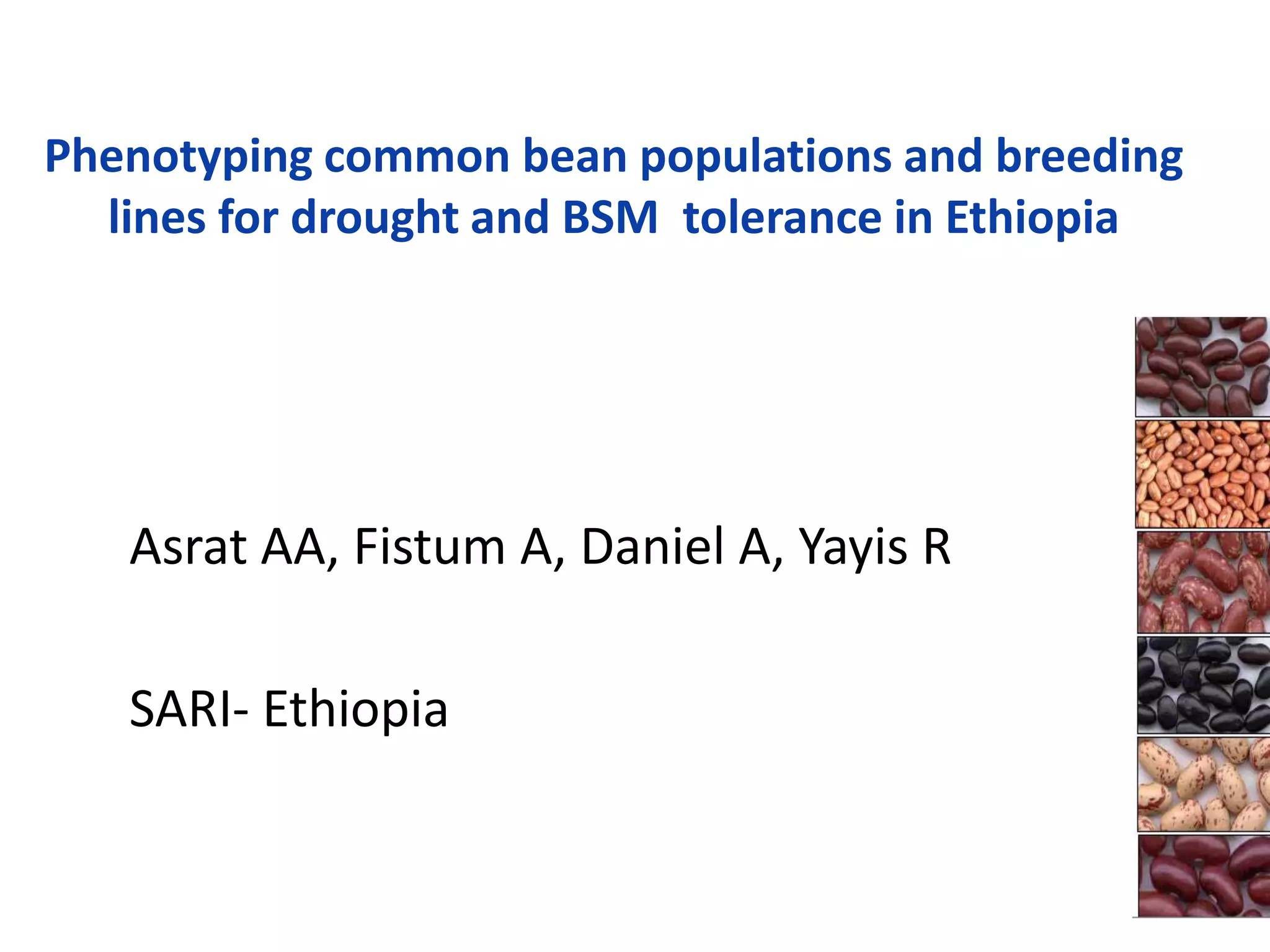
Phenotyping common bean populations and breeding
  lines for drought and BSM tolerance in Ethiopia


   Asrat AA, Fistum A, Daniel A, Yayis R

   SARI- Ethiopia
Act. 3: Deploy insect and disease resistance genes

Milestone 5: QTL for bean stem
maggot resistance
• Two populations evaluated for BSM
and drought combined stress in Ethiopia
at three locations as part of M.Sc.
                                            Objectives:
Thesis
                                           • To estimate the phenotypic and genotypic
• 14 released varieties evaluated for        variability for Morpho-physiological
BSM and drought combined stress              traits and asses the genetic variability for
tolerance in Ethiopia at three locations     drought and BSM resistance among
                                             common bean recombinant lines
                                           • To evaluate the performance of the
                                             recombinant lines of two populations
                                             from crosses G2333 x G19839 and
                                             BAT881 x G21212 for their drought and
                                             BSM combined resistance.
                                           • To evaluate the contribution of
                                             adventitious roots for BSM resistance
Act. 3: Deploy insect and disease resistance genes
Methodology
• The experiments were conducted at three locations
      • Areka
      • Humbo
      • Wondogenet
• Where BSM infestation is very common
• Four managed environments were created
   – 1. Non stress
      • Chemical treated for BSM and fully irrigated
   – 2.Intermittent Drought Stressed (Humbo and
     Wondogenet)
      • Stressed before flower initiation and at pod initiation
   – 3. Terminal drought stress at flower initiation (Humbo and
     Wondogenet)
   – 4. Terminal drought stress at pod initiation (Areka, Humbo
     and Wondogenet)
Act. 3: Deploy insect and disease resistance genes

 Methodology
  The materials evaluated in three groups
       14 regionally and nationally released common bean varieties
       82 RILs from cross G2333 x G19839 ( CIAT)
       100 RILS from cross BAT881 x G21212 ( CIAT)
  using
 14*14 simple lattice design
 Two rows plot leaving one row between plots
 60 cm spacing between rows and 10 cm between
   plants spacing
Act. 3: Deploy insect and disease resistance genes
    Data collected
•   All phenology data were collected
•   BSM count per plant
•   % of lodged plants due to BSM
•   BSM damage score per plot
•   BSM damage score per Individual plant
•   SPAD reading
•   Canopy temp
•   Root pulling resistance
•   Stem Diameter
•   PHI
•   Yield
•   Pod wall thickness
Areka non-stress
                     Humbo non-stress


                    Humbo stress

Areka stress
G2333 x G19839 RIL
                                           with adventitious root


                                            BAT881 x G21212 RIL


Field performance of two RIL populations
under drought and BSM stress
BAT881
                                                                            BAT881 x G21212 RIL
                                                                              G19839
                                                                              G21212
Grain yield kgha-1 Stress


                                                                              G2333
                                                                               Regional varieties

                                                                               G19839 x G2333 RIL


                                     Grain yield kgha-1 NS

                    Performance of RILs, parents and regional varieties for combined effect of DS & BSM
                    at Areka, Ethiopia 2011
Grain yield kgha-1 Stress


                                     Grain yield kgha-1 NS
                    Performance of RILs, parents and regional varieties for combined effect of DS & BSM
                    at Humbo, Ethiopia 2011
Act. 4: Deploy drought tolerance traits in
                   Andean gene pool
Milestone 6: 36 Andean genotypes characterized
   for drought traits

•   36 Andean genotypes were evaluate at Awassa
    Ethiopia under irrigated and stressed conditions
    and data on canopy temperature, root pulling
    resistance, PHI and grain yield
Act. 4: Deploy drought tolerance traits in
                    Andean gene pool

Milestone 7: Three visual scales for drought
• 64 lines developed from non-wilting parents
were evaluated at Awassa Ethiopia for wilting
resistance, root pulling resistance and PHI
Act. 4: Deploy drought tolerance traits in
                  Andean gene pool
Milestone 11: 1 population (drought-tolerant Durango x Andean) of 190
   lines phenotyped for MARS (years 2 and 3), in Colombia and
   Ethiopia
     – 126 DAB lines evaluated in Ethiopia at two sites under drought
       stress and non-stress environments using 9 x 14 alpha lattice
       design

    – 72 SAB lines evaluated in Ethiopia at two sites under drought
      stress and non-stress environments using 9 x 8 alpha lattice

• Population development and schematic diagram of MARS

• Population developed from single and multiple crosses
                  • Cross 16357 (CAL 143 x SAB 620) x SAB 626
                  • Cross 16358 (SAB 628 x CAL 143) x SAB 659
                  • Cross 16359 (SAB 628 x CAL 143) x SAB 686

• Advanced to F3-6 generation
Marker -assisted recurrent selection scheme on beans

                                     Single and multiple cross
                     Cross 16357 (CAL 143 x SAB 620) x SAB 626
                     Cross 16358 (SAB 628 x CAL 143) x SAB 659
Cycle one            Cross 16359 (SAB 628 x CAL 143) x SAB 686
                                  DAB lines


                                         F1


                                          F2


    Genotyping of                        F3-6                    Pheotyping of the whole
    parents (CIAT)                                                population(Colombia
                                                                      and Ethiopia)
                             Genotyping of the whole
                                   population
                                     (CIAT)

                                          QTL
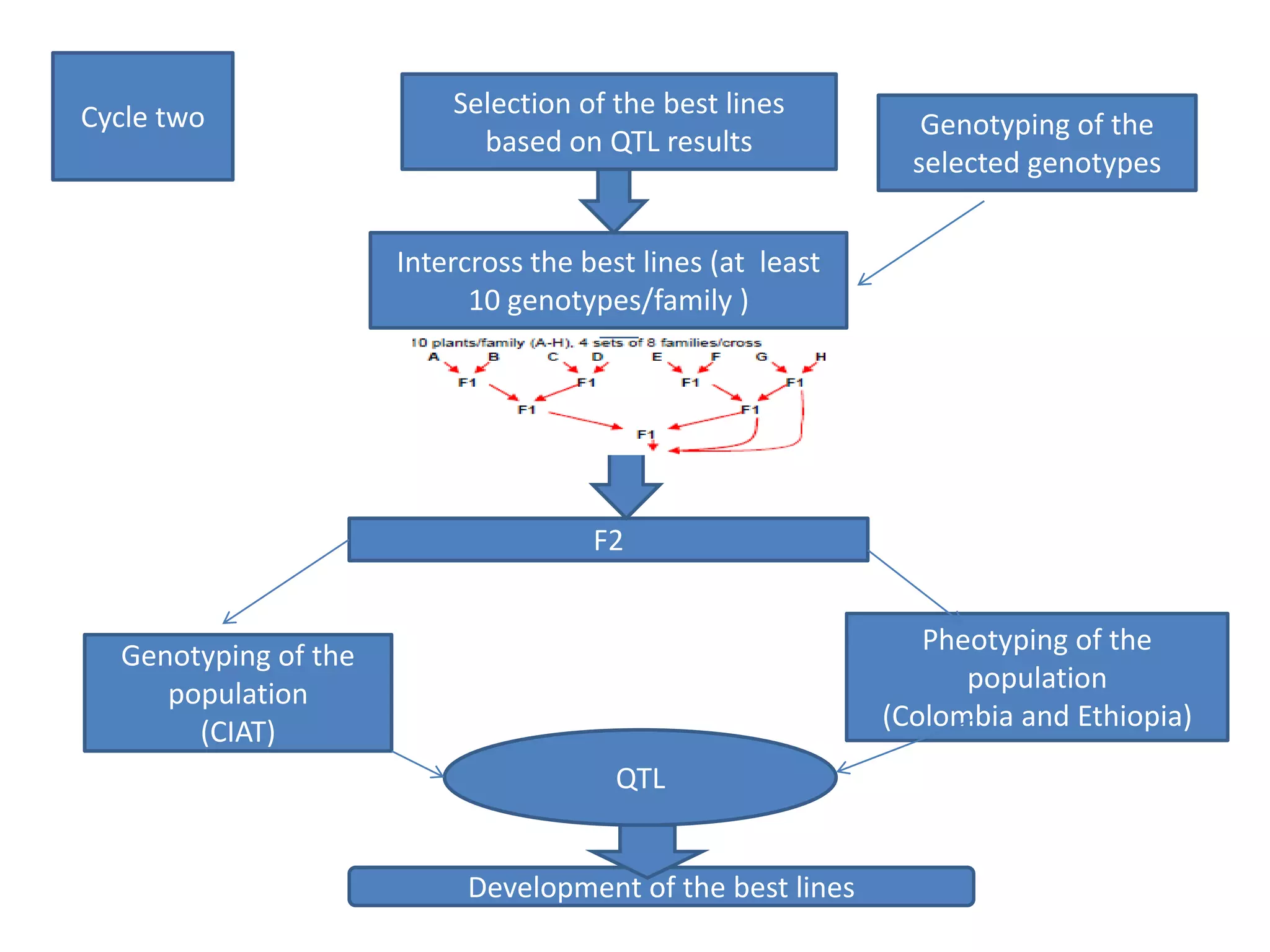
Cycle two                 Selection of the best lines
                                                               Genotyping of the
                            based on QTL results
                                                              selected genotypes


                      Intercross the best lines (at least
                            10 genotypes/family )


                                      F2


                                                               Pheotyping of the
  Genotyping of the
     population                                                   population
                                                            (Colombia and Ethiopia)
       (CIAT)
                                        QTL


                           Development of the best lines
Description of phenoytping Locations


• Arbaminch
  – is located in the Gamo Gofa Zone of the Southern Nations,
    Nationalities, and Peoples Region about 500 kilometres south of Addis
    Ababa, at an elevation of 1285 meters above sea level.
  – Geographical coordinates: 6° 2' 0" North, 37° 33' 0" East.
  – The soil is characterized in clay loam texture.
• Wondo genete
  – is located in the Sidama Zone of the Southern Nations, Nationalities,
    and Peoples Region about 300 kilometres South of Addis Ababa,
  – at an elevation of 1760 meters above sea level.
  – The Geographical coordinates: ??
  – The soil is characterized in loam texture.
MARS population early growth
MARS population evaluated by
Professors from University of Free
       State and Dr Beebe
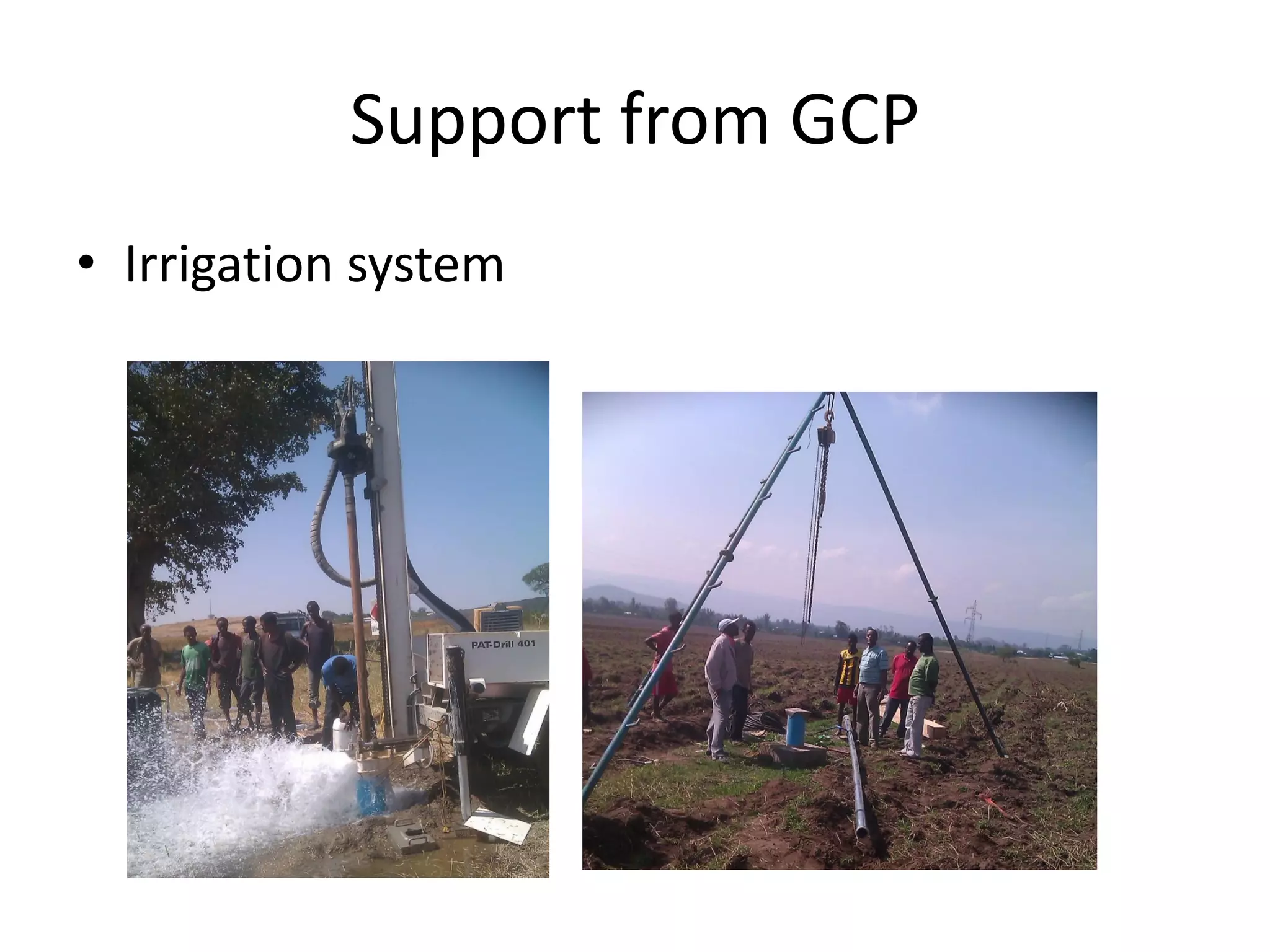
Support from GCP
• Irrigation system
Support from GCP
• Technician training on farm machinery
Acknowledgments
•   GCP
•   CIAT
•   Dr Steve Beebe
•   Dr Hannibal M from AgriconInternational
•   Jake Bentum
•   Dr Bodo
•   Gillian Summers
•   SARI
TLI 2012: Bean breeding - Ethiopia

TLI 2012: Bean breeding - Ethiopia

  • 1.
    Phenotyping common beanpopulations and breeding lines for drought and BSM tolerance in Ethiopia Asrat AA, Fistum A, Daniel A, Yayis R SARI- Ethiopia
  • 2.
    Act. 3: Deployinsect and disease resistance genes Milestone 5: QTL for bean stem maggot resistance • Two populations evaluated for BSM and drought combined stress in Ethiopia at three locations as part of M.Sc. Objectives: Thesis • To estimate the phenotypic and genotypic • 14 released varieties evaluated for variability for Morpho-physiological BSM and drought combined stress traits and asses the genetic variability for tolerance in Ethiopia at three locations drought and BSM resistance among common bean recombinant lines • To evaluate the performance of the recombinant lines of two populations from crosses G2333 x G19839 and BAT881 x G21212 for their drought and BSM combined resistance. • To evaluate the contribution of adventitious roots for BSM resistance
  • 3.
    Act. 3: Deployinsect and disease resistance genes Methodology • The experiments were conducted at three locations • Areka • Humbo • Wondogenet • Where BSM infestation is very common • Four managed environments were created – 1. Non stress • Chemical treated for BSM and fully irrigated – 2.Intermittent Drought Stressed (Humbo and Wondogenet) • Stressed before flower initiation and at pod initiation – 3. Terminal drought stress at flower initiation (Humbo and Wondogenet) – 4. Terminal drought stress at pod initiation (Areka, Humbo and Wondogenet)
  • 4.
    Act. 3: Deployinsect and disease resistance genes Methodology  The materials evaluated in three groups 14 regionally and nationally released common bean varieties 82 RILs from cross G2333 x G19839 ( CIAT) 100 RILS from cross BAT881 x G21212 ( CIAT) using 14*14 simple lattice design Two rows plot leaving one row between plots 60 cm spacing between rows and 10 cm between plants spacing
  • 5.
    Act. 3: Deployinsect and disease resistance genes Data collected • All phenology data were collected • BSM count per plant • % of lodged plants due to BSM • BSM damage score per plot • BSM damage score per Individual plant • SPAD reading • Canopy temp • Root pulling resistance • Stem Diameter • PHI • Yield • Pod wall thickness
  • 6.
    Areka non-stress Humbo non-stress Humbo stress Areka stress
  • 7.
    G2333 x G19839RIL with adventitious root BAT881 x G21212 RIL Field performance of two RIL populations under drought and BSM stress
  • 8.
    BAT881 BAT881 x G21212 RIL G19839 G21212 Grain yield kgha-1 Stress G2333 Regional varieties G19839 x G2333 RIL Grain yield kgha-1 NS Performance of RILs, parents and regional varieties for combined effect of DS & BSM at Areka, Ethiopia 2011
  • 9.
    Grain yield kgha-1Stress Grain yield kgha-1 NS Performance of RILs, parents and regional varieties for combined effect of DS & BSM at Humbo, Ethiopia 2011
  • 10.
    Act. 4: Deploydrought tolerance traits in Andean gene pool Milestone 6: 36 Andean genotypes characterized for drought traits • 36 Andean genotypes were evaluate at Awassa Ethiopia under irrigated and stressed conditions and data on canopy temperature, root pulling resistance, PHI and grain yield
  • 11.
    Act. 4: Deploydrought tolerance traits in Andean gene pool Milestone 7: Three visual scales for drought • 64 lines developed from non-wilting parents were evaluated at Awassa Ethiopia for wilting resistance, root pulling resistance and PHI
  • 12.
    Act. 4: Deploydrought tolerance traits in Andean gene pool Milestone 11: 1 population (drought-tolerant Durango x Andean) of 190 lines phenotyped for MARS (years 2 and 3), in Colombia and Ethiopia – 126 DAB lines evaluated in Ethiopia at two sites under drought stress and non-stress environments using 9 x 14 alpha lattice design – 72 SAB lines evaluated in Ethiopia at two sites under drought stress and non-stress environments using 9 x 8 alpha lattice • Population development and schematic diagram of MARS • Population developed from single and multiple crosses • Cross 16357 (CAL 143 x SAB 620) x SAB 626 • Cross 16358 (SAB 628 x CAL 143) x SAB 659 • Cross 16359 (SAB 628 x CAL 143) x SAB 686 • Advanced to F3-6 generation
  • 13.
    Marker -assisted recurrentselection scheme on beans Single and multiple cross Cross 16357 (CAL 143 x SAB 620) x SAB 626 Cross 16358 (SAB 628 x CAL 143) x SAB 659 Cycle one Cross 16359 (SAB 628 x CAL 143) x SAB 686 DAB lines F1 F2 Genotyping of F3-6 Pheotyping of the whole parents (CIAT) population(Colombia and Ethiopia) Genotyping of the whole population (CIAT) QTL
  • 14.
    Cycle two Selection of the best lines Genotyping of the based on QTL results selected genotypes Intercross the best lines (at least 10 genotypes/family ) F2 Pheotyping of the Genotyping of the population population (Colombia and Ethiopia) (CIAT) QTL Development of the best lines
  • 15.
    Description of phenoytpingLocations • Arbaminch – is located in the Gamo Gofa Zone of the Southern Nations, Nationalities, and Peoples Region about 500 kilometres south of Addis Ababa, at an elevation of 1285 meters above sea level. – Geographical coordinates: 6° 2' 0" North, 37° 33' 0" East. – The soil is characterized in clay loam texture. • Wondo genete – is located in the Sidama Zone of the Southern Nations, Nationalities, and Peoples Region about 300 kilometres South of Addis Ababa, – at an elevation of 1760 meters above sea level. – The Geographical coordinates: ?? – The soil is characterized in loam texture.
  • 16.
  • 18.
    MARS population evaluatedby Professors from University of Free State and Dr Beebe
  • 19.
    Support from GCP •Irrigation system
  • 20.
    Support from GCP •Technician training on farm machinery
  • 21.
    Acknowledgments • GCP • CIAT • Dr Steve Beebe • Dr Hannibal M from AgriconInternational • Jake Bentum • Dr Bodo • Gillian Summers • SARI