#BURNINGKEYBOARDS
DENIS.RISTIC@PERPETUUM.HR
GIT
GIT
INTRO
‣Git is a free and open source distributed version control
system designed to handle everything from small to very
large projects with speed and efficiency.
‣Git allows groups of people to work on the same
documents (often code) at the same time, and without
stepping on each other's toes.
3
GIT
INSTALL GIT (WINDOWS)
‣Download .exe file from https://git-for-
windows.github.io/
‣Execute file and it will install git
‣Simplicity and power in a beautiful Git GUI
‣https://www.sourcetreeapp.com/
4
GIT
CREATE A NEW REPOSITORY
create a new directory, open it and perform a
git init
to create a new git repository.
5
GIT
CHECKOUT A REPOSITORY
create a working copy of a local repository by running the
command
git clone /path/to/repository
when using a remote server, your command will be
git clone username@host:/path/to/repository
6
GIT
WORKFLOW
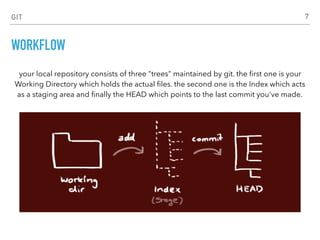
your local repository consists of three "trees" maintained by git. the first one is your
Working Directory which holds the actual files. the second one is the Index which acts
as a staging area and finally the HEAD which points to the last commit you've made.
7
GIT
ADD & COMMIT
You can propose changes (add it to the Index) using
git add <filename>
git add *
This is the first step in the basic git workflow. To actually
commit these changes use
git commit -m "Commit message"
Now the file is committed to the HEAD, but not in your
remote repository yet.
8
GIT
PUSHING CHANGES
Your changes are now in the HEAD of your local working
copy. To send those changes to your remote repository,
execute
git push origin master
Change master to whatever branch you want to push your
changes to.
9
GIT
PUSHING CHANGES
If you have not cloned an existing repository and want to
connect your repository to a remote server, you need to
add it with
git remote add origin <server>
Now you are able to push your changes to the selected
remote server
10
GIT
BRANCHING
Branches are used to develop features isolated from each other. The master branch is
the "default" branch when you create a repository. Use other branches for
development and merge them back to the master branch upon completion.
11
GIT
BRANCHING
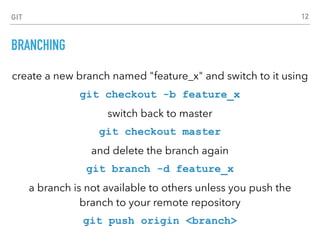
create a new branch named "feature_x" and switch to it using
git checkout -b feature_x
switch back to master
git checkout master
and delete the branch again
git branch -d feature_x
a branch is not available to others unless you push the
branch to your remote repository
git push origin <branch>
12
GIT
UPDATE & MERGE
to update your local repository to the newest commit, execute
git pull
in your working directory to fetch and merge remote changes.
to merge another branch into your active branch (e.g. master), use
git merge <branch>
in both cases git tries to auto-merge changes. Unfortunately, this is not always
possible and results in conflicts. You are responsible to merge those conflicts
manually by editing the files shown by git. After changing, you need to mark
them as merged with
git add <filename>
before merging changes, you can also preview them by using
git diff <source_branch> <target_branch>
13
GIT
TAGGING
it's recommended to create tags for software releases. this
is a known concept, which also exists in SVN. You can
create a new tag named 1.0.0 by executing
git tag 1.0.0 1b2e1d63ff
the 1b2e1d63ff stands for the first 10 characters of the
commit id you want to reference with your tag. You can
get the commit id by looking at the log
14
GIT
LOG
in its simplest form, you can study repository history using.. git log
You can add a lot of parameters to make the log look like what you want. To see only
the commits of a certain author:
git log --author=bob
To see a very compressed log where each commit is one line:
git log --pretty=oneline
Or maybe you want to see an ASCII art tree of all the branches, decorated with the
names of tags and branches:
git log --graph --oneline --decorate --all
See only which files have changed:
git log --name-status
These are just a few of the possible parameters you can use. For more, see git log --
help
15
GIT
REPLACE LOCAL CHANGES
In case you did something wrong, which for sure never
happens ;), you can replace local changes using the
command
git checkout -- <filename>
this replaces the changes in your working tree with the
last content in HEAD. Changes already added to the
index, as well as new files, will be kept.
16
GIT
REPLACE LOCAL CHANGES
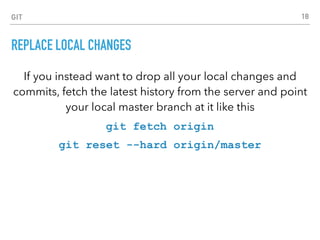
If you instead want to drop all your local changes and
commits, fetch the latest history from the server and point
your local master branch at it like this
git fetch origin
git reset --hard origin/master
17
GIT
USEFUL HINTS
built-in git GUI
gitk
use colorful git output
git config color.ui true
show log on just one line per commit
git config format.pretty oneline
use interactive adding
git add -i
18

18 Git #burningkeyboards

  • 1.
  • 2.
  • 3.
    GIT INTRO ‣Git is afree and open source distributed version control system designed to handle everything from small to very large projects with speed and efficiency. ‣Git allows groups of people to work on the same documents (often code) at the same time, and without stepping on each other's toes. 3
  • 4.
    GIT INSTALL GIT (WINDOWS) ‣Download.exe file from https://git-for- windows.github.io/ ‣Execute file and it will install git ‣Simplicity and power in a beautiful Git GUI ‣https://www.sourcetreeapp.com/ 4
  • 5.
    GIT CREATE A NEWREPOSITORY create a new directory, open it and perform a git init to create a new git repository. 5
  • 6.
    GIT CHECKOUT A REPOSITORY createa working copy of a local repository by running the command git clone /path/to/repository when using a remote server, your command will be git clone username@host:/path/to/repository 6
  • 7.
    GIT WORKFLOW your local repositoryconsists of three "trees" maintained by git. the first one is your Working Directory which holds the actual files. the second one is the Index which acts as a staging area and finally the HEAD which points to the last commit you've made. 7
  • 8.
    GIT ADD & COMMIT Youcan propose changes (add it to the Index) using git add <filename> git add * This is the first step in the basic git workflow. To actually commit these changes use git commit -m "Commit message" Now the file is committed to the HEAD, but not in your remote repository yet. 8
  • 9.
    GIT PUSHING CHANGES Your changesare now in the HEAD of your local working copy. To send those changes to your remote repository, execute git push origin master Change master to whatever branch you want to push your changes to. 9
  • 10.
    GIT PUSHING CHANGES If youhave not cloned an existing repository and want to connect your repository to a remote server, you need to add it with git remote add origin <server> Now you are able to push your changes to the selected remote server 10
  • 11.
    GIT BRANCHING Branches are usedto develop features isolated from each other. The master branch is the "default" branch when you create a repository. Use other branches for development and merge them back to the master branch upon completion. 11
  • 12.
    GIT BRANCHING create a newbranch named "feature_x" and switch to it using git checkout -b feature_x switch back to master git checkout master and delete the branch again git branch -d feature_x a branch is not available to others unless you push the branch to your remote repository git push origin <branch> 12
  • 13.
    GIT UPDATE & MERGE toupdate your local repository to the newest commit, execute git pull in your working directory to fetch and merge remote changes. to merge another branch into your active branch (e.g. master), use git merge <branch> in both cases git tries to auto-merge changes. Unfortunately, this is not always possible and results in conflicts. You are responsible to merge those conflicts manually by editing the files shown by git. After changing, you need to mark them as merged with git add <filename> before merging changes, you can also preview them by using git diff <source_branch> <target_branch> 13
  • 14.
    GIT TAGGING it's recommended tocreate tags for software releases. this is a known concept, which also exists in SVN. You can create a new tag named 1.0.0 by executing git tag 1.0.0 1b2e1d63ff the 1b2e1d63ff stands for the first 10 characters of the commit id you want to reference with your tag. You can get the commit id by looking at the log 14
  • 15.
    GIT LOG in its simplestform, you can study repository history using.. git log You can add a lot of parameters to make the log look like what you want. To see only the commits of a certain author: git log --author=bob To see a very compressed log where each commit is one line: git log --pretty=oneline Or maybe you want to see an ASCII art tree of all the branches, decorated with the names of tags and branches: git log --graph --oneline --decorate --all See only which files have changed: git log --name-status These are just a few of the possible parameters you can use. For more, see git log -- help 15
  • 16.
    GIT REPLACE LOCAL CHANGES Incase you did something wrong, which for sure never happens ;), you can replace local changes using the command git checkout -- <filename> this replaces the changes in your working tree with the last content in HEAD. Changes already added to the index, as well as new files, will be kept. 16
  • 17.
    GIT REPLACE LOCAL CHANGES Ifyou instead want to drop all your local changes and commits, fetch the latest history from the server and point your local master branch at it like this git fetch origin git reset --hard origin/master 17
  • 18.
    GIT USEFUL HINTS built-in gitGUI gitk use colorful git output git config color.ui true show log on just one line per commit git config format.pretty oneline use interactive adding git add -i 18