Git
A distributed version control system
Powerpoint credited to University of PA
And modified by Pepper
5-Apr-23
Version control systems
 Version control (or revision control, or source control) is all
about managing multiple versions of documents, programs, web
sites, etc.
 Almost all “real” projects use some kind of version control
 Essential for team projects, but also very useful for individual projects
 Some well-known version control systems are CVS, Subversion,
Mercurial, and Git
 CVS and Subversion use a “central” repository; users “check out” files,
work on them, and “check them in”
 Mercurial and Git treat all repositories as equal
 Distributed systems like Mercurial and Git are newer and are
gradually replacing centralized systems like CVS and Subversion
2
Why version control?
 For working by yourself:
 Gives you a “time machine” for going back to earlier versions
 Gives you great support for different versions (standalone,
web app, etc.) of the same basic project
 For working with others:
 Greatly simplifies concurrent work, merging changes
 For getting an internship or job:
 Any company with a clue uses some kind of version control
 Companies without a clue are bad places to work
3
Download and install Git
 Tutorials
 Standard one: http://git-scm.com/downloads
 Here’s one from StackExchange:
http://stackoverflow.com/questions/315911/git-for-beginners-the-
definitive-practical-guide#323764
 Install Git on your machine from http://git-scm.com/downloads
 Accept context menu items
 Git access:
 Right click from windows explorer
 gitBash to enter commands
 Current local directory is folder you launched from
 Good idea - one folder for your git local access
4
Introduce yourself to Git
 Start git / gitBash
 See your options:
 git config -l
 Enter these lines (with appropriate changes):
 git config --global user.name "John Smith"
 git config --global user.email jsmith@seas.upenn.edu
 You only need to do this once
 If you want to use a different name/email address for a
particular project, you can change it for just that project
 cd to the project directory
 Use the above commands, but leave out the --global
5
Setting options
 When you “commit,” git will require you to type in a
commit message
 For longer commit messages, you will use an editor
 To change the default editor:
 git config --global core.editor /usr/bin/vim
 You may also want to turn on colors:
 git config --global color.ui auto
 See your options:
 git config -l
6
Clone repositories on panther
 Our repositories
 http://home.adelphi.edu/~pe16132/csc440/repositories.html
 Get the files from your repository before starting
 Make a local respository as a clone of master
 Make a new folder
 Right click the folder and choose git bash
 Type: git clone
ssh://pepper@panther.adelphi.edu/opt/git/csc480ASpring15.git
 Enter your ecampus password
 See all the contents of the folder
 Windows Explorer: Change folder and search options to show
hidden files, folders and drives
 Git Bash (unix) : ls -a to see the .git folder.
7
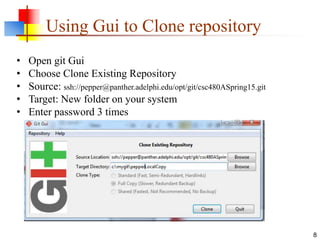
Using Gui to Clone repository
8
• Open git Gui
• Choose Clone Existing Repository
• Source: ssh://pepper@panther.adelphi.edu/opt/git/csc480ASpring15.git
• Target: New folder on your system
• Enter password 3 times
GitBash Changing your repositories
 Make changes
 See what changed
 git diff
 Stage changes
 git add –all (or particular files) note 2 dashes!
 git diff –cached (:q! to exit)
 Still only in your repository
 Put changes back up into repository
 Commit your staged changes in your repository
 git commit -m "the reason for the change"
 Update the respository:
 git push origin
9
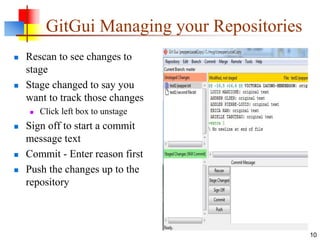
GitGui Managing your Repositories
 Rescan to see changes to
stage
 Stage changed to say you
want to track those changes
 Click left box to unstage
 Sign off to start a commit
message text
 Commit - Enter reason first
 Push the changes up to the
repository
10
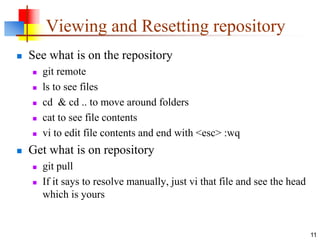
Viewing and Resetting repository
 See what is on the repository
 git remote
 ls to see files
 cd & cd .. to move around folders
 cat to see file contents
 vi to edit file contents and end with <esc> :wq
 Get what is on repository
 git pull
 If it says to resolve manually, just vi that file and see the head
which is yours
11
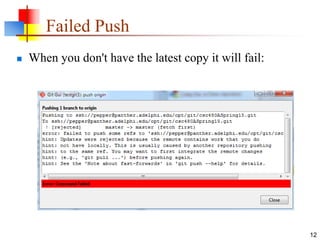
Failed Push
 When you don't have the latest copy it will fail:
12
Recover from failed push
 Copy your repository elsewhere first just in case
 Use git bash
 Git pull to pull down the changes
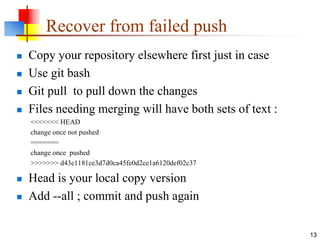
 Files needing merging will have both sets of text :
<<<<<<< HEAD
change once not pushed
=======
change once pushed
>>>>>>> d43e1181ce3d7d0ca45fe0d2ce1a6120def02c37
 Head is your local copy version
 Add --all ; commit and push again
13
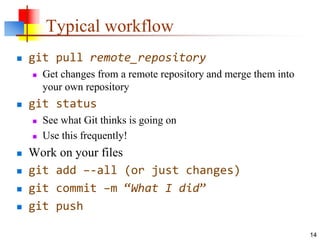
Typical workflow
 git pull remote_repository
 Get changes from a remote repository and merge them into
your own repository
 git status
 See what Git thinks is going on
 Use this frequently!
 Work on your files
 git add –-all (or just changes)
 git commit –m “What I did”
 git push
14
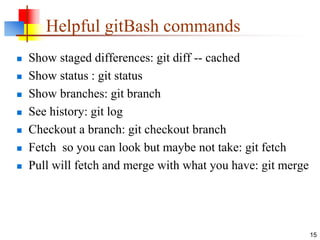
Helpful gitBash commands
 Show staged differences: git diff -- cached
 Show status : git status
 Show branches: git branch
 See history: git log
 Checkout a branch: git checkout branch
 Fetch so you can look but maybe not take: git fetch
 Pull will fetch and merge with what you have: git merge
15
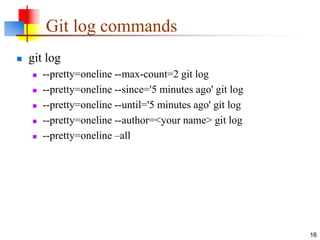
Git log commands
 git log
 --pretty=oneline --max-count=2 git log
 --pretty=oneline --since='5 minutes ago' git log
 --pretty=oneline --until='5 minutes ago' git log
 --pretty=oneline --author=<your name> git log
 --pretty=oneline –all
16
Git log pretty
 git log --pretty=format:"%h %ad | %s%d [%an]" --graph --
date=short
 --pretty="..." defines the output format.
 %h is the abbreviated hash of the commit
 %d commit decorations (e.g. branch heads or tags)
 %ad is the commit date
 %s is the comment
 %an is the name of the author
 --graph tells git to display the commit tree in the form of
an ASCII graph layout
 --date=short keeps the date format short and nice
17
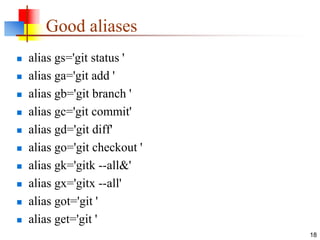
Good aliases
 alias gs='git status '
 alias ga='git add '
 alias gb='git branch '
 alias gc='git commit'
 alias gd='git diff'
 alias go='git checkout '
 alias gk='gitk --all&'
 alias gx='gitx --all'
 alias got='git '
 alias get='git '
18

git2.ppt

  • 1.
    Git A distributed versioncontrol system Powerpoint credited to University of PA And modified by Pepper 5-Apr-23
  • 2.
    Version control systems Version control (or revision control, or source control) is all about managing multiple versions of documents, programs, web sites, etc.  Almost all “real” projects use some kind of version control  Essential for team projects, but also very useful for individual projects  Some well-known version control systems are CVS, Subversion, Mercurial, and Git  CVS and Subversion use a “central” repository; users “check out” files, work on them, and “check them in”  Mercurial and Git treat all repositories as equal  Distributed systems like Mercurial and Git are newer and are gradually replacing centralized systems like CVS and Subversion 2
  • 3.
    Why version control? For working by yourself:  Gives you a “time machine” for going back to earlier versions  Gives you great support for different versions (standalone, web app, etc.) of the same basic project  For working with others:  Greatly simplifies concurrent work, merging changes  For getting an internship or job:  Any company with a clue uses some kind of version control  Companies without a clue are bad places to work 3
  • 4.
    Download and installGit  Tutorials  Standard one: http://git-scm.com/downloads  Here’s one from StackExchange: http://stackoverflow.com/questions/315911/git-for-beginners-the- definitive-practical-guide#323764  Install Git on your machine from http://git-scm.com/downloads  Accept context menu items  Git access:  Right click from windows explorer  gitBash to enter commands  Current local directory is folder you launched from  Good idea - one folder for your git local access 4
  • 5.
    Introduce yourself toGit  Start git / gitBash  See your options:  git config -l  Enter these lines (with appropriate changes):  git config --global user.name "John Smith"  git config --global user.email jsmith@seas.upenn.edu  You only need to do this once  If you want to use a different name/email address for a particular project, you can change it for just that project  cd to the project directory  Use the above commands, but leave out the --global 5
  • 6.
    Setting options  Whenyou “commit,” git will require you to type in a commit message  For longer commit messages, you will use an editor  To change the default editor:  git config --global core.editor /usr/bin/vim  You may also want to turn on colors:  git config --global color.ui auto  See your options:  git config -l 6
  • 7.
    Clone repositories onpanther  Our repositories  http://home.adelphi.edu/~pe16132/csc440/repositories.html  Get the files from your repository before starting  Make a local respository as a clone of master  Make a new folder  Right click the folder and choose git bash  Type: git clone ssh://pepper@panther.adelphi.edu/opt/git/csc480ASpring15.git  Enter your ecampus password  See all the contents of the folder  Windows Explorer: Change folder and search options to show hidden files, folders and drives  Git Bash (unix) : ls -a to see the .git folder. 7
  • 8.
    Using Gui toClone repository 8 • Open git Gui • Choose Clone Existing Repository • Source: ssh://pepper@panther.adelphi.edu/opt/git/csc480ASpring15.git • Target: New folder on your system • Enter password 3 times
  • 9.
    GitBash Changing yourrepositories  Make changes  See what changed  git diff  Stage changes  git add –all (or particular files) note 2 dashes!  git diff –cached (:q! to exit)  Still only in your repository  Put changes back up into repository  Commit your staged changes in your repository  git commit -m "the reason for the change"  Update the respository:  git push origin 9
  • 10.
    GitGui Managing yourRepositories  Rescan to see changes to stage  Stage changed to say you want to track those changes  Click left box to unstage  Sign off to start a commit message text  Commit - Enter reason first  Push the changes up to the repository 10
  • 11.
    Viewing and Resettingrepository  See what is on the repository  git remote  ls to see files  cd & cd .. to move around folders  cat to see file contents  vi to edit file contents and end with <esc> :wq  Get what is on repository  git pull  If it says to resolve manually, just vi that file and see the head which is yours 11
  • 12.
    Failed Push  Whenyou don't have the latest copy it will fail: 12
  • 13.
    Recover from failedpush  Copy your repository elsewhere first just in case  Use git bash  Git pull to pull down the changes  Files needing merging will have both sets of text : <<<<<<< HEAD change once not pushed ======= change once pushed >>>>>>> d43e1181ce3d7d0ca45fe0d2ce1a6120def02c37  Head is your local copy version  Add --all ; commit and push again 13
  • 14.
    Typical workflow  gitpull remote_repository  Get changes from a remote repository and merge them into your own repository  git status  See what Git thinks is going on  Use this frequently!  Work on your files  git add –-all (or just changes)  git commit –m “What I did”  git push 14
  • 15.
    Helpful gitBash commands Show staged differences: git diff -- cached  Show status : git status  Show branches: git branch  See history: git log  Checkout a branch: git checkout branch  Fetch so you can look but maybe not take: git fetch  Pull will fetch and merge with what you have: git merge 15
  • 16.
    Git log commands git log  --pretty=oneline --max-count=2 git log  --pretty=oneline --since='5 minutes ago' git log  --pretty=oneline --until='5 minutes ago' git log  --pretty=oneline --author=<your name> git log  --pretty=oneline –all 16
  • 17.
    Git log pretty git log --pretty=format:"%h %ad | %s%d [%an]" --graph -- date=short  --pretty="..." defines the output format.  %h is the abbreviated hash of the commit  %d commit decorations (e.g. branch heads or tags)  %ad is the commit date  %s is the comment  %an is the name of the author  --graph tells git to display the commit tree in the form of an ASCII graph layout  --date=short keeps the date format short and nice 17
  • 18.
    Good aliases  aliasgs='git status '  alias ga='git add '  alias gb='git branch '  alias gc='git commit'  alias gd='git diff'  alias go='git checkout '  alias gk='gitk --all&'  alias gx='gitx --all'  alias got='git '  alias get='git ' 18