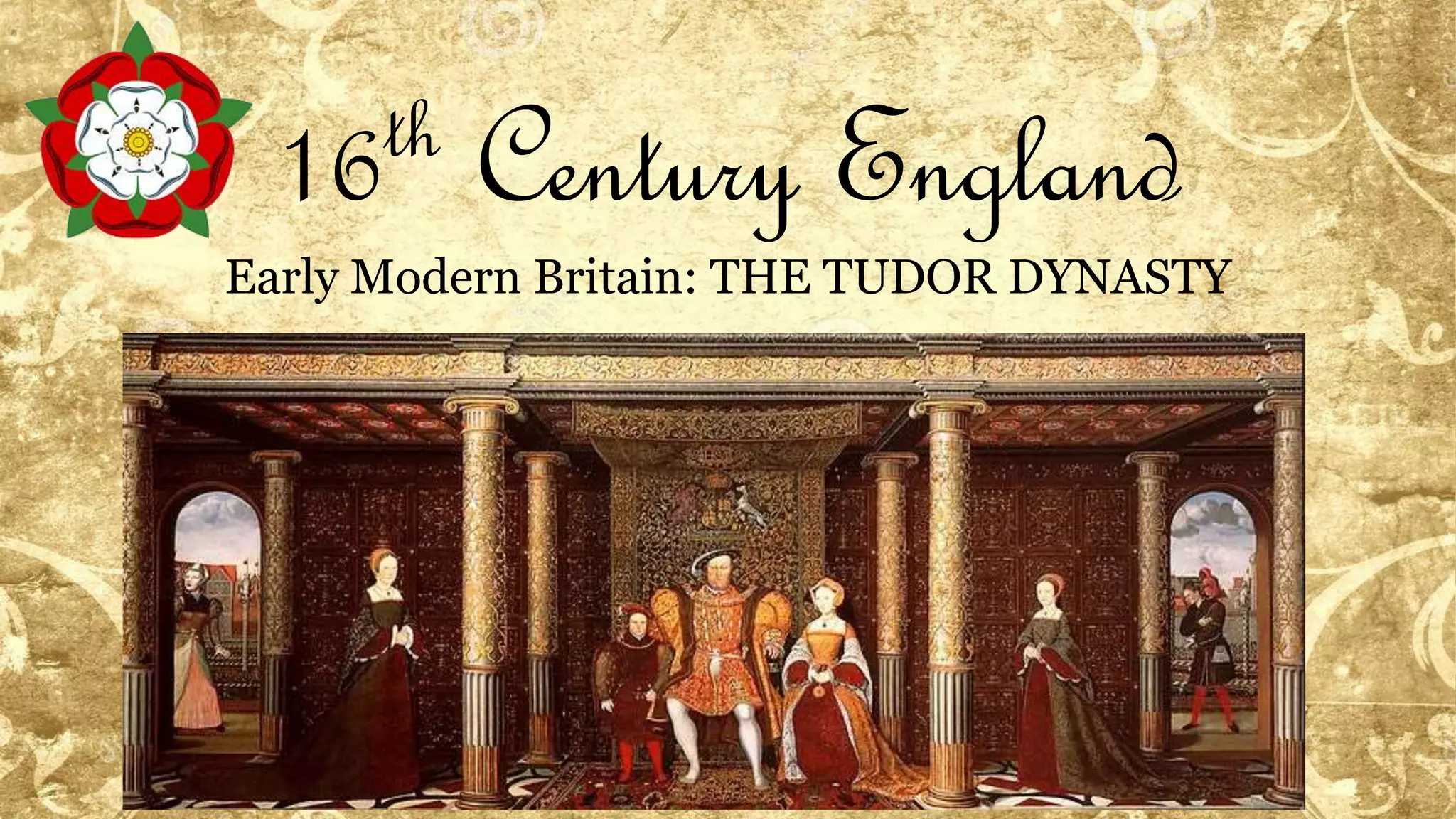



16th Century England
Early Modern Britain: THE TUDOR DYNASTY
What can you recall
about the War of the
Roses?
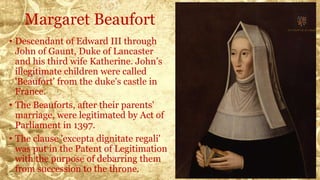
Margaret Beaufort
• Descendant of Edward III through
John of Gaunt, Duke of Lancaster
and his third wife Katherine. John’s
illegitimate children were called
'Beaufort' from the duke's castle in
France.
• The Beauforts, after their parents'
marriage, were legitimated by Act of
Parliament in 1397.
• The clause 'excepta dignitate regali'
was put in the Patent of Legitimation
with the purpose of debarring them
from succession to the throne.
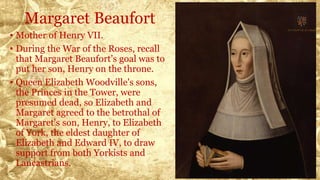
Margaret Beaufort
• Mother of Henry VII.
• During the War of the Roses, recall
that Margaret Beaufort’s goal was to
put her son, Henry on the throne.
• Queen Elizabeth Woodville's sons,
the Princes in the Tower, were
presumed dead, so Elizabeth and
Margaret agreed to the betrothal of
Margaret's son, Henry, to Elizabeth
of York, the eldest daughter of
Elizabeth and Edward IV, to draw
support from both Yorkists and
Lancastrians.
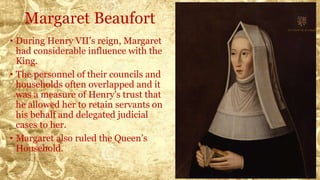
Margaret Beaufort
• During Henry VII’s reign, Margaret
had considerable influence with the
King.
• The personnel of their councils and
households often overlapped and it
was a measure of Henry's trust that
he allowed her to retain servants on
his behalf and delegated judicial
cases to her.
• Margaret also ruled the Queen’s
Household.
How did Margaret help
her son, Henry VII, to
become king?
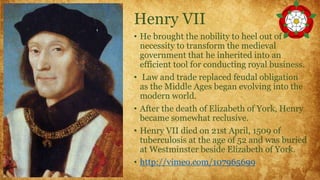
Henry VII
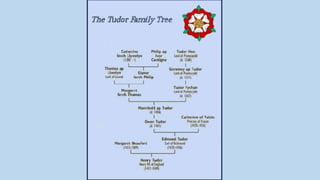
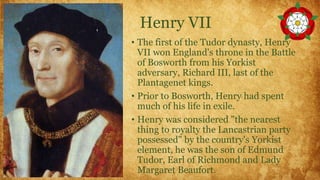
• The first of the Tudor dynasty, Henry
VII won England's throne in the Battle
of Bosworth from his Yorkist
adversary, Richard III, last of the
Plantagenet kings.
• Prior to Bosworth, Henry had spent
much of his life in exile.
• Henry was considered "the nearest
thing to royalty the Lancastrian party
possessed" by the country's Yorkist
element, he was the son of Edmund
Tudor, Earl of Richmond and Lady
Margaret Beaufort.
Henry VII
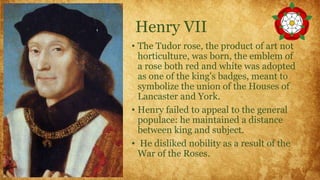
• The Tudor rose, the product of art not
horticulture, was born, the emblem of
a rose both red and white was adopted
as one of the king's badges, meant to
symbolize the union of the Houses of
Lancaster and York.
• Henry failed to appeal to the general
populace: he maintained a distance
between king and subject.
• He disliked nobility as a result of the
War of the Roses.
Henry VII
• He brought the nobility to heel out of
necessity to transform the medieval
government that he inherited into an
efficient tool for conducting royal business.
• Law and trade replaced feudal obligation
as the Middle Ages began evolving into the
modern world.
• After the death of Elizabeth of York, Henry
became somewhat reclusive.
• Henry VII died on 21st April, 1509 of
tuberculosis at the age of 52 and was buried
at Westminster beside Elizabeth of York.
• http://vimeo.com/107965699
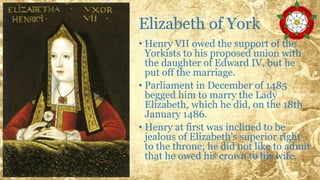
Elizabeth of York
• Henry VII owed the support of the
Yorkists to his proposed union with
the daughter of Edward IV, but he
put off the marriage.
• Parliament in December of 1485
begged him to marry the Lady
Elizabeth, which he did, on the 18th
January 1486.
• Henry at first was inclined to be
jealous of Elizabeth's superior right
to the throne; he did not like to admit
that he owed his crown to his wife.
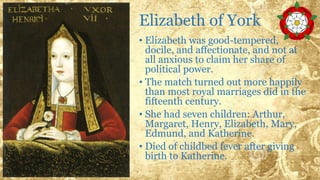
Elizabeth of York
• Elizabeth was good-tempered,
docile, and affectionate, and not at
all anxious to claim her share of
political power.
• The match turned out more happily
than most royal marriages did in the
fifteenth century.
• She had seven children: Arthur,
Margaret, Henry, Elizabeth, Mary,
Edmund, and Katherine.
• Died of childbed fever after giving
birth to Katherine.
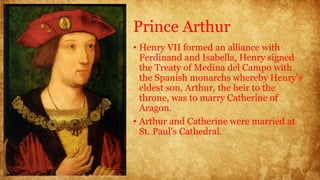
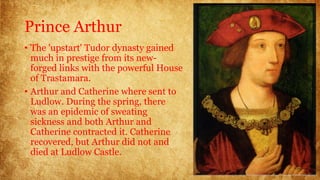
Prince Arthur
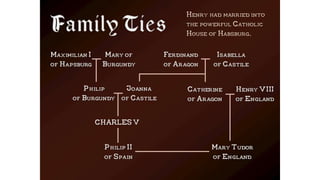
• Henry VII formed an alliance with
Ferdinand and Isabella, Henry signed
the Treaty of Medina del Campo with
the Spanish monarchs whereby Henry's
eldest son, Arthur, the heir to the
throne, was to marry Catherine of
Aragon.
• Arthur and Catherine were married at
St. Paul's Cathedral.
Prince Arthur
• The 'upstart' Tudor dynasty gained
much in prestige from its new-
forged links with the powerful House
of Trastamara.
• Arthur and Catherine where sent to
Ludlow. During the spring, there
was an epidemic of sweating
sickness and both Arthur and
Catherine contracted it. Catherine
recovered, but Arthur did not and
died at Ludlow Castle.
Why were Catherine and Arthur
married?
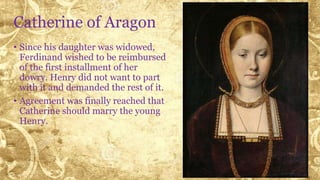
Catherine of Aragon
• Since his daughter was widowed,
Ferdinand wished to be reimbursed
of the first installment of her
dowry. Henry did not want to part
with it and demanded the rest of it.
• Agreement was finally reached that
Catherine should marry the young
Henry.
Catherine of Aragon
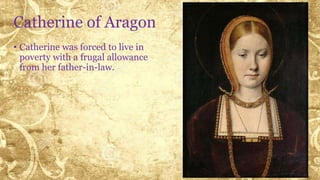
• Catherine was forced to live in
poverty with a frugal allowance
from her father-in-law.
How did Henry and
Catherine get permission
to marry?
Henry VIII
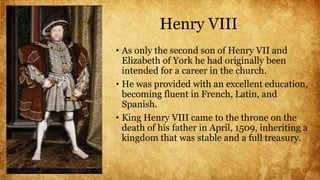
• As only the second son of Henry VII and
Elizabeth of York he had originally been
intended for a career in the church.
• He was provided with an excellent education,
becoming fluent in French, Latin, and
Spanish.
• King Henry VIII came to the throne on the
death of his father in April, 1509, inheriting a
kingdom that was stable and a full treasury.
Henry VIII
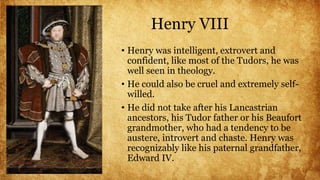
• Henry was intelligent, extrovert and
confident, like most of the Tudors, he was
well seen in theology.
• He could also be cruel and extremely self-
willed.
• He did not take after his Lancastrian
ancestors, his Tudor father or his Beaufort
grandmother, who had a tendency to be
austere, introvert and chaste. Henry was
recognizably like his paternal grandfather,
Edward IV.
Henry VIII
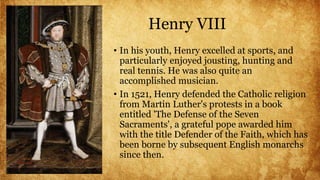
• In his youth, Henry excelled at sports, and
particularly enjoyed jousting, hunting and
real tennis. He was also quite an
accomplished musician.
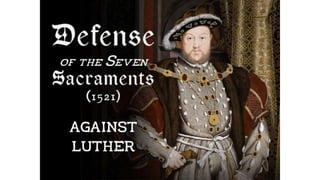
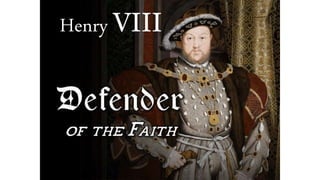
• In 1521, Henry defended the Catholic religion
from Martin Luther's protests in a book
entitled 'The Defense of the Seven
Sacraments', a grateful pope awarded him
with the title Defender of the Faith, which has
been borne by subsequent English monarchs
since then.
Henry VIII
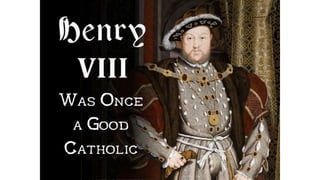
What kind of Christian
was Henry originally?
Did he doubt the Church
and see corruption?
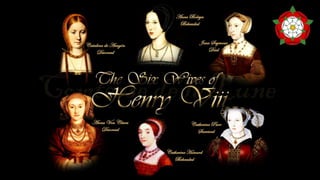
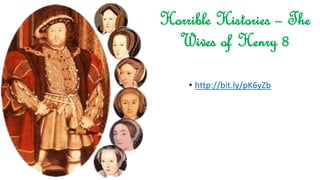
Horrible Histories – The
Wives of Henry 8
• http://bit.ly/pK6yZb
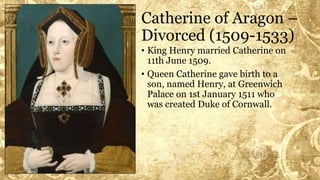
Catherine of Aragon –
Divorced (1509-1533)
• King Henry married Catherine on
11th June 1509.
• Queen Catherine gave birth to a
son, named Henry, at Greenwich
Palace on 1st January 1511 who
was created Duke of Cornwall.
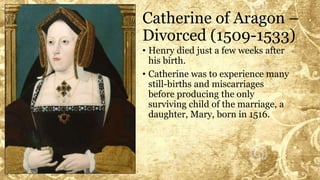
Catherine of Aragon –
Divorced (1509-1533)
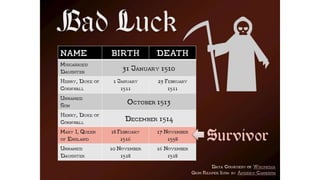
• Henry died just a few weeks after
his birth.
• Catherine was to experience many
still-births and miscarriages
before producing the only
surviving child of the marriage, a
daughter, Mary, born in 1516.
Anne Boleyn –
Beheaded (1533-1536)
• Her mother, Elizabeth Howard, was the
daughter of Thomas Howard, Earl of
Surrey; she was descended from Edward
I.
• Thomas Boleyn was amongst a group of
envoys assigned to the Regent of
Netherlands court in 1512. While there,
he formed a firm friendship with
Margaret, Archduchess of Austria, which
he used to secure a prestigious
appointment for his daughter.
Anne Boleyn –
Beheaded (1533-1536)
• Anne was educated in the household of
the Archduchess Margaret of Austria in
the Netherlands, and after the winter of
1514, in Paris.
• Anne proved to be proficient in her
lessons, particularly at languages. She
excelled in French and eventually came
to speak it like a native.
• Anne returned to England in 1521 and
first appeared at the English court at a
masquerade ball in March 1522.
Anne Boleyn –
Beheaded (1533-1536)
• Anne's sister Mary had been the mistress
of Henry VIII.
• In 1527 Henry became hopelessly
infatuated with Anne Boleyn.
• Learning from the example of her sister,
who had been cast off and was of no
further use, she resisted the king's
attempts to seduce her, and held out for
marriage.
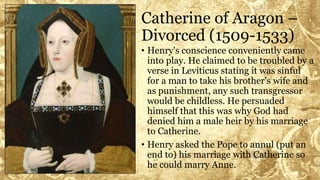
Catherine of Aragon –
Divorced (1509-1533)
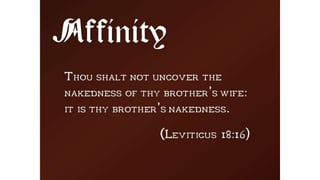
• Henry's conscience conveniently came
into play. He claimed to be troubled by a
verse in Leviticus stating it was sinful
for a man to take his brother's wife and
as punishment, any such transgressor
would be childless. He persuaded
himself that this was why God had
denied him a male heir by his marriage
to Catherine.
• Henry asked the Pope to annul (put an
end to) his marriage with Catherine so
he could marry Anne.
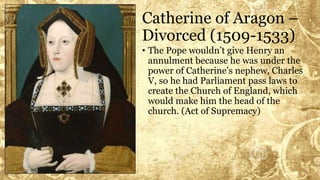
Catherine of Aragon –
Divorced (1509-1533)
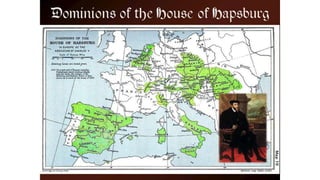
• The Pope wouldn’t give Henry an
annulment because he was under the
power of Catherine’s nephew, Charles
V, so he had Parliament pass laws to
create the Church of England, which
would make him the head of the
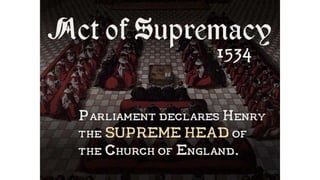
church. (Act of Supremacy)
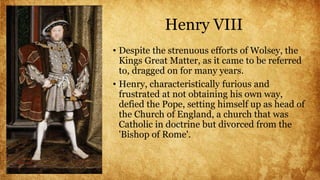
Henry VIII
• Despite the strenuous efforts of Wolsey, the
Kings Great Matter, as it came to be referred
to, dragged on for many years.
• Henry, characteristically furious and
frustrated at not obtaining his own way,
defied the Pope, setting himself up as head of
the Church of England, a church that was
Catholic in doctrine but divorced from the
'Bishop of Rome'.
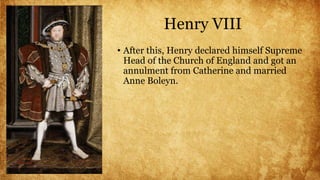
Henry VIII
• After this, Henry declared himself Supreme
Head of the Church of England and got an
annulment from Catherine and married
Anne Boleyn.
Henry VIII
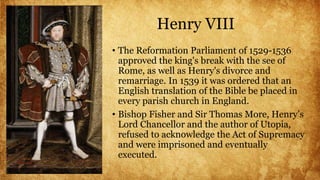
• The Reformation Parliament of 1529-1536
approved the king's break with the see of
Rome, as well as Henry's divorce and
remarriage. In 1539 it was ordered that an
English translation of the Bible be placed in
every parish church in England.
• Bishop Fisher and Sir Thomas More, Henry’s
Lord Chancellor and the author of Utopia,
refused to acknowledge the Act of Supremacy
and were imprisoned and eventually
executed.
Anne Boleyn –
Beheaded (1533-1536)
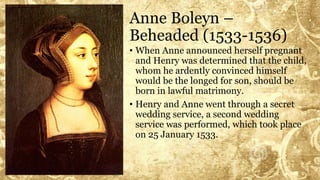
• When Anne announced herself pregnant
and Henry was determined that the child,
whom he ardently convinced himself
would be the longed for son, should be
born in lawful matrimony.
• Henry and Anne went through a secret
wedding service, a second wedding
service was performed, which took place
on 25 January 1533.
Anne Boleyn –
Beheaded (1533-1536)
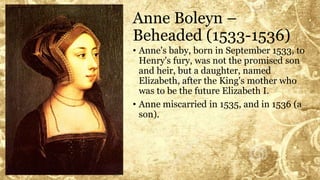
• Anne's baby, born in September 1533, to
Henry's fury, was not the promised son
and heir, but a daughter, named
Elizabeth, after the King's mother who
was to be the future Elizabeth I.
• Anne miscarried in 1535, and in 1536 (a
son).
Anne Boleyn –
Beheaded (1533-1536)
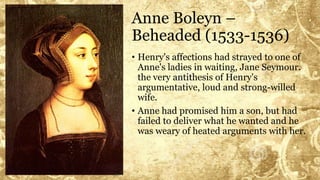
• Henry's affections had strayed to one of
Anne's ladies in waiting, Jane Seymour.
the very antithesis of Henry's
argumentative, loud and strong-willed
wife.
• Anne had promised him a son, but had
failed to deliver what he wanted and he
was weary of heated arguments with her.
Catherine of Aragon –
Divorced (1509-1533)
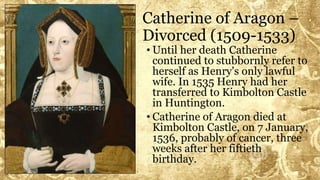
• Until her death Catherine
continued to stubbornly refer to
herself as Henry's only lawful
wife. In 1535 Henry had her
transferred to Kimbolton Castle
in Huntington.
• Catherine of Aragon died at
Kimbolton Castle, on 7 January,
1536, probably of cancer, three
weeks after her fiftieth
birthday.
Why and how did Henry
divorce Catherine? What
was the Act of
Supremacy?
Anne Boleyn –
Beheaded (1533-1536)
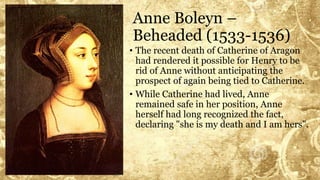
• The recent death of Catherine of Aragon
had rendered it possible for Henry to be
rid of Anne without anticipating the
prospect of again being tied to Catherine.
• While Catherine had lived, Anne
remained safe in her position, Anne
herself had long recognized the fact,
declaring "she is my death and I am hers".
Anne Boleyn –
Beheaded (1533-1536)
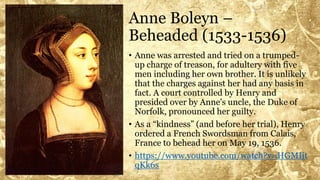
• Anne was arrested and tried on a trumped-
up charge of treason, for adultery with five
men including her own brother. It is unlikely
that the charges against her had any basis in
fact. A court controlled by Henry and
presided over by Anne's uncle, the Duke of
Norfolk, pronounced her guilty.
• As a “kindness” (and before her trial), Henry
ordered a French Swordsman from Calais,
France to behead her on May 19, 1536.
• https://www.youtube.com/watch?v=HGMIit
qKk6s
Why did Henry get rid of
Anne and how did he do
it?
Henry VIII
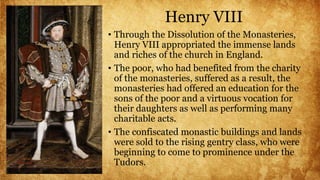
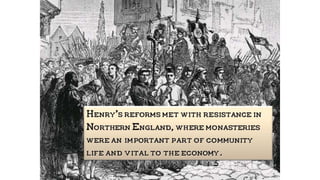
• Through the Dissolution of the Monasteries,
Henry VIII appropriated the immense lands
and riches of the church in England.
• The poor, who had benefited from the charity
of the monasteries, suffered as a result, the
monasteries had offered an education for the
sons of the poor and a virtuous vocation for
their daughters as well as performing many
charitable acts.
• The confiscated monastic buildings and lands
were sold to the rising gentry class, who were
beginning to come to prominence under the
Tudors.
Jane Seymour –
Died (1536-1537)
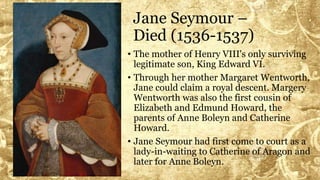
• The mother of Henry VIII's only surviving
legitimate son, King Edward VI.
• Through her mother Margaret Wentworth,
Jane could claim a royal descent. Margery
Wentworth was also the first cousin of
Elizabeth and Edmund Howard, the
parents of Anne Boleyn and Catherine
Howard.
• Jane Seymour had first come to court as a
lady-in-waiting to Catherine of Aragon and
later for Anne Boleyn.
Jane Seymour –
Died (1536-1537)
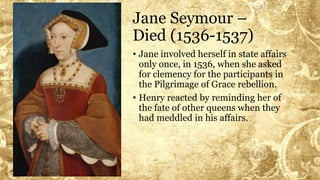
• Jane involved herself in state affairs
only once, in 1536, when she asked
for clemency for the participants in
the Pilgrimage of Grace rebellion.
• Henry reacted by reminding her of
the fate of other queens when they
had meddled in his affairs.
Jane Seymour –
Died (1536-1537)
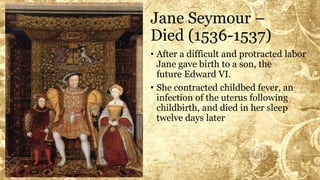
• After a difficult and protracted labor
Jane gave birth to a son, the
future Edward VI.
• She contracted childbed fever, an
infection of the uterus following
childbirth, and died in her sleep
twelve days later
What did Henry do with
Church property?
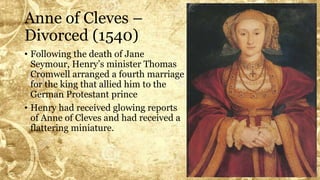
Anne of Cleves –
Divorced (1540)
• Following the death of Jane
Seymour, Henry’s minister Thomas
Cromwell arranged a fourth marriage
for the king that allied him to the
German Protestant prince
• Henry had received glowing reports
of Anne of Cleves and had received a
flattering miniature.
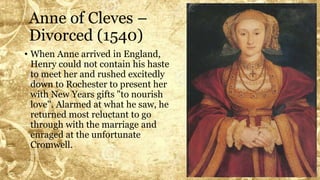
Anne of Cleves –
Divorced (1540)
• When Anne arrived in England,
Henry could not contain his haste
to meet her and rushed excitedly
down to Rochester to present her
with New Years gifts "to nourish
love". Alarmed at what he saw, he
returned most reluctant to go
through with the marriage and
enraged at the unfortunate
Cromwell.
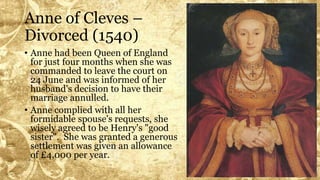
Anne of Cleves –
Divorced (1540)
• Anne had been Queen of England
for just four months when she was
commanded to leave the court on
24 June and was informed of her
husband's decision to have their
marriage annulled.
• Anne complied with all her
formidable spouse's requests, she
wisely agreed to be Henry's "good
sister". She was granted a generous
settlement was given an allowance
of £4,000 per year.
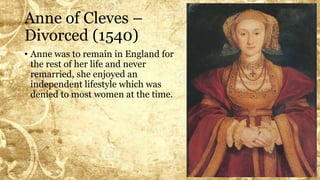
Anne of Cleves –
Divorced (1540)
• Anne was to remain in England for
the rest of her life and never
remarried, she enjoyed an
independent lifestyle which was
denied to most women at the time.
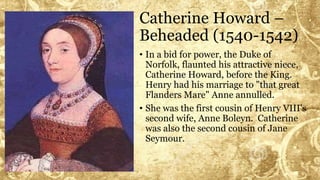
Catherine Howard –
Beheaded (1540-1542)
• In a bid for power, the Duke of
Norfolk, flaunted his attractive niece,
Catherine Howard, before the King.
Henry had his marriage to "that great
Flanders Mare" Anne annulled.
• She was the first cousin of Henry VIII's
second wife, Anne Boleyn. Catherine
was also the second cousin of Jane
Seymour.
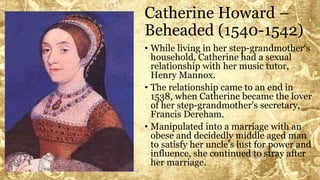
Catherine Howard –
Beheaded (1540-1542)
• While living in her step-grandmother‘s
household, Catherine had a sexual
relationship with her music tutor,
Henry Mannox.
• The relationship came to an end in
1538, when Catherine became the lover
of her step-grandmother's secretary,
Francis Dereham.
• Manipulated into a marriage with an
obese and decidedly middle aged man
to satisfy her uncle's lust for power and
influence, she continued to stray after
her marriage.
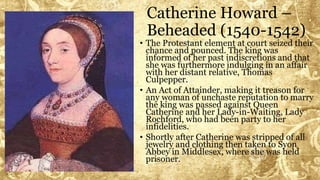
Catherine Howard –
Beheaded (1540-1542)
• The Protestant element at court seized their
chance and pounced. The king was
informed of her past indiscretions and that
she was furthermore indulging in an affair
with her distant relative, Thomas
Culpepper.
• An Act of Attainder, making it treason for
any woman of unchaste reputation to marry
the king was passed against Queen
Catherine and her Lady-in-Waiting, Lady
Rochford, who had been party to her
infidelities.
• Shortly after Catherine was stripped of all
jewelry and clothing then taken to Syon
Abbey in Middlesex, where she was held
prisoner.
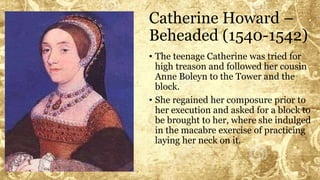
Catherine Howard –
Beheaded (1540-1542)
• The teenage Catherine was tried for
high treason and followed her cousin
Anne Boleyn to the Tower and the
block.
• She regained her composure prior to
her execution and asked for a block to
be brought to her, where she indulged
in the macabre exercise of practicing
laying her neck on it.
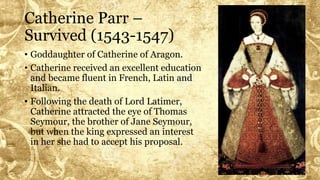
Catherine Parr –
Survived (1543-1547)
• Goddaughter of Catherine of Aragon.
• Catherine received an excellent education
and became fluent in French, Latin and
Italian.
• Following the death of Lord Latimer,
Catherine attracted the eye of Thomas
Seymour, the brother of Jane Seymour,
but when the king expressed an interest
in her she had to accept his proposal.
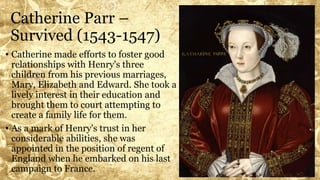
Catherine Parr –
Survived (1543-1547)
• Catherine made efforts to foster good
relationships with Henry's three
children from his previous marriages,
Mary, Elizabeth and Edward. She took a
lively interest in their education and
brought them to court attempting to
create a family life for them.
• As a mark of Henry's trust in her
considerable abilities, she was
appointed in the position of regent of
England when he embarked on his last
campaign to France.
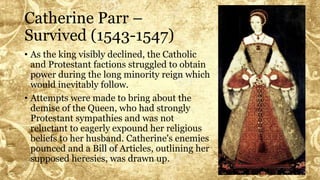
Catherine Parr –
Survived (1543-1547)
• As the king visibly declined, the Catholic
and Protestant factions struggled to obtain
power during the long minority reign which
would inevitably follow.
• Attempts were made to bring about the
demise of the Queen, who had strongly
Protestant sympathies and was not
reluctant to eagerly expound her religious
beliefs to her husband. Catherine's enemies
pounced and a Bill of Articles, outlining her
supposed heresies, was drawn up.
Catherine Parr –
Survived (1543-1547)
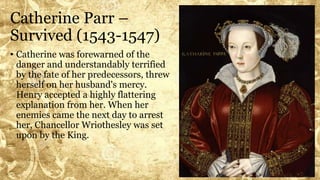
• Catherine was forewarned of the
danger and understandably terrified
by the fate of her predecessors, threw
herself on her husband's mercy.
Henry accepted a highly flattering
explanation from her. When her
enemies came the next day to arrest
her, Chancellor Wriothesley was set
upon by the King.
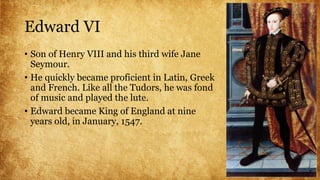
Edward VI
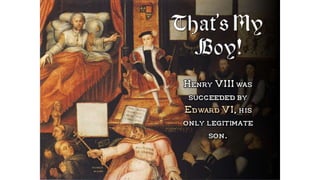
• Son of Henry VIII and his third wife Jane
Seymour.
• He quickly became proficient in Latin, Greek
and French. Like all the Tudors, he was fond
of music and played the lute.
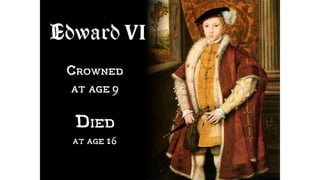
• Edward became King of England at nine
years old, in January, 1547.
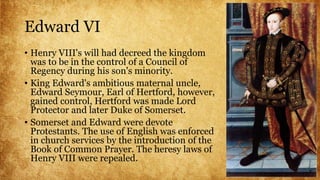
Edward VI
• Henry VIII's will had decreed the kingdom
was to be in the control of a Council of
Regency during his son's minority.
• King Edward's ambitious maternal uncle,
Edward Seymour, Earl of Hertford, however,
gained control, Hertford was made Lord
Protector and later Duke of Somerset.
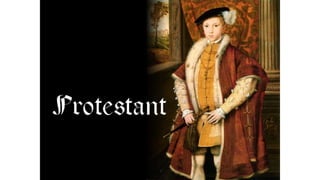
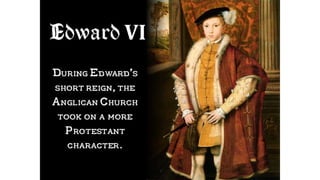
• Somerset and Edward were devote
Protestants. The use of English was enforced
in church services by the introduction of the
Book of Common Prayer. The heresy laws of
Henry VIII were repealed.
Edward VI
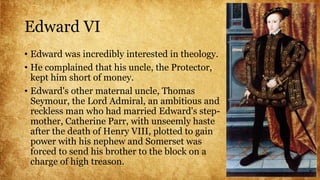
• Edward was incredibly interested in theology.
• He complained that his uncle, the Protector,
kept him short of money.
• Edward's other maternal uncle, Thomas
Seymour, the Lord Admiral, an ambitious and
reckless man who had married Edward's step-
mother, Catherine Parr, with unseemly haste
after the death of Henry VIII, plotted to gain
power with his nephew and Somerset was
forced to send his brother to the block on a
charge of high treason.
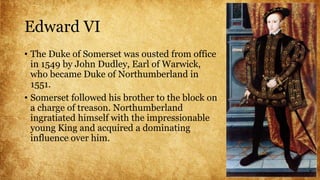
Edward VI
• The Duke of Somerset was ousted from office
in 1549 by John Dudley, Earl of Warwick,
who became Duke of Northumberland in
1551.
• Somerset followed his brother to the block on
a charge of treason. Northumberland
ingratiated himself with the impressionable
young King and acquired a dominating
influence over him.
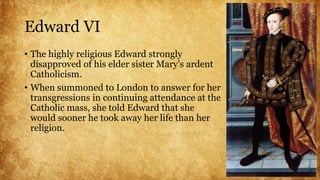
Edward VI
• The highly religious Edward strongly
disapproved of his elder sister Mary's ardent
Catholicism.
• When summoned to London to answer for her
transgressions in continuing attendance at the
Catholic mass, she told Edward that she
would sooner he took away her life than her
religion.
How was Edward VI
religious important?
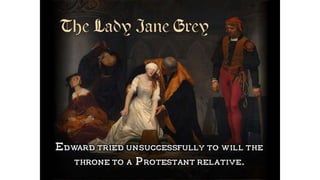
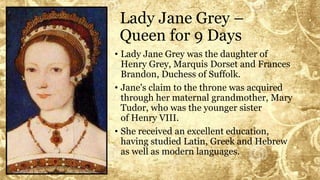
Lady Jane Grey –
Queen for 9 Days
• Lady Jane Grey was the daughter of
Henry Grey, Marquis Dorset and Frances
Brandon, Duchess of Suffolk.
• Jane's claim to the throne was acquired
through her maternal grandmother, Mary
Tudor, who was the younger sister
of Henry VIII.
• She received an excellent education,
having studied Latin, Greek and Hebrew
as well as modern languages.
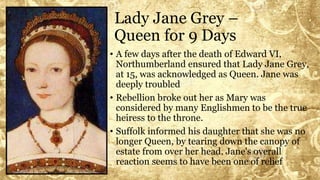
Lady Jane Grey –
Queen for 9 Days
• A few days after the death of Edward VI,
Northumberland ensured that Lady Jane Grey,
at 15, was acknowledged as Queen. Jane was
deeply troubled
• Rebellion broke out her as Mary was
considered by many Englishmen to be the true
heiress to the throne.
• Suffolk informed his daughter that she was no
longer Queen, by tearing down the canopy of
estate from over her head. Jane's overall
reaction seems to have been one of relief
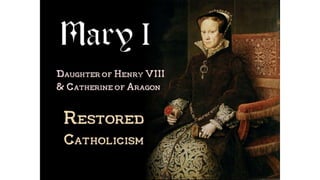
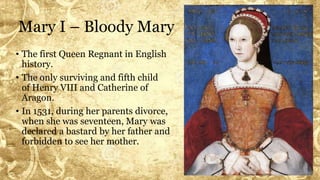
Mary I – Bloody Mary
• The first Queen Regnant in English
history.
• The only surviving and fifth child
of Henry VIII and Catherine of
Aragon.
• In 1531, during her parents divorce,
when she was seventeen, Mary was
declared a bastard by her father and
forbidden to see her mother.
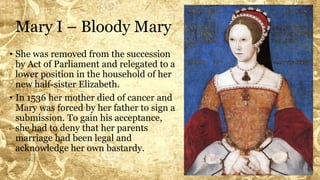
Mary I – Bloody Mary
• She was removed from the succession
by Act of Parliament and relegated to a
lower position in the household of her
new half-sister Elizabeth.
• In 1536 her mother died of cancer and
Mary was forced by her father to sign a
submission. To gain his acceptance,
she had to deny that her parents
marriage had been legal and
acknowledge her own bastardy.
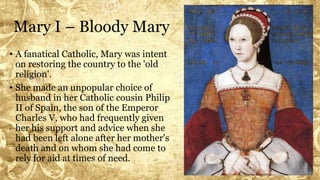
Mary I – Bloody Mary
• A fanatical Catholic, Mary was intent
on restoring the country to the 'old
religion'.
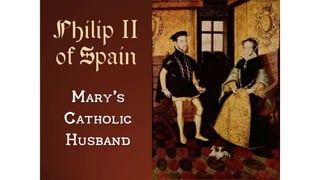
• She made an unpopular choice of
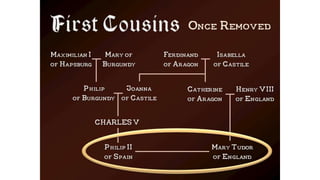
husband in her Catholic cousin Philip
II of Spain, the son of the Emperor
Charles V, who had frequently given
her his support and advice when she
had been left alone after her mother's
death and on whom she had come to
rely for aid at times of need.
Lady Jane Grey – Queen
for 9 Days
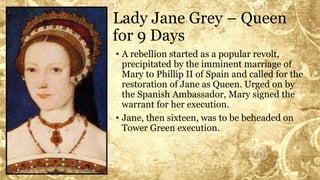
• A rebellion started as a popular revolt,
precipitated by the imminent marriage of
Mary to Phillip II of Spain and called for the
restoration of Jane as Queen. Urged on by
the Spanish Ambassador, Mary signed the
warrant for her execution.
• Jane, then sixteen, was to be beheaded on
Tower Green execution.
Mary I – Bloody Mary
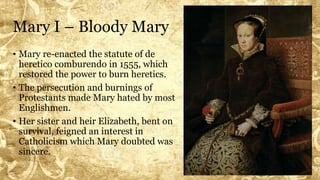
• Mary re-enacted the statute of de
heretico comburendo in 1555, which
restored the power to burn heretics.
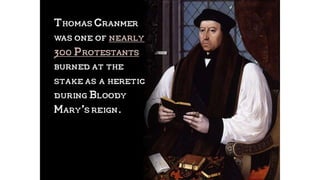
• The persecution and burnings of
Protestants made Mary hated by most
Englishmen.
• Her sister and heir Elizabeth, bent on
survival, feigned an interest in
Catholicism which Mary doubted was
sincere.
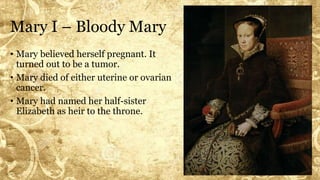
Mary I – Bloody Mary
• Mary believed herself pregnant. It
turned out to be a tumor.
• Mary died of either uterine or ovarian
cancer.
• Mary had named her half-sister
Elizabeth as heir to the throne.
What unpopular
decisions did Mary I
make during her reign?
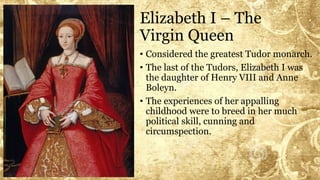
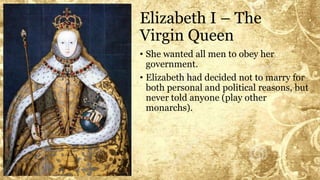
Elizabeth I – The
Virgin Queen
• Considered the greatest Tudor monarch.
• The last of the Tudors, Elizabeth I was
the daughter of Henry VIII and Anne
Boleyn.
• The experiences of her appalling
childhood were to breed in her much
political skill, cunning and
circumspection.
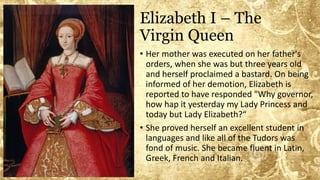
Elizabeth I – The
Virgin Queen
• Her mother was executed on her father's
orders, when she was but three years old
and herself proclaimed a bastard. On being
informed of her demotion, Elizabeth is
reported to have responded "Why governor,
how hap it yesterday my Lady Princess and
today but Lady Elizabeth?“
• She proved herself an excellent student in
languages and like all of the Tudors was
fond of music. She became fluent in Latin,
Greek, French and Italian.
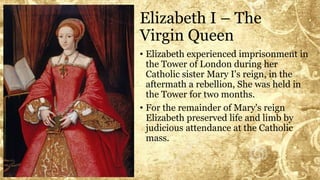
Elizabeth I – The
Virgin Queen
• Elizabeth experienced imprisonment in
the Tower of London during her
Catholic sister Mary I's reign, in the
aftermath a rebellion, She was held in
the Tower for two months.
• For the remainder of Mary's reign
Elizabeth preserved life and limb by
judicious attendance at the Catholic
mass.
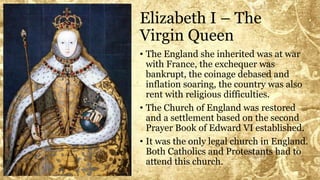
Elizabeth I – The
Virgin Queen
• The England she inherited was at war
with France, the exchequer was
bankrupt, the coinage debased and
inflation soaring, the country was also
rent with religious difficulties.
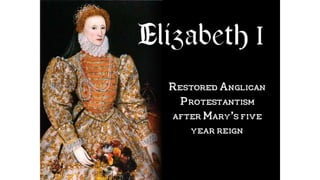
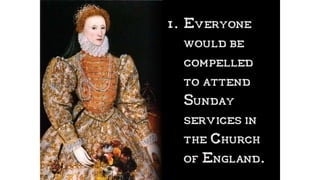
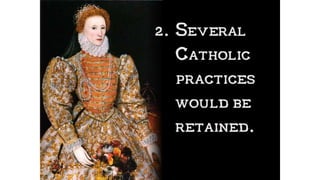
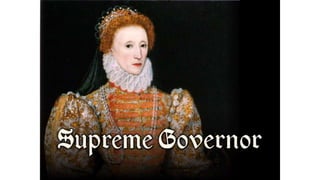
• The Church of England was restored
and a settlement based on the second
Prayer Book of Edward VI established.
• It was the only legal church in England.
Both Catholics and Protestants had to
attend this church.
How was Elizabeth
religiously important to
England?
Elizabeth I – The
Virgin Queen
• She wanted all men to obey her
government.
• Elizabeth had decided not to marry for
both personal and political reasons, but
never told anyone (play other
monarchs).
Elizabeth I – The
Virgin Queen
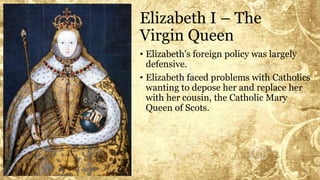
• Elizabeth's foreign policy was largely
defensive.
• Elizabeth faced problems with Catholics
wanting to depose her and replace her
with her cousin, the Catholic Mary
Queen of Scots.
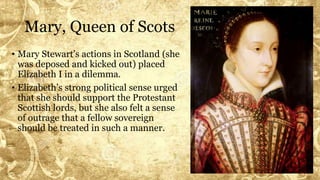
Mary, Queen of Scots
• Mary Stewart’s actions in Scotland (she
was deposed and kicked out) placed
Elizabeth I in a dilemma.
• Elizabeth’s strong political sense urged
that she should support the Protestant
Scottish lords, but she also felt a sense
of outrage that a fellow sovereign
should be treated in such a manner.
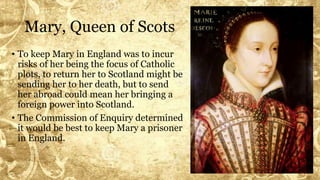
Mary, Queen of Scots
• To keep Mary in England was to incur
risks of her being the focus of Catholic
plots, to return her to Scotland might be
sending her to her death, but to send
her abroad could mean her bringing a
foreign power into Scotland.
• The Commission of Enquiry determined
it would be best to keep Mary a prisoner
in England.
Mary, Queen of Scots
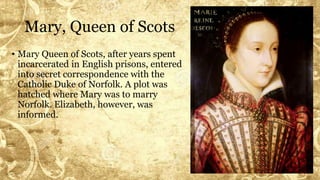
• Mary Queen of Scots, after years spent
incarcerated in English prisons, entered
into secret correspondence with the
Catholic Duke of Norfolk. A plot was
hatched where Mary was to marry
Norfolk. Elizabeth, however, was
informed.
Mary, Queen of Scots
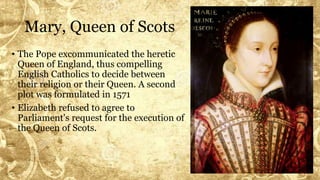
• The Pope excommunicated the heretic
Queen of England, thus compelling
English Catholics to decide between
their religion or their Queen. A second
plot was formulated in 1571
• Elizabeth refused to agree to
Parliament's request for the execution of
the Queen of Scots.
Mary, Queen of Scots
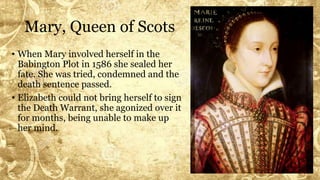
• When Mary involved herself in the
Babington Plot in 1586 she sealed her
fate. She was tried, condemned and the
death sentence passed.
• Elizabeth could not bring herself to sign
the Death Warrant, she agonized over it
for months, being unable to make up
her mind.
Mary, Queen of Scots
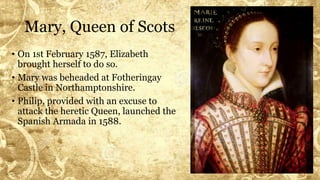
• On 1st February 1587, Elizabeth
brought herself to do so.
• Mary was beheaded at Fotheringay
Castle in Northamptonshire.
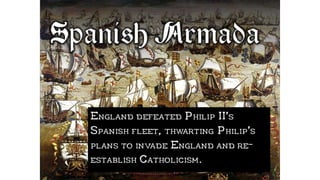
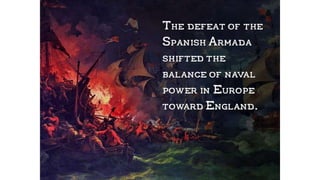
• Philip, provided with an excuse to
attack the heretic Queen, launched the
Spanish Armada in 1588.
Why was Mary, Queen of
Scots, beheaded?
Why was the defeat of
the Spanish Armada
important?
Elizabeth I – The
Virgin Queen
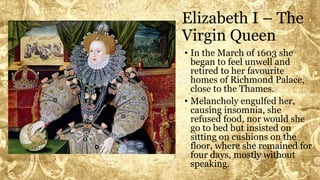
• In the March of 1603 she
began to feel unwell and
retired to her favourite
homes of Richmond Palace,
close to the Thames.
• Melancholy engulfed her,
causing insomnia, she
refused food, nor would she
go to bed but insisted on
sitting on cushions on the
floor, where she remained for
four days, mostly without
speaking.
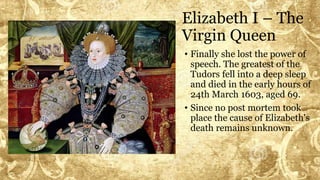
Elizabeth I – The
Virgin Queen
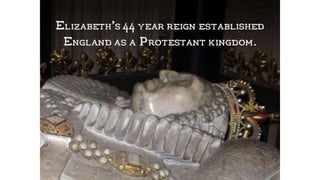
• Finally she lost the power of
speech. The greatest of the
Tudors fell into a deep sleep
and died in the early hours of
24th March 1603, aged 69.
• Since no post mortem took
place the cause of Elizabeth's
death remains unknown.
16th Century England

16th Century England

  • 1.
    16th Century England EarlyModern Britain: THE TUDOR DYNASTY
  • 2.
    What can yourecall about the War of the Roses?
  • 3.
    Margaret Beaufort • Descendantof Edward III through John of Gaunt, Duke of Lancaster and his third wife Katherine. John’s illegitimate children were called 'Beaufort' from the duke's castle in France. • The Beauforts, after their parents' marriage, were legitimated by Act of Parliament in 1397. • The clause 'excepta dignitate regali' was put in the Patent of Legitimation with the purpose of debarring them from succession to the throne.
  • 4.
    Margaret Beaufort • Motherof Henry VII. • During the War of the Roses, recall that Margaret Beaufort’s goal was to put her son, Henry on the throne. • Queen Elizabeth Woodville's sons, the Princes in the Tower, were presumed dead, so Elizabeth and Margaret agreed to the betrothal of Margaret's son, Henry, to Elizabeth of York, the eldest daughter of Elizabeth and Edward IV, to draw support from both Yorkists and Lancastrians.
  • 5.
    Margaret Beaufort • DuringHenry VII’s reign, Margaret had considerable influence with the King. • The personnel of their councils and households often overlapped and it was a measure of Henry's trust that he allowed her to retain servants on his behalf and delegated judicial cases to her. • Margaret also ruled the Queen’s Household.
  • 6.
    How did Margarethelp her son, Henry VII, to become king?
  • 8.
    Henry VII • Thefirst of the Tudor dynasty, Henry VII won England's throne in the Battle of Bosworth from his Yorkist adversary, Richard III, last of the Plantagenet kings. • Prior to Bosworth, Henry had spent much of his life in exile. • Henry was considered "the nearest thing to royalty the Lancastrian party possessed" by the country's Yorkist element, he was the son of Edmund Tudor, Earl of Richmond and Lady Margaret Beaufort.
  • 9.
    Henry VII • TheTudor rose, the product of art not horticulture, was born, the emblem of a rose both red and white was adopted as one of the king's badges, meant to symbolize the union of the Houses of Lancaster and York. • Henry failed to appeal to the general populace: he maintained a distance between king and subject. • He disliked nobility as a result of the War of the Roses.
  • 10.
    Henry VII • Hebrought the nobility to heel out of necessity to transform the medieval government that he inherited into an efficient tool for conducting royal business. • Law and trade replaced feudal obligation as the Middle Ages began evolving into the modern world. • After the death of Elizabeth of York, Henry became somewhat reclusive. • Henry VII died on 21st April, 1509 of tuberculosis at the age of 52 and was buried at Westminster beside Elizabeth of York. • http://vimeo.com/107965699
  • 11.
    Elizabeth of York •Henry VII owed the support of the Yorkists to his proposed union with the daughter of Edward IV, but he put off the marriage. • Parliament in December of 1485 begged him to marry the Lady Elizabeth, which he did, on the 18th January 1486. • Henry at first was inclined to be jealous of Elizabeth's superior right to the throne; he did not like to admit that he owed his crown to his wife.
  • 12.
    Elizabeth of York •Elizabeth was good-tempered, docile, and affectionate, and not at all anxious to claim her share of political power. • The match turned out more happily than most royal marriages did in the fifteenth century. • She had seven children: Arthur, Margaret, Henry, Elizabeth, Mary, Edmund, and Katherine. • Died of childbed fever after giving birth to Katherine.
  • 13.
    Prince Arthur • HenryVII formed an alliance with Ferdinand and Isabella, Henry signed the Treaty of Medina del Campo with the Spanish monarchs whereby Henry's eldest son, Arthur, the heir to the throne, was to marry Catherine of Aragon. • Arthur and Catherine were married at St. Paul's Cathedral.
  • 14.
    Prince Arthur • The'upstart' Tudor dynasty gained much in prestige from its new- forged links with the powerful House of Trastamara. • Arthur and Catherine where sent to Ludlow. During the spring, there was an epidemic of sweating sickness and both Arthur and Catherine contracted it. Catherine recovered, but Arthur did not and died at Ludlow Castle.
  • 15.
    Why were Catherineand Arthur married?
  • 16.
    Catherine of Aragon •Since his daughter was widowed, Ferdinand wished to be reimbursed of the first installment of her dowry. Henry did not want to part with it and demanded the rest of it. • Agreement was finally reached that Catherine should marry the young Henry.
  • 19.
    Catherine of Aragon •Catherine was forced to live in poverty with a frugal allowance from her father-in-law.
  • 21.
    How did Henryand Catherine get permission to marry?
  • 22.
    Henry VIII • Asonly the second son of Henry VII and Elizabeth of York he had originally been intended for a career in the church. • He was provided with an excellent education, becoming fluent in French, Latin, and Spanish. • King Henry VIII came to the throne on the death of his father in April, 1509, inheriting a kingdom that was stable and a full treasury.
  • 23.
    Henry VIII • Henrywas intelligent, extrovert and confident, like most of the Tudors, he was well seen in theology. • He could also be cruel and extremely self- willed. • He did not take after his Lancastrian ancestors, his Tudor father or his Beaufort grandmother, who had a tendency to be austere, introvert and chaste. Henry was recognizably like his paternal grandfather, Edward IV.
  • 24.
    Henry VIII • Inhis youth, Henry excelled at sports, and particularly enjoyed jousting, hunting and real tennis. He was also quite an accomplished musician. • In 1521, Henry defended the Catholic religion from Martin Luther's protests in a book entitled 'The Defense of the Seven Sacraments', a grateful pope awarded him with the title Defender of the Faith, which has been borne by subsequent English monarchs since then.
  • 27.
  • 28.
    What kind ofChristian was Henry originally? Did he doubt the Church and see corruption?
  • 30.
    Horrible Histories –The Wives of Henry 8 • http://bit.ly/pK6yZb
  • 31.
    Catherine of Aragon– Divorced (1509-1533) • King Henry married Catherine on 11th June 1509. • Queen Catherine gave birth to a son, named Henry, at Greenwich Palace on 1st January 1511 who was created Duke of Cornwall.
  • 33.
    Catherine of Aragon– Divorced (1509-1533) • Henry died just a few weeks after his birth. • Catherine was to experience many still-births and miscarriages before producing the only surviving child of the marriage, a daughter, Mary, born in 1516.
  • 35.
    Anne Boleyn – Beheaded(1533-1536) • Her mother, Elizabeth Howard, was the daughter of Thomas Howard, Earl of Surrey; she was descended from Edward I. • Thomas Boleyn was amongst a group of envoys assigned to the Regent of Netherlands court in 1512. While there, he formed a firm friendship with Margaret, Archduchess of Austria, which he used to secure a prestigious appointment for his daughter.
  • 36.
    Anne Boleyn – Beheaded(1533-1536) • Anne was educated in the household of the Archduchess Margaret of Austria in the Netherlands, and after the winter of 1514, in Paris. • Anne proved to be proficient in her lessons, particularly at languages. She excelled in French and eventually came to speak it like a native. • Anne returned to England in 1521 and first appeared at the English court at a masquerade ball in March 1522.
  • 37.
    Anne Boleyn – Beheaded(1533-1536) • Anne's sister Mary had been the mistress of Henry VIII. • In 1527 Henry became hopelessly infatuated with Anne Boleyn. • Learning from the example of her sister, who had been cast off and was of no further use, she resisted the king's attempts to seduce her, and held out for marriage.
  • 38.
    Catherine of Aragon– Divorced (1509-1533) • Henry's conscience conveniently came into play. He claimed to be troubled by a verse in Leviticus stating it was sinful for a man to take his brother's wife and as punishment, any such transgressor would be childless. He persuaded himself that this was why God had denied him a male heir by his marriage to Catherine. • Henry asked the Pope to annul (put an end to) his marriage with Catherine so he could marry Anne.
  • 39.
    Catherine of Aragon– Divorced (1509-1533) • The Pope wouldn’t give Henry an annulment because he was under the power of Catherine’s nephew, Charles V, so he had Parliament pass laws to create the Church of England, which would make him the head of the church. (Act of Supremacy)
  • 40.
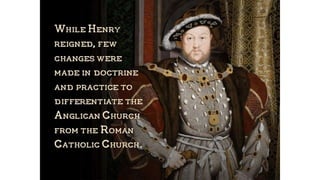
    Henry VIII • Despitethe strenuous efforts of Wolsey, the Kings Great Matter, as it came to be referred to, dragged on for many years. • Henry, characteristically furious and frustrated at not obtaining his own way, defied the Pope, setting himself up as head of the Church of England, a church that was Catholic in doctrine but divorced from the 'Bishop of Rome'.
  • 41.
    Henry VIII • Afterthis, Henry declared himself Supreme Head of the Church of England and got an annulment from Catherine and married Anne Boleyn.
  • 44.
    Henry VIII • TheReformation Parliament of 1529-1536 approved the king's break with the see of Rome, as well as Henry's divorce and remarriage. In 1539 it was ordered that an English translation of the Bible be placed in every parish church in England. • Bishop Fisher and Sir Thomas More, Henry’s Lord Chancellor and the author of Utopia, refused to acknowledge the Act of Supremacy and were imprisoned and eventually executed.
  • 45.
    Anne Boleyn – Beheaded(1533-1536) • When Anne announced herself pregnant and Henry was determined that the child, whom he ardently convinced himself would be the longed for son, should be born in lawful matrimony. • Henry and Anne went through a secret wedding service, a second wedding service was performed, which took place on 25 January 1533.
  • 46.
    Anne Boleyn – Beheaded(1533-1536) • Anne's baby, born in September 1533, to Henry's fury, was not the promised son and heir, but a daughter, named Elizabeth, after the King's mother who was to be the future Elizabeth I. • Anne miscarried in 1535, and in 1536 (a son).
  • 47.
    Anne Boleyn – Beheaded(1533-1536) • Henry's affections had strayed to one of Anne's ladies in waiting, Jane Seymour. the very antithesis of Henry's argumentative, loud and strong-willed wife. • Anne had promised him a son, but had failed to deliver what he wanted and he was weary of heated arguments with her.
  • 48.
    Catherine of Aragon– Divorced (1509-1533) • Until her death Catherine continued to stubbornly refer to herself as Henry's only lawful wife. In 1535 Henry had her transferred to Kimbolton Castle in Huntington. • Catherine of Aragon died at Kimbolton Castle, on 7 January, 1536, probably of cancer, three weeks after her fiftieth birthday.
  • 49.
    Why and howdid Henry divorce Catherine? What was the Act of Supremacy?
  • 50.
    Anne Boleyn – Beheaded(1533-1536) • The recent death of Catherine of Aragon had rendered it possible for Henry to be rid of Anne without anticipating the prospect of again being tied to Catherine. • While Catherine had lived, Anne remained safe in her position, Anne herself had long recognized the fact, declaring "she is my death and I am hers".
  • 51.
    Anne Boleyn – Beheaded(1533-1536) • Anne was arrested and tried on a trumped- up charge of treason, for adultery with five men including her own brother. It is unlikely that the charges against her had any basis in fact. A court controlled by Henry and presided over by Anne's uncle, the Duke of Norfolk, pronounced her guilty. • As a “kindness” (and before her trial), Henry ordered a French Swordsman from Calais, France to behead her on May 19, 1536. • https://www.youtube.com/watch?v=HGMIit qKk6s
  • 52.
    Why did Henryget rid of Anne and how did he do it?
  • 53.
    Henry VIII • Throughthe Dissolution of the Monasteries, Henry VIII appropriated the immense lands and riches of the church in England. • The poor, who had benefited from the charity of the monasteries, suffered as a result, the monasteries had offered an education for the sons of the poor and a virtuous vocation for their daughters as well as performing many charitable acts. • The confiscated monastic buildings and lands were sold to the rising gentry class, who were beginning to come to prominence under the Tudors.
  • 55.
    Jane Seymour – Died(1536-1537) • The mother of Henry VIII's only surviving legitimate son, King Edward VI. • Through her mother Margaret Wentworth, Jane could claim a royal descent. Margery Wentworth was also the first cousin of Elizabeth and Edmund Howard, the parents of Anne Boleyn and Catherine Howard. • Jane Seymour had first come to court as a lady-in-waiting to Catherine of Aragon and later for Anne Boleyn.
  • 56.
    Jane Seymour – Died(1536-1537) • Jane involved herself in state affairs only once, in 1536, when she asked for clemency for the participants in the Pilgrimage of Grace rebellion. • Henry reacted by reminding her of the fate of other queens when they had meddled in his affairs.
  • 58.
    Jane Seymour – Died(1536-1537) • After a difficult and protracted labor Jane gave birth to a son, the future Edward VI. • She contracted childbed fever, an infection of the uterus following childbirth, and died in her sleep twelve days later
  • 59.
    What did Henrydo with Church property?
  • 60.
    Anne of Cleves– Divorced (1540) • Following the death of Jane Seymour, Henry’s minister Thomas Cromwell arranged a fourth marriage for the king that allied him to the German Protestant prince • Henry had received glowing reports of Anne of Cleves and had received a flattering miniature.
  • 61.
    Anne of Cleves– Divorced (1540) • When Anne arrived in England, Henry could not contain his haste to meet her and rushed excitedly down to Rochester to present her with New Years gifts "to nourish love". Alarmed at what he saw, he returned most reluctant to go through with the marriage and enraged at the unfortunate Cromwell.
  • 62.
    Anne of Cleves– Divorced (1540) • Anne had been Queen of England for just four months when she was commanded to leave the court on 24 June and was informed of her husband's decision to have their marriage annulled. • Anne complied with all her formidable spouse's requests, she wisely agreed to be Henry's "good sister". She was granted a generous settlement was given an allowance of £4,000 per year.
  • 63.
    Anne of Cleves– Divorced (1540) • Anne was to remain in England for the rest of her life and never remarried, she enjoyed an independent lifestyle which was denied to most women at the time.
  • 64.
    Catherine Howard – Beheaded(1540-1542) • In a bid for power, the Duke of Norfolk, flaunted his attractive niece, Catherine Howard, before the King. Henry had his marriage to "that great Flanders Mare" Anne annulled. • She was the first cousin of Henry VIII's second wife, Anne Boleyn. Catherine was also the second cousin of Jane Seymour.
  • 65.
    Catherine Howard – Beheaded(1540-1542) • While living in her step-grandmother‘s household, Catherine had a sexual relationship with her music tutor, Henry Mannox. • The relationship came to an end in 1538, when Catherine became the lover of her step-grandmother's secretary, Francis Dereham. • Manipulated into a marriage with an obese and decidedly middle aged man to satisfy her uncle's lust for power and influence, she continued to stray after her marriage.
  • 66.
    Catherine Howard – Beheaded(1540-1542) • The Protestant element at court seized their chance and pounced. The king was informed of her past indiscretions and that she was furthermore indulging in an affair with her distant relative, Thomas Culpepper. • An Act of Attainder, making it treason for any woman of unchaste reputation to marry the king was passed against Queen Catherine and her Lady-in-Waiting, Lady Rochford, who had been party to her infidelities. • Shortly after Catherine was stripped of all jewelry and clothing then taken to Syon Abbey in Middlesex, where she was held prisoner.
  • 67.
    Catherine Howard – Beheaded(1540-1542) • The teenage Catherine was tried for high treason and followed her cousin Anne Boleyn to the Tower and the block. • She regained her composure prior to her execution and asked for a block to be brought to her, where she indulged in the macabre exercise of practicing laying her neck on it.
  • 69.
    Catherine Parr – Survived(1543-1547) • Goddaughter of Catherine of Aragon. • Catherine received an excellent education and became fluent in French, Latin and Italian. • Following the death of Lord Latimer, Catherine attracted the eye of Thomas Seymour, the brother of Jane Seymour, but when the king expressed an interest in her she had to accept his proposal.
  • 70.
    Catherine Parr – Survived(1543-1547) • Catherine made efforts to foster good relationships with Henry's three children from his previous marriages, Mary, Elizabeth and Edward. She took a lively interest in their education and brought them to court attempting to create a family life for them. • As a mark of Henry's trust in her considerable abilities, she was appointed in the position of regent of England when he embarked on his last campaign to France.
  • 71.
    Catherine Parr – Survived(1543-1547) • As the king visibly declined, the Catholic and Protestant factions struggled to obtain power during the long minority reign which would inevitably follow. • Attempts were made to bring about the demise of the Queen, who had strongly Protestant sympathies and was not reluctant to eagerly expound her religious beliefs to her husband. Catherine's enemies pounced and a Bill of Articles, outlining her supposed heresies, was drawn up.
  • 72.
    Catherine Parr – Survived(1543-1547) • Catherine was forewarned of the danger and understandably terrified by the fate of her predecessors, threw herself on her husband's mercy. Henry accepted a highly flattering explanation from her. When her enemies came the next day to arrest her, Chancellor Wriothesley was set upon by the King.
  • 76.
    Edward VI • Sonof Henry VIII and his third wife Jane Seymour. • He quickly became proficient in Latin, Greek and French. Like all the Tudors, he was fond of music and played the lute. • Edward became King of England at nine years old, in January, 1547.
  • 78.
    Edward VI • HenryVIII's will had decreed the kingdom was to be in the control of a Council of Regency during his son's minority. • King Edward's ambitious maternal uncle, Edward Seymour, Earl of Hertford, however, gained control, Hertford was made Lord Protector and later Duke of Somerset. • Somerset and Edward were devote Protestants. The use of English was enforced in church services by the introduction of the Book of Common Prayer. The heresy laws of Henry VIII were repealed.
  • 80.
    Edward VI • Edwardwas incredibly interested in theology. • He complained that his uncle, the Protector, kept him short of money. • Edward's other maternal uncle, Thomas Seymour, the Lord Admiral, an ambitious and reckless man who had married Edward's step- mother, Catherine Parr, with unseemly haste after the death of Henry VIII, plotted to gain power with his nephew and Somerset was forced to send his brother to the block on a charge of high treason.
  • 81.
    Edward VI • TheDuke of Somerset was ousted from office in 1549 by John Dudley, Earl of Warwick, who became Duke of Northumberland in 1551. • Somerset followed his brother to the block on a charge of treason. Northumberland ingratiated himself with the impressionable young King and acquired a dominating influence over him.
  • 82.
    Edward VI • Thehighly religious Edward strongly disapproved of his elder sister Mary's ardent Catholicism. • When summoned to London to answer for her transgressions in continuing attendance at the Catholic mass, she told Edward that she would sooner he took away her life than her religion.
  • 83.
    How was EdwardVI religious important?
  • 85.
    Lady Jane Grey– Queen for 9 Days • Lady Jane Grey was the daughter of Henry Grey, Marquis Dorset and Frances Brandon, Duchess of Suffolk. • Jane's claim to the throne was acquired through her maternal grandmother, Mary Tudor, who was the younger sister of Henry VIII. • She received an excellent education, having studied Latin, Greek and Hebrew as well as modern languages.
  • 86.
    Lady Jane Grey– Queen for 9 Days • A few days after the death of Edward VI, Northumberland ensured that Lady Jane Grey, at 15, was acknowledged as Queen. Jane was deeply troubled • Rebellion broke out her as Mary was considered by many Englishmen to be the true heiress to the throne. • Suffolk informed his daughter that she was no longer Queen, by tearing down the canopy of estate from over her head. Jane's overall reaction seems to have been one of relief
  • 88.
    Mary I –Bloody Mary • The first Queen Regnant in English history. • The only surviving and fifth child of Henry VIII and Catherine of Aragon. • In 1531, during her parents divorce, when she was seventeen, Mary was declared a bastard by her father and forbidden to see her mother.
  • 89.
    Mary I –Bloody Mary • She was removed from the succession by Act of Parliament and relegated to a lower position in the household of her new half-sister Elizabeth. • In 1536 her mother died of cancer and Mary was forced by her father to sign a submission. To gain his acceptance, she had to deny that her parents marriage had been legal and acknowledge her own bastardy.
  • 90.
    Mary I –Bloody Mary • A fanatical Catholic, Mary was intent on restoring the country to the 'old religion'. • She made an unpopular choice of husband in her Catholic cousin Philip II of Spain, the son of the Emperor Charles V, who had frequently given her his support and advice when she had been left alone after her mother's death and on whom she had come to rely for aid at times of need.
  • 93.
    Lady Jane Grey– Queen for 9 Days • A rebellion started as a popular revolt, precipitated by the imminent marriage of Mary to Phillip II of Spain and called for the restoration of Jane as Queen. Urged on by the Spanish Ambassador, Mary signed the warrant for her execution. • Jane, then sixteen, was to be beheaded on Tower Green execution.
  • 94.
    Mary I –Bloody Mary • Mary re-enacted the statute of de heretico comburendo in 1555, which restored the power to burn heretics. • The persecution and burnings of Protestants made Mary hated by most Englishmen. • Her sister and heir Elizabeth, bent on survival, feigned an interest in Catholicism which Mary doubted was sincere.
  • 96.
    Mary I –Bloody Mary • Mary believed herself pregnant. It turned out to be a tumor. • Mary died of either uterine or ovarian cancer. • Mary had named her half-sister Elizabeth as heir to the throne.
  • 97.
    What unpopular decisions didMary I make during her reign?
  • 99.
    Elizabeth I –The Virgin Queen • Considered the greatest Tudor monarch. • The last of the Tudors, Elizabeth I was the daughter of Henry VIII and Anne Boleyn. • The experiences of her appalling childhood were to breed in her much political skill, cunning and circumspection.
  • 100.
    Elizabeth I –The Virgin Queen • Her mother was executed on her father's orders, when she was but three years old and herself proclaimed a bastard. On being informed of her demotion, Elizabeth is reported to have responded "Why governor, how hap it yesterday my Lady Princess and today but Lady Elizabeth?“ • She proved herself an excellent student in languages and like all of the Tudors was fond of music. She became fluent in Latin, Greek, French and Italian.
  • 101.
    Elizabeth I –The Virgin Queen • Elizabeth experienced imprisonment in the Tower of London during her Catholic sister Mary I's reign, in the aftermath a rebellion, She was held in the Tower for two months. • For the remainder of Mary's reign Elizabeth preserved life and limb by judicious attendance at the Catholic mass.
  • 102.
    Elizabeth I –The Virgin Queen • The England she inherited was at war with France, the exchequer was bankrupt, the coinage debased and inflation soaring, the country was also rent with religious difficulties. • The Church of England was restored and a settlement based on the second Prayer Book of Edward VI established. • It was the only legal church in England. Both Catholics and Protestants had to attend this church.
  • 107.
    How was Elizabeth religiouslyimportant to England?
  • 108.
    Elizabeth I –The Virgin Queen • She wanted all men to obey her government. • Elizabeth had decided not to marry for both personal and political reasons, but never told anyone (play other monarchs).
  • 109.
    Elizabeth I –The Virgin Queen • Elizabeth's foreign policy was largely defensive. • Elizabeth faced problems with Catholics wanting to depose her and replace her with her cousin, the Catholic Mary Queen of Scots.
  • 110.
    Mary, Queen ofScots • Mary Stewart’s actions in Scotland (she was deposed and kicked out) placed Elizabeth I in a dilemma. • Elizabeth’s strong political sense urged that she should support the Protestant Scottish lords, but she also felt a sense of outrage that a fellow sovereign should be treated in such a manner.
  • 111.
    Mary, Queen ofScots • To keep Mary in England was to incur risks of her being the focus of Catholic plots, to return her to Scotland might be sending her to her death, but to send her abroad could mean her bringing a foreign power into Scotland. • The Commission of Enquiry determined it would be best to keep Mary a prisoner in England.
  • 112.
    Mary, Queen ofScots • Mary Queen of Scots, after years spent incarcerated in English prisons, entered into secret correspondence with the Catholic Duke of Norfolk. A plot was hatched where Mary was to marry Norfolk. Elizabeth, however, was informed.
  • 113.
    Mary, Queen ofScots • The Pope excommunicated the heretic Queen of England, thus compelling English Catholics to decide between their religion or their Queen. A second plot was formulated in 1571 • Elizabeth refused to agree to Parliament's request for the execution of the Queen of Scots.
  • 114.
    Mary, Queen ofScots • When Mary involved herself in the Babington Plot in 1586 she sealed her fate. She was tried, condemned and the death sentence passed. • Elizabeth could not bring herself to sign the Death Warrant, she agonized over it for months, being unable to make up her mind.
  • 115.
    Mary, Queen ofScots • On 1st February 1587, Elizabeth brought herself to do so. • Mary was beheaded at Fotheringay Castle in Northamptonshire. • Philip, provided with an excuse to attack the heretic Queen, launched the Spanish Armada in 1588.
  • 116.
    Why was Mary,Queen of Scots, beheaded?
  • 119.
    Why was thedefeat of the Spanish Armada important?
  • 120.
    Elizabeth I –The Virgin Queen • In the March of 1603 she began to feel unwell and retired to her favourite homes of Richmond Palace, close to the Thames. • Melancholy engulfed her, causing insomnia, she refused food, nor would she go to bed but insisted on sitting on cushions on the floor, where she remained for four days, mostly without speaking.
  • 121.
    Elizabeth I –The Virgin Queen • Finally she lost the power of speech. The greatest of the Tudors fell into a deep sleep and died in the early hours of 24th March 1603, aged 69. • Since no post mortem took place the cause of Elizabeth's death remains unknown.