Early
Modern
England
DRAMA OF THE ELIZABETHAN,
JACOBEAN, AND CAROLINE ERAS
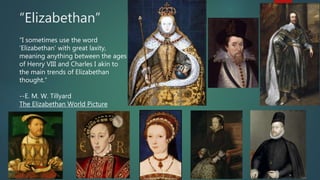
“Elizabethan”
“I sometimes use the word
‘Elizabethan’ with great laxity,
meaning anything between the ages
of Henry VIII and Charles I akin to
the main trends of Elizabethan
thought.”
--E. M. W. Tillyard
The Elizabethan World Picture
1.Henry VIII
2.Edward VI
3.Lady Jane Grey
4.Mary I (& Phillip II)
5.Elizabeth I
6.James VI/I
7.Charles I
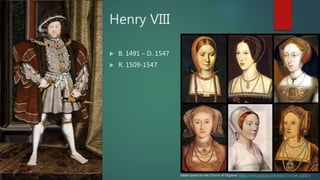
Henry VIII
 B. 1491 – D. 1547
 R. 1509-1547
Eddie Izzard on the Church of England: https://www.youtube.com/watch?v=Ope-1Zb5t-k
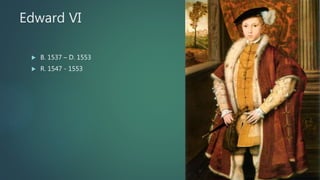
Edward VI
 B. 1537 – D. 1553
 R. 1547 - 1553
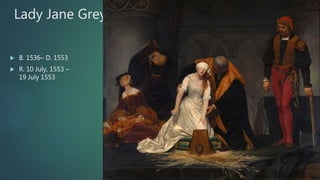
Lady Jane Grey
 B. 1536– D. 1553
 R. 10 July, 1553 –
19 July 1553
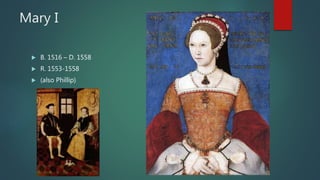
Mary I
 B. 1516 – D. 1558
 R. 1553-1558
 (also Phillip)
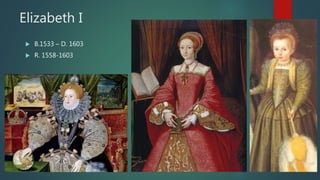
Elizabeth I
 B.1533 – D. 1603
 R. 1558-1603
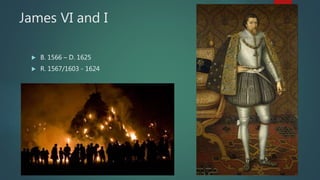
James VI and I
 B. 1566 – D. 1625
 R. 1567/1603 - 1624
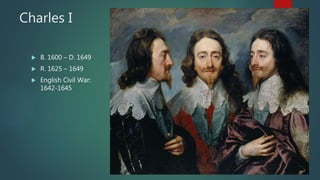
Charles I
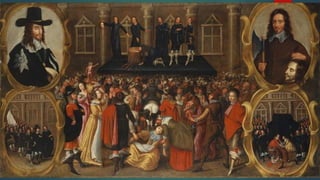
 B. 1600 – D. 1649
 R. 1625 – 1649
 English Civil War:
1642-1645
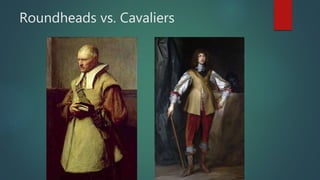
Roundheads vs. Cavaliers
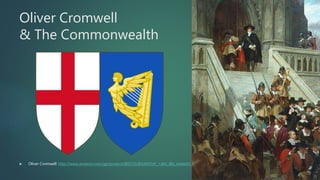
Oliver Cromwell
& The Commonwealth
 Oliver Cromwell: http://www.amazon.com/gp/product/B0172URVAM?ref_=aiv_dp_season_select
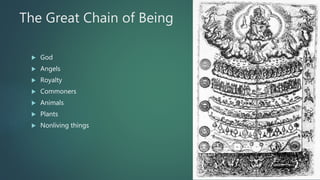
The Great Chain of Being
 God
 Angels
 Royalty
 Commoners
 Animals
 Plants
 Nonliving things
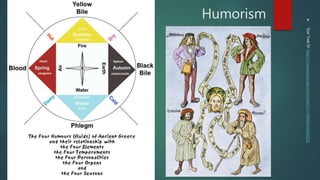
Humorism
StarTrekIV:https://www.youtube.com/watch?v=MMaGnpVaSGQ
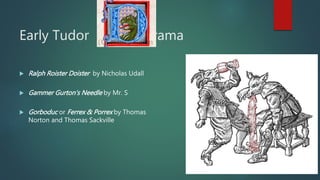
Early Tudor Drama
 Ralph Roister Doister by Nicholas Udall
 Gammer Gurton’s Needle by Mr. S
 Gorboduc or Ferrex & Porrex by Thomas
Norton and Thomas Sackville
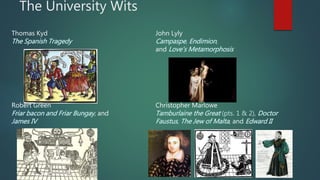
The University Wits
Thomas Kyd John Lyly
The Spanish Tragedy Campaspe, Endimion,
and Love’s Metamorphosis
Robert Green Christopher Marlowe
Friar bacon and Friar Bungay, and Tamburlaine the Great (pts. 1 & 2), Doctor
James IV Faustus, The Jew of Malta, and Edward II
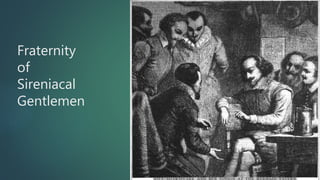
Fraternity
of
Sireniacal
Gentlemen
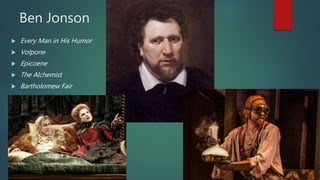
Ben Jonson
 Every Man in His Humor
 Volpone
 Epicoene
 The Alchemist
 Bartholomew Fair
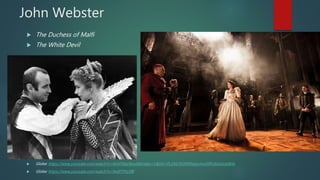
John Webster
 The Duchess of Malfi
 The White Devil
 Globe: https://www.youtube.com/watch?v=NnV54axNsw8&index=1&list=PL1NLFlCIMXIwjtumruEIRU6GxtsJe8Ktz
 Globe: https://www.youtube.com/watch?v=NoIP7Ftz5BI
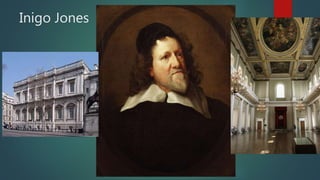
Inigo Jones
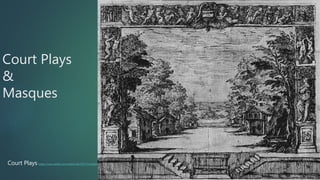
Court Plays
&
Masques
Court Plays: https://www.netflix.com/watch/18170373?trackId=14170286&tctx=1%2C0%2C3b5b8c3a-63bb-4056-8dc9-290f3cd0491f-133944609
Early Modern England

Early Modern England

Editor's Notes

  • #2 I don’t want to cover the same material as the chapter or the Bryson, but there are some big things we should cover as we head into this era
  • #3 Henry VIII  Edward VI  Jane Grey  Mary I (Phillip II the king of Spain was co-regent)  Elizabeth I  James I  Charles I
  • #5 The principal background event of the 16th century: Catholics vs. Protestants Henry VIII breaks from the Catholic Church (1529-1536) More political than religious First nation to embrace the Protestant Reformation that Martin Luther began in 1517 Forced conversions Dissolution of the monasteries and redistribution of their wealth Wives Catherine of Aragon Married 24 years (after she’d been married to his brother) Annulled Anne Boleyn Married 3 years Beheaded Jane Seymour Married 1 year She died Anne of Cleaves Married less than a year Annulled Catherin Howard Married 2 years Beheaded Catherine Parr Survived Married 4 years Winner Winner Chicken Dinner
  • #6 Henry’s only son Crowned in 1547 at age 9 Ruled as a protestant Power passed to his protestant cousin when it became clear he was dying
  • #7 Ruled for 9 days before Mary I had her thrown into the Tower of London and later executed
  • #8 Daughter from Henry VIII’s first marriage – back when he was catholic 1st English queen in 400 years (or in 9 days, whichever) Roman Catholic 300+ executed for heresy or sedition (Bloody Mary) Wyatt Rebellion Imprisoned her sister Elizabeth for nearly a year on suspicion of supporting Protestant rebels Executed her cousin Even after Mary died, Phillip tried to bring down Elizabeth
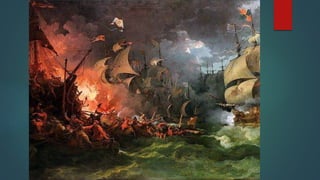
  • #9 One of her first moves as queen was to establish the English Protestant Church Moderate, tolerant 1588 The Spanish Armada (more on that with the Bryson) The bottom left painting was commissioned to commemorate the defeat of the Spanish Armada – note the placement of her hand on the globe to symbolize world domination Era famous for Above all the flourishing of drama Elizabeth enjoyed theater Brushed off censorship Allowed plays to be performed on sundays Recognized and encouraged
  • #10 More coming soon, but no visuals
  • #11 I freaking LOVE that he’s both VI and I!! Succeeded to the throne at 13 months when his mother Mary Queen of Scots was compelled to abdicate 1603 ruled England, Ireland, and Scotland in Personal Union Jacobean era British colonization of the Americas begins The Gunpowder Plot (1605) Drama and literature continue to flourish King James Bible d
  • #12 Believed in the Divine right of kings Married a Roman Catholic Civil War Roundheads vs. Cavaliers Demands for a constitutional monarchy Tried and executed for high treason January 1649 Monarchy abolished Commonwealth of England declared 1649-1660 Charles II restored to the throne and the monarchy was restored f
  • #14 Charles I : 5’4” at the start of his reign and 4’6” at the end of it
  • #15 Horrible Histories 15:52-19:57 Background info: http://guides.wikinut.com/The-Republic-of-Britain/114s_5y5/ The Commonwealth was the period from 1649 onwards when England, along later with Irelandand Scotland,[1] was ruled as a republic following the end of the Second English Civil War and the trial and execution of Charles I. The republic's existence was declared through "An Act declaring England to be a Commonwealth",[2] adopted by the Rump Parliament on 19 May 1649. Power in the early Commonwealth was vested primarily in the Parliament and a Council of State. During the period, fighting continued, particularly in Ireland and Scotland, between the parliamentary forces and those opposed to them, as part of what is now referred to as the Third English Civil War. In 1653, after the forcible dissolution of the Rump Parliament, Oliver Cromwell was declared Lord Protector of a united "Commonwealth of England, Scotland and Ireland" under the terms of theInstrument of Government, inaugurating the period now usually known as the Protectorate. After Cromwell's death, and following a brief period of rule under his son, Richard Cromwell, theProtectorate Parliament was dissolved in 1659 and the Rump Parliament recalled, the start of a process that led to the restoration of the monarchy in 1660. The term Commonwealth is sometimes used for the whole of 1649 to 1660 – a period referred to by monarchists as theInterregnum – although for other historians, the use of the term is limited to the years prior to Cromwell’s formal assumption of power in 1653.
  • #16 Order of the universe – was as absolutely real and unquestionable as our notion that all humans are created with equal potential regardless of race, gender, or any other qualifier Stretched from the foot of god’s throne down to inanimate objects Every (known) speck of creation was a link on the chain No part of the universe was superfluous Every class can excel in a single particular function Subdivisions – as you moved away from the center there was a separate heirarchy No movement on the chain The idea of the American dream is utterly unthinkable Makes the journey of Helena in ALLS WELL (and Bertram’s treatment of her) more comprehensible
  • #17 Was a system of medicine detailing the makeup and workings of the human body that posited that an excess or deficiency of any of 4 distinct bodily fluids in a person directly influences their temperament and health. From Hippocrates onward; adopted by Greek, Roman, Islamic physicians until the advent of modern medicine in the 19th century. The four humors are: black bile; yellow bile; phlegm; and blood. When in balance a person is healthy
  • #20 The Mermaid Tavern was a tavern on Cheapside in London during the Elizabethan era. It was the site of the Fraternity of Sirenaical Gentlemen – a drinking club that met on the first Friday of every month that included some of the era’s leading literary figures (ben jonson, john donne, john fletcher, francis beaumont, etc. Shakespeare’s participation has been widely presumed but no actual evidence exists. Tradition had it that it was the site of Jonson and Shakespeare’s battle-of-wits debates in which they discussed politics, religion and literature. According to legend, Shakespeare, though not as learned as Jonson often won these debates because Jonson was more ponderous and tangential.
  • #21 Went to prison several times for writing politcal satire Generally regarded as the second most famous Jacobean dramatist Subtle changes during the reign of James VI/I: increasing cynicism and doubt Tragicomedies: contrived happy endings for otherwise serious plays; pathetic and sensational vs. tragic emotions Hollywood blockbuster vs. indie films Thrills and excitement more important than significant insights of complex characterizations Technical skill increases Exposition clearer Action compressed into fewer episodes Complications built to startling climaxes Quiet scenes alternated with tumultuous ones Plays in this period are more skillfully contrived but lack profundity
  • #22 Jacobean ranked closest to Shakespeare in modern eyes Admired for Well drawn characters Powerful dramatic poetry Criticized for Obscurity of action Protagonists surrounded by corruption which leads to their destruction but they do not gain any deep or new insights as a result Raises important issues without illuminating them
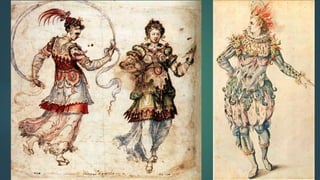
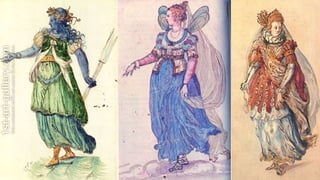
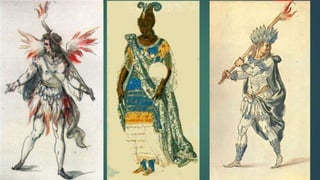
  • #23 First significant British architect of the early modern period (left: Banqueting House at Whitehall) Applied the rules of Vitruvius to his designs Collaborated with ben jonson Theatrical designer for masques Is credited for introducing moving scenery and the proscenium arch to English theater Over 450 drawings for scenery and costumes survive 1615 appointed the Surveyor General of the King’s works
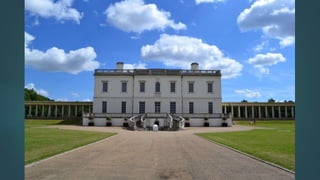
  • #24 The Queen’s House @ greenwich
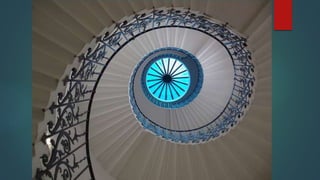
  • #25 The Tulip Staircase @ the queen’s hous, greenwich
  • #26 Court Plays Regular performances in the houses of nobility and at court Did not conflict with public theater performances Elizabeth saw (on average) 5 per year James VI/I saw (on average) 17 per year Charles I saw (on average) 25 per year Clip from Shakespeare in Love 9:33 – 13:35 Court Masques Introduced italian ideals of staging into england In and out of favor in tudor and stuart courts Twice a year: Twelfth night and Mardi Gras Similar to the italian intermezzo Allegorical stories suggesting parallels between the person being honored and some mythological person Story and symbolism conveyed primarily through visual means (scenery, cosutmes, props, pantomime, dance) narrative (sung/spoken) used to clarify the visuals Inigo Jones created the scenery, costumes, and special effects for most of th masques (he died in 1652 after drama was prohibited under the Commonwealth) Incidentally, most masques performed in the banqueting houses at whitehall palace; also designed by Jones