The Seventeenth Century   A period of civil war Religious strife Extortion by King Charles Led to the  Protectorate  of  Oliver Cromwell Eventual restoration of the Monarchy Literature continued in the vein of the Renaissance Time of great poetry
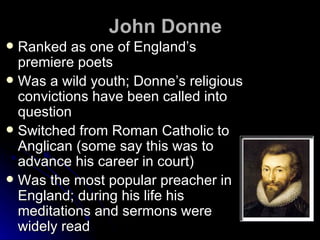
John Donne Ranked as one of England’s premiere poets Was a wild youth; Donne’s religious convictions have been called into question Switched from Roman Catholic to Anglican (some say this was to advance his career in court) Was the most popular preacher in England; during his life his meditations and sermons were widely read
Metaphysical Poetry Focused on philosophical and religious issues Characteristics include intellectual playfulness,  paradoxes,  irony, and elaborate and unusual  conceits Most famous writer of this time was  John Donne
Paradox A statement whose two parts seem contradictory yet make sense with more thought. Reveals a kind of truth which at first seems contradictory.  Christ used paradox in his teaching: "They have ears but hear not.“ “ Fair is Foul; Foul is Fair”
Conceit A far-fetched simile or metaphor, a literary conceit occurs when the speaker compares two highly dissimilar things.  comparable to an extended metaphor, conceit seems to bend reality and establish more of an imaginative image than does the extended metaphor.
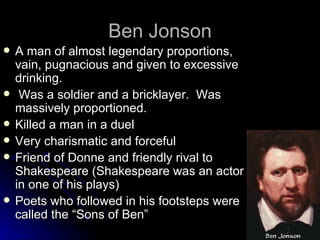
Ben Jonson A man of almost legendary proportions,  vain, pugnacious and given to excessive drinking. Was a soldier and a bricklayer.  Was massively proportioned. Killed a man in a duel Very charismatic and forceful Friend of Donne and friendly rival to Shakespeare (Shakespeare was an actor in one of his plays) Poets who followed in his footsteps were called the “Sons of Ben”
Apostrophe A work which addresses an idea, an inanimate object, or a missing or dead person as though they can hear and understand the work.
Carpe Diem SIEZE THE DAY Captured the spirit of “Let us eat and drink, for tomorrow we may die.” Often used to get maidens to yield to love while they still had their youth. Most famous may  be Robert Herrick’s “To the Virgins, To Make Much of Time”
Cavalier Lyricists (poets) Followers of King Charles and supporters of the Parliament Got name from the fact many were from the landed gentry who could go into battle as part of the  Cavalry. Composed lighthearted poetry dealing with earthly matters like love, chivalry, and loyalty to the king Poems were witty and often licentious

17th Century

  • 1.
    The Seventeenth Century A period of civil war Religious strife Extortion by King Charles Led to the Protectorate of Oliver Cromwell Eventual restoration of the Monarchy Literature continued in the vein of the Renaissance Time of great poetry
  • 2.
    John Donne Rankedas one of England’s premiere poets Was a wild youth; Donne’s religious convictions have been called into question Switched from Roman Catholic to Anglican (some say this was to advance his career in court) Was the most popular preacher in England; during his life his meditations and sermons were widely read
  • 3.
    Metaphysical Poetry Focusedon philosophical and religious issues Characteristics include intellectual playfulness, paradoxes, irony, and elaborate and unusual conceits Most famous writer of this time was John Donne
  • 4.
    Paradox A statementwhose two parts seem contradictory yet make sense with more thought. Reveals a kind of truth which at first seems contradictory. Christ used paradox in his teaching: "They have ears but hear not.“ “ Fair is Foul; Foul is Fair”
  • 5.
    Conceit A far-fetchedsimile or metaphor, a literary conceit occurs when the speaker compares two highly dissimilar things. comparable to an extended metaphor, conceit seems to bend reality and establish more of an imaginative image than does the extended metaphor.
  • 6.
    Ben Jonson Aman of almost legendary proportions, vain, pugnacious and given to excessive drinking. Was a soldier and a bricklayer. Was massively proportioned. Killed a man in a duel Very charismatic and forceful Friend of Donne and friendly rival to Shakespeare (Shakespeare was an actor in one of his plays) Poets who followed in his footsteps were called the “Sons of Ben”
  • 7.
    Apostrophe A workwhich addresses an idea, an inanimate object, or a missing or dead person as though they can hear and understand the work.
  • 8.
    Carpe Diem SIEZETHE DAY Captured the spirit of “Let us eat and drink, for tomorrow we may die.” Often used to get maidens to yield to love while they still had their youth. Most famous may be Robert Herrick’s “To the Virgins, To Make Much of Time”
  • 9.
    Cavalier Lyricists (poets)Followers of King Charles and supporters of the Parliament Got name from the fact many were from the landed gentry who could go into battle as part of the Cavalry. Composed lighthearted poetry dealing with earthly matters like love, chivalry, and loyalty to the king Poems were witty and often licentious