EXTINGUISHER
D
TRAINING
Objectives
• Understand the combustion process and
different fire classes.
• Understand fire extinguisher types,
operating procedures, capabilities, and
limitations.
• Understand basic firefighting concepts:
–R.A.C.E.
–P.A.S.S.
The Combustion Process
THE FIRE TETRAHEDRON
FUEL
TEMPERATURE
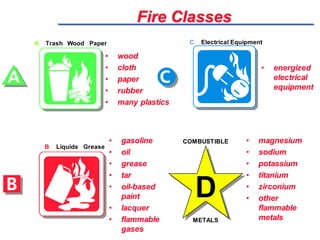
Fire Classes
A Trash Wood Paper C Electrical Equipment
B Liquids Grease
COMBUSTIBLE
METALS
D
• wood
• cloth
• paper
• rubber
• many plastics
• gasoline
• oil
• grease
• tar
• oil-based
paint
• lacquer
• flammable
gases
• energized
electrical
equipment
• magnesium
• sodium
• potassium
• titanium
• zirconium
• other
flammable
metals
Fire Classes (cont.)
K Cooking Media
• Recently recognized by NFPA 10.
• Fires involving combustible
vegetable or animal non-
saturated cooking fats in
commercial cooking equipment.
CLASS K FIRES
Fire Extinguisher Anatomy
DISCHARGE HOSE
DISCHARGE NOZZLE
DISCHARGE ORIFICE
BODY
DATA PLATE
CARRYING
HANDLE
PRESSURE GAUGE
(not found on CO2
extinguishers)
DISCHARGE LEVER
DISCHARGE LOCKING PIN
AND SEAL
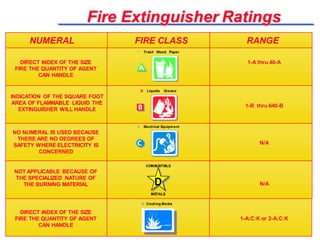
Fire Extinguisher Ratings
NUMERAL FIRE CLASS RANGE
DIRECT INDEX OF THE SIZE
FIRE THE QUANTITY OF AGENT
CAN HANDLE
1-A thru 40-A
A Trash Wood Paper
INDICATION OF THE SQUARE FOOT
AREA OF FLAMMABLE LIQUID THE
EXTINGUISHER WILL HANDLE
1-B thru 640-B
B Liquids Grease
C Electrical Equipment
NO NUMERAL IS USED BECAUSE
THERE ARE NO DEGREES OF
SAFETY WHERE ELECTRICITY IS
CONCERNED
N/A
NOT APPLICABLE BECAUSE OF
THE SPECIALIZED NATURE OF
THE BURNING MATERIAL N/A
D
COMBUSTIBLE
METALS
K Cooking Media
1-A:C:K or 2-A:C:K
DIRECT INDEX OF THE SIZE
FIRE THE QUANTITY OF AGENT
CAN HANDLE
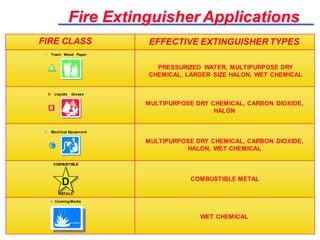
Fire Extinguisher Applications
FIRE CLASS EFFECTIVE EXTINGUISHER TYPES
PRESSURIZED WATER, MULTIPURPOSE DRY
CHEMICAL, LARGER SIZE HALON, WET CHEMICAL
MULTIPURPOSE DRY CHEMICAL, CARBON DIOXIDE,
HALON
MULTIPURPOSE DRY CHEMICAL, CARBON DIOXIDE,
HALON, WET CHEMICAL
COMBUSTIBLE METAL
D
COMBUSTIBLE
METALS
B Liquids Grease
C Electrical Equipment
A Trash Wood Paper
K Cooking Media
WET CHEMICAL
Fire Extinguisher Types
• Class “A” fires only.
• 2.5 gal. water at 150-175 psi (up to 1
minute discharge time).
• Has pressure gauge to allow visual
capacity check.
• 30-40 ft. maximum effective range.
• Can be started and stopped as
necessary.
• Extinguishes by cooling burning
materialbelow the ignition point.
PRESSURIZED WATER
A Trash Wood Paper
B Liquids Grease
C Electrical Equipment
A Trash Wood Paper
B Liquids Grease
C Electrical Equipment
Fire Extinguisher Types (cont.)
• Class “B” or “C” fires.
• 2.5-100 lb. of CO2 gas at 150-
200 psi (8-30 seconds
discharge time).
• Has NO pressure gauge--
capacity verified by weight.
• 3-8 ft. maximum effective
range.
• Extinguishes by smothering
burning materials.
• Effectiveness decreases as
temperature of burning
material increases.
CARBON DIOXIDE (CO2)
A Trash Wood Paper
B Liquids Grease
C Electrical Equipment
A Trash Wood Paper
B Liquids Grease
C Electrical Equipment
Fire Extinguisher Types (cont.)
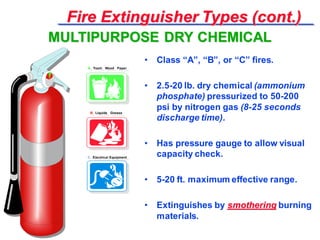
• Class “A”, “B”, or “C” fires.
• 2.5-20 lb. dry chemical (ammonium
phosphate) pressurized to 50-200
psi by nitrogen gas (8-25 seconds
discharge time).
• Has pressure gauge to allow visual
capacity check.
• 5-20 ft. maximum effective range.
• Extinguishes by smothering burning
materials.
MULTIPURPOSE DRY CHEMICAL
A Trash Wood Paper
B Liquids Grease
C Electrical Equipment
A Trash Wood Paper
B Liquids Grease
C Electrical Equipment
Fire Extinguisher Types (cont.)
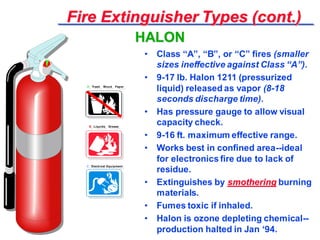
• Class “A”, “B”, or “C” fires (smaller
sizes ineffective against Class “A”).
• 9-17 lb. Halon 1211 (pressurized
liquid) released as vapor (8-18
seconds discharge time).
• Has pressure gauge to allow visual
capacity check.
• 9-16 ft. maximum effective range.
• Works best in confined area--ideal
for electronics fire due to lack of
residue.
• Extinguishes by smothering burning
materials.
• Fumes toxic if inhaled.
• Halon is ozone depleting chemical--
production halted in Jan ‘94.
HALON
A Trash Wood Paper
B Liquids Grease
C Electrical Equipment
A Trash Wood Paper
B Liquids Grease
C Electrical Equipment
Fire Extinguisher Types (cont.)
• Class “D” combustible metal
fires only.
• 30 lb. pressurized dry powder
optimized for specific
combustible metal (also
available in bulk containers for
hand scooping onto fire to
extinguish).
• 6-8 ft. maximum effective range.
• To activate, must first open
nitrogen cylinder on back to
pressurize body.
• Extinguishes by smothering
burning materials.
COMBUSTIBLE METAL
D
COMBUSTIBLE
METALS
Fire Extinguisher Types (cont.)
• Class “A”, “C”, and “K” fires.
• 1.5 gal. of stored pressure
PRX wet chemical
extinguishing agent (40 sec.
discharge time).
• 10-12 ft. maximum effective
range.
• On Class “K” fires, don’t use
until after fixed extinguishing
system has activated.
• Extinguishes by cooling and
forming foam blanket to
prevent reignition.
WET CHEMICAL
A Trash Wood Paper
A Trash Wood Paper
C ElectricalEquipment
K Cooking Media
Fire Extinguisher Summary
EXTINGUISHER TYPE WORKS BY EFFECTIVE AGAINST
PRESSURIZED
WATER
CARBON
DIOXIDE
MULTIPURPOSE
DRY CHEMICAL
HALON
COMBUSTIBLE
METAL
COOLING
SMOTHERING
SMOTHERING
SMOTHERING
SMOTHERING
D
WET CHEMICAL
COOLING/
SMOTHERING
Fire Emergency Response
R Rescue
Alarm
Contain
Extinguish
A
C
E
Firefighting Decision Criteria
• Know department emergency procedures and
evacuation routes.
• Know locations of extinguishers in your area
and how to use them.
• Always sound the alarm regardless of fire size.
• Avoid smoky conditions.
• Ensure area is evacuated.
• Don’t attempt to fight unless:
– Alarm is sounded.
– Fire is small and contained.
– You have safe egress route (can be reached
without exposure to fire).
– Available extinguishers are rated for size and type
of fire.
• If in doubt, evacuate!
Fighting the Fire
Sweep side to side
Aim low at the
base of flames
Squeeze the
handle
Pull the pin
P
A
S
S
Summary
• Combustion process (Fire Tetrahedron).
• Class A, B, C, D, K fires.
• Types of portable fire extinguishers:
– Operating procedures.
– Capabilities and limitations.
• Basic firefighting concepts:
– R.A.C.E.
– P.A.S.S.

EXTINGUISHER Training.pdf

  • 1.
  • 2.
    Objectives • Understand thecombustion process and different fire classes. • Understand fire extinguisher types, operating procedures, capabilities, and limitations. • Understand basic firefighting concepts: –R.A.C.E. –P.A.S.S.
  • 3.
    The Combustion Process THEFIRE TETRAHEDRON FUEL TEMPERATURE
  • 4.
    Fire Classes A TrashWood Paper C Electrical Equipment B Liquids Grease COMBUSTIBLE METALS D • wood • cloth • paper • rubber • many plastics • gasoline • oil • grease • tar • oil-based paint • lacquer • flammable gases • energized electrical equipment • magnesium • sodium • potassium • titanium • zirconium • other flammable metals
  • 5.
    Fire Classes (cont.) KCooking Media • Recently recognized by NFPA 10. • Fires involving combustible vegetable or animal non- saturated cooking fats in commercial cooking equipment. CLASS K FIRES
  • 6.
    Fire Extinguisher Anatomy DISCHARGEHOSE DISCHARGE NOZZLE DISCHARGE ORIFICE BODY DATA PLATE CARRYING HANDLE PRESSURE GAUGE (not found on CO2 extinguishers) DISCHARGE LEVER DISCHARGE LOCKING PIN AND SEAL
  • 7.
    Fire Extinguisher Ratings NUMERALFIRE CLASS RANGE DIRECT INDEX OF THE SIZE FIRE THE QUANTITY OF AGENT CAN HANDLE 1-A thru 40-A A Trash Wood Paper INDICATION OF THE SQUARE FOOT AREA OF FLAMMABLE LIQUID THE EXTINGUISHER WILL HANDLE 1-B thru 640-B B Liquids Grease C Electrical Equipment NO NUMERAL IS USED BECAUSE THERE ARE NO DEGREES OF SAFETY WHERE ELECTRICITY IS CONCERNED N/A NOT APPLICABLE BECAUSE OF THE SPECIALIZED NATURE OF THE BURNING MATERIAL N/A D COMBUSTIBLE METALS K Cooking Media 1-A:C:K or 2-A:C:K DIRECT INDEX OF THE SIZE FIRE THE QUANTITY OF AGENT CAN HANDLE
  • 8.
    Fire Extinguisher Applications FIRECLASS EFFECTIVE EXTINGUISHER TYPES PRESSURIZED WATER, MULTIPURPOSE DRY CHEMICAL, LARGER SIZE HALON, WET CHEMICAL MULTIPURPOSE DRY CHEMICAL, CARBON DIOXIDE, HALON MULTIPURPOSE DRY CHEMICAL, CARBON DIOXIDE, HALON, WET CHEMICAL COMBUSTIBLE METAL D COMBUSTIBLE METALS B Liquids Grease C Electrical Equipment A Trash Wood Paper K Cooking Media WET CHEMICAL
  • 9.
    Fire Extinguisher Types •Class “A” fires only. • 2.5 gal. water at 150-175 psi (up to 1 minute discharge time). • Has pressure gauge to allow visual capacity check. • 30-40 ft. maximum effective range. • Can be started and stopped as necessary. • Extinguishes by cooling burning materialbelow the ignition point. PRESSURIZED WATER A Trash Wood Paper B Liquids Grease C Electrical Equipment A Trash Wood Paper B Liquids Grease C Electrical Equipment
  • 10.
    Fire Extinguisher Types(cont.) • Class “B” or “C” fires. • 2.5-100 lb. of CO2 gas at 150- 200 psi (8-30 seconds discharge time). • Has NO pressure gauge-- capacity verified by weight. • 3-8 ft. maximum effective range. • Extinguishes by smothering burning materials. • Effectiveness decreases as temperature of burning material increases. CARBON DIOXIDE (CO2) A Trash Wood Paper B Liquids Grease C Electrical Equipment A Trash Wood Paper B Liquids Grease C Electrical Equipment
  • 11.
    Fire Extinguisher Types(cont.) • Class “A”, “B”, or “C” fires. • 2.5-20 lb. dry chemical (ammonium phosphate) pressurized to 50-200 psi by nitrogen gas (8-25 seconds discharge time). • Has pressure gauge to allow visual capacity check. • 5-20 ft. maximum effective range. • Extinguishes by smothering burning materials. MULTIPURPOSE DRY CHEMICAL A Trash Wood Paper B Liquids Grease C Electrical Equipment A Trash Wood Paper B Liquids Grease C Electrical Equipment
  • 12.
    Fire Extinguisher Types(cont.) • Class “A”, “B”, or “C” fires (smaller sizes ineffective against Class “A”). • 9-17 lb. Halon 1211 (pressurized liquid) released as vapor (8-18 seconds discharge time). • Has pressure gauge to allow visual capacity check. • 9-16 ft. maximum effective range. • Works best in confined area--ideal for electronics fire due to lack of residue. • Extinguishes by smothering burning materials. • Fumes toxic if inhaled. • Halon is ozone depleting chemical-- production halted in Jan ‘94. HALON A Trash Wood Paper B Liquids Grease C Electrical Equipment A Trash Wood Paper B Liquids Grease C Electrical Equipment
  • 13.
    Fire Extinguisher Types(cont.) • Class “D” combustible metal fires only. • 30 lb. pressurized dry powder optimized for specific combustible metal (also available in bulk containers for hand scooping onto fire to extinguish). • 6-8 ft. maximum effective range. • To activate, must first open nitrogen cylinder on back to pressurize body. • Extinguishes by smothering burning materials. COMBUSTIBLE METAL D COMBUSTIBLE METALS
  • 14.
    Fire Extinguisher Types(cont.) • Class “A”, “C”, and “K” fires. • 1.5 gal. of stored pressure PRX wet chemical extinguishing agent (40 sec. discharge time). • 10-12 ft. maximum effective range. • On Class “K” fires, don’t use until after fixed extinguishing system has activated. • Extinguishes by cooling and forming foam blanket to prevent reignition. WET CHEMICAL A Trash Wood Paper A Trash Wood Paper C ElectricalEquipment C ElectricalEquipment K Cooking Media
  • 15.
    Fire Extinguisher Summary EXTINGUISHERTYPE WORKS BY EFFECTIVE AGAINST PRESSURIZED WATER CARBON DIOXIDE MULTIPURPOSE DRY CHEMICAL HALON COMBUSTIBLE METAL COOLING SMOTHERING SMOTHERING SMOTHERING SMOTHERING D WET CHEMICAL COOLING/ SMOTHERING
  • 16.
    Fire Emergency Response RRescue Alarm Contain Extinguish A C E
  • 17.
    Firefighting Decision Criteria •Know department emergency procedures and evacuation routes. • Know locations of extinguishers in your area and how to use them. • Always sound the alarm regardless of fire size. • Avoid smoky conditions. • Ensure area is evacuated. • Don’t attempt to fight unless: – Alarm is sounded. – Fire is small and contained. – You have safe egress route (can be reached without exposure to fire). – Available extinguishers are rated for size and type of fire. • If in doubt, evacuate!
  • 18.
    Fighting the Fire Sweepside to side Aim low at the base of flames Squeeze the handle Pull the pin P A S S
  • 19.
    Summary • Combustion process(Fire Tetrahedron). • Class A, B, C, D, K fires. • Types of portable fire extinguishers: – Operating procedures. – Capabilities and limitations. • Basic firefighting concepts: – R.A.C.E. – P.A.S.S.