Click to edit Master title style
1
CHEMICAL INDUSTRIES
Click to edit Master title style
2
REFINING OF COPPER
To use copper we separate it from its ore because
in nature it is found as copper ores. This process
of separation of copper from its ore is called
Metallurgy.
Click to edit Master title style
3
STEPS IN METALLURGY
• Mining of ore
• Crushing and grinding of ore
• Concentration of ore
• Extraction of metal
• Refining of metal
Click to edit Master title style
4
MINING OF ORE
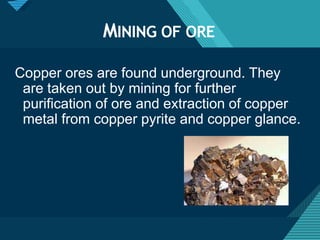
Copper ores are found underground. They
are taken out by mining for further
purification of ore and extraction of copper
metal from copper pyrite and copper glance.
Click to edit Master title style
5
CRUSHING AND GRINIDING OF ORE
The ores mined from the ground are
mechanically crushed and ground. It is done
to liberate valuable mineral (copper) from
the waste (gangue) mineral.
Click to edit Master title style
6
CONCENTRATION OF ORE
Most copper ores contain only a small
percentage of copper metal bound up within
valuable ore mineral, with the remainder of
the ore being unwanted rock or gangue
mineral
Click to edit Master title style
7
CONCENTRATION OF ORE
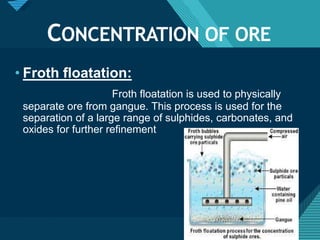
• Froth floatation:
Froth floatation is used to physically
separate ore from gangue. This process is used for the
separation of a large range of sulphides, carbonates, and
oxides for further refinement
Click to edit Master title style
8
EXTRACTION OF METAL
After the separation of ore and gangue by froth
flotation some chemical processes are done to
extract metals. These chemical processes are
roasting and smelting.
Click to edit Master title style
9
ROASTING
• Definition:
The process in which minerals are
converted into oxides by heating in the air below
their melting point is roasting.
• Chemical equation:
2 CuFeS2 + 3 O2 → 2 FeO + 2 CuS + 2 SO2
Click to edit Master title style
1
0
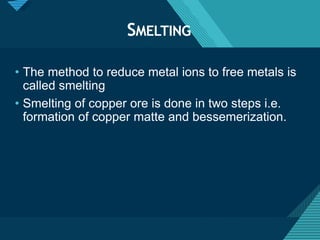
SMELTING
• The method to reduce metal ions to free metals is
called smelting
• Smelting of copper ore is done in two steps i.e.
formation of copper matte and bessemerization.
Click to edit Master title style
11
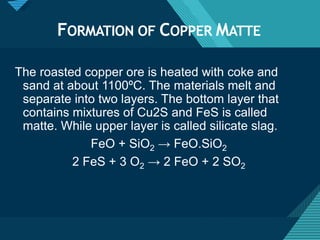
FORMATION OF COPPER MATTE
The roasted copper ore is heated with coke and
sand at about 1100ºC. The materials melt and
separate into two layers. The bottom layer that
contains mixtures of Cu2S and FeS is called
matte. While upper layer is called silicate slag.
FeO + SiO2 → FeO.SiO2
2 FeS + 3 O2 → 2 FeO + 2 SO2
Click to edit Master title style
1
2
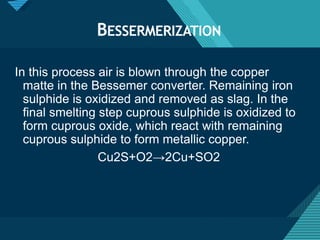
BESSERMERIZATION
In this process air is blown through the copper
matte in the Bessemer converter. Remaining iron
sulphide is oxidized and removed as slag. In the
final smelting step cuprous sulphide is oxidized to
form cuprous oxide, which react with remaining
cuprous sulphide to form metallic copper.
Cu2S+O2→2Cu+SO2
Click to edit Master title style
13
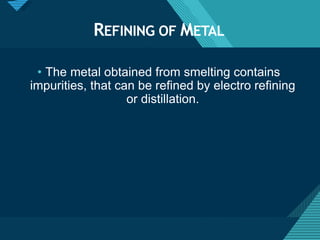
REFINING OF METAL
• The metal obtained from smelting contains
impurities, that can be refined by electro refining
or distillation.
Click to edit Master title style
1
4
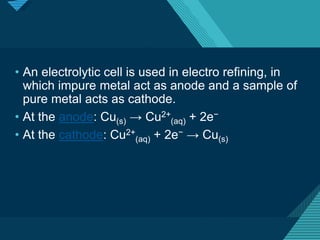
• An electrolytic cell is used in electro refining, in
which impure metal act as anode and a sample of
pure metal acts as cathode.
• At the anode: Cu(s) → Cu2+
(aq) + 2e−
• At the cathode: Cu2+
(aq) + 2e− → Cu(s)
Click to edit Master title style
15

Refining of copper

  • 1.
    Click to editMaster title style 1 CHEMICAL INDUSTRIES
  • 2.
    Click to editMaster title style 2 REFINING OF COPPER To use copper we separate it from its ore because in nature it is found as copper ores. This process of separation of copper from its ore is called Metallurgy.
  • 3.
    Click to editMaster title style 3 STEPS IN METALLURGY • Mining of ore • Crushing and grinding of ore • Concentration of ore • Extraction of metal • Refining of metal
  • 4.
    Click to editMaster title style 4 MINING OF ORE Copper ores are found underground. They are taken out by mining for further purification of ore and extraction of copper metal from copper pyrite and copper glance.
  • 5.
    Click to editMaster title style 5 CRUSHING AND GRINIDING OF ORE The ores mined from the ground are mechanically crushed and ground. It is done to liberate valuable mineral (copper) from the waste (gangue) mineral.
  • 6.
    Click to editMaster title style 6 CONCENTRATION OF ORE Most copper ores contain only a small percentage of copper metal bound up within valuable ore mineral, with the remainder of the ore being unwanted rock or gangue mineral
  • 7.
    Click to editMaster title style 7 CONCENTRATION OF ORE • Froth floatation: Froth floatation is used to physically separate ore from gangue. This process is used for the separation of a large range of sulphides, carbonates, and oxides for further refinement
  • 8.
    Click to editMaster title style 8 EXTRACTION OF METAL After the separation of ore and gangue by froth flotation some chemical processes are done to extract metals. These chemical processes are roasting and smelting.
  • 9.
    Click to editMaster title style 9 ROASTING • Definition: The process in which minerals are converted into oxides by heating in the air below their melting point is roasting. • Chemical equation: 2 CuFeS2 + 3 O2 → 2 FeO + 2 CuS + 2 SO2
  • 10.
    Click to editMaster title style 1 0 SMELTING • The method to reduce metal ions to free metals is called smelting • Smelting of copper ore is done in two steps i.e. formation of copper matte and bessemerization.
  • 11.
    Click to editMaster title style 11 FORMATION OF COPPER MATTE The roasted copper ore is heated with coke and sand at about 1100ºC. The materials melt and separate into two layers. The bottom layer that contains mixtures of Cu2S and FeS is called matte. While upper layer is called silicate slag. FeO + SiO2 → FeO.SiO2 2 FeS + 3 O2 → 2 FeO + 2 SO2
  • 12.
    Click to editMaster title style 1 2 BESSERMERIZATION In this process air is blown through the copper matte in the Bessemer converter. Remaining iron sulphide is oxidized and removed as slag. In the final smelting step cuprous sulphide is oxidized to form cuprous oxide, which react with remaining cuprous sulphide to form metallic copper. Cu2S+O2→2Cu+SO2
  • 13.
    Click to editMaster title style 13 REFINING OF METAL • The metal obtained from smelting contains impurities, that can be refined by electro refining or distillation.
  • 14.
    Click to editMaster title style 1 4 • An electrolytic cell is used in electro refining, in which impure metal act as anode and a sample of pure metal acts as cathode. • At the anode: Cu(s) → Cu2+ (aq) + 2e− • At the cathode: Cu2+ (aq) + 2e− → Cu(s)
  • 15.
    Click to editMaster title style 15