Psychology: A Journey
Chapter 2
UNIVERSITY OF
SWAT
Psychology: A Journey
Chapter 2
Chapter 2
Brain and Behavior
UNIVERSITY OF
SWAT
Psychology: A Journey
Chapter 2
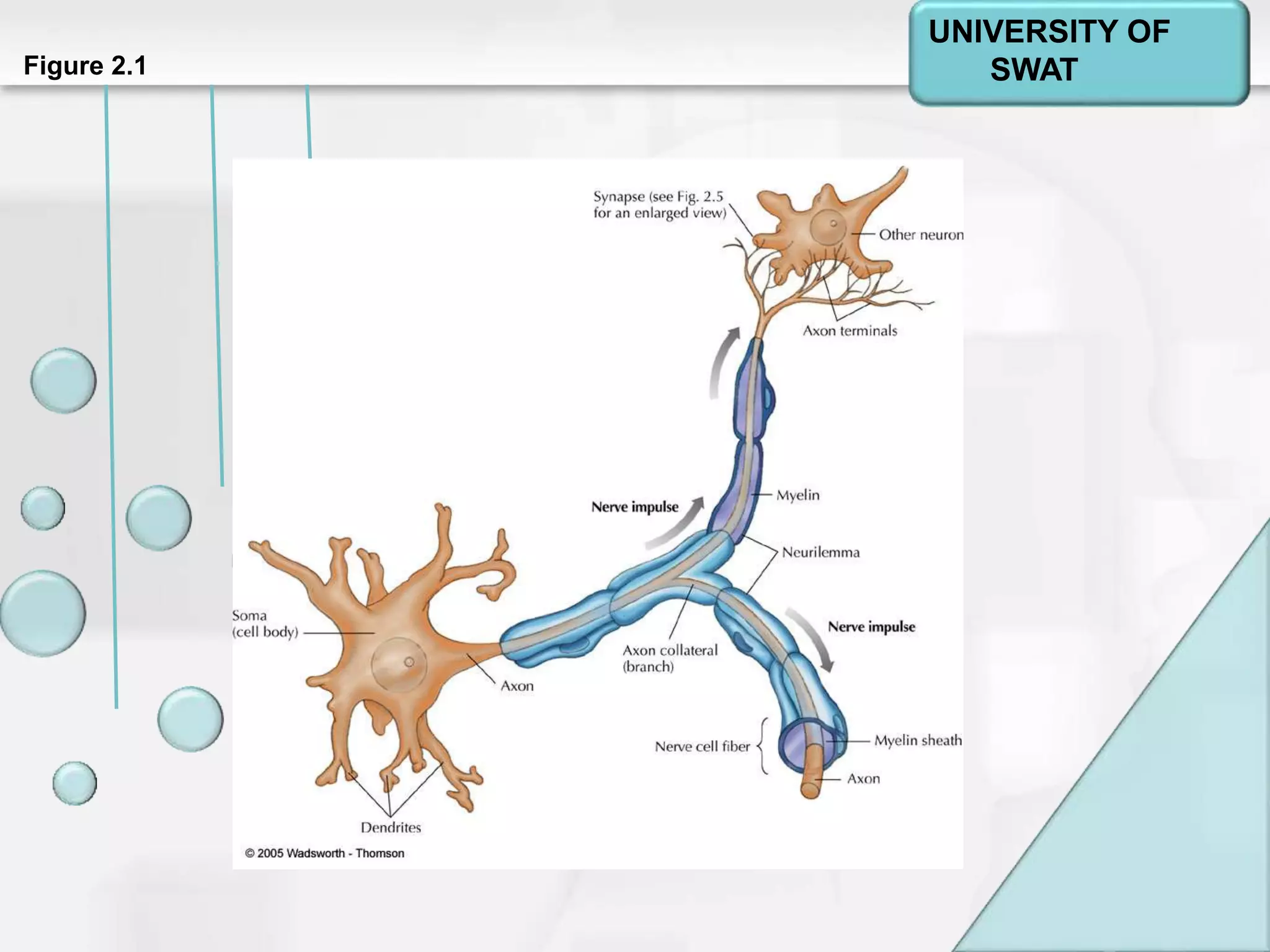
Neuron and Its Parts
• Neuron: Individual nerve cell
– Dendrites: Receive messages from other
neurons
– Soma: Cell body; body of the neuron
– Axon: Fiber that carries information away
from the cell body
– Axon Terminals: Branches that link the
dendrites and somas of other neurons
UNIVERSITY OF
SWAT
Psychology: A Journey
Chapter 2Figure 2.1
UNIVERSITY OF
SWAT
Psychology: A Journey
Chapter 2
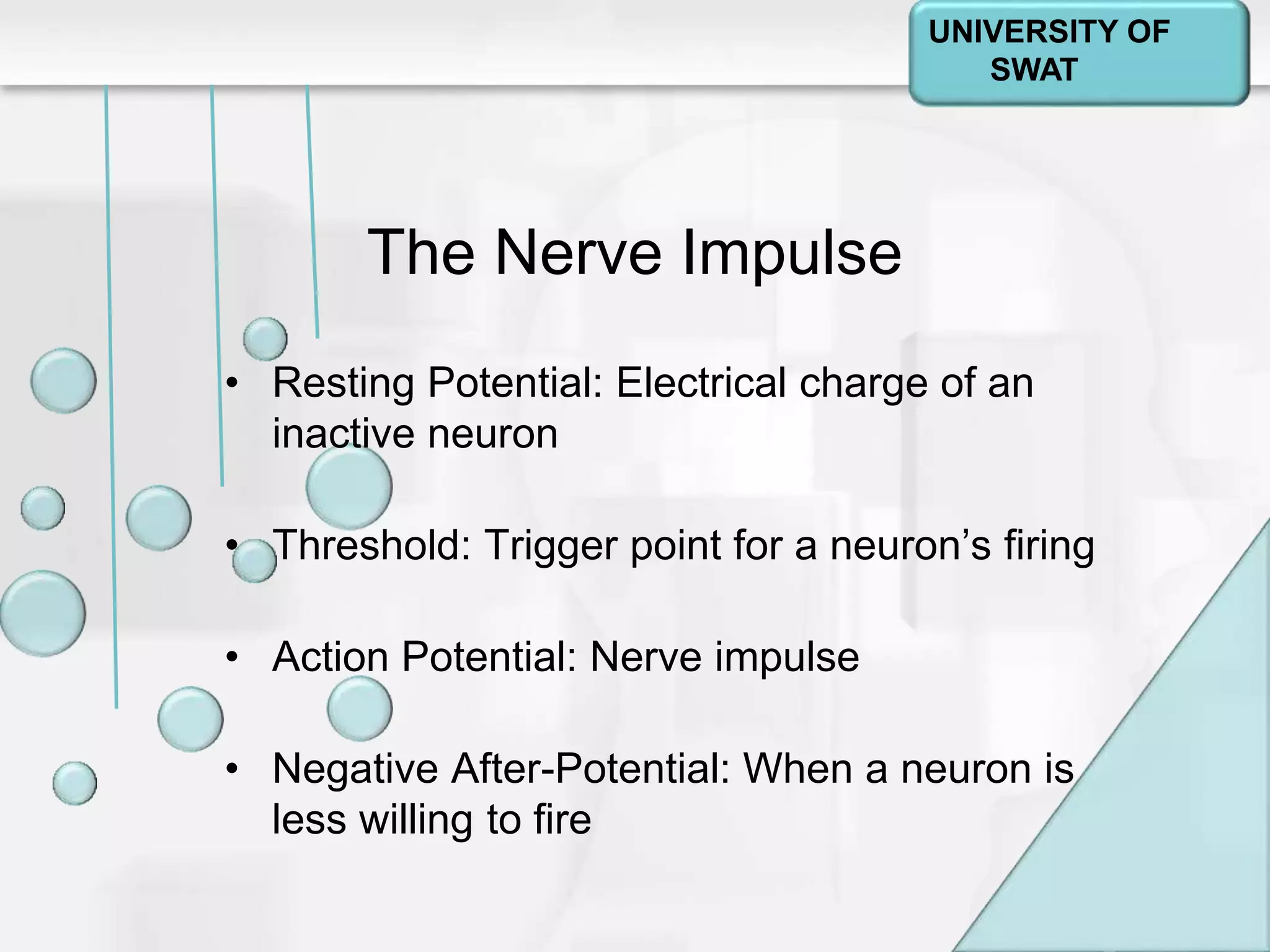
The Nerve Impulse
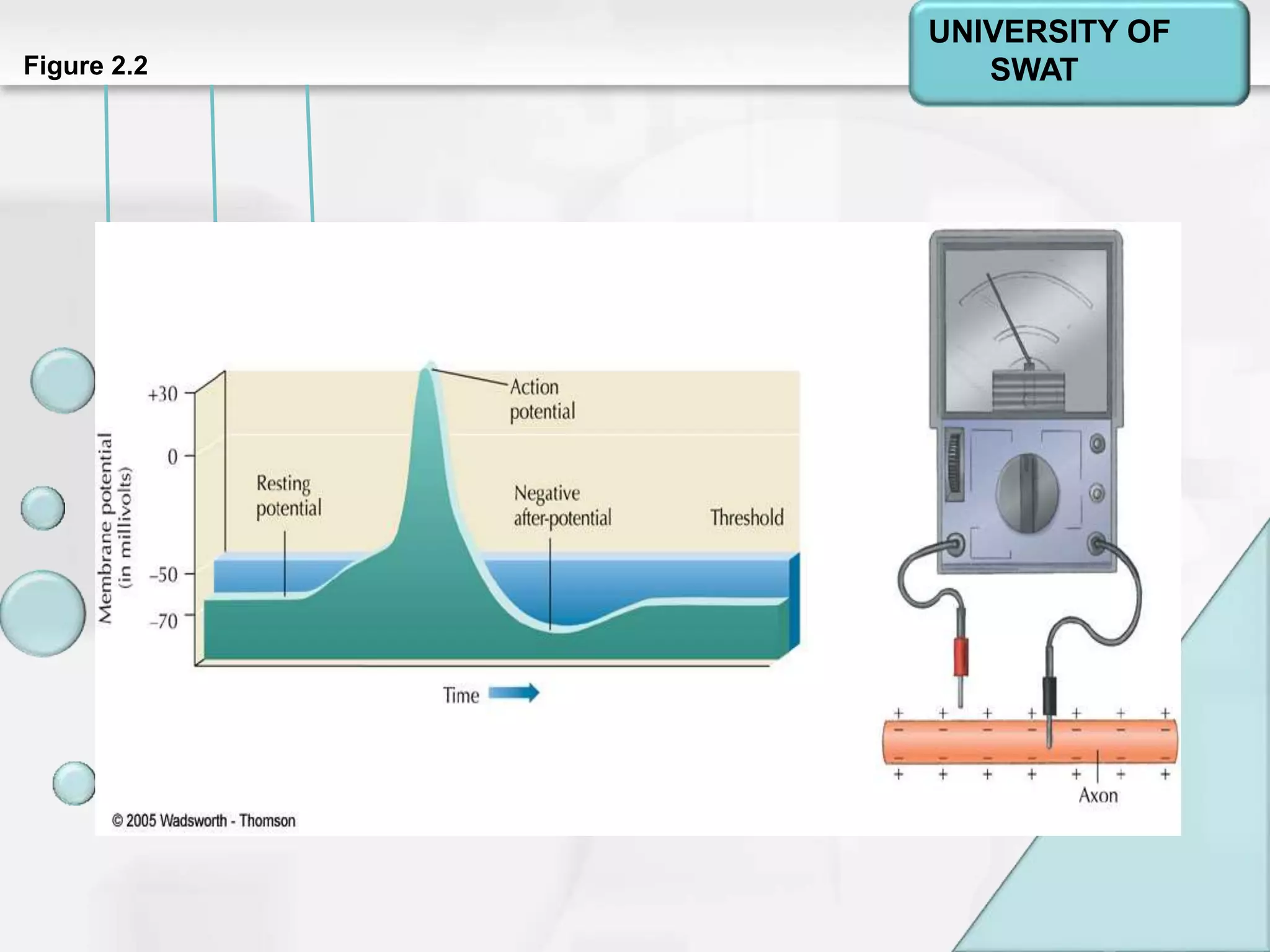
• Resting Potential: Electrical charge of an
inactive neuron
• Threshold: Trigger point for a neuron’s firing
• Action Potential: Nerve impulse
• Negative After-Potential: When a neuron is
less willing to fire
UNIVERSITY OF
SWAT
Psychology: A Journey
Chapter 2Figure 2.2
UNIVERSITY OF
SWAT
Psychology: A Journey
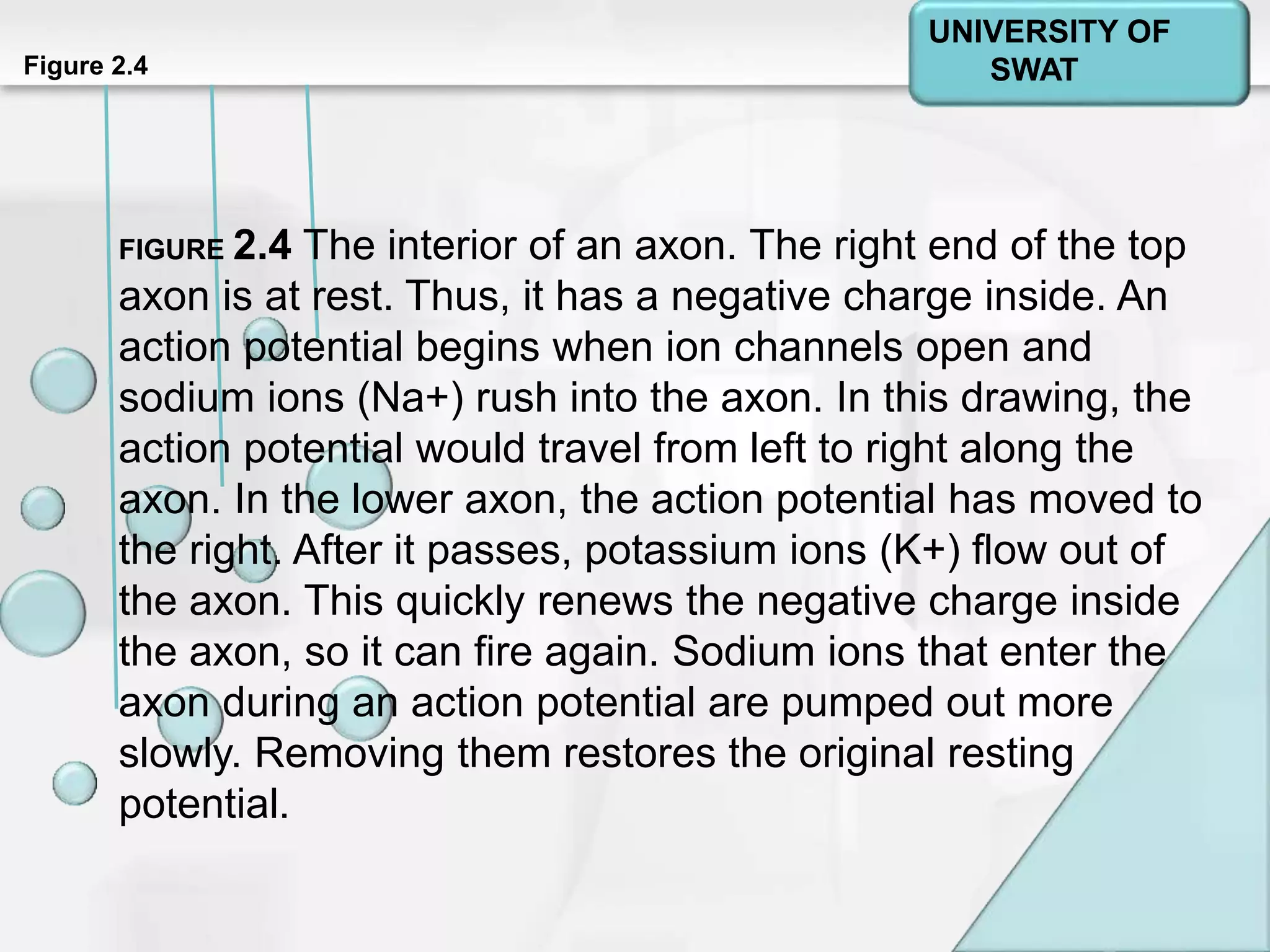
Chapter 2Figure 2.4
FIGURE 2.4 The interior of an axon. The right end of the top
axon is at rest. Thus, it has a negative charge inside. An
action potential begins when ion channels open and
sodium ions (Na+) rush into the axon. In this drawing, the
action potential would travel from left to right along the
axon. In the lower axon, the action potential has moved to
the right. After it passes, potassium ions (K+) flow out of
the axon. This quickly renews the negative charge inside
the axon, so it can fire again. Sodium ions that enter the
axon during an action potential are pumped out more
slowly. Removing them restores the original resting
potential.
UNIVERSITY OF
SWAT
Psychology: A Journey
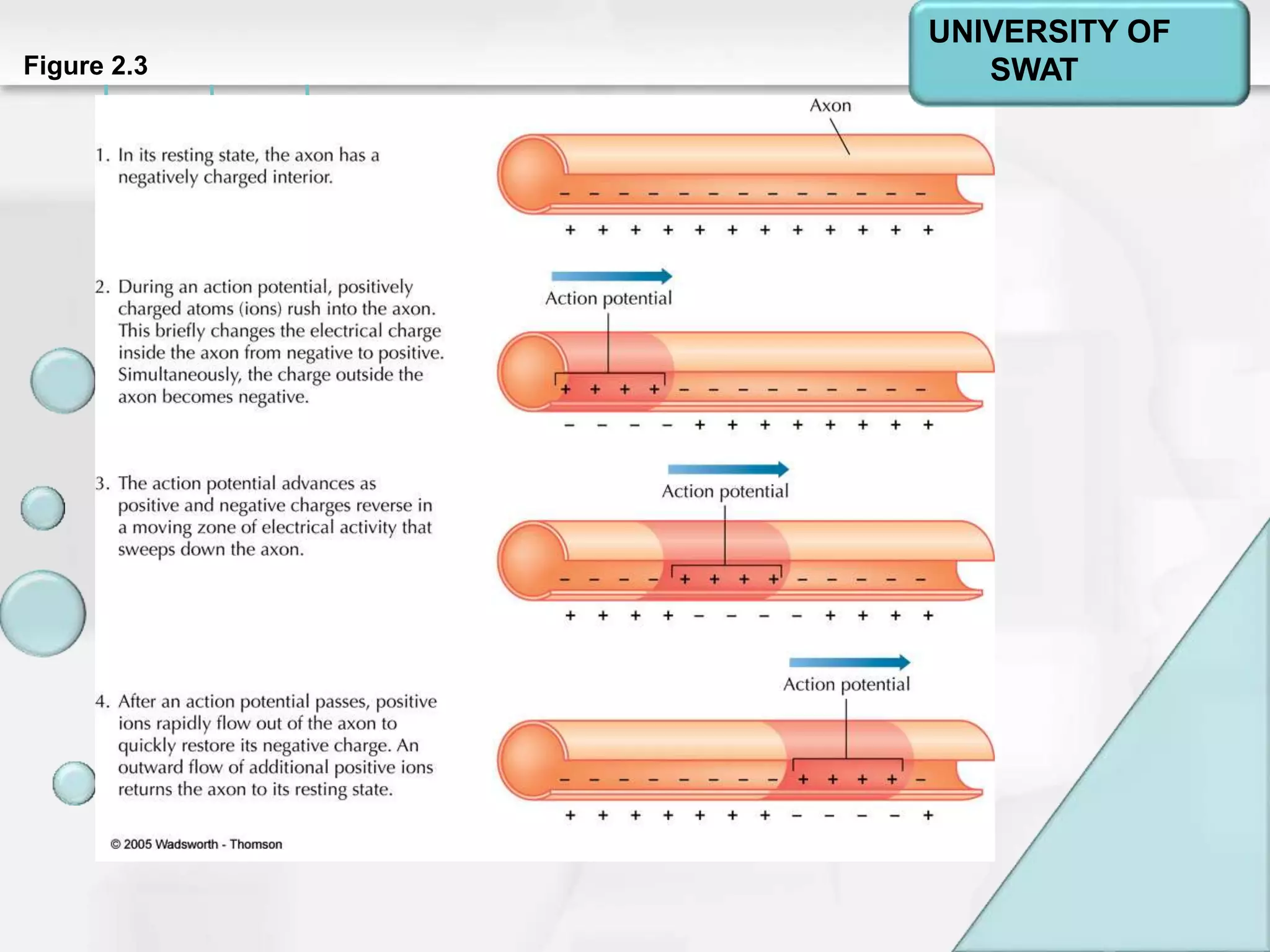
Chapter 2Figure 2.3
UNIVERSITY OF
SWAT
Psychology: A Journey
Chapter 2
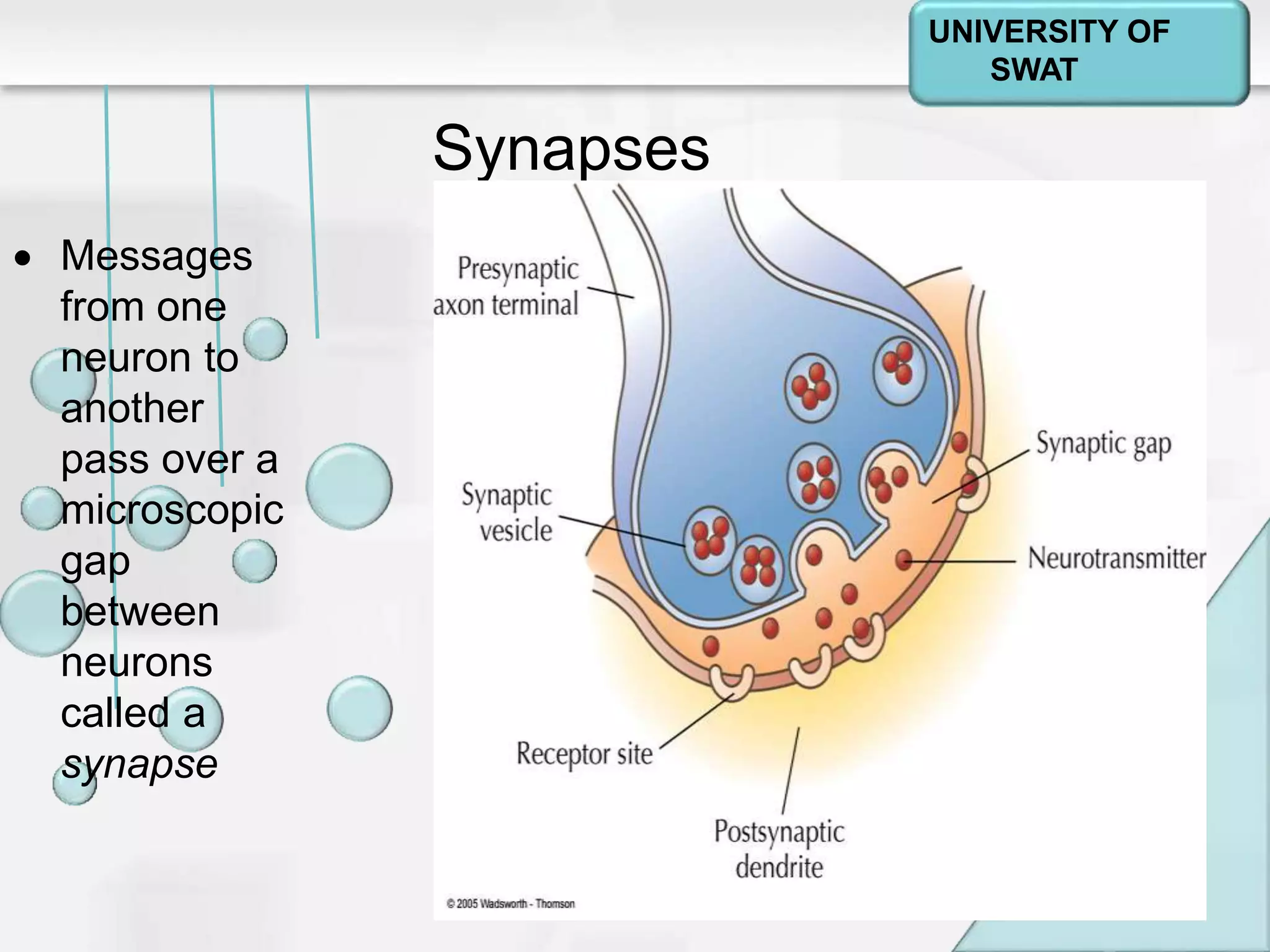
Synapses
 Messages
from one
neuron to
another
pass over a
microscopic
gap
between
neurons
called a
synapse
UNIVERSITY OF
SWAT
Psychology: A Journey
Chapter 2
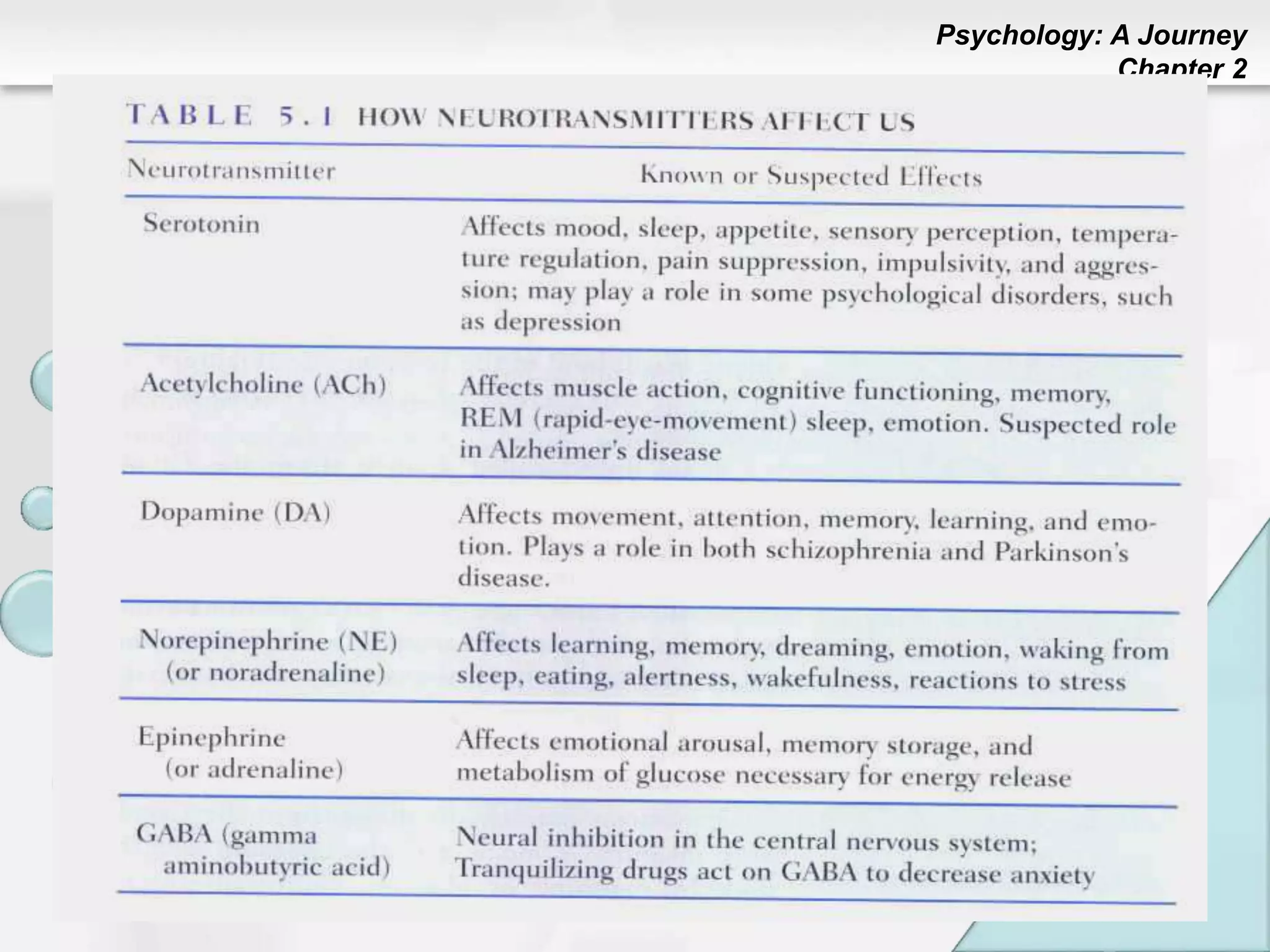
Neurotransmitters
 Chemicals in the brain that alter activity in neurons
• Receptor Site: Areas on the surface of neurons and
other cells that are sensitive to neurotransmitters
• Our knowledge of these chemicals is incomplete.
Suspected effects of 6 of them are displayed on the
following table.
UNIVERSITY OF
SWAT
Psychology: A Journey
Chapter 2
Psychology: A Journey
Chapter 2
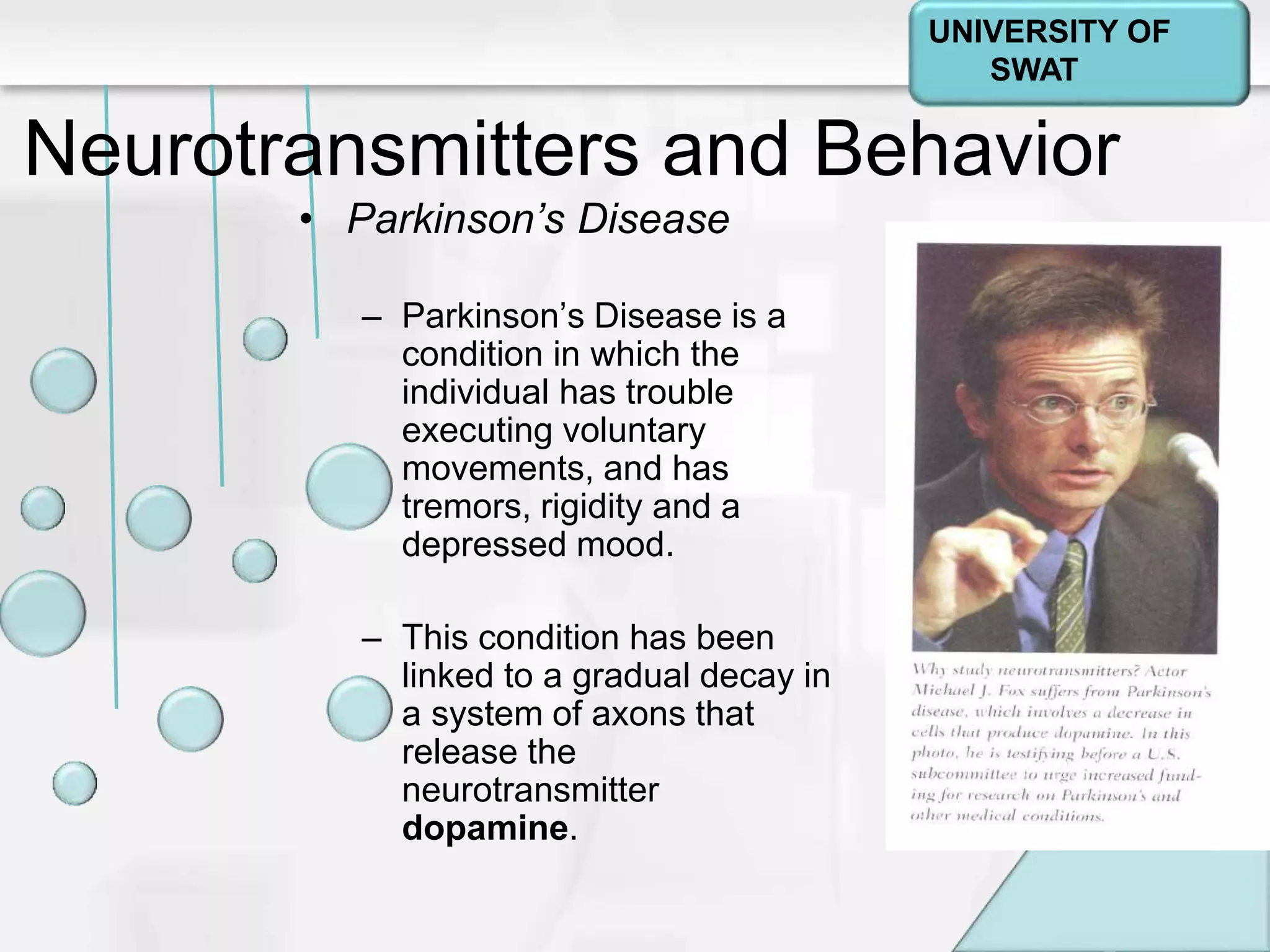
Neurotransmitters and Behavior
• Parkinson’s Disease
– Parkinson’s Disease is a
condition in which the
individual has trouble
executing voluntary
movements, and has
tremors, rigidity and a
depressed mood.
– This condition has been
linked to a gradual decay in
a system of axons that
release the
neurotransmitter
dopamine.
UNIVERSITY OF
SWAT
Psychology: A Journey
Chapter 2
– Why does the communication between
neurons have to be both an electrical and
chemical process? Why not just electrical?
UNIVERSITY OF
SWAT
Psychology: A Journey
Chapter 2
Nerves and Neurons
• Nerves: Large bundles of axons and dendrites
• Myelin: Fatty layer of tissue that coats axons
• Saltatory conduction: nerve impulses traveling down
an axon coated with myelin jump from gap to gap in
the myelin layer.
• What condition results when one’s immune system
destroys the myelin layer of axons?
UNIVERSITY OF
SWAT
Psychology: A Journey
Chapter 2
Neural Networks
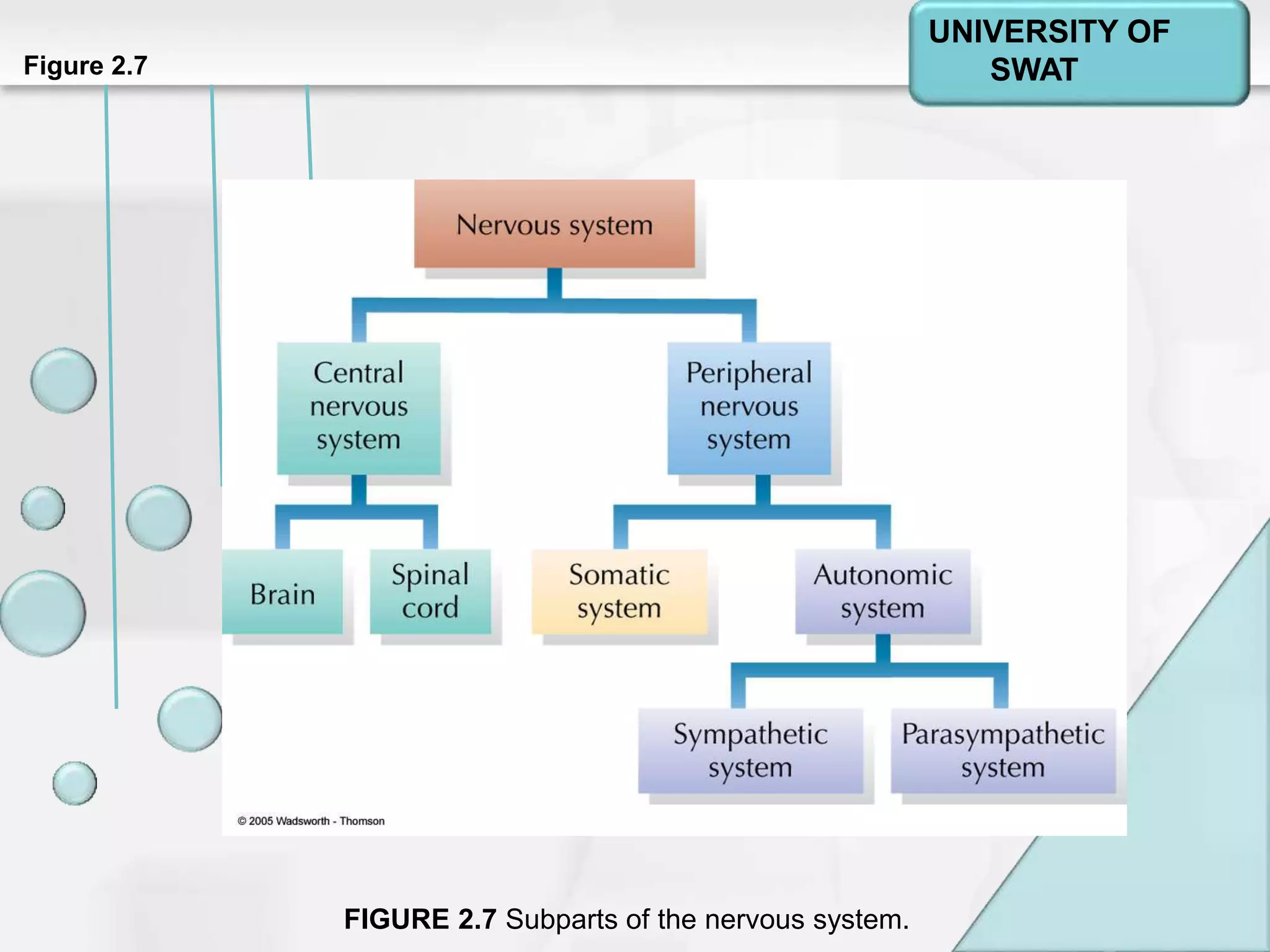
• Central Nervous System (CNS): Brain and spinal cord
• Peripheral Nervous System: All parts of the nervous
system outside of the brain and spinal cord
– Somatic System: Links spinal cord with body and
sense organs; controls voluntary behavior via
sensory neurons and motor neurons
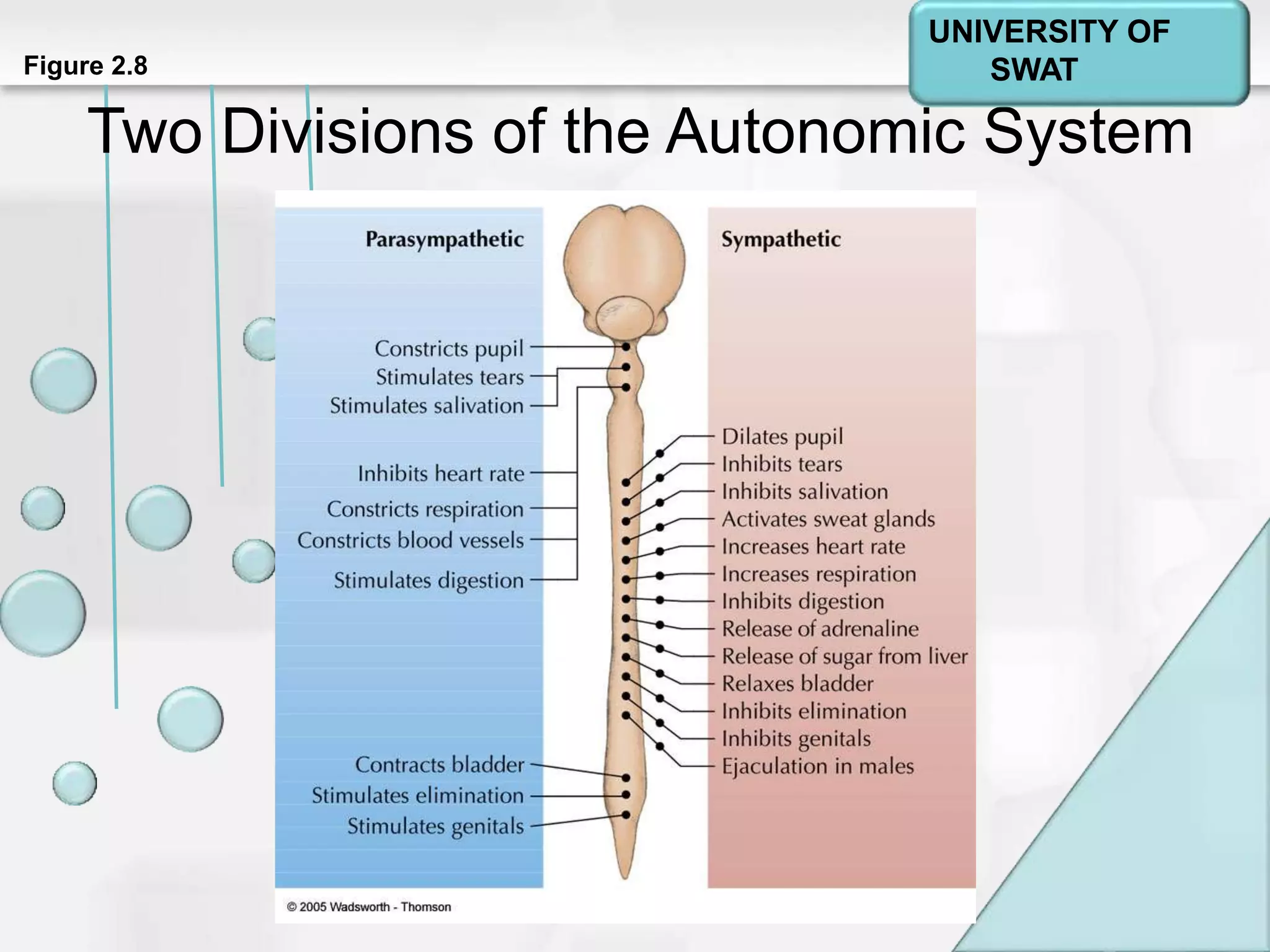
– Autonomic System: Serves internal organs and
glands; controls automatic functions such as heart
rate and blood pressure
UNIVERSITY OF
SWAT
Psychology: A Journey
Chapter 2Figure 2.8
Two Divisions of the Autonomic System
UNIVERSITY OF
SWAT
Psychology: A Journey
Chapter 2Figure 2.7
FIGURE 2.7 Subparts of the nervous system.
UNIVERSITY OF
SWAT
Psychology: A Journey
Chapter 2
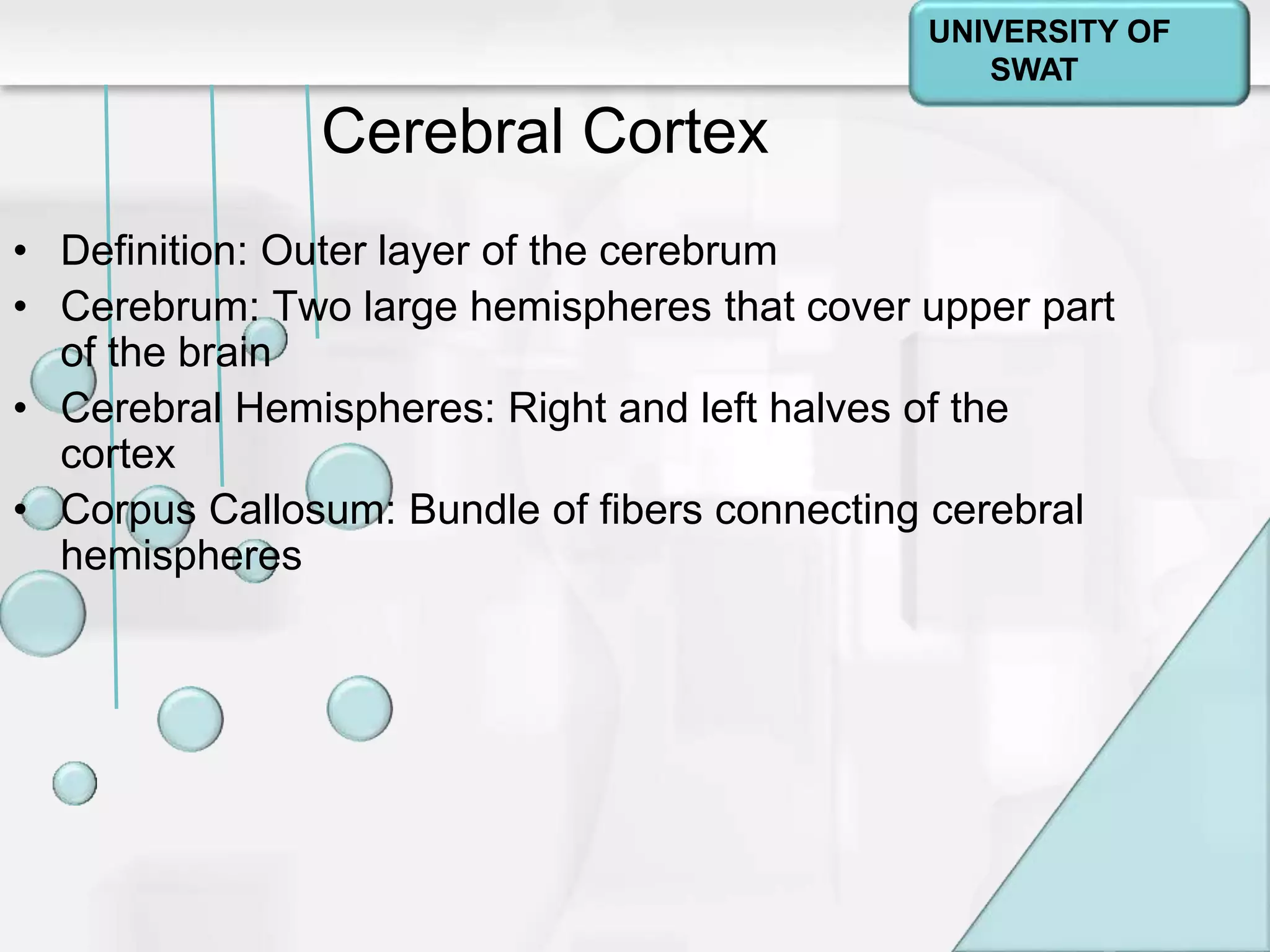
• Definition: Outer layer of the cerebrum
• Cerebrum: Two large hemispheres that cover upper part
of the brain
• Cerebral Hemispheres: Right and left halves of the
cortex
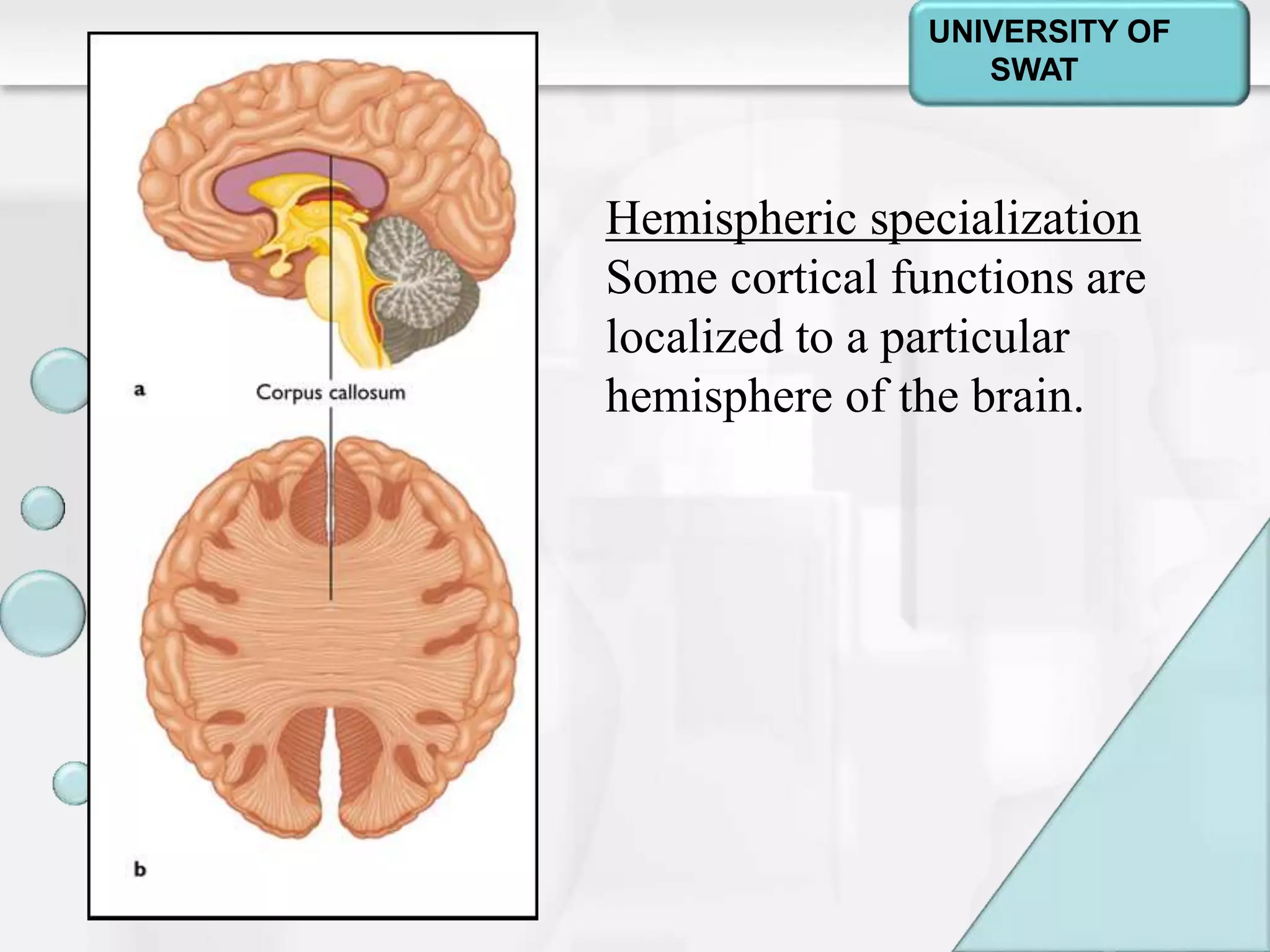
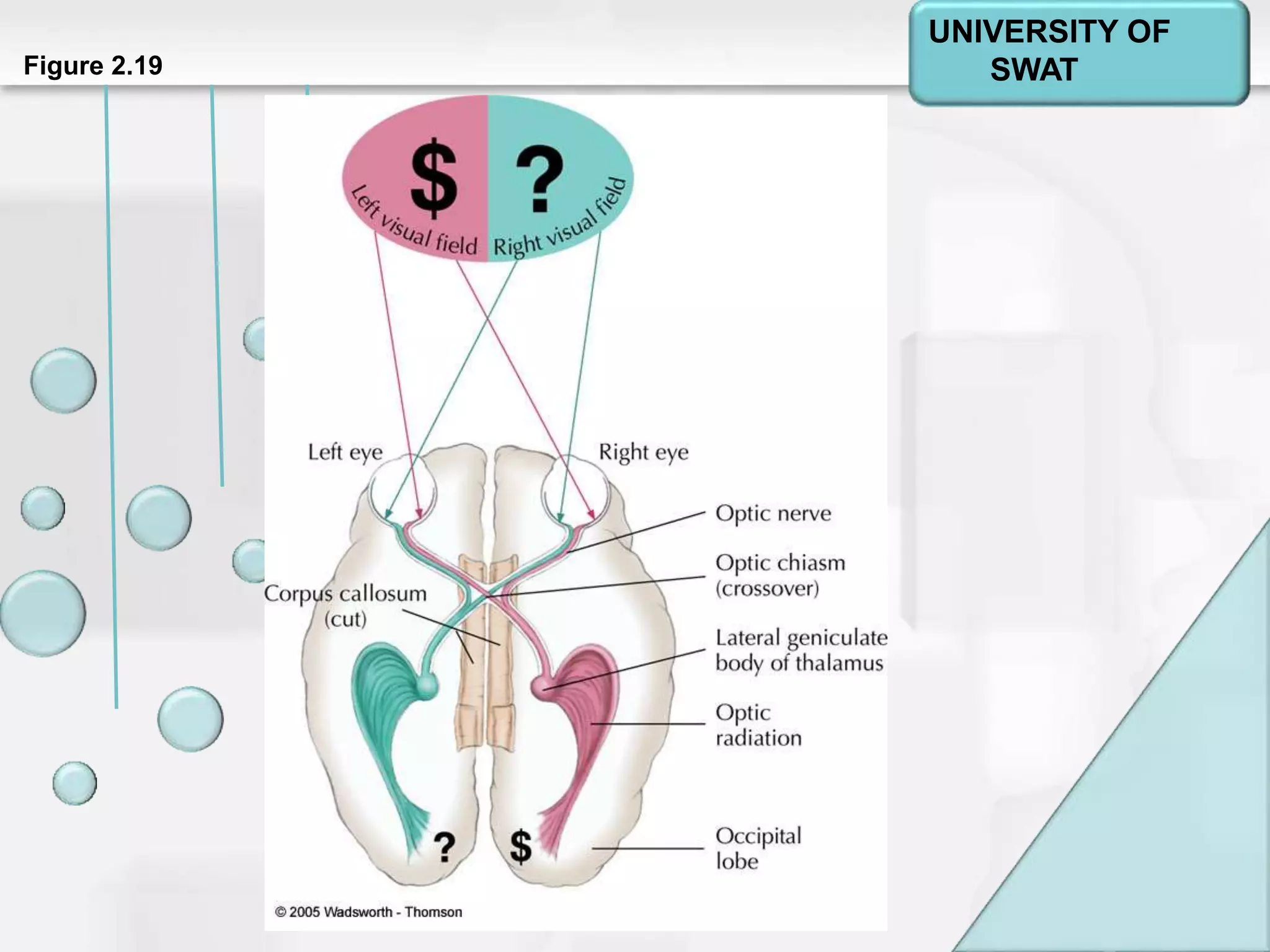
• Corpus Callosum: Bundle of fibers connecting cerebral
hemispheres
Cerebral Cortex
UNIVERSITY OF
SWAT
Psychology: A Journey
Chapter 2
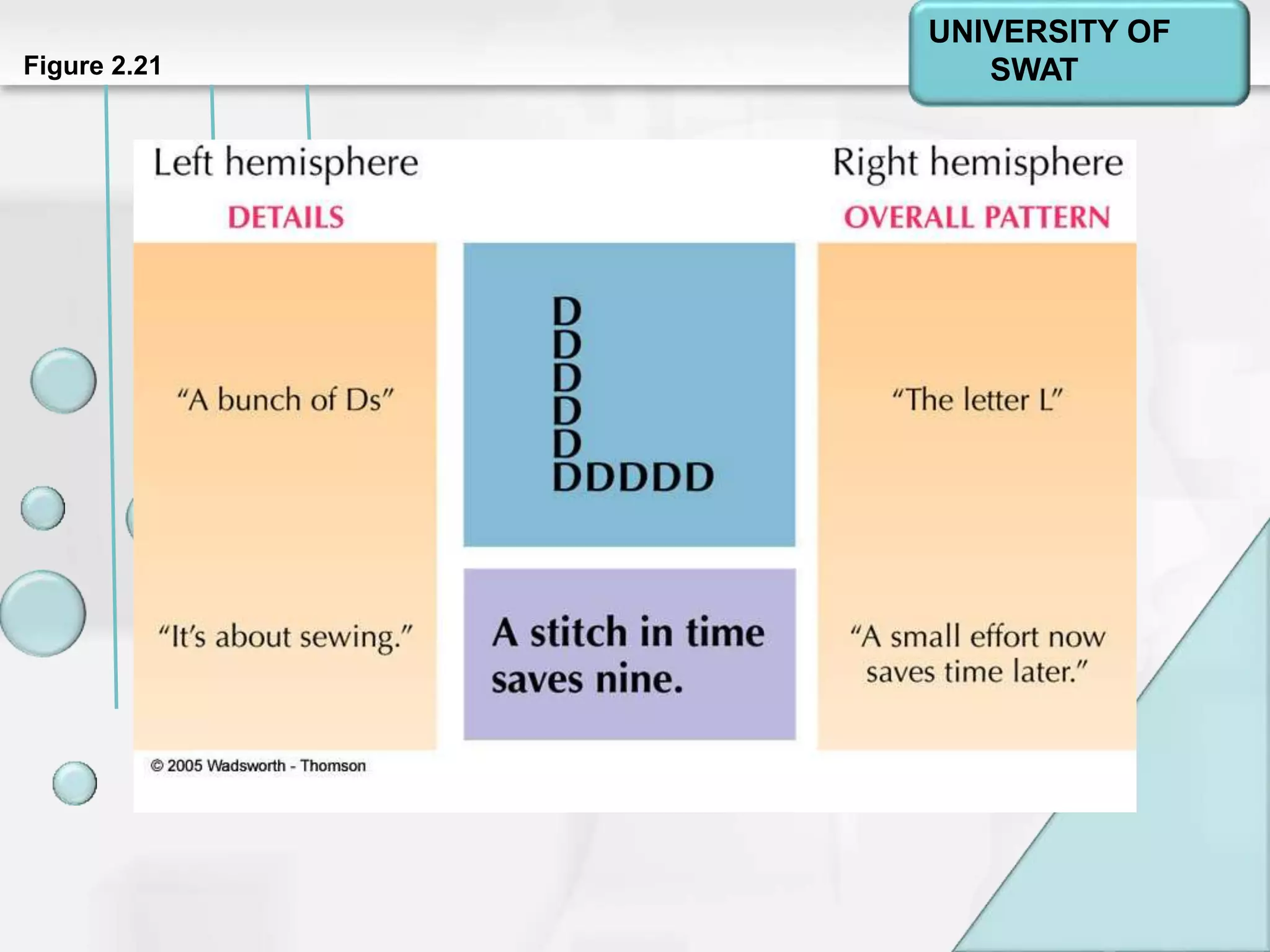
Hemispheric specialization
Some cortical functions are
localized to a particular
hemisphere of the brain.
UNIVERSITY OF
SWAT
Psychology: A Journey
Chapter 2
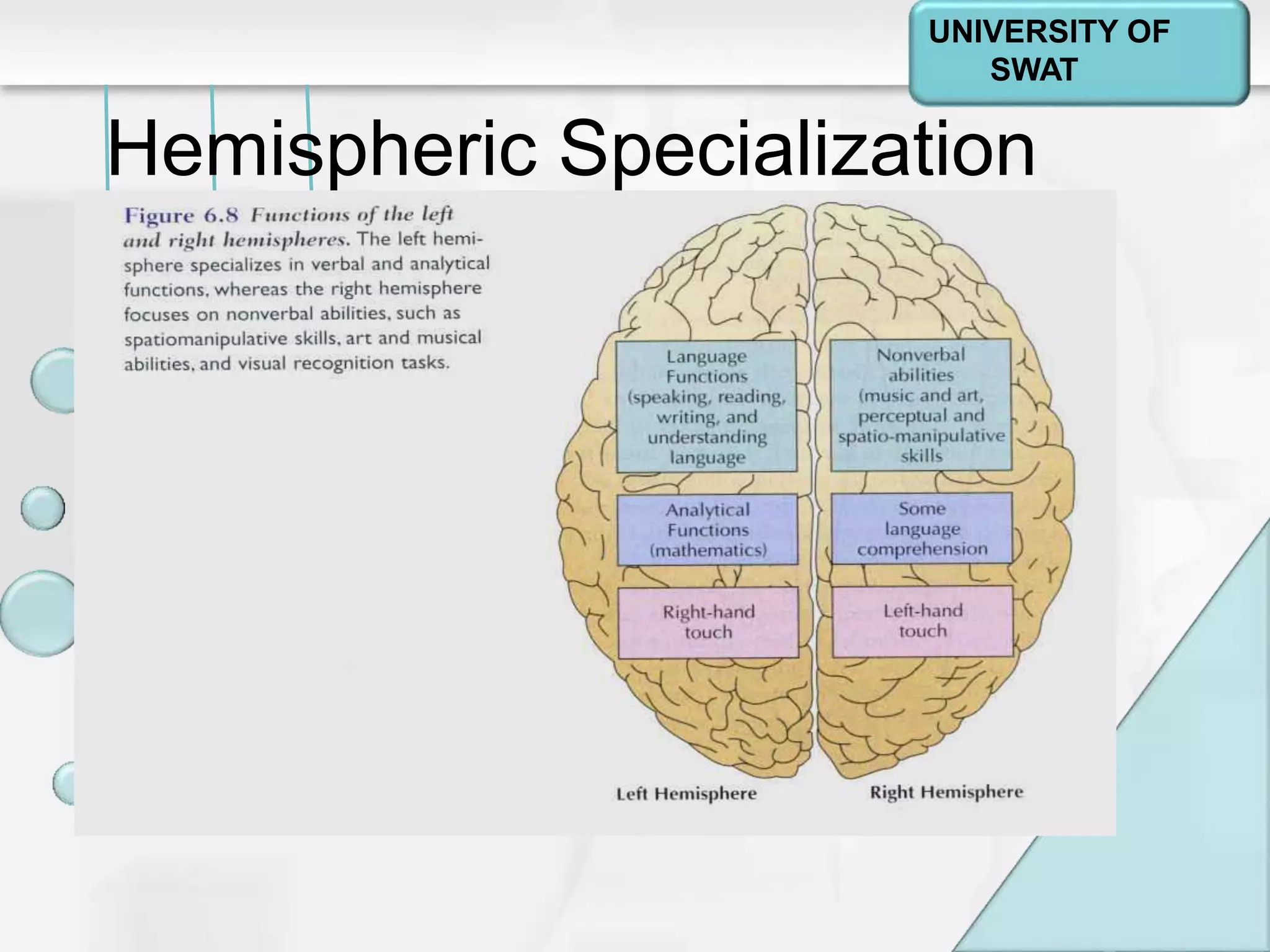
Hemispheric Specialization
UNIVERSITY OF
SWAT
Psychology: A Journey
Chapter 2Figure 2.21
UNIVERSITY OF
SWAT
Psychology: A Journey
Chapter 2
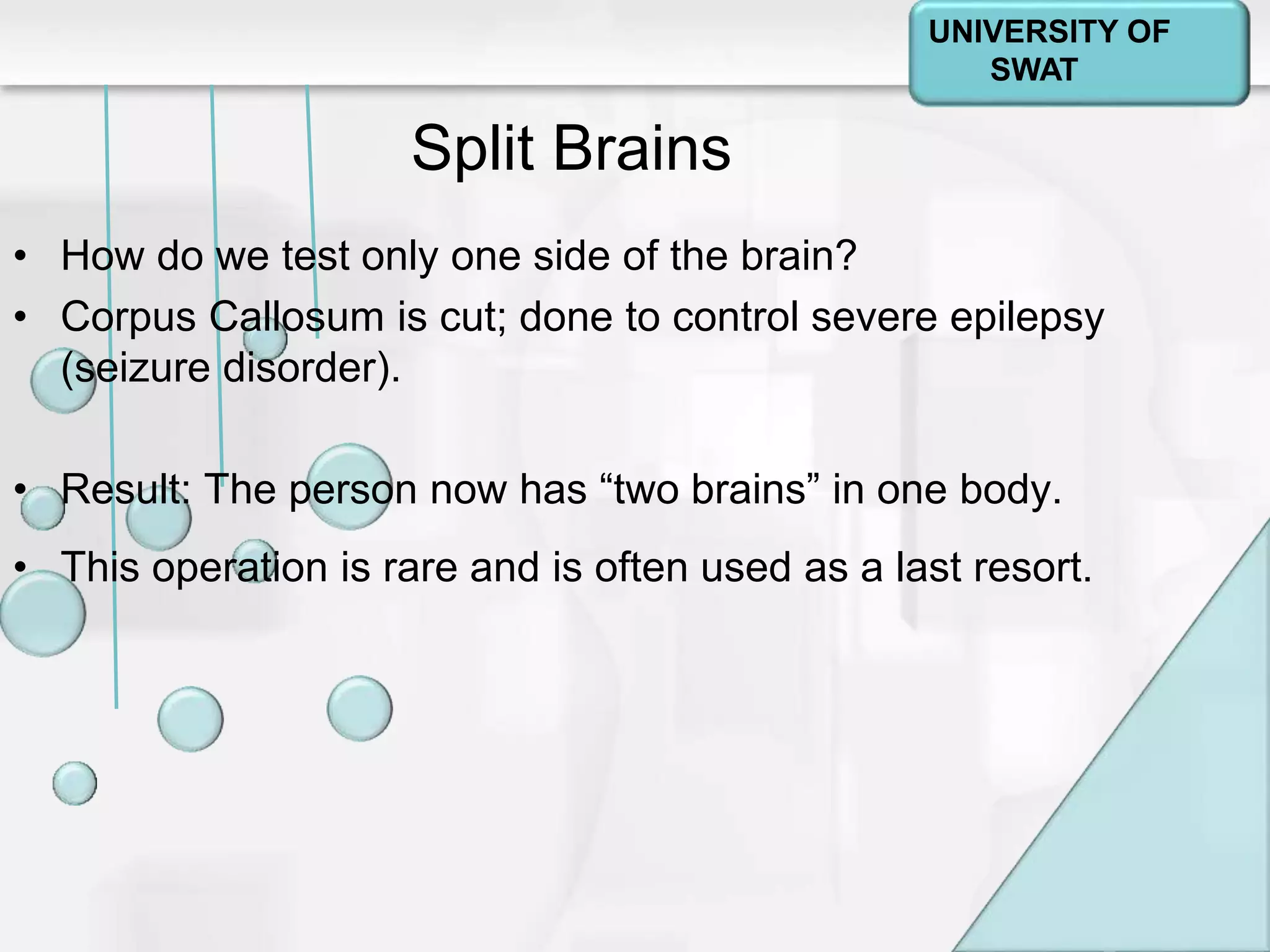
Split Brains
• How do we test only one side of the brain?
• Corpus Callosum is cut; done to control severe epilepsy
(seizure disorder).
• Result: The person now has “two brains” in one body.
• This operation is rare and is often used as a last resort.
UNIVERSITY OF
SWAT
Psychology: A Journey
Chapter 2Figure 2.19
UNIVERSITY OF
SWAT
Psychology: A Journey
Chapter 2
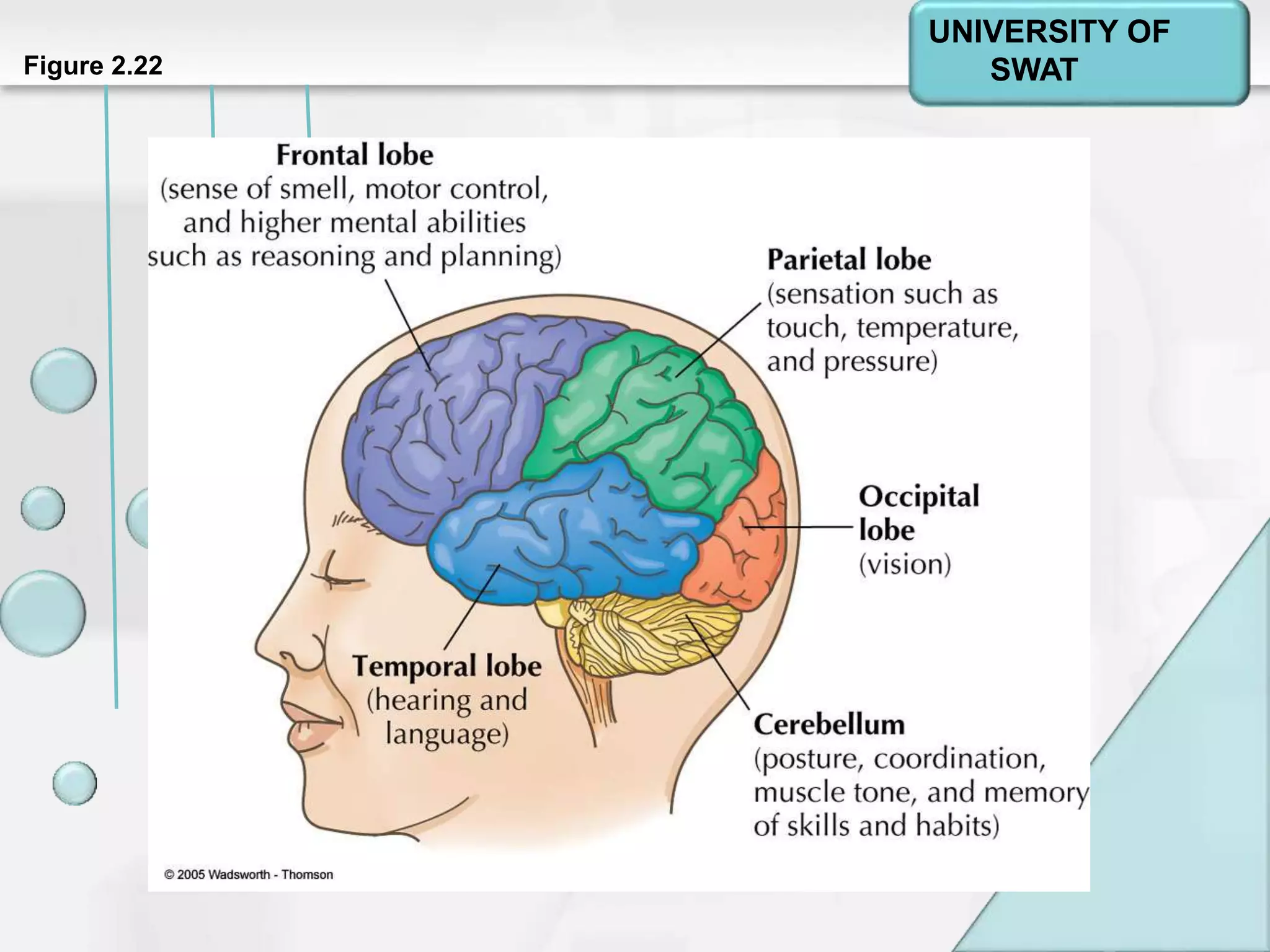
Central Cortex Lobes
• As discussed, the cerebral cortex can be divided into two
hemispheres.
• We can further divide the cortex into several smaller
areas called lobes.
UNIVERSITY OF
SWAT
Psychology: A Journey
Chapter 2Figure 2.22
UNIVERSITY OF
SWAT
Psychology: A Journey
Chapter 2
Which lobe is damaged if…..
• A person is unable to feel or locate the left
side of his/her body?
• A person has difficulty with fine movement
of the right hand?
• A person has loss of vision in the right
visual field?
• A person has hearing loss in the left ear?
UNIVERSITY OF
SWAT
Psychology: A Journey
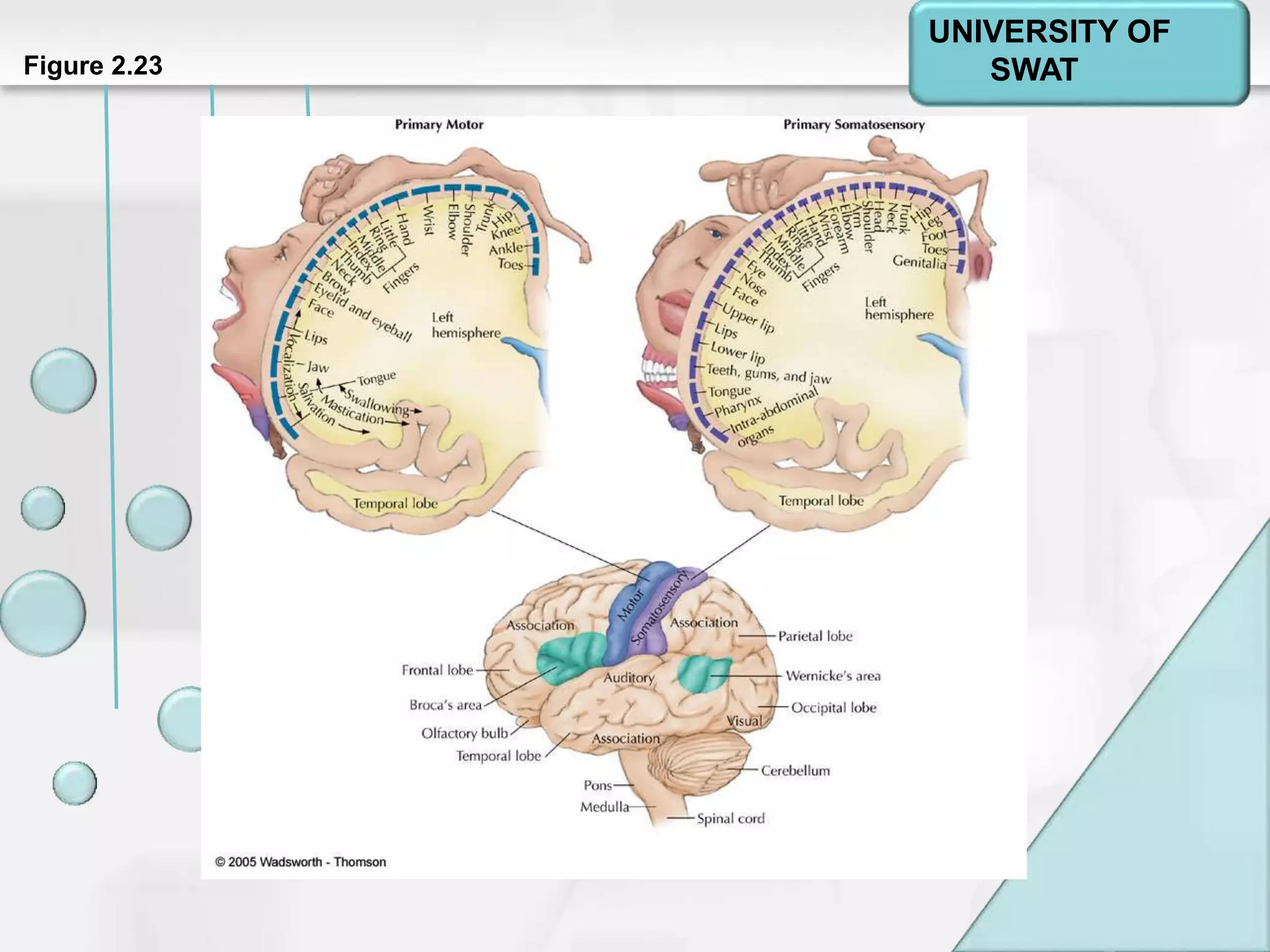
Chapter 2Figure 2.23
UNIVERSITY OF
SWAT
Psychology: A Journey
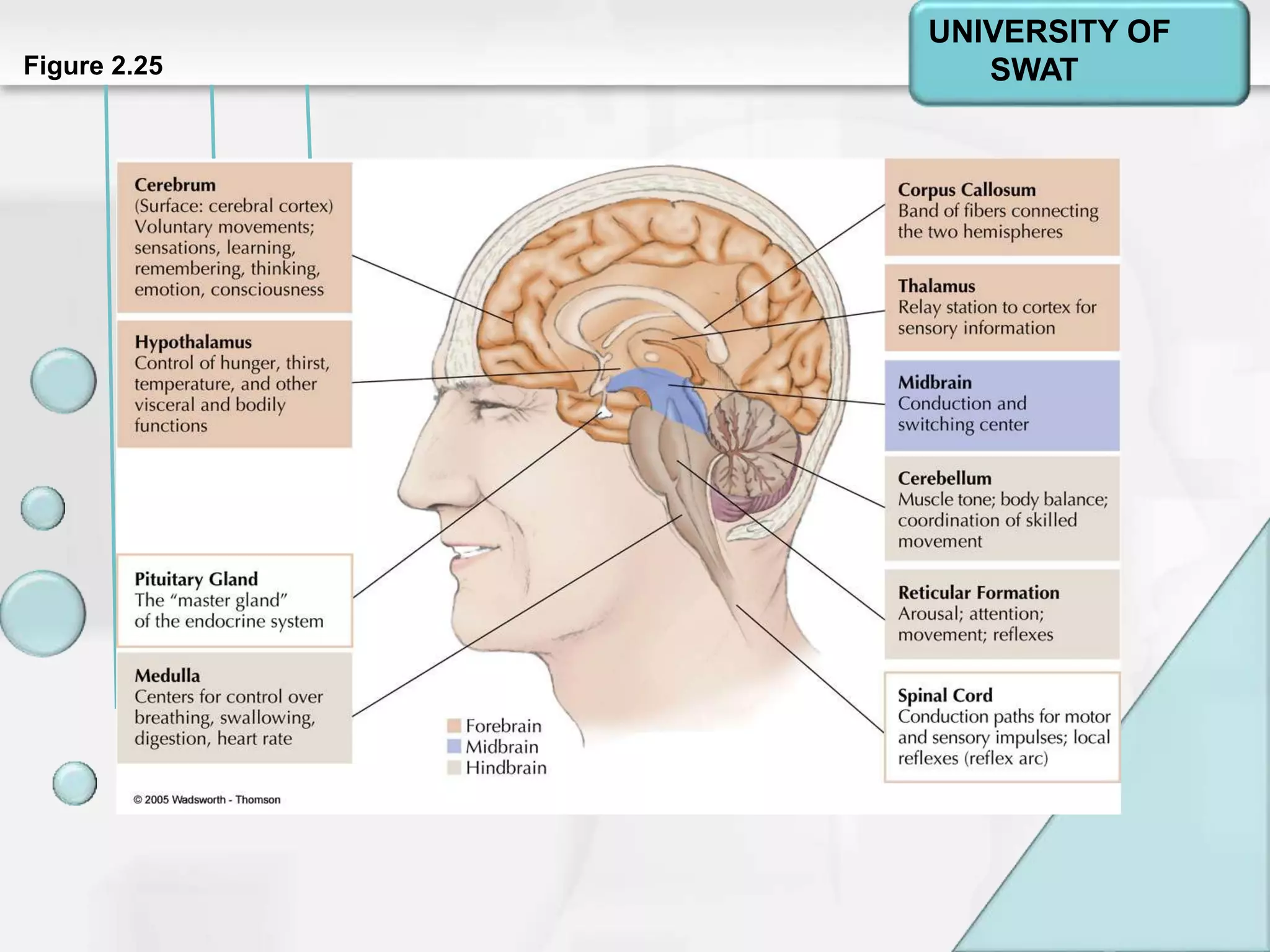
Chapter 2Figure 2.25
UNIVERSITY OF
SWAT
Psychology: A Journey
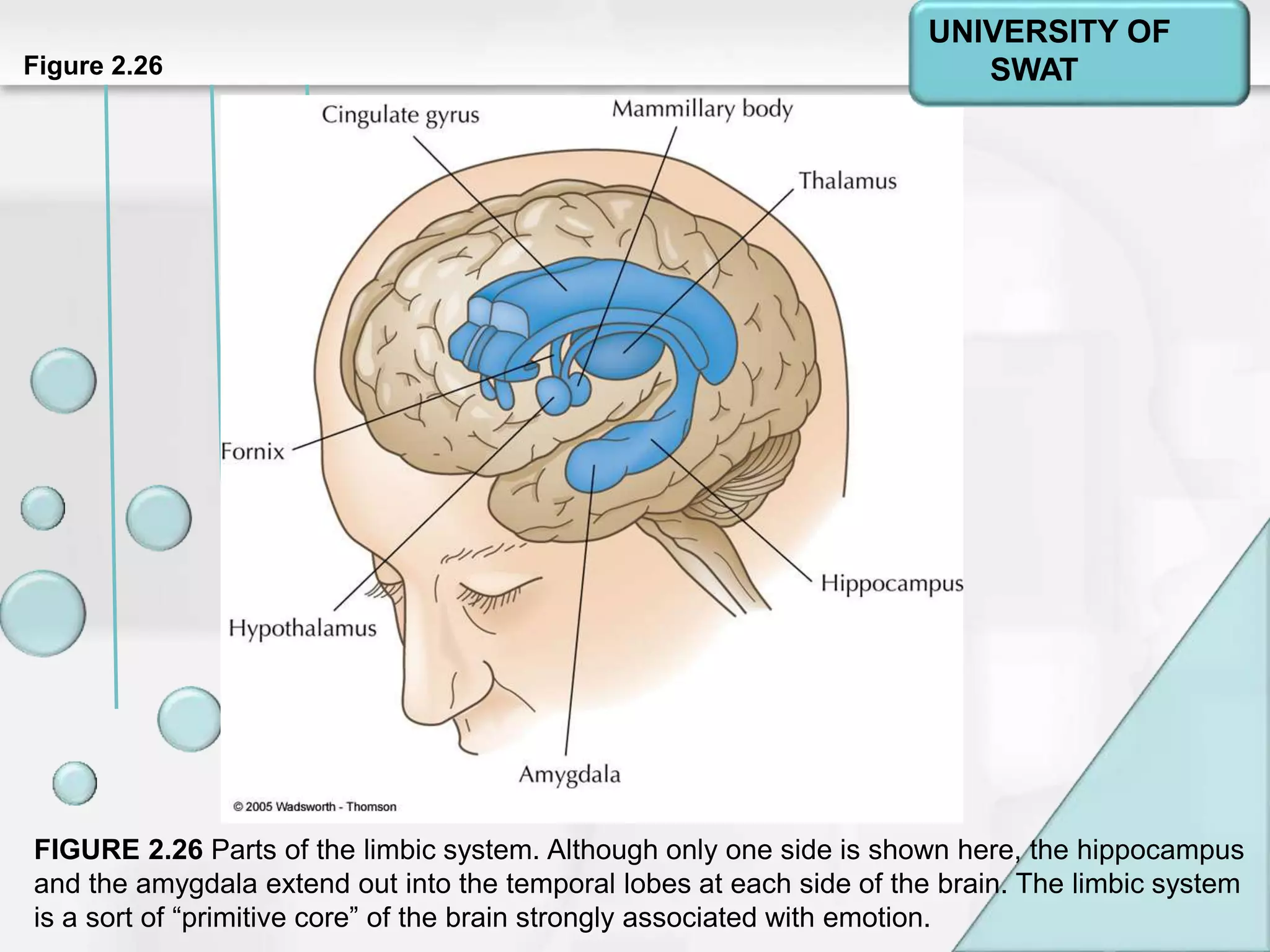
Chapter 2Figure 2.26
FIGURE 2.26 Parts of the limbic system. Although only one side is shown here, the hippocampus
and the amygdala extend out into the temporal lobes at each side of the brain. The limbic system
is a sort of “primitive core” of the brain strongly associated with emotion.
UNIVERSITY OF
SWAT

Brain and behavior

  • 1.
    Psychology: A Journey Chapter2 UNIVERSITY OF SWAT
  • 2.
    Psychology: A Journey Chapter2 Chapter 2 Brain and Behavior UNIVERSITY OF SWAT
  • 3.
    Psychology: A Journey Chapter2 Neuron and Its Parts • Neuron: Individual nerve cell – Dendrites: Receive messages from other neurons – Soma: Cell body; body of the neuron – Axon: Fiber that carries information away from the cell body – Axon Terminals: Branches that link the dendrites and somas of other neurons UNIVERSITY OF SWAT
  • 4.
    Psychology: A Journey Chapter2Figure 2.1 UNIVERSITY OF SWAT
  • 5.
    Psychology: A Journey Chapter2 The Nerve Impulse • Resting Potential: Electrical charge of an inactive neuron • Threshold: Trigger point for a neuron’s firing • Action Potential: Nerve impulse • Negative After-Potential: When a neuron is less willing to fire UNIVERSITY OF SWAT
  • 6.
    Psychology: A Journey Chapter2Figure 2.2 UNIVERSITY OF SWAT
  • 7.
    Psychology: A Journey Chapter2Figure 2.4 FIGURE 2.4 The interior of an axon. The right end of the top axon is at rest. Thus, it has a negative charge inside. An action potential begins when ion channels open and sodium ions (Na+) rush into the axon. In this drawing, the action potential would travel from left to right along the axon. In the lower axon, the action potential has moved to the right. After it passes, potassium ions (K+) flow out of the axon. This quickly renews the negative charge inside the axon, so it can fire again. Sodium ions that enter the axon during an action potential are pumped out more slowly. Removing them restores the original resting potential. UNIVERSITY OF SWAT
  • 8.
    Psychology: A Journey Chapter2Figure 2.3 UNIVERSITY OF SWAT
  • 9.
    Psychology: A Journey Chapter2 Synapses  Messages from one neuron to another pass over a microscopic gap between neurons called a synapse UNIVERSITY OF SWAT
  • 10.
    Psychology: A Journey Chapter2 Neurotransmitters  Chemicals in the brain that alter activity in neurons • Receptor Site: Areas on the surface of neurons and other cells that are sensitive to neurotransmitters • Our knowledge of these chemicals is incomplete. Suspected effects of 6 of them are displayed on the following table. UNIVERSITY OF SWAT
  • 11.
  • 12.
    Psychology: A Journey Chapter2 Neurotransmitters and Behavior • Parkinson’s Disease – Parkinson’s Disease is a condition in which the individual has trouble executing voluntary movements, and has tremors, rigidity and a depressed mood. – This condition has been linked to a gradual decay in a system of axons that release the neurotransmitter dopamine. UNIVERSITY OF SWAT
  • 13.
    Psychology: A Journey Chapter2 – Why does the communication between neurons have to be both an electrical and chemical process? Why not just electrical? UNIVERSITY OF SWAT
  • 14.
    Psychology: A Journey Chapter2 Nerves and Neurons • Nerves: Large bundles of axons and dendrites • Myelin: Fatty layer of tissue that coats axons • Saltatory conduction: nerve impulses traveling down an axon coated with myelin jump from gap to gap in the myelin layer. • What condition results when one’s immune system destroys the myelin layer of axons? UNIVERSITY OF SWAT
  • 15.
    Psychology: A Journey Chapter2 Neural Networks • Central Nervous System (CNS): Brain and spinal cord • Peripheral Nervous System: All parts of the nervous system outside of the brain and spinal cord – Somatic System: Links spinal cord with body and sense organs; controls voluntary behavior via sensory neurons and motor neurons – Autonomic System: Serves internal organs and glands; controls automatic functions such as heart rate and blood pressure UNIVERSITY OF SWAT
  • 16.
    Psychology: A Journey Chapter2Figure 2.8 Two Divisions of the Autonomic System UNIVERSITY OF SWAT
  • 17.
    Psychology: A Journey Chapter2Figure 2.7 FIGURE 2.7 Subparts of the nervous system. UNIVERSITY OF SWAT
  • 18.
    Psychology: A Journey Chapter2 • Definition: Outer layer of the cerebrum • Cerebrum: Two large hemispheres that cover upper part of the brain • Cerebral Hemispheres: Right and left halves of the cortex • Corpus Callosum: Bundle of fibers connecting cerebral hemispheres Cerebral Cortex UNIVERSITY OF SWAT
  • 19.
    Psychology: A Journey Chapter2 Hemispheric specialization Some cortical functions are localized to a particular hemisphere of the brain. UNIVERSITY OF SWAT
  • 20.
    Psychology: A Journey Chapter2 Hemispheric Specialization UNIVERSITY OF SWAT
  • 21.
    Psychology: A Journey Chapter2Figure 2.21 UNIVERSITY OF SWAT
  • 22.
    Psychology: A Journey Chapter2 Split Brains • How do we test only one side of the brain? • Corpus Callosum is cut; done to control severe epilepsy (seizure disorder). • Result: The person now has “two brains” in one body. • This operation is rare and is often used as a last resort. UNIVERSITY OF SWAT
  • 23.
    Psychology: A Journey Chapter2Figure 2.19 UNIVERSITY OF SWAT
  • 24.
    Psychology: A Journey Chapter2 Central Cortex Lobes • As discussed, the cerebral cortex can be divided into two hemispheres. • We can further divide the cortex into several smaller areas called lobes. UNIVERSITY OF SWAT
  • 25.
    Psychology: A Journey Chapter2Figure 2.22 UNIVERSITY OF SWAT
  • 26.
    Psychology: A Journey Chapter2 Which lobe is damaged if….. • A person is unable to feel or locate the left side of his/her body? • A person has difficulty with fine movement of the right hand? • A person has loss of vision in the right visual field? • A person has hearing loss in the left ear? UNIVERSITY OF SWAT
  • 27.
    Psychology: A Journey Chapter2Figure 2.23 UNIVERSITY OF SWAT
  • 28.
    Psychology: A Journey Chapter2Figure 2.25 UNIVERSITY OF SWAT
  • 29.
    Psychology: A Journey Chapter2Figure 2.26 FIGURE 2.26 Parts of the limbic system. Although only one side is shown here, the hippocampus and the amygdala extend out into the temporal lobes at each side of the brain. The limbic system is a sort of “primitive core” of the brain strongly associated with emotion. UNIVERSITY OF SWAT