arXiv:1502.01794v2[astro-ph.SR]26Feb2015
Mon. Not. R. Astron. Soc. 000, 1–?? (2002) Printed 27 February 2015 (MN LATEX style file v2.2)
Multiwavelength observations of NaSt1 (WR 122):
Equatorial mass loss and X-rays from an interacting
Wolf-Rayet binary
Jon Mauerhan1⋆
, Nathan Smith2
, Schuyler D. Van Dyk3
, Katie M. Morzinski2
,
Laird M. Close2
, Philip M. Hinz2
, Jared R. Males2
, and Timothy J. Rodigas4
1Department of Astronomy, University of California, Berkeley, CA 94720-3411, USA
2Steward Observatory, University of Arizona, 933 N. Cherry Ave., Tucson, AZ 85721, USA
3IPAC/Caltech, Mail Code 100-22, Pasadena, CA 91125, USA
4Department of Terrestrial Magnetism, Carnegie Institute of Washington, 5241 Broad Branch Road, NW, Washington, DC 20015, USA
Accepted 0000, Received 0000, in original form 0000
ABSTRACT
NaSt1 (aka Wolf-Rayet 122) is a peculiar emission-line star embedded in an extended
nebula of [N ii] emission with a compact dusty core. This object was characterized by
Crowther & Smith (1999) as a Wolf-Rayet (WR) star cloaked in an opaque nebula
of CNO-processed material, perhaps analogous to η Car and its Homunculus nebula,
albeit with a hotter central source. To discern the morphology of the [N ii] nebula
we performed narrowband imaging using the Hubble Space Telescope and Wide-field
Camera 3. The images reveal that the nebula has a disk-like geometry tilted ≈12◦
from edge-on, composed of a bright central ellipsoid surrounded by a larger clumpy
ring. Ground-based spectroscopy reveals radial velocity structure (±10 km s−1
) near
the outer portions of the nebula’s major axis, which is likely to be the imprint of
outflowing gas. Near-infrared adaptive-optics imaging with Magellan AO has resolved
a compact ellipsoid of Ks-band emission aligned with the larger [N ii] nebula, which
we suspect is the result of scattered He i line emission (λ2.06 µm). Observations with
the Chandra X-ray Observatory have revealed an X-ray point source at the core of
the nebula that is heavily absorbed at energies < 1 keV and has properties consistent
with WR stars and colliding-wind binaries. We suggest that NaSt1 is a WR binary
embedded in an equatorial outflow that formed as the result of non-conservative mass
transfer. NaSt1 thus appears to be a rare and important example of a stripped-envelope
WR forming through binary interaction, caught in the brief Roche-lobe overflow phase.
Key words: stars: individual (NaSt1) – stars: emission-line – stars: peculiar – stars:
Wolf-Rayet – stars: mass loss
1 INTRODUCTION
The physical processes by which massive stars shed their
hydrogen envelopes and become Wolf-Rayet (WR) stars
present an interesting challenge to the standard stellar evo-
lutionary paradigm (see review by Smith 2014 and refer-
ences therein). Mass loss via steady stellar winds is punc-
tuated by discrete, episodic, and sometimes explosive mass
ejections that occur during the post main-sequence, in the
so-called Luminous Blue Variable (LBV) phase (Smith &
Owocki 2006). The physics that trigger and drive these in-
tense bouts of eruptive mass loss are still not understood,
yet this mode is suspected to be a key channel by which
⋆ E-mail: mauerhan@astro.berkeley.edu
H-depleted WRs form. In addition to discrete eruptions, bi-
nary mass transfer via Roche lobe overflow (RLOF) is an-
other very important (perhaps even dominant) channel for
producing stripped-envelope WRs, and may even be critical
to account for Type Ib/c supernova progenitors (Smith et
al. 2011a; Dessart et al. 2012; Hachinger et al. 2012). Since
the time-scale of eruptive mass loss in such systems is brief,
only a precious few Galactic examples exist, especially for
cases where stellar multiplicity (i.e., binary vs. single) is an
influential factor. A particularly interesting example is RY
Scuti – a massive binary undergoing mass transfer that re-
cently resulted in an intense bout of equatorial mass loss,
and where one of the stellar components is likely on its way
to becoming a stripped-envelope WR (Smith et al. 2011b).
c⃝ 2002 RAS
2 Jon Mauerhan et al.
NaSt1, aka WR 122, is an evolved massive star that
has defied characterization. It was discovered by Nassau &
Stephenson (1963), who proposed a WR classification based
on the strong emission-line spectrum. It was later reclassified
as a late nitrogen-type WR (WN type) based on nitrogen
emission-line ratios in the optical spectrum (Massey & Conti
1983), then later proposed to be a B[e], O[e], or Ofpe/WN9
star based on its optical–IR spectral properties (van der
Hucht 1997). Subsequently, more detailed multi-wavelength
investigation by Crowther & Smith (1999; hereafter CS99)
showed that although NaSt1 is indeed a hot luminous ob-
ject with L ∼ 105.1
–106.1
L⊙, its emission-line spectrum is
mostly of nebular origin, not stellar. Moreover, ground-based
narrowband imaging through an [N ii] filter centered near
wavelength λ6584 ˚A revealed the presence of a compact cir-
cumstellar nebula with a diameter of ≈7′′
, whose elongated
yet poorly resolved dimensions gave the impression of pos-
sible bipolar morphology. No comparable extended compo-
nent was inferred for H i gas based on the much weaker de-
tection of nebulosity in images through a broader Hα+[N ii]
filter (which could simply be attributable to [N ii] emission
in the passband). He i and He ii narrowband images revealed
no extended component either.
Derivation of the chemical abundances in NaSt1’s neb-
ula via quantitative spectroscopy by CS99 showed it to be
extremely nitrogen enriched yet carbon and oxygen defi-
cient, which indicates that the nebula consists of highly
CNO-processed material ejected from an evolved massive
star. CS99 pointed out that the only other massive star
known to be enshrouded in a nebula having a compara-
ble level of nitrogen enrichment is the LBV+OB binary η
Car and its Homunculus nebula (Davidson et al. 1986; Du-
four et al. 1997; Smith & Morse 2004). However, CS99 note
that the chemical abundance ratios in the NaSt1 nebula are
characteristic of a WR, and probably inconsistent with a
red supergiant or H-rich LBV. Moreover, the derived ion-
ization potential requires that the central ionizing source
be T >> 30 kK, which suggests a spectral subtype earlier
than WN6–7. The absence of the characteristic broad emis-
sion lines from a WR wind, however, implies that the stel-
lar system is deeply embedded in an opaque nebula. High-
resolution spectroscopy by CS99 revealed that the nebular
lines have a double-peaked morphology, which suggests com-
plex geometry for the outflow.
NaSt1 also exhibits strong thermal excess from circum-
stellar dust, but from a much more compact region than the
[N ii] nebula. CS99 presented evidence for a two-temperature
spectral energy distribution in the infrared, consisting of
warm (T ≈ 700 K) and hot (T ≈ 2000 K) components.
A mid-infrared spectrum by Smith & Houck (2001) showed
it to be mostly featureless in the 8–14 µm wavelength range,
with the exception of two narrow nebular lines of [Fe ii] and
[Ne ii]. The results of mid-infrared interferometric imaging
at ∼ 10 µm wavelength by Rajagopal et al. (2007) were con-
sistent with at least two infrared components having angular
sizes within 50–60 mas. Based on the likely distance range of
1–3 kpc and on the measured outflow velocities from CS99,
the results of Rajagopal et al. (2007) imply that the dust
originates from within <100 AU of the central source1
and
thus has a short dynamical timescale of only 30 yr, which
implies only very recent and likely ongoing dust formation.
By comparison, the outer [N ii] nebula has a much larger
size of ≈7′′
(6,800–22,400 AU). The presence of an addi-
tional component of faint thermal dust emission associated
with the extended nebular structure, to our knowledge, has
never been assessed with sufficient spatial resolution.
The collective properties of NaSt1 led CS99 to con-
clude that this object could be a WR cloaked in an η Car-
like ejection nebula, while the interferometry of Rajagopal
et al. (2007) motivates a search for extended structure in
the near-infrared. Here, we investigate the situation further
by obtaining high-resolution narrowband images of NaSt1’s
nebula in the light of [N ii] using the Hubble Space Tele-
scope (HST), and adaptive-optics (AO) imaging in the near-
infrared with Magellan AO. Moreover, the possible presence
of a WR star in an η Car-like system also warrants the
search for an X-ray counterpart to NaSt1, which could be
expected to arise from shocks produced by hypersonic wind
flows that are often associated with WRs. NaSt1 was not
detected by the ROSAT all-sky Survey, but this is not par-
ticularly surprising, given the relatively shallow sensitivity
of this survey, in conjunction with the estimated distance
to the source and the anticipated absorption to X-rays with
energies ≤ 1–2 keV from interstellar material. Thus, we have
obtained deeper X-ray imaging observations of NaSt1 using
the Chandra X-ray Observatory. The resulting data from
these space-based and AO facilities provide new important
clues for the nature and evolutionary status of this object.
2 OBSERVATIONS AND RESULTS
2.1 Narrowband [N ii] imaging with HST/WFC3
NaSt1 was first observed with HST on 2013 March 20
(UT 02:34) using the Wide-field and Planetary Camera 3
(WFC3). Five 176 s exposures were obtained through both
the F658N and F645N filters, which have peak transmis-
sion wavelengths centered on the [N ii] λ6584 ˚A line and
the adjacent continuum, respectively. A five-point sub-pixel
dither pattern (WFC3-UVIS-DITHER-BOX) was executed
between individual exposures to improve sampling of the
WFC3 point spread function (PSF). Since NaSt1 exhibits a
small angular size, images were read out in a 1K×1K sub-
array mode to decrease readout overhead. To mitigate the
effect of degrading charge transfer efficiency (CTE) in the
WFC3 CCD chip, a 12 e−
post-flash was performed at the
end of each exposure, which slightly elevated the background
counts and mitigated against CTE losses.
Some of the F658N and F645N images obtained on
March 20 were severely degraded because the fine-guidance
sensors failed to track the guide stars from the Guide Star
Catalog, which turned out to be blends of multiple stars at
HST resolution. The observations thus defaulted to GYRO
pointing control and guiding, with no fine guidance. The
resulting stellar PSFs, which normally have optimal full-
width at half-maximum (FWHM) values of ∼ 0.′′
07, were
1 Note, however, that sensitivity of interferometry to spatial fre-
quencies depends on the distribution of the baselines.
c⃝ 2002 RAS, MNRAS 000, 1–??
Equatorial mass loss and X-rays from NaSt1 3
Figure 1. HST/WFC3 narrowband images of NaSt1 through F658N and F645N filters (logarithmic stretch), corresponding to the [N ii]
emission line and adjacent continuum, respectively (upper panels). The lower panels show the F658N image with the central point source
removed, and a 3-pixel smoothed version.
highly elliptical and, in some cases, double-peaked, exhibit-
ing FWHM values ranging from ∼ 0.′′
10 to ∼ 0.′′
19. Although
several of the individual images from this visit were salvage-
able and scientifically useful, the overall telescope drift dur-
ing the exposures significantly limited our planned imaging
sensitivity and resolution. NaSt1 was thus re-observed on 27
April 2013 (UT 21:04), using an observing strategy identi-
cal to the 20 March observations, although with new guide
stars that were confirmed to be single. The repeated obser-
vations achieved the intended sub-pixel dithering accuracy
and yielded images with FWHM PSF cores of 0.′′
09 using
the Multidrizzle pipeline. Three of the lesser quality F658N
[N ii] images and two of the F654N images from the initial
observations were of acceptable quality and worth adding
into our final drizzled image.
Figure 1 shows the drizzled F658N and F654N images
of NaSt1. Two sets of diffraction spikes with different in-
tensities can be seen, as a result of combining images from
two separate visits with HST at different roll angles for the
spacecraft. The nebula is clearly discernible in the F658N
image, while no extended structure is immediately appar-
ent in the F654N image. Subtraction of the bright cen-
tral point source was challenging, and the most optimal
strategy for getting the best possible subtraction was dif-
ficult to converge upon. The F658N line and F654N con-
tinuum filters produce PSFs that have substantially differ-
ent speckle distributions and Airy-ring patterns, so simple
subtraction of the continuum image from the line image
did not produce satisfactory results, leaving large residu-
als with complex mottled structure. Furthermore, both fil-
ters exhibit unique ring-like ghost patterns that extend to
≈ 0.′′
9 from the PSF centroid2
. Subtraction of artificial PSFs
2 WFC3 Instrument Handbook (§6.5.3).
generated by the Tiny Tim software also produced unsat-
isfactory results, since the PSF models do not account for
filter-dependent ghost artifacts. We thus found that the best
strategy for subtracting the central point source was to use
a bright neighboring star from the same images, 15′′
away
from NaSt1. We cut out a sub-image centered on this star,
smoothed the pixels outside of the PSF halo to mitigate
the effect of added noise to the subtracted image, and then
scaled the ‘model’ incrementally to find the optimal subtrac-
tion that minimized the difference residuals. In the end, the
best scale factor of 0.8 removed all the higher-order resid-
ual features in the subtracted image very well (the Airy
rings, speckles, and diffraction spikes), but left a substantial
amount of point-like [N ii] emission at the core of the neb-
ula. Some of this point-like emission could be real, or could
also be an artifact of imperfect subtraction. To check for
the presence of compact continuum emission, we performed
the same strategy for the F645N image and determined that
there is no detection of an extended component from con-
tinuum emission or scattered light at the image resolution,
just noise residuals.
Equatorial geometry
The lower panels of Figure 1 show the star-subtracted F658N
image and a 3-pixel smoothed version, which shows the inner
structure of the nebula more clearly. Overall, NaSt1’s nebula
exhibits a complex multi-component structure having disk-
like morphology with approximate major and minor axes of
7′′
and 2′′
, respectively, corresponding to an axis ratio ≈3.5.
The emitting material thus appears to have equatorial dis-
tribution and, if approximately circular, is tilted at an angle
of ≈ 12 ± 3◦
from edge-on (inclination angle of i = 78 ± 3◦
).
The central point source is slightly offset by 60 mas from
the geometric center of the nebula, as determined by the
distribution of isophotal contours of the faintest outer re-
c⃝ 2002 RAS, MNRAS 000, 1–??
4 Jon Mauerhan et al.
Figure 2. Left: star-subtracted 3-pixel smoothed F658N image of NaSt1 (logarithmic stretch), displayed in false color to enhance the
nebular structure. Right: same as above with 9-pixel smooth and more extreme stretch to enhance the faint outer nebula. Flux contours
of the brighter central regions from the 3-pixel smoothed image are overlaid for reference. The orientation of the images is the same as
in Figure 1.
gions. Figure 2 shows smoothed false-color versions of the
star-subtracted [N ii] image. The inner portion of the nebula
is composed of a relatively bright and smooth central ellip-
soid with major and minor axes of 2.′′
3 and 0.′′
6, respectively,
consistent with the same axis ratio as the greater structure.
Based on the distribution of isophotal contours, the central
point source also appears to be slightly offset from the center
of this inner ellipse by 50 mas. Outside of the central ellipse
there is a gap ≈1′′
in length along the major axis, most
notably on the south-west side. Beyond this gap, the outer
nebula is composed of a clumpy ring or arm that can possi-
bly be traced around the entirety of the structure. There is a
particularly bright cluster or knot of emission clumps within
this outer structure, at ≈1.′′
4 south/south-west of the cen-
tral point source. The brightest regions of the outer ring on
either side of the center appear to have approximate point-
reflection symmetry, which hints at a spiral structure for the
outer ring/arm(s). The offset of the central point source from
the apparent geometric center of the nebula could also be
an indication of a one-armed spiral morphology. A highly
contrast-stretched 9-pixel smoothed image (Figure 2, right
panel) shows faint nebular structure with a full diameter of
7.′′
7.
2.2 Optical spectroscopy
Optical spectroscopy of NaSt1 was performed on 2012 March
31 using the 2.3 m Bok Telescope at Kitt Peak, Arizona. A
low-resolution grating having 400 l mm−1
was used in con-
junction with a 1.′′
5 slit to achieve a FWHM spectral resolu-
tion of 4.6 ˚A and a wavelength range of λλ4150–7200 ˚A. Four
exposures of 120 s each were obtained at an airmass of 1.5–
1.6 and median combined into a final spectrum. Flat fielding
and wavelength calibration were performed by taking spec-
tral images of the internal continuum and arc lamps at the
beginning of the night. Flux calibration was performed us-
ing spectra of the white dwarf standard star BD+42 2811.
Spectroscopy was not performed with the slit aligned to the
parallactic angle, so some loss of blue light is expected. All
image and spectral reductions were conducted using stan-
dard iraf routines.
Spectroscopy of NaSt1 was also performed on 2012 Oct
17 with the 6.5 m telescope at MMT Observatory using the
Bluechannel spectrograph. The 1200 l mm−1
grating was uti-
lized with a 1′′
slit to achieve a dispersion of ≈0.5 ˚A per pixel
(≈20 km s−1
pixel−1
). For this observation, the slit was ori-
ented at 31◦
from north, approximately parallel to the major
axis of the nebula. This strategy was used in order to search
for kinematic features that might be discernible along the
resolved axis of the nebula. Three exposures of 300 s each
were obtained at an airmass of 1.4 and median combined
into a final spectrum. Flat fielding and wavelength calibra-
tion were performed by taking spectral images of the internal
continuum and arc lamps at the beginning and end of the
night. Flux calibration was performed using spectra of the
white dwarf standard star Feige 34. Since the slit was not
aligned with the parallactic angle, some loss of blue light is
expected.
Figure 3 shows the low- and moderate-resolution optical
spectra of NaSt1 from Bok and MMT. The spectral mor-
phology is mostly nebular in nature, exhibiting a complex
mix of permitted and forbidden emission lines spanning a
broad range of ionization. The comparatively higher reso-
lution spectrum from MMT shows the resolved Na i D dou-
c⃝ 2002 RAS, MNRAS 000, 1–??
Equatorial mass loss and X-rays from NaSt1 5
Figure 3. Optical spectra of NaSt1 from Bok (upper spectrum) and MMT (lower spectrum). The most prominent nebular features have
been marked (see CS99 for a comprehensive list of all emission lines).
Figure 4. Radial velocity of the [N ii] λ6584 profile (left panel, solid curve) as a function of position along the slit (middle panel), which
was approximately aligned with the major axis of the nebula, and the same for an arc line of Ne i ≈ 6599 ˚A (right panel). Real kinematic
motion for the outer nebula of NaSt1 is apparent. Note that velocity measurements for offsets < 2′′ are dominated by emission from the
central point source, and are not reliable.
blet from interstellar (and, perhaps, circumstellar) absorp-
tion along the line of sight. The MMT spectrum also shows
extended Lorentzian wings for the Hα, close examination of
which shows a full possible extent of at least ≈ ±2000 km s−1
for the wing edges; this Lorentzian profile indicates that Hα
is not entirely nebular in origin, and suggests that some of
the flux is from a physically distinct region of high optical
depth, where electron scattering could be occurring. Nar-
rower wings might also be associated with the He λ6680 ˚A
profile, but not at the level observed for Hα. Overall, the op-
tical spectra presented here are consistent with the previous
observations of CS99, and we find no substantial spectral dif-
ferences between the epochs presented here or with respect
to the measurements in the literature.
c⃝ 2002 RAS, MNRAS 000, 1–??
6 Jon Mauerhan et al.
Figure 5. Top: spatial profile of selected emission lines along the
spectrograph slit, which was tilted near the long axis of the nebula
at 35◦. The lines are scaled in intensity to roughly match the peak
of the [N ii] λ6584 feature. The nebula is clearly resolved in the
[N ii] transitions. The bumps on either side of the continuum
profile are an artifact of the scaling up of the continuum, and are
not real resolved continuum structure.
Spatially resolved kinematics
Figure 4 (center panel) shows a two-dimensional spectral im-
age of the [N ii] λ6584 line from the MMT observation, for
which the slit was aligned along the major axis of the neb-
ula. A similar image of a neighboring arc line (right panel)
from the calibration exposures is also shown for comparison.
The left panel of Figure 4 shows the measured shift in ra-
dial velocity of [N ii] along the spatial axis, which exhibits
an ‘S’ shaped curve having a peak velocity of ±10 km s−1
at ≈3′′
from the center of the continuum dispersion axis
(we note that the velocity measurements for offsets < 2′′
are dominated by emission from the PSF of the central
point-source, and are thus not reliable tracers of the neb-
ular velocity at those positions). We do not see any such
velocity structure associated with Hα or He i; this is to be
expected, since these features are spatially unresolved. For
example, Figure 5 shows the spatial profile of [N ii] along the
slit compared to Hα, He i, and the continuum adjacent to
[N ii] λ6584. It is apparent that the [N ii] emission from the
nebula is resolved, while the other prominent lines and the
continuum are not.
It thus appears likely that the [N ii] emission exhibits
real kinematic structure that is intrinsic to the object, likely
to be an imprint of outflowing gas. If the nebula is an ex-
panding disk or ring then the relative motions of gas along
the slit, which are aligned to the major axis of the neb-
ula, will be mostly transverse, not radial. In this case, the
true expansion velocity could be significantly higher. Spec-
troscopy with high spatial and spectral resolution, sampled
along the minor axis of the nebula is necessary to gauge the
true velocity structure.
3 INFRARED IMAGING AND
SPECTROSCOPY
3.1 AO imaging with MagAO+Clio2
Near-infrared AO images were obtained on 2013 April 7 with
the Magellan 6.5 m Clay telescope at Las Campanas Ob-
servatory during commissioning of the MagAO and Clio2
instrument (Morzinski et al. 2014). The wide camera was
used, yielding a plate scale of 27.5 mas and a field of view
of 28′′
× 14′′
. NaSt1 itself served as the natural guide star
for the AO system. Thirty images of 40 coadds each were
obtained through a Ks filter and 10 images of 40 coadds
each were obtained through L′
and M′
filters. The L′
and
M′
observations also included a neutral-density (ND) fil-
ter to prevent saturation of the detector. We note that
the Ks filter setup used throughout the observing run did
not have a long-wavelength blocker, which resulted in a
small amount of leakage of light from 3–5 µm wavelengths
(hereafter, reference to the Ks band includes the potential
for some long-wavelength leakage). The telescope was nod-
ded by 4′′
between exposures for background subtraction.
No flat-fielding was performed. The background-subtracted
data were then median combined into final image frames for
each filter. Three field stars in the Clio2 image have entries
in the United Kingdom Infrared Deep Sky Survey (UKIDSS;
Lawrence et al. 2007) Galactic Plane Survey (GPS) catalog
(Data Release 7), and were used to calibrate the astrome-
try. Two of those stars were also present in the HST/WFC3
frame, which enabled us to align the astrometry of the op-
tical and infrared images to a relative accuracy of 0.′′
064 in
physical arcsec.
Figure 6 (upper three panels) shows the MagAO/Clio2
images of NaSt1 in the three infrared bands. At M′
NaSt1
appears to be unresolved, as the diffraction-limited structure
of the circular PSF is clearly discernible in the form of mul-
tiple concentric Airy rings. The FWHM of the M′
PSF cen-
troid is 5.96 pixels, which corresponds to an angular size of
164 mas. At L′
the FWHM is 142 mas and the first Airy ring
is marginally discernible. The PSF halo is asymmetrically
bright, which could indicate that the source is marginally
resolved. The Ks-band image, by comparison, shows that
the source is fully resolved into an ellipsoidal structure that
is aligned with the halo asymmetry observed at L′
. The
FWHM of the Ks centroid along the longest axis is 171 mas,
substantially broader than the PSF centroids of the L′
and
M′
images. It thus seems unlikely that the ellipsoidal struc-
ture in the Ks band has resulted from the small amount of
potential leakage from 3–5 µm light. Moreover, observations
of an unresolved star (2MASS J12073100−3932281) having
the same Strehl ratio produced a substantially more com-
pact stellar Ks PSF having FWHM=123 mas. In addition,
observations of HD 73634, which is comparably bright to
NaSt1 in the 3–5 µm range, produced a stellar PSF having
FWHM=126 mas. Any potential degradation of the stellar
PSF from long-wavelength leakage, if present, should have
been noticeable in the images of this star as well. No such
effect is observed, and we thus conclude that the extended
Ks-band emission around NaSt1 is real. At L′
and M′
, how-
ever, NaSt1 has the same FWHM size as the comparison
stars and thus appears to be unresolved at these longer
wavelengths, although it is possible that there is marginally
resolved structure in the halo of the L′
source.
c⃝ 2002 RAS, MNRAS 000, 1–??
Equatorial mass loss and X-rays from NaSt1 7
M'Ks L'
MagAO Clio2 Ks HST + Ks contour
1”
Figure 6. Upper panels: MagAO Ks, L′, and M′ images of NaSt1
in false color. The images are ≈2.′′7 square in angular size and ori-
ented in detector coordinates. Lower panels: the Ks-band image
of NaSt1 with logarithmic intensity contours (left) and the HST
[N ii] narrow-band image from Figure 2 with the Ks contours
overlaid (right). An ellipsoid of extended Ks emission is clearly
resolved, and is approximately aligned with the major axis of the
optical nebula. The lower images are oriented with north up and
east toward the left.
Figure 6 (lower panels) also compares the extended Ks
image of NaSt1 to the [N ii] image from HST. Interestingly,
the position angle of the Ks ellipsoid on the sky is roughly
parallel to that of the major axis of the optical nebula,
which provides further reassurance that the extended in-
frared structure is real.
The FWHM of the long axis in the Ks band (171 mas)
corresponds to a physical diameter of 171–513 AU, given the
range of possible distance (1–3 kpc), and the outmost regions
of the Ks nebula could extend to 700–2100 AU. The near-
infrared angular size is thus substantially larger than the
8–13 µm size measured from the interferometric imaging of
Rajagopal et al. (2007). Those authors found that the an-
gular size of NaSt1 increases from 15 to 20 mas between 8
and 13 µm, respectively. This either implies that their inter-
ferometric measurements were not sensitive to lower spatial
frequencies from relatively large angular sizes of ≥140 mas,
or that the apparent size is of NaSt1 is intrinsically larger
at 2–3 µm than at 8–13 µm, and perhaps not the result of
the same emission source.
3.2 SINFONI spectrum
We obtained infrared spectra of NaSt1 from the European
Southern Observatory (ESO) archive. The object was ob-
served with the ESO VLT (Yepun) telescope on 2005 Aug.
30 using the integral field spectrograph SPIFFI within the
SINFONI module (Eisenhauer et al. 2003). The instrument
delivers a simultaneous three-dimensional data cube with
two spatial dimensions and one spectral dimension. The K-
band (1.95–2.45 µm) grating was used with a resolving power
Figure 7. K-band spectrum of NaSt1 from SINFONI.
R ≈ 4000. The pixel scale was 0.′′
1 with a field of view
of 3.′′
2 square. Observations were performed under seeing-
limited conditions, which were relatively poor at 1.4–1.6 arc-
sec. The airmass during the observations was 1.1. NaSt1 was
thus spatially unresolved by SPIFFI. The data were reduced
using the publicly available ESO SINFONI pipeline. The
K-band spectrum was extracted by averaging all “spaxels”
within an aperture that encompassed the ≈1.′′
5 seeing disk
of the unresolved source. Telluric correction was performed
using a SINFONI spectrum of the B5 star HD 183734 from
nearly the same airmass.
Figure 7 shows the K-band spectrum of NaSt1. The
morphology and relative line strengths appear consistent
with the spectrum presented in CS99. Overall, the spectrum
is dominated by an extremely strong emission line of He i at
λ2.06 µm, and the line profile exhibits Lorentzian wings ex-
tending to ≈ ±2500 km s−1
, similar to the Hα line in the
MMT spectrum (see Figure 3). This morphology suggests
that some of the emission is emerging from a region of high
optical-depth, where electron scattering is occurring. The
total integrated flux across the line amounts to ≈12% of the
integrated counts between 2.0 and 2.3 µm (before telluric
correction). The spectrum also exhibits strong He i emission
at 2.113µm, a blend of Brγ and He i near λ2.166 µm, He ii
at λ2.189µm, and Fe ii at λ2.089 µm.
3.2.1 The nature of the extended Ks-band emission
Based on the infrared SED presented in CS99, NaSt1 is
clearly a strong source of thermal infrared excess emission
from dust, which is composed of at least two dust compo-
nents having respective temperatures of 700 K and 2000 K.
It is thus natural to consider this dust as a potential source
of the extended flux resolved by MagAO in the Ks band.
However, if the extended flux is thermal continuum emission
from dust, then the source should have also been resolved
at M′
(where NaSt1 is brightest) for any reasonable range
of dust temperatures. Indeed, at >171 AU distances from
the central heat source, hot dust formed within an outflow
should have a cooler M′
counterpart with a larger angular
size. Instead, the PSF centroid at M′
is substantially smaller
than the angular size of the resolved source in the Ks band,
and no such extended counterpart is detected. This raises
c⃝ 2002 RAS, MNRAS 000, 1–??
8 Jon Mauerhan et al.
doubts that the extended Ks component results from hot
dust emission.
There is an alternative possibility that the extended
Ks-band emission is the result of photoionization. Given the
extremely bright flux of the He i emission lines observed in
the K-band spectrum, and the approximate sky alignment
between the Ks and [N ii] extended structures, it is plausi-
ble that the MagAO observations resolved the nebula in the
light of He i, the flux of which is dominated by the λ2.06 µm
transition. This also suggests that the marginally resolved
structure in the L′
PSF halo could be extended He i emis-
sion at λ3.703 µm. The compactness of He i relative to [N ii]
would explain why NaSt1 was not spatially resolved from the
ground in the light of He i by our spectroscopy (see Figure 5),
nor by the narrowband imaging of CS99. However, the broad
Lorentzian wings in the He i λ2.06 µm line profile indicate
that electron scattering is occurring, which is not likely to be
efficient in the extended nebula at >171 AU distances from
the central star. Rather, this type of line profile is sugges-
tive of emission from a dense stellar wind, which would have
to be produced near the central star and, hence, in the un-
resolved core of the nebula. Thus, if the broad-winged He i
emission is responsible for the resolved flux at Ks, then it
could be emission from the central stellar wind further scat-
tered into the outer resolved regions by dust that is too cool
to emit its own detectable continuum in the near-infrared.
This could explain the larger angular size at Ks versus M′
,
since dust scattering is more efficient in the former band, as
has been observed in η Car’s Homunculus nebula (Smith et
al. 1998). In this case, however, it is puzzling that no optical
counterpart of dust-scattered light was also detected in our
HST F654N optical continuum image of NaSt1.
Unfortunately, we cannot attribute the He i λ2.06 µm
line profile to specific regions within the nebula resolved by
MagAO, since the source was spatially unresolved by the
SINFONI observations. The broad-winged profile could sim-
ply be from the inner unresolved portion of the nebula, and
a narrower line profile could comprise the extended nebula
resolved at Ks. Future AO-assisted spectroscopy and near-
infrared spectropolarimetry could help discriminate between
direct line emission from the resolved nebula and dust scat-
tering of stellar wind emission emerging from the unresolved
interior.
We conclude that the extended flux at Ks is most likely
to be light from He i λ2.06 µm, where possibly some, and
perhaps most, of the flux could have been scattered out to
>171 AU by dust too cool to emit strongly at Ks, L′
, and
M′
. Therefore, the strong point-source emission at these
wavelengths must be from a compact component of hot dust
near the core, perhaps physically associated with the mid-
infrared source resolved by interferometry (Rajagopal et al.
2007).
4 CHANDRA X-RAY OBSERVATIONS
We observed NaSt1 on 2014 September 24 19:01 UT using
the Chandra X-ray Observatory (Obs. ID 15700) and the
Advanced CCD Imaging Spectrometer (ACIS) instrument
(Weisskopf et al. 2002). A total exposure time of 12 kilosec-
onds resulted in the detection of a faint point source at α =
18:52:17.53 δ = +00:59:44.6 (J2000.0), with an positional
error of 1.′′
25 (90% confidence), consistent with the respec-
tive optical and infrared positions of the bright central point
source from HST and Magellan. The proper designation for
the X-ray source is thus CXOU J185217.53+0059446, in ac-
cordance with the standard naming convention for Chandra
sources.
We extracted the source photometry and spectra using
the ciao routines srcflux and specextract, respectively.
After accounting for the background rate, the total num-
ber of counts attributable to the object is 42 ± 7 in the
broad 0.5–7.0 keV energy band. The associated photon flux
and energy fluxes in this band are 1.20.9
1.6 × 10⁻⁵
cm−2
s−1
and 2.92.2
3.7 × 10⁻¹⁴
erg cm−2
s−1
, respectively (values accom-
panied with 90% confidence envelopes defined by the sub-
script and superscript), and the average energy of the de-
tected emission is ⟨E⟩ = 1.7 ± 0.3 keV. The fluxes within
the individual soft (0.5–1.2 keV), medium (1.2–2.0 keV),
and hard (2.0–7.0 keV) bands are listed in Table 1, along
with the hardness ratios, defined as HRmed−soft = (Fmed −
Fsoft)/(Fsoft + Fmed + Fhard) and similarly for HRhard−med.
The hard band exhibits the largest energy flux, while the
majority of counts are in the medium band between 1 and
2 keV.
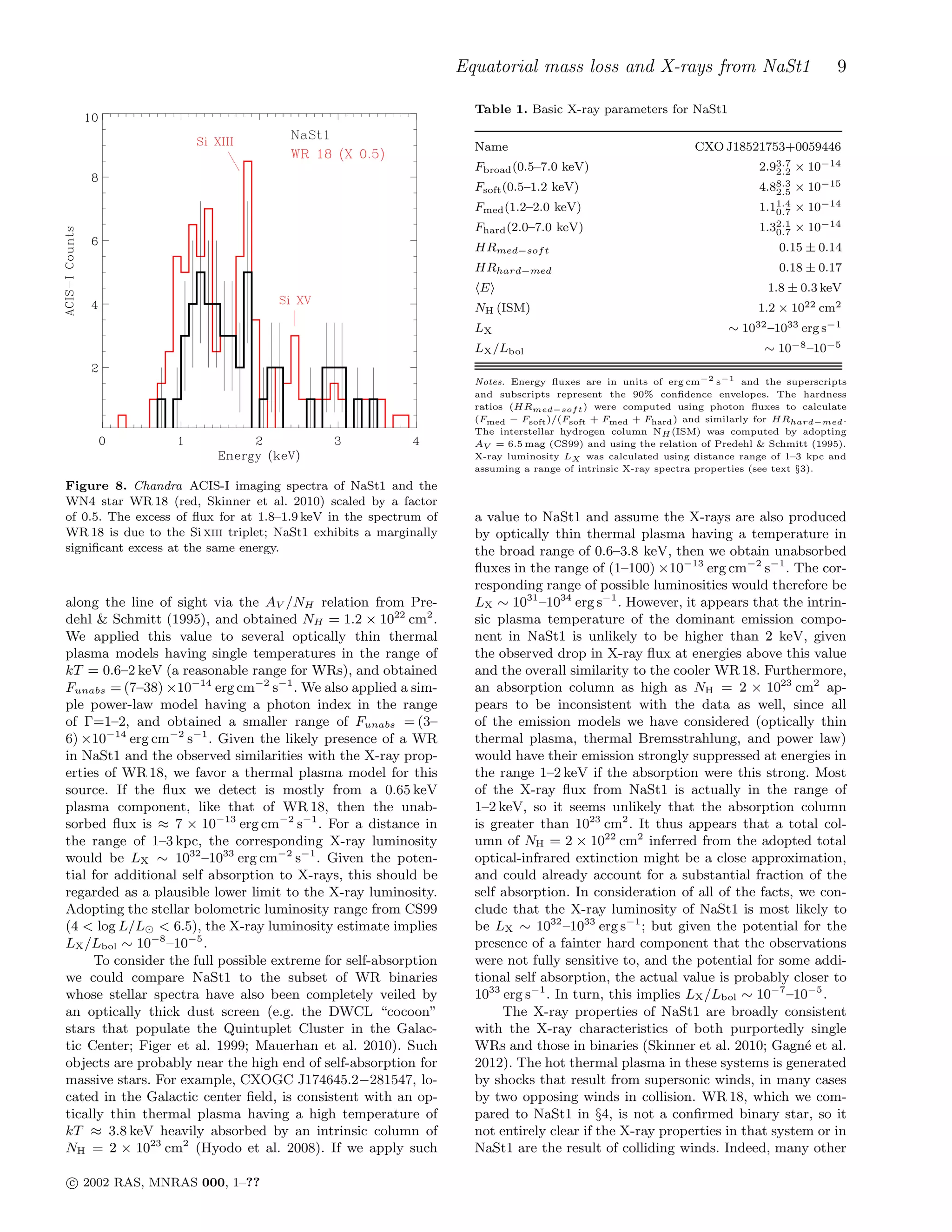
The ACIS-I energy spectrum of NaSt1 is shown in
Figure 8, along with an ACIS spectrum of the WN4 star
WR 18 for comparison (vertically scaled by 0.5), which we
obtained from the Chandra Data Archive (Obs. ID 8910, PI:
S. Skinner). Overall, the spectra of NaSt1 and WR 18 appear
similar, both having the majority of counts between 1 and
2 keV, heavy absorption at energies < 1 keV, and compara-
ble flux at harder energies relative to their 1–2 keV fluxes.
WR 18 exhibits strong Si xiii triplet emission at 1.84–1.86
keV; this is a common feature in the X-ray spectra of WN
stars that indicates emission from a thermal plasma hav-
ing a maximum line power temperature of log Tmax = 7.0 K.
NaSt1 also appears to exhibit an excess of flux at this energy;
we suspect this may result from the same Si xv transition,
although the detection is of relatively low statistical signifi-
cance. WR 18 also exhibits a Si xv feature at 2.46 keV, which
indicates the presence of an additional hot plasma compo-
nent having a higher temperature (log Tmax = 7.2 K); this
line is not detected in NaSt1, although our relatively weak
observational sensitivity at these higher energies does not
allow us to place meaningful constraints on its presence.
Skinner et al. (2010) modelled the full spectrum of
WR 18 with a two-temperature thermal plasma having
kTcool = 0.65 ± 0.22 keV, kThot = 3.5 ± 1.9 keV, and an
X-ray luminosity of LX ≈ 3 × 1032
erg cm−2
s−1
. Based on
the observed similarities, it is plausible that the X-ray emis-
sion from NaSt1 is also emitted by a thermal plasma having
physical parameters similar to WR 18. Unfortunately, we are
unable to attribute a unique plasma model to NaSt1 with
any confidence because of the low number of counts (e.g.,
a power-law model can be tuned to fit the spectrum with
the same level of statistical significance as a thermal plasma
model, such as that used in the case of WR 18). We can
nonetheless place some constraints on the parameters of the
emitting plasma using the broad-band X-ray photometry
and assuming a plausible range of emission models. First, to
estimate NaSt1’s absorption-corrected X-ray flux, Funabs,
we adopted the extinction value of AV = 6.5 mag from
CS99 to estimate the total hydrogen absorption NH column
c⃝ 2002 RAS, MNRAS 000, 1–??
Equatorial mass loss and X-rays from NaSt1 9
Figure 8. Chandra ACIS-I imaging spectra of NaSt1 and the
WN4 star WR 18 (red, Skinner et al. 2010) scaled by a factor
of 0.5. The excess of flux for at 1.8–1.9 keV in the spectrum of
WR 18 is due to the Si xiii triplet; NaSt1 exhibits a marginally
significant excess at the same energy.
along the line of sight via the AV /NH relation from Pre-
dehl & Schmitt (1995), and obtained NH = 1.2 × 10²²
cm2
.
We applied this value to several optically thin thermal
plasma models having single temperatures in the range of
kT = 0.6–2 keV (a reasonable range for WRs), and obtained
Funabs = (7–38) ×10−14
erg cm−2
s−1
. We also applied a sim-
ple power-law model having a photon index in the range
of Γ=1–2, and obtained a smaller range of Funabs = (3–
6) ×10−14
erg cm−2
s−1
. Given the likely presence of a WR
in NaSt1 and the observed similarities with the X-ray prop-
erties of WR 18, we favor a thermal plasma model for this
source. If the flux we detect is mostly from a 0.65 keV
plasma component, like that of WR 18, then the unab-
sorbed flux is ≈ 7 × 10⁻¹³
erg cm−2
s−1
. For a distance in
the range of 1–3 kpc, the corresponding X-ray luminosity
would be LX ∼ 1032
–1033
erg cm−2
s−1
. Given the poten-
tial for additional self absorption to X-rays, this should be
regarded as a plausible lower limit to the X-ray luminosity.
Adopting the stellar bolometric luminosity range from CS99
(4 < log L/L⊙ < 6.5), the X-ray luminosity estimate implies
LX/Lbol ∼ 10−8
–10−5
.
To consider the full possible extreme for self-absorption
we could compare NaSt1 to the subset of WR binaries
whose stellar spectra have also been completely veiled by
an optically thick dust screen (e.g. the DWCL “cocoon”
stars that populate the Quintuplet Cluster in the Galac-
tic Center; Figer et al. 1999; Mauerhan et al. 2010). Such
objects are probably near the high end of self-absorption for
massive stars. For example, CXOGC J174645.2−281547, lo-
cated in the Galactic center field, is consistent with an op-
tically thin thermal plasma having a high temperature of
kT ≈ 3.8 keV heavily absorbed by an intrinsic column of
NH = 2 × 10²³
cm2
(Hyodo et al. 2008). If we apply such
Table 1. Basic X-ray parameters for NaSt1
Name CXO J18521753+0059446
Fbroad(0.5–7.0 keV) 2.93.7
2.2 × 10⁻¹⁴
Fsoft(0.5–1.2 keV) 4.88.3
2.5 × 10⁻¹⁵
Fmed(1.2–2.0 keV) 1.11.4
0.7 × 10⁻¹⁴
Fhard(2.0–7.0 keV) 1.32.1
0.7 × 10⁻¹⁴
HRmed−soft 0.15 ± 0.14
HRhard−med 0.18 ± 0.17
⟨E⟩ 1.8 ± 0.3 keV
NH (ISM) 1.2 × 1022 cm2
LX ∼ 1032–1033 erg s−1
LX/Lbol ∼ 10−8–10−5
Notes. Energy fluxes are in units of erg cm−2
s−1
and the superscripts
and subscripts represent the 90% confidence envelopes. The hardness
ratios (HRmed−soft) were computed using photon fluxes to calculate
(Fmed − Fsoft)/(Fsoft + Fmed + Fhard) and similarly for HRhard−med.
The interstellar hydrogen column NH (ISM) was computed by adopting
AV = 6.5 mag (CS99) and using the relation of Predehl & Schmitt (1995).
X-ray luminosity LX was calculated using distance range of 1–3 kpc and
assuming a range of intrinsic X-ray spectra properties (see text §3).
a value to NaSt1 and assume the X-rays are also produced
by optically thin thermal plasma having a temperature in
the broad range of 0.6–3.8 keV, then we obtain unabsorbed
fluxes in the range of (1–100) ×10−13
erg cm−2
s−1
. The cor-
responding range of possible luminosities would therefore be
LX ∼ 1031
–1034
erg s−1
. However, it appears that the intrin-
sic plasma temperature of the dominant emission compo-
nent in NaSt1 is unlikely to be higher than 2 keV, given
the observed drop in X-ray flux at energies above this value
and the overall similarity to the cooler WR 18. Furthermore,
an absorption column as high as NH = 2 × 10²³
cm2
ap-
pears to be inconsistent with the data as well, since all
of the emission models we have considered (optically thin
thermal plasma, thermal Bremsstrahlung, and power law)
would have their emission strongly suppressed at energies in
the range 1–2 keV if the absorption were this strong. Most
of the X-ray flux from NaSt1 is actually in the range of
1–2 keV, so it seems unlikely that the absorption column
is greater than 1023
cm2
. It thus appears that a total col-
umn of NH = 2 × 10²²
cm2
inferred from the adopted total
optical-infrared extinction might be a close approximation,
and could already account for a substantial fraction of the
self absorption. In consideration of all of the facts, we con-
clude that the X-ray luminosity of NaSt1 is most likely to
be LX ∼ 1032
–1033
erg s−1
; but given the potential for the
presence of a fainter hard component that the observations
were not fully sensitive to, and the potential for some addi-
tional self absorption, the actual value is probably closer to
1033
erg s−1
. In turn, this implies LX/Lbol ∼ 10−7
–10−5
.
The X-ray properties of NaSt1 are broadly consistent
with the X-ray characteristics of both purportedly single
WRs and those in binaries (Skinner et al. 2010; Gagn´e et al.
2012). The hot thermal plasma in these systems is generated
by shocks that result from supersonic winds, in many cases
by two opposing winds in collision. WR 18, which we com-
pared to NaSt1 in §4, is not a confirmed binary star, so it
not entirely clear if the X-ray properties in that system or in
NaSt1 are the result of colliding winds. Indeed, many other
c⃝ 2002 RAS, MNRAS 000, 1–??
10 Jon Mauerhan et al.
colliding-wind binaries (CWBs) have more prominent hard
X-ray components (kT > 2 keV, Gagn´e et al. 2012), and
in some cases exhibit Fe Kα emission near 6.7 keV energy,
for example, in η Car (Corcoran et al. 2000) and WR 147
(Skinner et al. 2007). As noted earlier, the lack of a simi-
larly hard component in NaSt1 could simply be due to the
current observational sensitivity limits. Intrinsic dimness at
hard X-ray energies, on the other hand, could indicate that
the winds of the component stars are relatively slow com-
pared to the stars in more hard-X-ray bright CWBs (Luo
et al. 1990; Usov 1992). Hard X-ray emission can also vary
with orbital phase, so NaSt1 could have been observed in a
relatively soft state. Deeper X-ray observations in the future
will allow for more meaningful constraint on the presence of
hard X-rays and variability in NaSt1.
5 DISCUSSION
CS99 suggested that NaSt1 is a WR cloaked in an opaque
dusty nebula, similar to the Homunculus around η Car.
Indeed, their nebular analysis demonstrated that NaSt1 is
the only other object in the Galaxy known to exhibit such
an extreme level of nitrogen enrichment (indicative of ad-
vanced CNO processing from an evolved massive star), while
their derived parameters for the ionization source imply
T >> 30 kK and log (L/L⊙)=5.1–6.1, consistent with a WR
star. Our discovery of X-ray emission from NaSt1, shown in
§4, provides additional evidence for a WR, where hot plasma
is produced by shocks in supersonic stellar winds, perhaps
from colliding winds in a binary. However, although NaSt1
shares some interesting similarities with η Car’s Homuncu-
lus, the new data highlight some obvious differences, de-
scribed as follows.
The Homunculus was created during an extremely ener-
getic explosion that ejected at least ≈ 12 M⊙ of material at
velocities of ≈ 600 km s−1
(a ∼ 1050
erg event; Smith et al.
2003). The outflow exhibits a striking bipolar morphology
and is a strong source of [N ii] emission, but also Hα and
strong optical–infrared continuum from scattered light and
thermal radiation from dust. The extended nebula around
NaSt1, on the other hand, is clearly an equatorial structure,
with no obvious sign of a bipolar component. The optical
emission is pure [N ii], with no extended Hα emission or
extended continuum evident in our HST images (Figure 1)
or ground-based spectroscopy (Figure 4). Although we have
yet to obtain spatially-resolved kinematic spectroscopy of
NaSt1 along the minor axis of the nebula, where we ex-
pect the outflow’s apparent radial velocities to be highest,
there is currently no indication that the outflow velocities
are anywhere near those of η Car’s explosive Homunculus.
Unfortunately, we are unable to obtain a reliable mass esti-
mate for NaSt1’s nebula based on [N ii] alone, so information
on the kinetic energy of the outflow is lacking. Nonetheless,
the physical processes that created NaSt1’s nebula appear
to have been far less energetic than the giant eruption that
created η Car’s Homunculus, based on the available data.
Below we speculate on the origin of NaSt1 in the context of
other known massive binaries that have equatorial nebulae
and exhibit X-ray emission and thermal dust emission.
5.1 Dust formation from colliding winds?
NaSt1’s equatorial nebula and X-ray-emitting plasma, and
the compact thermal infrared component detected by CS99
and resolved by Rajagopal et al. (2007), are reminiscent
of a subset of WR binaries that produce dust (Gehrz &
Hackwell 1974; Williams et al. 1990; Oskinova & Hamann
2008), episodically in some cases (Williams et al. 1978, 1990;
Veen et al. 1998). The ring-like and possible spiral structure
in NaSt1 brings to mind the specific cases of WR 98a and
WR 104 (Monnier et al. 1999, 2002; Tuthill et al. 1999, 2008),
which are CWBs containing WC stars surrounded by strik-
ing Archimedean spirals of hot dust emission viewed nearly
face on (the so-called ‘pinwheel’ nebulae). The dust in these
systems is thought to be produced when a carbon-rich wind
from a WC star mixes with the H-rich wind of a less-evolved
OB companion, creating chemistry suitable for the forma-
tion of graphite or silicates. After strong shock compression,
dust condenses within a conic cooling flow that develops
downstream from the wind interaction zone (Williams 2008).
It is interesting in this regard that the thermal infrared emis-
sion comprising the spiral nebulae of WR 104 and WR 98a
have physical diameters of a few × 100 to 1000 AU, because
this is comparable to the infrared size we have measured for
NaSt1. It thus appears plausible that the resolved structure
of infrared emission revealed by our AO imaging could also
be a spiral structure viewed 12◦
from edge-on, whether the
emission is from thermal dust continuum or scattered line
emission. Meanwhile, the very recent formation of the hot
dust, as suggested by Rajagopal et al. (2007), suggests the
possibility of new evolutionary changes that only recently
created suitable conditions for dust formation. One possi-
bility is that the central WR recently transitioned from the
WN to the WC phase after the ejection of N-rich material.
Indeed, there is a growing body of evidence from observa-
tions of SNe Ibn, which indicates that WN stars can undergo
discrete super-Eddington eruptions before exploding (Foley
et al. 2007; Pastorello et al. 2008). If this is the case for
NaSt1, the eruption could have been followed by the devel-
opment of a C-rich wind from the newly formed WC star.
C-rich chemistry is not a requirement for dust to form
in a CWB. The circumstellar material around η Car, for ex-
ample, which is N-rich yet C-poor, exhibits firm evidence
for freshly synthesized hot dust (T = 1400–1700 K). Sim-
ilar to WC binaries, infrared monitoring has shown that η
Car forms dust episodically, apparently maximized by strong
shock compression of the stellar wind during periastron en-
counters (Smith 2010). In this case, the post-shock cool-
ing apparently results in the formation of corundum dust
(Al2O3), rather than graphite or silicates. However, corun-
dum usually produces a spectral emission feature near 12 µm
wavelength, which is not seen in the relatively featureless
spectrum of NaSt1 presented by Smith & Houck (2001). Sil-
icates are also expected to produce spectral features in the
8–14 µm range, unless the grains are extremely large. Amor-
phous carbon, on the other hand, can produce a feature-
less mid-infrared continuum (McDonald et al. 2012). Amor-
phous carbon has also been favored in the cases of other dust
producing WRs (Williams et al. 1987), and so it might be
the most plausible dust chemistry for NaSt1. However, the
limited 8–14 µm wavelength coverage of the existing mid-
infrared spectrum could make very broad spectral features
c⃝ 2002 RAS, MNRAS 000, 1–??
Equatorial mass loss and X-rays from NaSt1 11
from various dust species difficult to identify, and it might
be premature to characterize the mid-infrared SED as “fea-
tureless” based on those results alone. Broader wavelength
coverage of the mid-infrared spectrum will thus be necessary
to elucidate the dust chemistry in NaSt1.
Another open question is whether NaSt1 forms dust
episodically, similar to other WR CWBs (e.g, see Williams
et al. 1992, 1994) and η Car (Smith 2010). Such behavior
would indicate an eccentric orbit for the binary. We com-
pared the 12 µm flux of NaSt1 from the Wide-field Infrared
Survey Explorer (WISE) Allwise catalog (Wright et al. 2010)
with the flux measured at the same wavelength by Smith
& Houck (2001) over a decade earlier; no change in mid-
infrared brightness was detected. However, this does not
rule out episodic dust formation, which is usually evidenced
by variability in the near-infrared, since the freshly synthe-
sized dust is relatively hot. As such, mid-infrared variations
are not necessarily expected, since emission at these longer
wavelengths will come from cooler dust that has flowed away
from the system and piled up, to become more steadily illu-
minated by the luminosity of the central stars. Interestingly,
van der Hucht et al. (1997) noted near-infrared variability of
NaSt1 at the level of 0.6 mag over a month-long timescale, so
the possibility of episodic dust formation is worth investigat-
ing with continued near-infrared monitoring in the future.
Episodic dust formation might also be correlated with varia-
tions in X-ray luminosity and hardness from colliding-wind
emission (e.g., Williams et al. 2013), which is also worth
exploring. Such data could reveal an orbital period for the
system, which would provide much needed insights into the
physical parameters of the component stars.
5.2 Is NaSt1 the product of mass transfer?
NaSt1’s nebula of slowly moving CNO-processed mate-
rial could also have become an equatorial structure as
the result of binary mass transfer. If the evolved primary
star recently underwent a large radial expansion, material
could have been transferred to a companion via RLOF. In
the case of non-conservative mass transfer, high angular-
momentum material can bypass accretion and escape the
system through the outer Lagrange points (Vanbeveren et
al. 1998). This might explain the relatively low velocity of
the outer nebular material (compared with WR winds) and
its confinement to the equatorial plane. The Roche lobe need
not be filled by the star itself. In relatively wide binaries
mass transfer can also occur if the donor overfills it Roche
lobe with a slow dense wind (WRLOF; Abate et al. 2013),
and the same is probably true for dense material from a dis-
crete mass eruption, if the material moves slowly enough.
Hydrodynamic simulations of relatively low-mass RLOF bi-
naries containing asymptotic giant branch (AGB) stars have
shown that a circumbinary envelope with spiral structures
and diffuse clumpy rings can form in the equatorial plane
and enshroud the system (Sytov et al. 2009). We speculate
that NaSt1 could be a scaled-up analog of this process for a
more massive binary.
Mass transfer might also explain some of the kinematic
features previously observed in NaSt1’s spectra, in particu-
lar, the double-peaked emission profiles detected by CS99.
Those authors showed that the emission lines of various
atomic species spanning a wide range of ionizations states
Figure 9. High-resolution normalized spectrum of the [N ii] pro-
file of the central point source of NaSt1, as a function of radial
velocity (black solid line; reproduced from CS99), compared to
that of the sgB[e]/LBV binaries Wd1-9 (red dashed line; repro-
duced from Clark et al. 2013 ) and MWC 314 (blue dash-dotted
line; from Lobel et al. 2013), at arbitrary orbital phases, and RY
Scuti (green dash-triple-dotted line; from Smith et al. 2002). The
velocities were shifted to center the entire profiles. In the cases
of Wd1-9 and MWC 314, the double peaked profiles have been
interpreted as the result of rotational motion in a circumbinary
disk, but could also be from an expanding ring or torus, as is the
interpretation in the case of RY Scuti
exhibit an interesting correlation between profile width and
ionization potential, with the highest excitation lines ex-
hibiting the largest velocities (FWHM up to ≈160 km s−1
).
This implies that there are multiple line-forming regions in
NaSt1’s circumstellar envelope. These characteristics pro-
vide some important clues on the nature of NaSt1, and fa-
cilitate a comparison with other massive binaries in which
mass transfer is thought to have recently occurred.
Figure 9 shows the double-peaked [N ii] emission-line
profile of NaSt1 (reproduced from CS99) and for several
other binary systems containing evolved massive stars (note
that the spectroscopic observations which produced this pro-
file in NaSt1 were centered on the compact central source
and did not sample the larger nebula). The separation be-
tween each peak in the double profile is ≈30 km s−1
, compa-
rable to other systems, and is particularly similar to the ob-
ject Wd1-9 from the starburst cluster Westerlund 1 (Clark
et al. 2013). Wd1-9 is composed of a supergiant B[e] star
in a massive interacting binary that is undergoing, or has
recently exited from, a phase of rapid RLOF. The star ex-
hibits a rich emission-line spectrum with no photospheric
features, similar to NaSt1, albeit with softer ionization3
. In
addition to the [N ii] profile and overall spectral morphol-
3 Based on the presence of He ii emission, van der Hucht et al.
(1997) suggested an O[e] classification for NaSt1
c⃝ 2002 RAS, MNRAS 000, 1–??
12 Jon Mauerhan et al.
ogy, Wd1-9 is similar to NaSt1 in several other respects: it
is an X-ray source having LX ∼ 1033
erg s−1
and plasma
temperature consistent with colliding-wind shock emission
(Clark et al. 2008); it has an equatorially concentrated mass
of hot (T ∼ 1000 K) dust having a radius of 60–600 AU;
and it exhibits a similar correlation between emission-line
width and ionization potential. The presence of strong He ii
emission in NaSt1, however, suggests a significantly hotter
ionization source than that of Wd1-9, which does not exhibit
He ii emission.
Clark et al. (2013) interpreted the double-peaked line
profiles of Wd1-9 as being the result of quasi-Keplerian ro-
tation in a massive disk or torus. This interpretation has
also been invoked to explain the double-peaked line profiles
detected in the LBV binary MWC 314 (Lobel et al. 2013;
also shown in Figure 9). A rotational component from the
inner regions of NaSt1’s disk is thus worth considering as
a potential explanation for the double-peaked profile. How-
ever, such profiles can also be produced by another mecha-
nism. An expanding disk, torus, or flattened hollow cone ge-
ometry can generate double-peaked line profiles, as demon-
strated by Zickgraf (2003), who argued that many sgB[e] sys-
tems could actually be exhibiting a combination of rotating
disk emission at relatively small radii (where permitted lines
are formed) and emission from a radially outflowing disk at
larger radii (where forbidden lines, like [N ii], are formed). It
is difficult to discriminate between these possibilities for the
double-peaked profiles from the inner regions of NaSt1, al-
though the hypothesis of quasi-Keplerian rotation might be
more compatible with the observed correlation between pro-
file width and ionization potential shown by CS99. On the
other hand, the kinematics of the outer nebula, as indicated
by Figure 4, are more likely to be the result of an equatorial
outflow that is not perfectly azimuthally symmetric, since
rotation at such large radii seems unlikely.
5.2.1 NaSt1 as an advanced analog to RY Scuti
Another very relevant object for comparison to NaSt1 is
the eclipsing binary RY Scuti. It consists of a massive
O9/B0 supergiant primary currently undergoing RLOF, and
an accreting secondary (likely to be an O5 star) that is
buried inside an opaque accretion torus (Grundstrom et al.
2007; Smith et al. 2011b). The system as a whole is sur-
rounded by an expanding double-ring nebula of equatori-
ally concentrated ionized gas exhibiting multi-peaked emis-
sion profiles from both Hα and [N ii] (Smith et al. 2002),
the latter of which is also shown in Figure 9. In this case,
the multi-peaked morphology is clearly the result of non-
azimuthally symmetric expansion, not rotation. The rings
are ≈1800 AU in extent, expanding at roughly ±45 km s−1
.
Based on proper-motion measurements, the structure ap-
pears to have formed from multiple discrete eruptions of
mass that occurred 130 and 250 yr ago. Smith et al. (2011b)
suggested the possibility that the equatorial outflow was pro-
duced by an LBV-like stellar eruption that occurred in re-
sponse to the sudden accretion of mass, and that the sys-
tem is potentially on its way to becoming a B[e] supergiant
+ stripped-envelope WR binary. Interpreting NaSt1 in light
of RY Scuti is interesting because NaSt1 already exhibits
evidence consistent with the presence of both a B[e]-like
or O[e]-like supergiant star (producing the double-peaked
emission-line profiles) and a hot WR (to provide the ioniza-
tion and, perhaps, the X-ray emission), all surrounded by
an equatorially-concentrated nebula of CNO-processed ma-
terial having a physical extent over an order of magnitude
larger than the ionized nebula around RY Scuti. It is thus
plausible that NaSt1 is a more highly evolved analog of the
RY Scuti system.
5.3 On the lack of WR spectral features in NaSt1
CS99 concluded that the central ionization source in NaSt1
has a stellar temperature in excess of 30 kK, and is thus
likely to be an early-type WR. Such objects typically ex-
hibit fast winds that generate strong emission lines with
FWHM velocities of ≈ 2000–3000 km s−1
. The absence of
any such broad spectral lines from the purported early-type
WR is thus puzzling; we speculate below on several potential
causes.
Heavy obscuration of the WR spectrum by dust could
be exacerbated by the inclination of the system with respect
to our line of sight (≈ 12◦
from edge on). Dust formed via
colliding winds or in an equatorial outflow will probably be
concentrated in a similarly inclined plane, which, if suffi-
ciently compact, could obscure the central stars, while still
allowing some photoionizing radiation to escape at higher
latitudes. We speculated in §3 that the resolved structure in
the Ks band could be the result of He i λ2.06 µm emission
from the central source or stellar wind scattered beyond the
obscuring nebula, which would be allowable for the case of
an equatorial/toroidal distribution of dust. However, if dust
obscuration is to blame for the heavy suppression of the stel-
lar spectral features, then it is difficult to explain why the
same dust does not also obscure the high-ionization double-
peaked emission lines detected by CS99 or the 1–2 keV X-ray
emission shown in §4, which should arise in the hot inner re-
gions of the system, very close to the central stars.
An alternative explanation for the lack of WR fea-
tures is dilution by a more luminous companion star and
the circumstellar material that produces the bright nebular
spectrum. After all, WRs that form via mass-transfer can
stem from stars that have significantly lower initial masses
(≥ 8 M⊙; Podsiadlowski, Joss, & Tsu 1992; Vanbeveren et
al. 1998) and lower luminosities than WRs that form from
direct mass loss via strong winds (≥ 20–25 M⊙; Meynet
& Maeder 2005; Ekstr¨om et al. 2012; Smith & Tomble-
son 2015). Lower-mass WRs will likely have weaker winds
(slower and less dense) than classical WRs of relatively high
mass and luminosity. As such, these stars might not be
easily recognizable spectroscopically as WRs, lacking sim-
ilarly broad and luminous emission lines that can easily
shine through dense circumstellar material, as in the case
of NaSt1’s nebula. Relatively slow winds were already noted
as a possible explanation for the relative faintness of NaSt1
at harder X-ray energies relative to many other WR CWBs.
It thus seems plausible that dilution of the WR spectrum
by a luminous companion and nebula, combined with some
obscuration of the WR by dust, is the reason for the lack of
detectable WR features in the optical spectrum. Similarly,
the infrared spectrum of the WR could be diluted by the ex-
tremely luminous (Ks ≈ 6.3 mag) hot dust component. The
K-band brightness of a relatively under-luminous, reddened
WR at the distance of NaSt1 (adopting MK = −3 mag for
c⃝ 2002 RAS, MNRAS 000, 1–??
Equatorial mass loss and X-rays from NaSt1 13
faint WRs from Crowther et al. 2006) is expected to be ≈ 2–
4 mag fainter than the thermal dust, even without account-
ing for addition circumstellar extinction, so heavy dilution
of the stellar spectrum in the infrared is also plausible.
6 SUMMARY AND CONCLUDING REMARKS
Based on the results of high-resolution optical imaging with
HST, X-ray imaging with Chandra, and AO infrared imag-
ing with Magellan, and the nebular analysis of CS99, we
conclude that NaSt1 (WR 122) is likely to be a WR binary
enshrouded in an equatorial nebula of CNO-processed gas
with a compact thermal dust component. The apparently
slow kinematics and equatorial geometry of the nebula sug-
gest that it is the byproduct of mass transfer. NaSt1 could
thus be an analog to massive interacting binary systems,
such as RY Scuti, MWC 314, and Wd1-9, but at a more
advanced evolutionary stage, where one of the components
has lost enough mass to become a WR. NaSt1 could there-
fore represent a rare and important example of the recent
formation of a stripped-envelope WR formed from binary
interaction.
Many open questions about the NaSt1 system remain,
particularly regarding the origin of various spectral features,
dust chemistry, the physical parameters of the component
stars, and the orbital period of the system. Such information
might be obtainable via long-term photometric and monitor-
ing and high-resolution spectroscopy in the optical and in-
frared. Detailed spatially-resolved chemical abundances will
also shed more light on the recent evolution of the compo-
nent stars and the processes that created the nebula.
ACKNOWLEDGEMENTS
We thank the anonymous referee for an insightful review of
this manuscript. The scientific results reported in this article
are based on observations made with the NASA/ESA Hub-
ble Space Telescope, which is operated by the Association of
Universities for Research in Astronomy, Inc., under NASA
contract NAS 5-26555. These observations are associated
with program HST-GO-13034. Support for program HST-
GO-13034 was provided by NASA through a grant from the
Space Telescope Science Institute, which is operated by the
Association of Universities for Research in Astronomy, Inc.,
under NASA contract NAS 5-26555. The scientific results
reported in this article are based on observations made by
the Chandra X-ray Observatory. Support for this work was
provided by the National Aeronautics and Space Adminis-
tration through Chandra Award Number GO4-15003X is-
sued by the Chandra X-ray Observatory Center, which is
operated by the Smithsonian Astrophysical Observatory for
and on behalf of the National Aeronautics Space Adminis-
tration under contract NAS8-03060. This research has made
use of data obtained from the Chandra Data Archive and
the Chandra Source Catalog, and software provided by the
Chandra X-ray Center (CXC) in the application packages
CIAO, ChIPS, and Sherpa. N.S. received partial support
from NSF grant AST-1312221. Some observations reported
here were obtained at the MMT Observatory, a joint facility
of the University of Arizona and the Smithsonian Institu-
tion. This paper includes data gathered with the 6.5 me-
ter Magellan Telescopes located at Las Campanas Observa-
tory, Chile. This work was performed in part under contract
with the California Institute of Technology (Caltech) funded
by NASA through the Sagan Fellowship Program executed
by the NASA Exoplanet Science Institute. The results pre-
sented here were also based on observations made with ESO
Telescopes at the La Silla Paranal Observatory under pro-
gramme ID 075.B-0547(C). This publication makes use of
data products from the Wide-field Infrared Survey Explorer,
which is a joint project of the University of California, Los
Angeles, and the Jet Propulsion Laboratory/California In-
stitute of Technology, funded by the National Aeronautics
and Space Administration.
REFERENCES
Abate, C., Pols, O. R., Izzard, R. G., Mohamed, S. S., & de Mink,
S. E. 2013, A&A, 552, AA26
Clark, J. S., Ritchie, B. W., & Negueruela, I. 2013, A&A, 560,
A11
Clark, J. S., Muno, M. P., Negueruela, I., et al. 2008, A&A, 477,
147
Corcoran, M. F., Fredericks, A. C., Petre, R., Swank, J. H., &
Drake, S. A. 2000, ApJ, 545, 420
Crowther, P. A., & Smith, L. J. 1999, MNRAS, 308, 82
Crowther, P. A., Hadfield, L. J., Clark, J. S., Negueruela, I., &
Vacca, W. D. 2006, MNRAS, 372, 1407
Davidson, K., Dufour, R. J., Walborn, N. R., & Gull, T. R. 1986,
ApJ, 305, 867
Dessart, L., Hillier, D. J., Li, C., & Woosley, S. 2012, MNRAS,
424, 2139
Dufour, R. J., Glover, T. W., Hester, J. J., et al. 1997, Luminous
Blue Variables: Massive Stars in Transition, ASPC, 120, 255,
Ed. Nota, A. and Lamers, H.
Eisenhauer, F., Abuter, R., Bickert, K., et al. 2003, SPIE, 4841,
1548
Ekstr¨om, S., Georgy, C., Eggenberger, P., et al. 2012, A&A, 537,
A146
Figer, D. F., McLean, I. S., & Morris, M. 1999, ApJ, 514, 202
Foley, R. J., Smith, N., Ganeshalingam, M., et al. 2007, ApJL,
657, L105
Gagn´e, M., Fehon, G., Savoy, M. R., et al. 2012, Proceedings of
a Scientific Meeting in Honor of Anthony F. J. Moffat, 465,
301
Gehrz, R. D., & Hackwell, J. A. 1974, ApJ, 194, 619
Grundstrom, E. D., Gies, D. R., Hillwig, T. C., et al. 2007, ApJ,
667, 505
Hachinger, S., Mazzali, P. A., Taubenberger, S., et al. 2012, MN-
RAS, 422, 70
Hyodo, Y., Tsujimoto, M., Koyama, K., Nishiyama, S., Nagata,
T., Sakon, I., Murakami, H., & Matsumoto, H. 2008, PASJ,
60, 173
Lawrence, A., Warren, S. J., Almaini, O., et al. 2007, MNRAS,
379, 1599
Lobel, A., Groh, J. H., Martayan, C., et al. 2013, A&A, 559, A16
Luo, D., McCray, R., & Mac Low, M.-M. 1990, ApJ, 362, 267
Massey, P., & Conti, P. S. 1983, PASP, 95, 440
Mauerhan, J. C., Muno, M. P., Morris, M. R., Stolovy, S. R., &
Cotera, A. 2010, ApJ, 710, 706
McDonald, I., Zijlstra, A. A., & Boyer, M. L. 2012, MNRAS, 427,
343
Meynet, G., & Maeder, A. 2005, A&A, 429, 581
c⃝ 2002 RAS, MNRAS 000, 1–??
14 Jon Mauerhan et al.
Monnier, J. D., Tuthill, P. G., & Danchi, W. C. 1999, ApJL, 525,
L97
Monnier, J. D., Tuthill, P. G., & Danchi, W. C. 2002, ApJL, 567,
L137
Morzinski, K. M., Close, L. M., Males, J. R., et al. 2014, SPIE,
9148, 914804
Nassau, J. J., & Stephenson, C. B. 1963, Hamburger
Sternw. Warner & Swasey Obs., 0
Oskinova, L. M., & Hamann, W.-R. 2008, MNRAS, 390, L78
Pastorello, A., Mattila, S., Zampieri, L., et al. 2008, MNRAS,
389, 113
Podsiadlowski, P., Joss, P. C., & Hsu, J. J. L. 1992, ApJ, 391,
246
Predehl, P., & Schmitt, J. H. M. M. 1995, A&A, 293, 889
Rajagopal, J., Menut, J.-L., Wallace, D., et al. 2007, ApJ, 671,
2017
Skinner, S. L., Zhekov, S. A., G¨udel, M., Schmutz, W., & Sokal,
K. R. 2010, AJ, 139, 825
Skinner, S. L., Zhekov, S. A., G¨udel, M., & Schmutz, W. 2007,
MNRAS, 378, 1491
Smith, N., Gehrz, R. D., & Krautter, J. 1998, AJ, 116, 1332
Smith, N., Gehrz, R. D., Stahl, O., Balick, B., & Kaufer, A. 2002,
ApJ, 578, 464
Smith, N., Gehrz, R. D., Hinz, P. M., et al. 2003, AJ, 125, 1458
Smith, N., & Morse, J. A. 2004, ApJ, 605, 854
Smith, N., & Owocki, S. P. 2006, ApJL, 645, L45
Smith, N. 2010, MNRAS, 402, 145
Smith, N., Li, W., Filippenko, A. V., & Chornock, R. 2011a,
MNRAS, 412, 1522
Smith, N., Gehrz, R. D., Campbell, R., et al. 2011b, MNRAS,
418, 1959
Smith, N. 2014, ARA&A, 52, 487
Smith, N., & Tombleson, R. 2015, MNRAS, 447, 598
Smith, J. D. T., & Houck, J. R. 2001, AJ, 121, 2115
Sytov, A. Y., Bisikalo, D. V., Kaigorodov, P. V., & Boyarchuk,
A. A. 2009, Astronomy Reports, 53, 223
Tuthill, P. G., Monnier, J. D., & Danchi, W. C. 1999, Nature,
398, 487
Tuthill, P. G., Monnier, J. D., Lawrance, N., et al. 2008, ApJ,
675, 698
Usov, V. V. 1992, ApJ, 389, 635
Vanbeveren, D., De Loore, C., & Van Rensbergen, W. 1998,
A&ARv, 9, 63
van der Hucht, K. A., Williams, P. M., Morris, P. W., & van Gen-
deren, A. M. 1997, Luminous Blue Variables: Massive Stars
in Transition, 120, 211
Veen, P. M., van der Hucht, K. A., Williams, P. M., et al. 1998,
A&A, 339, L45
Weisskopf, M. C., Brinkman, B., Canizares, C., et al. 2002, PASP,
114, 1
Williams, P. M., Beattie, D. H., Lee, T. J., Stewart, J. M., &
Antonopoulou, E. 1978, MNRAS, 185, 467
Williams, P. M., van der Hucht, K. A., & The, P. S. 1987, A&A,
182, 91
Williams, P. M., van der Hucht, K. A., The, P. S., & Bouchet, P.
1990, MNRAS, 247, 18P
Williams, P. M., van der Hucht, K. A., Bouchet, P., et al. 1992,
MNRAS, 258, 461
Williams, P. M., van der Hucht, K. A., Kidger, M. R., Geballe,
T. R., & Bouchet, P. 1994, MNRAS, 266, 247
Williams, P. M. 2008, Revista Mexicana de Astronomia y As-
trofisica Conference Series, 33, 71
Williams, P. M., Chu, Y.-H., Gruendl, R. A., & Guerrero, M. A.
2013, MNRAS, 431, 1160
Wright, E. L., Eisenhardt, P. R. M., Mainzer, A. K., et al. 2010,
AJ, 140, 1868
Zickgraf, F.-J. 2003, A&A, 408, 257
c⃝ 2002 RAS, MNRAS 000, 1–??

Multiwavelength observations of_na_st1_(wr122)_equatorial_mass_loss_and_x_rays_from_an_interacting_wolf_rayet_binary

  • 1.
    arXiv:1502.01794v2[astro-ph.SR]26Feb2015 Mon. Not. R.Astron. Soc. 000, 1–?? (2002) Printed 27 February 2015 (MN LATEX style file v2.2) Multiwavelength observations of NaSt1 (WR 122): Equatorial mass loss and X-rays from an interacting Wolf-Rayet binary Jon Mauerhan1⋆ , Nathan Smith2 , Schuyler D. Van Dyk3 , Katie M. Morzinski2 , Laird M. Close2 , Philip M. Hinz2 , Jared R. Males2 , and Timothy J. Rodigas4 1Department of Astronomy, University of California, Berkeley, CA 94720-3411, USA 2Steward Observatory, University of Arizona, 933 N. Cherry Ave., Tucson, AZ 85721, USA 3IPAC/Caltech, Mail Code 100-22, Pasadena, CA 91125, USA 4Department of Terrestrial Magnetism, Carnegie Institute of Washington, 5241 Broad Branch Road, NW, Washington, DC 20015, USA Accepted 0000, Received 0000, in original form 0000 ABSTRACT NaSt1 (aka Wolf-Rayet 122) is a peculiar emission-line star embedded in an extended nebula of [N ii] emission with a compact dusty core. This object was characterized by Crowther & Smith (1999) as a Wolf-Rayet (WR) star cloaked in an opaque nebula of CNO-processed material, perhaps analogous to η Car and its Homunculus nebula, albeit with a hotter central source. To discern the morphology of the [N ii] nebula we performed narrowband imaging using the Hubble Space Telescope and Wide-field Camera 3. The images reveal that the nebula has a disk-like geometry tilted ≈12◦ from edge-on, composed of a bright central ellipsoid surrounded by a larger clumpy ring. Ground-based spectroscopy reveals radial velocity structure (±10 km s−1 ) near the outer portions of the nebula’s major axis, which is likely to be the imprint of outflowing gas. Near-infrared adaptive-optics imaging with Magellan AO has resolved a compact ellipsoid of Ks-band emission aligned with the larger [N ii] nebula, which we suspect is the result of scattered He i line emission (λ2.06 µm). Observations with the Chandra X-ray Observatory have revealed an X-ray point source at the core of the nebula that is heavily absorbed at energies < 1 keV and has properties consistent with WR stars and colliding-wind binaries. We suggest that NaSt1 is a WR binary embedded in an equatorial outflow that formed as the result of non-conservative mass transfer. NaSt1 thus appears to be a rare and important example of a stripped-envelope WR forming through binary interaction, caught in the brief Roche-lobe overflow phase. Key words: stars: individual (NaSt1) – stars: emission-line – stars: peculiar – stars: Wolf-Rayet – stars: mass loss 1 INTRODUCTION The physical processes by which massive stars shed their hydrogen envelopes and become Wolf-Rayet (WR) stars present an interesting challenge to the standard stellar evo- lutionary paradigm (see review by Smith 2014 and refer- ences therein). Mass loss via steady stellar winds is punc- tuated by discrete, episodic, and sometimes explosive mass ejections that occur during the post main-sequence, in the so-called Luminous Blue Variable (LBV) phase (Smith & Owocki 2006). The physics that trigger and drive these in- tense bouts of eruptive mass loss are still not understood, yet this mode is suspected to be a key channel by which ⋆ E-mail: mauerhan@astro.berkeley.edu H-depleted WRs form. In addition to discrete eruptions, bi- nary mass transfer via Roche lobe overflow (RLOF) is an- other very important (perhaps even dominant) channel for producing stripped-envelope WRs, and may even be critical to account for Type Ib/c supernova progenitors (Smith et al. 2011a; Dessart et al. 2012; Hachinger et al. 2012). Since the time-scale of eruptive mass loss in such systems is brief, only a precious few Galactic examples exist, especially for cases where stellar multiplicity (i.e., binary vs. single) is an influential factor. A particularly interesting example is RY Scuti – a massive binary undergoing mass transfer that re- cently resulted in an intense bout of equatorial mass loss, and where one of the stellar components is likely on its way to becoming a stripped-envelope WR (Smith et al. 2011b). c⃝ 2002 RAS
  • 2.
    2 Jon Mauerhanet al. NaSt1, aka WR 122, is an evolved massive star that has defied characterization. It was discovered by Nassau & Stephenson (1963), who proposed a WR classification based on the strong emission-line spectrum. It was later reclassified as a late nitrogen-type WR (WN type) based on nitrogen emission-line ratios in the optical spectrum (Massey & Conti 1983), then later proposed to be a B[e], O[e], or Ofpe/WN9 star based on its optical–IR spectral properties (van der Hucht 1997). Subsequently, more detailed multi-wavelength investigation by Crowther & Smith (1999; hereafter CS99) showed that although NaSt1 is indeed a hot luminous ob- ject with L ∼ 105.1 –106.1 L⊙, its emission-line spectrum is mostly of nebular origin, not stellar. Moreover, ground-based narrowband imaging through an [N ii] filter centered near wavelength λ6584 ˚A revealed the presence of a compact cir- cumstellar nebula with a diameter of ≈7′′ , whose elongated yet poorly resolved dimensions gave the impression of pos- sible bipolar morphology. No comparable extended compo- nent was inferred for H i gas based on the much weaker de- tection of nebulosity in images through a broader Hα+[N ii] filter (which could simply be attributable to [N ii] emission in the passband). He i and He ii narrowband images revealed no extended component either. Derivation of the chemical abundances in NaSt1’s neb- ula via quantitative spectroscopy by CS99 showed it to be extremely nitrogen enriched yet carbon and oxygen defi- cient, which indicates that the nebula consists of highly CNO-processed material ejected from an evolved massive star. CS99 pointed out that the only other massive star known to be enshrouded in a nebula having a compara- ble level of nitrogen enrichment is the LBV+OB binary η Car and its Homunculus nebula (Davidson et al. 1986; Du- four et al. 1997; Smith & Morse 2004). However, CS99 note that the chemical abundance ratios in the NaSt1 nebula are characteristic of a WR, and probably inconsistent with a red supergiant or H-rich LBV. Moreover, the derived ion- ization potential requires that the central ionizing source be T >> 30 kK, which suggests a spectral subtype earlier than WN6–7. The absence of the characteristic broad emis- sion lines from a WR wind, however, implies that the stel- lar system is deeply embedded in an opaque nebula. High- resolution spectroscopy by CS99 revealed that the nebular lines have a double-peaked morphology, which suggests com- plex geometry for the outflow. NaSt1 also exhibits strong thermal excess from circum- stellar dust, but from a much more compact region than the [N ii] nebula. CS99 presented evidence for a two-temperature spectral energy distribution in the infrared, consisting of warm (T ≈ 700 K) and hot (T ≈ 2000 K) components. A mid-infrared spectrum by Smith & Houck (2001) showed it to be mostly featureless in the 8–14 µm wavelength range, with the exception of two narrow nebular lines of [Fe ii] and [Ne ii]. The results of mid-infrared interferometric imaging at ∼ 10 µm wavelength by Rajagopal et al. (2007) were con- sistent with at least two infrared components having angular sizes within 50–60 mas. Based on the likely distance range of 1–3 kpc and on the measured outflow velocities from CS99, the results of Rajagopal et al. (2007) imply that the dust originates from within <100 AU of the central source1 and thus has a short dynamical timescale of only 30 yr, which implies only very recent and likely ongoing dust formation. By comparison, the outer [N ii] nebula has a much larger size of ≈7′′ (6,800–22,400 AU). The presence of an addi- tional component of faint thermal dust emission associated with the extended nebular structure, to our knowledge, has never been assessed with sufficient spatial resolution. The collective properties of NaSt1 led CS99 to con- clude that this object could be a WR cloaked in an η Car- like ejection nebula, while the interferometry of Rajagopal et al. (2007) motivates a search for extended structure in the near-infrared. Here, we investigate the situation further by obtaining high-resolution narrowband images of NaSt1’s nebula in the light of [N ii] using the Hubble Space Tele- scope (HST), and adaptive-optics (AO) imaging in the near- infrared with Magellan AO. Moreover, the possible presence of a WR star in an η Car-like system also warrants the search for an X-ray counterpart to NaSt1, which could be expected to arise from shocks produced by hypersonic wind flows that are often associated with WRs. NaSt1 was not detected by the ROSAT all-sky Survey, but this is not par- ticularly surprising, given the relatively shallow sensitivity of this survey, in conjunction with the estimated distance to the source and the anticipated absorption to X-rays with energies ≤ 1–2 keV from interstellar material. Thus, we have obtained deeper X-ray imaging observations of NaSt1 using the Chandra X-ray Observatory. The resulting data from these space-based and AO facilities provide new important clues for the nature and evolutionary status of this object. 2 OBSERVATIONS AND RESULTS 2.1 Narrowband [N ii] imaging with HST/WFC3 NaSt1 was first observed with HST on 2013 March 20 (UT 02:34) using the Wide-field and Planetary Camera 3 (WFC3). Five 176 s exposures were obtained through both the F658N and F645N filters, which have peak transmis- sion wavelengths centered on the [N ii] λ6584 ˚A line and the adjacent continuum, respectively. A five-point sub-pixel dither pattern (WFC3-UVIS-DITHER-BOX) was executed between individual exposures to improve sampling of the WFC3 point spread function (PSF). Since NaSt1 exhibits a small angular size, images were read out in a 1K×1K sub- array mode to decrease readout overhead. To mitigate the effect of degrading charge transfer efficiency (CTE) in the WFC3 CCD chip, a 12 e− post-flash was performed at the end of each exposure, which slightly elevated the background counts and mitigated against CTE losses. Some of the F658N and F645N images obtained on March 20 were severely degraded because the fine-guidance sensors failed to track the guide stars from the Guide Star Catalog, which turned out to be blends of multiple stars at HST resolution. The observations thus defaulted to GYRO pointing control and guiding, with no fine guidance. The resulting stellar PSFs, which normally have optimal full- width at half-maximum (FWHM) values of ∼ 0.′′ 07, were 1 Note, however, that sensitivity of interferometry to spatial fre- quencies depends on the distribution of the baselines. c⃝ 2002 RAS, MNRAS 000, 1–??
  • 3.
    Equatorial mass lossand X-rays from NaSt1 3 Figure 1. HST/WFC3 narrowband images of NaSt1 through F658N and F645N filters (logarithmic stretch), corresponding to the [N ii] emission line and adjacent continuum, respectively (upper panels). The lower panels show the F658N image with the central point source removed, and a 3-pixel smoothed version. highly elliptical and, in some cases, double-peaked, exhibit- ing FWHM values ranging from ∼ 0.′′ 10 to ∼ 0.′′ 19. Although several of the individual images from this visit were salvage- able and scientifically useful, the overall telescope drift dur- ing the exposures significantly limited our planned imaging sensitivity and resolution. NaSt1 was thus re-observed on 27 April 2013 (UT 21:04), using an observing strategy identi- cal to the 20 March observations, although with new guide stars that were confirmed to be single. The repeated obser- vations achieved the intended sub-pixel dithering accuracy and yielded images with FWHM PSF cores of 0.′′ 09 using the Multidrizzle pipeline. Three of the lesser quality F658N [N ii] images and two of the F654N images from the initial observations were of acceptable quality and worth adding into our final drizzled image. Figure 1 shows the drizzled F658N and F654N images of NaSt1. Two sets of diffraction spikes with different in- tensities can be seen, as a result of combining images from two separate visits with HST at different roll angles for the spacecraft. The nebula is clearly discernible in the F658N image, while no extended structure is immediately appar- ent in the F654N image. Subtraction of the bright cen- tral point source was challenging, and the most optimal strategy for getting the best possible subtraction was dif- ficult to converge upon. The F658N line and F654N con- tinuum filters produce PSFs that have substantially differ- ent speckle distributions and Airy-ring patterns, so simple subtraction of the continuum image from the line image did not produce satisfactory results, leaving large residu- als with complex mottled structure. Furthermore, both fil- ters exhibit unique ring-like ghost patterns that extend to ≈ 0.′′ 9 from the PSF centroid2 . Subtraction of artificial PSFs 2 WFC3 Instrument Handbook (§6.5.3). generated by the Tiny Tim software also produced unsat- isfactory results, since the PSF models do not account for filter-dependent ghost artifacts. We thus found that the best strategy for subtracting the central point source was to use a bright neighboring star from the same images, 15′′ away from NaSt1. We cut out a sub-image centered on this star, smoothed the pixels outside of the PSF halo to mitigate the effect of added noise to the subtracted image, and then scaled the ‘model’ incrementally to find the optimal subtrac- tion that minimized the difference residuals. In the end, the best scale factor of 0.8 removed all the higher-order resid- ual features in the subtracted image very well (the Airy rings, speckles, and diffraction spikes), but left a substantial amount of point-like [N ii] emission at the core of the neb- ula. Some of this point-like emission could be real, or could also be an artifact of imperfect subtraction. To check for the presence of compact continuum emission, we performed the same strategy for the F645N image and determined that there is no detection of an extended component from con- tinuum emission or scattered light at the image resolution, just noise residuals. Equatorial geometry The lower panels of Figure 1 show the star-subtracted F658N image and a 3-pixel smoothed version, which shows the inner structure of the nebula more clearly. Overall, NaSt1’s nebula exhibits a complex multi-component structure having disk- like morphology with approximate major and minor axes of 7′′ and 2′′ , respectively, corresponding to an axis ratio ≈3.5. The emitting material thus appears to have equatorial dis- tribution and, if approximately circular, is tilted at an angle of ≈ 12 ± 3◦ from edge-on (inclination angle of i = 78 ± 3◦ ). The central point source is slightly offset by 60 mas from the geometric center of the nebula, as determined by the distribution of isophotal contours of the faintest outer re- c⃝ 2002 RAS, MNRAS 000, 1–??
  • 4.
    4 Jon Mauerhanet al. Figure 2. Left: star-subtracted 3-pixel smoothed F658N image of NaSt1 (logarithmic stretch), displayed in false color to enhance the nebular structure. Right: same as above with 9-pixel smooth and more extreme stretch to enhance the faint outer nebula. Flux contours of the brighter central regions from the 3-pixel smoothed image are overlaid for reference. The orientation of the images is the same as in Figure 1. gions. Figure 2 shows smoothed false-color versions of the star-subtracted [N ii] image. The inner portion of the nebula is composed of a relatively bright and smooth central ellip- soid with major and minor axes of 2.′′ 3 and 0.′′ 6, respectively, consistent with the same axis ratio as the greater structure. Based on the distribution of isophotal contours, the central point source also appears to be slightly offset from the center of this inner ellipse by 50 mas. Outside of the central ellipse there is a gap ≈1′′ in length along the major axis, most notably on the south-west side. Beyond this gap, the outer nebula is composed of a clumpy ring or arm that can possi- bly be traced around the entirety of the structure. There is a particularly bright cluster or knot of emission clumps within this outer structure, at ≈1.′′ 4 south/south-west of the cen- tral point source. The brightest regions of the outer ring on either side of the center appear to have approximate point- reflection symmetry, which hints at a spiral structure for the outer ring/arm(s). The offset of the central point source from the apparent geometric center of the nebula could also be an indication of a one-armed spiral morphology. A highly contrast-stretched 9-pixel smoothed image (Figure 2, right panel) shows faint nebular structure with a full diameter of 7.′′ 7. 2.2 Optical spectroscopy Optical spectroscopy of NaSt1 was performed on 2012 March 31 using the 2.3 m Bok Telescope at Kitt Peak, Arizona. A low-resolution grating having 400 l mm−1 was used in con- junction with a 1.′′ 5 slit to achieve a FWHM spectral resolu- tion of 4.6 ˚A and a wavelength range of λλ4150–7200 ˚A. Four exposures of 120 s each were obtained at an airmass of 1.5– 1.6 and median combined into a final spectrum. Flat fielding and wavelength calibration were performed by taking spec- tral images of the internal continuum and arc lamps at the beginning of the night. Flux calibration was performed us- ing spectra of the white dwarf standard star BD+42 2811. Spectroscopy was not performed with the slit aligned to the parallactic angle, so some loss of blue light is expected. All image and spectral reductions were conducted using stan- dard iraf routines. Spectroscopy of NaSt1 was also performed on 2012 Oct 17 with the 6.5 m telescope at MMT Observatory using the Bluechannel spectrograph. The 1200 l mm−1 grating was uti- lized with a 1′′ slit to achieve a dispersion of ≈0.5 ˚A per pixel (≈20 km s−1 pixel−1 ). For this observation, the slit was ori- ented at 31◦ from north, approximately parallel to the major axis of the nebula. This strategy was used in order to search for kinematic features that might be discernible along the resolved axis of the nebula. Three exposures of 300 s each were obtained at an airmass of 1.4 and median combined into a final spectrum. Flat fielding and wavelength calibra- tion were performed by taking spectral images of the internal continuum and arc lamps at the beginning and end of the night. Flux calibration was performed using spectra of the white dwarf standard star Feige 34. Since the slit was not aligned with the parallactic angle, some loss of blue light is expected. Figure 3 shows the low- and moderate-resolution optical spectra of NaSt1 from Bok and MMT. The spectral mor- phology is mostly nebular in nature, exhibiting a complex mix of permitted and forbidden emission lines spanning a broad range of ionization. The comparatively higher reso- lution spectrum from MMT shows the resolved Na i D dou- c⃝ 2002 RAS, MNRAS 000, 1–??
  • 5.
    Equatorial mass lossand X-rays from NaSt1 5 Figure 3. Optical spectra of NaSt1 from Bok (upper spectrum) and MMT (lower spectrum). The most prominent nebular features have been marked (see CS99 for a comprehensive list of all emission lines). Figure 4. Radial velocity of the [N ii] λ6584 profile (left panel, solid curve) as a function of position along the slit (middle panel), which was approximately aligned with the major axis of the nebula, and the same for an arc line of Ne i ≈ 6599 ˚A (right panel). Real kinematic motion for the outer nebula of NaSt1 is apparent. Note that velocity measurements for offsets < 2′′ are dominated by emission from the central point source, and are not reliable. blet from interstellar (and, perhaps, circumstellar) absorp- tion along the line of sight. The MMT spectrum also shows extended Lorentzian wings for the Hα, close examination of which shows a full possible extent of at least ≈ ±2000 km s−1 for the wing edges; this Lorentzian profile indicates that Hα is not entirely nebular in origin, and suggests that some of the flux is from a physically distinct region of high optical depth, where electron scattering could be occurring. Nar- rower wings might also be associated with the He λ6680 ˚A profile, but not at the level observed for Hα. Overall, the op- tical spectra presented here are consistent with the previous observations of CS99, and we find no substantial spectral dif- ferences between the epochs presented here or with respect to the measurements in the literature. c⃝ 2002 RAS, MNRAS 000, 1–??
  • 6.
    6 Jon Mauerhanet al. Figure 5. Top: spatial profile of selected emission lines along the spectrograph slit, which was tilted near the long axis of the nebula at 35◦. The lines are scaled in intensity to roughly match the peak of the [N ii] λ6584 feature. The nebula is clearly resolved in the [N ii] transitions. The bumps on either side of the continuum profile are an artifact of the scaling up of the continuum, and are not real resolved continuum structure. Spatially resolved kinematics Figure 4 (center panel) shows a two-dimensional spectral im- age of the [N ii] λ6584 line from the MMT observation, for which the slit was aligned along the major axis of the neb- ula. A similar image of a neighboring arc line (right panel) from the calibration exposures is also shown for comparison. The left panel of Figure 4 shows the measured shift in ra- dial velocity of [N ii] along the spatial axis, which exhibits an ‘S’ shaped curve having a peak velocity of ±10 km s−1 at ≈3′′ from the center of the continuum dispersion axis (we note that the velocity measurements for offsets < 2′′ are dominated by emission from the PSF of the central point-source, and are thus not reliable tracers of the neb- ular velocity at those positions). We do not see any such velocity structure associated with Hα or He i; this is to be expected, since these features are spatially unresolved. For example, Figure 5 shows the spatial profile of [N ii] along the slit compared to Hα, He i, and the continuum adjacent to [N ii] λ6584. It is apparent that the [N ii] emission from the nebula is resolved, while the other prominent lines and the continuum are not. It thus appears likely that the [N ii] emission exhibits real kinematic structure that is intrinsic to the object, likely to be an imprint of outflowing gas. If the nebula is an ex- panding disk or ring then the relative motions of gas along the slit, which are aligned to the major axis of the neb- ula, will be mostly transverse, not radial. In this case, the true expansion velocity could be significantly higher. Spec- troscopy with high spatial and spectral resolution, sampled along the minor axis of the nebula is necessary to gauge the true velocity structure. 3 INFRARED IMAGING AND SPECTROSCOPY 3.1 AO imaging with MagAO+Clio2 Near-infrared AO images were obtained on 2013 April 7 with the Magellan 6.5 m Clay telescope at Las Campanas Ob- servatory during commissioning of the MagAO and Clio2 instrument (Morzinski et al. 2014). The wide camera was used, yielding a plate scale of 27.5 mas and a field of view of 28′′ × 14′′ . NaSt1 itself served as the natural guide star for the AO system. Thirty images of 40 coadds each were obtained through a Ks filter and 10 images of 40 coadds each were obtained through L′ and M′ filters. The L′ and M′ observations also included a neutral-density (ND) fil- ter to prevent saturation of the detector. We note that the Ks filter setup used throughout the observing run did not have a long-wavelength blocker, which resulted in a small amount of leakage of light from 3–5 µm wavelengths (hereafter, reference to the Ks band includes the potential for some long-wavelength leakage). The telescope was nod- ded by 4′′ between exposures for background subtraction. No flat-fielding was performed. The background-subtracted data were then median combined into final image frames for each filter. Three field stars in the Clio2 image have entries in the United Kingdom Infrared Deep Sky Survey (UKIDSS; Lawrence et al. 2007) Galactic Plane Survey (GPS) catalog (Data Release 7), and were used to calibrate the astrome- try. Two of those stars were also present in the HST/WFC3 frame, which enabled us to align the astrometry of the op- tical and infrared images to a relative accuracy of 0.′′ 064 in physical arcsec. Figure 6 (upper three panels) shows the MagAO/Clio2 images of NaSt1 in the three infrared bands. At M′ NaSt1 appears to be unresolved, as the diffraction-limited structure of the circular PSF is clearly discernible in the form of mul- tiple concentric Airy rings. The FWHM of the M′ PSF cen- troid is 5.96 pixels, which corresponds to an angular size of 164 mas. At L′ the FWHM is 142 mas and the first Airy ring is marginally discernible. The PSF halo is asymmetrically bright, which could indicate that the source is marginally resolved. The Ks-band image, by comparison, shows that the source is fully resolved into an ellipsoidal structure that is aligned with the halo asymmetry observed at L′ . The FWHM of the Ks centroid along the longest axis is 171 mas, substantially broader than the PSF centroids of the L′ and M′ images. It thus seems unlikely that the ellipsoidal struc- ture in the Ks band has resulted from the small amount of potential leakage from 3–5 µm light. Moreover, observations of an unresolved star (2MASS J12073100−3932281) having the same Strehl ratio produced a substantially more com- pact stellar Ks PSF having FWHM=123 mas. In addition, observations of HD 73634, which is comparably bright to NaSt1 in the 3–5 µm range, produced a stellar PSF having FWHM=126 mas. Any potential degradation of the stellar PSF from long-wavelength leakage, if present, should have been noticeable in the images of this star as well. No such effect is observed, and we thus conclude that the extended Ks-band emission around NaSt1 is real. At L′ and M′ , how- ever, NaSt1 has the same FWHM size as the comparison stars and thus appears to be unresolved at these longer wavelengths, although it is possible that there is marginally resolved structure in the halo of the L′ source. c⃝ 2002 RAS, MNRAS 000, 1–??
  • 7.
    Equatorial mass lossand X-rays from NaSt1 7 M'Ks L' MagAO Clio2 Ks HST + Ks contour 1” Figure 6. Upper panels: MagAO Ks, L′, and M′ images of NaSt1 in false color. The images are ≈2.′′7 square in angular size and ori- ented in detector coordinates. Lower panels: the Ks-band image of NaSt1 with logarithmic intensity contours (left) and the HST [N ii] narrow-band image from Figure 2 with the Ks contours overlaid (right). An ellipsoid of extended Ks emission is clearly resolved, and is approximately aligned with the major axis of the optical nebula. The lower images are oriented with north up and east toward the left. Figure 6 (lower panels) also compares the extended Ks image of NaSt1 to the [N ii] image from HST. Interestingly, the position angle of the Ks ellipsoid on the sky is roughly parallel to that of the major axis of the optical nebula, which provides further reassurance that the extended in- frared structure is real. The FWHM of the long axis in the Ks band (171 mas) corresponds to a physical diameter of 171–513 AU, given the range of possible distance (1–3 kpc), and the outmost regions of the Ks nebula could extend to 700–2100 AU. The near- infrared angular size is thus substantially larger than the 8–13 µm size measured from the interferometric imaging of Rajagopal et al. (2007). Those authors found that the an- gular size of NaSt1 increases from 15 to 20 mas between 8 and 13 µm, respectively. This either implies that their inter- ferometric measurements were not sensitive to lower spatial frequencies from relatively large angular sizes of ≥140 mas, or that the apparent size is of NaSt1 is intrinsically larger at 2–3 µm than at 8–13 µm, and perhaps not the result of the same emission source. 3.2 SINFONI spectrum We obtained infrared spectra of NaSt1 from the European Southern Observatory (ESO) archive. The object was ob- served with the ESO VLT (Yepun) telescope on 2005 Aug. 30 using the integral field spectrograph SPIFFI within the SINFONI module (Eisenhauer et al. 2003). The instrument delivers a simultaneous three-dimensional data cube with two spatial dimensions and one spectral dimension. The K- band (1.95–2.45 µm) grating was used with a resolving power Figure 7. K-band spectrum of NaSt1 from SINFONI. R ≈ 4000. The pixel scale was 0.′′ 1 with a field of view of 3.′′ 2 square. Observations were performed under seeing- limited conditions, which were relatively poor at 1.4–1.6 arc- sec. The airmass during the observations was 1.1. NaSt1 was thus spatially unresolved by SPIFFI. The data were reduced using the publicly available ESO SINFONI pipeline. The K-band spectrum was extracted by averaging all “spaxels” within an aperture that encompassed the ≈1.′′ 5 seeing disk of the unresolved source. Telluric correction was performed using a SINFONI spectrum of the B5 star HD 183734 from nearly the same airmass. Figure 7 shows the K-band spectrum of NaSt1. The morphology and relative line strengths appear consistent with the spectrum presented in CS99. Overall, the spectrum is dominated by an extremely strong emission line of He i at λ2.06 µm, and the line profile exhibits Lorentzian wings ex- tending to ≈ ±2500 km s−1 , similar to the Hα line in the MMT spectrum (see Figure 3). This morphology suggests that some of the emission is emerging from a region of high optical-depth, where electron scattering is occurring. The total integrated flux across the line amounts to ≈12% of the integrated counts between 2.0 and 2.3 µm (before telluric correction). The spectrum also exhibits strong He i emission at 2.113µm, a blend of Brγ and He i near λ2.166 µm, He ii at λ2.189µm, and Fe ii at λ2.089 µm. 3.2.1 The nature of the extended Ks-band emission Based on the infrared SED presented in CS99, NaSt1 is clearly a strong source of thermal infrared excess emission from dust, which is composed of at least two dust compo- nents having respective temperatures of 700 K and 2000 K. It is thus natural to consider this dust as a potential source of the extended flux resolved by MagAO in the Ks band. However, if the extended flux is thermal continuum emission from dust, then the source should have also been resolved at M′ (where NaSt1 is brightest) for any reasonable range of dust temperatures. Indeed, at >171 AU distances from the central heat source, hot dust formed within an outflow should have a cooler M′ counterpart with a larger angular size. Instead, the PSF centroid at M′ is substantially smaller than the angular size of the resolved source in the Ks band, and no such extended counterpart is detected. This raises c⃝ 2002 RAS, MNRAS 000, 1–??
  • 8.
    8 Jon Mauerhanet al. doubts that the extended Ks component results from hot dust emission. There is an alternative possibility that the extended Ks-band emission is the result of photoionization. Given the extremely bright flux of the He i emission lines observed in the K-band spectrum, and the approximate sky alignment between the Ks and [N ii] extended structures, it is plausi- ble that the MagAO observations resolved the nebula in the light of He i, the flux of which is dominated by the λ2.06 µm transition. This also suggests that the marginally resolved structure in the L′ PSF halo could be extended He i emis- sion at λ3.703 µm. The compactness of He i relative to [N ii] would explain why NaSt1 was not spatially resolved from the ground in the light of He i by our spectroscopy (see Figure 5), nor by the narrowband imaging of CS99. However, the broad Lorentzian wings in the He i λ2.06 µm line profile indicate that electron scattering is occurring, which is not likely to be efficient in the extended nebula at >171 AU distances from the central star. Rather, this type of line profile is sugges- tive of emission from a dense stellar wind, which would have to be produced near the central star and, hence, in the un- resolved core of the nebula. Thus, if the broad-winged He i emission is responsible for the resolved flux at Ks, then it could be emission from the central stellar wind further scat- tered into the outer resolved regions by dust that is too cool to emit its own detectable continuum in the near-infrared. This could explain the larger angular size at Ks versus M′ , since dust scattering is more efficient in the former band, as has been observed in η Car’s Homunculus nebula (Smith et al. 1998). In this case, however, it is puzzling that no optical counterpart of dust-scattered light was also detected in our HST F654N optical continuum image of NaSt1. Unfortunately, we cannot attribute the He i λ2.06 µm line profile to specific regions within the nebula resolved by MagAO, since the source was spatially unresolved by the SINFONI observations. The broad-winged profile could sim- ply be from the inner unresolved portion of the nebula, and a narrower line profile could comprise the extended nebula resolved at Ks. Future AO-assisted spectroscopy and near- infrared spectropolarimetry could help discriminate between direct line emission from the resolved nebula and dust scat- tering of stellar wind emission emerging from the unresolved interior. We conclude that the extended flux at Ks is most likely to be light from He i λ2.06 µm, where possibly some, and perhaps most, of the flux could have been scattered out to >171 AU by dust too cool to emit strongly at Ks, L′ , and M′ . Therefore, the strong point-source emission at these wavelengths must be from a compact component of hot dust near the core, perhaps physically associated with the mid- infrared source resolved by interferometry (Rajagopal et al. 2007). 4 CHANDRA X-RAY OBSERVATIONS We observed NaSt1 on 2014 September 24 19:01 UT using the Chandra X-ray Observatory (Obs. ID 15700) and the Advanced CCD Imaging Spectrometer (ACIS) instrument (Weisskopf et al. 2002). A total exposure time of 12 kilosec- onds resulted in the detection of a faint point source at α = 18:52:17.53 δ = +00:59:44.6 (J2000.0), with an positional error of 1.′′ 25 (90% confidence), consistent with the respec- tive optical and infrared positions of the bright central point source from HST and Magellan. The proper designation for the X-ray source is thus CXOU J185217.53+0059446, in ac- cordance with the standard naming convention for Chandra sources. We extracted the source photometry and spectra using the ciao routines srcflux and specextract, respectively. After accounting for the background rate, the total num- ber of counts attributable to the object is 42 ± 7 in the broad 0.5–7.0 keV energy band. The associated photon flux and energy fluxes in this band are 1.20.9 1.6 × 10⁻⁵ cm−2 s−1 and 2.92.2 3.7 × 10⁻¹⁴ erg cm−2 s−1 , respectively (values accom- panied with 90% confidence envelopes defined by the sub- script and superscript), and the average energy of the de- tected emission is ⟨E⟩ = 1.7 ± 0.3 keV. The fluxes within the individual soft (0.5–1.2 keV), medium (1.2–2.0 keV), and hard (2.0–7.0 keV) bands are listed in Table 1, along with the hardness ratios, defined as HRmed−soft = (Fmed − Fsoft)/(Fsoft + Fmed + Fhard) and similarly for HRhard−med. The hard band exhibits the largest energy flux, while the majority of counts are in the medium band between 1 and 2 keV. The ACIS-I energy spectrum of NaSt1 is shown in Figure 8, along with an ACIS spectrum of the WN4 star WR 18 for comparison (vertically scaled by 0.5), which we obtained from the Chandra Data Archive (Obs. ID 8910, PI: S. Skinner). Overall, the spectra of NaSt1 and WR 18 appear similar, both having the majority of counts between 1 and 2 keV, heavy absorption at energies < 1 keV, and compara- ble flux at harder energies relative to their 1–2 keV fluxes. WR 18 exhibits strong Si xiii triplet emission at 1.84–1.86 keV; this is a common feature in the X-ray spectra of WN stars that indicates emission from a thermal plasma hav- ing a maximum line power temperature of log Tmax = 7.0 K. NaSt1 also appears to exhibit an excess of flux at this energy; we suspect this may result from the same Si xv transition, although the detection is of relatively low statistical signifi- cance. WR 18 also exhibits a Si xv feature at 2.46 keV, which indicates the presence of an additional hot plasma compo- nent having a higher temperature (log Tmax = 7.2 K); this line is not detected in NaSt1, although our relatively weak observational sensitivity at these higher energies does not allow us to place meaningful constraints on its presence. Skinner et al. (2010) modelled the full spectrum of WR 18 with a two-temperature thermal plasma having kTcool = 0.65 ± 0.22 keV, kThot = 3.5 ± 1.9 keV, and an X-ray luminosity of LX ≈ 3 × 1032 erg cm−2 s−1 . Based on the observed similarities, it is plausible that the X-ray emis- sion from NaSt1 is also emitted by a thermal plasma having physical parameters similar to WR 18. Unfortunately, we are unable to attribute a unique plasma model to NaSt1 with any confidence because of the low number of counts (e.g., a power-law model can be tuned to fit the spectrum with the same level of statistical significance as a thermal plasma model, such as that used in the case of WR 18). We can nonetheless place some constraints on the parameters of the emitting plasma using the broad-band X-ray photometry and assuming a plausible range of emission models. First, to estimate NaSt1’s absorption-corrected X-ray flux, Funabs, we adopted the extinction value of AV = 6.5 mag from CS99 to estimate the total hydrogen absorption NH column c⃝ 2002 RAS, MNRAS 000, 1–??
  • 9.
    Equatorial mass lossand X-rays from NaSt1 9 Figure 8. Chandra ACIS-I imaging spectra of NaSt1 and the WN4 star WR 18 (red, Skinner et al. 2010) scaled by a factor of 0.5. The excess of flux for at 1.8–1.9 keV in the spectrum of WR 18 is due to the Si xiii triplet; NaSt1 exhibits a marginally significant excess at the same energy. along the line of sight via the AV /NH relation from Pre- dehl & Schmitt (1995), and obtained NH = 1.2 × 1022 cm2 . We applied this value to several optically thin thermal plasma models having single temperatures in the range of kT = 0.6–2 keV (a reasonable range for WRs), and obtained Funabs = (7–38) ×10−14 erg cm−2 s−1 . We also applied a sim- ple power-law model having a photon index in the range of Γ=1–2, and obtained a smaller range of Funabs = (3– 6) ×10−14 erg cm−2 s−1 . Given the likely presence of a WR in NaSt1 and the observed similarities with the X-ray prop- erties of WR 18, we favor a thermal plasma model for this source. If the flux we detect is mostly from a 0.65 keV plasma component, like that of WR 18, then the unab- sorbed flux is ≈ 7 × 10⁻¹³ erg cm−2 s−1 . For a distance in the range of 1–3 kpc, the corresponding X-ray luminosity would be LX ∼ 1032 –1033 erg cm−2 s−1 . Given the poten- tial for additional self absorption to X-rays, this should be regarded as a plausible lower limit to the X-ray luminosity. Adopting the stellar bolometric luminosity range from CS99 (4 < log L/L⊙ < 6.5), the X-ray luminosity estimate implies LX/Lbol ∼ 10−8 –10−5 . To consider the full possible extreme for self-absorption we could compare NaSt1 to the subset of WR binaries whose stellar spectra have also been completely veiled by an optically thick dust screen (e.g. the DWCL “cocoon” stars that populate the Quintuplet Cluster in the Galac- tic Center; Figer et al. 1999; Mauerhan et al. 2010). Such objects are probably near the high end of self-absorption for massive stars. For example, CXOGC J174645.2−281547, lo- cated in the Galactic center field, is consistent with an op- tically thin thermal plasma having a high temperature of kT ≈ 3.8 keV heavily absorbed by an intrinsic column of NH = 2 × 1023 cm2 (Hyodo et al. 2008). If we apply such Table 1. Basic X-ray parameters for NaSt1 Name CXO J18521753+0059446 Fbroad(0.5–7.0 keV) 2.93.7 2.2 × 10⁻¹⁴ Fsoft(0.5–1.2 keV) 4.88.3 2.5 × 10⁻¹⁵ Fmed(1.2–2.0 keV) 1.11.4 0.7 × 10⁻¹⁴ Fhard(2.0–7.0 keV) 1.32.1 0.7 × 10⁻¹⁴ HRmed−soft 0.15 ± 0.14 HRhard−med 0.18 ± 0.17 ⟨E⟩ 1.8 ± 0.3 keV NH (ISM) 1.2 × 1022 cm2 LX ∼ 1032–1033 erg s−1 LX/Lbol ∼ 10−8–10−5 Notes. Energy fluxes are in units of erg cm−2 s−1 and the superscripts and subscripts represent the 90% confidence envelopes. The hardness ratios (HRmed−soft) were computed using photon fluxes to calculate (Fmed − Fsoft)/(Fsoft + Fmed + Fhard) and similarly for HRhard−med. The interstellar hydrogen column NH (ISM) was computed by adopting AV = 6.5 mag (CS99) and using the relation of Predehl & Schmitt (1995). X-ray luminosity LX was calculated using distance range of 1–3 kpc and assuming a range of intrinsic X-ray spectra properties (see text §3). a value to NaSt1 and assume the X-rays are also produced by optically thin thermal plasma having a temperature in the broad range of 0.6–3.8 keV, then we obtain unabsorbed fluxes in the range of (1–100) ×10−13 erg cm−2 s−1 . The cor- responding range of possible luminosities would therefore be LX ∼ 1031 –1034 erg s−1 . However, it appears that the intrin- sic plasma temperature of the dominant emission compo- nent in NaSt1 is unlikely to be higher than 2 keV, given the observed drop in X-ray flux at energies above this value and the overall similarity to the cooler WR 18. Furthermore, an absorption column as high as NH = 2 × 1023 cm2 ap- pears to be inconsistent with the data as well, since all of the emission models we have considered (optically thin thermal plasma, thermal Bremsstrahlung, and power law) would have their emission strongly suppressed at energies in the range 1–2 keV if the absorption were this strong. Most of the X-ray flux from NaSt1 is actually in the range of 1–2 keV, so it seems unlikely that the absorption column is greater than 1023 cm2 . It thus appears that a total col- umn of NH = 2 × 1022 cm2 inferred from the adopted total optical-infrared extinction might be a close approximation, and could already account for a substantial fraction of the self absorption. In consideration of all of the facts, we con- clude that the X-ray luminosity of NaSt1 is most likely to be LX ∼ 1032 –1033 erg s−1 ; but given the potential for the presence of a fainter hard component that the observations were not fully sensitive to, and the potential for some addi- tional self absorption, the actual value is probably closer to 1033 erg s−1 . In turn, this implies LX/Lbol ∼ 10−7 –10−5 . The X-ray properties of NaSt1 are broadly consistent with the X-ray characteristics of both purportedly single WRs and those in binaries (Skinner et al. 2010; Gagn´e et al. 2012). The hot thermal plasma in these systems is generated by shocks that result from supersonic winds, in many cases by two opposing winds in collision. WR 18, which we com- pared to NaSt1 in §4, is not a confirmed binary star, so it not entirely clear if the X-ray properties in that system or in NaSt1 are the result of colliding winds. Indeed, many other c⃝ 2002 RAS, MNRAS 000, 1–??
  • 10.
    10 Jon Mauerhanet al. colliding-wind binaries (CWBs) have more prominent hard X-ray components (kT > 2 keV, Gagn´e et al. 2012), and in some cases exhibit Fe Kα emission near 6.7 keV energy, for example, in η Car (Corcoran et al. 2000) and WR 147 (Skinner et al. 2007). As noted earlier, the lack of a simi- larly hard component in NaSt1 could simply be due to the current observational sensitivity limits. Intrinsic dimness at hard X-ray energies, on the other hand, could indicate that the winds of the component stars are relatively slow com- pared to the stars in more hard-X-ray bright CWBs (Luo et al. 1990; Usov 1992). Hard X-ray emission can also vary with orbital phase, so NaSt1 could have been observed in a relatively soft state. Deeper X-ray observations in the future will allow for more meaningful constraint on the presence of hard X-rays and variability in NaSt1. 5 DISCUSSION CS99 suggested that NaSt1 is a WR cloaked in an opaque dusty nebula, similar to the Homunculus around η Car. Indeed, their nebular analysis demonstrated that NaSt1 is the only other object in the Galaxy known to exhibit such an extreme level of nitrogen enrichment (indicative of ad- vanced CNO processing from an evolved massive star), while their derived parameters for the ionization source imply T >> 30 kK and log (L/L⊙)=5.1–6.1, consistent with a WR star. Our discovery of X-ray emission from NaSt1, shown in §4, provides additional evidence for a WR, where hot plasma is produced by shocks in supersonic stellar winds, perhaps from colliding winds in a binary. However, although NaSt1 shares some interesting similarities with η Car’s Homuncu- lus, the new data highlight some obvious differences, de- scribed as follows. The Homunculus was created during an extremely ener- getic explosion that ejected at least ≈ 12 M⊙ of material at velocities of ≈ 600 km s−1 (a ∼ 1050 erg event; Smith et al. 2003). The outflow exhibits a striking bipolar morphology and is a strong source of [N ii] emission, but also Hα and strong optical–infrared continuum from scattered light and thermal radiation from dust. The extended nebula around NaSt1, on the other hand, is clearly an equatorial structure, with no obvious sign of a bipolar component. The optical emission is pure [N ii], with no extended Hα emission or extended continuum evident in our HST images (Figure 1) or ground-based spectroscopy (Figure 4). Although we have yet to obtain spatially-resolved kinematic spectroscopy of NaSt1 along the minor axis of the nebula, where we ex- pect the outflow’s apparent radial velocities to be highest, there is currently no indication that the outflow velocities are anywhere near those of η Car’s explosive Homunculus. Unfortunately, we are unable to obtain a reliable mass esti- mate for NaSt1’s nebula based on [N ii] alone, so information on the kinetic energy of the outflow is lacking. Nonetheless, the physical processes that created NaSt1’s nebula appear to have been far less energetic than the giant eruption that created η Car’s Homunculus, based on the available data. Below we speculate on the origin of NaSt1 in the context of other known massive binaries that have equatorial nebulae and exhibit X-ray emission and thermal dust emission. 5.1 Dust formation from colliding winds? NaSt1’s equatorial nebula and X-ray-emitting plasma, and the compact thermal infrared component detected by CS99 and resolved by Rajagopal et al. (2007), are reminiscent of a subset of WR binaries that produce dust (Gehrz & Hackwell 1974; Williams et al. 1990; Oskinova & Hamann 2008), episodically in some cases (Williams et al. 1978, 1990; Veen et al. 1998). The ring-like and possible spiral structure in NaSt1 brings to mind the specific cases of WR 98a and WR 104 (Monnier et al. 1999, 2002; Tuthill et al. 1999, 2008), which are CWBs containing WC stars surrounded by strik- ing Archimedean spirals of hot dust emission viewed nearly face on (the so-called ‘pinwheel’ nebulae). The dust in these systems is thought to be produced when a carbon-rich wind from a WC star mixes with the H-rich wind of a less-evolved OB companion, creating chemistry suitable for the forma- tion of graphite or silicates. After strong shock compression, dust condenses within a conic cooling flow that develops downstream from the wind interaction zone (Williams 2008). It is interesting in this regard that the thermal infrared emis- sion comprising the spiral nebulae of WR 104 and WR 98a have physical diameters of a few × 100 to 1000 AU, because this is comparable to the infrared size we have measured for NaSt1. It thus appears plausible that the resolved structure of infrared emission revealed by our AO imaging could also be a spiral structure viewed 12◦ from edge-on, whether the emission is from thermal dust continuum or scattered line emission. Meanwhile, the very recent formation of the hot dust, as suggested by Rajagopal et al. (2007), suggests the possibility of new evolutionary changes that only recently created suitable conditions for dust formation. One possi- bility is that the central WR recently transitioned from the WN to the WC phase after the ejection of N-rich material. Indeed, there is a growing body of evidence from observa- tions of SNe Ibn, which indicates that WN stars can undergo discrete super-Eddington eruptions before exploding (Foley et al. 2007; Pastorello et al. 2008). If this is the case for NaSt1, the eruption could have been followed by the devel- opment of a C-rich wind from the newly formed WC star. C-rich chemistry is not a requirement for dust to form in a CWB. The circumstellar material around η Car, for ex- ample, which is N-rich yet C-poor, exhibits firm evidence for freshly synthesized hot dust (T = 1400–1700 K). Sim- ilar to WC binaries, infrared monitoring has shown that η Car forms dust episodically, apparently maximized by strong shock compression of the stellar wind during periastron en- counters (Smith 2010). In this case, the post-shock cool- ing apparently results in the formation of corundum dust (Al2O3), rather than graphite or silicates. However, corun- dum usually produces a spectral emission feature near 12 µm wavelength, which is not seen in the relatively featureless spectrum of NaSt1 presented by Smith & Houck (2001). Sil- icates are also expected to produce spectral features in the 8–14 µm range, unless the grains are extremely large. Amor- phous carbon, on the other hand, can produce a feature- less mid-infrared continuum (McDonald et al. 2012). Amor- phous carbon has also been favored in the cases of other dust producing WRs (Williams et al. 1987), and so it might be the most plausible dust chemistry for NaSt1. However, the limited 8–14 µm wavelength coverage of the existing mid- infrared spectrum could make very broad spectral features c⃝ 2002 RAS, MNRAS 000, 1–??
  • 11.
    Equatorial mass lossand X-rays from NaSt1 11 from various dust species difficult to identify, and it might be premature to characterize the mid-infrared SED as “fea- tureless” based on those results alone. Broader wavelength coverage of the mid-infrared spectrum will thus be necessary to elucidate the dust chemistry in NaSt1. Another open question is whether NaSt1 forms dust episodically, similar to other WR CWBs (e.g, see Williams et al. 1992, 1994) and η Car (Smith 2010). Such behavior would indicate an eccentric orbit for the binary. We com- pared the 12 µm flux of NaSt1 from the Wide-field Infrared Survey Explorer (WISE) Allwise catalog (Wright et al. 2010) with the flux measured at the same wavelength by Smith & Houck (2001) over a decade earlier; no change in mid- infrared brightness was detected. However, this does not rule out episodic dust formation, which is usually evidenced by variability in the near-infrared, since the freshly synthe- sized dust is relatively hot. As such, mid-infrared variations are not necessarily expected, since emission at these longer wavelengths will come from cooler dust that has flowed away from the system and piled up, to become more steadily illu- minated by the luminosity of the central stars. Interestingly, van der Hucht et al. (1997) noted near-infrared variability of NaSt1 at the level of 0.6 mag over a month-long timescale, so the possibility of episodic dust formation is worth investigat- ing with continued near-infrared monitoring in the future. Episodic dust formation might also be correlated with varia- tions in X-ray luminosity and hardness from colliding-wind emission (e.g., Williams et al. 2013), which is also worth exploring. Such data could reveal an orbital period for the system, which would provide much needed insights into the physical parameters of the component stars. 5.2 Is NaSt1 the product of mass transfer? NaSt1’s nebula of slowly moving CNO-processed mate- rial could also have become an equatorial structure as the result of binary mass transfer. If the evolved primary star recently underwent a large radial expansion, material could have been transferred to a companion via RLOF. In the case of non-conservative mass transfer, high angular- momentum material can bypass accretion and escape the system through the outer Lagrange points (Vanbeveren et al. 1998). This might explain the relatively low velocity of the outer nebular material (compared with WR winds) and its confinement to the equatorial plane. The Roche lobe need not be filled by the star itself. In relatively wide binaries mass transfer can also occur if the donor overfills it Roche lobe with a slow dense wind (WRLOF; Abate et al. 2013), and the same is probably true for dense material from a dis- crete mass eruption, if the material moves slowly enough. Hydrodynamic simulations of relatively low-mass RLOF bi- naries containing asymptotic giant branch (AGB) stars have shown that a circumbinary envelope with spiral structures and diffuse clumpy rings can form in the equatorial plane and enshroud the system (Sytov et al. 2009). We speculate that NaSt1 could be a scaled-up analog of this process for a more massive binary. Mass transfer might also explain some of the kinematic features previously observed in NaSt1’s spectra, in particu- lar, the double-peaked emission profiles detected by CS99. Those authors showed that the emission lines of various atomic species spanning a wide range of ionizations states Figure 9. High-resolution normalized spectrum of the [N ii] pro- file of the central point source of NaSt1, as a function of radial velocity (black solid line; reproduced from CS99), compared to that of the sgB[e]/LBV binaries Wd1-9 (red dashed line; repro- duced from Clark et al. 2013 ) and MWC 314 (blue dash-dotted line; from Lobel et al. 2013), at arbitrary orbital phases, and RY Scuti (green dash-triple-dotted line; from Smith et al. 2002). The velocities were shifted to center the entire profiles. In the cases of Wd1-9 and MWC 314, the double peaked profiles have been interpreted as the result of rotational motion in a circumbinary disk, but could also be from an expanding ring or torus, as is the interpretation in the case of RY Scuti exhibit an interesting correlation between profile width and ionization potential, with the highest excitation lines ex- hibiting the largest velocities (FWHM up to ≈160 km s−1 ). This implies that there are multiple line-forming regions in NaSt1’s circumstellar envelope. These characteristics pro- vide some important clues on the nature of NaSt1, and fa- cilitate a comparison with other massive binaries in which mass transfer is thought to have recently occurred. Figure 9 shows the double-peaked [N ii] emission-line profile of NaSt1 (reproduced from CS99) and for several other binary systems containing evolved massive stars (note that the spectroscopic observations which produced this pro- file in NaSt1 were centered on the compact central source and did not sample the larger nebula). The separation be- tween each peak in the double profile is ≈30 km s−1 , compa- rable to other systems, and is particularly similar to the ob- ject Wd1-9 from the starburst cluster Westerlund 1 (Clark et al. 2013). Wd1-9 is composed of a supergiant B[e] star in a massive interacting binary that is undergoing, or has recently exited from, a phase of rapid RLOF. The star ex- hibits a rich emission-line spectrum with no photospheric features, similar to NaSt1, albeit with softer ionization3 . In addition to the [N ii] profile and overall spectral morphol- 3 Based on the presence of He ii emission, van der Hucht et al. (1997) suggested an O[e] classification for NaSt1 c⃝ 2002 RAS, MNRAS 000, 1–??
  • 12.
    12 Jon Mauerhanet al. ogy, Wd1-9 is similar to NaSt1 in several other respects: it is an X-ray source having LX ∼ 1033 erg s−1 and plasma temperature consistent with colliding-wind shock emission (Clark et al. 2008); it has an equatorially concentrated mass of hot (T ∼ 1000 K) dust having a radius of 60–600 AU; and it exhibits a similar correlation between emission-line width and ionization potential. The presence of strong He ii emission in NaSt1, however, suggests a significantly hotter ionization source than that of Wd1-9, which does not exhibit He ii emission. Clark et al. (2013) interpreted the double-peaked line profiles of Wd1-9 as being the result of quasi-Keplerian ro- tation in a massive disk or torus. This interpretation has also been invoked to explain the double-peaked line profiles detected in the LBV binary MWC 314 (Lobel et al. 2013; also shown in Figure 9). A rotational component from the inner regions of NaSt1’s disk is thus worth considering as a potential explanation for the double-peaked profile. How- ever, such profiles can also be produced by another mecha- nism. An expanding disk, torus, or flattened hollow cone ge- ometry can generate double-peaked line profiles, as demon- strated by Zickgraf (2003), who argued that many sgB[e] sys- tems could actually be exhibiting a combination of rotating disk emission at relatively small radii (where permitted lines are formed) and emission from a radially outflowing disk at larger radii (where forbidden lines, like [N ii], are formed). It is difficult to discriminate between these possibilities for the double-peaked profiles from the inner regions of NaSt1, al- though the hypothesis of quasi-Keplerian rotation might be more compatible with the observed correlation between pro- file width and ionization potential shown by CS99. On the other hand, the kinematics of the outer nebula, as indicated by Figure 4, are more likely to be the result of an equatorial outflow that is not perfectly azimuthally symmetric, since rotation at such large radii seems unlikely. 5.2.1 NaSt1 as an advanced analog to RY Scuti Another very relevant object for comparison to NaSt1 is the eclipsing binary RY Scuti. It consists of a massive O9/B0 supergiant primary currently undergoing RLOF, and an accreting secondary (likely to be an O5 star) that is buried inside an opaque accretion torus (Grundstrom et al. 2007; Smith et al. 2011b). The system as a whole is sur- rounded by an expanding double-ring nebula of equatori- ally concentrated ionized gas exhibiting multi-peaked emis- sion profiles from both Hα and [N ii] (Smith et al. 2002), the latter of which is also shown in Figure 9. In this case, the multi-peaked morphology is clearly the result of non- azimuthally symmetric expansion, not rotation. The rings are ≈1800 AU in extent, expanding at roughly ±45 km s−1 . Based on proper-motion measurements, the structure ap- pears to have formed from multiple discrete eruptions of mass that occurred 130 and 250 yr ago. Smith et al. (2011b) suggested the possibility that the equatorial outflow was pro- duced by an LBV-like stellar eruption that occurred in re- sponse to the sudden accretion of mass, and that the sys- tem is potentially on its way to becoming a B[e] supergiant + stripped-envelope WR binary. Interpreting NaSt1 in light of RY Scuti is interesting because NaSt1 already exhibits evidence consistent with the presence of both a B[e]-like or O[e]-like supergiant star (producing the double-peaked emission-line profiles) and a hot WR (to provide the ioniza- tion and, perhaps, the X-ray emission), all surrounded by an equatorially-concentrated nebula of CNO-processed ma- terial having a physical extent over an order of magnitude larger than the ionized nebula around RY Scuti. It is thus plausible that NaSt1 is a more highly evolved analog of the RY Scuti system. 5.3 On the lack of WR spectral features in NaSt1 CS99 concluded that the central ionization source in NaSt1 has a stellar temperature in excess of 30 kK, and is thus likely to be an early-type WR. Such objects typically ex- hibit fast winds that generate strong emission lines with FWHM velocities of ≈ 2000–3000 km s−1 . The absence of any such broad spectral lines from the purported early-type WR is thus puzzling; we speculate below on several potential causes. Heavy obscuration of the WR spectrum by dust could be exacerbated by the inclination of the system with respect to our line of sight (≈ 12◦ from edge on). Dust formed via colliding winds or in an equatorial outflow will probably be concentrated in a similarly inclined plane, which, if suffi- ciently compact, could obscure the central stars, while still allowing some photoionizing radiation to escape at higher latitudes. We speculated in §3 that the resolved structure in the Ks band could be the result of He i λ2.06 µm emission from the central source or stellar wind scattered beyond the obscuring nebula, which would be allowable for the case of an equatorial/toroidal distribution of dust. However, if dust obscuration is to blame for the heavy suppression of the stel- lar spectral features, then it is difficult to explain why the same dust does not also obscure the high-ionization double- peaked emission lines detected by CS99 or the 1–2 keV X-ray emission shown in §4, which should arise in the hot inner re- gions of the system, very close to the central stars. An alternative explanation for the lack of WR fea- tures is dilution by a more luminous companion star and the circumstellar material that produces the bright nebular spectrum. After all, WRs that form via mass-transfer can stem from stars that have significantly lower initial masses (≥ 8 M⊙; Podsiadlowski, Joss, & Tsu 1992; Vanbeveren et al. 1998) and lower luminosities than WRs that form from direct mass loss via strong winds (≥ 20–25 M⊙; Meynet & Maeder 2005; Ekstr¨om et al. 2012; Smith & Tomble- son 2015). Lower-mass WRs will likely have weaker winds (slower and less dense) than classical WRs of relatively high mass and luminosity. As such, these stars might not be easily recognizable spectroscopically as WRs, lacking sim- ilarly broad and luminous emission lines that can easily shine through dense circumstellar material, as in the case of NaSt1’s nebula. Relatively slow winds were already noted as a possible explanation for the relative faintness of NaSt1 at harder X-ray energies relative to many other WR CWBs. It thus seems plausible that dilution of the WR spectrum by a luminous companion and nebula, combined with some obscuration of the WR by dust, is the reason for the lack of detectable WR features in the optical spectrum. Similarly, the infrared spectrum of the WR could be diluted by the ex- tremely luminous (Ks ≈ 6.3 mag) hot dust component. The K-band brightness of a relatively under-luminous, reddened WR at the distance of NaSt1 (adopting MK = −3 mag for c⃝ 2002 RAS, MNRAS 000, 1–??
  • 13.
    Equatorial mass lossand X-rays from NaSt1 13 faint WRs from Crowther et al. 2006) is expected to be ≈ 2– 4 mag fainter than the thermal dust, even without account- ing for addition circumstellar extinction, so heavy dilution of the stellar spectrum in the infrared is also plausible. 6 SUMMARY AND CONCLUDING REMARKS Based on the results of high-resolution optical imaging with HST, X-ray imaging with Chandra, and AO infrared imag- ing with Magellan, and the nebular analysis of CS99, we conclude that NaSt1 (WR 122) is likely to be a WR binary enshrouded in an equatorial nebula of CNO-processed gas with a compact thermal dust component. The apparently slow kinematics and equatorial geometry of the nebula sug- gest that it is the byproduct of mass transfer. NaSt1 could thus be an analog to massive interacting binary systems, such as RY Scuti, MWC 314, and Wd1-9, but at a more advanced evolutionary stage, where one of the components has lost enough mass to become a WR. NaSt1 could there- fore represent a rare and important example of the recent formation of a stripped-envelope WR formed from binary interaction. Many open questions about the NaSt1 system remain, particularly regarding the origin of various spectral features, dust chemistry, the physical parameters of the component stars, and the orbital period of the system. Such information might be obtainable via long-term photometric and monitor- ing and high-resolution spectroscopy in the optical and in- frared. Detailed spatially-resolved chemical abundances will also shed more light on the recent evolution of the compo- nent stars and the processes that created the nebula. ACKNOWLEDGEMENTS We thank the anonymous referee for an insightful review of this manuscript. The scientific results reported in this article are based on observations made with the NASA/ESA Hub- ble Space Telescope, which is operated by the Association of Universities for Research in Astronomy, Inc., under NASA contract NAS 5-26555. These observations are associated with program HST-GO-13034. Support for program HST- GO-13034 was provided by NASA through a grant from the Space Telescope Science Institute, which is operated by the Association of Universities for Research in Astronomy, Inc., under NASA contract NAS 5-26555. The scientific results reported in this article are based on observations made by the Chandra X-ray Observatory. Support for this work was provided by the National Aeronautics and Space Adminis- tration through Chandra Award Number GO4-15003X is- sued by the Chandra X-ray Observatory Center, which is operated by the Smithsonian Astrophysical Observatory for and on behalf of the National Aeronautics Space Adminis- tration under contract NAS8-03060. This research has made use of data obtained from the Chandra Data Archive and the Chandra Source Catalog, and software provided by the Chandra X-ray Center (CXC) in the application packages CIAO, ChIPS, and Sherpa. N.S. received partial support from NSF grant AST-1312221. Some observations reported here were obtained at the MMT Observatory, a joint facility of the University of Arizona and the Smithsonian Institu- tion. This paper includes data gathered with the 6.5 me- ter Magellan Telescopes located at Las Campanas Observa- tory, Chile. This work was performed in part under contract with the California Institute of Technology (Caltech) funded by NASA through the Sagan Fellowship Program executed by the NASA Exoplanet Science Institute. The results pre- sented here were also based on observations made with ESO Telescopes at the La Silla Paranal Observatory under pro- gramme ID 075.B-0547(C). This publication makes use of data products from the Wide-field Infrared Survey Explorer, which is a joint project of the University of California, Los Angeles, and the Jet Propulsion Laboratory/California In- stitute of Technology, funded by the National Aeronautics and Space Administration. REFERENCES Abate, C., Pols, O. R., Izzard, R. G., Mohamed, S. S., & de Mink, S. E. 2013, A&A, 552, AA26 Clark, J. S., Ritchie, B. W., & Negueruela, I. 2013, A&A, 560, A11 Clark, J. S., Muno, M. P., Negueruela, I., et al. 2008, A&A, 477, 147 Corcoran, M. F., Fredericks, A. C., Petre, R., Swank, J. H., & Drake, S. A. 2000, ApJ, 545, 420 Crowther, P. A., & Smith, L. J. 1999, MNRAS, 308, 82 Crowther, P. A., Hadfield, L. J., Clark, J. S., Negueruela, I., & Vacca, W. D. 2006, MNRAS, 372, 1407 Davidson, K., Dufour, R. J., Walborn, N. R., & Gull, T. R. 1986, ApJ, 305, 867 Dessart, L., Hillier, D. J., Li, C., & Woosley, S. 2012, MNRAS, 424, 2139 Dufour, R. J., Glover, T. W., Hester, J. J., et al. 1997, Luminous Blue Variables: Massive Stars in Transition, ASPC, 120, 255, Ed. Nota, A. and Lamers, H. Eisenhauer, F., Abuter, R., Bickert, K., et al. 2003, SPIE, 4841, 1548 Ekstr¨om, S., Georgy, C., Eggenberger, P., et al. 2012, A&A, 537, A146 Figer, D. F., McLean, I. S., & Morris, M. 1999, ApJ, 514, 202 Foley, R. J., Smith, N., Ganeshalingam, M., et al. 2007, ApJL, 657, L105 Gagn´e, M., Fehon, G., Savoy, M. R., et al. 2012, Proceedings of a Scientific Meeting in Honor of Anthony F. J. Moffat, 465, 301 Gehrz, R. D., & Hackwell, J. A. 1974, ApJ, 194, 619 Grundstrom, E. D., Gies, D. R., Hillwig, T. C., et al. 2007, ApJ, 667, 505 Hachinger, S., Mazzali, P. A., Taubenberger, S., et al. 2012, MN- RAS, 422, 70 Hyodo, Y., Tsujimoto, M., Koyama, K., Nishiyama, S., Nagata, T., Sakon, I., Murakami, H., & Matsumoto, H. 2008, PASJ, 60, 173 Lawrence, A., Warren, S. J., Almaini, O., et al. 2007, MNRAS, 379, 1599 Lobel, A., Groh, J. H., Martayan, C., et al. 2013, A&A, 559, A16 Luo, D., McCray, R., & Mac Low, M.-M. 1990, ApJ, 362, 267 Massey, P., & Conti, P. S. 1983, PASP, 95, 440 Mauerhan, J. C., Muno, M. P., Morris, M. R., Stolovy, S. R., & Cotera, A. 2010, ApJ, 710, 706 McDonald, I., Zijlstra, A. A., & Boyer, M. L. 2012, MNRAS, 427, 343 Meynet, G., & Maeder, A. 2005, A&A, 429, 581 c⃝ 2002 RAS, MNRAS 000, 1–??
  • 14.
    14 Jon Mauerhanet al. Monnier, J. D., Tuthill, P. G., & Danchi, W. C. 1999, ApJL, 525, L97 Monnier, J. D., Tuthill, P. G., & Danchi, W. C. 2002, ApJL, 567, L137 Morzinski, K. M., Close, L. M., Males, J. R., et al. 2014, SPIE, 9148, 914804 Nassau, J. J., & Stephenson, C. B. 1963, Hamburger Sternw. Warner & Swasey Obs., 0 Oskinova, L. M., & Hamann, W.-R. 2008, MNRAS, 390, L78 Pastorello, A., Mattila, S., Zampieri, L., et al. 2008, MNRAS, 389, 113 Podsiadlowski, P., Joss, P. C., & Hsu, J. J. L. 1992, ApJ, 391, 246 Predehl, P., & Schmitt, J. H. M. M. 1995, A&A, 293, 889 Rajagopal, J., Menut, J.-L., Wallace, D., et al. 2007, ApJ, 671, 2017 Skinner, S. L., Zhekov, S. A., G¨udel, M., Schmutz, W., & Sokal, K. R. 2010, AJ, 139, 825 Skinner, S. L., Zhekov, S. A., G¨udel, M., & Schmutz, W. 2007, MNRAS, 378, 1491 Smith, N., Gehrz, R. D., & Krautter, J. 1998, AJ, 116, 1332 Smith, N., Gehrz, R. D., Stahl, O., Balick, B., & Kaufer, A. 2002, ApJ, 578, 464 Smith, N., Gehrz, R. D., Hinz, P. M., et al. 2003, AJ, 125, 1458 Smith, N., & Morse, J. A. 2004, ApJ, 605, 854 Smith, N., & Owocki, S. P. 2006, ApJL, 645, L45 Smith, N. 2010, MNRAS, 402, 145 Smith, N., Li, W., Filippenko, A. V., & Chornock, R. 2011a, MNRAS, 412, 1522 Smith, N., Gehrz, R. D., Campbell, R., et al. 2011b, MNRAS, 418, 1959 Smith, N. 2014, ARA&A, 52, 487 Smith, N., & Tombleson, R. 2015, MNRAS, 447, 598 Smith, J. D. T., & Houck, J. R. 2001, AJ, 121, 2115 Sytov, A. Y., Bisikalo, D. V., Kaigorodov, P. V., & Boyarchuk, A. A. 2009, Astronomy Reports, 53, 223 Tuthill, P. G., Monnier, J. D., & Danchi, W. C. 1999, Nature, 398, 487 Tuthill, P. G., Monnier, J. D., Lawrance, N., et al. 2008, ApJ, 675, 698 Usov, V. V. 1992, ApJ, 389, 635 Vanbeveren, D., De Loore, C., & Van Rensbergen, W. 1998, A&ARv, 9, 63 van der Hucht, K. A., Williams, P. M., Morris, P. W., & van Gen- deren, A. M. 1997, Luminous Blue Variables: Massive Stars in Transition, 120, 211 Veen, P. M., van der Hucht, K. A., Williams, P. M., et al. 1998, A&A, 339, L45 Weisskopf, M. C., Brinkman, B., Canizares, C., et al. 2002, PASP, 114, 1 Williams, P. M., Beattie, D. H., Lee, T. J., Stewart, J. M., & Antonopoulou, E. 1978, MNRAS, 185, 467 Williams, P. M., van der Hucht, K. A., & The, P. S. 1987, A&A, 182, 91 Williams, P. M., van der Hucht, K. A., The, P. S., & Bouchet, P. 1990, MNRAS, 247, 18P Williams, P. M., van der Hucht, K. A., Bouchet, P., et al. 1992, MNRAS, 258, 461 Williams, P. M., van der Hucht, K. A., Kidger, M. R., Geballe, T. R., & Bouchet, P. 1994, MNRAS, 266, 247 Williams, P. M. 2008, Revista Mexicana de Astronomia y As- trofisica Conference Series, 33, 71 Williams, P. M., Chu, Y.-H., Gruendl, R. A., & Guerrero, M. A. 2013, MNRAS, 431, 1160 Wright, E. L., Eisenhardt, P. R. M., Mainzer, A. K., et al. 2010, AJ, 140, 1868 Zickgraf, F.-J. 2003, A&A, 408, 257 c⃝ 2002 RAS, MNRAS 000, 1–??