1
ELECTRIC CURRNT AND ITS EFFECTS
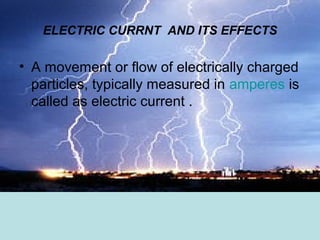
• A movement or flow of electrically charged
particles, typically measured in amperes is
called as electric current .
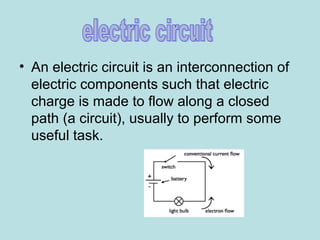
• An electric circuit is an interconnection of
electric components such that electric
charge is made to flow along a closed
path (a circuit), usually to perform some
useful task.
• In the 19th century, James Joule studied a
property, which says that "when an electric
current flows through the filament of a
bulb, it generates heat, and so the bulb
becomes hot". This property is named the
heating effect of electric current.
• Heating effect of electric current has many
applications.
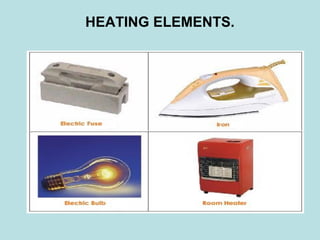
• HEATING ELEMENTS.
These appliances have coils of wire that produce heat,
which are known as heating elements
As current flows through these electrical appliances,
the coils of wire inside turn bright orange red in colour.
This is because a huge amount of heat is produced.
Different appliances have different types of heating elements.
The type of heating element depends on the function of the
appliance.
Some appliances are required to produce more heat than others
HEATING ELEMENTS.
• Electric Fuse
• The electric fuse works on the principle of the heating
effect of electric current. An electric fuse is a safety
device to prevent damage to an electrical circuit when
excessive current flows through it. It is made of a special
material. As the current increases beyond a limit, the
wire in the electric fuse melts and breaks off. The fuse is
then said to have blown off. The circuit is broken and
current stops flowing through it. Thus, a fuse prevents
fires.
There are various types of fuses. Some fuses are used
only in buildings, while others are used in appliances.
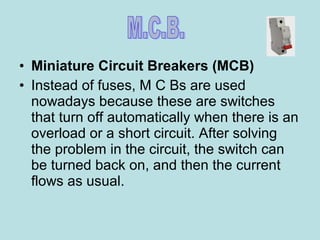
• Miniature Circuit Breakers (MCB)
• Instead of fuses, M C Bs are used
nowadays because these are switches
that turn off automatically when there is an
overload or a short circuit. After solving
the problem in the circuit, the switch can
be turned back on, and then the current
flows as usual.
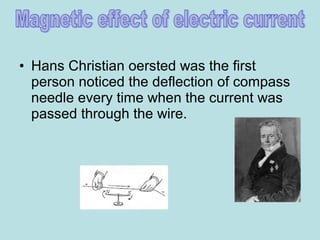
• Hans Christian oersted was the first
person noticed the deflection of compass
needle every time when the current was
passed through the wire.
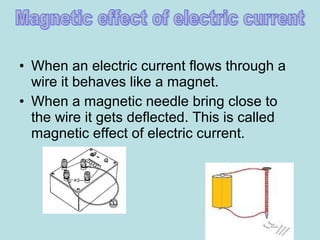
• When an electric current flows through a
wire it behaves like a magnet.
• When a magnetic needle bring close to
the wire it gets deflected. This is called
magnetic effect of electric current.
• An electromagnet is a type of magnet in
which the magnetic field is produced by
the flow of electric current. The magnetic
field disappears when the current is turned
off. Electromagnets are widely used as
components of other electrical devices,
such as electric bells, motors, generators,
relays, loudspeakers, hard disks, MRI
machines,
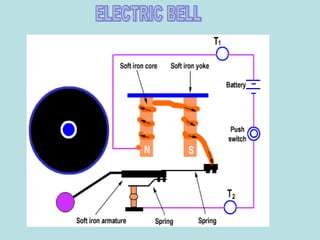
• CONSTRUCTION     One end of armature 
winding is connected to terminal T1 and 
the other to a spring, which is mounted on 
    a soft iron strip. A rod is attached to the 
armature and the free end of the rod 
carries a small hammer,     which strikes a 
bell. A very light spring is attached to a 
screw, which is joined to terminal T2
• WORKING OF ELECTRIC BELL    The electric circuit is 
completed through a battery and push switch button 
connected to the terminal T1     and T2. When the push 
button is pressed the electric circuit is completed and the 
armature is attracted     towards the electromagnet as a 
result, the small spring gets detached from the screw 
due to which the     electric circuit is broken and the 
electromagnet is demagnetized. Hence, the attraction 
disappears and     the armature is brought back by the 
spring to its original position. Contact of the spring with 
the screw is     now remade, which completes the electric 
circuit. The action is repeated over and over again 
    consequently. The armature vibrates and hammer 
attached to it strikes the gong and the bell rings and 
    sound is produced.
14. Electric currentand its effects by Dilip Kumar Chandra

14. Electric currentand its effects by Dilip Kumar Chandra

  • 1.
  • 2.
    ELECTRIC CURRNT ANDITS EFFECTS • A movement or flow of electrically charged particles, typically measured in amperes is called as electric current .
  • 3.
    • An electriccircuit is an interconnection of electric components such that electric charge is made to flow along a closed path (a circuit), usually to perform some useful task.
  • 5.
    • In the19th century, James Joule studied a property, which says that "when an electric current flows through the filament of a bulb, it generates heat, and so the bulb becomes hot". This property is named the heating effect of electric current.
  • 6.
    • Heating effectof electric current has many applications. • HEATING ELEMENTS. These appliances have coils of wire that produce heat, which are known as heating elements As current flows through these electrical appliances, the coils of wire inside turn bright orange red in colour. This is because a huge amount of heat is produced. Different appliances have different types of heating elements. The type of heating element depends on the function of the appliance. Some appliances are required to produce more heat than others
  • 7.
  • 8.
    • Electric Fuse •The electric fuse works on the principle of the heating effect of electric current. An electric fuse is a safety device to prevent damage to an electrical circuit when excessive current flows through it. It is made of a special material. As the current increases beyond a limit, the wire in the electric fuse melts and breaks off. The fuse is then said to have blown off. The circuit is broken and current stops flowing through it. Thus, a fuse prevents fires. There are various types of fuses. Some fuses are used only in buildings, while others are used in appliances.
  • 9.
    • Miniature CircuitBreakers (MCB) • Instead of fuses, M C Bs are used nowadays because these are switches that turn off automatically when there is an overload or a short circuit. After solving the problem in the circuit, the switch can be turned back on, and then the current flows as usual.
  • 10.
    • Hans Christianoersted was the first person noticed the deflection of compass needle every time when the current was passed through the wire.
  • 11.
    • When anelectric current flows through a wire it behaves like a magnet. • When a magnetic needle bring close to the wire it gets deflected. This is called magnetic effect of electric current.
  • 12.
    • An electromagnetis a type of magnet in which the magnetic field is produced by the flow of electric current. The magnetic field disappears when the current is turned off. Electromagnets are widely used as components of other electrical devices, such as electric bells, motors, generators, relays, loudspeakers, hard disks, MRI machines,
  • 14.
  • 15.
    • WORKING OFELECTRIC BELL    The electric circuit is  completed through a battery and push switch button  connected to the terminal T1     and T2. When the push  button is pressed the electric circuit is completed and the  armature is attracted     towards the electromagnet as a  result, the small spring gets detached from the screw  due to which the     electric circuit is broken and the  electromagnet is demagnetized. Hence, the attraction  disappears and     the armature is brought back by the  spring to its original position. Contact of the spring with  the screw is     now remade, which completes the electric  circuit. The action is repeated over and over again      consequently. The armature vibrates and hammer  attached to it strikes the gong and the bell rings and      sound is produced.