Chapter- 14
Electric Current
and
its Effects
Period-1
Electric Circuits:
• Electric Current:
The flow of electricity along a
path is called an Electric
Current.
• Electric Circuit:
Electricity flows through a
closed path called an Electric
Circuit.
• Circuit Diagram:
The representation of an electric
circuit with the help of standard
symbols for the various
components of the circuit is
called Circuit Diagram.
Self Assessment-1
1. What is Electric Current?
2. What is Electric Circuit?
3. What is Circuit Diagram?
4. Draw the symbol of Electric Bulb.
5. Draw the symbol of Electric Cell.
6. Draw the symbol of Electric Battery.
7. Draw the symbol of Connecting Wires.
8. Draw the symbol of Open Switch.
9. Draw the symbol of Closed Switch.
Period-2
The Components of an Electric Circuit
(a) The Cell or Battery:
 An electric circuit needs a source of
electricity.
 The single unit of source of electricity
that is used to supply electric current
to an electric circuit is called a Cell.
 A combination of two or more cells is
known as Battery.
 If we observe a cell then we will
notice that symbols ‘+’ and ‘-’ printed
on it.
 ‘+’ sign represents the positive
terminal and ‘-’ sign represents the
negative terminal. These symbols
help us to connect the cells correctly.
The Components of an Electric Circuit
(a) The Cell or Battery:
 There are different ways to connect
cells to form a battery.
 Cells can be placed end to end such
that the negative terminal of the
first cell touches the positive
terminal of the second cell and so
on.
 Sometimes, wires or strips of metal
are used to connect the positive
terminal of one cell to the negative
terminal of another.
 We also use battery holders to
make batteries of two or more
cells.
The Components of an Electric Circuit
• More Cells, More Current:
 Let us connect a bulb to a cell using
wires to complete the circuit. Let us
note the brightness of the bulb.
 Let us connect one more cells to the
circuit. Let us note the brightness of
the same bulb when two cells are
connected in a row to the circuit.
 Let us increase the cell numbers
connected to the circuit to three. Let
us note the brightness of the bulb.
 We will notice that the bulb glows the
brightest when three cells in a row
are connected to the circuit.
 More electric current flows through
the circuit when three cells are
connected in a row.
The Components of an Electric Circuit
• (b) The Switch:
The electric component that
enables us to switch on or
switch off an electric circuit is
called a Switch.
 A switch can be placed
anywhere in a circuit such that
it is essential to complete the
circuit.
 When the switch is closed, the
circuit is complete and current
flows through it.
 When the switch is open, the
circuit is broken and current
does not flow through it.
The Components of an Electric Circuit
• (c) Electric Appliances:
 The devices which run on
electricity to perform a particular
desired task are known as Electric
Appliances.
 Different appliances use the
electric current for different
purposes. A Bulb produces light, A
Microwave Oven produces heat ,
A Bread Toaster produces heat
and so on .
e.g. Electric Bulb, Microwave
Oven, Electric Toaster etc.
• (d) Connecting Wires:
Connecting Wires are usually
insulated wires made of a
good conductor like copper.
Self Assessment-2
1. What is an Electric Cell?
2. What is an Electric Battery?
3. How can we identify the Positive and Negative terminals of a Cell?
4. What is an Electric Switch?
5. What are Electric Appliances?
6. What are Connecting Wires?
7. Different Appliances use the Electric Current for different purposes. Justify the statement.
8. Name the materials used to make Connecting Wires.
9. What do you mean by the term ‘Complete Circuit’?
10. Mention a way of connecting three Electric Cells to make a Battery.
Period-3
The Heating Effect of Electric Current:
 The effect by virtue of which heat
is produced in current carrying
wires or in electric appliances
when electric current passes
through them is known as Heating
Effect of Electric Current.
 Electric Bulb:
 An electric bulb contains a filament
usually made of a material called
Tungsten. When electric current
passes through the filament, heat
energy is produced. The tungsten
filament becomes so hot that it
glows, giving out light.
 Several appliances like Electric
Clothes Irons, Electric Toasters,
Room Heaters and Hair Dryers use
the heating effect of current.
 These devices have coils of wire
(usually made of Nichrome)
called elements . An element
becomes red hot and gives out
heat when current is passed
through the device.
The Factors Affecting Heating Effect of Electric Current:
 The amount of heat produced (H)
in a wire due to current flow
depends on
 Amount of Current flowing
through the wire (I).
 Resistance offered by the wire to
the current flow (R).
Resistance offered by a current
carrying wire depends on
o Length of the wire (l)
o Cross-sectional area (Thickness)
of the wire (A)
o Material of the wire (Specific
Resistance) (ρ)
 Time Interval of current flow (t).
H = I²Rt = I²{(ρ l)/A}t = (I²ρ l t)/A
Niblet:
 The heating effect of electric
current has a few disadvantages
too. Electrical equipment like
Music
Systems, Television Sets and
Computers become warm with
continuous use and are fitted
with fans or air vents to cool
them. Excessive heating can also
result in electrical fires.
The Electric Fuse:
 There is a maximum limit on
the amount of current that can
flow through a circuit . If this safety
limit is exceeded, it could damage
the circuit and cause a fire.
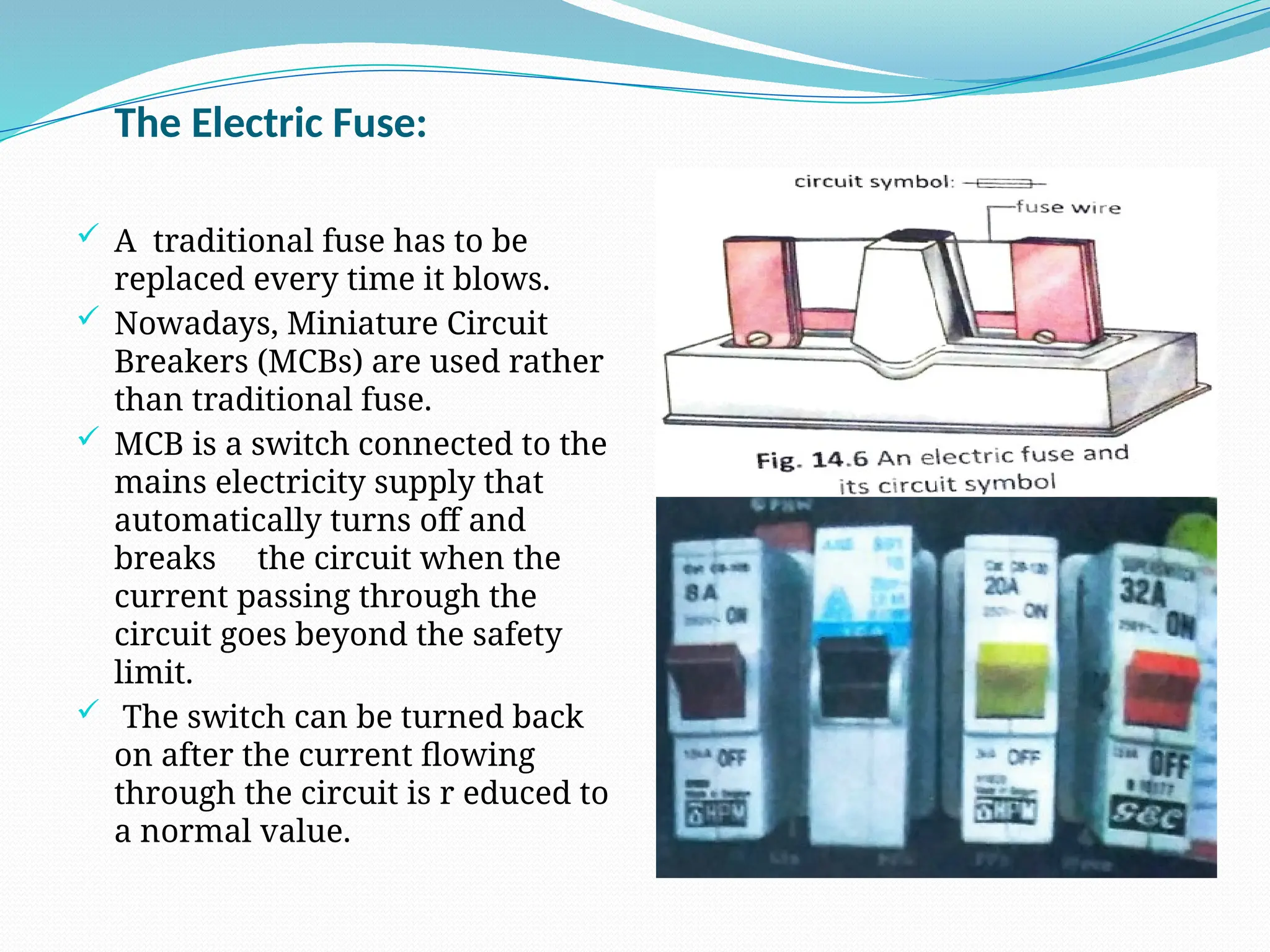
 Electric Fuse is a safety device used
in an electric circuit.
 A fuse is made of a wire fitted into
a carrier made of glass or porcelain
(an insulator).
 The fuse wire is made of a material
that has a low melting point.
 When a very high current flows
through a circuit, the fuse wire gets
heated and melts .
 When this happens, we say that the
fuse has 'blown '.
 The fuse breaks the circuit to
prevent damage to the electrical
appliances connected in the
circuit or fire due to over
heating.
 All the circuits in a building
must have a fuse.
The Electric Fuse:
 A traditional fuse has to be
replaced every time it blows.
 Nowadays, Miniature Circuit
Breakers (MCBs) are used rather
than traditional fuse.
 MCB is a switch connected to the
mains electricity supply that
automatically turns off and
breaks the circuit when the
current passing through the
circuit goes beyond the safety
limit.
 The switch can be turned back
on after the current flowing
through the circuit is r educed to
a normal value.
Self Assessment-3
1. What is Heating Effect of Electric Current?
2. Name the heating element of an Electric Bulb.
3. Name the material used to make the filament of an Electric Bulb.
4. How does the Filament of an Electric Bulb produce Light?
5. Name the material used to make the filament of an Electric Toaster.
6. List the factors on which the Heat produced in a current carrying wire depends.
7. List the factors on which the Resistance of a current carrying wire depends.
8. Write the Mathematical Formula of Heat produced in a current carrying wire.
9. What is an Electric Fuse?
10. How does a Traditional Fuse work?
11. What type of material is chosen for an Electric Fuse?
12. What is the disadvantage of a Traditional Electric Fuse?
13. What is a Miniature Circuit Breaker (MCB)?
14. How does a Miniature circuit Breaker (MCB) work?
15. What is the advantage of Miniature Circuit Breaker (MCB) over Traditional Fuse?
16. Mention the advantages of Heating Effect Electric Current.
17. Mention the disadvantages of Heating Effect Electric Current.
Period-4
The Magnetic Effect of Electric Current:
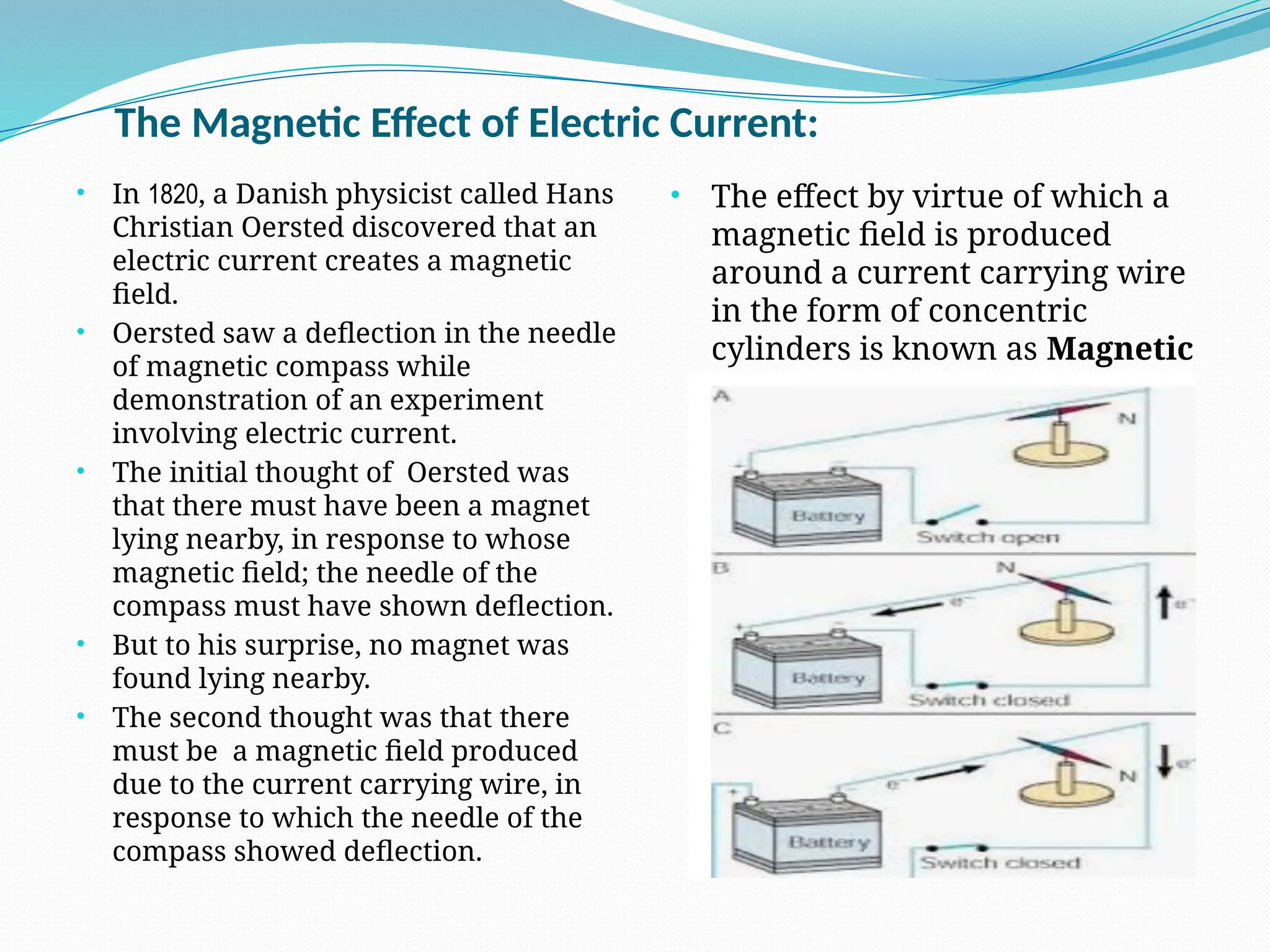
• In 1820, a Danish physicist called Hans
Christian Oersted discovered that an
electric current creates a magnetic
field.
• Oersted saw a deflection in the needle
of magnetic compass while
demonstration of an experiment
involving electric current.
• The initial thought of Oersted was
that there must have been a magnet
lying nearby, in response to whose
magnetic field; the needle of the
compass must have shown deflection.
• But to his surprise, no magnet was
found lying nearby.
• The second thought was that there
must be a magnetic field produced
due to the current carrying wire, in
response to which the needle of the
compass showed deflection.
• The effect by virtue of which a
magnetic field is produced
around a current carrying wire
in the form of concentric
cylinders is known as Magnetic
Effect of Electric Current.
The Magnetic Effect of Electric Current:
 Do It:
Aim of the Activity:
To demonstrate the Magnetic effect
of Electric Current.
Materials Required:
Electric Cell, Petri Dish, Copper
Wire, Switch and Magnetic Compass.
Procedure:
 Let us place a magnetic compass in a
petri dish.
 Let us fix an insulated copper wire
across the rim of the petri dish such
that the wire is aligned in the same
direction as the compass needle.
 Let us connect the free ends of the
wire to an electric cell and a switch.
 Let us turn on the switch and
observe the compass needle.
 Observation:
 When the switch is turned on,
electric current flows in the
circuit, the needle of the
compass deflects to one side.
 When the switch is turned off,
no electric current flows
through the circuit, the needle
of the compass goes back to its
original position.
Conclusion:
An electric current can create a
magnetic field.
Electromagnets:
 A soft metal core that acts as magnet
when an electric current is passed
through the coil of insulated wire
wrapped around it is called an
Electromagnet.
 Do It:
Aim of the Activity:
To demonstrate the working of a simple
Electromagnet.
Materials Required:
Electric Cell, Copper Wire, Switch, Iron
nail and Staple Pins.
Procedure:
 Let us wind a long piece of insulated wire
around an Iron nail.
 Let us connect the two ends of the wire to
an Electric Cell and a Switch.
 Let us hold the Iron nail above some
Staple pins.
 Let us Switch on and off the electric
circuit alternately.
Observation and Conclusion:
 When the electric circuit is
turned on, electric current flows
through the circuit. The Iron
nail acts as an electromagnet.
The Staple pins stick to the Iron
nail (Electromagnet).
 When the electric circuit is
turned off, electric current stops
flowing through the circuit. The
Iron nail looses
electromagnetism . The Staple
pins fall off from the Iron nail.
Electromagnets:
 Do It:
Aim of the Activity:
To study the factors affecting the
strength of an Electromagnet.
Materials Required:
Electric Cell, Copper Wire, Switch,
Iron nail and Staple Pins.
Procedure:
Case-I
 Let us wind 12 turns of a long piece of
insulated wire around an Iron nail.
 Let us connect the two free ends of the
wire to an Electric cell and a Switch.
 Let us hold the Iron nail above some
Staple pins and Switch on the circuit.
Case-II
 Let us wind 12 turns of a long piece of
insulated wire around an Iron nail.
 Let us connect the two free ends
of the wire to two Electric cells
and a Switch.
 Let us hold the Iron nail above
some Staple pins and Switch on
the circuit.
Observation-I:
 The Iron nail connected to two
cells will attract more number
of Staple pins.
Conclusion-I:
 Greater the magnitude of
electric current, stronger the
strength of the electromagnet.
Electromagnets:
Procedure:
Case-III
 Let us wind 12 turns of a long piece of
insulated wire around an Iron nail.
 Let us connect the two free ends of
the wire to two Electric Cells and a
Switch.
 Let us hold the Iron nail above some
Staple Pins and Switch on the circuit.
Case-IV
 Let us wind 16 turns of a long piece of
insulated wire around an Iron nail.
 Let us connect the two free ends of
the wire to two Electric Cells and a
Switch.
 Let us hold the Iron nail above some
Staple pins and Switch on the circuit.
Observation-II:
 The Iron nail with 16 turns of
insulated wire wrapped
around it will attract more
number of Staple pins.
Conclusion-II:
 Greater the number of turns of
insulated wire wrapped
around the Iron nail, stronger
the strength of the
electromagnet.
Self Assessment-4
1. What is Magnetic Effect of Electric Current?
2. Name the scientist who discovered Magnetic Effect of Electric Current.
3. With the help of an activity demonstrate the Magnetic Effect of Electric Current.
4. What is an Electromagnet?
5. With the help of an activity demonstrate the working of an Electromagnet.
6. List the factors that affect the strength of an Electromagnet.
7. With the help of an activity demonstrate the factors that affect the strength of an Electromagnet.
8. Can we have Permanent Electromagnets? Comment.
Period-5
Uses of Electromagnets:
 Though electromagnets are
temporary magnets, their strength
can be increased either by
increasing the number of turns of
the insulated wire wrapped or
increasing the amount of current
passing through the wrapped wire.
 Electromagnets can be made to be
very strong.
 Electromagnets are used in cranes
to lift very heavy iron or steel
objects.
 Many machines used in
household, like fans, some kinds of
TVs, door bells and refrigerators,
have electromagnets in them.
 Microphones and loudspeakers
use electromagnets too.
Uses of Electromagnets:
 Electric Bell:
• An electric bell works on the
principle of the magnetic effect
of electric current.
Structure:
• An electric bell has a soft iron
rod that is attached to a hammer
at one end.
• When this hammer hits a metal
disc called a gong, it makes a
sound.
• The iron rod is mounted on a
spring and is placed near an
electromagnet. The circuit has a
switch, which controls the flow
of electricity.
Uses of Electromagnets:
 Electric Bell:
• Working:
 When the switch is turned on, current
flows through the electromagnet.
 The electromagnet attracts the soft
iron rod towards itself. This causes the
hammer that is attached to the rod to
hit the gong and produce a ringing
sound.
 The movement of the iron rod towards
the electromagnet breaks the circuit.
 The electromagnet loses its magnetic
nature since current does not flow
through it; it can thus no longer attract
the iron rod. The iron rod moves back
to its original position and completes
the circuit once more.
 The electromagnet regains its
magnetic nature. The hammer hits the
gong again.
• This process of completing and
breaking the circuit goes on and
the bell rings as long as the
switch is on.
Self Assessment-5
1. Mention an advantage of Electromagnets over Natural magnets.
2. List few uses of Electromagnets.
3. What is the working principle of Electric Bell?
4. With the help of a neat labeled diagram discuss the working of an Electric Bell.
5. Will the Electric bell work if the Electromagnet is replaced by a Permanent Magnet.

GD-VII-Ch-14-Electric-Current-and-its-Effects.pptx

  • 1.
  • 2.
  • 3.
    Electric Circuits: • ElectricCurrent: The flow of electricity along a path is called an Electric Current. • Electric Circuit: Electricity flows through a closed path called an Electric Circuit. • Circuit Diagram: The representation of an electric circuit with the help of standard symbols for the various components of the circuit is called Circuit Diagram.
  • 4.
    Self Assessment-1 1. Whatis Electric Current? 2. What is Electric Circuit? 3. What is Circuit Diagram? 4. Draw the symbol of Electric Bulb. 5. Draw the symbol of Electric Cell. 6. Draw the symbol of Electric Battery. 7. Draw the symbol of Connecting Wires. 8. Draw the symbol of Open Switch. 9. Draw the symbol of Closed Switch.
  • 5.
  • 6.
    The Components ofan Electric Circuit (a) The Cell or Battery:  An electric circuit needs a source of electricity.  The single unit of source of electricity that is used to supply electric current to an electric circuit is called a Cell.  A combination of two or more cells is known as Battery.  If we observe a cell then we will notice that symbols ‘+’ and ‘-’ printed on it.  ‘+’ sign represents the positive terminal and ‘-’ sign represents the negative terminal. These symbols help us to connect the cells correctly.
  • 7.
    The Components ofan Electric Circuit (a) The Cell or Battery:  There are different ways to connect cells to form a battery.  Cells can be placed end to end such that the negative terminal of the first cell touches the positive terminal of the second cell and so on.  Sometimes, wires or strips of metal are used to connect the positive terminal of one cell to the negative terminal of another.  We also use battery holders to make batteries of two or more cells.
  • 8.
    The Components ofan Electric Circuit • More Cells, More Current:  Let us connect a bulb to a cell using wires to complete the circuit. Let us note the brightness of the bulb.  Let us connect one more cells to the circuit. Let us note the brightness of the same bulb when two cells are connected in a row to the circuit.  Let us increase the cell numbers connected to the circuit to three. Let us note the brightness of the bulb.  We will notice that the bulb glows the brightest when three cells in a row are connected to the circuit.  More electric current flows through the circuit when three cells are connected in a row.
  • 9.
    The Components ofan Electric Circuit • (b) The Switch: The electric component that enables us to switch on or switch off an electric circuit is called a Switch.  A switch can be placed anywhere in a circuit such that it is essential to complete the circuit.  When the switch is closed, the circuit is complete and current flows through it.  When the switch is open, the circuit is broken and current does not flow through it.
  • 10.
    The Components ofan Electric Circuit • (c) Electric Appliances:  The devices which run on electricity to perform a particular desired task are known as Electric Appliances.  Different appliances use the electric current for different purposes. A Bulb produces light, A Microwave Oven produces heat , A Bread Toaster produces heat and so on . e.g. Electric Bulb, Microwave Oven, Electric Toaster etc. • (d) Connecting Wires: Connecting Wires are usually insulated wires made of a good conductor like copper.
  • 11.
    Self Assessment-2 1. Whatis an Electric Cell? 2. What is an Electric Battery? 3. How can we identify the Positive and Negative terminals of a Cell? 4. What is an Electric Switch? 5. What are Electric Appliances? 6. What are Connecting Wires? 7. Different Appliances use the Electric Current for different purposes. Justify the statement. 8. Name the materials used to make Connecting Wires. 9. What do you mean by the term ‘Complete Circuit’? 10. Mention a way of connecting three Electric Cells to make a Battery.
  • 12.
  • 13.
    The Heating Effectof Electric Current:  The effect by virtue of which heat is produced in current carrying wires or in electric appliances when electric current passes through them is known as Heating Effect of Electric Current.  Electric Bulb:  An electric bulb contains a filament usually made of a material called Tungsten. When electric current passes through the filament, heat energy is produced. The tungsten filament becomes so hot that it glows, giving out light.  Several appliances like Electric Clothes Irons, Electric Toasters, Room Heaters and Hair Dryers use the heating effect of current.  These devices have coils of wire (usually made of Nichrome) called elements . An element becomes red hot and gives out heat when current is passed through the device.
  • 14.
    The Factors AffectingHeating Effect of Electric Current:  The amount of heat produced (H) in a wire due to current flow depends on  Amount of Current flowing through the wire (I).  Resistance offered by the wire to the current flow (R). Resistance offered by a current carrying wire depends on o Length of the wire (l) o Cross-sectional area (Thickness) of the wire (A) o Material of the wire (Specific Resistance) (ρ)  Time Interval of current flow (t). H = I²Rt = I²{(ρ l)/A}t = (I²ρ l t)/A Niblet:  The heating effect of electric current has a few disadvantages too. Electrical equipment like Music Systems, Television Sets and Computers become warm with continuous use and are fitted with fans or air vents to cool them. Excessive heating can also result in electrical fires.
  • 15.
    The Electric Fuse: There is a maximum limit on the amount of current that can flow through a circuit . If this safety limit is exceeded, it could damage the circuit and cause a fire.  Electric Fuse is a safety device used in an electric circuit.  A fuse is made of a wire fitted into a carrier made of glass or porcelain (an insulator).  The fuse wire is made of a material that has a low melting point.  When a very high current flows through a circuit, the fuse wire gets heated and melts .  When this happens, we say that the fuse has 'blown '.  The fuse breaks the circuit to prevent damage to the electrical appliances connected in the circuit or fire due to over heating.  All the circuits in a building must have a fuse.
  • 16.
    The Electric Fuse: A traditional fuse has to be replaced every time it blows.  Nowadays, Miniature Circuit Breakers (MCBs) are used rather than traditional fuse.  MCB is a switch connected to the mains electricity supply that automatically turns off and breaks the circuit when the current passing through the circuit goes beyond the safety limit.  The switch can be turned back on after the current flowing through the circuit is r educed to a normal value.
  • 17.
    Self Assessment-3 1. Whatis Heating Effect of Electric Current? 2. Name the heating element of an Electric Bulb. 3. Name the material used to make the filament of an Electric Bulb. 4. How does the Filament of an Electric Bulb produce Light? 5. Name the material used to make the filament of an Electric Toaster. 6. List the factors on which the Heat produced in a current carrying wire depends. 7. List the factors on which the Resistance of a current carrying wire depends. 8. Write the Mathematical Formula of Heat produced in a current carrying wire. 9. What is an Electric Fuse? 10. How does a Traditional Fuse work? 11. What type of material is chosen for an Electric Fuse? 12. What is the disadvantage of a Traditional Electric Fuse? 13. What is a Miniature Circuit Breaker (MCB)? 14. How does a Miniature circuit Breaker (MCB) work? 15. What is the advantage of Miniature Circuit Breaker (MCB) over Traditional Fuse? 16. Mention the advantages of Heating Effect Electric Current. 17. Mention the disadvantages of Heating Effect Electric Current.
  • 18.
  • 19.
    The Magnetic Effectof Electric Current: • In 1820, a Danish physicist called Hans Christian Oersted discovered that an electric current creates a magnetic field. • Oersted saw a deflection in the needle of magnetic compass while demonstration of an experiment involving electric current. • The initial thought of Oersted was that there must have been a magnet lying nearby, in response to whose magnetic field; the needle of the compass must have shown deflection. • But to his surprise, no magnet was found lying nearby. • The second thought was that there must be a magnetic field produced due to the current carrying wire, in response to which the needle of the compass showed deflection. • The effect by virtue of which a magnetic field is produced around a current carrying wire in the form of concentric cylinders is known as Magnetic Effect of Electric Current.
  • 20.
    The Magnetic Effectof Electric Current:  Do It: Aim of the Activity: To demonstrate the Magnetic effect of Electric Current. Materials Required: Electric Cell, Petri Dish, Copper Wire, Switch and Magnetic Compass. Procedure:  Let us place a magnetic compass in a petri dish.  Let us fix an insulated copper wire across the rim of the petri dish such that the wire is aligned in the same direction as the compass needle.  Let us connect the free ends of the wire to an electric cell and a switch.  Let us turn on the switch and observe the compass needle.  Observation:  When the switch is turned on, electric current flows in the circuit, the needle of the compass deflects to one side.  When the switch is turned off, no electric current flows through the circuit, the needle of the compass goes back to its original position. Conclusion: An electric current can create a magnetic field.
  • 21.
    Electromagnets:  A softmetal core that acts as magnet when an electric current is passed through the coil of insulated wire wrapped around it is called an Electromagnet.  Do It: Aim of the Activity: To demonstrate the working of a simple Electromagnet. Materials Required: Electric Cell, Copper Wire, Switch, Iron nail and Staple Pins. Procedure:  Let us wind a long piece of insulated wire around an Iron nail.  Let us connect the two ends of the wire to an Electric Cell and a Switch.  Let us hold the Iron nail above some Staple pins.  Let us Switch on and off the electric circuit alternately. Observation and Conclusion:  When the electric circuit is turned on, electric current flows through the circuit. The Iron nail acts as an electromagnet. The Staple pins stick to the Iron nail (Electromagnet).  When the electric circuit is turned off, electric current stops flowing through the circuit. The Iron nail looses electromagnetism . The Staple pins fall off from the Iron nail.
  • 22.
    Electromagnets:  Do It: Aimof the Activity: To study the factors affecting the strength of an Electromagnet. Materials Required: Electric Cell, Copper Wire, Switch, Iron nail and Staple Pins. Procedure: Case-I  Let us wind 12 turns of a long piece of insulated wire around an Iron nail.  Let us connect the two free ends of the wire to an Electric cell and a Switch.  Let us hold the Iron nail above some Staple pins and Switch on the circuit. Case-II  Let us wind 12 turns of a long piece of insulated wire around an Iron nail.  Let us connect the two free ends of the wire to two Electric cells and a Switch.  Let us hold the Iron nail above some Staple pins and Switch on the circuit. Observation-I:  The Iron nail connected to two cells will attract more number of Staple pins. Conclusion-I:  Greater the magnitude of electric current, stronger the strength of the electromagnet.
  • 23.
    Electromagnets: Procedure: Case-III  Let uswind 12 turns of a long piece of insulated wire around an Iron nail.  Let us connect the two free ends of the wire to two Electric Cells and a Switch.  Let us hold the Iron nail above some Staple Pins and Switch on the circuit. Case-IV  Let us wind 16 turns of a long piece of insulated wire around an Iron nail.  Let us connect the two free ends of the wire to two Electric Cells and a Switch.  Let us hold the Iron nail above some Staple pins and Switch on the circuit. Observation-II:  The Iron nail with 16 turns of insulated wire wrapped around it will attract more number of Staple pins. Conclusion-II:  Greater the number of turns of insulated wire wrapped around the Iron nail, stronger the strength of the electromagnet.
  • 24.
    Self Assessment-4 1. Whatis Magnetic Effect of Electric Current? 2. Name the scientist who discovered Magnetic Effect of Electric Current. 3. With the help of an activity demonstrate the Magnetic Effect of Electric Current. 4. What is an Electromagnet? 5. With the help of an activity demonstrate the working of an Electromagnet. 6. List the factors that affect the strength of an Electromagnet. 7. With the help of an activity demonstrate the factors that affect the strength of an Electromagnet. 8. Can we have Permanent Electromagnets? Comment.
  • 25.
  • 26.
    Uses of Electromagnets: Though electromagnets are temporary magnets, their strength can be increased either by increasing the number of turns of the insulated wire wrapped or increasing the amount of current passing through the wrapped wire.  Electromagnets can be made to be very strong.  Electromagnets are used in cranes to lift very heavy iron or steel objects.  Many machines used in household, like fans, some kinds of TVs, door bells and refrigerators, have electromagnets in them.  Microphones and loudspeakers use electromagnets too.
  • 27.
    Uses of Electromagnets: Electric Bell: • An electric bell works on the principle of the magnetic effect of electric current. Structure: • An electric bell has a soft iron rod that is attached to a hammer at one end. • When this hammer hits a metal disc called a gong, it makes a sound. • The iron rod is mounted on a spring and is placed near an electromagnet. The circuit has a switch, which controls the flow of electricity.
  • 28.
    Uses of Electromagnets: Electric Bell: • Working:  When the switch is turned on, current flows through the electromagnet.  The electromagnet attracts the soft iron rod towards itself. This causes the hammer that is attached to the rod to hit the gong and produce a ringing sound.  The movement of the iron rod towards the electromagnet breaks the circuit.  The electromagnet loses its magnetic nature since current does not flow through it; it can thus no longer attract the iron rod. The iron rod moves back to its original position and completes the circuit once more.  The electromagnet regains its magnetic nature. The hammer hits the gong again. • This process of completing and breaking the circuit goes on and the bell rings as long as the switch is on.
  • 29.
    Self Assessment-5 1. Mentionan advantage of Electromagnets over Natural magnets. 2. List few uses of Electromagnets. 3. What is the working principle of Electric Bell? 4. With the help of a neat labeled diagram discuss the working of an Electric Bell. 5. Will the Electric bell work if the Electromagnet is replaced by a Permanent Magnet.