Themis
An I/O-Efficient MapReduce
Alex Rasmussen, Michael Conley,
Rishi Kapoor, Vinh The Lam,
George Porter, AminVahdat*
University of California San Diego
*& Google, Inc.
1
MapReduce is Everywhere
  First published in OSDI 2004
  De facto standard for large-scale bulk
data processing
  Key benefit: simple programming model,
can handle large volume of data
2
I/O Path Efficiency
  I/O bound, so disks are bottleneck
  Existing implementations do a lot of disk I/O
– Materialize map output, re-read during shuffle
– Multiple sort passes if intermediate data large
– Swapping in response to memory pressure
  Hadoop Sort 2009: <3MBps per node
(3% of single disk’s throughput!)
3
How Low CanYou Go?
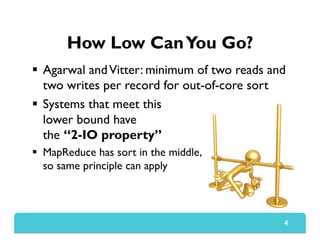
  Agarwal andVitter: minimum of two reads and
two writes per record for out-of-core sort
  Systems that meet this
lower bound have
the “2-IO property”
  MapReduce has sort in the middle,
so same principle can apply
4
Themis
  Goal: Build a MapReduce implementation with
the 2-IO property
  TritonSort (NSDI ’11): 2-IO sort
– World record holder in large-scale sorting
  Runs on a cluster of machines with many disks
per machine and fast NICs
  Performs wide range of I/O-bound
MapReduce jobs at nearly TritonSort speeds
5
Outline
  Architecture Overview
  Memory Management
  Fault Tolerance
  Evaluation
6
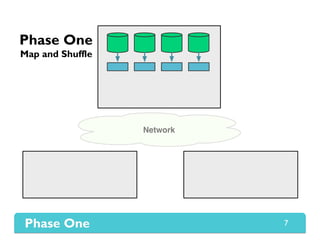
7
Network
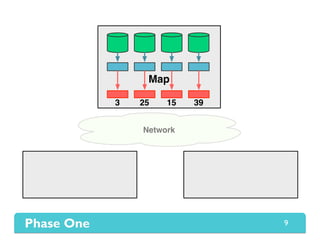
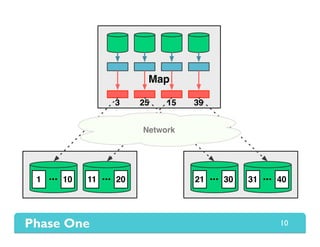
Phase One
Map and Shuffle
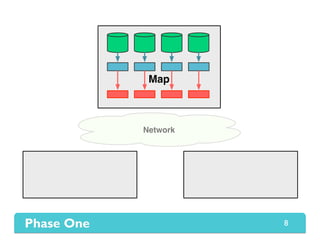
Map
Network
8
Map
3 3925 15
Network
9
Map
3 3925 15
1 10 11 20••• ••• 21 30 31 40••• •••
Network
10
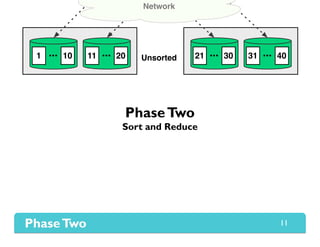
1 10 11 20••• ••• 21 30 31 40••• •••Unsorted
Network
11
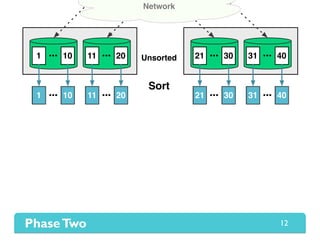
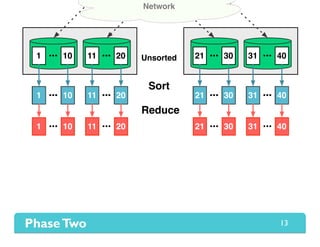
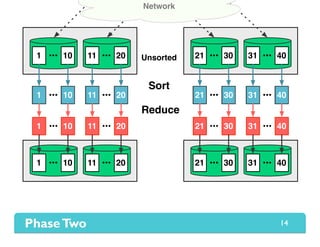
PhaseTwo
Sort and Reduce
1 10 11 20••• ••• 21 30 31 40••• •••
1 10 11 20 21 30 31 40••• ••• ••• •••1 10 11 20 21 30 31 40••• ••• ••• •••
Unsorted
Network
Sort
12
1 10 11 20••• ••• 21 30 31 40••• •••
1 10 11 20 21 30 31 40••• ••• ••• •••1 10 11 20 21 30 31 40••• ••• ••• •••
1 10 11 20 21 30 31 40••• ••• ••• •••
Unsorted
Reduce
Network
Sort
13
1 10 11 20••• ••• 21 30 31 40••• •••
1 10 11 20 21 30 31 40••• ••• ••• •••1 10 11 20 21 30 31 40••• ••• ••• •••
1 10 11 20 21 30 31 40••• ••• ••• •••
Unsorted
Reduce
Network
1 10 11 20 21 30 31 40••• ••• ••• •••
Sort
14
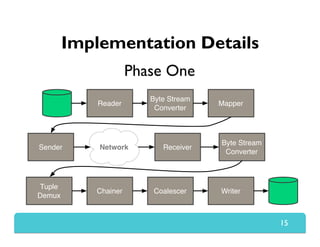
Reader
Byte Stream
Converter
Mapper
Sender Receiver
Byte Stream
Converter
Tuple
Demux
Chainer Coalescer Writer
Network
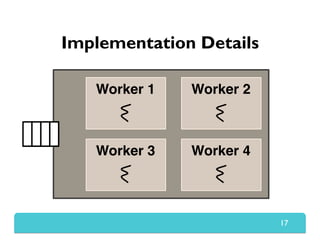
Implementation Details
15
Phase One
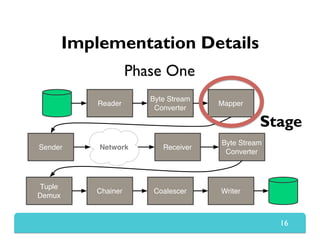
Reader
Byte Stream
Converter
Mapper
Sender Receiver
Byte Stream
Converter
Tuple
Demux
Chainer Coalescer Writer
Network
Implementation Details
16
Phase One
Stage
Implementation Details
17
Worker 1 Worker 2
Worker 3 Worker 4
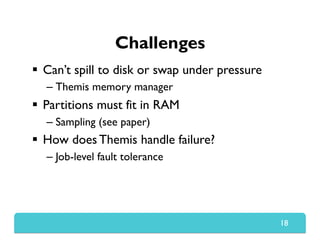
Challenges
  Can’t spill to disk or swap under pressure
– Themis memory manager
  Partitions must fit in RAM
– Sampling (see paper)
  How does Themis handle failure?
– Job-level fault tolerance
18
Outline
  Architecture Overview
  Memory Management
  Fault Tolerance
  Evaluation
19
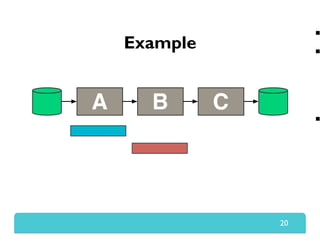
Example



20
A B C
Memory Management - Goals
  If we exceed physical memory, have to swap
– OS approach: virtual memory, swapping
– Hadoop approach: spill files
  Since this incurs more I/O, unacceptable
21
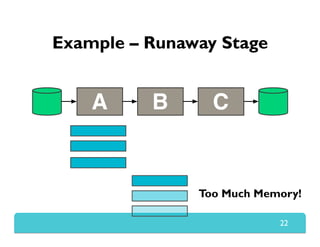
Example – Runaway Stage
22
A B C
Too Much Memory!
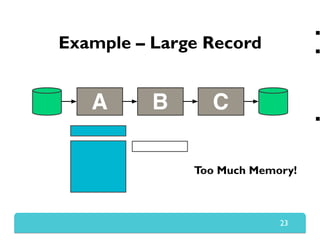
Example – Large Record



23
A B C
Too Much Memory!
Requirements
  Main requirement: can’t allocate more than
the amount physical memory
– Swapping or spilling breaks 2-IO
  Provide flow control via back-pressure
– Prevent stage from monopolizing memory
– Memory allocation can block indefinitely
  Support large records
  Should have high memory utilization
24
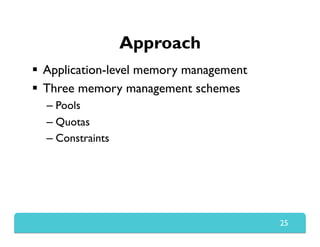
Approach
  Application-level memory management
  Three memory management schemes
– Pools
– Quotas
– Constraints
25
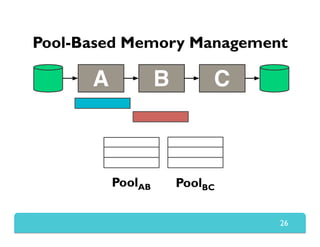
Pool-Based Memory Management
26
A B C
PoolAB PoolBC
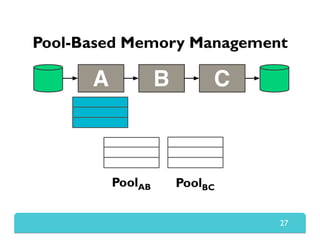
Pool-Based Memory Management
27
A B C
PoolAB PoolBC
Pool-Based Memory Management
  Prevents using more than what’s in a pool
  Empty pools cause back-pressure
  Record size limited to size of buffer
  Unless tuned, memory utilization might be low
– Tuning is hard; must set buffer, pool sizes
  Used when receiving data from network
– Must be fast to keep up with 10Gbps links
28
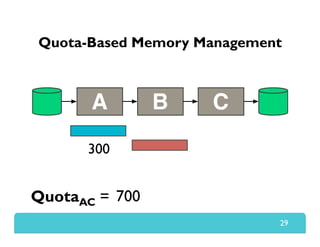
Quota-Based Memory Management
29
A B C
QuotaAC = 1000
300
700
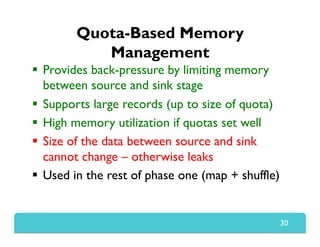
Quota-Based Memory
Management
  Provides back-pressure by limiting memory
between source and sink stage
  Supports large records (up to size of quota)
  High memory utilization if quotas set well
  Size of the data between source and sink
cannot change – otherwise leaks
  Used in the rest of phase one (map + shuffle)
30
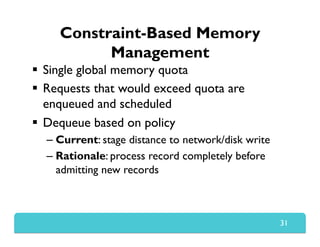
Constraint-Based Memory
Management
  Single global memory quota
  Requests that would exceed quota are
enqueued and scheduled
  Dequeue based on policy
– Current: stage distance to network/disk write
– Rationale: process record completely before
admitting new records
31
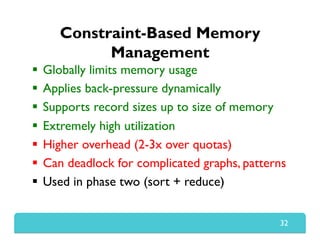
Constraint-Based Memory
Management
  Globally limits memory usage
  Applies back-pressure dynamically
  Supports record sizes up to size of memory
  Extremely high utilization
  Higher overhead (2-3x over quotas)
  Can deadlock for complicated graphs, patterns
  Used in phase two (sort + reduce)
32
Outline
  Architecture Overview
  Memory Management
  Fault Tolerance
  Evaluation
33
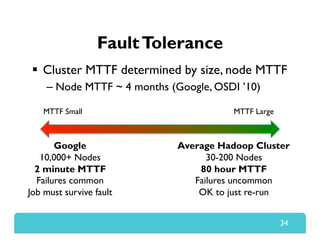
FaultTolerance
  Cluster MTTF determined by size, node MTTF
– Node MTTF ~ 4 months (Google, OSDI ’10)
34
Google
10,000+ Nodes
2 minute MTTF
Failures common
Job must survive fault
Average Hadoop Cluster
30-200 Nodes
80 hour MTTF
Failures uncommon
OK to just re-run
MTTF Small MTTF Large
Why are Smaller Clusters OK?
  Hardware trends let you do more with less
– Increased hard drive density (32TB in 2U)
– Faster bus speeds
– 10Gbps Ethernet at end host
– Larger core counts
  Can store, process petabytes
  But is it really OK to just restart on failure?
35
Analytical Modeling
  Modeling goal: when is performance gain
nullified by restart cost?
  Example: 2x improvement
– 30 minute jobs: ~4300 nodes
– 2.5 hr jobs: ~800 nodes
  Can sort 100TB on 52 machines in ~2.5 hours
– Petabyte scale easily possible in these regions
  See paper for additional discussion
36
Outline
  Architecture Overview
  Memory Management
  Fault Tolerance
  Evaluation
37
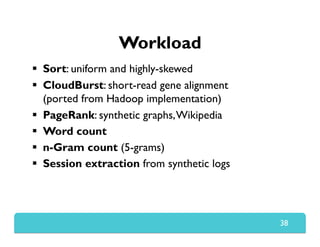
Workload
  Sort: uniform and highly-skewed
  CloudBurst: short-read gene alignment
(ported from Hadoop implementation)
  PageRank: synthetic graphs,Wikipedia
  Word count
  n-Gram count (5-grams)
  Session extraction from synthetic logs
38
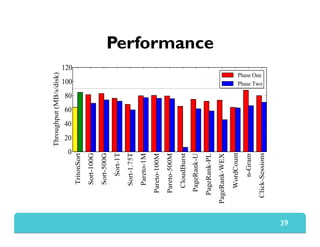
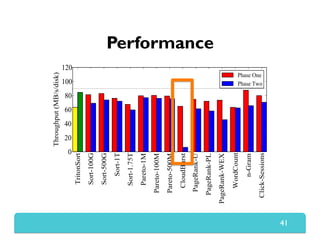
Performance
39
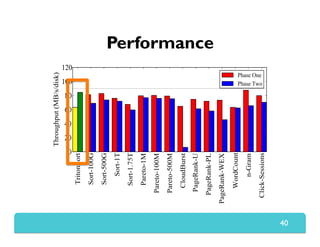
Performance
40
Performance
41
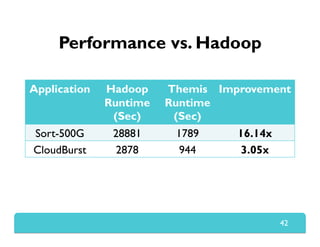
Performance vs. Hadoop
42
Application Hadoop
Runtime
(Sec)
Themis
Runtime
(Sec)
Improvement
Sort-500G 28881 1789 16.14x
CloudBurst 2878 944 3.05x
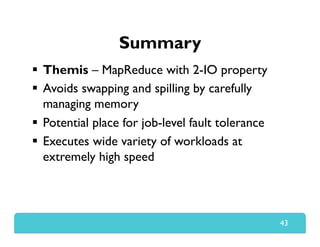
Summary
  Themis – MapReduce with 2-IO property
  Avoids swapping and spilling by carefully
managing memory
  Potential place for job-level fault tolerance
  Executes wide variety of workloads at
extremely high speed
43
Themis - Questions?
44
Zoom!
http://themis.sysnet.ucsd.edu/!

Themis: An I/O-Efficient MapReduce (SoCC 2012)

  • 1.
    Themis An I/O-Efficient MapReduce AlexRasmussen, Michael Conley, Rishi Kapoor, Vinh The Lam, George Porter, AminVahdat* University of California San Diego *& Google, Inc. 1
  • 2.
    MapReduce is Everywhere  First published in OSDI 2004   De facto standard for large-scale bulk data processing   Key benefit: simple programming model, can handle large volume of data 2
  • 3.
    I/O Path Efficiency  I/O bound, so disks are bottleneck   Existing implementations do a lot of disk I/O – Materialize map output, re-read during shuffle – Multiple sort passes if intermediate data large – Swapping in response to memory pressure   Hadoop Sort 2009: <3MBps per node (3% of single disk’s throughput!) 3
  • 4.
    How Low CanYouGo?   Agarwal andVitter: minimum of two reads and two writes per record for out-of-core sort   Systems that meet this lower bound have the “2-IO property”   MapReduce has sort in the middle, so same principle can apply 4
  • 5.
    Themis   Goal: Builda MapReduce implementation with the 2-IO property   TritonSort (NSDI ’11): 2-IO sort – World record holder in large-scale sorting   Runs on a cluster of machines with many disks per machine and fast NICs   Performs wide range of I/O-bound MapReduce jobs at nearly TritonSort speeds 5
  • 6.
    Outline   Architecture Overview  Memory Management   Fault Tolerance   Evaluation 6
  • 7.
  • 8.
  • 9.
  • 10.
    Map 3 3925 15 110 11 20••• ••• 21 30 31 40••• ••• Network 10
  • 11.
    1 10 1120••• ••• 21 30 31 40••• •••Unsorted Network 11 PhaseTwo Sort and Reduce
  • 12.
    1 10 1120••• ••• 21 30 31 40••• ••• 1 10 11 20 21 30 31 40••• ••• ••• •••1 10 11 20 21 30 31 40••• ••• ••• ••• Unsorted Network Sort 12
  • 13.
    1 10 1120••• ••• 21 30 31 40••• ••• 1 10 11 20 21 30 31 40••• ••• ••• •••1 10 11 20 21 30 31 40••• ••• ••• ••• 1 10 11 20 21 30 31 40••• ••• ••• ••• Unsorted Reduce Network Sort 13
  • 14.
    1 10 1120••• ••• 21 30 31 40••• ••• 1 10 11 20 21 30 31 40••• ••• ••• •••1 10 11 20 21 30 31 40••• ••• ••• ••• 1 10 11 20 21 30 31 40••• ••• ••• ••• Unsorted Reduce Network 1 10 11 20 21 30 31 40••• ••• ••• ••• Sort 14
  • 15.
    Reader Byte Stream Converter Mapper Sender Receiver ByteStream Converter Tuple Demux Chainer Coalescer Writer Network Implementation Details 15 Phase One
  • 16.
    Reader Byte Stream Converter Mapper Sender Receiver ByteStream Converter Tuple Demux Chainer Coalescer Writer Network Implementation Details 16 Phase One Stage
  • 17.
    Implementation Details 17 Worker 1Worker 2 Worker 3 Worker 4
  • 18.
    Challenges   Can’t spillto disk or swap under pressure – Themis memory manager   Partitions must fit in RAM – Sampling (see paper)   How does Themis handle failure? – Job-level fault tolerance 18
  • 19.
    Outline   Architecture Overview  Memory Management   Fault Tolerance   Evaluation 19
  • 20.
  • 21.
    Memory Management -Goals   If we exceed physical memory, have to swap – OS approach: virtual memory, swapping – Hadoop approach: spill files   Since this incurs more I/O, unacceptable 21
  • 22.
    Example – RunawayStage 22 A B C Too Much Memory!
  • 23.
    Example – LargeRecord    23 A B C Too Much Memory!
  • 24.
    Requirements   Main requirement:can’t allocate more than the amount physical memory – Swapping or spilling breaks 2-IO   Provide flow control via back-pressure – Prevent stage from monopolizing memory – Memory allocation can block indefinitely   Support large records   Should have high memory utilization 24
  • 25.
    Approach   Application-level memorymanagement   Three memory management schemes – Pools – Quotas – Constraints 25
  • 26.
  • 27.
  • 28.
    Pool-Based Memory Management  Prevents using more than what’s in a pool   Empty pools cause back-pressure   Record size limited to size of buffer   Unless tuned, memory utilization might be low – Tuning is hard; must set buffer, pool sizes   Used when receiving data from network – Must be fast to keep up with 10Gbps links 28
  • 29.
    Quota-Based Memory Management 29 AB C QuotaAC = 1000 300 700
  • 30.
    Quota-Based Memory Management   Providesback-pressure by limiting memory between source and sink stage   Supports large records (up to size of quota)   High memory utilization if quotas set well   Size of the data between source and sink cannot change – otherwise leaks   Used in the rest of phase one (map + shuffle) 30
  • 31.
    Constraint-Based Memory Management   Singleglobal memory quota   Requests that would exceed quota are enqueued and scheduled   Dequeue based on policy – Current: stage distance to network/disk write – Rationale: process record completely before admitting new records 31
  • 32.
    Constraint-Based Memory Management   Globallylimits memory usage   Applies back-pressure dynamically   Supports record sizes up to size of memory   Extremely high utilization   Higher overhead (2-3x over quotas)   Can deadlock for complicated graphs, patterns   Used in phase two (sort + reduce) 32
  • 33.
    Outline   Architecture Overview  Memory Management   Fault Tolerance   Evaluation 33
  • 34.
    FaultTolerance   Cluster MTTFdetermined by size, node MTTF – Node MTTF ~ 4 months (Google, OSDI ’10) 34 Google 10,000+ Nodes 2 minute MTTF Failures common Job must survive fault Average Hadoop Cluster 30-200 Nodes 80 hour MTTF Failures uncommon OK to just re-run MTTF Small MTTF Large
  • 35.
    Why are SmallerClusters OK?   Hardware trends let you do more with less – Increased hard drive density (32TB in 2U) – Faster bus speeds – 10Gbps Ethernet at end host – Larger core counts   Can store, process petabytes   But is it really OK to just restart on failure? 35
  • 36.
    Analytical Modeling   Modelinggoal: when is performance gain nullified by restart cost?   Example: 2x improvement – 30 minute jobs: ~4300 nodes – 2.5 hr jobs: ~800 nodes   Can sort 100TB on 52 machines in ~2.5 hours – Petabyte scale easily possible in these regions   See paper for additional discussion 36
  • 37.
    Outline   Architecture Overview  Memory Management   Fault Tolerance   Evaluation 37
  • 38.
    Workload   Sort: uniformand highly-skewed   CloudBurst: short-read gene alignment (ported from Hadoop implementation)   PageRank: synthetic graphs,Wikipedia   Word count   n-Gram count (5-grams)   Session extraction from synthetic logs 38
  • 39.
  • 40.
  • 41.
  • 42.
    Performance vs. Hadoop 42 ApplicationHadoop Runtime (Sec) Themis Runtime (Sec) Improvement Sort-500G 28881 1789 16.14x CloudBurst 2878 944 3.05x
  • 43.
    Summary   Themis –MapReduce with 2-IO property   Avoids swapping and spilling by carefully managing memory   Potential place for job-level fault tolerance   Executes wide variety of workloads at extremely high speed 43
  • 44.