Intermittent Fault Detection & Isolation
Reduces NFF and Enables Cost
Effective Readiness
Ken Anderson
Universal Synaptics
801.731.8508
www.USynaptics.com
@USynaptics
© Copyright 2017, Universal Synaptics Corporation. All Rights Reserved
No Fault Found
• No Fault Found (NFF) is an annual multi-billion dollar non-value
added expense to the DoD
– Intermittent discontinuity resulting in NFF is now recognized by the
Department of Defense (DoD) as an operational readiness degrader and life-
cycle cost driver
– DoD estimates that 3 out of 4 (75%) of DoD weapons systems have
undetected intermittent faults that manifest as operational failures
– NFF costs the Department of Defense (DoD) between $2B - $10B annually
(Source: Office of the Secretary of Defense (OSD) Maintenance, CTMA Partners Meeting)
• Universal Synaptics
– Over 20 years experience in NFF remediation and solutions
– Focus on improved diagnostics capability to address intermittent faults in Line
Replaceable Units (LRUs) and Electrical Wiring Interconnect Systems (EWIS)
which has been conclusively linked as a significant contributor to NFF
– Deployed intermittent fault detection capability has demonstrated significant
reductions in NFF, improved availability and cost savings
Intermittent Fault Detection & Isolation = Cost Effective Readiness
The Problem
• Aircraft electronic LRUs test “No Fault Found” (NFF)
approximately 50% of the time
– Box malfunctions intermittently during flight, but tests good during
subsequent ground testing
– Intermittent activity also categorized as RTOK, CND, NTF, NEOF or
even “gremlins”
– Intermittent discontinuity is also a significant problem in electronic wiring
interconnect systems
• Intermittent faults are mechanical in nature
– Failures are in wiring, solder joints, wire wraps, connectors, via’s etc.
– Modern components are more reliable and capable – intermittent
discontinuity between components is a major concern and cost driver
No Fault Found costs the DoD between $2 and $10 Billion annually
Conventional Approach
• Functional ATE and Continuity testers cannot detect and
isolate intermittent faults that cause NFF
– Test only one function at a time
– Test only one circuit at a time, even when connected to multiple circuits
– Digital averaging, scanning and sampling masks / misses the
intermittent faults – a testing “blind spot” / “testing void” exists
– LRUs are not tested in an operational environment which is where the
failures occur, EWIS is also tested in static environment
– Only designed to find functional failures, failed components and “hard”
failures (opens circuits / short circuits)
– Intermittent faults that cause NFF do not follow specific failure patterns
Conventional Approach = Conventional Results
Conventional Approach
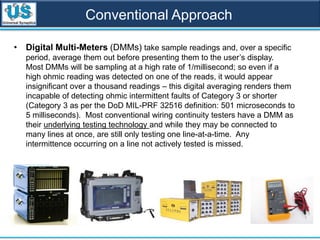
• Digital Multi-Meters (DMMs) take sample readings and, over a specific
period, average them out before presenting them to the user’s display.
Most DMMs will be sampling at a high rate of 1/millisecond; so even if a
high ohmic reading was detected on one of the reads, it would appear
insignificant over a thousand readings – this digital averaging renders them
incapable of detecting ohmic intermittent faults of Category 3 or shorter
(Category 3 as per the DoD MIL-PRF 32516 definition: 501 microseconds to
5 milliseconds). Most conventional wiring continuity testers have a DMM as
their underlying testing technology and while they may be connected to
many lines at once, are still only testing one line-at-a-time. Any
intermittence occurring on a line not actively tested is missed.
MX and Supply Impact
• Tools provided to maintainers are not sufficient:
– Just because an LRU passes BIT or ATE tests multiple times in a row,
does NOT mean there isn’t a lurking problem in the LRU
– BIT / ATE testing does not check all circuits simultaneously or functional
paths in an LRU or connection paths to SRUs
– Conventional ATE does not test in an operationally relevant environment
– Conventional ATE is incapable of detecting short duration intermittent
faults that cause NFF
• Flight Line “Blacklisting” of LRUs makes an expensive supply
problem worse
– Creates availability issues / drives unnecessary acquisition
– Masks the real problem / drives “swaptronics”
– Recirculates “bad actors” to other military units, thus perpetuating the
problem
An Innovative Solution is Needed to Solve This Problem
Operational Impact
• High MICAP rates
– Missions canceled and postponed
– Readiness is negatively impacted
• High NFF / RTOK / CND rates
– Wasted O / I / D-level maintenance resources and supply man-hours
– Wasted time on supply documentation, transportation and
troubleshooting
• Supply chain becomes more expensive and less responsive
– Each LRU sent to the depot for a non-fix, unnecessarily wastes Combat
and Support Commands millions of dollars each year
– High availability (even a 100% production fill rate) does not equal high
reliability or weapon system readiness
The DoD Mx Enterprise is large, global, complex and costly
change is required to reduce NFF & improve operational
availability
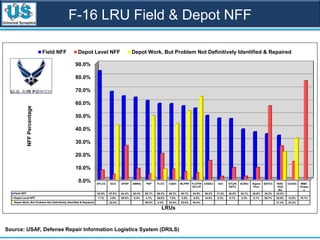
F-16 LRU Field & Depot NFF
0.0%
10.0%
20.0%
30.0%
40.0%
50.0%
60.0%
70.0%
80.0%
90.0%
DFLCC ECA APSP AMRIU PSP FLCC CADC MLPRF FLCP/N
VFLCP
CDEEU Ant DTU/N
VDTU
ACRIU Signal
Proc
EEFCC WAC
HUD
EU
UCADC MMC
Chassi
s
Field NFF 83.8% 67.8% 64.4% 63.4% 60.7% 58.5% 58.3% 56.7% 54.9% 49.2% 47.2% 46.8% 38.7% 36.6% 35.2% 34.0%
Depot Level NFF 7.1% 3.8% 26.0% 8.4% 4.1% 20.0% 7.8% 5.8% 5.0% 14.5% 2.3% 9.1% 2.4% 9.1% 56.7% 25.8% 13.8% 76.1%
Depot Work, But Problem Not Definitively Identified & Repaired 42.0% 49.0% 8.0% 43.0% 53.0% 64.0% 21.4% 32.0%
NFFPercentage
LRUs
Field NFF Depot Level NFF Depot Work, But Problem Not Definitively Identified & Repaired
Source: USAF, Defense Repair Information Logistics System (DRILS)
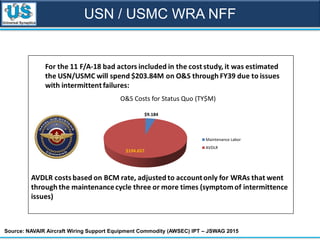
USN / USMC WRA NFF
Source: NAVAIR Aircraft Wiring Support Equipment Commodity (AWSEC) IPT – JSWAG 2015
$9.184
$194.657
O&S Costs for Status Quo (TY$M)
Maintenance Labor
AVDLR
Intermittent Faults / NFF
• The Testing Problem: Intermittence occurs randomly in time, place,
amplitude and duration. The very nature of the failure mode suggests that
the ability to detect and further isolate the intermittence root cause is based
on test detection SENSITIVITY and PROBABILITY rather than conventional
parametric methods concentrating on ohmic measurement accuracy.
• Simply put, you can’t detect an intermittent event until it occurs, and then
you may have limited opportunities to capture it on the specific circuit when
it does occur - by any reasonable scientific explanation of the problem, to
catch intermittents on the ground, you need to have phenomenal testing
speed (sensitivity) and a 100% bandwidth (probability).
• In other words, the proper technology for the task must be able to test all of
the failing system’s lines, all of the time, in a simultaneous and continuous
fashion. Conventional test equipment does just the opposite.
“DoD maintained 400 types of test systems and spent $50B to
buy and support these systems over a 12 year period” – GAO.
None of these test systems are solving the NFF problem
Intermittent Faults
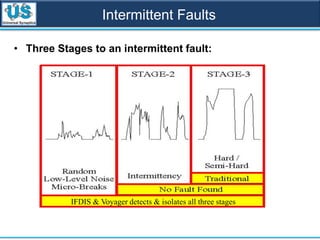
• Three Stages to an intermittent fault:
IFDIS & Voyager detects & isolates all three stages
Intermittent Faults
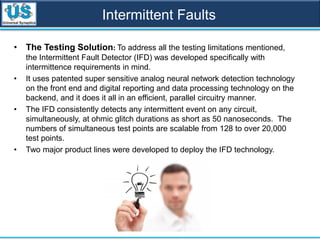
• The Testing Solution: To address all the testing limitations mentioned,
the Intermittent Fault Detector (IFD) was developed specifically with
intermittence requirements in mind.
• It uses patented super sensitive analog neural network detection technology
on the front end and digital reporting and data processing technology on the
backend, and it does it all in an efficient, parallel circuitry manner.
• The IFD consistently detects any intermittent event on any circuit,
simultaneously, at ohmic glitch durations as short as 50 nanoseconds. The
numbers of simultaneous test points are scalable from 128 to over 20,000
test points.
• Two major product lines were developed to deploy the IFD technology.
Intermittent Fault Detection
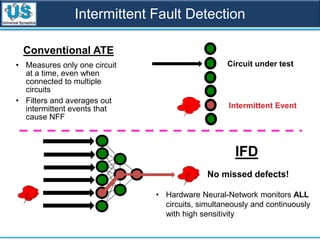
Conventional ATE
• Measures only one circuit
at a time, even when
connected to multiple
circuits
• Filters and averages out
intermittent events that
cause NFF
Circuit under test
Intermittent Event
IFD
No missed defects!
• Hardware Neural-Network monitors ALL
circuits, simultaneously and continuously
with high sensitivity
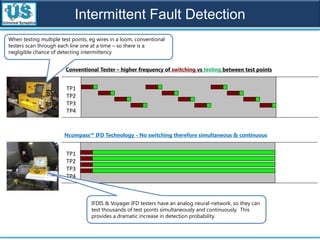
Conventional Tester – higher frequency of switching vs testing between test points
TP1
TP2
TP3
TP4
Ncompass™ IFD Technology - No switching therefore simultaneous & continuous
TP1
TP2
TP3
TP4
IFDIS & Voyager IFD testers have an analog neural-network, so they can
test thousands of test points simultaneously and continuously. This
provides a dramatic increase in detection probability.
When testing multiple test points, eg wires in a loom, conventional
testers scan through each line one at a time – so there is a
negligible chance of detecting intermittency
Intermittent Fault Detection
Universal Synaptics NFF Solutions
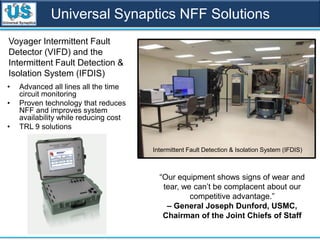
Intermittent Fault Detection & Isolation System (IFDIS)
• Advanced all lines all the time
circuit monitoring
• Proven technology that reduces
NFF and improves system
availability while reducing cost
• TRL 9 solutions
“Our equipment shows signs of wear and
tear, we can’t be complacent about our
competitive advantage.”
– General Joseph Dunford, USMC,
Chairman of the Joint Chiefs of Staff
Voyager Intermittent Fault
Detector (VIFD) and the
Intermittent Fault Detection &
Isolation System (IFDIS)
Universal Synaptics NFF Solutions
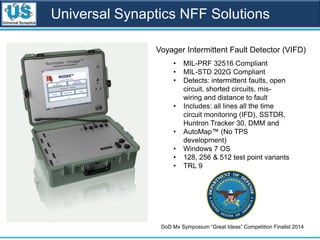
Voyager Intermittent Fault Detector (VIFD)
• MIL-PRF 32516 Compliant
• MIL-STD 202G Compliant
• Detects: intermittent faults, open
circuit, shorted circuits, mis-
wiring and distance to fault
• Includes: all lines all the time
circuit monitoring (IFD), SSTDR,
Huntron Tracker 30, DMM and
• AutoMap™ (No TPS
development)
• Windows 7 OS
• 128, 256 & 512 test point variants
• TRL 9
DoD Mx Symposium “Great Ideas” Competition Finalist 2014
Universal Synaptics NFF Solutions
DoD Mx Symposium “Great Ideas”
Competition Winner 2010 & 2012
Intermittent Fault Detection & Isolation System (IFDIS)
• MIL-PRF 32516 Compliant
• Detects: intermittent faults,
open circuit, shorted circuits
and mis-wiring
• Includes: all lines all the time
circuit monitoring (IFD),
Picoscope, DMM and
• AutoMap™
• Windows 7 OS
• Expandable to over 20,000
test points
• TRL 9
IFDIS
"If we’re going to keep the advantage
that we’ve historically had then we need
to keep up [technologically].”
– Secretary of Defense Ash Carter
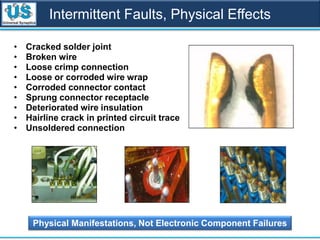
Intermittent Faults, Physical Effects
• Cracked solder joint
• Broken wire
• Loose crimp connection
• Loose or corroded wire wrap
• Corroded connector contact
• Sprung connector receptacle
• Deteriorated wire insulation
• Hairline crack in printed circuit trace
• Unsoldered connection
Physical Manifestations, Not Electronic Component Failures
Department of Defense Solution
• Office of the Secretary of Defense established the Joint Intermittence
Testing (JIT) Working Integrated Product Team (WIPT) in 2012 – Joint
Service effort to address the intermittent testing void
• DoD released Military Performance Specification (MIL-PRF) in March 2015,
MIL-PRF 32516 “Electronic Test Equipment, Intermittent Fault Detection &
Isolation”
• JIT Industry Week (04 – 07 Jan 2016), Universal Synaptics IFD technology
passed all JIT Intermittent Fault Emulator (IFE) tests in compliance with
MIL-PRF 32516
• Universal Synaptics has proven solutions that detect and isolate intermittent
faults down to 50ns *TRL 9 technology solutions
“Ladies & Gentlemen, we are out of money, we have to think” –
Winston Churchill
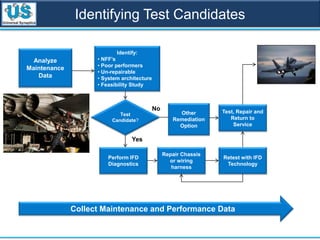
Identifying Test Candidates
Collect Maintenance and Performance Data
Perform IFD
Diagnostics
Retest with IFD
Technology
Repair Chassis
or wiring
harness
Identify:
• NFF’s
• Poor performers
• Un-repairable
• System architecture
• Feasibility Study
Analyze
Maintenance
Data
Test
Candidate?
Test, Repair and
Return to
Service
No
Yes
Other
Remediation
Option
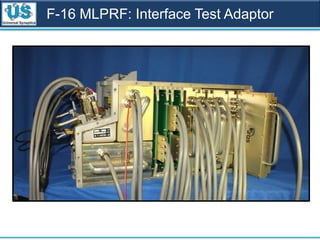
F-16 MLPRF: Interface Test Adaptor
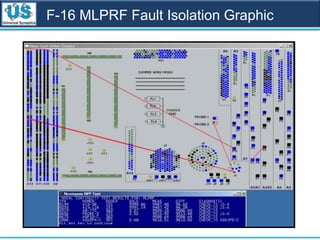
F-16 MLPRF Fault Isolation Graphic
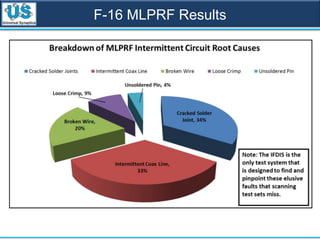
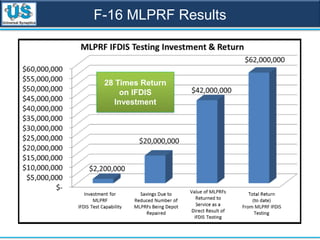
F-16 MLPRF Results
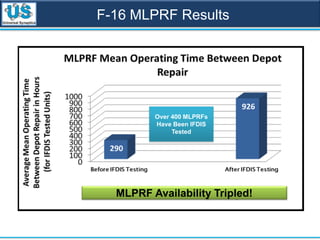
F-16 MLPRF Results
MLPRF Availability Tripled!
Over 400 MLPRFs
Have Been IFDIS
Tested
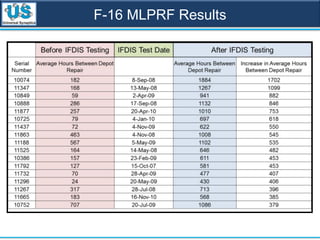
F-16 MLPRF Results
F-16 MLPRF Results
28 Times Return
on IFDIS
Investment
• NAVAIR F/A-18 Generator Converter Unit (GCU) is a Top Ten Fleet
Degrader & number 1 cannibalized WRA at O-Level
• GCU Inductions have outpaced production for the last three years
• GCU inventory continues to increase due to aircraft production yet time on
wing continues to decrease causing more GCU inductions each year
• BCM & I-Level AVDLR costs were $161.22M in FY14
• GCU G4 upgrade in process as well as multiple SRA modifications /
upgrades
• An innovative solution was needed to improve time on wing, reduce BCM &
AVDLR costs, reduce A-799 (NFF) and enable cost effective readiness – the
solution now exists
F/A-18 GCU: Overview
F/A-18 GCU IFDIS Delivered to FRC SW in January 2016
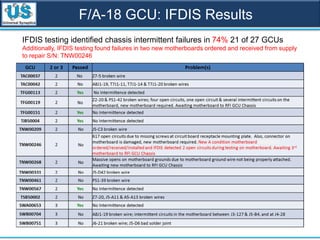
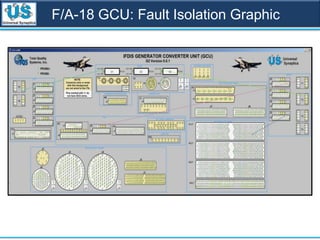
F/A-18 GCU: IFDIS Results
IFDIS testing identified chassis intermittent failures in 74% 21 of 27 GCUs
Additionally, IFDIS testing found failures in two new motherboards ordered and received from supply
to repair S/N: TNW00246
F/A-18 GCU: IFDIS Results
• F/A-18 GCU: IFDIS Results to date:
“Collaboration, innovation and forward thinking were key words used to
describe the amazing work taking place across the FRC landscape in
support of the Naval Aviation Enterprise Vision.
At FRC West, Sailors teamed with artisans to interdict repairs for Generator
Control Units—or GCU—using the Intermittent Fault Detection and Isolation
System. This resulted in the GCU time on wing to more than double,
providing what was a top ten degrader asset, to be readily available for
longer periods of time in support of flight operations.”
Rear Adm Zarkowski
Commander FRCs
USN
F/A-18 GCU: Fault Isolation Graphic
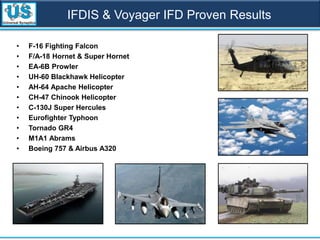
IFDIS & Voyager IFD Proven Results
• F-16 Fighting Falcon
• F/A-18 Hornet & Super Hornet
• EA-6B Prowler
• UH-60 Blackhawk Helicopter
• AH-64 Apache Helicopter
• CH-47 Chinook Helicopter
• C-130J Super Hercules
• Eurofighter Typhoon
• Tornado GR4
• M1A1 Abrams
• Boeing 757 & Airbus A320
Technology Partners
Technology Recognition
Best of State, Applied Science & Technology Category – Winner 2014
DoD Maintenance Symposium, “Great Ideas” Competition – Winner 2010 & 2012,
“Top 5 Finalist” 2014
CTMA Symposium, OSD MX Technology Challenge – “Top 5 Finalist” 2012 & 2013
“Create the Future” Contest – “Top 100 Finalist” 2015
Conclusion
• Undetected intermittent faults are a systemic issue – a multi-billion
dollar NFF problem exists
• Advanced IFD diagnostic solutions are available to detect and
isolate intermittent faults that cause NFF in compliance with MIL-
PRF 32516
• Intermittent fault detection and isolation capability has proven to
reduce NFF, reduce life cycle costs, reduce MICAPs, improve Time
on Wing (TOW) and improve operational availability
• IFDIS™ & Voyager™ are proven solutions making a positive impact
today and can be utilized on any platform
It’s Time to Stop Admiring the Problem
Questions?
Contact: Ken Anderson - 801.731.8508 – Contact@Usynaptics.com – www.USynaptics.com - @USynaptics
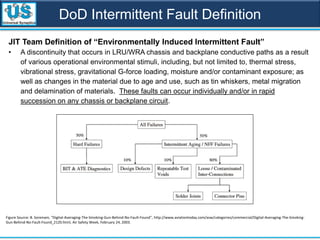
JIT Team Definition of “Environmentally Induced Intermittent Fault”
• A discontinuity that occurs in LRU/WRA chassis and backplane conductive paths as a result
of various operational environmental stimuli, including, but not limited to, thermal stress,
vibrational stress, gravitational G-force loading, moisture and/or contaminant exposure; as
well as changes in the material due to age and use, such as tin whiskers, metal migration
and delamination of materials. These faults can occur individually and/or in rapid
succession on any chassis or backplane circuit.
Figure Source: B. Sorensen, “Digital-Averaging-The-Smoking-Gun-Behind-No-Fault-Found”, http://www.aviationtoday.com/asw/categories/commercial/Digital-Averaging-The-Smoking-
Gun-Behind-No-Fault-Found_2120.html, Air Safety Week, February 24, 2003.
DoD Intermittent Fault Definition
MIL-PRF 32516 “Electronic Test Equipment, Intermittent Fault Detection &
Isolation”
• Covers the “minimum performance requirements for equipment to detect and
isolate nanosecond, microsecond and millisecond conductive path intermittent
faults”
• “Intermittent faults can occur in any and all of the hundreds to thousands of LRU /
WRA chassis and backplane circuits and their wire harnesses”
• Establishes performance requirements framework for intermittent fault detection
test equipment to detect and isolate nanosecond, microsecond and millisecond
intermittent faults
• “Not intended to address hard opens, shorts or constant function failures found in
routine electronics repair”
DoD MIL-PRF 32516
Intermittent Faults
• Hi-Pot testers rely on the breakdown of the insulation to show if there is a
fault. It is well known that this technique stresses the cable under test and
in some cases can actually damage the insulation on sites that would
otherwise have not caused a problem. Some recognized military forces
have banned high voltage insulation testing following the NTSB report into
the cause of the loss of TWA Flight 800 in 1996. In addition, Hi-Pot testing
can actually mask intermittent faults and can result in a false negative
result.
• Low Energy High Voltage testers are a better solution for finding some
intermittent faults than Hi-Pot testers because they use a low energy pulse.
However, depending on the type of intermittent they then need to use higher
voltages to expose the fault, which can then lead to the same
disadvantages as Hi-Pot testers. On commencing testing it is not possible
to know the type of the intermittent being dealt with so it is difficult to
determine what voltage level to use. This method also assumes that
intermittent faults have an adjacent escape path for the pulse ie the
airframe, or another adjacent cable with exposed conducting material; this is
not always the case and so detection probabilities are low and scenario
driven.
Intermittent Faults
• Spread-Spectrum Time Domain Reflectometry (SSTDR)
technology is very advanced at detecting cable changes using complex
signals, reading reflections and carrying out post analysis. However, the
detection rate is limited to approximately 50 millisecond changes, which
means that not all intermittent faults below this threshold can be detected.
Furthermore, as a stand-alone tool, SSTDR can be applied to just one wire
per cable loom at any given time and this ‘switching’ approach between
wires in the loom introduces more opportunities to miss the intermittent fault
than it does to find it.
• Oscilloscopes can be set up to have a latching trigger and defined trigger
parameters to detect and latch a particular condition. Generally they do not
have a self-stimulus and so this needs to be provided as a 3rd party aspect
of the test when using an oscilloscope in this mode. Importantly, setting up
the triggers and releasing the latching trigger in time for capturing
subsequent fault(s) is an extremely complex technique and it would only be
applicable for a single line-at-a-time. These approaches could be used on I
or D-level applications but it would be extremely time consuming to apply to
each of the suspect lines during fault investigations.
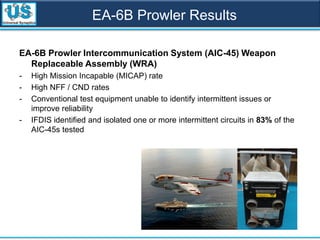
EA-6B Prowler Intercommunication System (AIC-45) Weapon
Replaceable Assembly (WRA)
- High Mission Incapable (MICAP) rate
- High NFF / CND rates
- Conventional test equipment unable to identify intermittent issues or
improve reliability
- IFDIS identified and isolated one or more intermittent circuits in 83% of the
AIC-45s tested
EA-6B Prowler Results
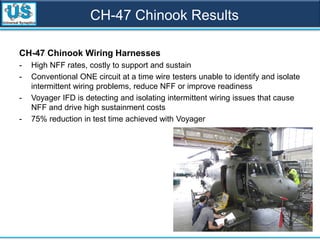
CH-47 Chinook Wiring Harnesses
- High NFF rates, costly to support and sustain
- Conventional ONE circuit at a time wire testers unable to identify and isolate
intermittent wiring problems, reduce NFF or improve readiness
- Voyager IFD is detecting and isolating intermittent wiring issues that cause
NFF and drive high sustainment costs
- 75% reduction in test time achieved with Voyager
CH-47 Chinook Results
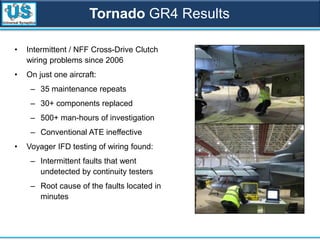
Tornado GR4 Results
• Intermittent / NFF Cross-Drive Clutch
wiring problems since 2006
• On just one aircraft:
– 35 maintenance repeats
– 30+ components replaced
– 500+ man-hours of investigation
– Conventional ATE ineffective
• Voyager IFD testing of wiring found:
– Intermittent faults that went
undetected by continuity testers
– Root cause of the faults located in
minutes

1330 anderson

  • 1.
    Intermittent Fault Detection& Isolation Reduces NFF and Enables Cost Effective Readiness Ken Anderson Universal Synaptics 801.731.8508 www.USynaptics.com @USynaptics © Copyright 2017, Universal Synaptics Corporation. All Rights Reserved
  • 2.
    No Fault Found •No Fault Found (NFF) is an annual multi-billion dollar non-value added expense to the DoD – Intermittent discontinuity resulting in NFF is now recognized by the Department of Defense (DoD) as an operational readiness degrader and life- cycle cost driver – DoD estimates that 3 out of 4 (75%) of DoD weapons systems have undetected intermittent faults that manifest as operational failures – NFF costs the Department of Defense (DoD) between $2B - $10B annually (Source: Office of the Secretary of Defense (OSD) Maintenance, CTMA Partners Meeting) • Universal Synaptics – Over 20 years experience in NFF remediation and solutions – Focus on improved diagnostics capability to address intermittent faults in Line Replaceable Units (LRUs) and Electrical Wiring Interconnect Systems (EWIS) which has been conclusively linked as a significant contributor to NFF – Deployed intermittent fault detection capability has demonstrated significant reductions in NFF, improved availability and cost savings Intermittent Fault Detection & Isolation = Cost Effective Readiness
  • 3.
    The Problem • Aircraftelectronic LRUs test “No Fault Found” (NFF) approximately 50% of the time – Box malfunctions intermittently during flight, but tests good during subsequent ground testing – Intermittent activity also categorized as RTOK, CND, NTF, NEOF or even “gremlins” – Intermittent discontinuity is also a significant problem in electronic wiring interconnect systems • Intermittent faults are mechanical in nature – Failures are in wiring, solder joints, wire wraps, connectors, via’s etc. – Modern components are more reliable and capable – intermittent discontinuity between components is a major concern and cost driver No Fault Found costs the DoD between $2 and $10 Billion annually
  • 4.
    Conventional Approach • FunctionalATE and Continuity testers cannot detect and isolate intermittent faults that cause NFF – Test only one function at a time – Test only one circuit at a time, even when connected to multiple circuits – Digital averaging, scanning and sampling masks / misses the intermittent faults – a testing “blind spot” / “testing void” exists – LRUs are not tested in an operational environment which is where the failures occur, EWIS is also tested in static environment – Only designed to find functional failures, failed components and “hard” failures (opens circuits / short circuits) – Intermittent faults that cause NFF do not follow specific failure patterns Conventional Approach = Conventional Results
  • 5.
    Conventional Approach • DigitalMulti-Meters (DMMs) take sample readings and, over a specific period, average them out before presenting them to the user’s display. Most DMMs will be sampling at a high rate of 1/millisecond; so even if a high ohmic reading was detected on one of the reads, it would appear insignificant over a thousand readings – this digital averaging renders them incapable of detecting ohmic intermittent faults of Category 3 or shorter (Category 3 as per the DoD MIL-PRF 32516 definition: 501 microseconds to 5 milliseconds). Most conventional wiring continuity testers have a DMM as their underlying testing technology and while they may be connected to many lines at once, are still only testing one line-at-a-time. Any intermittence occurring on a line not actively tested is missed.
  • 6.
    MX and SupplyImpact • Tools provided to maintainers are not sufficient: – Just because an LRU passes BIT or ATE tests multiple times in a row, does NOT mean there isn’t a lurking problem in the LRU – BIT / ATE testing does not check all circuits simultaneously or functional paths in an LRU or connection paths to SRUs – Conventional ATE does not test in an operationally relevant environment – Conventional ATE is incapable of detecting short duration intermittent faults that cause NFF • Flight Line “Blacklisting” of LRUs makes an expensive supply problem worse – Creates availability issues / drives unnecessary acquisition – Masks the real problem / drives “swaptronics” – Recirculates “bad actors” to other military units, thus perpetuating the problem An Innovative Solution is Needed to Solve This Problem
  • 7.
    Operational Impact • HighMICAP rates – Missions canceled and postponed – Readiness is negatively impacted • High NFF / RTOK / CND rates – Wasted O / I / D-level maintenance resources and supply man-hours – Wasted time on supply documentation, transportation and troubleshooting • Supply chain becomes more expensive and less responsive – Each LRU sent to the depot for a non-fix, unnecessarily wastes Combat and Support Commands millions of dollars each year – High availability (even a 100% production fill rate) does not equal high reliability or weapon system readiness The DoD Mx Enterprise is large, global, complex and costly change is required to reduce NFF & improve operational availability
  • 8.
    F-16 LRU Field& Depot NFF 0.0% 10.0% 20.0% 30.0% 40.0% 50.0% 60.0% 70.0% 80.0% 90.0% DFLCC ECA APSP AMRIU PSP FLCC CADC MLPRF FLCP/N VFLCP CDEEU Ant DTU/N VDTU ACRIU Signal Proc EEFCC WAC HUD EU UCADC MMC Chassi s Field NFF 83.8% 67.8% 64.4% 63.4% 60.7% 58.5% 58.3% 56.7% 54.9% 49.2% 47.2% 46.8% 38.7% 36.6% 35.2% 34.0% Depot Level NFF 7.1% 3.8% 26.0% 8.4% 4.1% 20.0% 7.8% 5.8% 5.0% 14.5% 2.3% 9.1% 2.4% 9.1% 56.7% 25.8% 13.8% 76.1% Depot Work, But Problem Not Definitively Identified & Repaired 42.0% 49.0% 8.0% 43.0% 53.0% 64.0% 21.4% 32.0% NFFPercentage LRUs Field NFF Depot Level NFF Depot Work, But Problem Not Definitively Identified & Repaired Source: USAF, Defense Repair Information Logistics System (DRILS)
  • 9.
    USN / USMCWRA NFF Source: NAVAIR Aircraft Wiring Support Equipment Commodity (AWSEC) IPT – JSWAG 2015 $9.184 $194.657 O&S Costs for Status Quo (TY$M) Maintenance Labor AVDLR
  • 10.
    Intermittent Faults /NFF • The Testing Problem: Intermittence occurs randomly in time, place, amplitude and duration. The very nature of the failure mode suggests that the ability to detect and further isolate the intermittence root cause is based on test detection SENSITIVITY and PROBABILITY rather than conventional parametric methods concentrating on ohmic measurement accuracy. • Simply put, you can’t detect an intermittent event until it occurs, and then you may have limited opportunities to capture it on the specific circuit when it does occur - by any reasonable scientific explanation of the problem, to catch intermittents on the ground, you need to have phenomenal testing speed (sensitivity) and a 100% bandwidth (probability). • In other words, the proper technology for the task must be able to test all of the failing system’s lines, all of the time, in a simultaneous and continuous fashion. Conventional test equipment does just the opposite. “DoD maintained 400 types of test systems and spent $50B to buy and support these systems over a 12 year period” – GAO. None of these test systems are solving the NFF problem
  • 11.
    Intermittent Faults • ThreeStages to an intermittent fault: IFDIS & Voyager detects & isolates all three stages
  • 12.
    Intermittent Faults • TheTesting Solution: To address all the testing limitations mentioned, the Intermittent Fault Detector (IFD) was developed specifically with intermittence requirements in mind. • It uses patented super sensitive analog neural network detection technology on the front end and digital reporting and data processing technology on the backend, and it does it all in an efficient, parallel circuitry manner. • The IFD consistently detects any intermittent event on any circuit, simultaneously, at ohmic glitch durations as short as 50 nanoseconds. The numbers of simultaneous test points are scalable from 128 to over 20,000 test points. • Two major product lines were developed to deploy the IFD technology.
  • 13.
    Intermittent Fault Detection ConventionalATE • Measures only one circuit at a time, even when connected to multiple circuits • Filters and averages out intermittent events that cause NFF Circuit under test Intermittent Event IFD No missed defects! • Hardware Neural-Network monitors ALL circuits, simultaneously and continuously with high sensitivity
  • 14.
    Conventional Tester –higher frequency of switching vs testing between test points TP1 TP2 TP3 TP4 Ncompass™ IFD Technology - No switching therefore simultaneous & continuous TP1 TP2 TP3 TP4 IFDIS & Voyager IFD testers have an analog neural-network, so they can test thousands of test points simultaneously and continuously. This provides a dramatic increase in detection probability. When testing multiple test points, eg wires in a loom, conventional testers scan through each line one at a time – so there is a negligible chance of detecting intermittency Intermittent Fault Detection
  • 15.
    Universal Synaptics NFFSolutions Intermittent Fault Detection & Isolation System (IFDIS) • Advanced all lines all the time circuit monitoring • Proven technology that reduces NFF and improves system availability while reducing cost • TRL 9 solutions “Our equipment shows signs of wear and tear, we can’t be complacent about our competitive advantage.” – General Joseph Dunford, USMC, Chairman of the Joint Chiefs of Staff Voyager Intermittent Fault Detector (VIFD) and the Intermittent Fault Detection & Isolation System (IFDIS)
  • 16.
    Universal Synaptics NFFSolutions Voyager Intermittent Fault Detector (VIFD) • MIL-PRF 32516 Compliant • MIL-STD 202G Compliant • Detects: intermittent faults, open circuit, shorted circuits, mis- wiring and distance to fault • Includes: all lines all the time circuit monitoring (IFD), SSTDR, Huntron Tracker 30, DMM and • AutoMap™ (No TPS development) • Windows 7 OS • 128, 256 & 512 test point variants • TRL 9 DoD Mx Symposium “Great Ideas” Competition Finalist 2014
  • 17.
    Universal Synaptics NFFSolutions DoD Mx Symposium “Great Ideas” Competition Winner 2010 & 2012 Intermittent Fault Detection & Isolation System (IFDIS) • MIL-PRF 32516 Compliant • Detects: intermittent faults, open circuit, shorted circuits and mis-wiring • Includes: all lines all the time circuit monitoring (IFD), Picoscope, DMM and • AutoMap™ • Windows 7 OS • Expandable to over 20,000 test points • TRL 9 IFDIS "If we’re going to keep the advantage that we’ve historically had then we need to keep up [technologically].” – Secretary of Defense Ash Carter
  • 18.
    Intermittent Faults, PhysicalEffects • Cracked solder joint • Broken wire • Loose crimp connection • Loose or corroded wire wrap • Corroded connector contact • Sprung connector receptacle • Deteriorated wire insulation • Hairline crack in printed circuit trace • Unsoldered connection Physical Manifestations, Not Electronic Component Failures
  • 19.
    Department of DefenseSolution • Office of the Secretary of Defense established the Joint Intermittence Testing (JIT) Working Integrated Product Team (WIPT) in 2012 – Joint Service effort to address the intermittent testing void • DoD released Military Performance Specification (MIL-PRF) in March 2015, MIL-PRF 32516 “Electronic Test Equipment, Intermittent Fault Detection & Isolation” • JIT Industry Week (04 – 07 Jan 2016), Universal Synaptics IFD technology passed all JIT Intermittent Fault Emulator (IFE) tests in compliance with MIL-PRF 32516 • Universal Synaptics has proven solutions that detect and isolate intermittent faults down to 50ns *TRL 9 technology solutions “Ladies & Gentlemen, we are out of money, we have to think” – Winston Churchill
  • 20.
    Identifying Test Candidates CollectMaintenance and Performance Data Perform IFD Diagnostics Retest with IFD Technology Repair Chassis or wiring harness Identify: • NFF’s • Poor performers • Un-repairable • System architecture • Feasibility Study Analyze Maintenance Data Test Candidate? Test, Repair and Return to Service No Yes Other Remediation Option
  • 21.
  • 22.
    F-16 MLPRF FaultIsolation Graphic
  • 23.
  • 24.
    F-16 MLPRF Results MLPRFAvailability Tripled! Over 400 MLPRFs Have Been IFDIS Tested
  • 25.
  • 26.
    F-16 MLPRF Results 28Times Return on IFDIS Investment
  • 27.
    • NAVAIR F/A-18Generator Converter Unit (GCU) is a Top Ten Fleet Degrader & number 1 cannibalized WRA at O-Level • GCU Inductions have outpaced production for the last three years • GCU inventory continues to increase due to aircraft production yet time on wing continues to decrease causing more GCU inductions each year • BCM & I-Level AVDLR costs were $161.22M in FY14 • GCU G4 upgrade in process as well as multiple SRA modifications / upgrades • An innovative solution was needed to improve time on wing, reduce BCM & AVDLR costs, reduce A-799 (NFF) and enable cost effective readiness – the solution now exists F/A-18 GCU: Overview F/A-18 GCU IFDIS Delivered to FRC SW in January 2016
  • 28.
    F/A-18 GCU: IFDISResults IFDIS testing identified chassis intermittent failures in 74% 21 of 27 GCUs Additionally, IFDIS testing found failures in two new motherboards ordered and received from supply to repair S/N: TNW00246
  • 29.
    F/A-18 GCU: IFDISResults • F/A-18 GCU: IFDIS Results to date: “Collaboration, innovation and forward thinking were key words used to describe the amazing work taking place across the FRC landscape in support of the Naval Aviation Enterprise Vision. At FRC West, Sailors teamed with artisans to interdict repairs for Generator Control Units—or GCU—using the Intermittent Fault Detection and Isolation System. This resulted in the GCU time on wing to more than double, providing what was a top ten degrader asset, to be readily available for longer periods of time in support of flight operations.” Rear Adm Zarkowski Commander FRCs USN
  • 30.
    F/A-18 GCU: FaultIsolation Graphic
  • 31.
    IFDIS & VoyagerIFD Proven Results • F-16 Fighting Falcon • F/A-18 Hornet & Super Hornet • EA-6B Prowler • UH-60 Blackhawk Helicopter • AH-64 Apache Helicopter • CH-47 Chinook Helicopter • C-130J Super Hercules • Eurofighter Typhoon • Tornado GR4 • M1A1 Abrams • Boeing 757 & Airbus A320
  • 32.
  • 33.
    Technology Recognition Best ofState, Applied Science & Technology Category – Winner 2014 DoD Maintenance Symposium, “Great Ideas” Competition – Winner 2010 & 2012, “Top 5 Finalist” 2014 CTMA Symposium, OSD MX Technology Challenge – “Top 5 Finalist” 2012 & 2013 “Create the Future” Contest – “Top 100 Finalist” 2015
  • 34.
    Conclusion • Undetected intermittentfaults are a systemic issue – a multi-billion dollar NFF problem exists • Advanced IFD diagnostic solutions are available to detect and isolate intermittent faults that cause NFF in compliance with MIL- PRF 32516 • Intermittent fault detection and isolation capability has proven to reduce NFF, reduce life cycle costs, reduce MICAPs, improve Time on Wing (TOW) and improve operational availability • IFDIS™ & Voyager™ are proven solutions making a positive impact today and can be utilized on any platform It’s Time to Stop Admiring the Problem
  • 35.
    Questions? Contact: Ken Anderson- 801.731.8508 – Contact@Usynaptics.com – www.USynaptics.com - @USynaptics
  • 36.
    JIT Team Definitionof “Environmentally Induced Intermittent Fault” • A discontinuity that occurs in LRU/WRA chassis and backplane conductive paths as a result of various operational environmental stimuli, including, but not limited to, thermal stress, vibrational stress, gravitational G-force loading, moisture and/or contaminant exposure; as well as changes in the material due to age and use, such as tin whiskers, metal migration and delamination of materials. These faults can occur individually and/or in rapid succession on any chassis or backplane circuit. Figure Source: B. Sorensen, “Digital-Averaging-The-Smoking-Gun-Behind-No-Fault-Found”, http://www.aviationtoday.com/asw/categories/commercial/Digital-Averaging-The-Smoking- Gun-Behind-No-Fault-Found_2120.html, Air Safety Week, February 24, 2003. DoD Intermittent Fault Definition
  • 37.
    MIL-PRF 32516 “ElectronicTest Equipment, Intermittent Fault Detection & Isolation” • Covers the “minimum performance requirements for equipment to detect and isolate nanosecond, microsecond and millisecond conductive path intermittent faults” • “Intermittent faults can occur in any and all of the hundreds to thousands of LRU / WRA chassis and backplane circuits and their wire harnesses” • Establishes performance requirements framework for intermittent fault detection test equipment to detect and isolate nanosecond, microsecond and millisecond intermittent faults • “Not intended to address hard opens, shorts or constant function failures found in routine electronics repair” DoD MIL-PRF 32516
  • 38.
    Intermittent Faults • Hi-Pottesters rely on the breakdown of the insulation to show if there is a fault. It is well known that this technique stresses the cable under test and in some cases can actually damage the insulation on sites that would otherwise have not caused a problem. Some recognized military forces have banned high voltage insulation testing following the NTSB report into the cause of the loss of TWA Flight 800 in 1996. In addition, Hi-Pot testing can actually mask intermittent faults and can result in a false negative result. • Low Energy High Voltage testers are a better solution for finding some intermittent faults than Hi-Pot testers because they use a low energy pulse. However, depending on the type of intermittent they then need to use higher voltages to expose the fault, which can then lead to the same disadvantages as Hi-Pot testers. On commencing testing it is not possible to know the type of the intermittent being dealt with so it is difficult to determine what voltage level to use. This method also assumes that intermittent faults have an adjacent escape path for the pulse ie the airframe, or another adjacent cable with exposed conducting material; this is not always the case and so detection probabilities are low and scenario driven.
  • 39.
    Intermittent Faults • Spread-SpectrumTime Domain Reflectometry (SSTDR) technology is very advanced at detecting cable changes using complex signals, reading reflections and carrying out post analysis. However, the detection rate is limited to approximately 50 millisecond changes, which means that not all intermittent faults below this threshold can be detected. Furthermore, as a stand-alone tool, SSTDR can be applied to just one wire per cable loom at any given time and this ‘switching’ approach between wires in the loom introduces more opportunities to miss the intermittent fault than it does to find it. • Oscilloscopes can be set up to have a latching trigger and defined trigger parameters to detect and latch a particular condition. Generally they do not have a self-stimulus and so this needs to be provided as a 3rd party aspect of the test when using an oscilloscope in this mode. Importantly, setting up the triggers and releasing the latching trigger in time for capturing subsequent fault(s) is an extremely complex technique and it would only be applicable for a single line-at-a-time. These approaches could be used on I or D-level applications but it would be extremely time consuming to apply to each of the suspect lines during fault investigations.
  • 40.
    EA-6B Prowler IntercommunicationSystem (AIC-45) Weapon Replaceable Assembly (WRA) - High Mission Incapable (MICAP) rate - High NFF / CND rates - Conventional test equipment unable to identify intermittent issues or improve reliability - IFDIS identified and isolated one or more intermittent circuits in 83% of the AIC-45s tested EA-6B Prowler Results
  • 41.
    CH-47 Chinook WiringHarnesses - High NFF rates, costly to support and sustain - Conventional ONE circuit at a time wire testers unable to identify and isolate intermittent wiring problems, reduce NFF or improve readiness - Voyager IFD is detecting and isolating intermittent wiring issues that cause NFF and drive high sustainment costs - 75% reduction in test time achieved with Voyager CH-47 Chinook Results
  • 42.
    Tornado GR4 Results •Intermittent / NFF Cross-Drive Clutch wiring problems since 2006 • On just one aircraft: – 35 maintenance repeats – 30+ components replaced – 500+ man-hours of investigation – Conventional ATE ineffective • Voyager IFD testing of wiring found: – Intermittent faults that went undetected by continuity testers – Root cause of the faults located in minutes