




OSFHealthcareAdvancedAnalytics
The Benefits and Challenges of Building an
In-House Data Science Team
October 31, 2017
Agenda
• Introduction
• Getting Started with a Data Science Team
• Project Highlights
WHY
Introduction
Advanced Analytics at OSF Healthcare
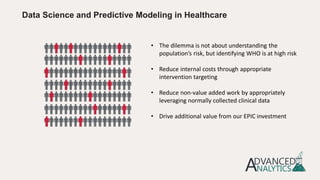
• The dilemma is not about understanding the
population’s risk, but identifying WHO is at high risk
• Reduce internal costs through appropriate
intervention targeting
• Reduce non-value added work by appropriately
leveraging normally collected clinical data
• Drive additional value from our EPIC investment
Data Science and Predictive Modeling in Healthcare
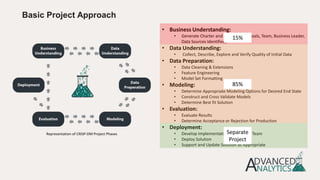
• Business Understanding:
• Generate Charter and Project Plan (Goals, Team, Business Leader,
Data Sources Identified)
• Data Understanding:
• Collect, Describe, Explore and Verify Quality of Initial Data
• Data Preparation:
• Data Cleaning & Extensions
• Feature Engineering
• Model Set Formatting
• Modeling:
• Determine Appropriate Modeling Options for Desired End State
• Construct and Cross Validate Models
• Determine Best fit Solution
• Evaluation:
• Evaluate Results
• Determine Acceptance or Rejection for Production
• Deployment:
• Develop Implementation Project and Team
• Deploy Solution
• Support and Update Solution as Appropriate
15%
85%
Separate
Project
Representation of CRISP-DM Project Phases
Basic Project Approach
Key Success Factors
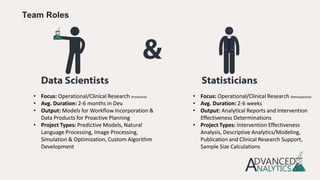
• Focus: Operational/Clinical Research (Predictive)
• Avg. Duration: 2-6 months in Dev.
• Output: Models for Workflow Incorporation &
Data Products for Proactive Planning
• Project Types: Predictive Models, Natural
Language Processing, Image Processing,
Simulation & Optimization, Custom Algorithm
Development
• Focus: Operational/Clinical Research (Retrospective)
• Avg. Duration: 2-6 weeks
• Output: Analytical Reports and Intervention
Effectiveness Determinations
• Project Types: Intervention Effectiveness
Analysis, Descriptive Analytics/Modeling,
Publication and Clinical Research Support,
Sample Size Calculations
Team Roles
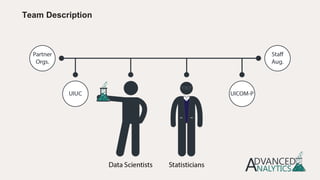
Team Description
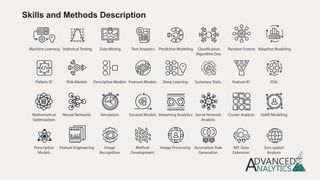
Skills and Methods Description
GettingStarted
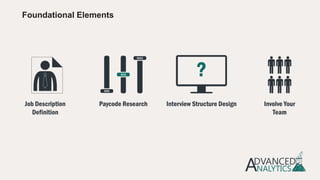
Foundational Elements
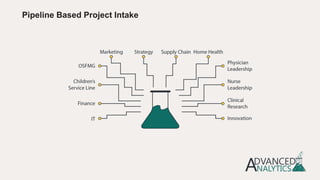
Pipeline Based Project Intake
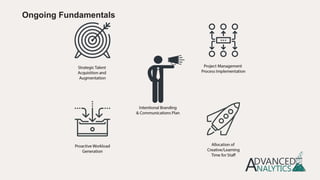
Ongoing Fundamentals
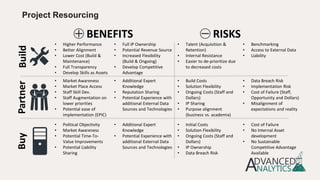
• Higher Performance
• Better Alignment
• Lower Cost (Build &
Maintenance)
• Full Transparency
• Develop Skills as Assets
• Full IP Ownership
• Potential Revenue Source
• Increased Flexibility
(Build & Ongoing)
• Develop Competitive
Advantage
• Talent (Acquisition &
Retention)
• Internal Resistance
• Easier to de-prioritize due
to decreased costs
• Benchmarking
• Access to External Data
• Liability
• Market Awareness
• Market Place Access
• Staff Skill Dev.
• Staff Augmentation on
lower priorities
• Potential ease of
implementation (EPIC)
• Additional Expert
Knowledge
• Reputation Sharing
• Potential Experience with
additional External Data
Sources and Technologies
• Build Costs
• Solution Flexibility
• Ongoing Costs (Staff and
Dollars)
• IP Sharing
• Purpose alignment
(business vs. academia)
• Data Breach Risk
• Implementation Risk
• Cost of Failure (Staff,
Opportunity and Dollars)
• Misalignment of
expectations and reality
• Political Objectivity
• Market Awareness
• Potential Time-To-
Value Improvements
• Potential Liability
Sharing
• Additional Expert
Knowledge
• Potential Experience with
additional External Data
Sources and Technologies
• Initial Costs
• Solution Flexibility
• Ongoing Costs (Staff and
Dollars)
• IP Ownership
• Data Breach Risk
• Cost of Failure
• No Internal Asset
development
• No Sustainable
Competitive Advantage
Available
BENEFITS RISKS
BuildPartnerBuy
Project Resourcing
ProjectHighlights
Project wins and lessons learned
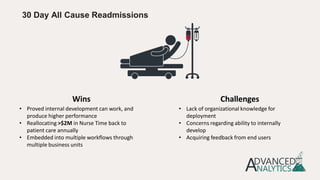
30 Day All Cause Readmissions
• Proved internal development can work, and
produce higher performance
• Reallocating >$2M in Nurse Time back to
patient care annually
• Embedded into multiple workflows through
multiple business units
• Lack of organizational knowledge for
deployment
• Concerns regarding ability to internally
develop
• Acquiring feedback from end users
Wins Challenges
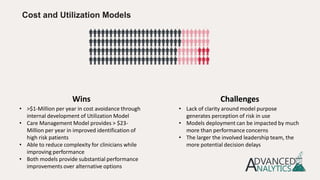
Cost and Utilization Models
• >$1-Million per year in cost avoidance through
internal development of Utilization Model
• Care Management Model provides > $23-
Million per year in improved identification of
high risk patients
• Able to reduce complexity for clinicians while
improving performance
• Both models provide substantial performance
improvements over alternative options
• Lack of clarity around model purpose
generates perception of risk in use
• Models deployment can be impacted by much
more than performance concerns
• The larger the involved leadership team, the
more potential decision delays
Wins Challenges
Staffing Simulation/Optimization
• Optimized Call Center Staffing to ensure
improved performance metrics
• Helped right size ePharmacy staffing prior to
service implementation
• Added a high impact, and easily understood,
method to the Advanced Analytics toolbox
• More direct interaction with study subjects
than typical
• Requires workflow mapping, which isn’t a
commonly used approach on the team
• Working through IT processes to provide
business leader Python
Wins Challenges
Risk of Hospitalization Models
• Built models with substantially improved
performance for COPD and Heart Failure
• Created adaptive learning approaches for
production
• While clinical interest in the models is high,
defined processes/expectations for model use
is lacking
Wins Challenges
ED Sepsis Risk Models
• Provides alert of high risk ~68 minutes faster
than current solution
• Improved precision and recall, compared to
current solution
• Built strong collaborative relationships across
multiple teams
• Concerns regarding custom solution vs. better
known, but less performant approaches
• First real-time implementation inside EPIC for
point-of-care modeling
• Defining rules for when and where to trigger
best practice alert (BPA)
Wins Challenges
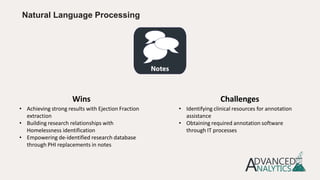
Natural Language Processing
• Achieving strong results with Ejection Fraction
extraction
• Building research relationships with
Homelessness identification
• Empowering de-identified research database
through PHI replacements in notes
• Identifying clinical resources for annotation
assistance
• Obtaining required annotation software
through IT processes
Wins Challenges
Contact
Juli Plack
Vice President, Information Delivery
Juliann.B.Plack@osfhealthcare.org
Chris Franciskovich
Manager, Advanced Analytics
Chris.M.Franciskovich@osfhealthcare.org

1615 plack using our laptop

  • 1.
    OSFHealthcareAdvancedAnalytics The Benefits andChallenges of Building an In-House Data Science Team October 31, 2017
  • 2.
    Agenda • Introduction • GettingStarted with a Data Science Team • Project Highlights WHY
  • 3.
  • 8.
    • The dilemmais not about understanding the population’s risk, but identifying WHO is at high risk • Reduce internal costs through appropriate intervention targeting • Reduce non-value added work by appropriately leveraging normally collected clinical data • Drive additional value from our EPIC investment Data Science and Predictive Modeling in Healthcare
  • 9.
    • Business Understanding: •Generate Charter and Project Plan (Goals, Team, Business Leader, Data Sources Identified) • Data Understanding: • Collect, Describe, Explore and Verify Quality of Initial Data • Data Preparation: • Data Cleaning & Extensions • Feature Engineering • Model Set Formatting • Modeling: • Determine Appropriate Modeling Options for Desired End State • Construct and Cross Validate Models • Determine Best fit Solution • Evaluation: • Evaluate Results • Determine Acceptance or Rejection for Production • Deployment: • Develop Implementation Project and Team • Deploy Solution • Support and Update Solution as Appropriate 15% 85% Separate Project Representation of CRISP-DM Project Phases Basic Project Approach
  • 10.
  • 11.
    • Focus: Operational/ClinicalResearch (Predictive) • Avg. Duration: 2-6 months in Dev. • Output: Models for Workflow Incorporation & Data Products for Proactive Planning • Project Types: Predictive Models, Natural Language Processing, Image Processing, Simulation & Optimization, Custom Algorithm Development • Focus: Operational/Clinical Research (Retrospective) • Avg. Duration: 2-6 weeks • Output: Analytical Reports and Intervention Effectiveness Determinations • Project Types: Intervention Effectiveness Analysis, Descriptive Analytics/Modeling, Publication and Clinical Research Support, Sample Size Calculations Team Roles
  • 12.
  • 13.
    Skills and MethodsDescription
  • 14.
  • 15.
  • 16.
  • 17.
  • 18.
    • Higher Performance •Better Alignment • Lower Cost (Build & Maintenance) • Full Transparency • Develop Skills as Assets • Full IP Ownership • Potential Revenue Source • Increased Flexibility (Build & Ongoing) • Develop Competitive Advantage • Talent (Acquisition & Retention) • Internal Resistance • Easier to de-prioritize due to decreased costs • Benchmarking • Access to External Data • Liability • Market Awareness • Market Place Access • Staff Skill Dev. • Staff Augmentation on lower priorities • Potential ease of implementation (EPIC) • Additional Expert Knowledge • Reputation Sharing • Potential Experience with additional External Data Sources and Technologies • Build Costs • Solution Flexibility • Ongoing Costs (Staff and Dollars) • IP Sharing • Purpose alignment (business vs. academia) • Data Breach Risk • Implementation Risk • Cost of Failure (Staff, Opportunity and Dollars) • Misalignment of expectations and reality • Political Objectivity • Market Awareness • Potential Time-To- Value Improvements • Potential Liability Sharing • Additional Expert Knowledge • Potential Experience with additional External Data Sources and Technologies • Initial Costs • Solution Flexibility • Ongoing Costs (Staff and Dollars) • IP Ownership • Data Breach Risk • Cost of Failure • No Internal Asset development • No Sustainable Competitive Advantage Available BENEFITS RISKS BuildPartnerBuy Project Resourcing
  • 19.
  • 20.
    30 Day AllCause Readmissions • Proved internal development can work, and produce higher performance • Reallocating >$2M in Nurse Time back to patient care annually • Embedded into multiple workflows through multiple business units • Lack of organizational knowledge for deployment • Concerns regarding ability to internally develop • Acquiring feedback from end users Wins Challenges
  • 21.
    Cost and UtilizationModels • >$1-Million per year in cost avoidance through internal development of Utilization Model • Care Management Model provides > $23- Million per year in improved identification of high risk patients • Able to reduce complexity for clinicians while improving performance • Both models provide substantial performance improvements over alternative options • Lack of clarity around model purpose generates perception of risk in use • Models deployment can be impacted by much more than performance concerns • The larger the involved leadership team, the more potential decision delays Wins Challenges
  • 22.
    Staffing Simulation/Optimization • OptimizedCall Center Staffing to ensure improved performance metrics • Helped right size ePharmacy staffing prior to service implementation • Added a high impact, and easily understood, method to the Advanced Analytics toolbox • More direct interaction with study subjects than typical • Requires workflow mapping, which isn’t a commonly used approach on the team • Working through IT processes to provide business leader Python Wins Challenges
  • 23.
    Risk of HospitalizationModels • Built models with substantially improved performance for COPD and Heart Failure • Created adaptive learning approaches for production • While clinical interest in the models is high, defined processes/expectations for model use is lacking Wins Challenges
  • 24.
    ED Sepsis RiskModels • Provides alert of high risk ~68 minutes faster than current solution • Improved precision and recall, compared to current solution • Built strong collaborative relationships across multiple teams • Concerns regarding custom solution vs. better known, but less performant approaches • First real-time implementation inside EPIC for point-of-care modeling • Defining rules for when and where to trigger best practice alert (BPA) Wins Challenges
  • 25.
    Natural Language Processing •Achieving strong results with Ejection Fraction extraction • Building research relationships with Homelessness identification • Empowering de-identified research database through PHI replacements in notes • Identifying clinical resources for annotation assistance • Obtaining required annotation software through IT processes Wins Challenges
  • 26.
    Contact Juli Plack Vice President,Information Delivery Juliann.B.Plack@osfhealthcare.org Chris Franciskovich Manager, Advanced Analytics Chris.M.Franciskovich@osfhealthcare.org