POLITICAL PARTIES
WHAT IS A POLITICAL PARTY ?
A political party is a group of people who
come together to contest elections and
hold power in the government.
They agree on same policies and
programmes for the society with a view to
promote the collective good.
A political party has 3 components-
1. The Leaders
2. The Active Members
3. The Followers
FUNCTIONS OF POLITICAL
PARTY
1. Political Parties contest
elections.
2. Parties put forward different
policies and programmes.
3. Parties play a decisive role in
making laws for a country.
4. Parties run and form
governments.
5. Parties that lose elections play the
role of opposition to the party in
power.
6. Parties shape public opinion and
raise and highlight issues.
7. They provide people access to
government machinery and
welfare schemes.
Different Party Systems
 One-Party System: In this system,
only one party is allowed to control
and run the government. For example,
in China only the Communist Party is
allowed to rule.
 Two-Party System: In some
countries, power usually changes
between two main parties. USA and
UK are examples of two-party system.
 Multi-Party System: Several parties
compete for power, and more than two
parties have a reasonable chance of
coming to power. this system often
appears very messy and leads to
political instability.
For example, India has a multi-party
system.
Election
Commission
 The Election Commission of India (ECI) is
an autonomous constitutional authority
responsible for administering election
processes in India.
 The Election Commission operates under the
authority of Constitution.
 Every party in the country has to register with
the Election Commission.
Recognized Political Parties
 While the Election Commission traeats all
parties equally, it offers some special
facilities to large and established parties.
 These parties are given a unique symbol-
only the official candidates of that party
can use that election symbol.
 Parties that get this privilege and some
other special facilities are known as
‘Recognized Political Parties.’
State Party
 A party that secures at least 6% of the
total votes in an election to the
Legislative Assembly of a state and
wins at least 2 seats is recognized as
a State Party or Regional Party.
National Party
 A party that secures at least 6% of the
total votes in Lok Sabha elections or
Assembly Elections and wins at least
4 seats in the Lok Sabha is
recognized as a National Party.
 There are six national recognized
parties in the country.
The six National Parties of India are-
1. Indian National Congress (INC)
2. Bhartiya Janta Party (BJP)
3. Bahujan Samaj Party (BSP)
4. Communist Party of India-Marxist (CPI-
M)
5. Communist Party of India (CPI)
Indian National Congress (INC)
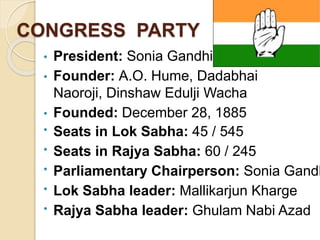
CONGRESS PARTY
• President: Sonia Gandhi
• Founder: A.O. Hume, Dadabhai
Naoroji, Dinshaw Edulji Wacha
• Founded: December 28, 1885
• Seats in Lok Sabha: 45 / 545
• Seats in Rajya Sabha: 60 / 245
• Parliamentary Chairperson: Sonia Gandh
• Lok Sabha leader: Mallikarjun Kharge
• Rajya Sabha leader: Ghulam Nabi Azad
BHARTIYA JANTA PARTY (BJP)
BHARTIYA JANTA PARTY
• President: Amit Shah
• Lok Sabha leader: Narendra Modi
• Rajya Sabha leader: Arun Jaitley
• Founded: 6 April 1980
• Seats in Lok Sabha: 280 / 545
• Seats in Rajya Sabha: 55 / 245
• Ideology: Integral humanism, Social
conservatism, Hindu nationalism,
Gandhian socialism, Hindutva
BAHUJAN SAMAJ PARTY (BSP)
Bahujan Samaj Party
• Leader: Mayawati
• President: Mayawati
• Founder: Kanshi Ram
• Seats in Lok Sabha: 0 / 545
• Seats in Rajya Sabha: 6 / 245
• Founded: 1984
• Ideology: Social transformation,
Social equality, Social justice
Communist Party of India (Marxist)
• Secretary-General: Sitaram Yechury
• Lok Sabha leader: P. Karunakaran
• Rajya Sabha leader: Sitaram Yechury
• Founded: 7 November,1964
• Ideology: Communism Marxism–
Leninism
• Seats in Lok Sabha: 9 / 545
• Seats in Rajya Sabha: 8 / 245
• Split from: Communist Party Of India
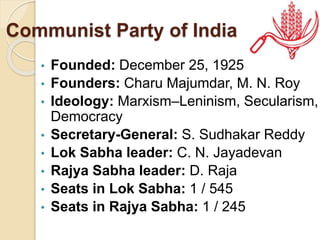
Communist Party of India
• Founded: December 25, 1925
• Founders: Charu Majumdar, M. N. Roy
• Ideology: Marxism–Leninism, Secularism,
Democracy
• Secretary-General: S. Sudhakar Reddy
• Lok Sabha leader: C. N. Jayadevan
• Rajya Sabha leader: D. Raja
• Seats in Lok Sabha: 1 / 545
• Seats in Rajya Sabha: 1 / 245
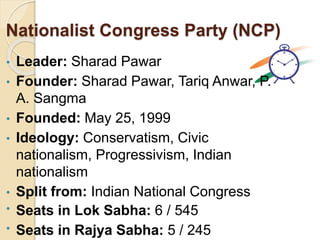
Nationalist Congress Party (NCP)
• Leader: Sharad Pawar
• Founder: Sharad Pawar, Tariq Anwar, P.
A. Sangma
• Founded: May 25, 1999
• Ideology: Conservatism, Civic
nationalism, Progressivism, Indian
nationalism
• Split from: Indian National Congress
• Seats in Lok Sabha: 6 / 545
• Seats in Rajya Sabha: 5 / 245
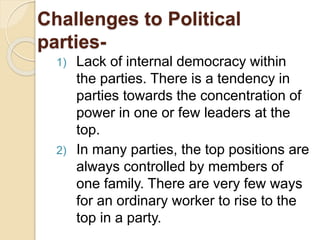
Challenges to Political
parties-
1) Lack of internal democracy within
the parties. There is a tendency in
parties towards the concentration of
power in one or few leaders at the
top.
2) In many parties, the top positions are
always controlled by members of
one family. There are very few ways
for an ordinary worker to rise to the
top in a party.
3) Due to the growing role of money
and muscle power in parties,
especially during elections, parties
tend to nominate those candidates
who have or can raise lots of money.
4) Very often parties do not seem to
offer a meaningful choice to the
voters. For example, the difference
between the Labour Party and the
Conservative Party in Britain is very
little.
Reformation of Political Parties
The Constitution was amended to
prevent elected MLAs and MPs from
changing parties. The law says that if
any MLA or MP changes party, he/she
will lose the seat in legislature.
Now, it is mandatory for every
candidate who contests election to file
an Affidavit giving details of his
property and criminal cases pending
against him.
The Election Commission passed an
order making it necessary for political
parties to hold their organizational
elections and file their income tax returns.
It should be made compulsory for
political parties to maintain a register of
its members, to follow its own
constitution, to have an independent
authority, to act as a judge in case of
party disputes, to hold open elections to
the highest posts.
It should be mandatory for political
parties to give about one-third of its
tickets to women candidates.
The government should give parties
money to support their election expenses.
This support could be given in kind:
petrol, paper, telephone, etc.
People can put pressure on political
parties through petitions, publicity and
agitations. Pressure groups and
movements and media can play an
important role in this.
Political Parties can improve if those who
want this join political parties. The quality
of democracy depends on the degree of
Political parties of India