Ir. TRI TJAHJONO, MT/INTERNAL COMBUSTION ENGINE
INTRODUCTION
1. HEAT ENGINE (MESIN KALOR)
A heat engine is a device which transforms the chemical energy of fuel into thermal
energy and uses this energy to produce mechanical work. Heat engine are divided into two
broad classes (2 kelompok besar):
(a) External combustion engines, and
(b) Internal combustion engines.
• External combustion engines :
The product of combustion of air and fuel transfer heat to second fluid which is the working
fluid of the cycle.
Example:
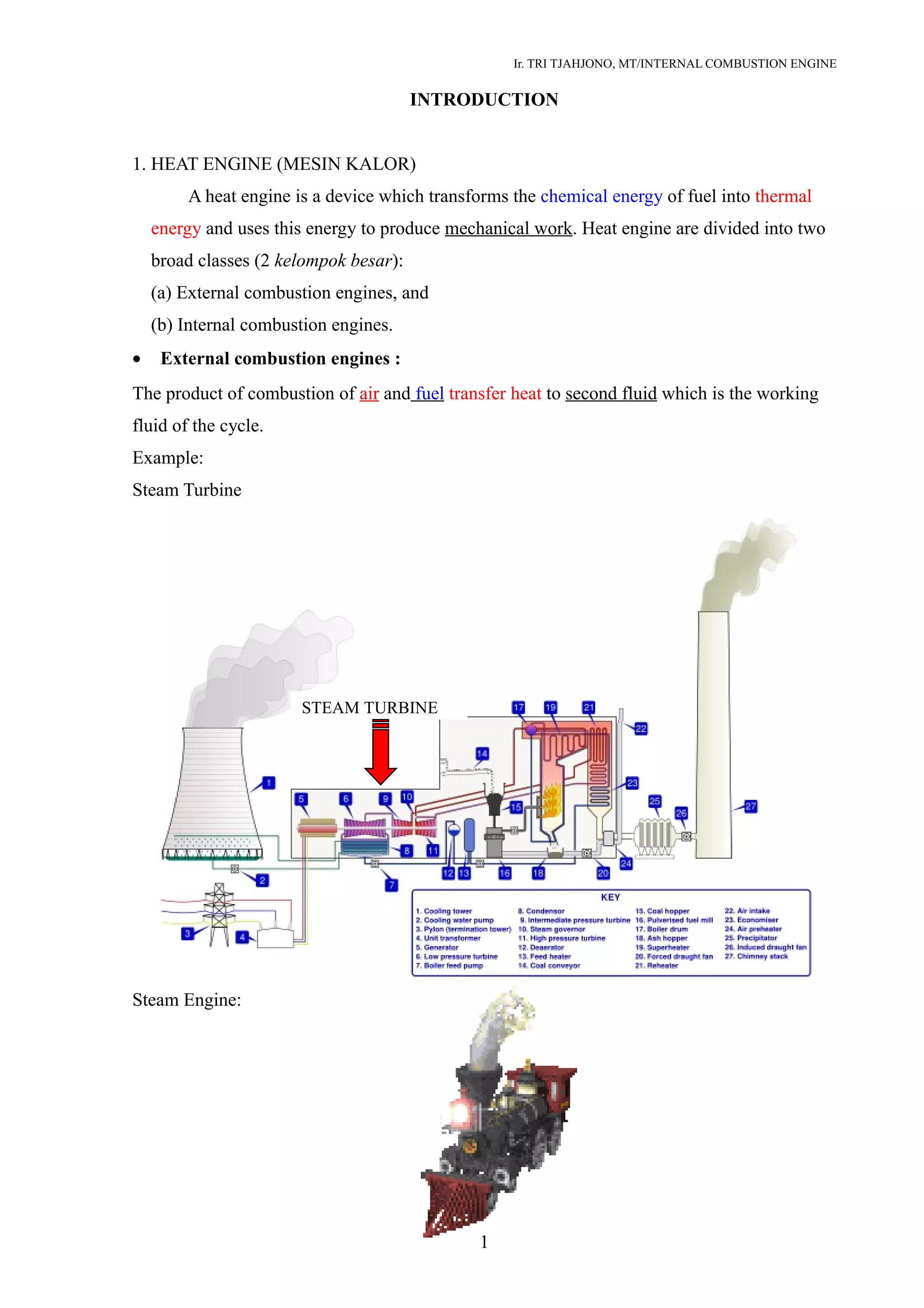
Steam Turbine
Steam Engine:
1
STEAM TURBINE
Ir. TRI TJAHJONO, MT/INTERNAL COMBUSTION ENGINE
Gas Turbine:
• Internal combustion engines :
2. CLASSIFICATION:
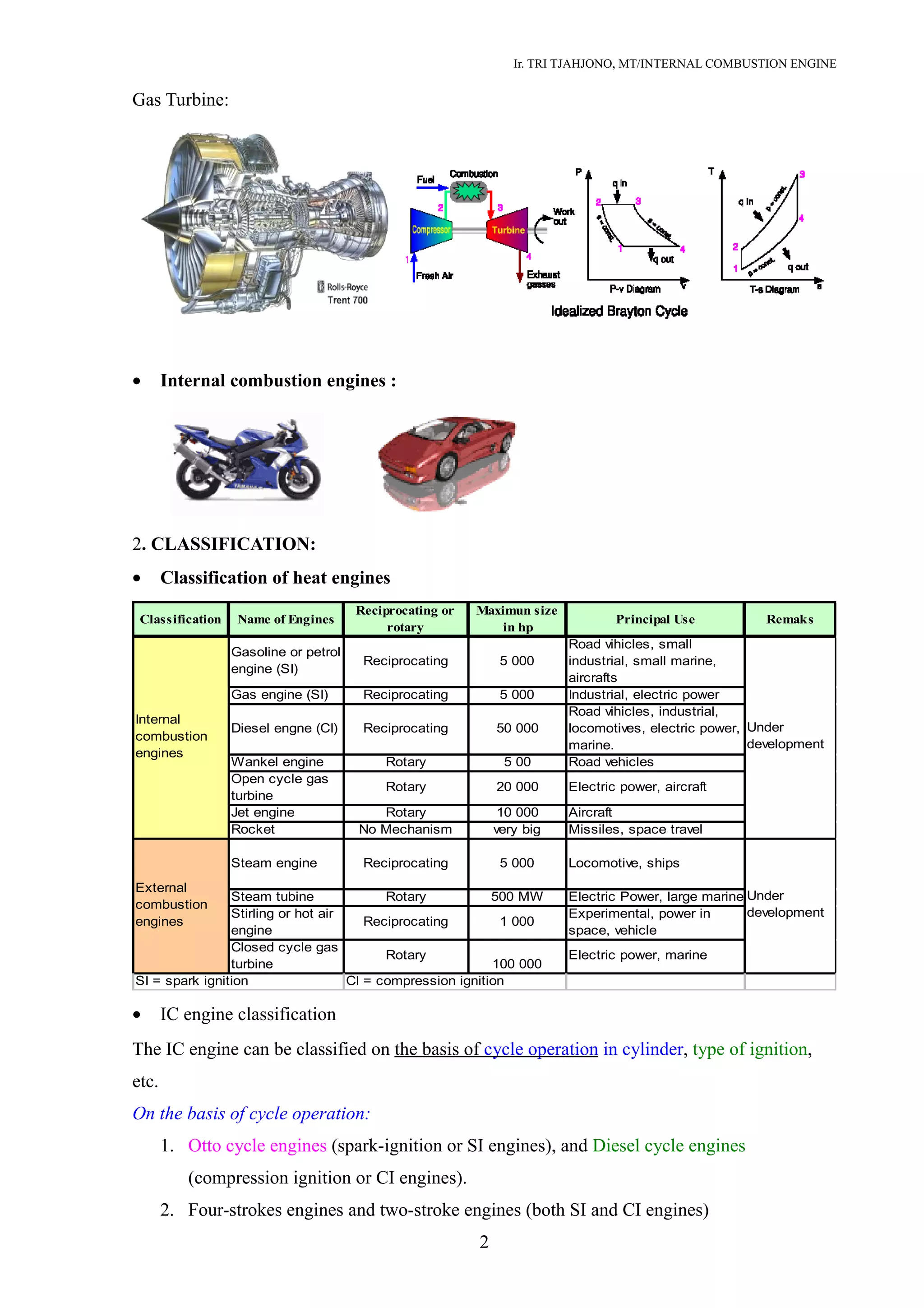
• Classification of heat engines
Classification Name of Engines
Reciprocating or
rotary
Maximun size
in hp
Principal Use Remaks
Gasoline or petrol
engine (SI)
Reciprocating 5 000
Road vihicles, small
industrial, small marine,
aircrafts
Gas engine (SI) Reciprocating 5 000 Industrial, electric power
Diesel engne (CI) Reciprocating 50 000
Road vihicles, industrial,
locomotives, electric power,
marine.
Wankel engine Rotary 5 00 Road vehicles
Open cycle gas
turbine
Rotary 20 000 Electric power, aircraft
Jet engine Rotary 10 000 Aircraft
Rocket No Mechanism very big Missiles, space travel
Steam engine Reciprocating 5 000 Locomotive, ships
Steam tubine Rotary 500 MW Electric Power, large marine
Stirling or hot air
engine
Reciprocating 1 000
Experimental, power in
space, vehicle
Closed cycle gas
turbine
Rotary
100 000
Electric power, marine
Internal
combustion
engines
Under
development
Under
development
External
combustion
engines
SI = spark ignition CI = compression ignition
• IC engine classification
The IC engine can be classified on the basis of cycle operation in cylinder, type of ignition,
etc.
On the basis of cycle operation:
1. Otto cycle engines (spark-ignition or SI engines), and Diesel cycle engines
(compression ignition or CI engines).
2. Four-strokes engines and two-stroke engines (both SI and CI engines)
2
Ir. TRI TJAHJONO, MT/INTERNAL COMBUSTION ENGINE
Further classification of spark-ignition engines:
(a) On the basis of fuel used: Gas engines and petrol engines.
(b) On the basis of method of supply of fuel:
1. Carbureted types:
Fuel supplied through carburetor.
2. Injection type:
(ii) Fuel injected into inlet ports or inlet manifold.
(iii) Fuel injected into the cylinders before ignition.
(c) On the basis of method of ignition: Battery ignition and magneto-ignition.
Further classification of compression-ignition engines:
(i) Normally type, using liquid fuel, i.e. light diesel oil (LDO), high speed diesel oil
(HSD), heavy oil
(ii) Dual-fuel type, using liquid fuel for ignition, with supplementary gaseous fuel,
either injected or carbureted.
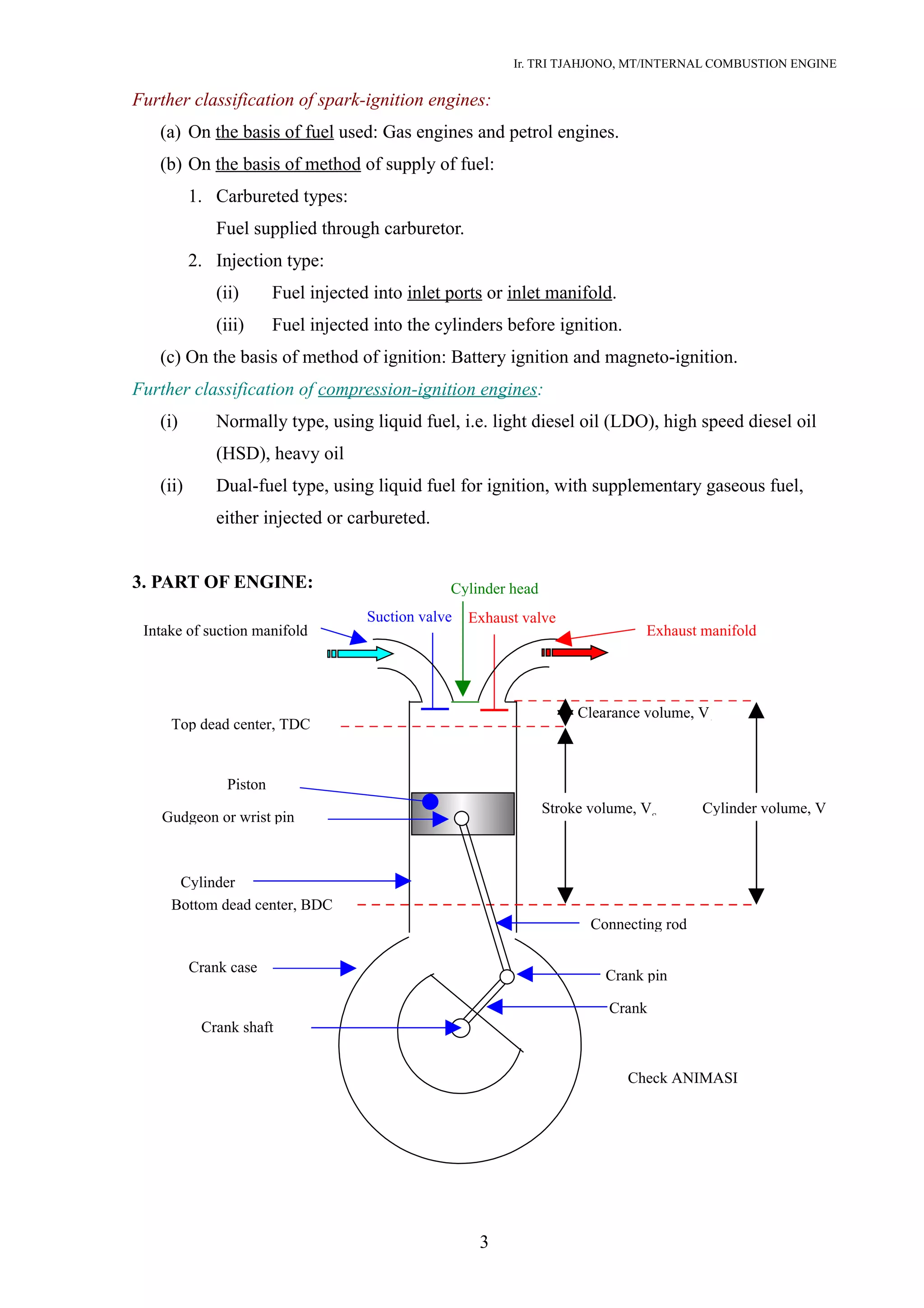
3. PART OF ENGINE:
3
Cylinder volume, V
Clearance volume, Vc
Stroke volume, VS
Top dead center, TDC
Bottom dead center, BDC
Connecting rod
Crank
Check ANIMASI
Crank case
Cylinder
Crank pin
Gudgeon or wrist pin
Piston
Suction valve Exhaust valve
Intake of suction manifold
Cylinder head
Exhaust manifold
Crank shaft
Ir. TRI TJAHJONO, MT/INTERNAL COMBUSTION ENGINE
 Cylinder volume (V).
The sum of piston swept volume and clearance volume.
CS VVV +=
 Compression ratio (CR or r).
The numerical value of the cylinder volume is divided by the numerical value of the
combustion space volume.
CV
V
rnratioCompressio =
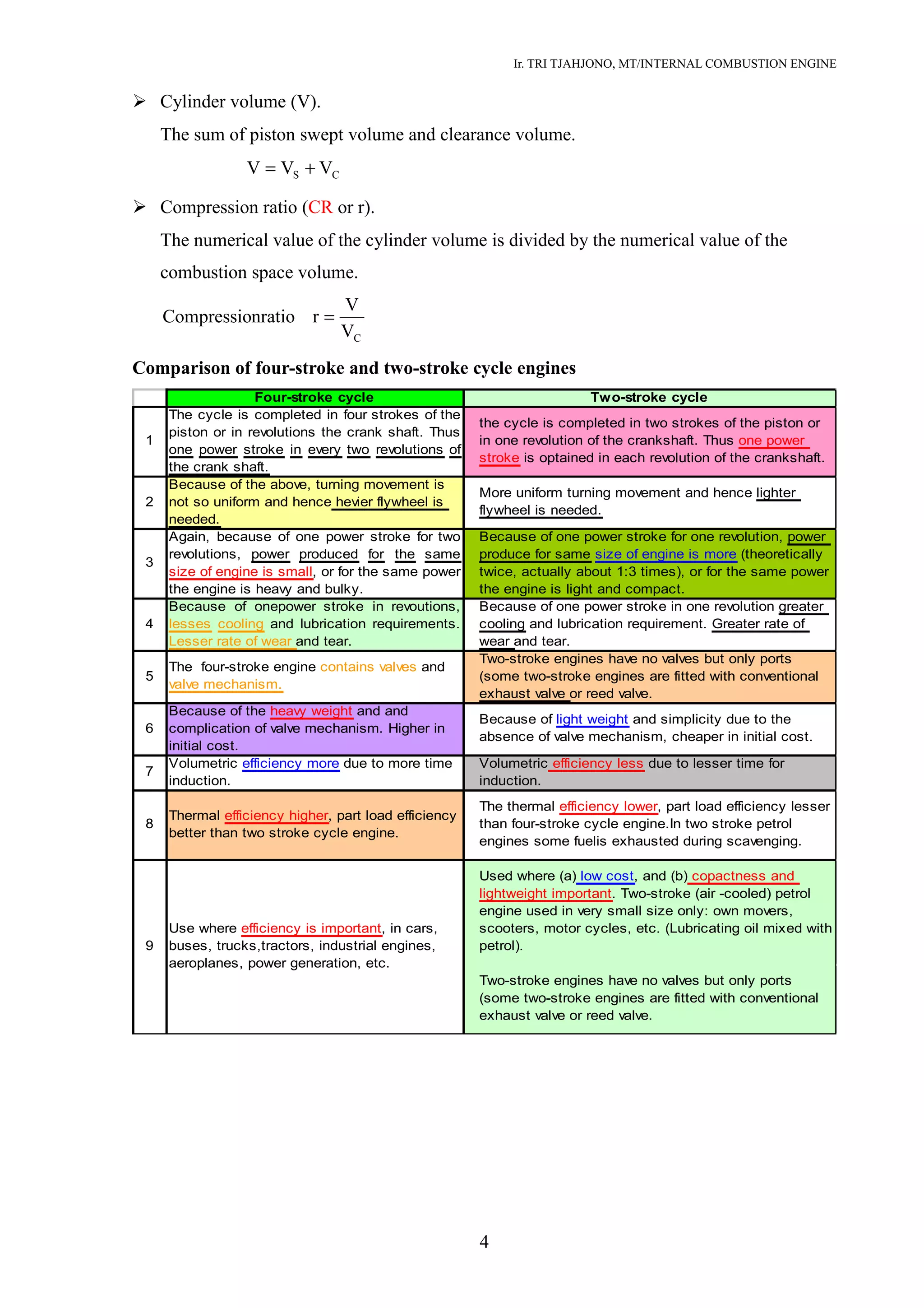
Comparison of four-stroke and two-stroke cycle engines
Four-stroke cycle Two-stroke cycle
1
The cycle is completed in four strokes of the
piston or in revolutions the crank shaft. Thus
one power stroke in every two revolutions of
the crank shaft.
the cycle is completed in two strokes of the piston or
in one revolution of the crankshaft. Thus one power
stroke is optained in each revolution of the crankshaft.
2
Because of the above, turning movement is
not so uniform and hence hevier flywheel is
needed.
More uniform turning movement and hence lighter
flywheel is needed.
3
Again, because of one power stroke for two
revolutions, power produced for the same
size of engine is small, or for the same power
the engine is heavy and bulky.
Because of one power stroke for one revolution, power
produce for same size of engine is more (theoretically
twice, actually about 1:3 times), or for the same power
the engine is light and compact.
4
Because of onepower stroke in revoutions,
lesses cooling and lubrication requirements.
Lesser rate of wear and tear.
Because of one power stroke in one revolution greater
cooling and lubrication requirement. Greater rate of
wear and tear.
5
The four-stroke engine contains valves and
valve mechanism.
Two-stroke engines have no valves but only ports
(some two-stroke engines are fitted with conventional
exhaust valve or reed valve.
6
Because of the heavy weight and and
complication of valve mechanism. Higher in
initial cost.
Because of light weight and simplicity due to the
absence of valve mechanism, cheaper in initial cost.
7
Volumetric efficiency more due to more time
induction.
Volumetric efficiency less due to lesser time for
induction.
8
Thermal efficiency higher, part load efficiency
better than two stroke cycle engine.
The thermal efficiency lower, part load efficiency lesser
than four-stroke cycle engine.In two stroke petrol
engines some fuelis exhausted during scavenging.
Used where (a) low cost, and (b) copactness and
lightweight important. Two-stroke (air -cooled) petrol
engine used in very small size only: own movers,
scooters, motor cycles, etc. (Lubricating oil mixed with
petrol).
Two-stroke engines have no valves but only ports
(some two-stroke engines are fitted with conventional
exhaust valve or reed valve.
Use where efficiency is important, in cars,
buses, trucks,tractors, industrial engines,
aeroplanes, power generation, etc.
9
4
Ir. TRI TJAHJONO, MT/INTERNAL COMBUSTION ENGINE
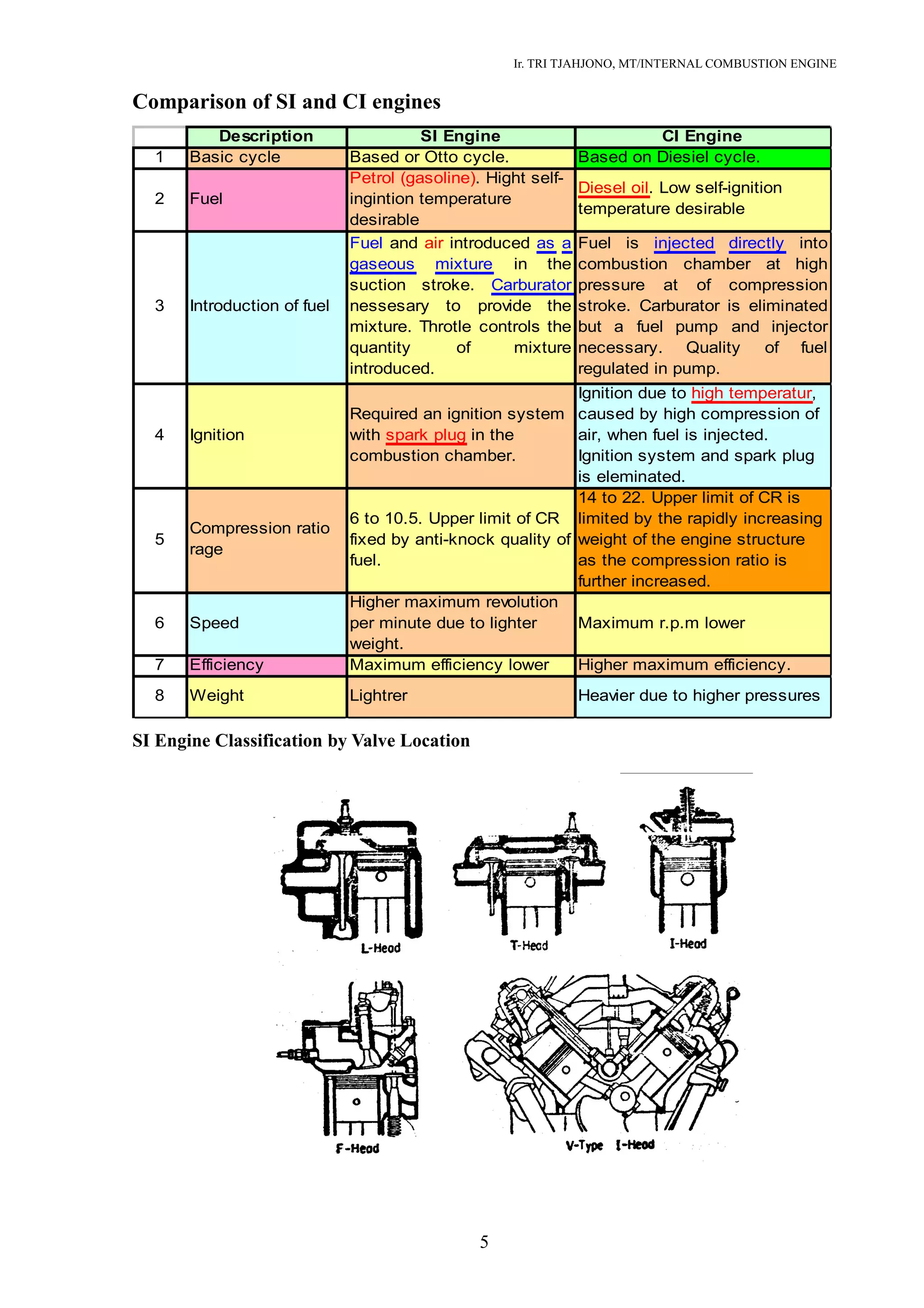
Comparison of SI and CI engines
Description SI Engine CI Engine
1 Basic cycle Based or Otto cycle. Based on Diesiel cycle.
2 Fuel
Petrol (gasoline). Hight self-
ingintion temperature
desirable
Diesel oil. Low self-ignition
temperature desirable
3 Introduction of fuel
Fuel and air introduced as a
gaseous mixture in the
suction stroke. Carburator
nessesary to provide the
mixture. Throtle controls the
quantity of mixture
introduced.
Fuel is injected directly into
combustion chamber at high
pressure at of compression
stroke. Carburator is eliminated
but a fuel pump and injector
necessary. Quality of fuel
regulated in pump.
4 Ignition
Required an ignition system
with spark plug in the
combustion chamber.
Ignition due to high temperatur,
caused by high compression of
air, when fuel is injected.
Ignition system and spark plug
is eleminated.
5
Compression ratio
rage
6 to 10.5. Upper limit of CR
fixed by anti-knock quality of
fuel.
14 to 22. Upper limit of CR is
limited by the rapidly increasing
weight of the engine structure
as the compression ratio is
further increased.
6 Speed
Higher maximum revolution
per minute due to lighter
weight.
Maximum r.p.m lower
7 Efficiency Maximum efficiency lower Higher maximum efficiency.
8 Weight Lightrer Heavier due to higher pressures
SI Engine Classification by Valve Location
5
Ir. TRI TJAHJONO, MT/INTERNAL COMBUSTION ENGINE
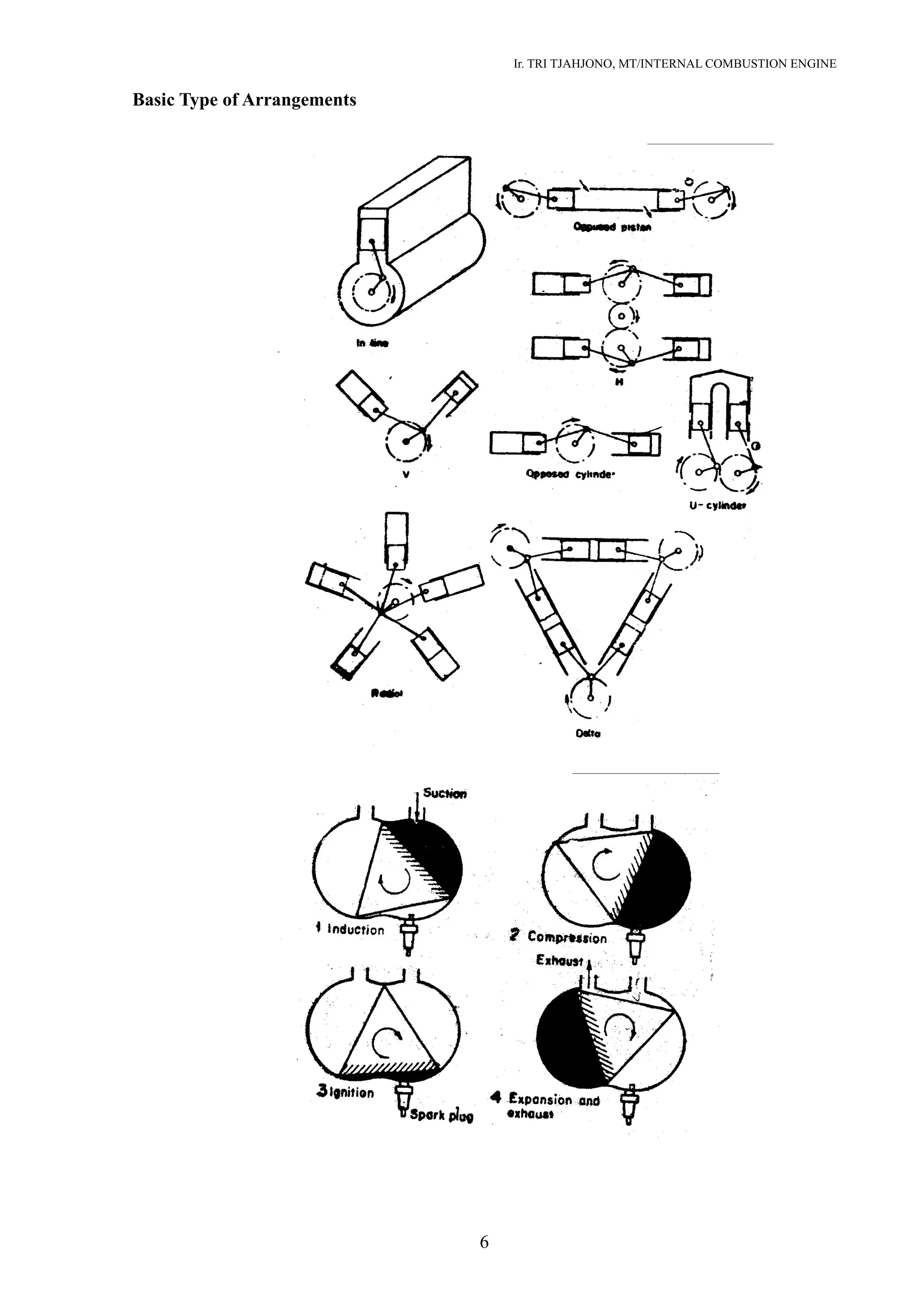
Basic Type of Arrangements
6

13085540 ice-lecture-1

  • 1.
    Ir. TRI TJAHJONO,MT/INTERNAL COMBUSTION ENGINE INTRODUCTION 1. HEAT ENGINE (MESIN KALOR) A heat engine is a device which transforms the chemical energy of fuel into thermal energy and uses this energy to produce mechanical work. Heat engine are divided into two broad classes (2 kelompok besar): (a) External combustion engines, and (b) Internal combustion engines. • External combustion engines : The product of combustion of air and fuel transfer heat to second fluid which is the working fluid of the cycle. Example: Steam Turbine Steam Engine: 1 STEAM TURBINE
  • 2.
    Ir. TRI TJAHJONO,MT/INTERNAL COMBUSTION ENGINE Gas Turbine: • Internal combustion engines : 2. CLASSIFICATION: • Classification of heat engines Classification Name of Engines Reciprocating or rotary Maximun size in hp Principal Use Remaks Gasoline or petrol engine (SI) Reciprocating 5 000 Road vihicles, small industrial, small marine, aircrafts Gas engine (SI) Reciprocating 5 000 Industrial, electric power Diesel engne (CI) Reciprocating 50 000 Road vihicles, industrial, locomotives, electric power, marine. Wankel engine Rotary 5 00 Road vehicles Open cycle gas turbine Rotary 20 000 Electric power, aircraft Jet engine Rotary 10 000 Aircraft Rocket No Mechanism very big Missiles, space travel Steam engine Reciprocating 5 000 Locomotive, ships Steam tubine Rotary 500 MW Electric Power, large marine Stirling or hot air engine Reciprocating 1 000 Experimental, power in space, vehicle Closed cycle gas turbine Rotary 100 000 Electric power, marine Internal combustion engines Under development Under development External combustion engines SI = spark ignition CI = compression ignition • IC engine classification The IC engine can be classified on the basis of cycle operation in cylinder, type of ignition, etc. On the basis of cycle operation: 1. Otto cycle engines (spark-ignition or SI engines), and Diesel cycle engines (compression ignition or CI engines). 2. Four-strokes engines and two-stroke engines (both SI and CI engines) 2
  • 3.
    Ir. TRI TJAHJONO,MT/INTERNAL COMBUSTION ENGINE Further classification of spark-ignition engines: (a) On the basis of fuel used: Gas engines and petrol engines. (b) On the basis of method of supply of fuel: 1. Carbureted types: Fuel supplied through carburetor. 2. Injection type: (ii) Fuel injected into inlet ports or inlet manifold. (iii) Fuel injected into the cylinders before ignition. (c) On the basis of method of ignition: Battery ignition and magneto-ignition. Further classification of compression-ignition engines: (i) Normally type, using liquid fuel, i.e. light diesel oil (LDO), high speed diesel oil (HSD), heavy oil (ii) Dual-fuel type, using liquid fuel for ignition, with supplementary gaseous fuel, either injected or carbureted. 3. PART OF ENGINE: 3 Cylinder volume, V Clearance volume, Vc Stroke volume, VS Top dead center, TDC Bottom dead center, BDC Connecting rod Crank Check ANIMASI Crank case Cylinder Crank pin Gudgeon or wrist pin Piston Suction valve Exhaust valve Intake of suction manifold Cylinder head Exhaust manifold Crank shaft
  • 4.
    Ir. TRI TJAHJONO,MT/INTERNAL COMBUSTION ENGINE  Cylinder volume (V). The sum of piston swept volume and clearance volume. CS VVV +=  Compression ratio (CR or r). The numerical value of the cylinder volume is divided by the numerical value of the combustion space volume. CV V rnratioCompressio = Comparison of four-stroke and two-stroke cycle engines Four-stroke cycle Two-stroke cycle 1 The cycle is completed in four strokes of the piston or in revolutions the crank shaft. Thus one power stroke in every two revolutions of the crank shaft. the cycle is completed in two strokes of the piston or in one revolution of the crankshaft. Thus one power stroke is optained in each revolution of the crankshaft. 2 Because of the above, turning movement is not so uniform and hence hevier flywheel is needed. More uniform turning movement and hence lighter flywheel is needed. 3 Again, because of one power stroke for two revolutions, power produced for the same size of engine is small, or for the same power the engine is heavy and bulky. Because of one power stroke for one revolution, power produce for same size of engine is more (theoretically twice, actually about 1:3 times), or for the same power the engine is light and compact. 4 Because of onepower stroke in revoutions, lesses cooling and lubrication requirements. Lesser rate of wear and tear. Because of one power stroke in one revolution greater cooling and lubrication requirement. Greater rate of wear and tear. 5 The four-stroke engine contains valves and valve mechanism. Two-stroke engines have no valves but only ports (some two-stroke engines are fitted with conventional exhaust valve or reed valve. 6 Because of the heavy weight and and complication of valve mechanism. Higher in initial cost. Because of light weight and simplicity due to the absence of valve mechanism, cheaper in initial cost. 7 Volumetric efficiency more due to more time induction. Volumetric efficiency less due to lesser time for induction. 8 Thermal efficiency higher, part load efficiency better than two stroke cycle engine. The thermal efficiency lower, part load efficiency lesser than four-stroke cycle engine.In two stroke petrol engines some fuelis exhausted during scavenging. Used where (a) low cost, and (b) copactness and lightweight important. Two-stroke (air -cooled) petrol engine used in very small size only: own movers, scooters, motor cycles, etc. (Lubricating oil mixed with petrol). Two-stroke engines have no valves but only ports (some two-stroke engines are fitted with conventional exhaust valve or reed valve. Use where efficiency is important, in cars, buses, trucks,tractors, industrial engines, aeroplanes, power generation, etc. 9 4
  • 5.
    Ir. TRI TJAHJONO,MT/INTERNAL COMBUSTION ENGINE Comparison of SI and CI engines Description SI Engine CI Engine 1 Basic cycle Based or Otto cycle. Based on Diesiel cycle. 2 Fuel Petrol (gasoline). Hight self- ingintion temperature desirable Diesel oil. Low self-ignition temperature desirable 3 Introduction of fuel Fuel and air introduced as a gaseous mixture in the suction stroke. Carburator nessesary to provide the mixture. Throtle controls the quantity of mixture introduced. Fuel is injected directly into combustion chamber at high pressure at of compression stroke. Carburator is eliminated but a fuel pump and injector necessary. Quality of fuel regulated in pump. 4 Ignition Required an ignition system with spark plug in the combustion chamber. Ignition due to high temperatur, caused by high compression of air, when fuel is injected. Ignition system and spark plug is eleminated. 5 Compression ratio rage 6 to 10.5. Upper limit of CR fixed by anti-knock quality of fuel. 14 to 22. Upper limit of CR is limited by the rapidly increasing weight of the engine structure as the compression ratio is further increased. 6 Speed Higher maximum revolution per minute due to lighter weight. Maximum r.p.m lower 7 Efficiency Maximum efficiency lower Higher maximum efficiency. 8 Weight Lightrer Heavier due to higher pressures SI Engine Classification by Valve Location 5
  • 6.
    Ir. TRI TJAHJONO,MT/INTERNAL COMBUSTION ENGINE Basic Type of Arrangements 6