DI ST URBANCES I N
  OX Y GE NAT I ON
    CARRYI NG
 ME C H A N I S M A N D
T RANS P ORT AT I ON
   F ACI L I T I ES
     Jefferson C. Ramos, RMT RN
BLOOD

   Circulatory fluid of the the
    Cardiovasclar system that is
    circulating constantly through
    a closed circuit of tubes.
PARTS OF THE BLOOD
  Liquid   Portion

      Plasma - a pale, straw
       colored fluid that remains
       if coagulation is prevented

      Serum - fluid part that
       remains after separation
       of the clot
PARTS OF THE BLOOD
 Solid   Portion

     Red Blood
      Cells/Erythrocytes

     White Blood
      Cells/Leukocytes

     Platelets/Thrombocytes
CHARACTERISTICS OF BLOOD
 Volume                               Specific   Gravity
     5 - 6 liters or 7 - 8% of the        Between 1.055 - 1.065
      body weight

                                       Reaction
 Color
     Venous blood - dark red              Range of 7.35 - 7.45 (avg.
     Arterial blood - bright               of 7.4)
      scarlet red


 Viscosity
     Thick and sticky (5x that
      of water)
FUNCTIONS OF BLOOD
   Metabolic Functions

       Respiration              Regulation of body
                                  temperature

       Nutrition
                                 Transportation of
                                  hormones
       Excretion

                                 Maintenance of normal
       Regulation of water       acid-base balance in the
        balance                   body
FUNCTIONS OF BLOOD
   Defensive Functions

       Production of immune
        globulins

       Functions as phagocytes
ERYTHROCYTES
 Biconcave    discs resembling a soft ball
  compressed between 2 fingers
 Gases can easily diffuse across it due to
  its very thin membrane
 Contains HEMOGLOBIN

    From matured erythrocytes; with Iron
    Makes up 95% of blood mass
    Enables the RBCs to perform its
     principal function
RBC DESTRUCTION
 120 days
 Removed by the reticuloendothelial cells in the liver
  and spleen
 Hemoglobin is recycled
     Bilirubin
     New hgb molecules in the bone marrow
     Sterco- and urobilinogen
KINDS OF WBCS
 Granulocytes      • Agranulocytes

     Neutrophils     • Lymphocytes

     Eosinophils
                      • Monocytes
     Basophils
NEUTROPHILS
   Most abundant type of
    phagocyte, 50 - 60%

   Responsible for
    neutralizing bacterial
    infections

   They engulf pathogens
    coated with antibodies

   Does not return to the
    blood
EOSINOPHILS


                 1 - 3%

                 They play a crucial
                  part in killing
                  parasites

                 Neutralize
                  histamine
BASOPHILS
0 - 1% of the
 differential count

 Appears in
 inflammatory
 reactions esp. those
 that cause allergic
 reations

 Containsheparin &
 histamine
LYPMHOCYTES
                 About 25 - 33% of the
                  differential

                 Usually abnormal
                  results in diseases
                  caused by viruses

                 Has three kinds:
                   Natural Killer Cells
                   T Cells
                   B Cells
MONOCYTES

   About 3 - 7%

   Functions to replenish
    resident macrophages
    and dendrictic cells
    under noramal states

   Also responds to
    inflammation signals
THROMBOCYTES

 100,000   - 450,000 in
 value

 Derivedfrom the
 fragmentation of
 precursor
 megakaryocytes

 Plays
     a key role in
 hemostasis
ASSESSMENT AND DIAGNOSTIC FINDNIGS
Hematologic   Studies
  Complete  blood count
  Peripheral blood smear
  Hemoglobin
  Hematocrit
  RBC indices
ASSESSMENT AND DIAGNOSTIC FINDNIGS
 Bone marrow aspiration
 and biopsy
  Bone marrow aspiration
  Bone marrow biopsy
MANAGEMENT OF HEMATOLOGIC
DISORDERS
ANEMIA
A  condition in which Hemoglobin
 (Hgb) concentration is lower than
 normal
   Hgb = 75 – 175 μg/dL or
             13.5-17.5 g/dL (M)
          = 65 to 165 μg/dL or
            11.5-15.5 g/dL (F)
ANEMIA: CAUSES
 Acute or chronic blood loss
 Inadequate dietary intake of vitamins and
  minerals
 Increased demands of vitamins and
  minerals for RBC production
 Decreased RBC production by bone
  marrow
 Increased RBC destruction
Hemolytic


           ANEMIA         Hypo-
                       proliferative
Bleeding
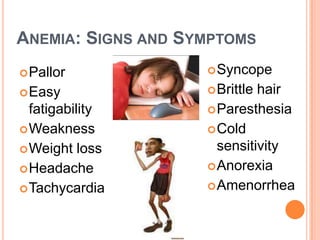
ANEMIA: SIGNS AND SYMPTOMS
 Pallor             Syncope

 Easy               Brittlehair
  fatigability       Paresthesia
 Weakness           Cold
 Weight loss         sensitivity
 Headache           Anorexia

 Tachycardia        Amenorrhea
IRON DEFICIENCY ANEMIA
   Laboratory findings       Assessment
 1.   CBC- Low levels of    1.   Pallor
      Hct, Hgb and RBC
      count                 2.   Weakness & fatigue
 2.   Low serum iron, low   3.   Smooth & sore
      ferritin                   tongue
 3.   Bone marrow
      aspiration- MOST      4.   Koilonychia
      definitive            5.   Vinson Plummer
                                 syndrome
MEGALOBLASTIC ANEMIAS:
VIT. B12 DEFICIENCY

 Inadequate   dietary intake

 Pernicious   Anemia
   Due to the absence of intrinsic factor
    secreted by the parietal cells
   Intrinsic factor binds with Vit. B12 to
    promote absorption
MEGALOBLASTIC ANEMIAS:
  VIT. B12 DEFICIENCY
Causative   factors
1.Strict vegetarian diet
2.Gastrointestinal
  malabsorption
3.Crohn's disease
4.Gastrectomy
MEGALOBLASTIC ANEMIAS:
MANIFIESTATIONS
 1.   Weakness
 2.   Fatigue
 3.   Listless
 4.   Neurologic manifestations (only in Vit.
      B12 deficiency)
 5.   Jaundice – due to poor erythropoiesis
 6.   Red beefy tongue
 7.   Mild diarrhea
 8.   Extreme pallor
 9.   Paresthesias in the extremities
MEGALOBLASTIC ANEMIAS: LAB DATA
1.   Peripheral blood smear- shows
     giant RBCs, WBCs with giant
     hypersegmented nuclei
2.   Very high MCV
3.   Schilling’s test – determines the
     cause of Vit B12 deficiency
4.   Intrinsic factor antibody test
MEGALOBLASTIC ANEMIAS
1.       Vitamin supplementation
        Folic acid 1 mg daily
2.       Diet supplementation
        Vegetarians should have
         vitamin intake or fortified soy
         milk
3.       Lifetime monthly injection
         of IM Vit. B12 – 1000µg (if
         intrinsic factor is absent)
MEGALOBLASTIC ANEMIAS

1.   Monitor patient (neurologic
     assessment)
2.   Provide assistance in
     ambulation
3.   Oral care for sore tongue
4.   Explain the need for lifetime IM
     injection of Vit. B12
POLYCYTHEMIA

 Refers  to an INCREASE
  volume of RBCs
 The hematocrit (Hct) is
  ELEVATED to more than 55%
 Classified as Primary or
  Secondary
POLYCYTHEMIA: PRIMARY
POLYCYTHEMIA        VERA


                                Colleen C. Flores, RN
A proliferative disorder in
 which the myeloid stem cells
 become uncontrolled
Causative factor: unknown
POLYCYTHEMIA: PRIMARY
Uncontrollable
stem cell growth         Increased blood
                             viscosity
  Hypercellular
  bone marrow
    Increase in number   Increased RBC,
    of blood cells        WBC, platelets

      Hematopoiesis
      in spleen            Splenomegaly
        Fibrotic bone
        marrow
POLYCYTHEMIA: PRIMARY
1.   Ruddy skin       1. Angina
2.   Splenomegaly     2. Claudication
3.   Headache
                      3. Dyspnea
4.   Tinnitus
5.   Fatigue          4. Thrombo-
6.   Paresthesia         phlebitis
7.   Blurred vision   5. Pruritus
                      6. Erythromelalgia
POLYCYTHEMIA: PRIMARY
Laboratory    findings
  1.   CBC- shows elevated RBC
       mass
  2.   Elevated WBC and platelets
  3.   Elevated hematocrit
  4.   Normal oxygen saturation
POLYCYTHEMIA: PRIMARY
Complications
 1.   Increased risk for
      thrombophlebitis, CVA and
      MI
 2.   Bleeding due to
      dysfunctional platelets
POLYCYTHEMIA: PRIMARY
 1.  To reduce the high blood cell
     mass (goal)


                                        Colleen C. Flores, RN
          PHLEBOTOMY
 2.       Allopurinol (Zyloprim) – if uric
          acid is increased
 3.       Dipyridamole (Persantine)
 4.       Chemotherapy to suppress
          bone marrow (hydroxyurea)
POLYCYTHEMIA: PRIMARY
    Patient education: Client instructions on:
1.   Avoiding Iron supplements
2.   Bathing with cool water (cocoa-butter
     based lotion and bath products)
3.   Minimize bleeding
       Avoid Aspirin (if with bleeding history)
       Minimize alcohol intake
POLYCYTHEMIA: SECONDARY

    Caused by:
        Excessive production of
         erythropoietin (hypoxic stimulus)
        Hemoglobinopathies
        Neoplasms (renal cell carcinoma)
    Treat primary problem
BLEEDING DISORDERS


    Platelets
THROMBOCYTOPENIA

Low  platelet level due to:
  1. Decreased platelet production by bone
     marrow
  2. Increased platelet destruction (ITP)
  3. Increased platelet consumption (DIC)
Manifestation: bleeding and petichiae
 (<20,000mm3)
IDIOPATHIC THROMBOCYTOPENIC
PURPURA (ITP)
ITP
  Goal: safe platelet count (>30,000mm3)
  Immunosuppressants - block the binding
   receptors on macrophages so that the platelets
   are not destroyed
    1. Prednisone
    2. Cyclophosphamide (Cytoxan)
    3. Azathioprine (Imuran)
    4. Dexamethasone (Decadron)
  IVIG

  Spleenectomy

  Chemotherapy – Vincristine (Oncovin)
                     Colleen C. Flores, RN
ITP
       Determine   bleeding risks
       Client education regarding
         Medication and treatment
         Lifestyle
         Refrain from vigorous sexual
          intercourse (< 10,000/mm3)
       Avoid client constipation
HEMOPHILIA
 Inherited (x-linked) bleeding disorder
 Deficient or defective factor VIII (A)

 Deficient or defective factor IX (B)

 Hemorrhage after minimal trauma (joints)
HEMOPHILIA: INHERITANCE
VON WILLEBRAND’S DISEASE
 Inherited(autosomal dominant)
  bleeding disorder; deficiency of the
  vWF
 Common manifestations

   Nosebleeds
   Heavy menses
 Lab data = normal platelet count but
  prolonged PTT
VON WILLEBRAND’S DISEASE: MANAGEMENT
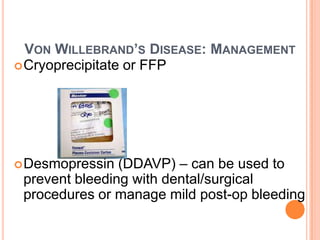
 Cryoprecipitate or FFP


 Desmopressin  (DDAVP) – can be used to
 prevent bleeding with dental/surgical
 procedures or manage mild post-op bleeding
DISSEMINATED INTRAVASCULAR
COAGULATION (DIC)

A  potentially life-threatening
 sign of an underlying condition
Triggered by sepsis, trauma,
 cancer, abruptio placenta,
 transfusion reactions
 (hemolysis)
DIC: MANIFESTATIONS
   Minimal  occult internal bleeding to
    profuse hemorrhage
   Lab data:
     Fibrin degradation products – high
     PTT - high
     Platelet count - low
     PT - high
     Serum fibrinogen - low
DIC: MANAGEMENT
Treatunderlying disorder
Correct secondary effects of tissue
 ischemia
Cryoprecipitate or FFP
Heparin infusion* – to interrupt
 thrombosis
13   hema

13 hema

  • 1.
    DI ST URBANCESI N OX Y GE NAT I ON CARRYI NG ME C H A N I S M A N D T RANS P ORT AT I ON F ACI L I T I ES Jefferson C. Ramos, RMT RN
  • 2.
    BLOOD  Circulatory fluid of the the Cardiovasclar system that is circulating constantly through a closed circuit of tubes.
  • 3.
    PARTS OF THEBLOOD  Liquid Portion  Plasma - a pale, straw colored fluid that remains if coagulation is prevented  Serum - fluid part that remains after separation of the clot
  • 4.
    PARTS OF THEBLOOD  Solid Portion  Red Blood Cells/Erythrocytes  White Blood Cells/Leukocytes  Platelets/Thrombocytes
  • 5.
    CHARACTERISTICS OF BLOOD Volume  Specific Gravity  5 - 6 liters or 7 - 8% of the  Between 1.055 - 1.065 body weight  Reaction  Color  Venous blood - dark red  Range of 7.35 - 7.45 (avg.  Arterial blood - bright of 7.4) scarlet red  Viscosity  Thick and sticky (5x that of water)
  • 6.
    FUNCTIONS OF BLOOD  Metabolic Functions  Respiration  Regulation of body temperature  Nutrition  Transportation of hormones  Excretion  Maintenance of normal  Regulation of water acid-base balance in the balance body
  • 7.
    FUNCTIONS OF BLOOD  Defensive Functions  Production of immune globulins  Functions as phagocytes
  • 8.
    ERYTHROCYTES  Biconcave discs resembling a soft ball compressed between 2 fingers  Gases can easily diffuse across it due to its very thin membrane  Contains HEMOGLOBIN  From matured erythrocytes; with Iron  Makes up 95% of blood mass  Enables the RBCs to perform its principal function
  • 9.
    RBC DESTRUCTION  120days  Removed by the reticuloendothelial cells in the liver and spleen  Hemoglobin is recycled  Bilirubin  New hgb molecules in the bone marrow  Sterco- and urobilinogen
  • 10.
    KINDS OF WBCS Granulocytes • Agranulocytes  Neutrophils • Lymphocytes  Eosinophils • Monocytes  Basophils
  • 11.
    NEUTROPHILS  Most abundant type of phagocyte, 50 - 60%  Responsible for neutralizing bacterial infections  They engulf pathogens coated with antibodies  Does not return to the blood
  • 12.
    EOSINOPHILS  1 - 3%  They play a crucial part in killing parasites  Neutralize histamine
  • 13.
    BASOPHILS 0 - 1%of the differential count  Appears in inflammatory reactions esp. those that cause allergic reations  Containsheparin & histamine
  • 14.
    LYPMHOCYTES  About 25 - 33% of the differential  Usually abnormal results in diseases caused by viruses  Has three kinds:  Natural Killer Cells  T Cells  B Cells
  • 15.
    MONOCYTES  About 3 - 7%  Functions to replenish resident macrophages and dendrictic cells under noramal states  Also responds to inflammation signals
  • 16.
    THROMBOCYTES  100,000 - 450,000 in value  Derivedfrom the fragmentation of precursor megakaryocytes  Plays a key role in hemostasis
  • 17.
    ASSESSMENT AND DIAGNOSTICFINDNIGS Hematologic Studies  Complete blood count  Peripheral blood smear  Hemoglobin  Hematocrit  RBC indices
  • 18.
    ASSESSMENT AND DIAGNOSTICFINDNIGS  Bone marrow aspiration and biopsy  Bone marrow aspiration  Bone marrow biopsy
  • 19.
  • 20.
    ANEMIA A conditionin which Hemoglobin (Hgb) concentration is lower than normal  Hgb = 75 – 175 μg/dL or 13.5-17.5 g/dL (M) = 65 to 165 μg/dL or 11.5-15.5 g/dL (F)
  • 21.
    ANEMIA: CAUSES  Acuteor chronic blood loss  Inadequate dietary intake of vitamins and minerals  Increased demands of vitamins and minerals for RBC production  Decreased RBC production by bone marrow  Increased RBC destruction
  • 22.
    Hemolytic ANEMIA Hypo- proliferative Bleeding
  • 23.
    ANEMIA: SIGNS ANDSYMPTOMS  Pallor  Syncope  Easy  Brittlehair fatigability  Paresthesia  Weakness  Cold  Weight loss sensitivity  Headache  Anorexia  Tachycardia  Amenorrhea
  • 24.
    IRON DEFICIENCY ANEMIA  Laboratory findings  Assessment 1. CBC- Low levels of 1. Pallor Hct, Hgb and RBC count 2. Weakness & fatigue 2. Low serum iron, low 3. Smooth & sore ferritin tongue 3. Bone marrow aspiration- MOST 4. Koilonychia definitive 5. Vinson Plummer syndrome
  • 25.
    MEGALOBLASTIC ANEMIAS: VIT. B12DEFICIENCY  Inadequate dietary intake  Pernicious Anemia  Due to the absence of intrinsic factor secreted by the parietal cells  Intrinsic factor binds with Vit. B12 to promote absorption
  • 26.
    MEGALOBLASTIC ANEMIAS: VIT. B12 DEFICIENCY Causative factors 1.Strict vegetarian diet 2.Gastrointestinal malabsorption 3.Crohn's disease 4.Gastrectomy
  • 27.
    MEGALOBLASTIC ANEMIAS: MANIFIESTATIONS 1. Weakness 2. Fatigue 3. Listless 4. Neurologic manifestations (only in Vit. B12 deficiency) 5. Jaundice – due to poor erythropoiesis 6. Red beefy tongue 7. Mild diarrhea 8. Extreme pallor 9. Paresthesias in the extremities
  • 28.
    MEGALOBLASTIC ANEMIAS: LABDATA 1. Peripheral blood smear- shows giant RBCs, WBCs with giant hypersegmented nuclei 2. Very high MCV 3. Schilling’s test – determines the cause of Vit B12 deficiency 4. Intrinsic factor antibody test
  • 29.
    MEGALOBLASTIC ANEMIAS 1. Vitamin supplementation  Folic acid 1 mg daily 2. Diet supplementation  Vegetarians should have vitamin intake or fortified soy milk 3. Lifetime monthly injection of IM Vit. B12 – 1000µg (if intrinsic factor is absent)
  • 30.
    MEGALOBLASTIC ANEMIAS 1. Monitor patient (neurologic assessment) 2. Provide assistance in ambulation 3. Oral care for sore tongue 4. Explain the need for lifetime IM injection of Vit. B12
  • 31.
    POLYCYTHEMIA Refers to an INCREASE volume of RBCs The hematocrit (Hct) is ELEVATED to more than 55% Classified as Primary or Secondary
  • 32.
    POLYCYTHEMIA: PRIMARY POLYCYTHEMIA VERA Colleen C. Flores, RN A proliferative disorder in which the myeloid stem cells become uncontrolled Causative factor: unknown
  • 33.
    POLYCYTHEMIA: PRIMARY Uncontrollable stem cellgrowth Increased blood viscosity Hypercellular bone marrow Increase in number Increased RBC, of blood cells WBC, platelets Hematopoiesis in spleen Splenomegaly Fibrotic bone marrow
  • 34.
    POLYCYTHEMIA: PRIMARY 1. Ruddy skin 1. Angina 2. Splenomegaly 2. Claudication 3. Headache 3. Dyspnea 4. Tinnitus 5. Fatigue 4. Thrombo- 6. Paresthesia phlebitis 7. Blurred vision 5. Pruritus 6. Erythromelalgia
  • 35.
    POLYCYTHEMIA: PRIMARY Laboratory findings 1. CBC- shows elevated RBC mass 2. Elevated WBC and platelets 3. Elevated hematocrit 4. Normal oxygen saturation
  • 36.
    POLYCYTHEMIA: PRIMARY Complications 1. Increased risk for thrombophlebitis, CVA and MI 2. Bleeding due to dysfunctional platelets
  • 37.
    POLYCYTHEMIA: PRIMARY 1. To reduce the high blood cell mass (goal) Colleen C. Flores, RN  PHLEBOTOMY 2. Allopurinol (Zyloprim) – if uric acid is increased 3. Dipyridamole (Persantine) 4. Chemotherapy to suppress bone marrow (hydroxyurea)
  • 38.
    POLYCYTHEMIA: PRIMARY  Patient education: Client instructions on: 1. Avoiding Iron supplements 2. Bathing with cool water (cocoa-butter based lotion and bath products) 3. Minimize bleeding  Avoid Aspirin (if with bleeding history)  Minimize alcohol intake
  • 39.
    POLYCYTHEMIA: SECONDARY  Caused by:  Excessive production of erythropoietin (hypoxic stimulus)  Hemoglobinopathies  Neoplasms (renal cell carcinoma)  Treat primary problem
  • 40.
  • 41.
    THROMBOCYTOPENIA Low plateletlevel due to: 1. Decreased platelet production by bone marrow 2. Increased platelet destruction (ITP) 3. Increased platelet consumption (DIC) Manifestation: bleeding and petichiae (<20,000mm3)
  • 42.
  • 43.
    ITP  Goal:safe platelet count (>30,000mm3)  Immunosuppressants - block the binding receptors on macrophages so that the platelets are not destroyed 1. Prednisone 2. Cyclophosphamide (Cytoxan) 3. Azathioprine (Imuran) 4. Dexamethasone (Decadron)  IVIG  Spleenectomy  Chemotherapy – Vincristine (Oncovin) Colleen C. Flores, RN
  • 44.
    ITP  Determine bleeding risks  Client education regarding  Medication and treatment  Lifestyle  Refrain from vigorous sexual intercourse (< 10,000/mm3)  Avoid client constipation
  • 45.
    HEMOPHILIA  Inherited (x-linked)bleeding disorder  Deficient or defective factor VIII (A)  Deficient or defective factor IX (B)  Hemorrhage after minimal trauma (joints)
  • 46.
  • 47.
    VON WILLEBRAND’S DISEASE Inherited(autosomal dominant) bleeding disorder; deficiency of the vWF  Common manifestations  Nosebleeds  Heavy menses  Lab data = normal platelet count but prolonged PTT
  • 48.
    VON WILLEBRAND’S DISEASE:MANAGEMENT  Cryoprecipitate or FFP  Desmopressin (DDAVP) – can be used to prevent bleeding with dental/surgical procedures or manage mild post-op bleeding
  • 49.
    DISSEMINATED INTRAVASCULAR COAGULATION (DIC) A potentially life-threatening sign of an underlying condition Triggered by sepsis, trauma, cancer, abruptio placenta, transfusion reactions (hemolysis)
  • 50.
    DIC: MANIFESTATIONS  Minimal occult internal bleeding to profuse hemorrhage  Lab data:  Fibrin degradation products – high  PTT - high  Platelet count - low  PT - high  Serum fibrinogen - low
  • 51.
    DIC: MANAGEMENT Treatunderlying disorder Correctsecondary effects of tissue ischemia Cryoprecipitate or FFP Heparin infusion* – to interrupt thrombosis