Module I

Introduction to Accounting: Need and Types of
Accounting, Users of Accounting, concepts and
conventions of Accounting, Accounting Equations.
INTRODUCTION
 In all activities (whether business activities or non-
 business activities) and in all organizations (whether
 business organizations like a manufacturing entity or
 trading entity or non-business organizations like
 schools, colleges, hospitals, libraries, clubs, temples,
 political parties) which require money and other
 economic resources, accounting is required to account
 for these resources.
MEANING AND DEFINITION OF BOOKKEEPING
 Meaning
 Book- keeping includes recording of journal, posting in
  ledgers and balancing of accounts. All the records before
  the preparation of trail balance is the whole subject
  matter of book- keeping.
 Definition
 “Book- keeping is the science and art of correctly
  recording in books of account all those business
  transactions that result in the transfer of money or
  money’s worth”. R.N.Carter
Objectives of Book- keeping
 i) Book- keeping provides a permanent record of
  each transactions.
 ii) Soundness of a firm can be assessed from the
  records of assets and abilities on a particular date.
 iii) Entries related to incomes and expenditures of a
  concern facilitate to know the profit and loss for a
  given period.
 iv) It enables to prepare a list of customers and
  suppliers to ascertain the amount to be received or
  paid.
Count….,
 v) It is a method gives opportunities to review the
  business policies in the light of the past records.
 vi) Amendment of business laws, provision of
  licenses, assessment of taxes etc., are based on records.
ACCOUNTING
 Meaning of Accounting
 Accounting, is an information system is the process of
 identifying, measuring and communicating the
 economic information of an organization to its users
 who need the information for decision making.
 Definition of Accounting
 American Institute of Certified Public Accountants
 (AICPA) which defines accounting as “the art of
 recording, classifying and summarizing in a
 significant manner and in terms of money,
 transactions and events, which are, in part at least, of a
 financial character and interpreting the results
 thereof”.
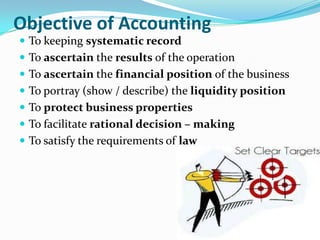
Objective of Accounting
 To keeping systematic record
 To ascertain the results of the operation
 To ascertain the financial position of the business
 To portray (show / describe) the liquidity position
 To protect business properties
 To facilitate rational decision – making
 To satisfy the requirements of law
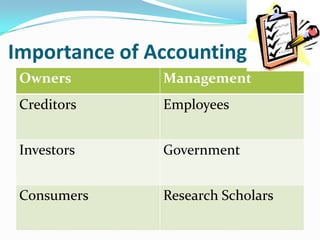
Importance of Accounting
 Owners        Management
 Creditors     Employees


 Investors     Government


 Consumers     Research Scholars
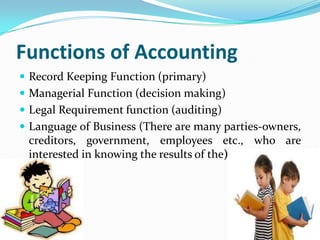
Functions of Accounting
 Record Keeping Function (primary)
 Managerial Function (decision making)
 Legal Requirement function (auditing)
 Language of Business (There are many parties-owners,
 creditors, government, employees etc., who are
 interested in knowing the results of the)
Methods of Accounting
 Business transactions are recorded in two different
   ways.
1 Single Entry
2 Double Entry
1 Single Entry: It is incomplete system of recording
   business transactions. The business organization
   maintains only cash book and personal accounts
   of debtors and creditors. So the complete recording
   of transactions cannot be made and trail balance
   cannot be prepared.
Count….,

 2. Double Entry: It this system every business
 transaction is having a two fold effect of benefits
 giving and benefit receiving aspects. The recording is
 made on the basis of both these aspects. Double Entry
 is an accounting system that records the effects of
 transactions and other events in at least two accounts
 with equal debits and credits.
Steps involved in Double entry system

(a) Preparation of Journal: Journal is
  called the book of original entry. It records
  the effect of all transactions for the first
  time. Here the job of recording takes place.
(b) Preparation of Ledger: Ledger is the
  collection of all accounts used by a
  business. Here the grouping of accounts is
  performed. Journal is posted to ledger.
Count….,
c) Trial Balance preparation: Summarizing. It is a
  summary of ledge balances prepared in the form of
  a list.
(d) Preparation of Final Account: At the end of the
  accounting period to know the achievements of the
  organization and its financial state of affairs, the
  final accounts are prepared.
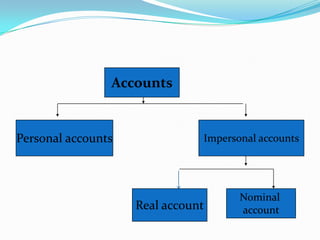
Types of Accounting
 To achieve this object, business transactions have been
  classified into three categories:
 (i) Transactions relating to persons. (Personal
  Accounts)
 (ii) Transactions relating to properties and assets
  (Real Accounts )
 (iii) Transactions relating to incomes and
  expenses.(Nominal Accounts)
Accounts


Personal accounts              Impersonal accounts


                                      Nominal
                    Real account      account
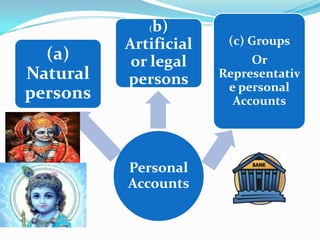
(b)
          Artificial    (c) Groups
  (a)      or legal         Or
Natural   persons      Representativ
                        e personal
persons                  Accounts


          Personal
          Accounts
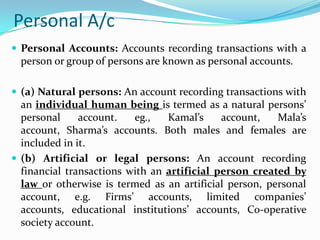
Personal A/c
 Personal Accounts: Accounts recording transactions with a
  person or group of persons are known as personal accounts.

 (a) Natural persons: An account recording transactions with
  an individual human being is termed as a natural persons’
  personal     account.   eg.,   Kamal’s     account,   Mala’s
  account, Sharma’s accounts. Both males and females are
  included in it.
 (b) Artificial or legal persons: An account recording
  financial transactions with an artificial person created by
  law or otherwise is termed as an artificial person, personal
  account, e.g. Firms’ accounts, limited companies’
  accounts, educational institutions’ accounts, Co-operative
  society account.
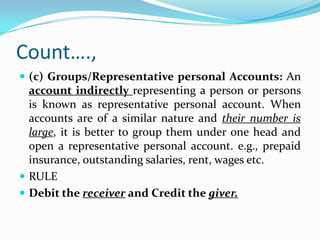
Count….,
 (c) Groups/Representative personal Accounts: An
  account indirectly representing a person or persons
  is known as representative personal account. When
  accounts are of a similar nature and their number is
  large, it is better to group them under one head and
  open a representative personal account. e.g., prepaid
  insurance, outstanding salaries, rent, wages etc.
 RULE
 Debit the receiver and Credit the giver.
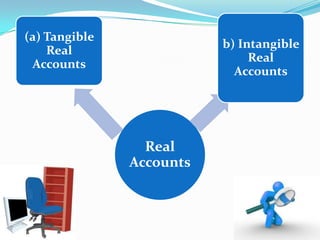
(a) Tangible
                          b) Intangible
    Real
                               Real
 Accounts
                            Accounts


                 Real
               Accounts
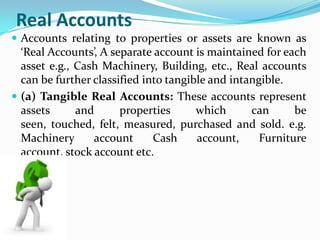
Real Accounts
 Accounts relating to properties or assets are known as
  ‘Real Accounts’, A separate account is maintained for each
  asset e.g., Cash Machinery, Building, etc., Real accounts
  can be further classified into tangible and intangible.
 (a) Tangible Real Accounts: These accounts represent
  assets      and      properties      which      can      be
  seen, touched, felt, measured, purchased and sold. e.g.
  Machinery      account      Cash     account,     Furniture
  account, stock account etc.
Count…,
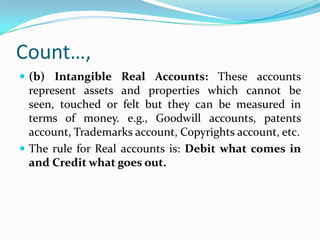
 (b) Intangible Real Accounts: These accounts
  represent assets and properties which cannot be
  seen, touched or felt but they can be measured in
  terms of money. e.g., Goodwill accounts, patents
  account, Trademarks account, Copyrights account, etc.
 The rule for Real accounts is: Debit what comes in
  and Credit what goes out.
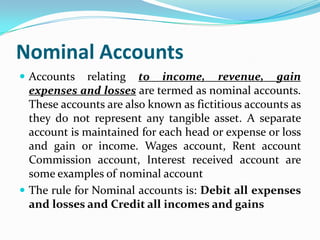
Nominal Accounts
 Accounts    relating to income, revenue, gain
  expenses and losses are termed as nominal accounts.
  These accounts are also known as fictitious accounts as
  they do not represent any tangible asset. A separate
  account is maintained for each head or expense or loss
  and gain or income. Wages account, Rent account
  Commission account, Interest received account are
  some examples of nominal account
 The rule for Nominal accounts is: Debit all expenses
  and losses and Credit all incomes and gains
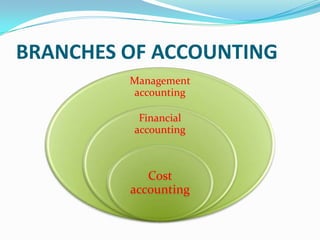
BRANCHES OF ACCOUNTING
         Management
         accounting

          Financial
         accounting


            Cost
         accounting
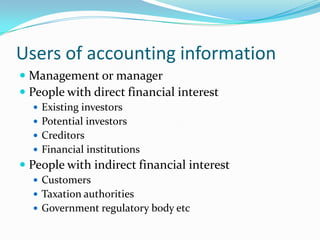
Users of accounting information
 Management or manager
 People with direct financial interest
   Existing investors
   Potential investors
   Creditors
   Financial institutions
 People with indirect financial interest
   Customers
   Taxation authorities
   Government regulatory body etc
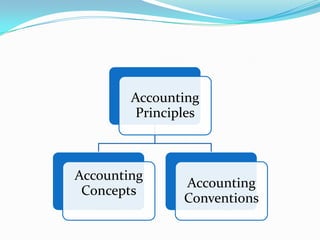
Accounting
         Principles


Accounting
                Accounting
 Concepts
                Conventions
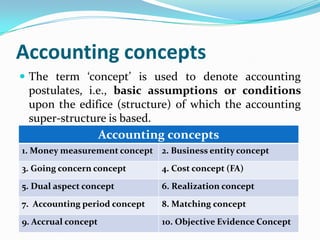
Accounting concepts
 The term ‘concept’ is used to denote accounting
 postulates, i.e., basic assumptions or conditions
 upon the edifice (structure) of which the accounting
 super-structure is based.
                     Accounting concepts
1. Money measurement concept 2. Business entity concept
3. Going concern concept       4. Cost concept (FA)
5. Dual aspect concept         6. Realization concept
7. Accounting period concept   8. Matching concept
9. Accrual concept             10. Objective Evidence Concept
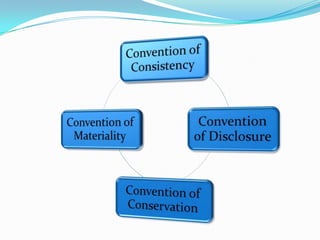
Accounting Convention
 Accounting Convention refers to the customs and
 traditions followed by the accountants as guidelines
 while preparing accounting statements. The important
 Accounting Conventions are as follows;
Any Questions?
Accounting for management

Accounting for management

  • 1.
    Module I Introduction toAccounting: Need and Types of Accounting, Users of Accounting, concepts and conventions of Accounting, Accounting Equations.
  • 2.
    INTRODUCTION  In allactivities (whether business activities or non- business activities) and in all organizations (whether business organizations like a manufacturing entity or trading entity or non-business organizations like schools, colleges, hospitals, libraries, clubs, temples, political parties) which require money and other economic resources, accounting is required to account for these resources.
  • 3.
    MEANING AND DEFINITIONOF BOOKKEEPING  Meaning  Book- keeping includes recording of journal, posting in ledgers and balancing of accounts. All the records before the preparation of trail balance is the whole subject matter of book- keeping.  Definition  “Book- keeping is the science and art of correctly recording in books of account all those business transactions that result in the transfer of money or money’s worth”. R.N.Carter
  • 4.
    Objectives of Book-keeping  i) Book- keeping provides a permanent record of each transactions.  ii) Soundness of a firm can be assessed from the records of assets and abilities on a particular date.  iii) Entries related to incomes and expenditures of a concern facilitate to know the profit and loss for a given period.  iv) It enables to prepare a list of customers and suppliers to ascertain the amount to be received or paid.
  • 5.
    Count….,  v) Itis a method gives opportunities to review the business policies in the light of the past records.  vi) Amendment of business laws, provision of licenses, assessment of taxes etc., are based on records.
  • 6.
    ACCOUNTING  Meaning ofAccounting  Accounting, is an information system is the process of identifying, measuring and communicating the economic information of an organization to its users who need the information for decision making.
  • 7.
     Definition ofAccounting  American Institute of Certified Public Accountants (AICPA) which defines accounting as “the art of recording, classifying and summarizing in a significant manner and in terms of money, transactions and events, which are, in part at least, of a financial character and interpreting the results thereof”.
  • 8.
    Objective of Accounting To keeping systematic record  To ascertain the results of the operation  To ascertain the financial position of the business  To portray (show / describe) the liquidity position  To protect business properties  To facilitate rational decision – making  To satisfy the requirements of law
  • 9.
    Importance of Accounting Owners Management Creditors Employees Investors Government Consumers Research Scholars
  • 10.
    Functions of Accounting Record Keeping Function (primary)  Managerial Function (decision making)  Legal Requirement function (auditing)  Language of Business (There are many parties-owners, creditors, government, employees etc., who are interested in knowing the results of the)
  • 11.
    Methods of Accounting Business transactions are recorded in two different ways. 1 Single Entry 2 Double Entry 1 Single Entry: It is incomplete system of recording business transactions. The business organization maintains only cash book and personal accounts of debtors and creditors. So the complete recording of transactions cannot be made and trail balance cannot be prepared.
  • 12.
    Count….,  2. DoubleEntry: It this system every business transaction is having a two fold effect of benefits giving and benefit receiving aspects. The recording is made on the basis of both these aspects. Double Entry is an accounting system that records the effects of transactions and other events in at least two accounts with equal debits and credits.
  • 13.
    Steps involved inDouble entry system (a) Preparation of Journal: Journal is called the book of original entry. It records the effect of all transactions for the first time. Here the job of recording takes place. (b) Preparation of Ledger: Ledger is the collection of all accounts used by a business. Here the grouping of accounts is performed. Journal is posted to ledger.
  • 14.
    Count…., c) Trial Balancepreparation: Summarizing. It is a summary of ledge balances prepared in the form of a list. (d) Preparation of Final Account: At the end of the accounting period to know the achievements of the organization and its financial state of affairs, the final accounts are prepared.
  • 15.
    Types of Accounting To achieve this object, business transactions have been classified into three categories:  (i) Transactions relating to persons. (Personal Accounts)  (ii) Transactions relating to properties and assets (Real Accounts )  (iii) Transactions relating to incomes and expenses.(Nominal Accounts)
  • 16.
    Accounts Personal accounts Impersonal accounts Nominal Real account account
  • 17.
    (b) Artificial (c) Groups (a) or legal Or Natural persons Representativ e personal persons Accounts Personal Accounts
  • 18.
    Personal A/c  PersonalAccounts: Accounts recording transactions with a person or group of persons are known as personal accounts.  (a) Natural persons: An account recording transactions with an individual human being is termed as a natural persons’ personal account. eg., Kamal’s account, Mala’s account, Sharma’s accounts. Both males and females are included in it.  (b) Artificial or legal persons: An account recording financial transactions with an artificial person created by law or otherwise is termed as an artificial person, personal account, e.g. Firms’ accounts, limited companies’ accounts, educational institutions’ accounts, Co-operative society account.
  • 19.
    Count….,  (c) Groups/Representativepersonal Accounts: An account indirectly representing a person or persons is known as representative personal account. When accounts are of a similar nature and their number is large, it is better to group them under one head and open a representative personal account. e.g., prepaid insurance, outstanding salaries, rent, wages etc.  RULE  Debit the receiver and Credit the giver.
  • 20.
    (a) Tangible b) Intangible Real Real Accounts Accounts Real Accounts
  • 21.
    Real Accounts  Accountsrelating to properties or assets are known as ‘Real Accounts’, A separate account is maintained for each asset e.g., Cash Machinery, Building, etc., Real accounts can be further classified into tangible and intangible.  (a) Tangible Real Accounts: These accounts represent assets and properties which can be seen, touched, felt, measured, purchased and sold. e.g. Machinery account Cash account, Furniture account, stock account etc.
  • 22.
    Count…,  (b) IntangibleReal Accounts: These accounts represent assets and properties which cannot be seen, touched or felt but they can be measured in terms of money. e.g., Goodwill accounts, patents account, Trademarks account, Copyrights account, etc.  The rule for Real accounts is: Debit what comes in and Credit what goes out.
  • 23.
    Nominal Accounts  Accounts relating to income, revenue, gain expenses and losses are termed as nominal accounts. These accounts are also known as fictitious accounts as they do not represent any tangible asset. A separate account is maintained for each head or expense or loss and gain or income. Wages account, Rent account Commission account, Interest received account are some examples of nominal account  The rule for Nominal accounts is: Debit all expenses and losses and Credit all incomes and gains
  • 24.
    BRANCHES OF ACCOUNTING Management accounting Financial accounting Cost accounting
  • 25.
    Users of accountinginformation  Management or manager  People with direct financial interest  Existing investors  Potential investors  Creditors  Financial institutions  People with indirect financial interest  Customers  Taxation authorities  Government regulatory body etc
  • 26.
    Accounting Principles Accounting Accounting Concepts Conventions
  • 27.
    Accounting concepts  Theterm ‘concept’ is used to denote accounting postulates, i.e., basic assumptions or conditions upon the edifice (structure) of which the accounting super-structure is based. Accounting concepts 1. Money measurement concept 2. Business entity concept 3. Going concern concept 4. Cost concept (FA) 5. Dual aspect concept 6. Realization concept 7. Accounting period concept 8. Matching concept 9. Accrual concept 10. Objective Evidence Concept
  • 28.
    Accounting Convention  AccountingConvention refers to the customs and traditions followed by the accountants as guidelines while preparing accounting statements. The important Accounting Conventions are as follows;
  • 30.