FINANCIALS WORKFORCE CAPEX PROJECTS CRM
Let's Connect
EPM | CPM | CRM | Data Analytics Consulting Experts
Oracle Financial Consolidation and Close Cloud
FCCS Financial Accounting
www.bispsolutions.com
FCCS Basic Financial Keywords
The balance sheet displays the company’s total assets, and how these assets are financed,
through either debt or equity. It can also be referred to as a statement of net worth, or a
statement of financial position. The balance sheet is based on the fundamental equation:
Assets = Liabilities + Equity.
FCCS Basic Financial Keywords
www.bispsolutions.com
The below diagram shows how Balance Sheet Structure is mapped with FCCS standard financial hierarchy.
While creating FCCS application, system provides below options.
FCCS Basic Financial Keywords
www.bispsolutions.com
FCCS Basic Financial Keywords
www.bispsolutions.com
The Income Statement is one of a company’s core financial statements that shows their profit
and loss over a period of time. The profit or loss is determined by taking all revenues and
subtracting all expenses from both operating and non-operating activities.
FCCS Basic Financial Keywords
www.bispsolutions.com
FCCS Basic Financial Keywords
www.bispsolutions.com
A Cash Flow Statement (also called the Statement
of Cash Flows) shows how much cash is generated
and used during a given time period. The main
categories found in a cash flow statement are (1)
operating activities, (2) investing activities, and (3)
financing activities of a company and are organized
respectively.
Cash from operating activities : usually refers to the first section of the statement of cash flows. Cash
from operating activities focuses on the cash inflows and outflows from a company's main business
activities of buying and selling merchandise, providing services, etc.
Cash flows from investing activities : is the second section of a statement of cash flows which details
cash flows related to acquisition and disposal of a company's long-term investments such as property,
plant and equipment, investment in subsidiaries and associates, etc
Cash flows from financing activities: It shows the cash inflows and outflows related to transactions
with the providers of finance i.e. the owners and the creditors of the company. Thus, cash flows from
financing activities include the following basic components:
• Proceeds from borrowings (both shot-term and long-term)
• Cash received from owners usually on issuance of stock
• Repayments of borrowings
• Repayments to owners
FCCS Basic Financial Keywords
www.bispsolutions.com
The Movement dimension captures the movement details of an account. By default,
the system provides members in the Movement dimension to capture the Opening Balance,
Closing Balance, changes, and FX calculations.
Statement of Changes in Shareholders Equity
www.bispsolutions.com
A statement of changes in shareholders equity is a financial statement that presents a
summary of the changes in shareholders’ equity accounts over the reporting period. It
reconciles the opening balances of equity accounts with their closing balances
How are the 3 Financial Statements Linked?
www.bispsolutions.com
The relationship between balance sheet and income statement is that the profit of the
business shown in the income statement, belongs to the owners and this is shown by a
movement in equity between the opening and closing balance sheets of the business.
Net Income & Retained Earnings
Net income from the
bottom of the income
statement links to the
balance sheet and cash
flow statement. On the
balance sheet, it feeds
into retained
earnings and on the
cash flow statement, it is
the starting point for the
cash from operations
section.
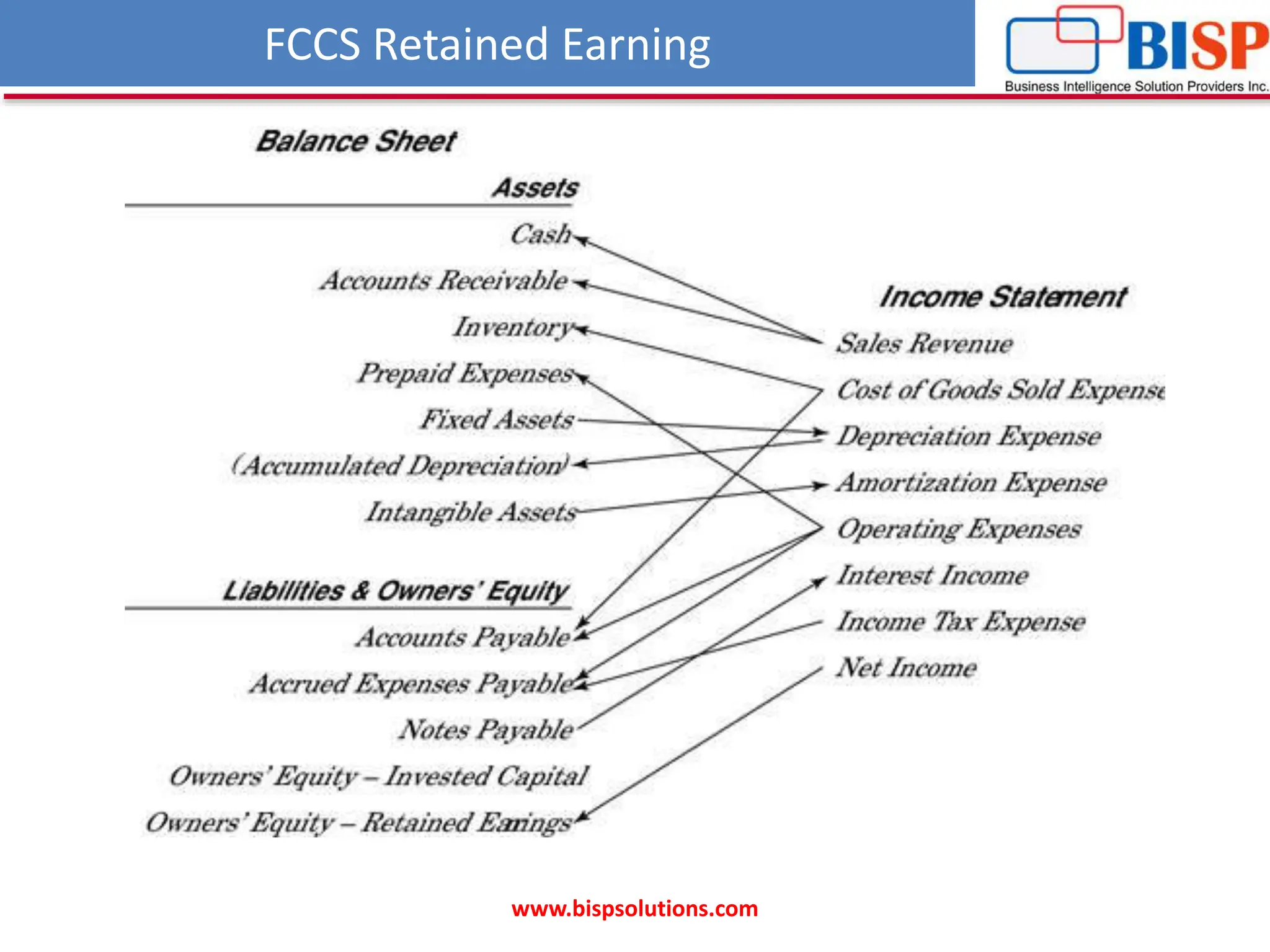
FCCS Retained Earning
www.bispsolutions.com
Industry Standard vs Oracle Approach
www.bispsolutions.com
FCCS Retained Earning
www.bispsolutions.com
PP&E, Depreciation, and Capex
Depreciation and other capitalized expenses on the income statement need to be added back to net
income to calculate the cash flow from operations. Depreciation flows out of the balance sheet
from Property Plant and Equipment (PP&E) onto the income statement as an expense, and then gets added
back in the cash flow statement
FCCS Retained Earning
www.bispsolutions.com
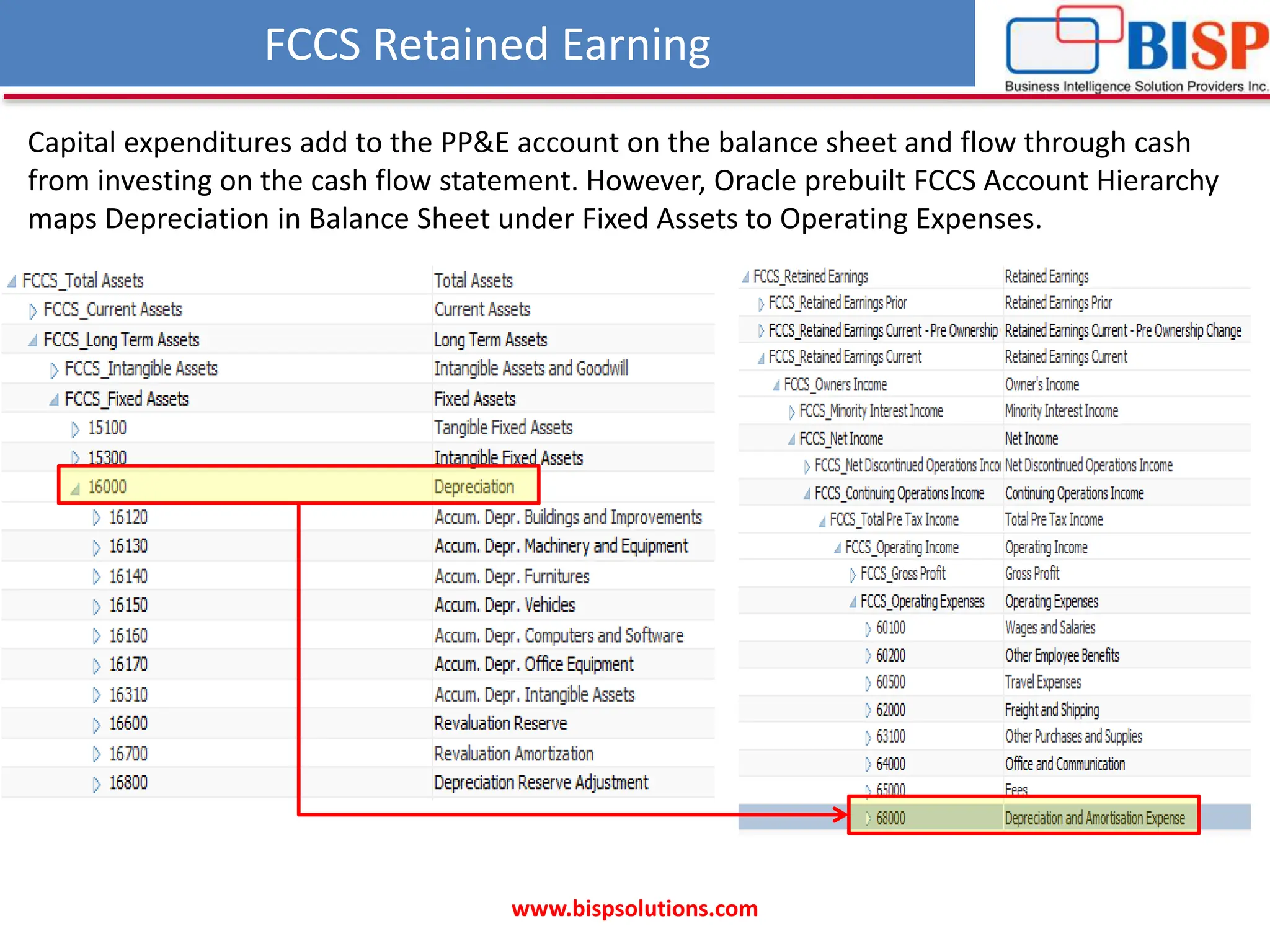
Capital expenditures add to the PP&E account on the balance sheet and flow through cash
from investing on the cash flow statement. However, Oracle prebuilt FCCS Account Hierarchy
maps Depreciation in Balance Sheet under Fixed Assets to Operating Expenses.
FCCS Retained Earning
www.bispsolutions.com
Working Capital
Changes in current assets and current liabilities on the balance sheet are related to revenues
and expenses on the income statement but need to be adjusted on the cash flow statement
to reflect the actual amount of cash received or spent by the business. In order to do this, we
create a separate section that calculates the changes in net working capital.
FCCS Retained Earning
www.bispsolutions.com
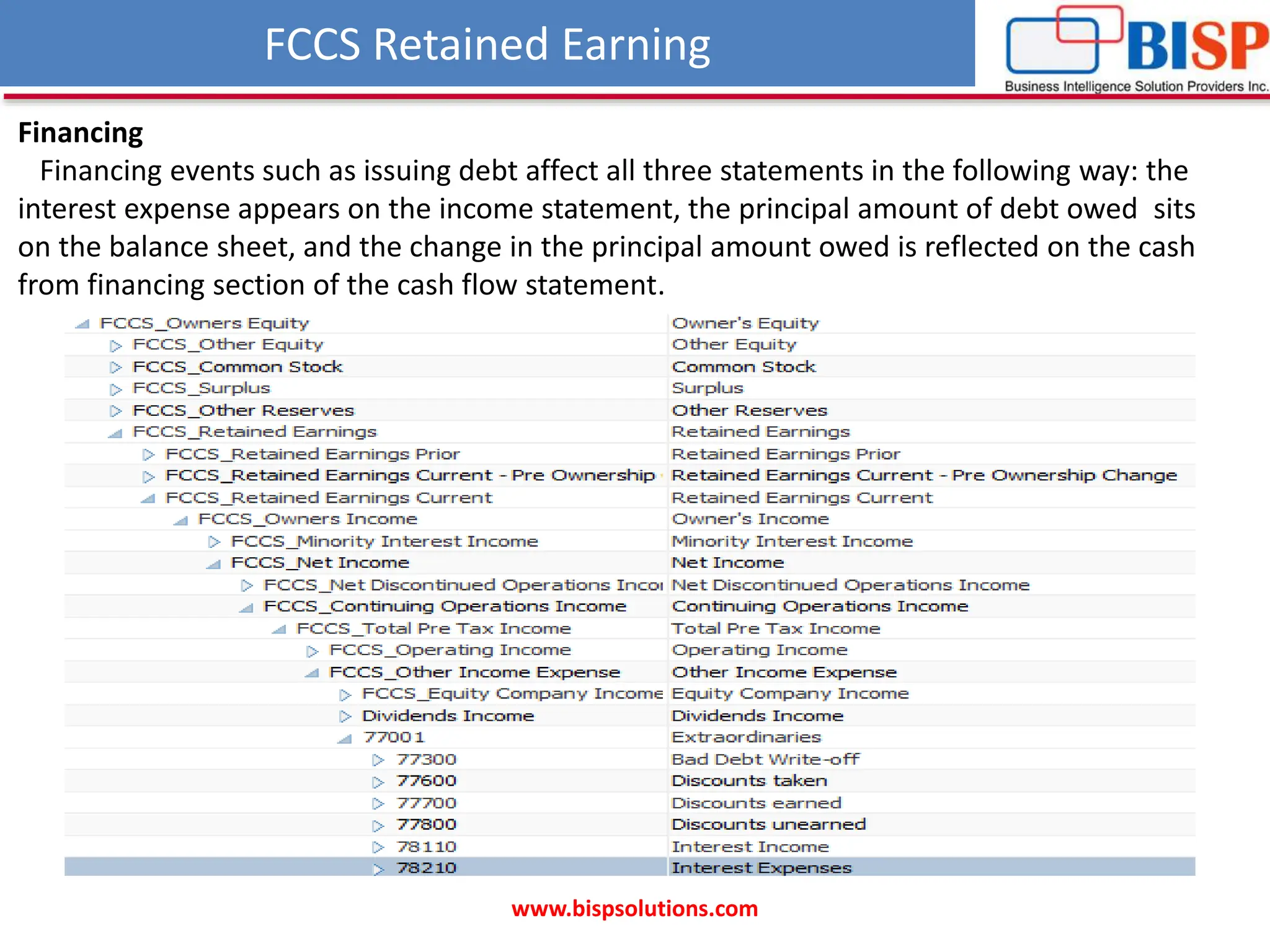
Financing
Financing events such as issuing debt affect all three statements in the following way: the
interest expense appears on the income statement, the principal amount of debt owed sits
on the balance sheet, and the change in the principal amount owed is reflected on the cash
from financing section of the cash flow statement.
Cash Balance
www.bispsolutions.com
Cash Balance
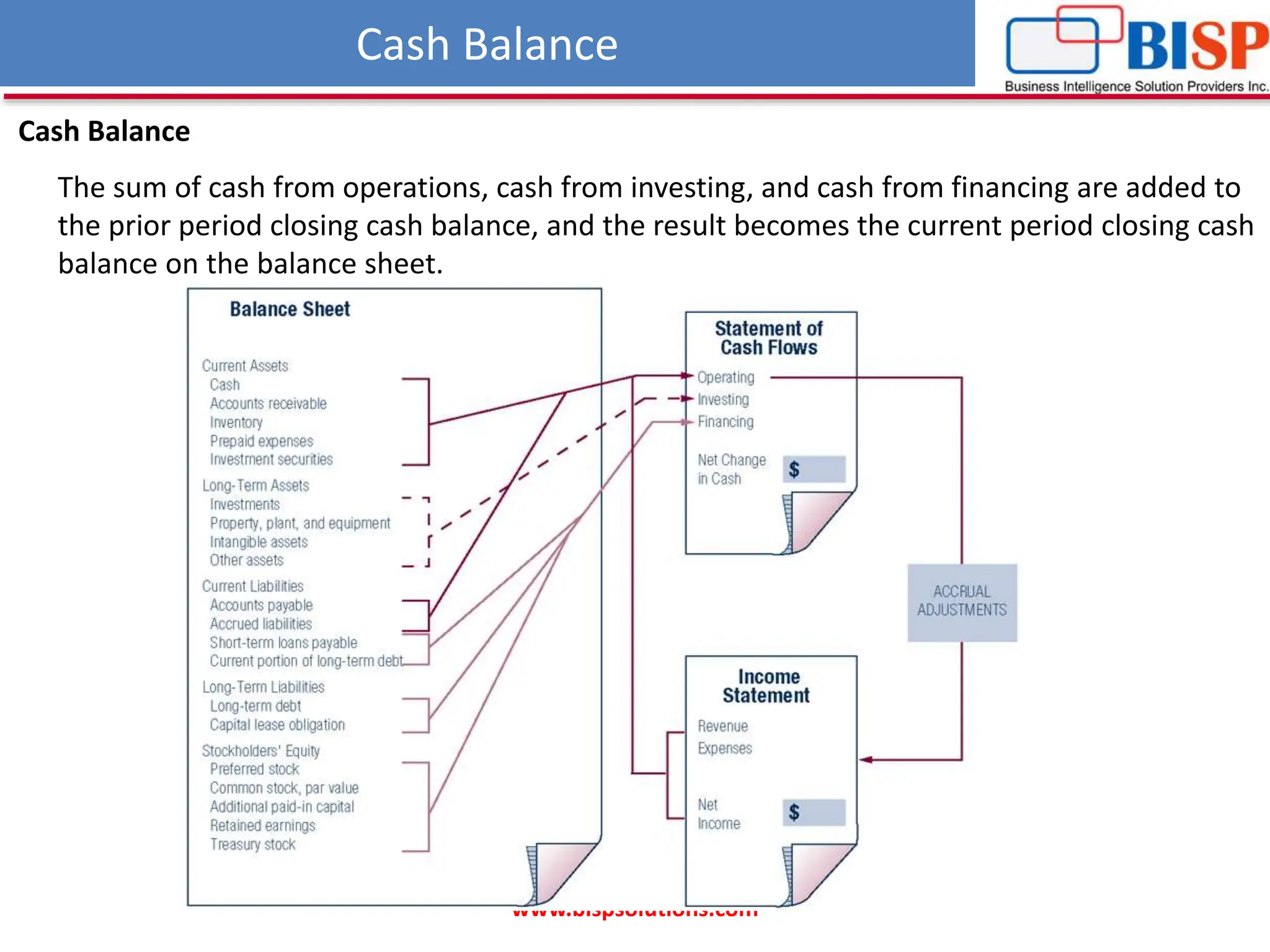
The sum of cash from operations, cash from investing, and cash from financing are added to
the prior period closing cash balance, and the result becomes the current period closing cash
balance on the balance sheet.
Balance Sheet Movement
www.bispsolutions.com
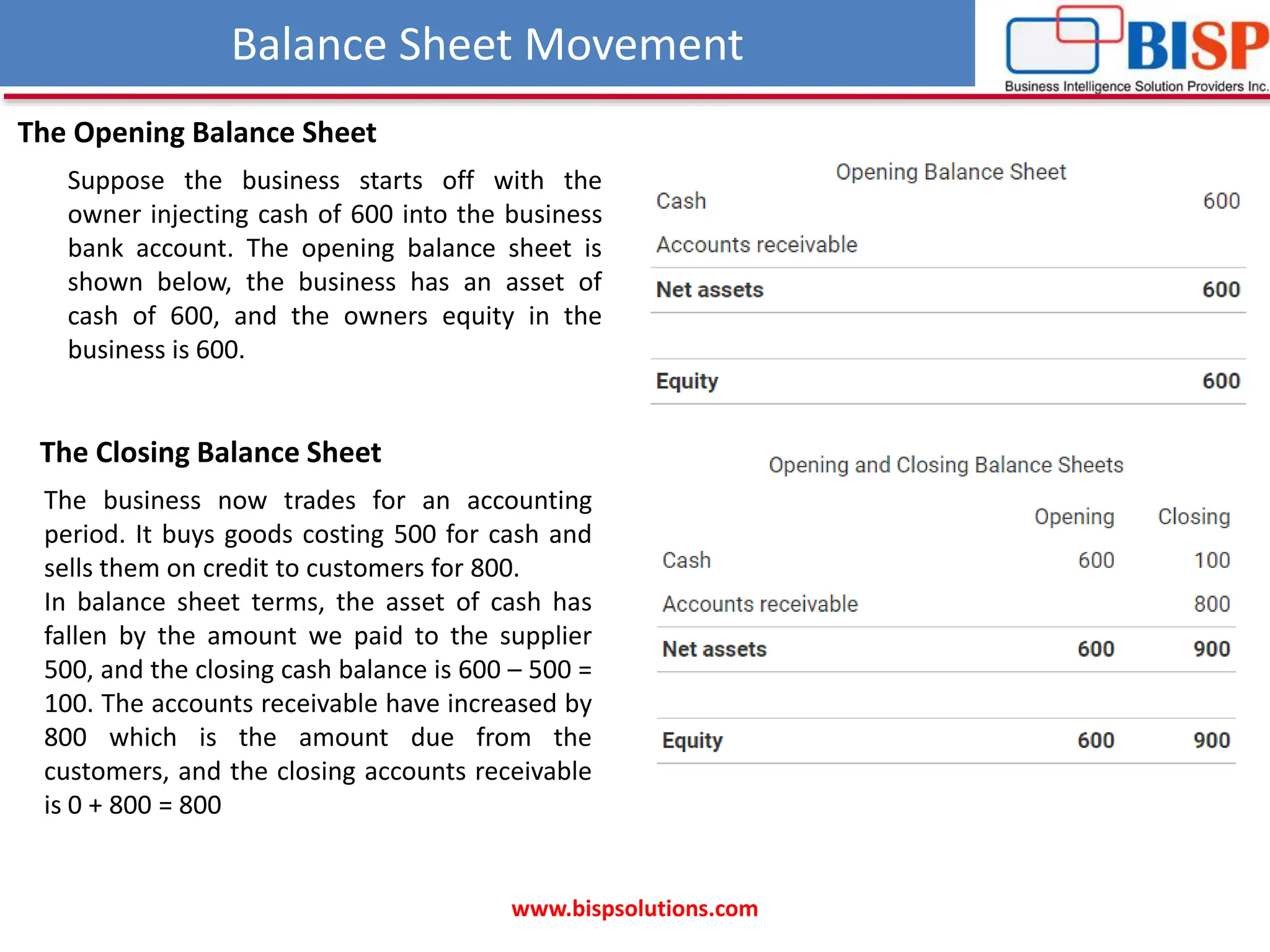
The Opening Balance Sheet
Suppose the business starts off with the
owner injecting cash of 600 into the business
bank account. The opening balance sheet is
shown below, the business has an asset of
cash of 600, and the owners equity in the
business is 600.
The Closing Balance Sheet
The business now trades for an accounting
period. It buys goods costing 500 for cash and
sells them on credit to customers for 800.
In balance sheet terms, the asset of cash has
fallen by the amount we paid to the supplier
500, and the closing cash balance is 600 – 500 =
100. The accounts receivable have increased by
800 which is the amount due from the
customers, and the closing accounts receivable
is 0 + 800 = 800
The Balance Sheet Movement
www.bispsolutions.com
The Balance Sheet Movement
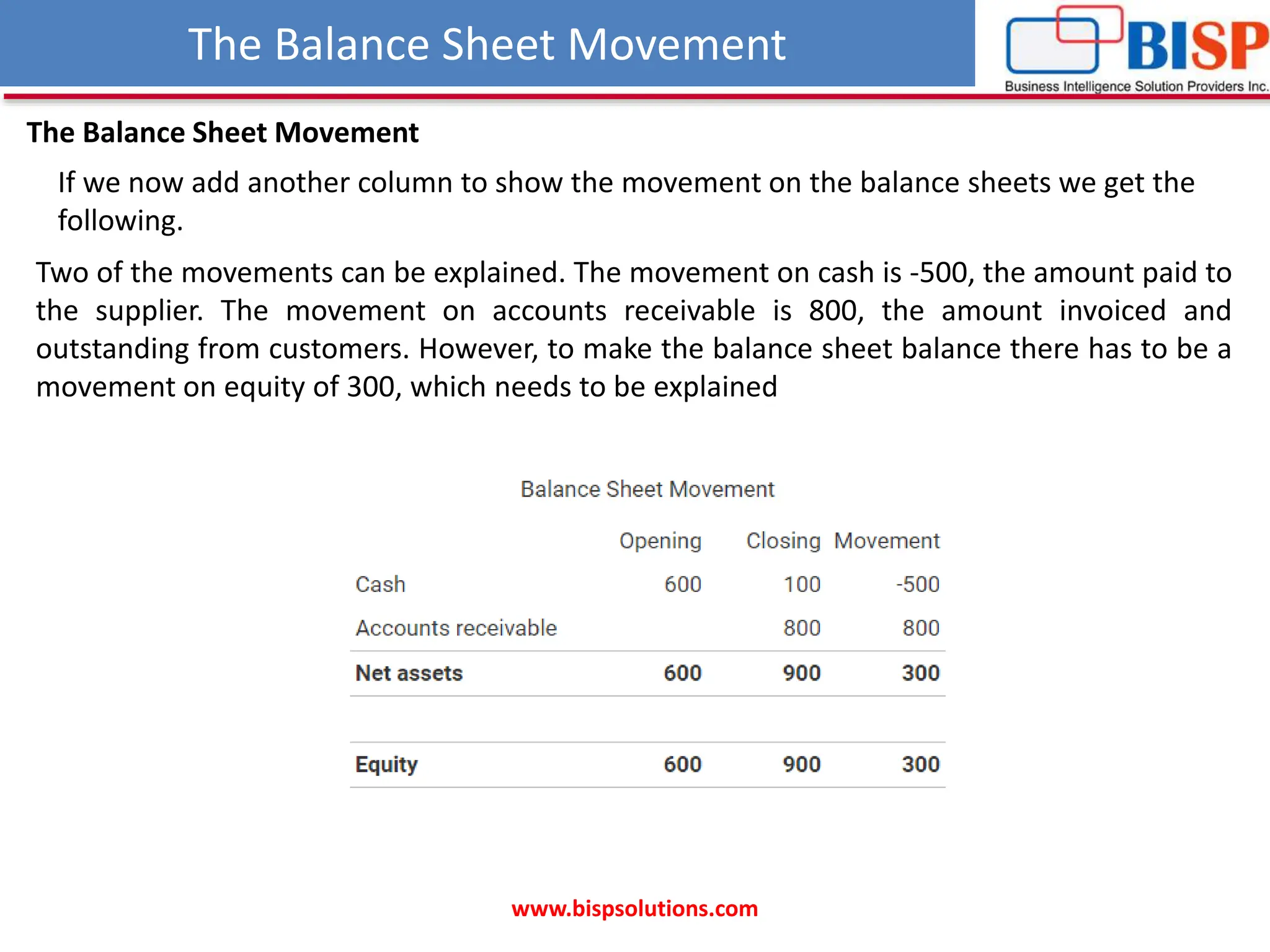
If we now add another column to show the movement on the balance sheets we get the
following.
Two of the movements can be explained. The movement on cash is -500, the amount paid to
the supplier. The movement on accounts receivable is 800, the amount invoiced and
outstanding from customers. However, to make the balance sheet balance there has to be a
movement on equity of 300, which needs to be explained
Balance Sheet Movement
www.bispsolutions.com
The Income Statement Movement
www.bispsolutions.com
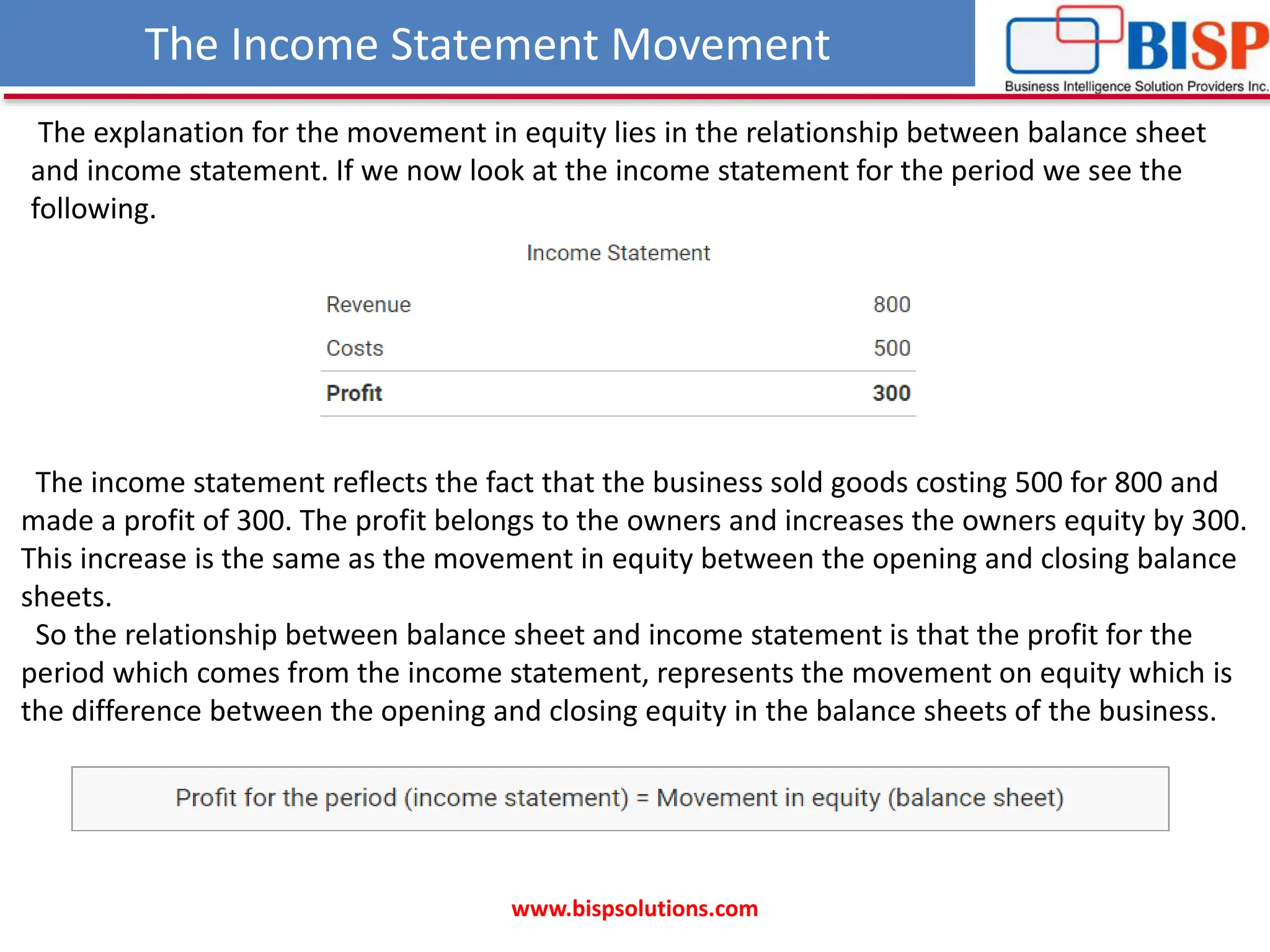
The explanation for the movement in equity lies in the relationship between balance sheet
and income statement. If we now look at the income statement for the period we see the
following.
The income statement reflects the fact that the business sold goods costing 500 for 800 and
made a profit of 300. The profit belongs to the owners and increases the owners equity by 300.
This increase is the same as the movement in equity between the opening and closing balance
sheets.
So the relationship between balance sheet and income statement is that the profit for the
period which comes from the income statement, represents the movement on equity which is
the difference between the opening and closing equity in the balance sheets of the business.
Goodwill
www.bispsolutions.com
Goodwill
www.bispsolutions.com
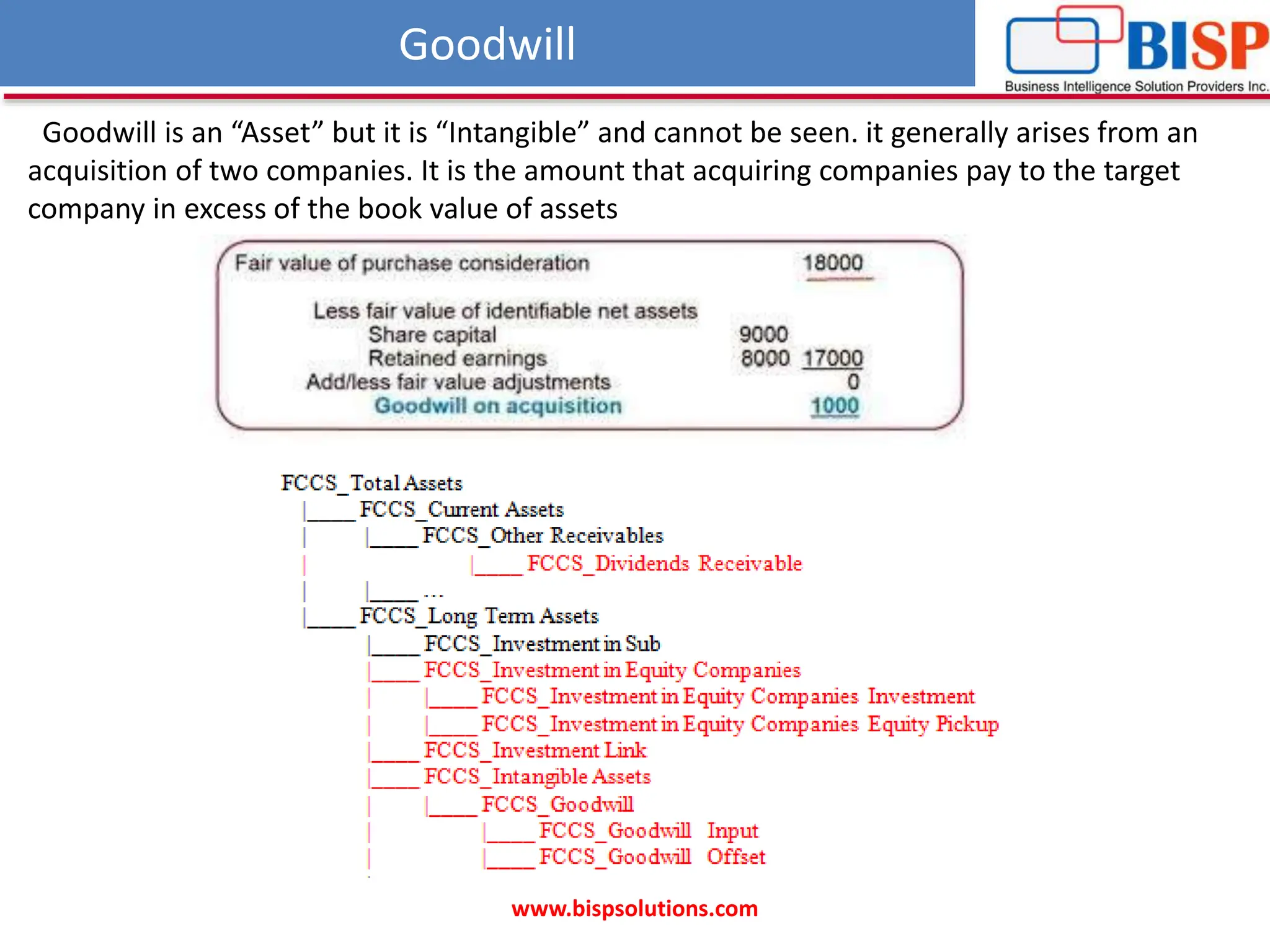
Goodwill is an “Asset” but it is “Intangible” and cannot be seen. it generally arises from an
acquisition of two companies. It is the amount that acquiring companies pay to the target
company in excess of the book value of assets
Book Value Vs Fair Value
www.bispsolutions.com
The book value of an asset is its original purchase cost, adjusted for any subsequent changes,
such as for impairment or depreciation. Market value is the price that could be obtained by
selling an asset on a competitive, open market. There is nearly always a disparity between
book value and market value, since the first is a recorded historical cost and the second is
based on the perceived supply and demand for an asset, which can vary constantly.
Asset Impairment
www.bispsolutions.com
An asset impairment arises when there is a sudden drop in the fair value of an asset below
its recorded cost. The accounting for asset impairment is to write off the difference between
the fair value and the recorded cost. Some impairments can be so large that they cause a
significant decline in the reported asset base and profitability of a business.
Generally, an impaired asset is an asset whose market value is below book
value.
For example, Generally Accepted Accounting Principles (GAAP) require companies to
"test" goodwill every year for impairments. For example, let's assume that Company XYZ
purchases Company ABC. The book value of Company ABC's assets is $10 million, but for
various good reasons, Company XYZ pays $15 million for Company ABC. Because Company XYZ
paid $15 million for $10 million worth of assets, Company XYZ records $5 million of goodwill as
an asset on its balance sheet.
After the acquisition, Company ABC's sales fell by 40% over the year because Company XYZ
changed its product line, which proved unpopular. Also, a competitor introduced a newer,
lighter, faster and cheaper product. As a result, Company ABC's fair market value falls to $8
million
Currency Translation Adjustment
Overall Risk : When cash flows are translated from the local currency into the currency used for financial
reporting, the translation may result in a gain or loss. Recognizing the gain or loss is commonly referred to as
Currency Translation Adjustment(CTA).
Two types of exchange rates are used in translating financial statements:
1. Historical Exchange Rate:
The exchange rate that exists when a transaction occurs.
2. Current Exchange Rate:
The exchange rate that exists at the balance sheet date.
Currency Translation Adjustment
www.bispsolutions.com
Book Value Vs Fair Value
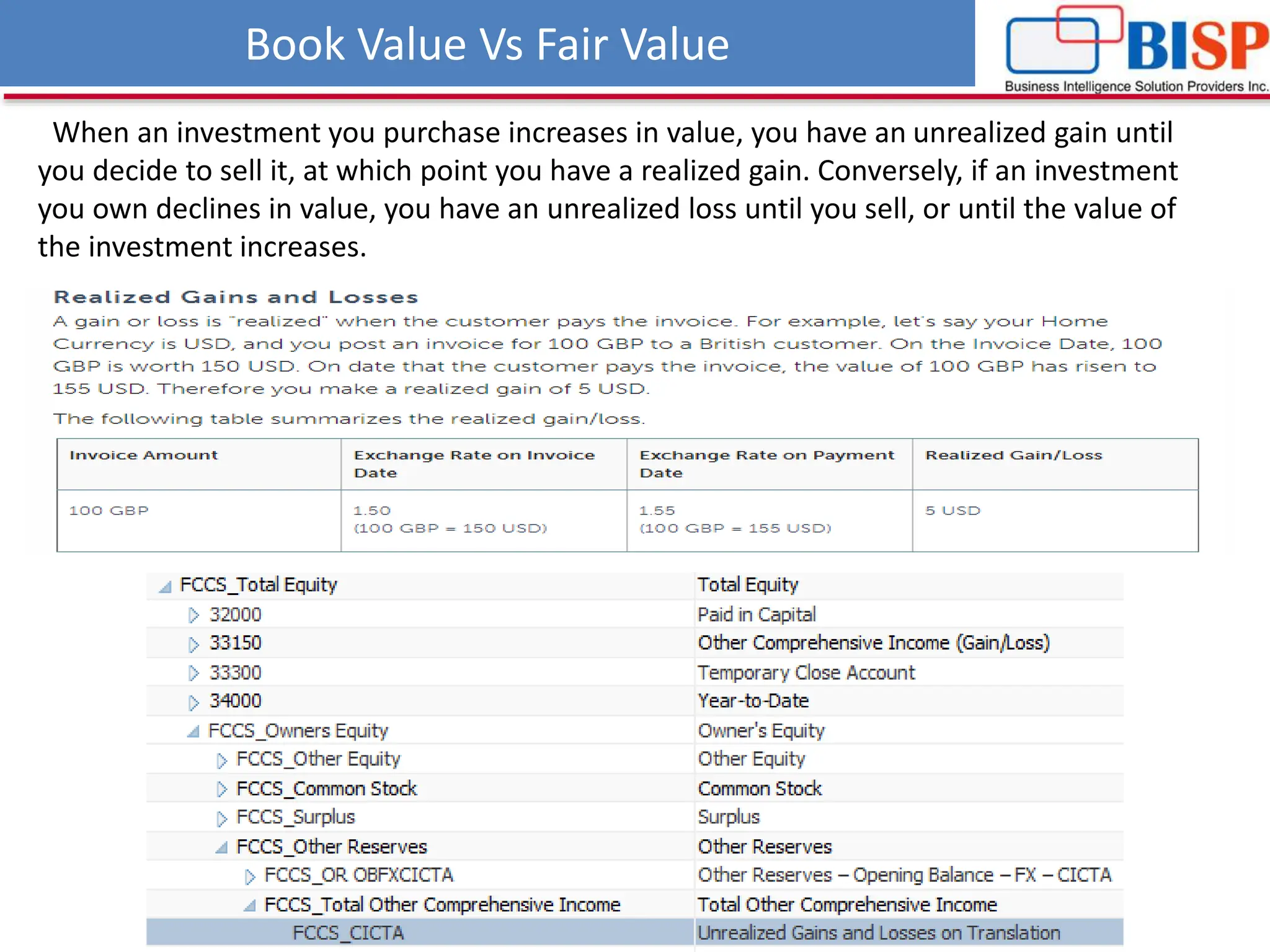
When an investment you purchase increases in value, you have an unrealized gain until
you decide to sell it, at which point you have a realized gain. Conversely, if an investment
you own declines in value, you have an unrealized loss until you sell, or until the value of
the investment increases.
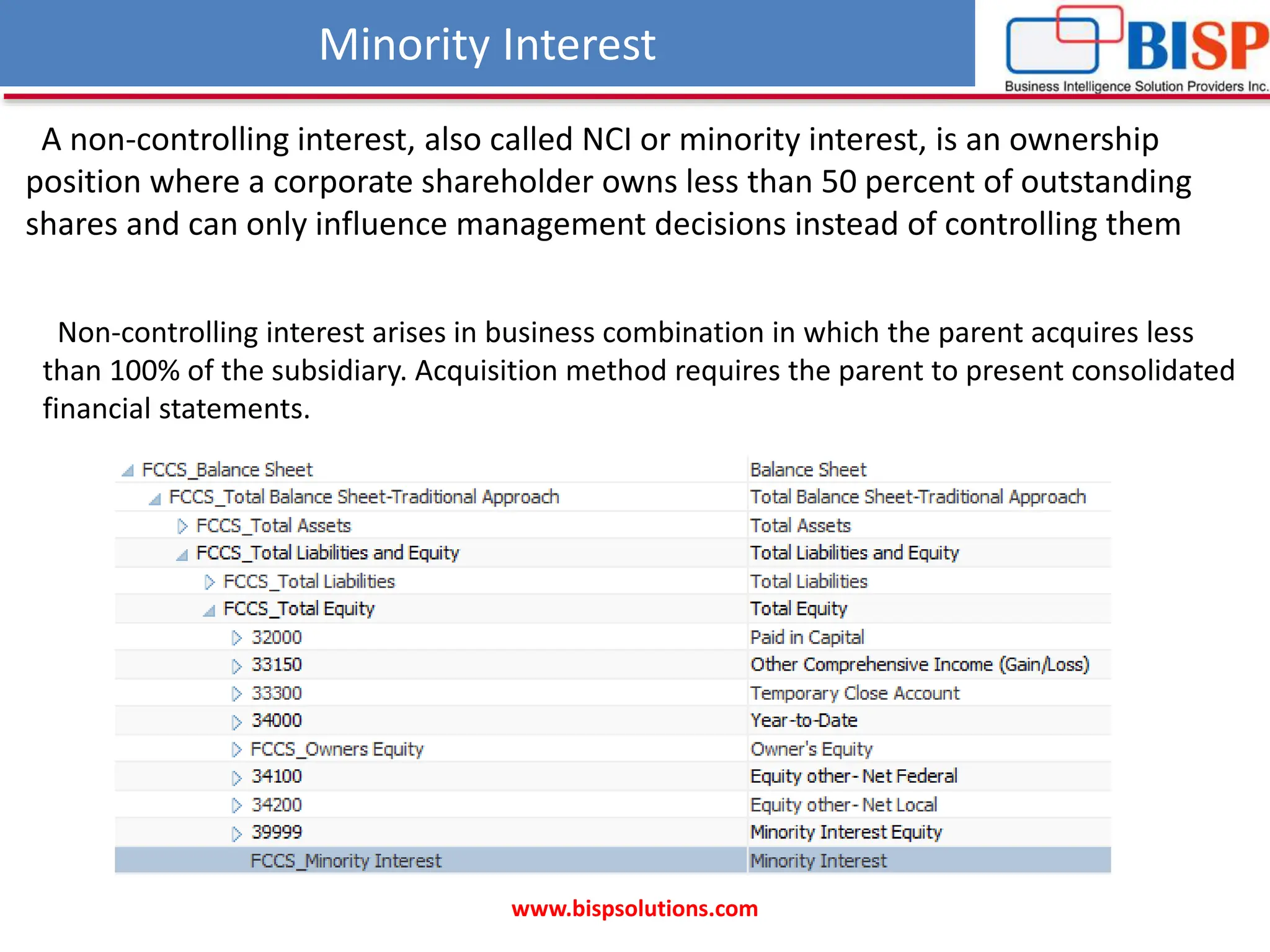
Minority Interest
www.bispsolutions.com
Non-controlling interest arises in business combination in which the parent acquires less
than 100% of the subsidiary. Acquisition method requires the parent to present consolidated
financial statements.
A non-controlling interest, also called NCI or minority interest, is an ownership
position where a corporate shareholder owns less than 50 percent of outstanding
shares and can only influence management decisions instead of controlling them
Minority Interest
www.bispsolutions.com
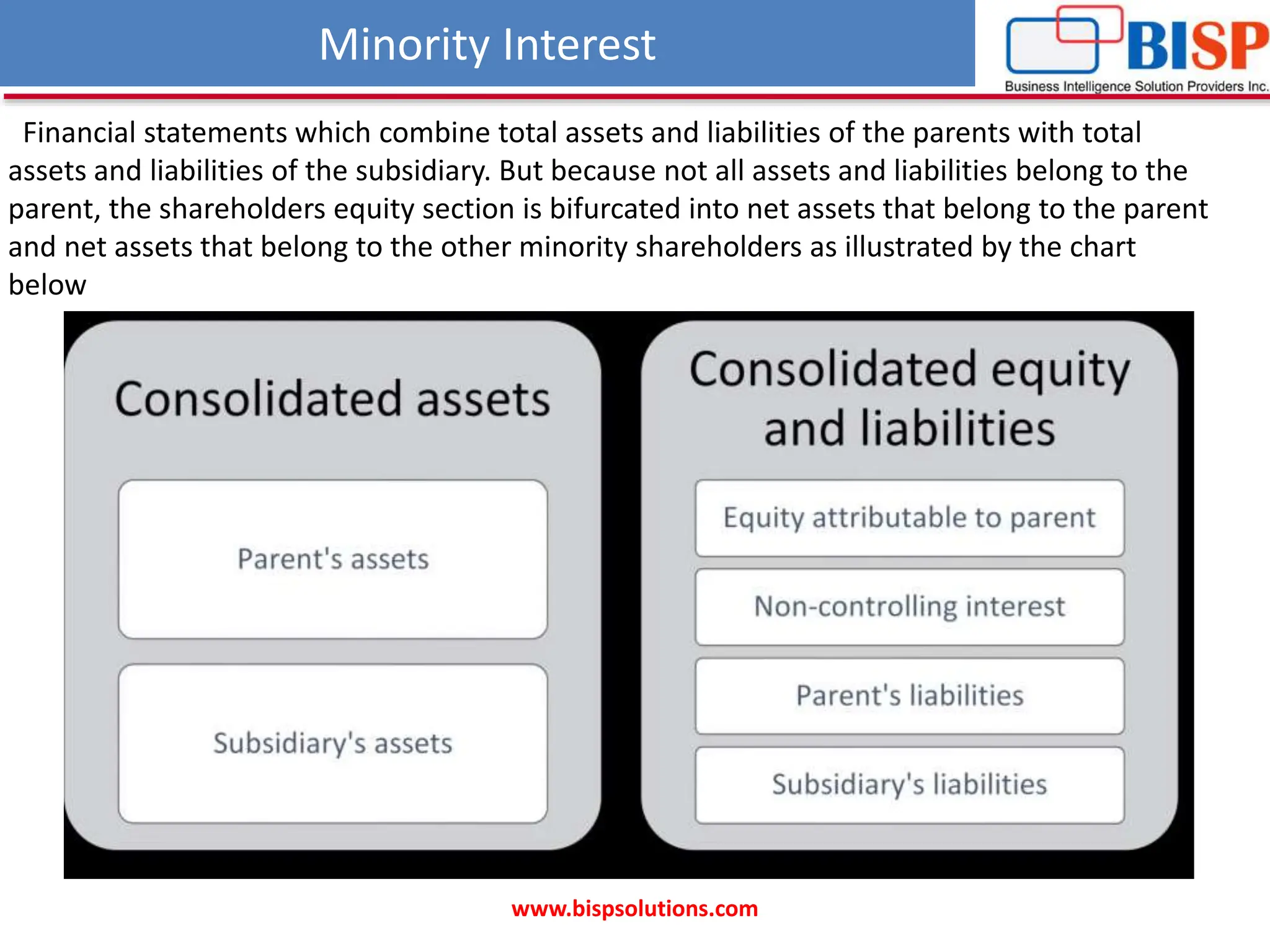
Financial statements which combine total assets and liabilities of the parents with total
assets and liabilities of the subsidiary. But because not all assets and liabilities belong to the
parent, the shareholders equity section is bifurcated into net assets that belong to the parent
and net assets that belong to the other minority shareholders as illustrated by the chart
below
Investment in Subsidiary
www.bispsolutions.com
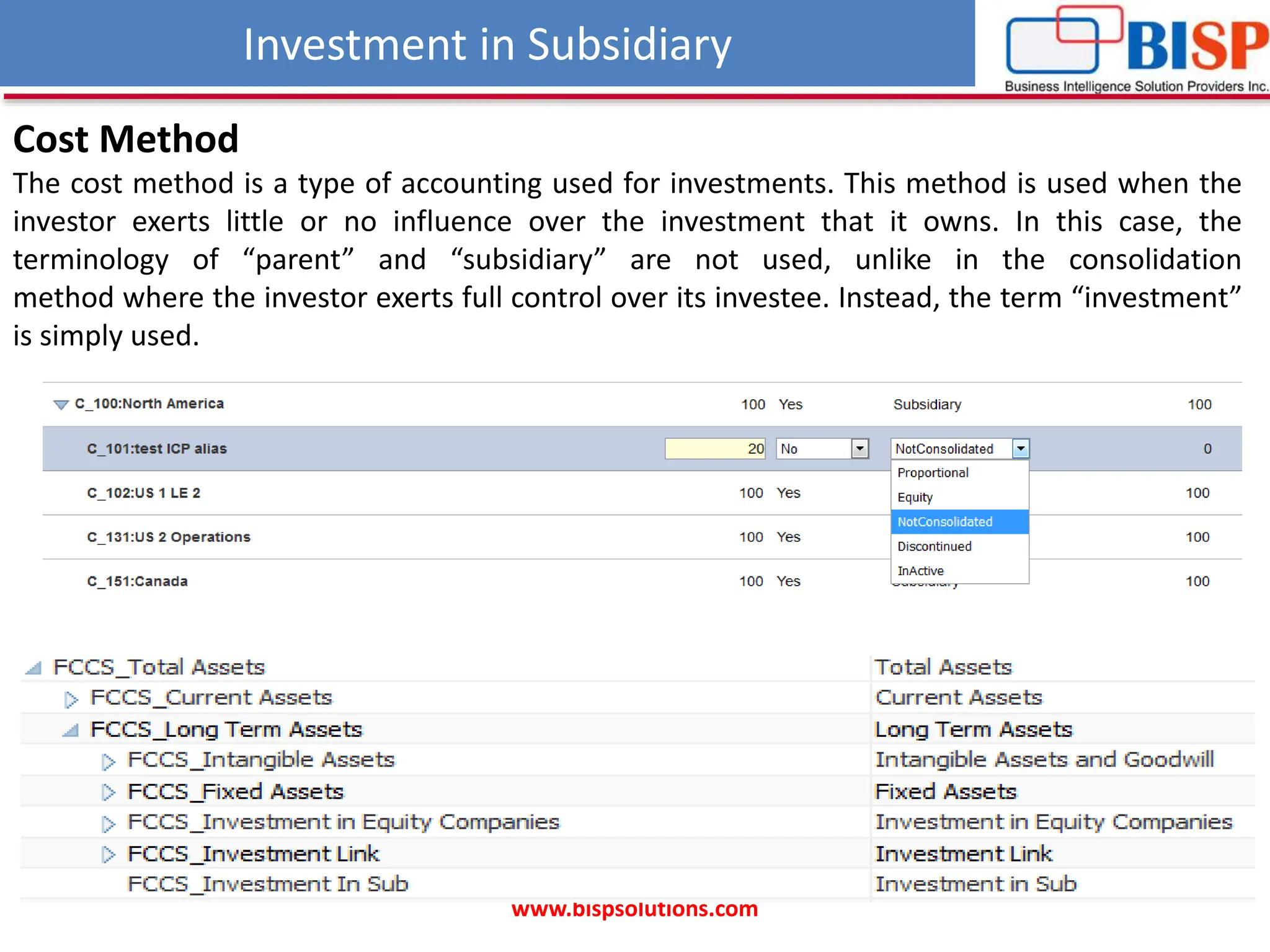
Cost Method
The cost method is a type of accounting used for investments. This method is used when the
investor exerts little or no influence over the investment that it owns. In this case, the
terminology of “parent” and “subsidiary” are not used, unlike in the consolidation
method where the investor exerts full control over its investee. Instead, the term “investment”
is simply used.
Par Value of Stocks
Par Value of Stocks
Some states require that companies cannot sell shares below the par value of these shares. To
comply with state regulations, most companies set a par value for their stocks to a minimal
amount. For example, the par value for shares of Apple, Inc. is $0.00001 and the par value for
Amazon stock is $0.01. Shares cannot be sold below this value upon initial public offering - this
way, investors are confident that no one is receiving a favorable price treatmen
Additional Paid in Capital
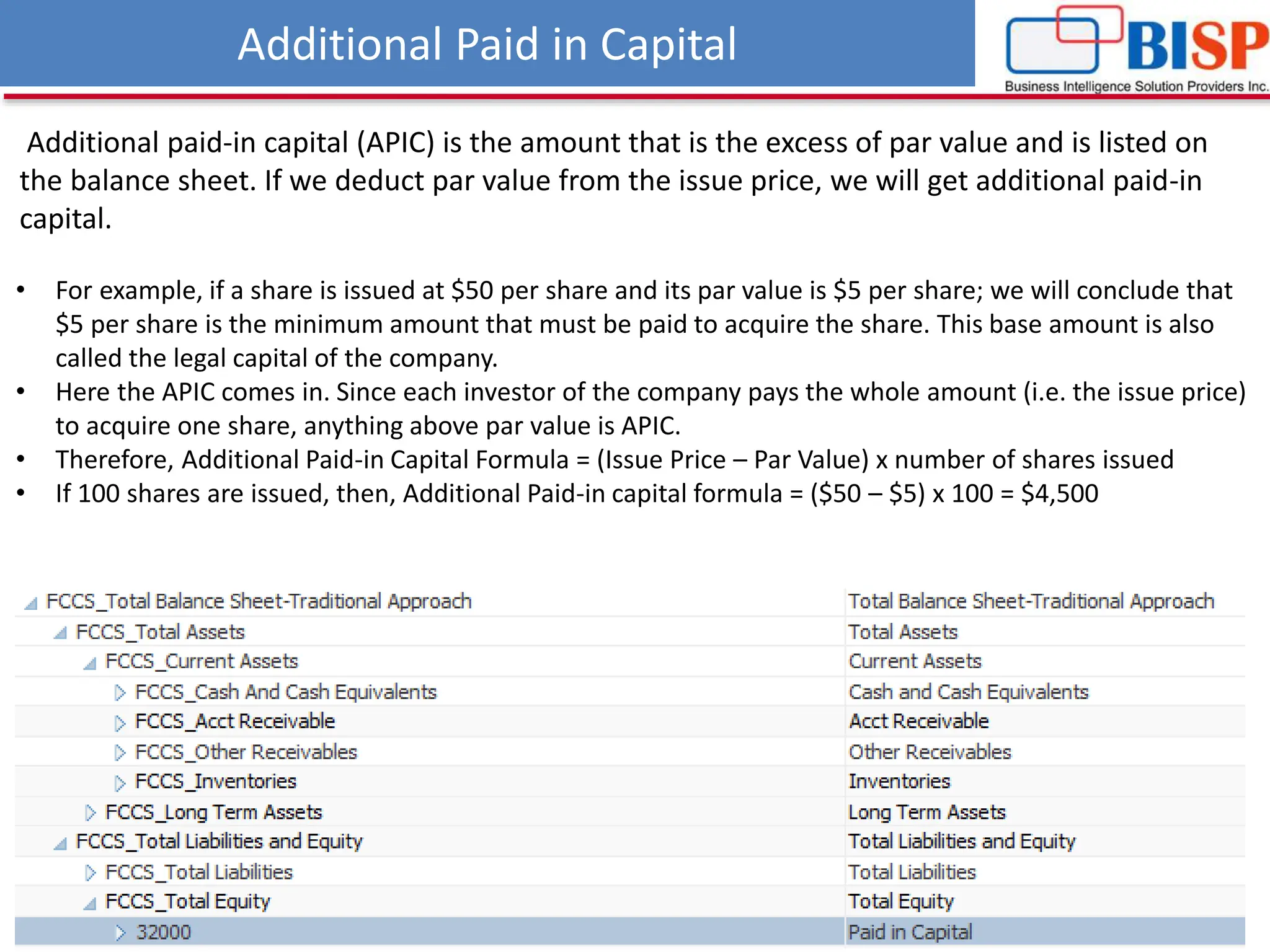
Additional paid-in capital (APIC) is the amount that is the excess of par value and is listed on
the balance sheet. If we deduct par value from the issue price, we will get additional paid-in
capital.
• For example, if a share is issued at $50 per share and its par value is $5 per share; we will conclude that
$5 per share is the minimum amount that must be paid to acquire the share. This base amount is also
called the legal capital of the company.
• Here the APIC comes in. Since each investor of the company pays the whole amount (i.e. the issue price)
to acquire one share, anything above par value is APIC.
• Therefore, Additional Paid-in Capital Formula = (Issue Price – Par Value) x number of shares issued
• If 100 shares are issued, then, Additional Paid-in capital formula = ($50 – $5) x 100 = $4,500
Any Question?
www.bispsolutions.com

FCCS Basic Accounts Outline and Hierarchy.pptx

  • 1.
    FINANCIALS WORKFORCE CAPEXPROJECTS CRM Let's Connect EPM | CPM | CRM | Data Analytics Consulting Experts Oracle Financial Consolidation and Close Cloud FCCS Financial Accounting www.bispsolutions.com
  • 2.
    FCCS Basic FinancialKeywords The balance sheet displays the company’s total assets, and how these assets are financed, through either debt or equity. It can also be referred to as a statement of net worth, or a statement of financial position. The balance sheet is based on the fundamental equation: Assets = Liabilities + Equity.
  • 3.
    FCCS Basic FinancialKeywords www.bispsolutions.com The below diagram shows how Balance Sheet Structure is mapped with FCCS standard financial hierarchy. While creating FCCS application, system provides below options.
  • 4.
    FCCS Basic FinancialKeywords www.bispsolutions.com
  • 5.
    FCCS Basic FinancialKeywords www.bispsolutions.com The Income Statement is one of a company’s core financial statements that shows their profit and loss over a period of time. The profit or loss is determined by taking all revenues and subtracting all expenses from both operating and non-operating activities.
  • 6.
    FCCS Basic FinancialKeywords www.bispsolutions.com
  • 7.
    FCCS Basic FinancialKeywords www.bispsolutions.com A Cash Flow Statement (also called the Statement of Cash Flows) shows how much cash is generated and used during a given time period. The main categories found in a cash flow statement are (1) operating activities, (2) investing activities, and (3) financing activities of a company and are organized respectively. Cash from operating activities : usually refers to the first section of the statement of cash flows. Cash from operating activities focuses on the cash inflows and outflows from a company's main business activities of buying and selling merchandise, providing services, etc. Cash flows from investing activities : is the second section of a statement of cash flows which details cash flows related to acquisition and disposal of a company's long-term investments such as property, plant and equipment, investment in subsidiaries and associates, etc Cash flows from financing activities: It shows the cash inflows and outflows related to transactions with the providers of finance i.e. the owners and the creditors of the company. Thus, cash flows from financing activities include the following basic components: • Proceeds from borrowings (both shot-term and long-term) • Cash received from owners usually on issuance of stock • Repayments of borrowings • Repayments to owners
  • 8.
    FCCS Basic FinancialKeywords www.bispsolutions.com The Movement dimension captures the movement details of an account. By default, the system provides members in the Movement dimension to capture the Opening Balance, Closing Balance, changes, and FX calculations.
  • 9.
    Statement of Changesin Shareholders Equity www.bispsolutions.com A statement of changes in shareholders equity is a financial statement that presents a summary of the changes in shareholders’ equity accounts over the reporting period. It reconciles the opening balances of equity accounts with their closing balances
  • 10.
    How are the3 Financial Statements Linked? www.bispsolutions.com The relationship between balance sheet and income statement is that the profit of the business shown in the income statement, belongs to the owners and this is shown by a movement in equity between the opening and closing balance sheets of the business. Net Income & Retained Earnings Net income from the bottom of the income statement links to the balance sheet and cash flow statement. On the balance sheet, it feeds into retained earnings and on the cash flow statement, it is the starting point for the cash from operations section.
  • 11.
  • 12.
    Industry Standard vsOracle Approach www.bispsolutions.com
  • 13.
    FCCS Retained Earning www.bispsolutions.com PP&E,Depreciation, and Capex Depreciation and other capitalized expenses on the income statement need to be added back to net income to calculate the cash flow from operations. Depreciation flows out of the balance sheet from Property Plant and Equipment (PP&E) onto the income statement as an expense, and then gets added back in the cash flow statement
  • 14.
    FCCS Retained Earning www.bispsolutions.com Capitalexpenditures add to the PP&E account on the balance sheet and flow through cash from investing on the cash flow statement. However, Oracle prebuilt FCCS Account Hierarchy maps Depreciation in Balance Sheet under Fixed Assets to Operating Expenses.
  • 15.
    FCCS Retained Earning www.bispsolutions.com WorkingCapital Changes in current assets and current liabilities on the balance sheet are related to revenues and expenses on the income statement but need to be adjusted on the cash flow statement to reflect the actual amount of cash received or spent by the business. In order to do this, we create a separate section that calculates the changes in net working capital.
  • 16.
    FCCS Retained Earning www.bispsolutions.com Financing Financingevents such as issuing debt affect all three statements in the following way: the interest expense appears on the income statement, the principal amount of debt owed sits on the balance sheet, and the change in the principal amount owed is reflected on the cash from financing section of the cash flow statement.
  • 17.
    Cash Balance www.bispsolutions.com Cash Balance Thesum of cash from operations, cash from investing, and cash from financing are added to the prior period closing cash balance, and the result becomes the current period closing cash balance on the balance sheet.
  • 18.
    Balance Sheet Movement www.bispsolutions.com TheOpening Balance Sheet Suppose the business starts off with the owner injecting cash of 600 into the business bank account. The opening balance sheet is shown below, the business has an asset of cash of 600, and the owners equity in the business is 600. The Closing Balance Sheet The business now trades for an accounting period. It buys goods costing 500 for cash and sells them on credit to customers for 800. In balance sheet terms, the asset of cash has fallen by the amount we paid to the supplier 500, and the closing cash balance is 600 – 500 = 100. The accounts receivable have increased by 800 which is the amount due from the customers, and the closing accounts receivable is 0 + 800 = 800
  • 19.
    The Balance SheetMovement www.bispsolutions.com The Balance Sheet Movement If we now add another column to show the movement on the balance sheets we get the following. Two of the movements can be explained. The movement on cash is -500, the amount paid to the supplier. The movement on accounts receivable is 800, the amount invoiced and outstanding from customers. However, to make the balance sheet balance there has to be a movement on equity of 300, which needs to be explained
  • 20.
  • 21.
    The Income StatementMovement www.bispsolutions.com The explanation for the movement in equity lies in the relationship between balance sheet and income statement. If we now look at the income statement for the period we see the following. The income statement reflects the fact that the business sold goods costing 500 for 800 and made a profit of 300. The profit belongs to the owners and increases the owners equity by 300. This increase is the same as the movement in equity between the opening and closing balance sheets. So the relationship between balance sheet and income statement is that the profit for the period which comes from the income statement, represents the movement on equity which is the difference between the opening and closing equity in the balance sheets of the business.
  • 22.
  • 23.
    Goodwill www.bispsolutions.com Goodwill is an“Asset” but it is “Intangible” and cannot be seen. it generally arises from an acquisition of two companies. It is the amount that acquiring companies pay to the target company in excess of the book value of assets
  • 24.
    Book Value VsFair Value www.bispsolutions.com The book value of an asset is its original purchase cost, adjusted for any subsequent changes, such as for impairment or depreciation. Market value is the price that could be obtained by selling an asset on a competitive, open market. There is nearly always a disparity between book value and market value, since the first is a recorded historical cost and the second is based on the perceived supply and demand for an asset, which can vary constantly.
  • 25.
    Asset Impairment www.bispsolutions.com An assetimpairment arises when there is a sudden drop in the fair value of an asset below its recorded cost. The accounting for asset impairment is to write off the difference between the fair value and the recorded cost. Some impairments can be so large that they cause a significant decline in the reported asset base and profitability of a business. Generally, an impaired asset is an asset whose market value is below book value. For example, Generally Accepted Accounting Principles (GAAP) require companies to "test" goodwill every year for impairments. For example, let's assume that Company XYZ purchases Company ABC. The book value of Company ABC's assets is $10 million, but for various good reasons, Company XYZ pays $15 million for Company ABC. Because Company XYZ paid $15 million for $10 million worth of assets, Company XYZ records $5 million of goodwill as an asset on its balance sheet. After the acquisition, Company ABC's sales fell by 40% over the year because Company XYZ changed its product line, which proved unpopular. Also, a competitor introduced a newer, lighter, faster and cheaper product. As a result, Company ABC's fair market value falls to $8 million
  • 26.
    Currency Translation Adjustment OverallRisk : When cash flows are translated from the local currency into the currency used for financial reporting, the translation may result in a gain or loss. Recognizing the gain or loss is commonly referred to as Currency Translation Adjustment(CTA). Two types of exchange rates are used in translating financial statements: 1. Historical Exchange Rate: The exchange rate that exists when a transaction occurs. 2. Current Exchange Rate: The exchange rate that exists at the balance sheet date.
  • 27.
  • 28.
    Book Value VsFair Value When an investment you purchase increases in value, you have an unrealized gain until you decide to sell it, at which point you have a realized gain. Conversely, if an investment you own declines in value, you have an unrealized loss until you sell, or until the value of the investment increases.
  • 29.
    Minority Interest www.bispsolutions.com Non-controlling interestarises in business combination in which the parent acquires less than 100% of the subsidiary. Acquisition method requires the parent to present consolidated financial statements. A non-controlling interest, also called NCI or minority interest, is an ownership position where a corporate shareholder owns less than 50 percent of outstanding shares and can only influence management decisions instead of controlling them
  • 30.
    Minority Interest www.bispsolutions.com Financial statementswhich combine total assets and liabilities of the parents with total assets and liabilities of the subsidiary. But because not all assets and liabilities belong to the parent, the shareholders equity section is bifurcated into net assets that belong to the parent and net assets that belong to the other minority shareholders as illustrated by the chart below
  • 31.
    Investment in Subsidiary www.bispsolutions.com CostMethod The cost method is a type of accounting used for investments. This method is used when the investor exerts little or no influence over the investment that it owns. In this case, the terminology of “parent” and “subsidiary” are not used, unlike in the consolidation method where the investor exerts full control over its investee. Instead, the term “investment” is simply used.
  • 32.
    Par Value ofStocks Par Value of Stocks Some states require that companies cannot sell shares below the par value of these shares. To comply with state regulations, most companies set a par value for their stocks to a minimal amount. For example, the par value for shares of Apple, Inc. is $0.00001 and the par value for Amazon stock is $0.01. Shares cannot be sold below this value upon initial public offering - this way, investors are confident that no one is receiving a favorable price treatmen
  • 33.
    Additional Paid inCapital Additional paid-in capital (APIC) is the amount that is the excess of par value and is listed on the balance sheet. If we deduct par value from the issue price, we will get additional paid-in capital. • For example, if a share is issued at $50 per share and its par value is $5 per share; we will conclude that $5 per share is the minimum amount that must be paid to acquire the share. This base amount is also called the legal capital of the company. • Here the APIC comes in. Since each investor of the company pays the whole amount (i.e. the issue price) to acquire one share, anything above par value is APIC. • Therefore, Additional Paid-in Capital Formula = (Issue Price – Par Value) x number of shares issued • If 100 shares are issued, then, Additional Paid-in capital formula = ($50 – $5) x 100 = $4,500
  • 34.

Editor's Notes

  • #2 Links: 2 TSG homepage