
-Step one: Clean out your file
in the back!
-Look for any notes handed in!
-Also, look for any vocabulary!
-Grab all your old tests!
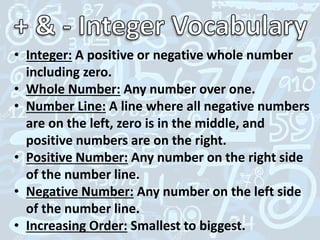
• Integer: A positive or negative whole number
including zero.
• Whole Number: Any number over one.
• Number Line: A line where all negative numbers
are on the left, zero is in the middle, and
positive numbers are on the right.
• Positive Number: Any number on the right side
of the number line.
• Negative Number: Any number on the left side
of the number line.
• Increasing Order: Smallest to biggest.
• When Signs are the same, add the
numbers!
EX: -5 - 1 = 5 + 1
• Answer gets the sign of the larger
number.
5 is the largest number
it’s sign is a (-).
Answer is -6.
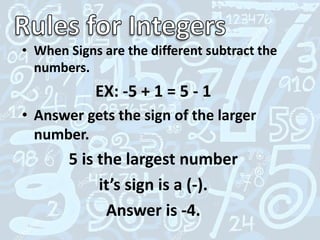
• When Signs are the different subtract the
numbers.
EX: -5 + 1 = 5 - 1
• Answer gets the sign of the larger
number.
5 is the largest number
it’s sign is a (-).
Answer is -4.
Let’s Practice
1) 5 - 6 =
2) -3 + 2 =
3) 6 + 5 =
4) -8 + 7 =
5) 9 - 9 =
Remember: If signs are the same add
the numbers, if signs are different
subtract the numbers. Then give the
answer the sign of the largest number!
-1
-1
+11
-1
0
Rules for Integers
• When Parenthesis ( ) are
involved we get to doodle!
• This is where you need to draw
some faces. (Bet you didn’t know
you’d be doing Art in Math!)
Rules for Adding & Subtracting Integers
Continued
• When you multiply a (+ x -) you get a (-).
• When you multiply a (- x -) you get a (+).
• When you multiply a (+ x +) you get a (+).
5 + (-1) = 4
5 – (-1) = 6
5 + (+5) = 10
-
+
+
Let’s Practice
1) 4 – (-5) =
2) 9 + (-7) =
3) 6 – (+2) =
4) 8 – (-7) =
5) 9 + (+3) =
Remember: DRAW the faces first! If signs are
the same add the numbers, if signs are
different subtract the numbers. Then give the
answer the sign of the largest number!
9
2
4
15
12
+
-
+
-
+
Let’s Practice Cont.
1) 5 + (-2) =
2) 3 – (-4) =
3) 1 – (+2) =
4) 5 – (-3) =
5) 7 – (-6) =
Remember: DRAW the faces first! If signs are
the same add the numbers, if signs are
different subtract the numbers. Then give the
answer the sign of the largest number!
-
+
+
-
+
3
7
-1
8
13
• Reciprocal: Flipping of a fraction.
• Rational Number: All real numbers… -
3, -2, -1, 0, 1, 2, 3…
• Absolute Value: Two lines on either
side of a number asking how far away
from zero.
• Product: To multiply
• Quotient: To divide
Rules for
Multiplying Integers (x)
• The product of two integers with
the same signs is POSITIVE.
• The product of two integers with
different signs is NEGATIVE.
Rules Summary for
Multiplication
• Positive x Positive = Positive
• Negative x Negative = Positive
• Positive x Negative= Negative
• Negative x Positive = Negative
Let’s Practice “Multiplication”
1) 6 x (-3) =
2) 3 x 3 =
3) -4 x 5 =
4) -6 x (-2) =
5) -7 x (-8) =
-18
9
-20
12
56
Remember:
Positive x Positive = Positive
Negative x Negative = Positive
Positive x Negative= Negative
Negative x Positive = Negative
Did you know that
the rules for
multiplication and
division are the
same?
Rules for
Dividing Integers (÷)
• The quotient of two integers
with the same signs is POSITIVE.
• The quotient of two integers
with different signs is NEGATIVE.
Rules Summary for
Division
• Positive ÷ Positive = Positive
• Negative ÷ Negative = Positive
• Positive ÷ Negative= Negative
• Negative ÷ Positive = Negative
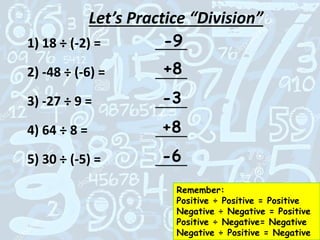
Let’s Practice “Division”
1) 18 ÷ (-2) =
2) -48 ÷ (-6) =
3) -27 ÷ 9 =
4) 64 ÷ 8 =
5) 30 ÷ (-5) =
-9
+8
-3
+8
-6
Remember:
Positive ÷ Positive = Positive
Negative ÷ Negative = Positive
Positive ÷ Negative= Negative
Negative ÷ Positive = Negative
• Denominator: Bottom number of a
fractions.
• Numerator: Top number of a fraction.
• Whole Number: Any number over
one.
• Bar: The line between two numbers
creating a fraction.
1. Count by the bottom number.
2. Circle the match.
3. Count over to the match.
4. Multiply by the old top number.
5. Add/Subtract
• Play with the top-leave the bottom alone.
• Remember to borrow if you need to.
6. Divide if top number is bigger
7. Reduce if you need to.
New
Bottom
Number
New Top
Number
𝟏
𝟔
𝟏
𝟒
+
12
18
24
8
12
16
20
24
=
𝟏𝟎
𝟐𝟒
÷ 2
÷ 2
=
𝟓
𝟏𝟐
𝟒
𝟐𝟒
+
𝟔
𝟐𝟒
=
𝟐
𝟒
𝟏
𝟑
-
8
12
6
9
12
=
𝟐
𝟏𝟐
÷ 2
÷ 2
=
𝟏
𝟔
𝟔
𝟏𝟐
-
𝟒
𝟏𝟐
=
𝟏
𝟒
𝟕
𝟖
+
8
=
𝟗
𝟖
𝟗8
= 𝟏
𝟏
𝟖
𝟐
𝟖
+
𝟕
𝟖
=
1
-8
1
𝟏
𝟖
𝟓
𝟔
𝟓
𝟗
-
12
18
24
30
36
18
21
27
36
=
𝟏𝟎
𝟑𝟔
÷ 2
÷ 2
=
𝟓
𝟏𝟖
𝟑𝟎
𝟑𝟔
-
𝟐𝟎
𝟑𝟔
=
𝟐
𝟕
𝟏
𝟐
+
14 4
6
8
10
12
14
=
𝟏𝟏
𝟏𝟒
𝟒
𝟏𝟒
+
𝟕
𝟏𝟒
=
• Improper Fraction: When the numerator is
larger than the denominator.
• Proper Fraction: When a fraction has been
simplified and reduced fully.
• Reduce: To divide the top and bottom
number of a fraction by the same number.
• Simplify: To make an improper fraction
proper.
Reduce if you can:
You can’t reduce side to side!
Multiply straight across.
Divide if top number is bigger.
𝟐
𝟔
𝟑
𝟒
X =
𝟑
𝟗
𝟏
𝟔
𝟏
𝟒
X
𝟓
𝟏𝟎
=
1
2
1
2
1
2
3
1
𝟑
𝟔
𝟔
𝟏𝟎
X =
𝟑
𝟏𝟎
1
5
3
2
𝟑
𝟏𝟎
𝟓
𝟏𝟓
X =
𝟏
𝟏𝟎
1
5
1
2
Flip the SECOND fraction = Change the sign
Reduce if you can:
You can’t reduce side to side!
Multiply straight across.
Divide if top number is bigger.
𝟐
𝟔
𝟑
𝟒
÷ =
𝟑
𝟗
𝟓
𝟏𝟎
𝟐
𝟔
÷
𝟓
𝟏𝟎
=
3
2
1
2
3
1
X
𝟒
𝟑
=
𝟒
𝟗
X
𝟗
𝟑
=
𝟑
𝟐
𝟑2
1
-2
1
𝟏
𝟐
• Inverse Operation: Addition & Subtraction
or Multiplication & Division.
• Fulcrum: Equal sign.
• Additive Inverse Strategy: Moves opposite
of the whole term to the other side.
• Multiplicative Inverse Strategy: Moves
part of the term to the other side.
Solve the following equation for x:
x – 4 = 9
+ 4 +4
x = 13
We are able to get the x by itself
by ADDING 4 to each side!
Solve the following equation for p:
p + 7 = 21
- 7 - 7
p = 14
We are able to get the p by itself
by SUBTRACTING 7 from each side!
Solve the following equation for m
3 m = 18
• Divide both sides by 3 and simplify --
your work should look like this :
3 m = 18
3 3
m = 6
Solve the following equation for n:
2n = 3
5 7
• Multiply each side by the inverse of 2
5 :
5 • 2n = 3 • 5
2 5 7 2
n = 15
14
= 1
1
14
• Variable: A letter or symbol that stands for an
unknown number.
• Terms: Parts of an algebraic expression of an
equation separated by operations.
• Coefficient: The number in front of a variable.
• Like Terms: Terms that have the same variable.
• Constant: A number not attached to a
variable.
• Combining Like Terms: Putting together terms
that have the same variable.
Rule 1: Each action should get the letter (variable) closer
to being alone.
Rule2: Additive inverse strategy moves the opposite of
the whole term to the other side.
>change signs - cancel – keep or put with a like
term
Rule 3: Multiplicative inverse strategy moves part of a
term to the other side.
>if a number is next to variable – divide
>if a number is below variable - multiply
Rule 4: Combining like terms put terms with same
ending together that are on the same side of the equal
sign.
14m + 2 – 10m – 11
4m -9
22p + 6 – 32p +14
-10p + 20
4n2 – 3n + 6n – 5n2
-1n2 +3n
4x(x-4) + 3(-x-5)
4x2 – 16x – 3x – 15
4x2 - 19x - 15
Pre-Algebra Final Review

Pre-Algebra Final Review

  • 1.
    -Step one: Cleanout your file in the back! -Look for any notes handed in! -Also, look for any vocabulary! -Grab all your old tests!
  • 2.
    • Integer: Apositive or negative whole number including zero. • Whole Number: Any number over one. • Number Line: A line where all negative numbers are on the left, zero is in the middle, and positive numbers are on the right. • Positive Number: Any number on the right side of the number line. • Negative Number: Any number on the left side of the number line. • Increasing Order: Smallest to biggest.
  • 3.
    • When Signsare the same, add the numbers! EX: -5 - 1 = 5 + 1 • Answer gets the sign of the larger number. 5 is the largest number it’s sign is a (-). Answer is -6.
  • 4.
    • When Signsare the different subtract the numbers. EX: -5 + 1 = 5 - 1 • Answer gets the sign of the larger number. 5 is the largest number it’s sign is a (-). Answer is -4.
  • 5.
    Let’s Practice 1) 5- 6 = 2) -3 + 2 = 3) 6 + 5 = 4) -8 + 7 = 5) 9 - 9 = Remember: If signs are the same add the numbers, if signs are different subtract the numbers. Then give the answer the sign of the largest number! -1 -1 +11 -1 0
  • 6.
    Rules for Integers •When Parenthesis ( ) are involved we get to doodle! • This is where you need to draw some faces. (Bet you didn’t know you’d be doing Art in Math!)
  • 7.
    Rules for Adding& Subtracting Integers Continued • When you multiply a (+ x -) you get a (-). • When you multiply a (- x -) you get a (+). • When you multiply a (+ x +) you get a (+). 5 + (-1) = 4 5 – (-1) = 6 5 + (+5) = 10 - + +
  • 8.
    Let’s Practice 1) 4– (-5) = 2) 9 + (-7) = 3) 6 – (+2) = 4) 8 – (-7) = 5) 9 + (+3) = Remember: DRAW the faces first! If signs are the same add the numbers, if signs are different subtract the numbers. Then give the answer the sign of the largest number! 9 2 4 15 12 + - + - +
  • 9.
    Let’s Practice Cont. 1)5 + (-2) = 2) 3 – (-4) = 3) 1 – (+2) = 4) 5 – (-3) = 5) 7 – (-6) = Remember: DRAW the faces first! If signs are the same add the numbers, if signs are different subtract the numbers. Then give the answer the sign of the largest number! - + + - + 3 7 -1 8 13
  • 10.
    • Reciprocal: Flippingof a fraction. • Rational Number: All real numbers… - 3, -2, -1, 0, 1, 2, 3… • Absolute Value: Two lines on either side of a number asking how far away from zero. • Product: To multiply • Quotient: To divide
  • 11.
    Rules for Multiplying Integers(x) • The product of two integers with the same signs is POSITIVE. • The product of two integers with different signs is NEGATIVE.
  • 12.
    Rules Summary for Multiplication •Positive x Positive = Positive • Negative x Negative = Positive • Positive x Negative= Negative • Negative x Positive = Negative
  • 13.
    Let’s Practice “Multiplication” 1)6 x (-3) = 2) 3 x 3 = 3) -4 x 5 = 4) -6 x (-2) = 5) -7 x (-8) = -18 9 -20 12 56 Remember: Positive x Positive = Positive Negative x Negative = Positive Positive x Negative= Negative Negative x Positive = Negative
  • 14.
    Did you knowthat the rules for multiplication and division are the same?
  • 15.
    Rules for Dividing Integers(÷) • The quotient of two integers with the same signs is POSITIVE. • The quotient of two integers with different signs is NEGATIVE.
  • 16.
    Rules Summary for Division •Positive ÷ Positive = Positive • Negative ÷ Negative = Positive • Positive ÷ Negative= Negative • Negative ÷ Positive = Negative
  • 17.
    Let’s Practice “Division” 1)18 ÷ (-2) = 2) -48 ÷ (-6) = 3) -27 ÷ 9 = 4) 64 ÷ 8 = 5) 30 ÷ (-5) = -9 +8 -3 +8 -6 Remember: Positive ÷ Positive = Positive Negative ÷ Negative = Positive Positive ÷ Negative= Negative Negative ÷ Positive = Negative
  • 18.
    • Denominator: Bottomnumber of a fractions. • Numerator: Top number of a fraction. • Whole Number: Any number over one. • Bar: The line between two numbers creating a fraction.
  • 19.
    1. Count bythe bottom number. 2. Circle the match. 3. Count over to the match. 4. Multiply by the old top number. 5. Add/Subtract • Play with the top-leave the bottom alone. • Remember to borrow if you need to. 6. Divide if top number is bigger 7. Reduce if you need to. New Bottom Number New Top Number
  • 20.
  • 21.
  • 22.
  • 23.
  • 24.
  • 25.
    • Improper Fraction:When the numerator is larger than the denominator. • Proper Fraction: When a fraction has been simplified and reduced fully. • Reduce: To divide the top and bottom number of a fraction by the same number. • Simplify: To make an improper fraction proper.
  • 26.
    Reduce if youcan: You can’t reduce side to side! Multiply straight across. Divide if top number is bigger.
  • 27.
  • 28.
    Flip the SECONDfraction = Change the sign Reduce if you can: You can’t reduce side to side! Multiply straight across. Divide if top number is bigger.
  • 29.
  • 30.
    • Inverse Operation:Addition & Subtraction or Multiplication & Division. • Fulcrum: Equal sign. • Additive Inverse Strategy: Moves opposite of the whole term to the other side. • Multiplicative Inverse Strategy: Moves part of the term to the other side.
  • 31.
    Solve the followingequation for x: x – 4 = 9 + 4 +4 x = 13 We are able to get the x by itself by ADDING 4 to each side!
  • 32.
    Solve the followingequation for p: p + 7 = 21 - 7 - 7 p = 14 We are able to get the p by itself by SUBTRACTING 7 from each side!
  • 33.
    Solve the followingequation for m 3 m = 18 • Divide both sides by 3 and simplify -- your work should look like this : 3 m = 18 3 3 m = 6
  • 34.
    Solve the followingequation for n: 2n = 3 5 7 • Multiply each side by the inverse of 2 5 : 5 • 2n = 3 • 5 2 5 7 2 n = 15 14 = 1 1 14
  • 35.
    • Variable: Aletter or symbol that stands for an unknown number. • Terms: Parts of an algebraic expression of an equation separated by operations. • Coefficient: The number in front of a variable. • Like Terms: Terms that have the same variable. • Constant: A number not attached to a variable. • Combining Like Terms: Putting together terms that have the same variable.
  • 36.
    Rule 1: Eachaction should get the letter (variable) closer to being alone. Rule2: Additive inverse strategy moves the opposite of the whole term to the other side. >change signs - cancel – keep or put with a like term Rule 3: Multiplicative inverse strategy moves part of a term to the other side. >if a number is next to variable – divide >if a number is below variable - multiply Rule 4: Combining like terms put terms with same ending together that are on the same side of the equal sign.
  • 37.
    14m + 2– 10m – 11 4m -9 22p + 6 – 32p +14 -10p + 20
  • 38.
    4n2 – 3n+ 6n – 5n2 -1n2 +3n 4x(x-4) + 3(-x-5) 4x2 – 16x – 3x – 15 4x2 - 19x - 15