Participant pre test
Mathematics for Manufacturing                                                                           Version 1.3


Student Name_________________________________________                           Date_______________


DIRECTIONS

      The problems below represent many of the math skills you will need to enter
      the field of precision metalworking. This test will help your teachers
      understand what you need to know. Don't worry if you can't answer the
      questions because we are going to teach you the things that you don't know.
      Your test will be scored, not to assign a grade, but so that we can measure
      the progress that you will make in this program.

      Take your time and carefully answer each question as best you can. If you
      don't know how to answer a question, just leave it blank and don't worry.


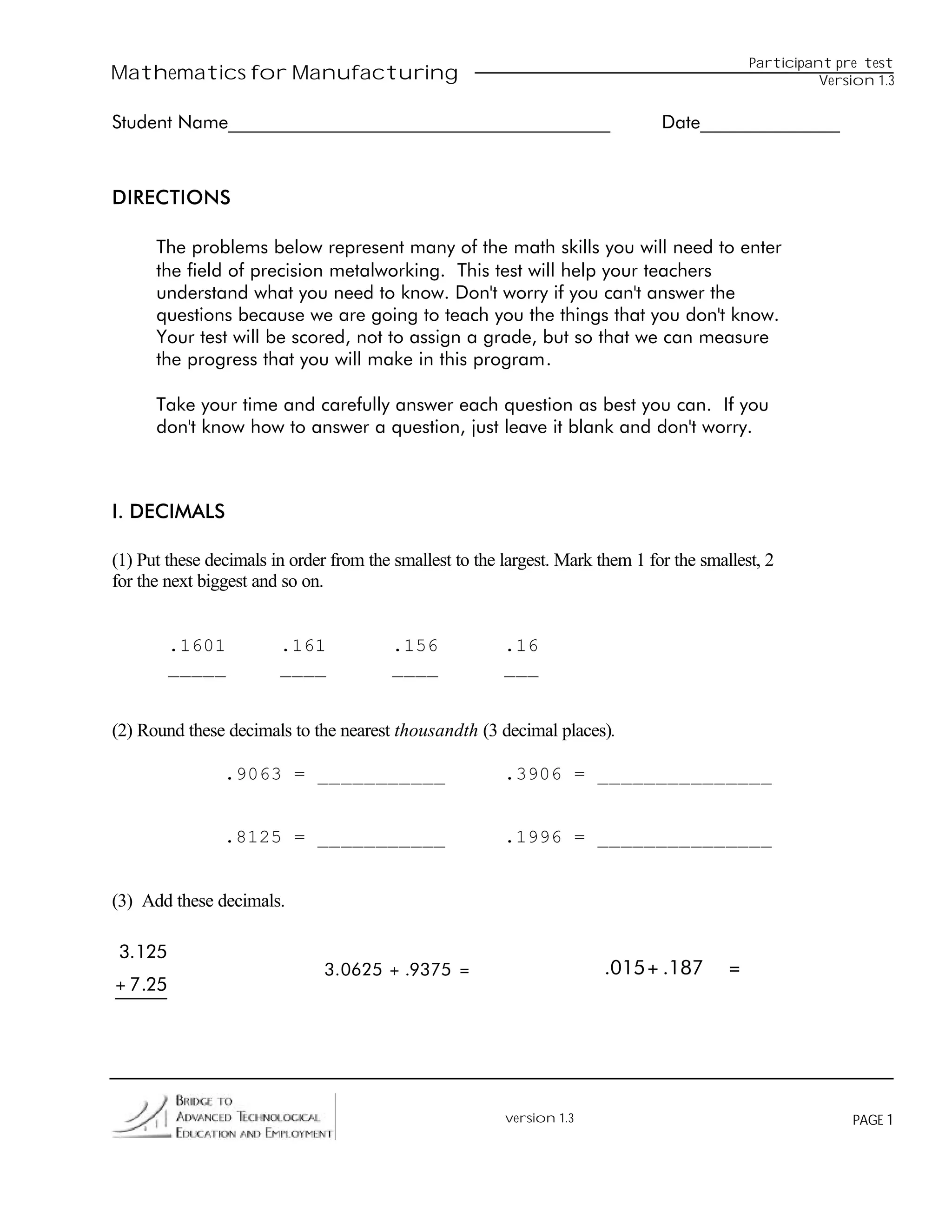
I. DECIMALS

(1) Put these decimals in order from the smallest to the largest. Mark them 1 for the smallest, 2
for the next biggest and so on.


          .1601         .161             .156            .16
          _____         ____             ____            ___


(2) Round these decimals to the nearest thousandth (3 decimal places).

                .9063 = ___________                      .3906 = _______________


                .8125 = ___________                      .1996 = _______________


(3) Add these decimals.

 3.125
                               3. 0625 + .9375 =                        .015 + .187       =
+ 7 .25


                                                         version 1.3                                        PAGE 1
Participant pre test
Mathematics for Manufacturing                                                               Version 1.3


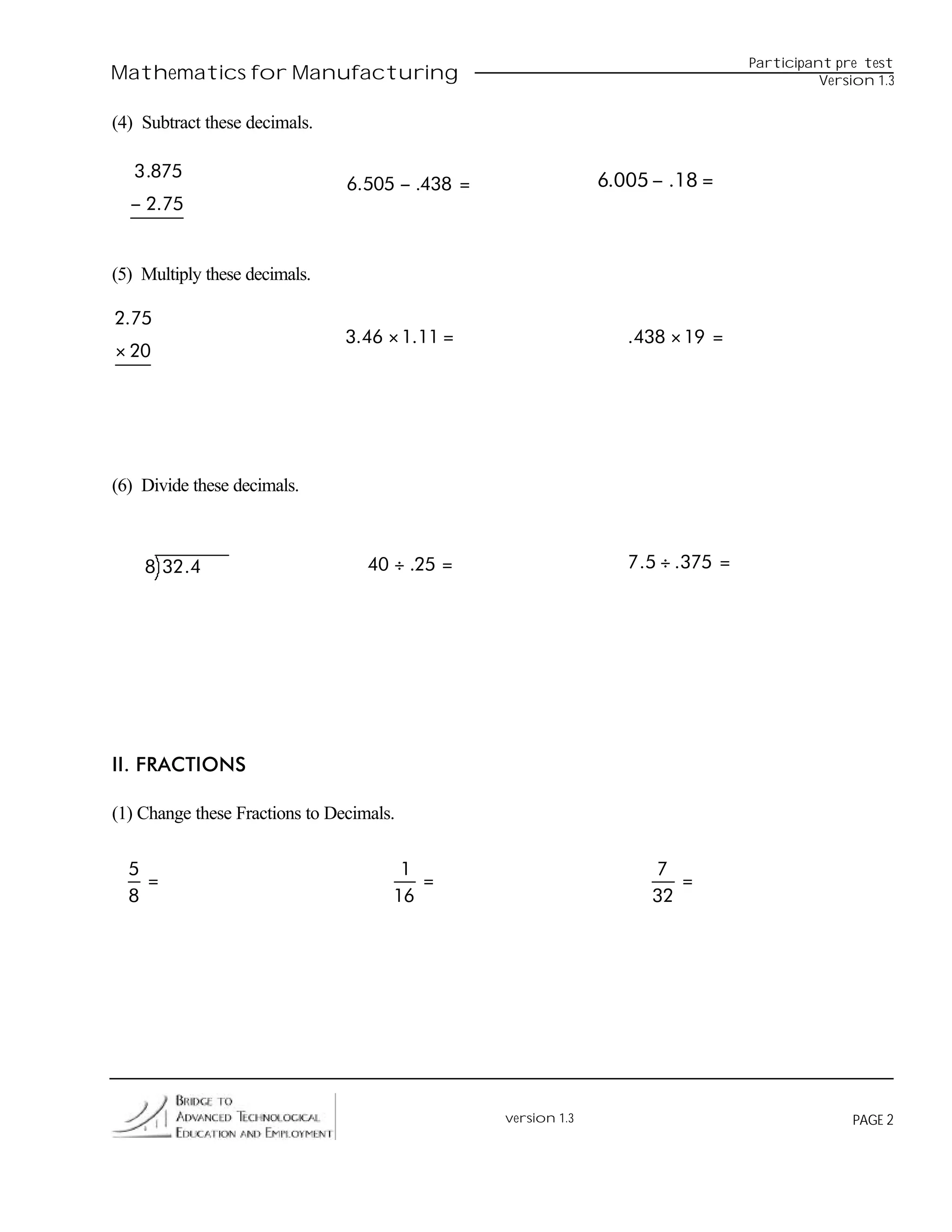
(4) Subtract these decimals.

   3 .875
                                6.505 − .438 =                 6.005 − .18 =
  − 2.75


(5) Multiply these decimals.

2.75
                                3.46 × 1.11 =                     .438 × 19 =
× 20


(6) Divide these decimals.


    8 32 .4                        40 ÷ .25 =                     7 .5 ÷ .375 =


II. FRACTIONS

(1) Change these Fractions to Decimals.


  5                                    1                             7
    =                                    =                              =
  8                                   16                             32


                                                 version 1.3                                    PAGE 2
Participant pre test
Mathematics for Manufacturing                                                 Version 1.3


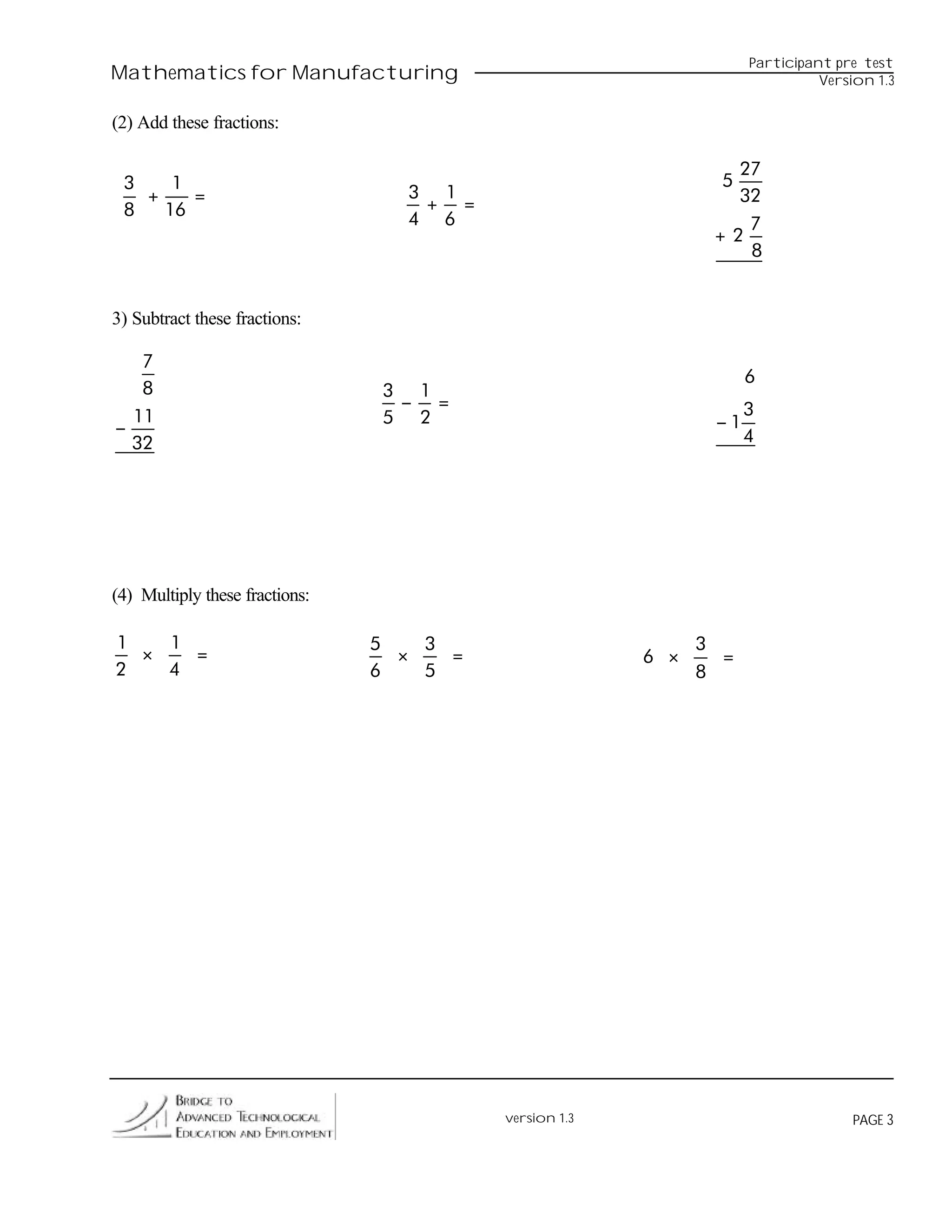
(2) Add these fractions:

                                                                 27
 3    1                                                         5
   +    =                         3 1                            32
 8   16                            + =
                                  4 6                             7
                                                               +2
                                                                  8


3) Subtract these fractions:

   7
                                                                    6
   8                            3 1
                                 − =                                3
  11                            5 2                            −1
−                                                                   4
  32


(4) Multiply these fractions:

1   1                           5   3                         3
  ×   =                           ×   =                 6 ×     =
2   4                           6   5                         8


                                          version 1.3                             PAGE 3
Participant pre test
Mathematics for Manufacturing                           Version 1.3


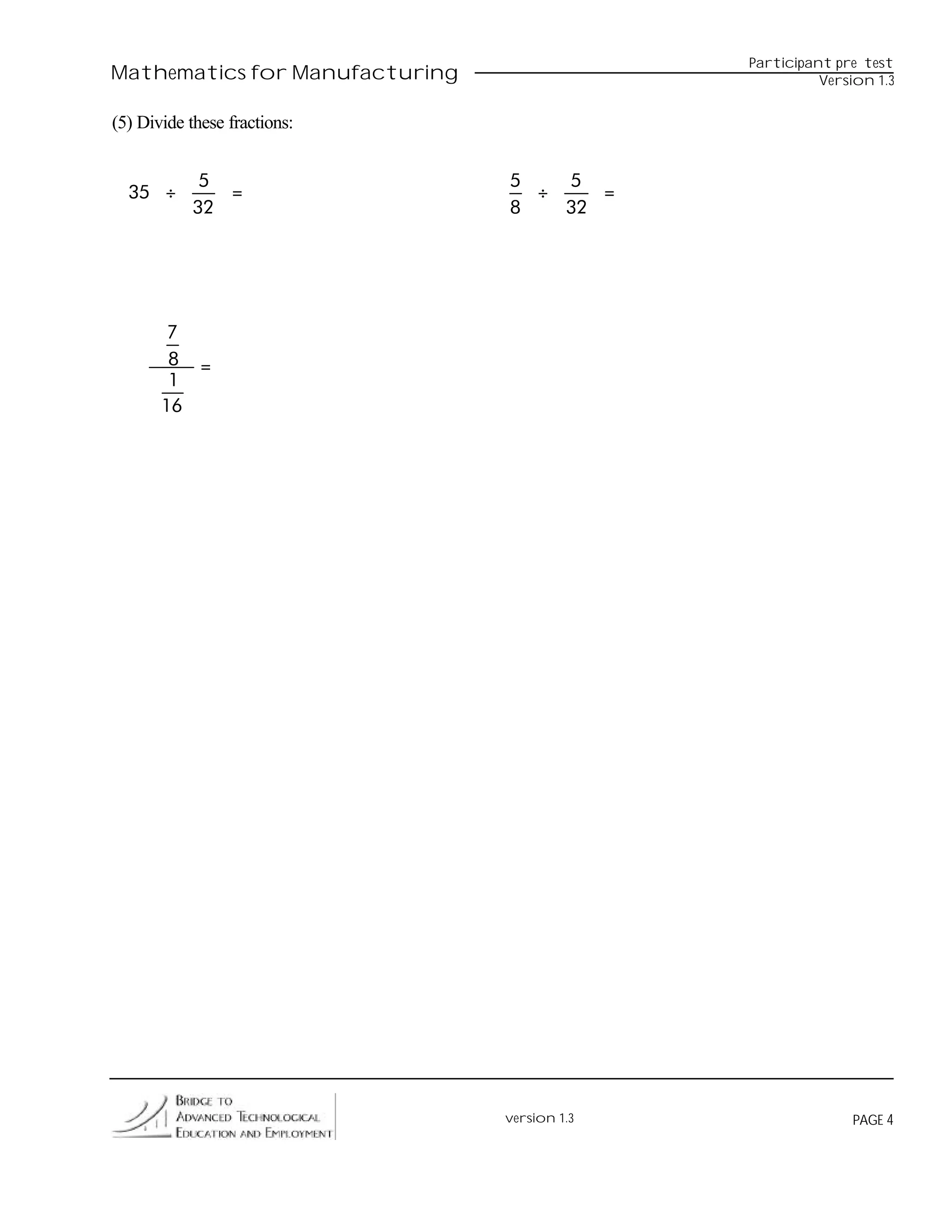
(5) Divide these fractions:


            5                   5   5
  35 ÷        =                   ÷    =
           32                   8   32


        7
        8 =
        1
       16


                                version 1.3                 PAGE 4
Participant pre test
Mathematics for Manufacturing                                                           Version 1.3


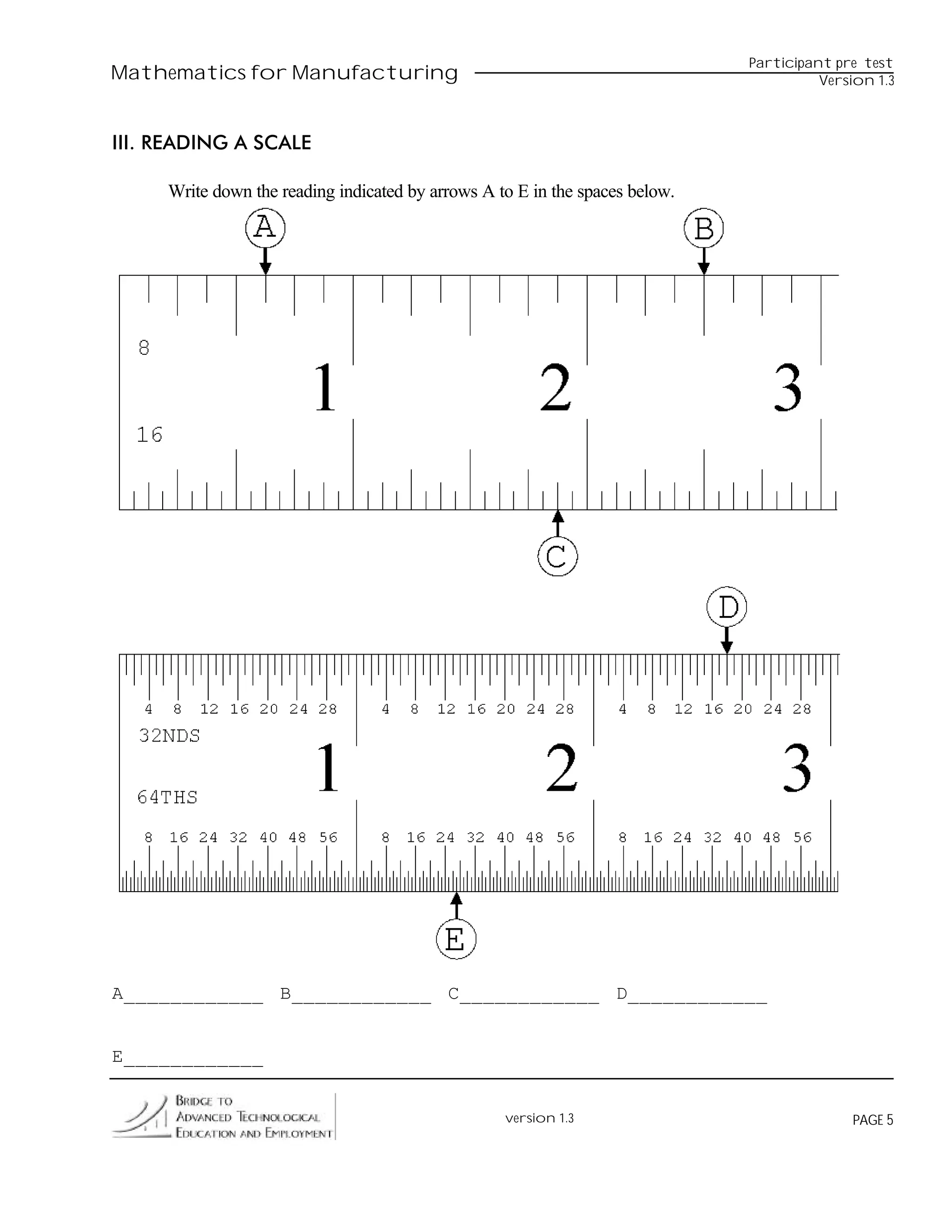
III. READING A SCALE

     Write down the reading indicated by arrows A to E in the spaces below.


A____________ B____________ C____________ D____________


E____________


                                                   version 1.3                              PAGE 5
Participant pre test
Mathematics for Manufacturing                                                                       Version 1.3


IV. SHOP MATH PROBLEMS
Solve the problems below and be sure to show your work so we know how you got your answer.


(13) If a machine can make 225 parts in one hour, how long will it take it to make 4,500 parts?


(14) A job order requires 48 pieces of rough stock, each 1 ¼ inches long. Roughly how much
bar stock is required to prepare this order?


(15) If you cut a 12 foot bar of aluminum stock into lengths of 4 ½ inches, roughly how many
pieces will you get?


                                                       version 1.3                                      PAGE 6
Participant pre test
Mathematics for Manufacturing                                                                       Version 1.3


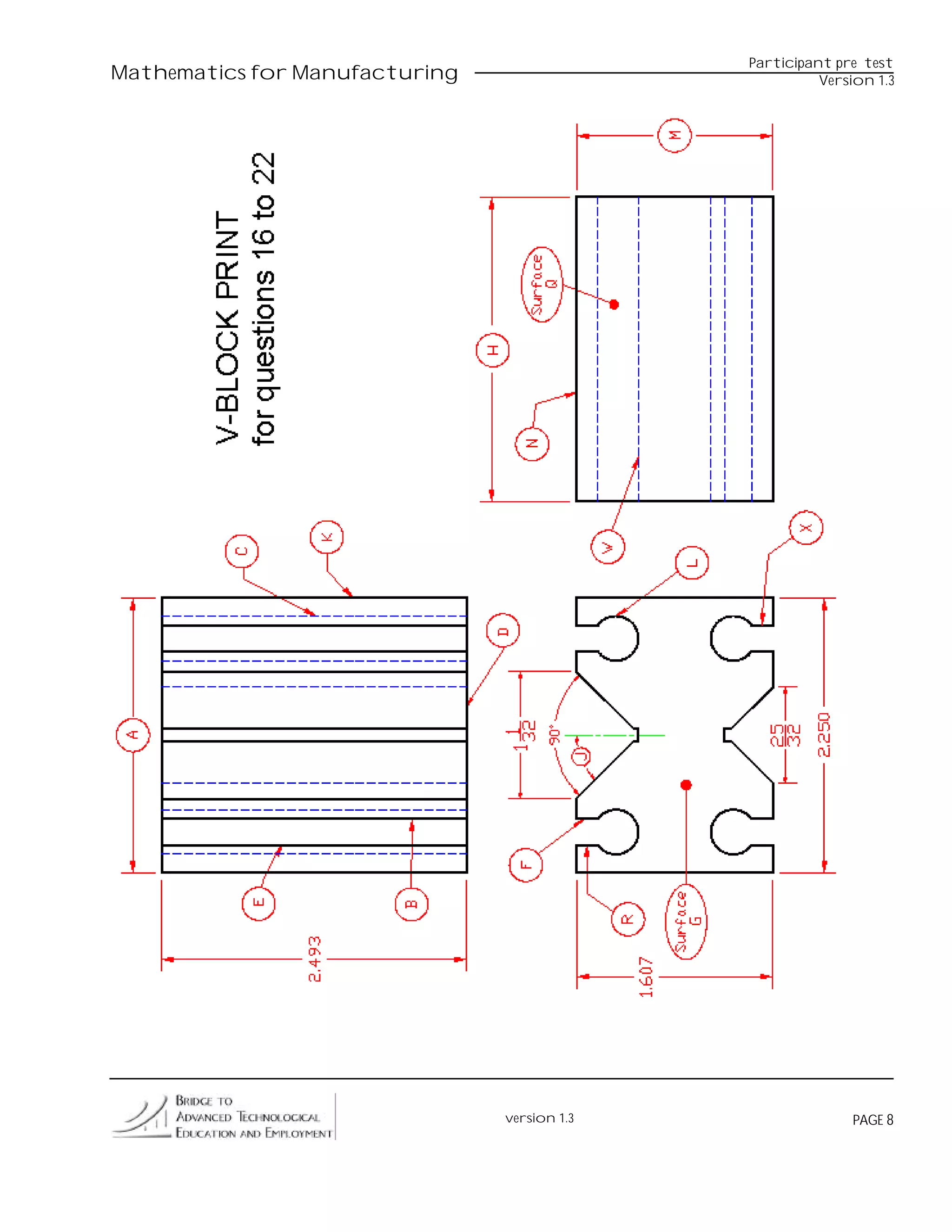
V. BLUEPRINT READING

        Instructions: Use the print on the next page to answer the following questions.


(16) Look at the feature labeled "B". How is this feature labeled in the front view?           ______

(17) Look at the feature labeled "C". How is it labeled in the front view?                     ______

(18) How is surface "G" labeled in the top view?                                               ______

(19) What is the size of dimension "H"?                                                        ______

(20) What is the size of dimension "A"?                                                        ______

(21) How is surface "Q" labeled in the top view?                                               ______

(22) What is dimension "J"?                                                                    ______


                                                        version 1.3                                     PAGE 7
Participant pre test
Mathematics for Manufacturing                           Version 1.3


                                version 1.3                 PAGE 8
Participant POST test
Mathematics for Manufacturing                                                                          Version 1.3


Student Name_________________________________________                            Date_______________


DIRECTIONS

        The problems below represent many of the math skills you will need to enter the
        field of precision metalworking. This test will help your teachers assess what skills
        you have learned in this program. This test is similar to some of the tests that
        employers give to job applicants.

        Take your time and carefully answer each question as best you can. If you don't
        know how to answer a question, just leave it blank and don't worry.


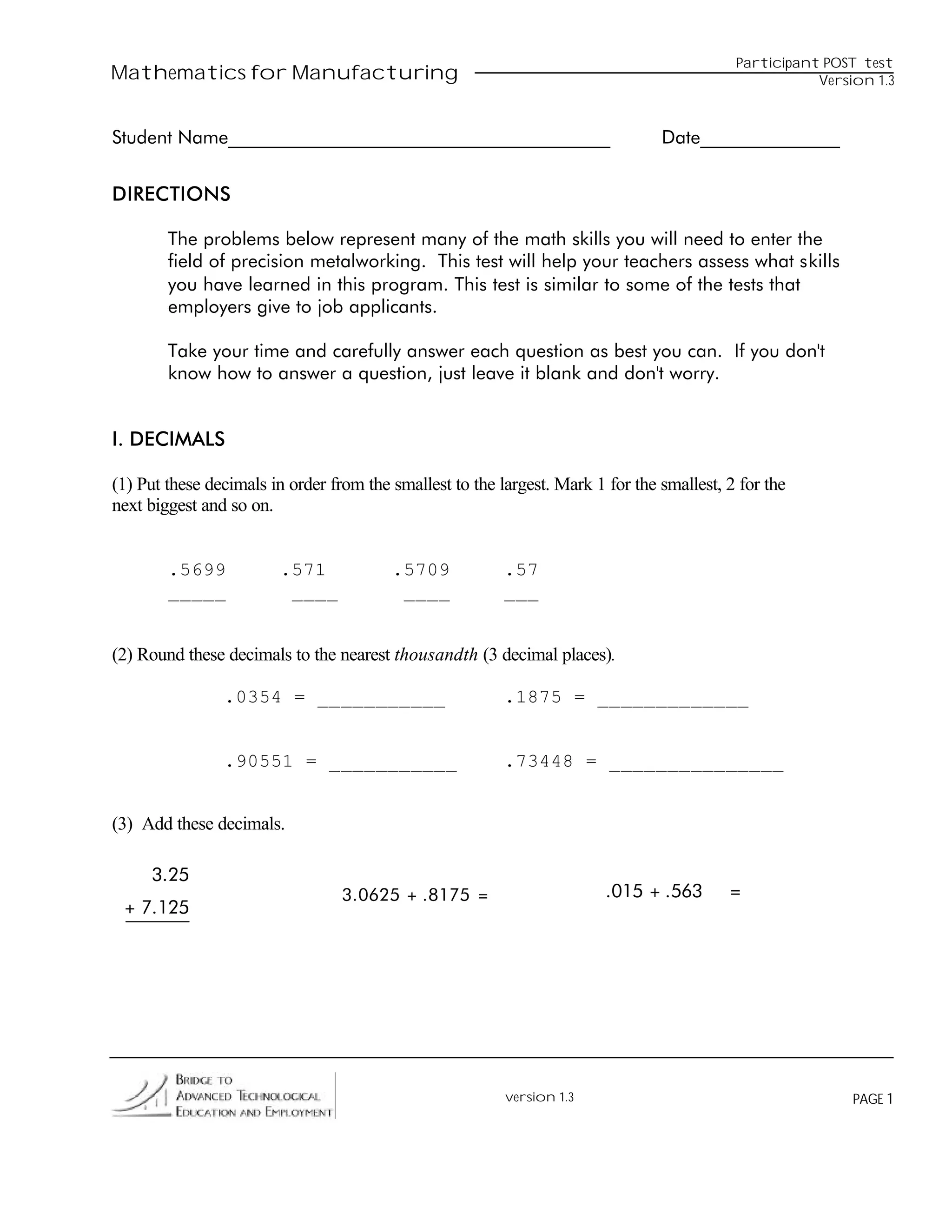
I. DECIMALS

(1) Put these decimals in order from the smallest to the largest. Mark 1 for the smallest, 2 for the
next biggest and so on.


        .5699           .571             .5709            .57
        _____            ____             ____            ___


(2) Round these decimals to the nearest thousandth (3 decimal places).

                .0354 = ___________                       .1875 = _____________


                .90551 = ___________                      .73448 = _______________


(3) Add these decimals.

     3.25
                                  3. 0625 + . 8175 =                     .015 + .563       =
 + 7.125


                                                          version 1.3                                       PAGE 1
Participant POST test
Mathematics for Manufacturing                                                                 Version 1.3


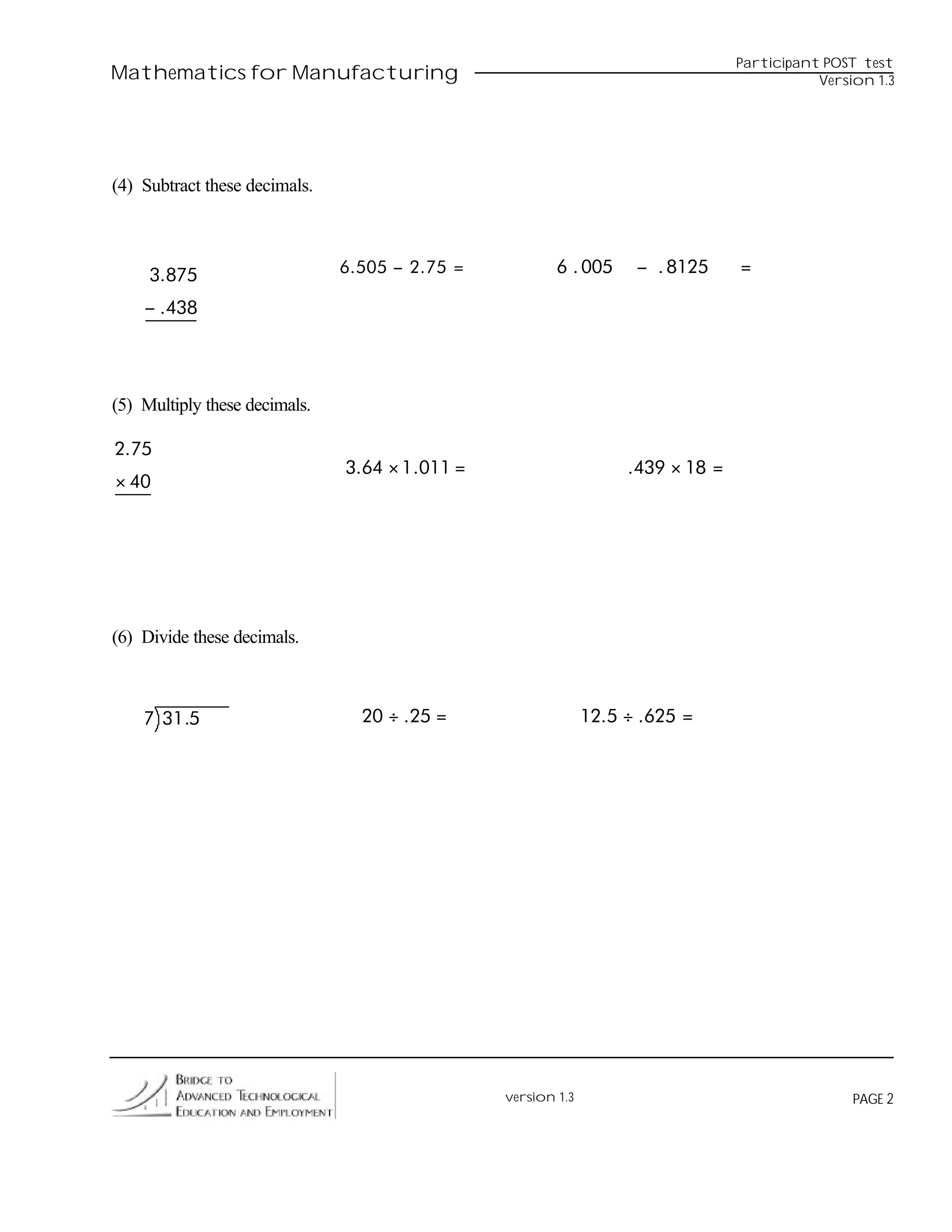
(4) Subtract these decimals.


     3.875                     6. 505 − 2. 75 =           6 . 005     − . 8125     =

    − .438


(5) Multiply these decimals.

2.75
                               3.64 × 1 .011 =                       .439 × 18 =
× 40


(6) Divide these decimals.


    7 31 .5                      20 ÷ .25 =                     12.5 ÷ .625 =


                                                  version 1.3                                      PAGE 2
Participant POST test
Mathematics for Manufacturing                                                             Version 1.3


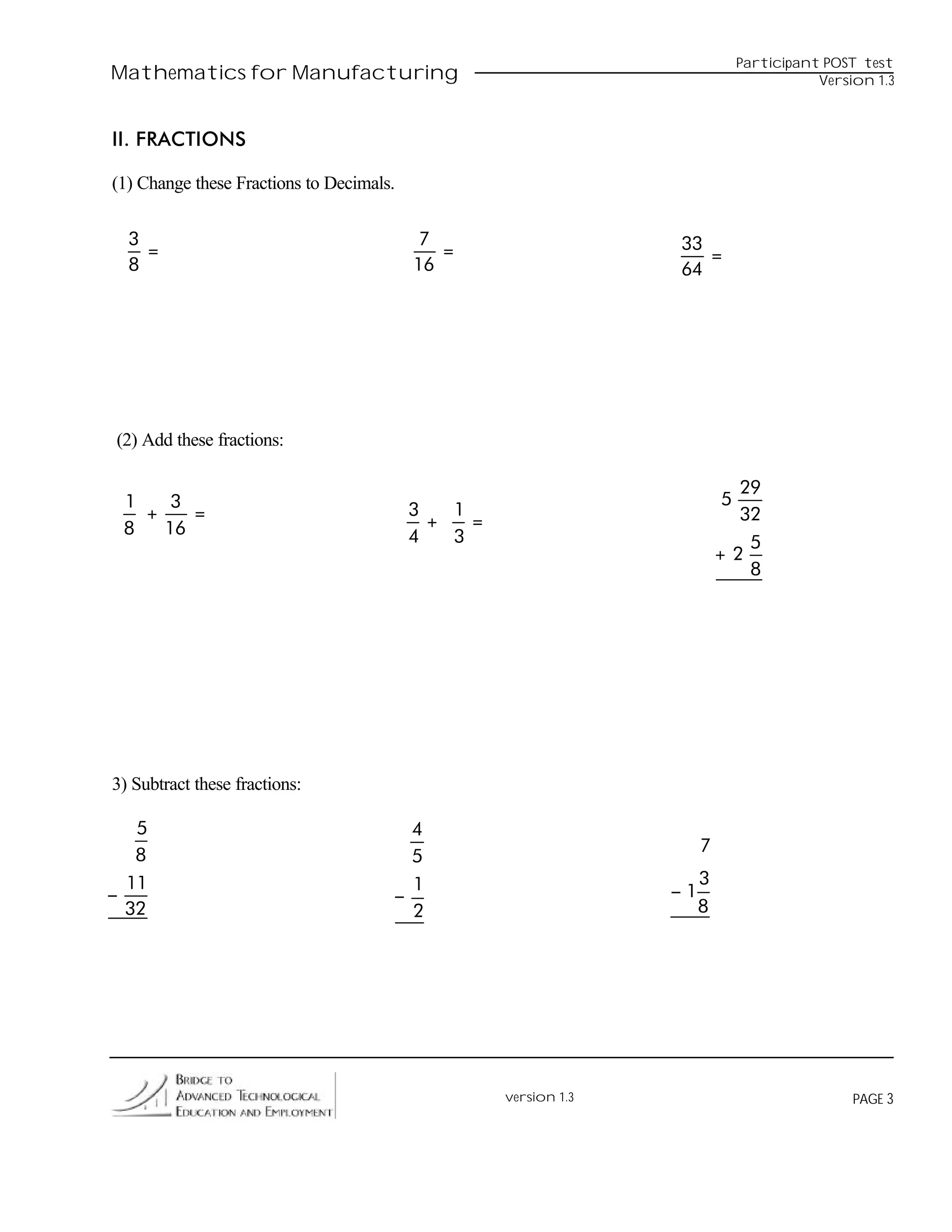
II. FRACTIONS

(1) Change these Fractions to Decimals.


  3                                        7                      33
    =                                        =                       =
  8                                       16                      64


(2) Add these fractions:

                                                                             29
 1    3                                                                    5
   +    =                                 3   1                              32
 8   16                                     +   =
                                          4   3                               5
                                                                           +2
                                                                              8


3) Subtract these fractions:

   5                                    4
                                                                       7
   8                                    5
  11                                    1                              3
−                                     −                           −1
  32                                    2                              8


                                                    version 1.3                                PAGE 3
Participant POST test
Mathematics for Manufacturing                                                         Version 1.3


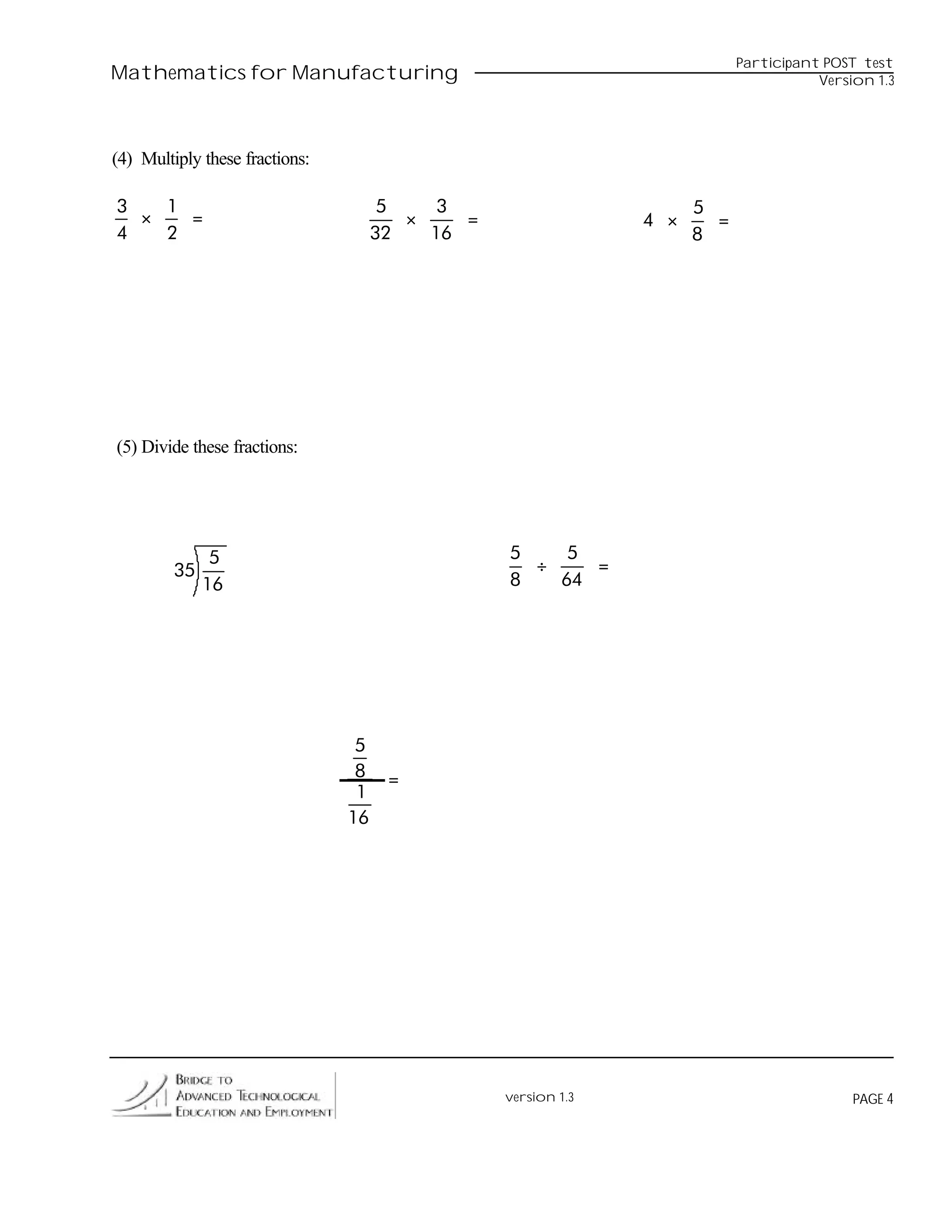
(4) Multiply these fractions:

3   1                                 5    3                         5
  ×   =                                 ×    =                 4 ×     =
4   2                                32   16                         8


(5) Divide these fractions:


               5                                 5    5
         35                                        ÷    =
              16                                 8   64


                                 5
                                 8    =
                                 1
                                16


                                                 version 1.3                               PAGE 4
Participant POST test
Mathematics for Manufacturing                                                              Version 1.3


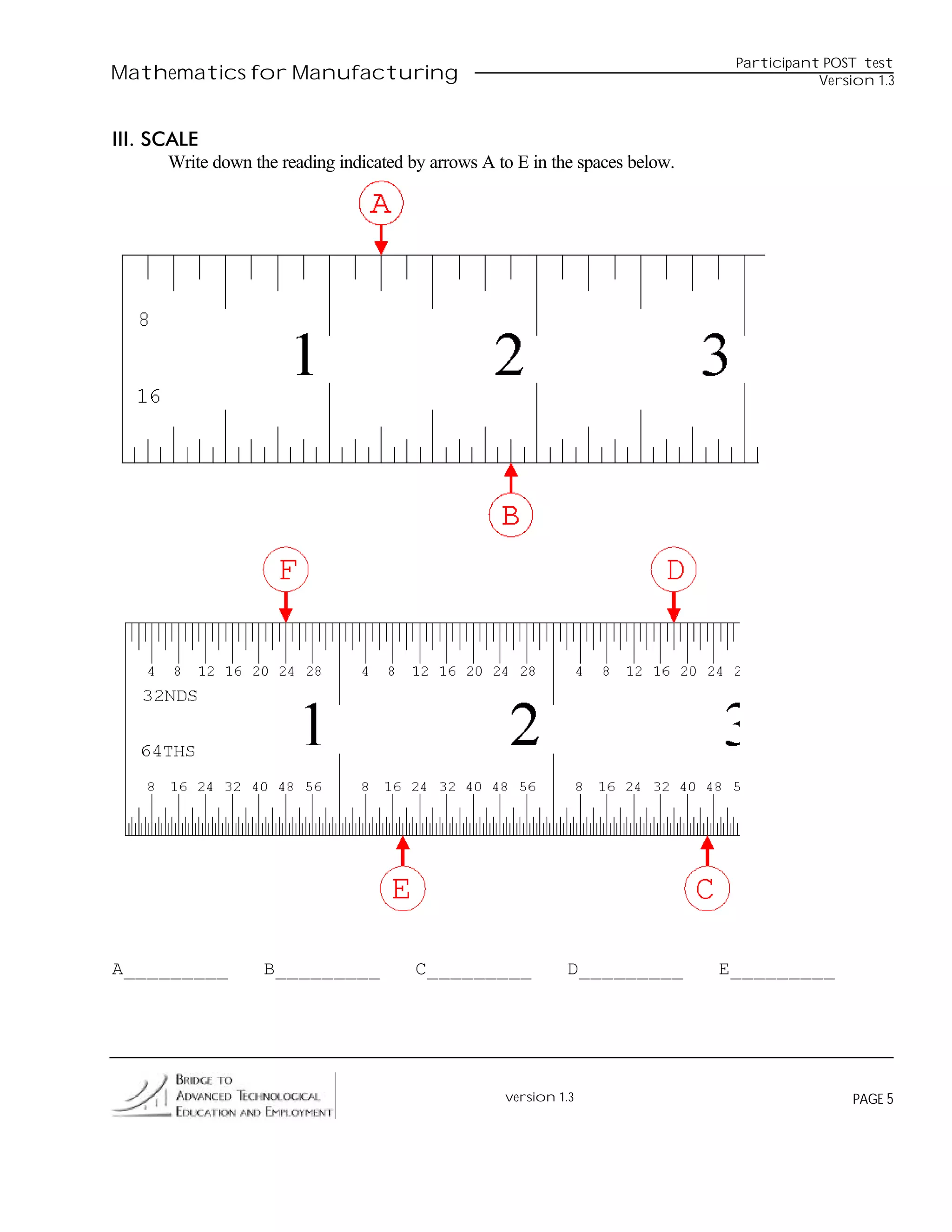
III. SCALE
      Write down the reading indicated by arrows A to E in the spaces below.


A_________         B_________           C_________           D_________        E_________


                                                    version 1.3                                 PAGE 5
Participant POST test
Mathematics for Manufacturing                                                                      Version 1.3


IV. SHOP MATH PROBLEMS

Solve the problems below and be sure to show your work so we know how you got the answer.

(13) If a machine can make 540 parts in one hour, how long will it take it to make 8,100 parts?


(14) If you cut a 12-foot bar of aluminum stock into lengths of 2 ¼ inches, roughly how many
pieces will you get?


(15) A job order requires you to use a horizontal band saw to cut 50 pieces of rough stock. The
pieces have to be 5 ¾ inches long.

       (a) Roughly how much bar stock is required to prepare this order? (Don't account for
       waste from the cutting). Give your answer as inches of bar stock.


       (b) Recalculate you answer and this time account for the width of the saw blade. Allow
       1/16" for each saw cut. Now exactly how much bar stock do you need?


                                                       version 1.3                                      PAGE 6
Participant POST test
Mathematics for Manufacturing                                                                   Version 1.3


    (c) If you cut the pieces from bar stock that comes in 12 foot lengths, you will have to
    calculate how many of these bars are needed to cut all 50 pieces. In order to do this you
    have to calculate how many pieces you can get from each bar.
    And when you use a horizontal band saw, you must allow for the material that has to be
    held in the clamp while you are sawing. Allow 8" at the end of each bar for the clamp.

    How many pieces can you get from one 12-foot bar?


    (d) How many 12 ft. bars do you need for this job?


    (e) When you are done cutting the 50 pieces, will you have any bar stock leftover to be
    put back in the rack? (Note: pieces less than 12" are waste and go in the recycle bin.)
    And if so, how long would it be?


                                                    version 1.3                                      PAGE 7
Participant POST test
Mathematics for Manufacturing                                                                          Version 1.3


(16) Burrs on the edges of holes punched in metal parts are usually allowed to be no more than
5% of the material thickness.

       (a) If you are punching holes in material that is .120" thick, what is the maximum
       allowable burr?


       (b) What if the material is .032" thick?


(17) If you run 4,270 pieces on a press and 162 were rejects, what percent are bad?


(18) If you earn $10.75/hour and you get paid "time and a half" for every hour over 40 hours
that you work in one week, how much would your gross pay be if you worked 51 hours?


                                                        version 1.3                                         PAGE 8
Participant POST test
Mathematics for Manufacturing                                                                     Version 1.3


V. BLUEPRINT READING

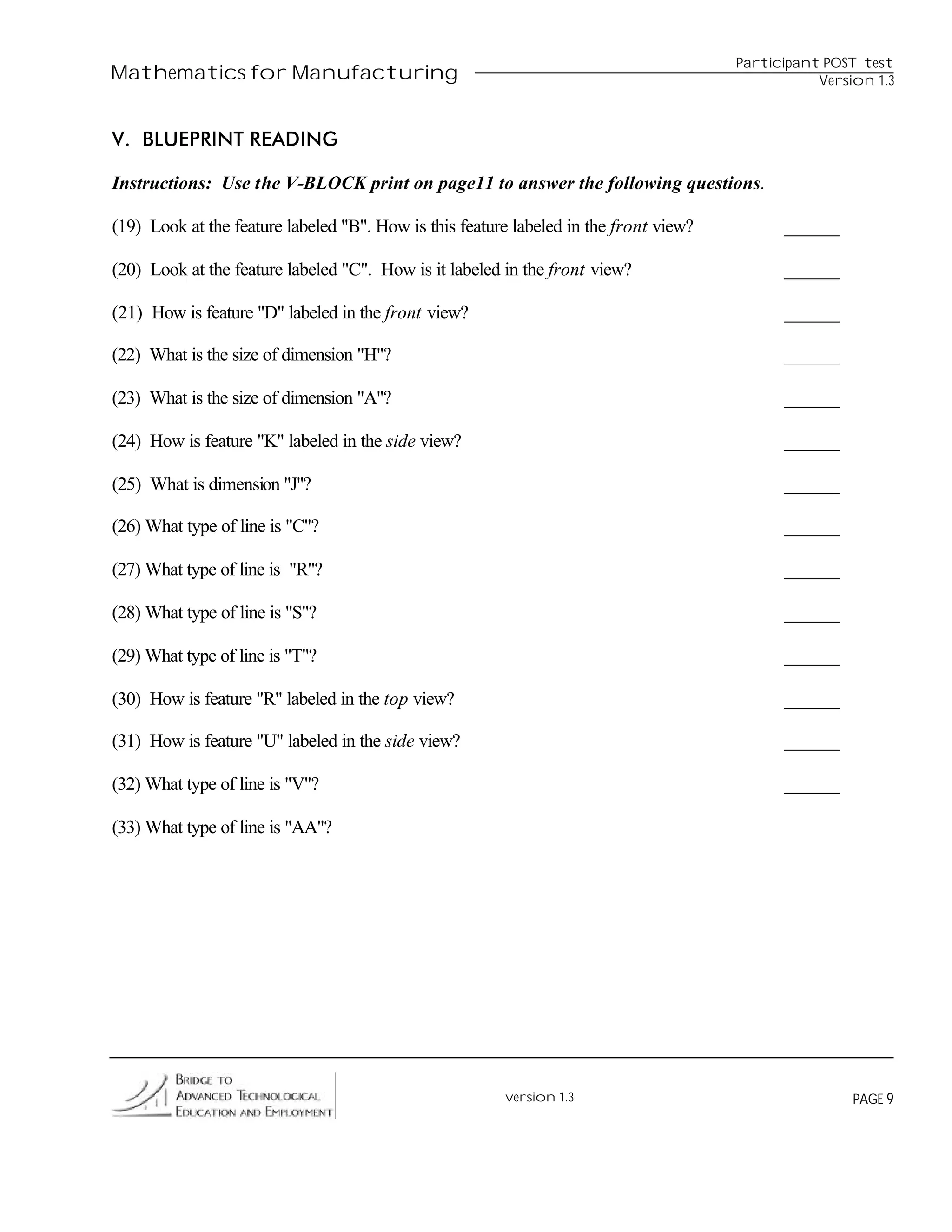
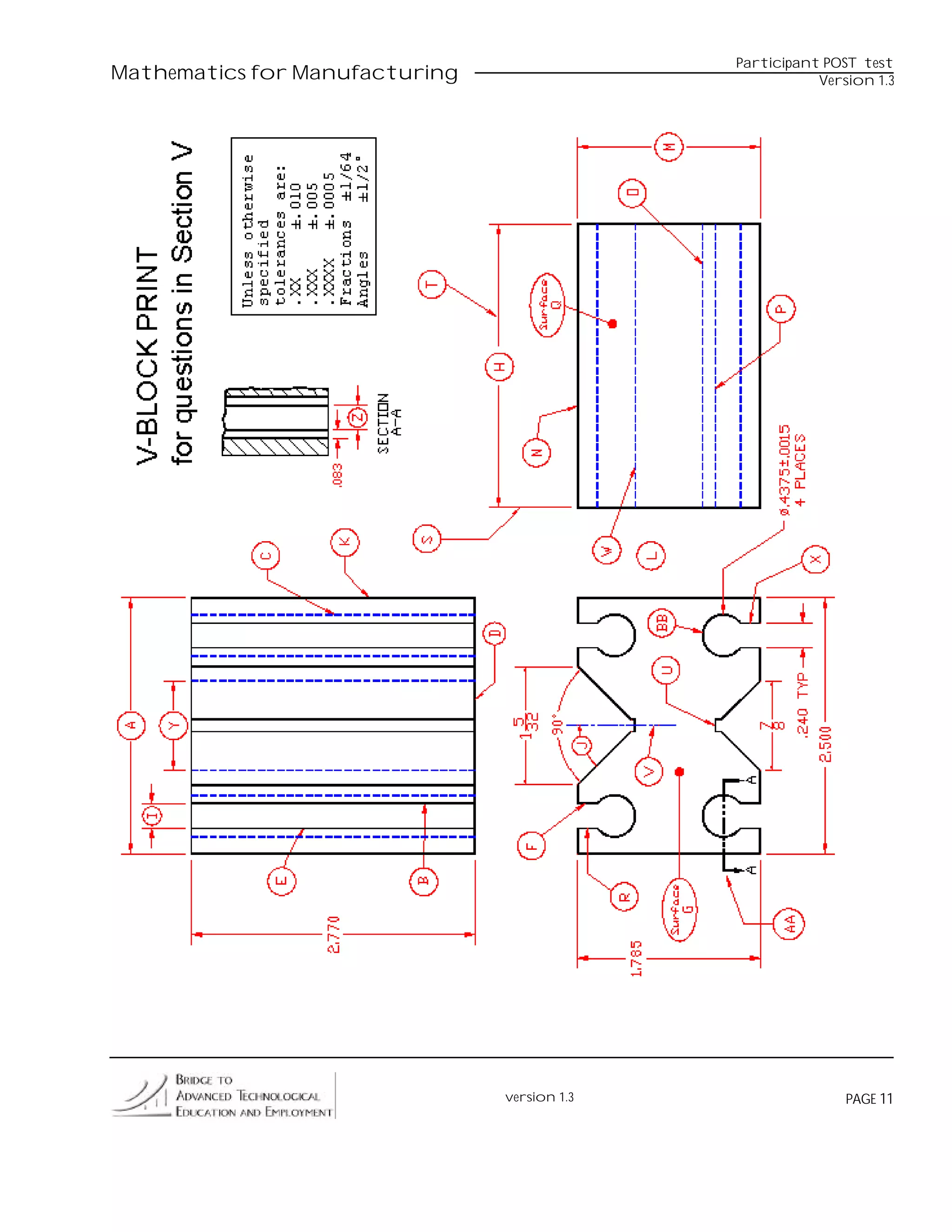
Instructions: Use the V-BLOCK print on page11 to answer the following questions.

(19) Look at the feature labeled "B". How is this feature labeled in the front view?         ______

(20) Look at the feature labeled "C". How is it labeled in the front view?                   ______

(21) How is feature "D" labeled in the front view?                                           ______

(22) What is the size of dimension "H"?                                                      ______

(23) What is the size of dimension "A"?                                                      ______

(24) How is feature "K" labeled in the side view?                                            ______

(25) What is dimension "J"?                                                                  ______

(26) What type of line is "C"?                                                               ______

(27) What type of line is "R"?                                                               ______

(28) What type of line is "S"?                                                               ______

(29) What type of line is "T"?                                                               ______

(30) How is feature "R" labeled in the top view?                                             ______

(31) How is feature "U" labeled in the side view?                                            ______

(32) What type of line is "V"?                                                               ______

(33) What type of line is "AA"?


                                                        version 1.3                                    PAGE 9
Participant POST test
Mathematics for Manufacturing                                                        Version 1.3


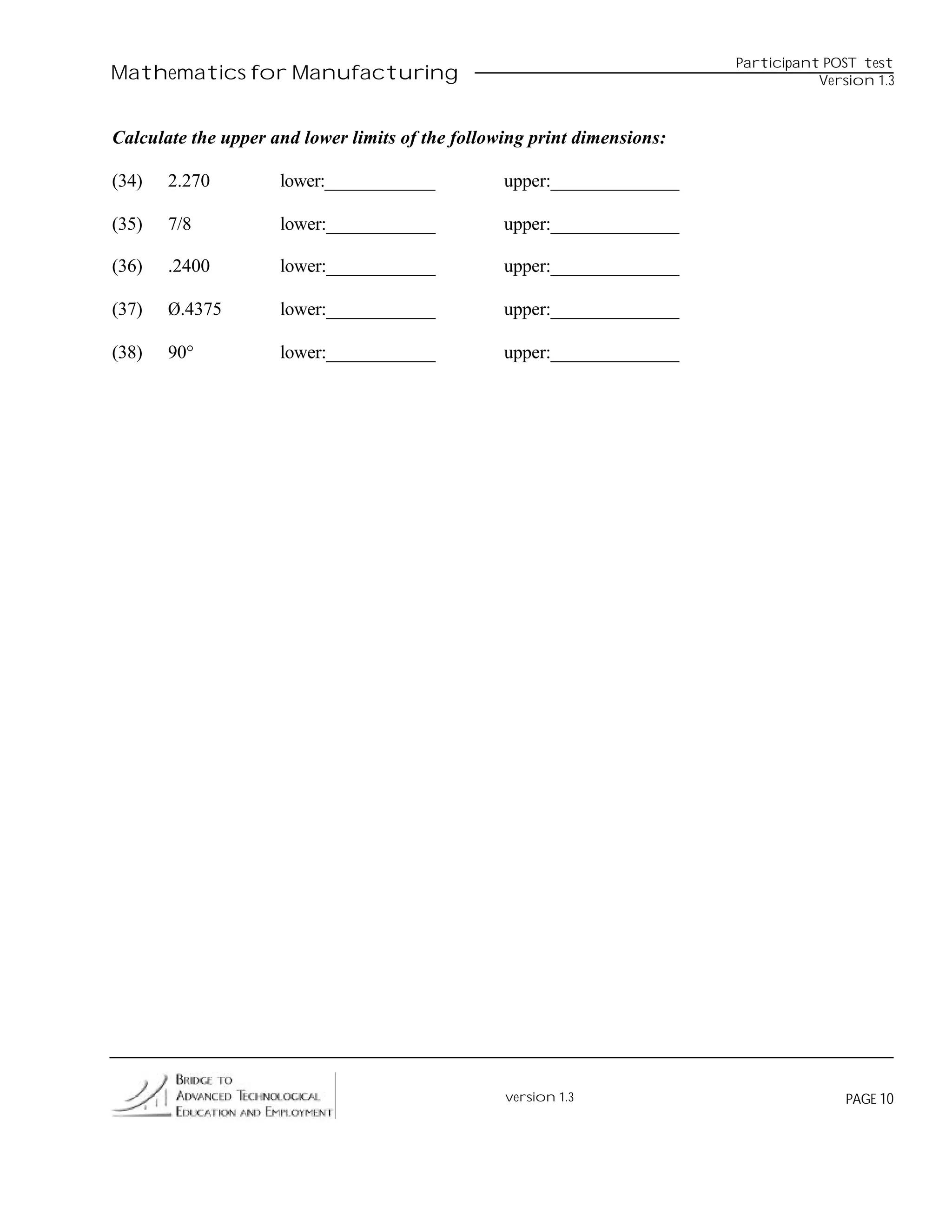
Calculate the upper and lower limits of the following print dimensions:

(34)   2.270         lower:____________           upper:______________

(35)   7/8           lower:____________           upper:______________

(36)   .2400         lower:____________           upper:______________

(37)   Ø.4375        lower:____________           upper:______________

(38)   90°           lower:____________           upper:______________


                                                  version 1.3                            PAGE 10
Participant POST test
Mathematics for Manufacturing                            Version 1.3


                                version 1.3                  PAGE 11
Participant POST test
Mathematics for Manufacturing                                                       Version 1.3


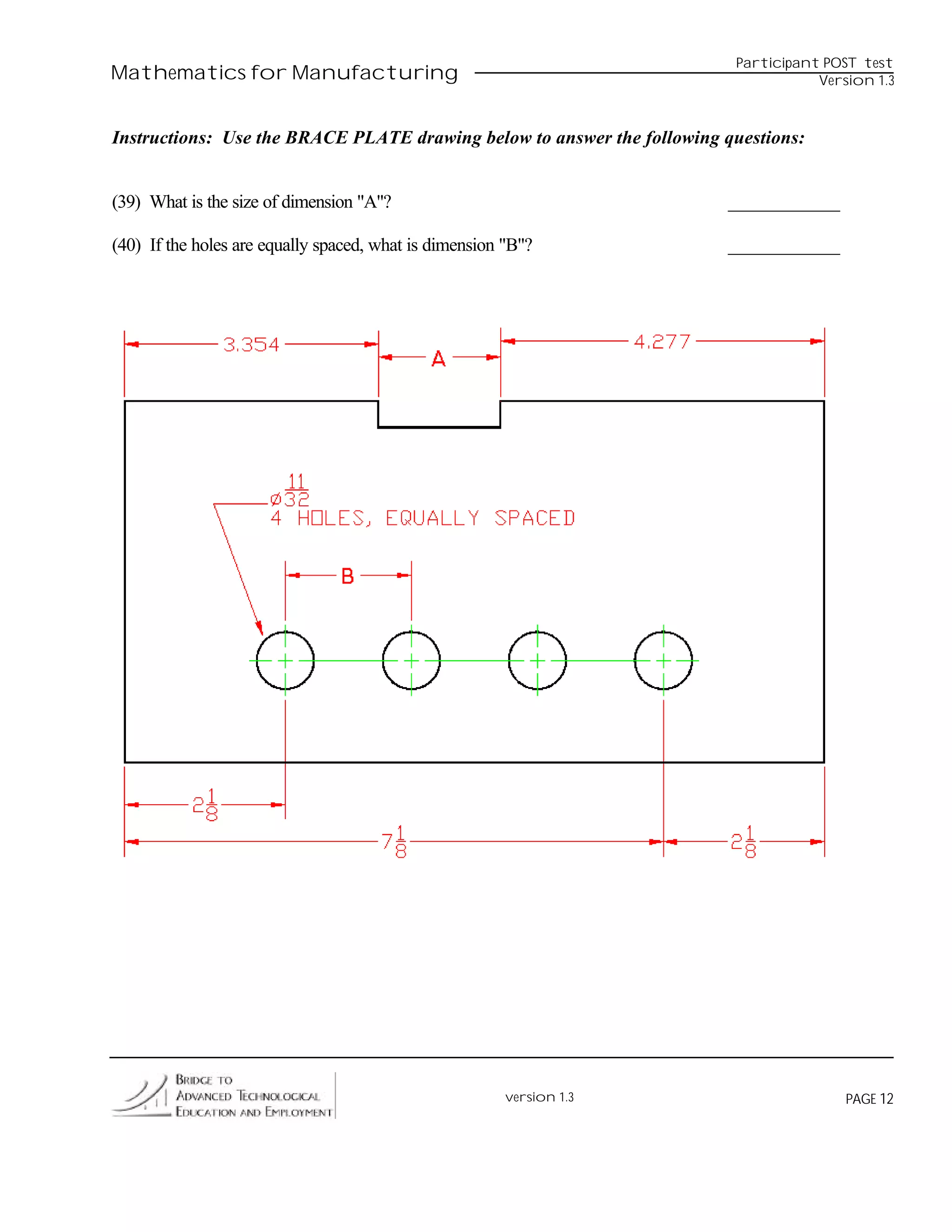
Instructions: Use the BRACE PLATE drawing below to answer the following questions:


(39) What is the size of dimension "A"?                                 ____________

(40) If the holes are equally spaced, what is dimension "B"?            ____________


                                                        version 1.3                     PAGE 12

Engineering pre test first week

  • 1.
    Participant pre test Mathematicsfor Manufacturing Version 1.3 Student Name_________________________________________ Date_______________ DIRECTIONS The problems below represent many of the math skills you will need to enter the field of precision metalworking. This test will help your teachers understand what you need to know. Don't worry if you can't answer the questions because we are going to teach you the things that you don't know. Your test will be scored, not to assign a grade, but so that we can measure the progress that you will make in this program. Take your time and carefully answer each question as best you can. If you don't know how to answer a question, just leave it blank and don't worry. I. DECIMALS (1) Put these decimals in order from the smallest to the largest. Mark them 1 for the smallest, 2 for the next biggest and so on. .1601 .161 .156 .16 _____ ____ ____ ___ (2) Round these decimals to the nearest thousandth (3 decimal places). .9063 = ___________ .3906 = _______________ .8125 = ___________ .1996 = _______________ (3) Add these decimals. 3.125 3. 0625 + .9375 = .015 + .187 = + 7 .25 version 1.3 PAGE 1
  • 2.
    Participant pre test Mathematicsfor Manufacturing Version 1.3 (4) Subtract these decimals. 3 .875 6.505 − .438 = 6.005 − .18 = − 2.75 (5) Multiply these decimals. 2.75 3.46 × 1.11 = .438 × 19 = × 20 (6) Divide these decimals. 8 32 .4 40 ÷ .25 = 7 .5 ÷ .375 = II. FRACTIONS (1) Change these Fractions to Decimals. 5 1 7 = = = 8 16 32 version 1.3 PAGE 2
  • 3.
    Participant pre test Mathematicsfor Manufacturing Version 1.3 (2) Add these fractions: 27 3 1 5 + = 3 1 32 8 16 + = 4 6 7 +2 8 3) Subtract these fractions: 7 6 8 3 1 − = 3 11 5 2 −1 − 4 32 (4) Multiply these fractions: 1 1 5 3 3 × = × = 6 × = 2 4 6 5 8 version 1.3 PAGE 3
  • 4.
    Participant pre test Mathematicsfor Manufacturing Version 1.3 (5) Divide these fractions: 5 5 5 35 ÷ = ÷ = 32 8 32 7 8 = 1 16 version 1.3 PAGE 4
  • 5.
    Participant pre test Mathematicsfor Manufacturing Version 1.3 III. READING A SCALE Write down the reading indicated by arrows A to E in the spaces below. A____________ B____________ C____________ D____________ E____________ version 1.3 PAGE 5
  • 6.
    Participant pre test Mathematicsfor Manufacturing Version 1.3 IV. SHOP MATH PROBLEMS Solve the problems below and be sure to show your work so we know how you got your answer. (13) If a machine can make 225 parts in one hour, how long will it take it to make 4,500 parts? (14) A job order requires 48 pieces of rough stock, each 1 ¼ inches long. Roughly how much bar stock is required to prepare this order? (15) If you cut a 12 foot bar of aluminum stock into lengths of 4 ½ inches, roughly how many pieces will you get? version 1.3 PAGE 6
  • 7.
    Participant pre test Mathematicsfor Manufacturing Version 1.3 V. BLUEPRINT READING Instructions: Use the print on the next page to answer the following questions. (16) Look at the feature labeled "B". How is this feature labeled in the front view? ______ (17) Look at the feature labeled "C". How is it labeled in the front view? ______ (18) How is surface "G" labeled in the top view? ______ (19) What is the size of dimension "H"? ______ (20) What is the size of dimension "A"? ______ (21) How is surface "Q" labeled in the top view? ______ (22) What is dimension "J"? ______ version 1.3 PAGE 7
  • 8.
    Participant pre test Mathematicsfor Manufacturing Version 1.3 version 1.3 PAGE 8
  • 9.
    Participant POST test Mathematicsfor Manufacturing Version 1.3 Student Name_________________________________________ Date_______________ DIRECTIONS The problems below represent many of the math skills you will need to enter the field of precision metalworking. This test will help your teachers assess what skills you have learned in this program. This test is similar to some of the tests that employers give to job applicants. Take your time and carefully answer each question as best you can. If you don't know how to answer a question, just leave it blank and don't worry. I. DECIMALS (1) Put these decimals in order from the smallest to the largest. Mark 1 for the smallest, 2 for the next biggest and so on. .5699 .571 .5709 .57 _____ ____ ____ ___ (2) Round these decimals to the nearest thousandth (3 decimal places). .0354 = ___________ .1875 = _____________ .90551 = ___________ .73448 = _______________ (3) Add these decimals. 3.25 3. 0625 + . 8175 = .015 + .563 = + 7.125 version 1.3 PAGE 1
  • 10.
    Participant POST test Mathematicsfor Manufacturing Version 1.3 (4) Subtract these decimals. 3.875 6. 505 − 2. 75 = 6 . 005 − . 8125 = − .438 (5) Multiply these decimals. 2.75 3.64 × 1 .011 = .439 × 18 = × 40 (6) Divide these decimals. 7 31 .5 20 ÷ .25 = 12.5 ÷ .625 = version 1.3 PAGE 2
  • 11.
    Participant POST test Mathematicsfor Manufacturing Version 1.3 II. FRACTIONS (1) Change these Fractions to Decimals. 3 7 33 = = = 8 16 64 (2) Add these fractions: 29 1 3 5 + = 3 1 32 8 16 + = 4 3 5 +2 8 3) Subtract these fractions: 5 4 7 8 5 11 1 3 − − −1 32 2 8 version 1.3 PAGE 3
  • 12.
    Participant POST test Mathematicsfor Manufacturing Version 1.3 (4) Multiply these fractions: 3 1 5 3 5 × = × = 4 × = 4 2 32 16 8 (5) Divide these fractions: 5 5 5 35 ÷ = 16 8 64 5 8 = 1 16 version 1.3 PAGE 4
  • 13.
    Participant POST test Mathematicsfor Manufacturing Version 1.3 III. SCALE Write down the reading indicated by arrows A to E in the spaces below. A_________ B_________ C_________ D_________ E_________ version 1.3 PAGE 5
  • 14.
    Participant POST test Mathematicsfor Manufacturing Version 1.3 IV. SHOP MATH PROBLEMS Solve the problems below and be sure to show your work so we know how you got the answer. (13) If a machine can make 540 parts in one hour, how long will it take it to make 8,100 parts? (14) If you cut a 12-foot bar of aluminum stock into lengths of 2 ¼ inches, roughly how many pieces will you get? (15) A job order requires you to use a horizontal band saw to cut 50 pieces of rough stock. The pieces have to be 5 ¾ inches long. (a) Roughly how much bar stock is required to prepare this order? (Don't account for waste from the cutting). Give your answer as inches of bar stock. (b) Recalculate you answer and this time account for the width of the saw blade. Allow 1/16" for each saw cut. Now exactly how much bar stock do you need? version 1.3 PAGE 6
  • 15.
    Participant POST test Mathematicsfor Manufacturing Version 1.3 (c) If you cut the pieces from bar stock that comes in 12 foot lengths, you will have to calculate how many of these bars are needed to cut all 50 pieces. In order to do this you have to calculate how many pieces you can get from each bar. And when you use a horizontal band saw, you must allow for the material that has to be held in the clamp while you are sawing. Allow 8" at the end of each bar for the clamp. How many pieces can you get from one 12-foot bar? (d) How many 12 ft. bars do you need for this job? (e) When you are done cutting the 50 pieces, will you have any bar stock leftover to be put back in the rack? (Note: pieces less than 12" are waste and go in the recycle bin.) And if so, how long would it be? version 1.3 PAGE 7
  • 16.
    Participant POST test Mathematicsfor Manufacturing Version 1.3 (16) Burrs on the edges of holes punched in metal parts are usually allowed to be no more than 5% of the material thickness. (a) If you are punching holes in material that is .120" thick, what is the maximum allowable burr? (b) What if the material is .032" thick? (17) If you run 4,270 pieces on a press and 162 were rejects, what percent are bad? (18) If you earn $10.75/hour and you get paid "time and a half" for every hour over 40 hours that you work in one week, how much would your gross pay be if you worked 51 hours? version 1.3 PAGE 8
  • 17.
    Participant POST test Mathematicsfor Manufacturing Version 1.3 V. BLUEPRINT READING Instructions: Use the V-BLOCK print on page11 to answer the following questions. (19) Look at the feature labeled "B". How is this feature labeled in the front view? ______ (20) Look at the feature labeled "C". How is it labeled in the front view? ______ (21) How is feature "D" labeled in the front view? ______ (22) What is the size of dimension "H"? ______ (23) What is the size of dimension "A"? ______ (24) How is feature "K" labeled in the side view? ______ (25) What is dimension "J"? ______ (26) What type of line is "C"? ______ (27) What type of line is "R"? ______ (28) What type of line is "S"? ______ (29) What type of line is "T"? ______ (30) How is feature "R" labeled in the top view? ______ (31) How is feature "U" labeled in the side view? ______ (32) What type of line is "V"? ______ (33) What type of line is "AA"? version 1.3 PAGE 9
  • 18.
    Participant POST test Mathematicsfor Manufacturing Version 1.3 Calculate the upper and lower limits of the following print dimensions: (34) 2.270 lower:____________ upper:______________ (35) 7/8 lower:____________ upper:______________ (36) .2400 lower:____________ upper:______________ (37) Ø.4375 lower:____________ upper:______________ (38) 90° lower:____________ upper:______________ version 1.3 PAGE 10
  • 19.
    Participant POST test Mathematicsfor Manufacturing Version 1.3 version 1.3 PAGE 11
  • 20.
    Participant POST test Mathematicsfor Manufacturing Version 1.3 Instructions: Use the BRACE PLATE drawing below to answer the following questions: (39) What is the size of dimension "A"? ____________ (40) If the holes are equally spaced, what is dimension "B"? ____________ version 1.3 PAGE 12