The Flower
LEARNING OUTCOME
To study the structure of bisexual flower
To summarise essential and non-essential
reproductive whorls
LEARNING OBJECTIVE
DISCUSS IN DETAIL ABOUT THE STRUCTURE OF A BISEXUAL
FLOWER?
The Flower
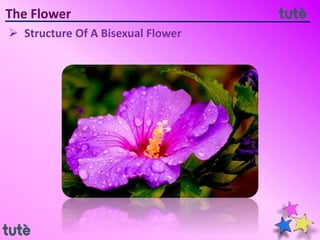
 Structure Of A Bisexual Flower
The Flower
 Structure Of A Bisexual
Flower
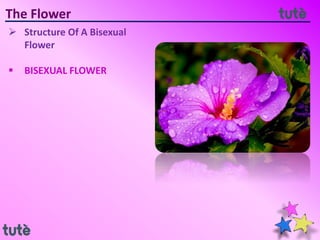
 BISEXUAL FLOWER
The Flower
 Structure Of A Bisexual
Flower
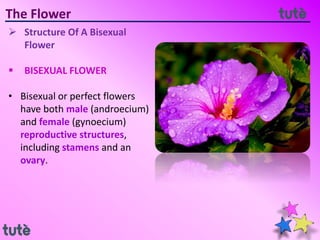
 BISEXUAL FLOWER
• Bisexual or perfect flowers
have both male (androecium)
and female (gynoecium)
reproductive structures,
including stamens and an
ovary.
The Flower
 Structure Of A Bisexual
Flower
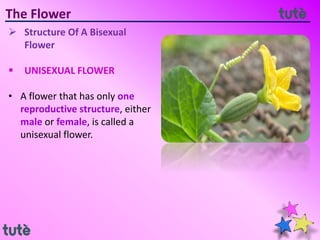
 UNISEXUAL FLOWER
• A flower that has only one
reproductive structure, either
male or female, is called a
unisexual flower.
The Flower
 Structure Of A Bisexual
Flower
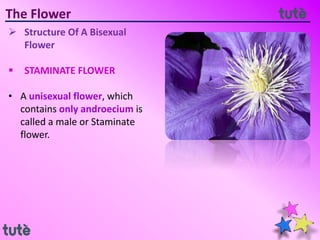
 STAMINATE FLOWER
• A unisexual flower, which
contains only androecium is
called a male or Staminate
flower.
The Flower
 Structure Of A Bisexual
Flower
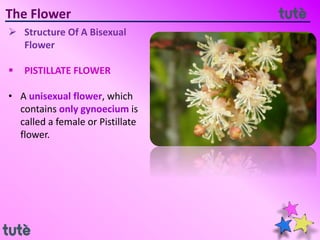
 PISTILLATE FLOWER
• A unisexual flower, which
contains only gynoecium is
called a female or Pistillate
flower.
The Flower
 Structure Of A Bisexual
Flower
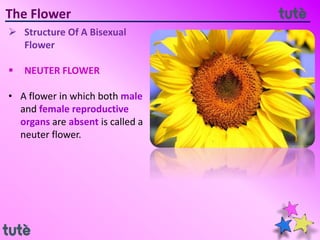
 NEUTER FLOWER
• A flower in which both male
and female reproductive
organs are absent is called a
neuter flower.
The Flower
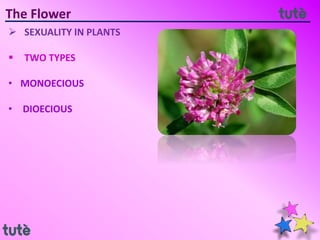
 SEXUALITY IN PLANTS
 TWO TYPES
• MONOECIOUS
• DIOECIOUS
The Flower
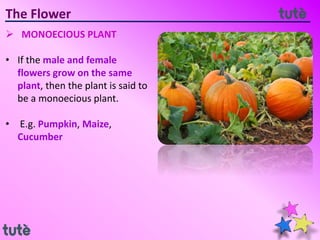
 MONOECIOUS PLANT
• If the male and female
flowers grow on the same
plant, then the plant is said to
be a monoecious plant.
• E.g. Pumpkin, Maize,
Cucumber
The Flower
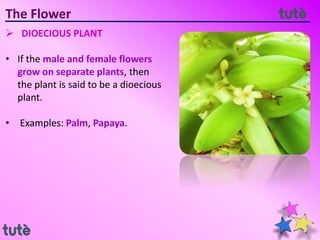
 DIOECIOUS PLANT
• If the male and female flowers
grow on separate plants, then
the plant is said to be a dioecious
plant.
• Examples: Palm, Papaya.
The Flower
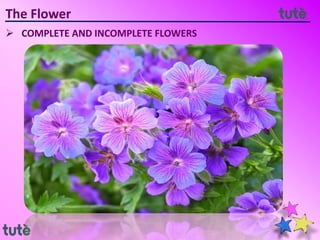
 COMPLETE AND INCOMPLETE FLOWERS
The Flower
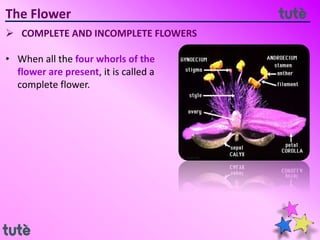
 COMPLETE AND INCOMPLETE FLOWERS
• When all the four whorls of the
flower are present, it is called a
complete flower.
LEARNING OUTCOME
To study the structure of bisexual flower
To summarise essential and non-essential
reproductive whorls
The Flower
 COMPLETE AND INCOMPLETE FLOWERS
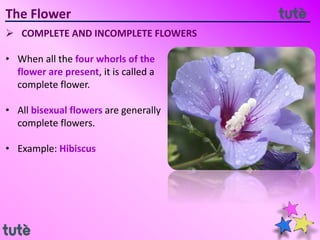
• When all the four whorls of the
flower are present, it is called a
complete flower.
• All bisexual flowers are generally
complete flowers.
• Example: Hibiscus
The Flower
 COMPLETE AND INCOMPLETE FLOWERS
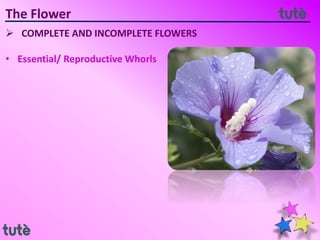
• Essential/ Reproductive Whorls
The Flower
 COMPLETE AND INCOMPLETE FLOWERS
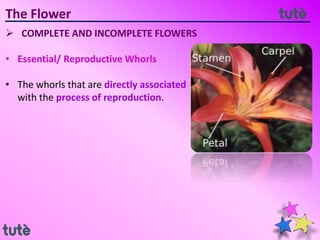
• Essential/ Reproductive Whorls
• The whorls that are directly associated
with the process of reproduction.
The Flower
 COMPLETE AND INCOMPLETE FLOWERS
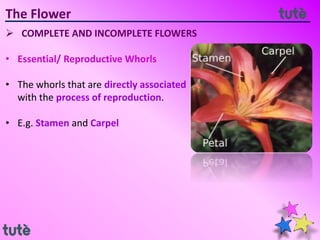
• Essential/ Reproductive Whorls
• The whorls that are directly associated
with the process of reproduction.
• E.g. Stamen and Carpel
The Flower
 Non- Essential/ Non-Reproductive
Whorls
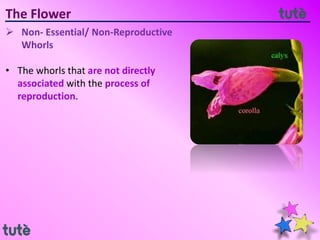
• The whorls that are not directly
associated with the process of
reproduction.
The Flower
 Non- Essential/ Non-Reproductive
Whorls
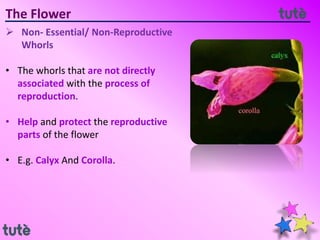
• The whorls that are not directly
associated with the process of
reproduction.
• Help and protect the reproductive
parts of the flower
• E.g. Calyx And Corolla.
The Flower
 Non- Essential/ Non-Reproductive
Whorls
 PERIANTH
The Flower
 Non- Essential/ Non-Reproductive
Whorls
 PERIANTH
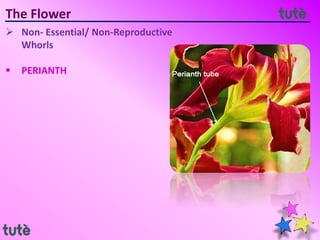
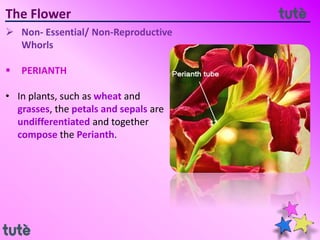
• In plants, such as wheat and
grasses, the petals and sepals are
undifferentiated and together
compose the Perianth.
The Flower
 Non- Essential/ Non-Reproductive
Whorls
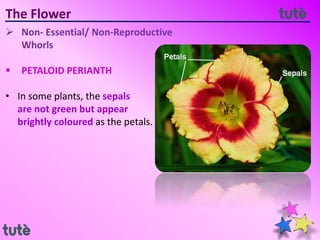
 PETALOID PERIANTH
• In some plants, the sepals
are not green but appear
brightly coloured as the petals.
The Flower
 Non- Essential/ Non-Reproductive
Whorls
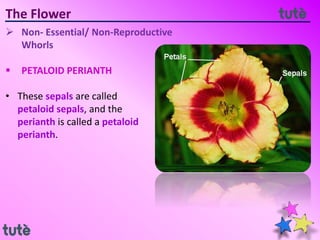
 PETALOID PERIANTH
• These sepals are called
petaloid sepals, and the
perianth is called a petaloid
perianth.
The Flower
 Non- Essential/ Non-Reproductive
Whorls
 PETALOID PERIANTH
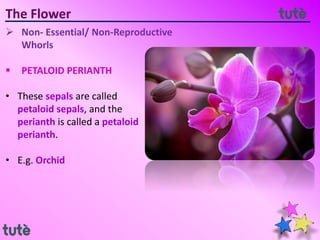
• These sepals are called
petaloid sepals, and the
perianth is called a petaloid
perianth.
• E.g. Orchid
The Flower
 Non- Essential/ Non-Reproductive
Whorls
 SEPALOID PERIANTH
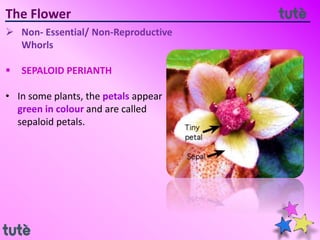
• In some plants, the petals appear
green in colour and are called
sepaloid petals.
The Flower
 Non- Essential/ Non-Reproductive
Whorls
 SEPALOID PERIANTH
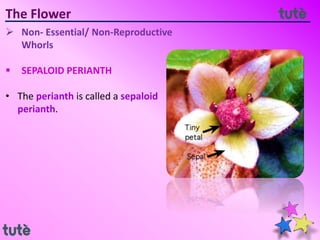
• The perianth is called a sepaloid
perianth.
The Flower
 Non- Essential/ Non-Reproductive
Whorls
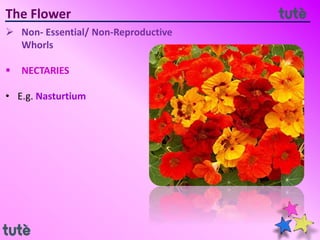
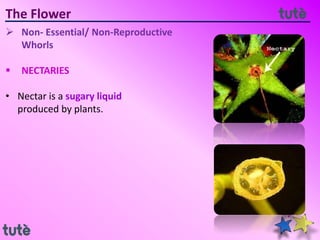
 NECTARIES
• Nectar is a sugary liquid
produced by plants.
The Flower
 Non- Essential/ Non-Reproductive
Whorls
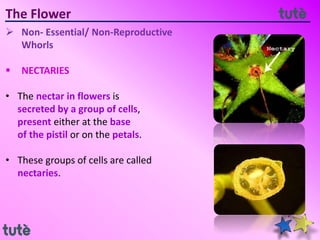
 NECTARIES
• The nectar in flowers is
secreted by a group of cells,
present either at the base
of the pistil or on the petals.
• These groups of cells are called
nectaries.
The Flower
 Non- Essential/ Non-Reproductive
Whorls
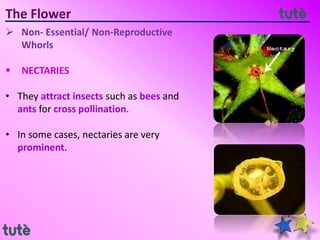
 NECTARIES
• They attract insects such as bees and
ants for cross pollination.
• In some cases, nectaries are very
prominent.
The Flower
 Non- Essential/ Non-Reproductive
Whorls
 NECTARIES
• E.g. Nasturtium
LEARNING OUTCOME
To study the structure of bisexual flower
To summarise essential and non-essential
reproductive whorls
Whiteboard
12th - the flower - biology

12th - the flower - biology

  • 1.
  • 2.
    LEARNING OUTCOME To studythe structure of bisexual flower To summarise essential and non-essential reproductive whorls
  • 3.
    LEARNING OBJECTIVE DISCUSS INDETAIL ABOUT THE STRUCTURE OF A BISEXUAL FLOWER?
  • 4.
    The Flower  StructureOf A Bisexual Flower
  • 5.
    The Flower  StructureOf A Bisexual Flower  BISEXUAL FLOWER
  • 6.
    The Flower  StructureOf A Bisexual Flower  BISEXUAL FLOWER • Bisexual or perfect flowers have both male (androecium) and female (gynoecium) reproductive structures, including stamens and an ovary.
  • 7.
    The Flower  StructureOf A Bisexual Flower  UNISEXUAL FLOWER • A flower that has only one reproductive structure, either male or female, is called a unisexual flower.
  • 8.
    The Flower  StructureOf A Bisexual Flower  STAMINATE FLOWER • A unisexual flower, which contains only androecium is called a male or Staminate flower.
  • 9.
    The Flower  StructureOf A Bisexual Flower  PISTILLATE FLOWER • A unisexual flower, which contains only gynoecium is called a female or Pistillate flower.
  • 10.
    The Flower  StructureOf A Bisexual Flower  NEUTER FLOWER • A flower in which both male and female reproductive organs are absent is called a neuter flower.
  • 11.
    The Flower  SEXUALITYIN PLANTS  TWO TYPES • MONOECIOUS • DIOECIOUS
  • 12.
    The Flower  MONOECIOUSPLANT • If the male and female flowers grow on the same plant, then the plant is said to be a monoecious plant. • E.g. Pumpkin, Maize, Cucumber
  • 13.
    The Flower  DIOECIOUSPLANT • If the male and female flowers grow on separate plants, then the plant is said to be a dioecious plant. • Examples: Palm, Papaya.
  • 14.
    The Flower  COMPLETEAND INCOMPLETE FLOWERS
  • 15.
    The Flower  COMPLETEAND INCOMPLETE FLOWERS • When all the four whorls of the flower are present, it is called a complete flower.
  • 16.
    LEARNING OUTCOME To studythe structure of bisexual flower To summarise essential and non-essential reproductive whorls
  • 17.
    The Flower  COMPLETEAND INCOMPLETE FLOWERS • When all the four whorls of the flower are present, it is called a complete flower. • All bisexual flowers are generally complete flowers. • Example: Hibiscus
  • 18.
    The Flower  COMPLETEAND INCOMPLETE FLOWERS • Essential/ Reproductive Whorls
  • 19.
    The Flower  COMPLETEAND INCOMPLETE FLOWERS • Essential/ Reproductive Whorls • The whorls that are directly associated with the process of reproduction.
  • 20.
    The Flower  COMPLETEAND INCOMPLETE FLOWERS • Essential/ Reproductive Whorls • The whorls that are directly associated with the process of reproduction. • E.g. Stamen and Carpel
  • 21.
    The Flower  Non-Essential/ Non-Reproductive Whorls • The whorls that are not directly associated with the process of reproduction.
  • 22.
    The Flower  Non-Essential/ Non-Reproductive Whorls • The whorls that are not directly associated with the process of reproduction. • Help and protect the reproductive parts of the flower • E.g. Calyx And Corolla.
  • 23.
    The Flower  Non-Essential/ Non-Reproductive Whorls  PERIANTH
  • 24.
    The Flower  Non-Essential/ Non-Reproductive Whorls  PERIANTH • In plants, such as wheat and grasses, the petals and sepals are undifferentiated and together compose the Perianth.
  • 25.
    The Flower  Non-Essential/ Non-Reproductive Whorls  PETALOID PERIANTH • In some plants, the sepals are not green but appear brightly coloured as the petals.
  • 26.
    The Flower  Non-Essential/ Non-Reproductive Whorls  PETALOID PERIANTH • These sepals are called petaloid sepals, and the perianth is called a petaloid perianth.
  • 27.
    The Flower  Non-Essential/ Non-Reproductive Whorls  PETALOID PERIANTH • These sepals are called petaloid sepals, and the perianth is called a petaloid perianth. • E.g. Orchid
  • 28.
    The Flower  Non-Essential/ Non-Reproductive Whorls  SEPALOID PERIANTH • In some plants, the petals appear green in colour and are called sepaloid petals.
  • 29.
    The Flower  Non-Essential/ Non-Reproductive Whorls  SEPALOID PERIANTH • The perianth is called a sepaloid perianth.
  • 30.
    The Flower  Non-Essential/ Non-Reproductive Whorls  NECTARIES • Nectar is a sugary liquid produced by plants.
  • 31.
    The Flower  Non-Essential/ Non-Reproductive Whorls  NECTARIES • The nectar in flowers is secreted by a group of cells, present either at the base of the pistil or on the petals. • These groups of cells are called nectaries.
  • 32.
    The Flower  Non-Essential/ Non-Reproductive Whorls  NECTARIES • They attract insects such as bees and ants for cross pollination. • In some cases, nectaries are very prominent.
  • 33.
    The Flower  Non-Essential/ Non-Reproductive Whorls  NECTARIES • E.g. Nasturtium
  • 34.
    LEARNING OUTCOME To studythe structure of bisexual flower To summarise essential and non-essential reproductive whorls
  • 35.

Editor's Notes

  • #2 An overview of the content of the lesson Must be in the form of a question where appropriate Students should be able to answer the question at the end - either fully, partly or in a way that demonstrates they understand what gaps in their knowledge they need to address Verbs such as to understand / to know / to gain confidence / to learn Ask students to give the question a go and point out that, at the end of the lesson, they should be able to answer fully
  • #3 An overview of the content of the lesson Must be in the form of a question where appropriate Students should be able to answer the question at the end - either fully, partly or in a way that demonstrates they understand what gaps in their knowledge they need to address Verbs such as to understand / to know / to gain confidence / to learn Ask students to give the question a go and point out that, at the end of the lesson, they should be able to answer fully
  • #4 An overview of the content of the lesson Must be in the form of a question where appropriate Students should be able to answer the question at the end - either fully, partly or in a way that demonstrates they understand what gaps in their knowledge they need to address Verbs such as to understand / to know / to gain confidence / to learn Ask students to give the question a go and point out that, at the end of the lesson, they should be able to answer fully
  • #5 An overview of the content of the lesson Must be in the form of a question where appropriate Students should be able to answer the question at the end - either fully, partly or in a way that demonstrates they understand what gaps in their knowledge they need to address Verbs such as to understand / to know / to gain confidence / to learn Ask students to give the question a go and point out that, at the end of the lesson, they should be able to answer fully
  • #6 An overview of the content of the lesson Must be in the form of a question where appropriate Students should be able to answer the question at the end - either fully, partly or in a way that demonstrates they understand what gaps in their knowledge they need to address Verbs such as to understand / to know / to gain confidence / to learn Ask students to give the question a go and point out that, at the end of the lesson, they should be able to answer fully
  • #7 An overview of the content of the lesson Must be in the form of a question where appropriate Students should be able to answer the question at the end - either fully, partly or in a way that demonstrates they understand what gaps in their knowledge they need to address Verbs such as to understand / to know / to gain confidence / to learn Ask students to give the question a go and point out that, at the end of the lesson, they should be able to answer fully
  • #8 An overview of the content of the lesson Must be in the form of a question where appropriate Students should be able to answer the question at the end - either fully, partly or in a way that demonstrates they understand what gaps in their knowledge they need to address Verbs such as to understand / to know / to gain confidence / to learn Ask students to give the question a go and point out that, at the end of the lesson, they should be able to answer fully
  • #9 An overview of the content of the lesson Must be in the form of a question where appropriate Students should be able to answer the question at the end - either fully, partly or in a way that demonstrates they understand what gaps in their knowledge they need to address Verbs such as to understand / to know / to gain confidence / to learn Ask students to give the question a go and point out that, at the end of the lesson, they should be able to answer fully
  • #10 An overview of the content of the lesson Must be in the form of a question where appropriate Students should be able to answer the question at the end - either fully, partly or in a way that demonstrates they understand what gaps in their knowledge they need to address Verbs such as to understand / to know / to gain confidence / to learn Ask students to give the question a go and point out that, at the end of the lesson, they should be able to answer fully
  • #11 An overview of the content of the lesson Must be in the form of a question where appropriate Students should be able to answer the question at the end - either fully, partly or in a way that demonstrates they understand what gaps in their knowledge they need to address Verbs such as to understand / to know / to gain confidence / to learn Ask students to give the question a go and point out that, at the end of the lesson, they should be able to answer fully
  • #12 An overview of the content of the lesson Must be in the form of a question where appropriate Students should be able to answer the question at the end - either fully, partly or in a way that demonstrates they understand what gaps in their knowledge they need to address Verbs such as to understand / to know / to gain confidence / to learn Ask students to give the question a go and point out that, at the end of the lesson, they should be able to answer fully
  • #13 An overview of the content of the lesson Must be in the form of a question where appropriate Students should be able to answer the question at the end - either fully, partly or in a way that demonstrates they understand what gaps in their knowledge they need to address Verbs such as to understand / to know / to gain confidence / to learn Ask students to give the question a go and point out that, at the end of the lesson, they should be able to answer fully
  • #14 An overview of the content of the lesson Must be in the form of a question where appropriate Students should be able to answer the question at the end - either fully, partly or in a way that demonstrates they understand what gaps in their knowledge they need to address Verbs such as to understand / to know / to gain confidence / to learn Ask students to give the question a go and point out that, at the end of the lesson, they should be able to answer fully
  • #15 An overview of the content of the lesson Must be in the form of a question where appropriate Students should be able to answer the question at the end - either fully, partly or in a way that demonstrates they understand what gaps in their knowledge they need to address Verbs such as to understand / to know / to gain confidence / to learn Ask students to give the question a go and point out that, at the end of the lesson, they should be able to answer fully
  • #16 An overview of the content of the lesson Must be in the form of a question where appropriate Students should be able to answer the question at the end - either fully, partly or in a way that demonstrates they understand what gaps in their knowledge they need to address Verbs such as to understand / to know / to gain confidence / to learn Ask students to give the question a go and point out that, at the end of the lesson, they should be able to answer fully
  • #17 An overview of the content of the lesson Must be in the form of a question where appropriate Students should be able to answer the question at the end - either fully, partly or in a way that demonstrates they understand what gaps in their knowledge they need to address Verbs such as to understand / to know / to gain confidence / to learn Ask students to give the question a go and point out that, at the end of the lesson, they should be able to answer fully
  • #18 An overview of the content of the lesson Must be in the form of a question where appropriate Students should be able to answer the question at the end - either fully, partly or in a way that demonstrates they understand what gaps in their knowledge they need to address Verbs such as to understand / to know / to gain confidence / to learn Ask students to give the question a go and point out that, at the end of the lesson, they should be able to answer fully
  • #19 An overview of the content of the lesson Must be in the form of a question where appropriate Students should be able to answer the question at the end - either fully, partly or in a way that demonstrates they understand what gaps in their knowledge they need to address Verbs such as to understand / to know / to gain confidence / to learn Ask students to give the question a go and point out that, at the end of the lesson, they should be able to answer fully
  • #20 An overview of the content of the lesson Must be in the form of a question where appropriate Students should be able to answer the question at the end - either fully, partly or in a way that demonstrates they understand what gaps in their knowledge they need to address Verbs such as to understand / to know / to gain confidence / to learn Ask students to give the question a go and point out that, at the end of the lesson, they should be able to answer fully
  • #21 An overview of the content of the lesson Must be in the form of a question where appropriate Students should be able to answer the question at the end - either fully, partly or in a way that demonstrates they understand what gaps in their knowledge they need to address Verbs such as to understand / to know / to gain confidence / to learn Ask students to give the question a go and point out that, at the end of the lesson, they should be able to answer fully
  • #22 An overview of the content of the lesson Must be in the form of a question where appropriate Students should be able to answer the question at the end - either fully, partly or in a way that demonstrates they understand what gaps in their knowledge they need to address Verbs such as to understand / to know / to gain confidence / to learn Ask students to give the question a go and point out that, at the end of the lesson, they should be able to answer fully
  • #23 An overview of the content of the lesson Must be in the form of a question where appropriate Students should be able to answer the question at the end - either fully, partly or in a way that demonstrates they understand what gaps in their knowledge they need to address Verbs such as to understand / to know / to gain confidence / to learn Ask students to give the question a go and point out that, at the end of the lesson, they should be able to answer fully
  • #24 An overview of the content of the lesson Must be in the form of a question where appropriate Students should be able to answer the question at the end - either fully, partly or in a way that demonstrates they understand what gaps in their knowledge they need to address Verbs such as to understand / to know / to gain confidence / to learn Ask students to give the question a go and point out that, at the end of the lesson, they should be able to answer fully
  • #25 An overview of the content of the lesson Must be in the form of a question where appropriate Students should be able to answer the question at the end - either fully, partly or in a way that demonstrates they understand what gaps in their knowledge they need to address Verbs such as to understand / to know / to gain confidence / to learn Ask students to give the question a go and point out that, at the end of the lesson, they should be able to answer fully
  • #26 An overview of the content of the lesson Must be in the form of a question where appropriate Students should be able to answer the question at the end - either fully, partly or in a way that demonstrates they understand what gaps in their knowledge they need to address Verbs such as to understand / to know / to gain confidence / to learn Ask students to give the question a go and point out that, at the end of the lesson, they should be able to answer fully
  • #27 An overview of the content of the lesson Must be in the form of a question where appropriate Students should be able to answer the question at the end - either fully, partly or in a way that demonstrates they understand what gaps in their knowledge they need to address Verbs such as to understand / to know / to gain confidence / to learn Ask students to give the question a go and point out that, at the end of the lesson, they should be able to answer fully
  • #28 An overview of the content of the lesson Must be in the form of a question where appropriate Students should be able to answer the question at the end - either fully, partly or in a way that demonstrates they understand what gaps in their knowledge they need to address Verbs such as to understand / to know / to gain confidence / to learn Ask students to give the question a go and point out that, at the end of the lesson, they should be able to answer fully
  • #29 An overview of the content of the lesson Must be in the form of a question where appropriate Students should be able to answer the question at the end - either fully, partly or in a way that demonstrates they understand what gaps in their knowledge they need to address Verbs such as to understand / to know / to gain confidence / to learn Ask students to give the question a go and point out that, at the end of the lesson, they should be able to answer fully
  • #30 An overview of the content of the lesson Must be in the form of a question where appropriate Students should be able to answer the question at the end - either fully, partly or in a way that demonstrates they understand what gaps in their knowledge they need to address Verbs such as to understand / to know / to gain confidence / to learn Ask students to give the question a go and point out that, at the end of the lesson, they should be able to answer fully
  • #31 An overview of the content of the lesson Must be in the form of a question where appropriate Students should be able to answer the question at the end - either fully, partly or in a way that demonstrates they understand what gaps in their knowledge they need to address Verbs such as to understand / to know / to gain confidence / to learn Ask students to give the question a go and point out that, at the end of the lesson, they should be able to answer fully
  • #32 An overview of the content of the lesson Must be in the form of a question where appropriate Students should be able to answer the question at the end - either fully, partly or in a way that demonstrates they understand what gaps in their knowledge they need to address Verbs such as to understand / to know / to gain confidence / to learn Ask students to give the question a go and point out that, at the end of the lesson, they should be able to answer fully
  • #33 An overview of the content of the lesson Must be in the form of a question where appropriate Students should be able to answer the question at the end - either fully, partly or in a way that demonstrates they understand what gaps in their knowledge they need to address Verbs such as to understand / to know / to gain confidence / to learn Ask students to give the question a go and point out that, at the end of the lesson, they should be able to answer fully
  • #34 An overview of the content of the lesson Must be in the form of a question where appropriate Students should be able to answer the question at the end - either fully, partly or in a way that demonstrates they understand what gaps in their knowledge they need to address Verbs such as to understand / to know / to gain confidence / to learn Ask students to give the question a go and point out that, at the end of the lesson, they should be able to answer fully
  • #35 An overview of the content of the lesson Must be in the form of a question where appropriate Students should be able to answer the question at the end - either fully, partly or in a way that demonstrates they understand what gaps in their knowledge they need to address Verbs such as to understand / to know / to gain confidence / to learn Ask students to give the question a go and point out that, at the end of the lesson, they should be able to answer fully
  • #36 As previously.