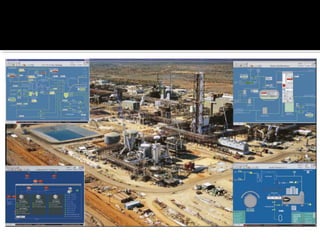
   SCADA provides a complete pictorial overview of
    the entire plant process with necessary monitoring
    and control facilities at a central location

   The control systems are always coupled with Man
    Machine Interface (MMI) or Supervisory Control and
    Data Acquisition Software

   SCADA software is to be connected to PLC / PID /
    DCS systems which in turn are connected to field
    instruments
   Previously without SCADA software, an industrial
    process was entirely controlled by PLC, CNC , PID &
    micro controllers having programmed in certain
    languages or codes.

   These codes were either written in assembly language
    or relay logic without any true animation that would
    explain the process running.

   It is always easy to understand the status of the
    process if it is shown with some animations rather
    than written codes.
   It works like a supervisor who supervises the entire
    plant area, it also controls the process as well as it
    converts the data segments for storing process
    values i.e. level, pressure, switch positions, density,
    temperature, messages, etc

   From a distant place if we want to run the process
    i.e. starting , stopping , opening and closing of field
    instruments, resetting alarms, as well as logging the
    various values; SCADA can help…
 Dynamic process graphic
 Real-time and Historical trending
 Alarms
 Recipe Management
 Security
 Device connectivity
 Script for logic development
 Database connectivity
 Networking
 Using  this feature, one can develop graphics
  which can resemble the plant.
 The  graphics can include reactors, valves,
  pumps, agitators, conveyors as well as other
  equipment and machinery used in the plant.
 The  status of the equipment running/stopped
  can be shown using different colors/animation.
 Typicallythe SCADA software will have many
  ready to use symbols for proper representation
  which can be used in any type of industry.
   This facility is used for representing the data in
    graphical form

   Real-time data will plot the real-time value for fixed
    period of time while historical data will have
    historical data stored value which can be viewed on
    demand

   Depending upon the storing capacity of the hard-
    disk one can specify the no of days the data can be
    stored
   Every plant needs proper monitoring and control of
    the process parameters
   Alarms represent warnings of process conditions
    that could cause problems, and require an operator
    response
   Generally alarms are implemented by using the
    lamps or hooters in field but in SCADA it can be
    represented using animation.
    In many SCADA software, four type of alarm limits
    are used ie HI, HIHI, LOW, LOW LOW
   In many cases we use the same plant for
    manufacturing different product range. For example
    an oil blending plant can manufacture power oil,
    transformer oil, automobile oil.

   The recipe management is facility used for maintain
    various recipes of different products and implement
    it on the process

   The recipe can be stored in a single server and it can
    be fetched by any client server from any area to run
    the process
   Every SCADA software has various levels of security
    for securing the application by avoiding
    unauthorized access
   Depending upon the access level given the
    operator/engineers is allowed to do the task. In
    most of the cases, operators are allowed only to
    operate the plant while maintenance engineers can
    do the application modifications
   The security can be given for individual as well as for
    groups
   Every control hardware has its own communication protocol
    for communicating with different hardware/software. Some
    of the leading communication protocol include Modbus,
    Profibus, Ethernet, Dh+, DH485, Devicenet, Controlnet.

   The SCADA software needs device driver software for
    communication with PLC or other control hardware.

   More the driver software available better is the device
    connectivity. Most of the SCADA software used in the
    industry have connectivity with most of the leading control
    system.
   In many plants, it is important to download the real-
    time information to the MIS. In this case the
    database connectivity is must.
   Many SCADA software don’t have their own
    database. Hence for storage and reporting they use
    third party database like MS Access or SQL
   Script is a way of writing logic in SCADA software.
    Every SCADA software has its own instructions and
    way of writing program.

   Using scripts, one can develop complex
    applications. You can create your own functions to
    suit the process requirement and execution.

   Various types of scripts make project execution
    simpler for programmer.
   In many applications, we have to use more than one
    SCADA software/operator stations. This can be
    achieved by taking the SCADA node on network.

   In many cases Ethernet TCP/IP is commonly used
    for networking.

   In certain cases the SCADA software use proprietary
    networking protocols for networking.
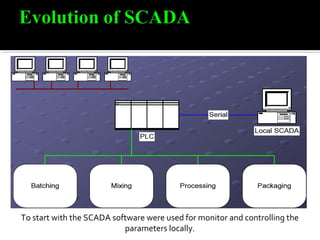
To start with the SCADA software were used for monitor and controlling the
                           parameters locally.
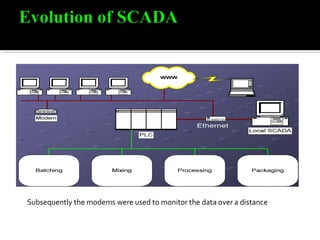
Subsequently the modems were used to monitor the data over a distance
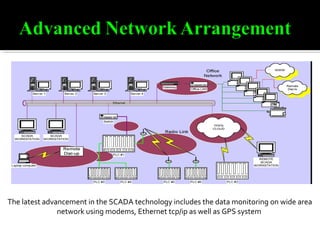
The latest advancement in the SCADA technology includes the data monitoring on wide area
               network using modems, Ethernet tcp/ip as well as GPS system
 Wonderware : InTouch
 Intellution : iFix (Earlier Fix DMACS)
 Allen Bradley : RS View (Earlier Control View)
 Siemens : WinCC (Earlier Coros LS /B )
 GE Fanuc : Cimplicity
 Indusoft : I W S
 Movicon : Progea
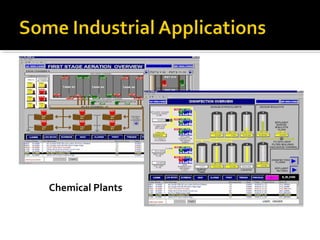
Chemical Plants
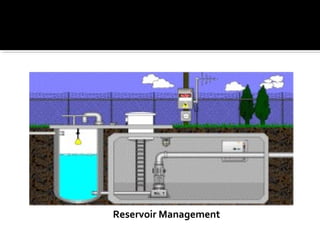
Reservoir Management

123126804 scada

  • 3.
    SCADA provides a complete pictorial overview of the entire plant process with necessary monitoring and control facilities at a central location  The control systems are always coupled with Man Machine Interface (MMI) or Supervisory Control and Data Acquisition Software  SCADA software is to be connected to PLC / PID / DCS systems which in turn are connected to field instruments
  • 4.
    Previously without SCADA software, an industrial process was entirely controlled by PLC, CNC , PID & micro controllers having programmed in certain languages or codes.  These codes were either written in assembly language or relay logic without any true animation that would explain the process running.  It is always easy to understand the status of the process if it is shown with some animations rather than written codes.
  • 5.
    It works like a supervisor who supervises the entire plant area, it also controls the process as well as it converts the data segments for storing process values i.e. level, pressure, switch positions, density, temperature, messages, etc  From a distant place if we want to run the process i.e. starting , stopping , opening and closing of field instruments, resetting alarms, as well as logging the various values; SCADA can help…
  • 6.
     Dynamic processgraphic  Real-time and Historical trending  Alarms  Recipe Management  Security  Device connectivity  Script for logic development  Database connectivity  Networking
  • 7.
     Using this feature, one can develop graphics which can resemble the plant.  The graphics can include reactors, valves, pumps, agitators, conveyors as well as other equipment and machinery used in the plant.  The status of the equipment running/stopped can be shown using different colors/animation.  Typicallythe SCADA software will have many ready to use symbols for proper representation which can be used in any type of industry.
  • 8.
    This facility is used for representing the data in graphical form  Real-time data will plot the real-time value for fixed period of time while historical data will have historical data stored value which can be viewed on demand  Depending upon the storing capacity of the hard- disk one can specify the no of days the data can be stored
  • 9.
    Every plant needs proper monitoring and control of the process parameters  Alarms represent warnings of process conditions that could cause problems, and require an operator response  Generally alarms are implemented by using the lamps or hooters in field but in SCADA it can be represented using animation.  In many SCADA software, four type of alarm limits are used ie HI, HIHI, LOW, LOW LOW
  • 10.
    In many cases we use the same plant for manufacturing different product range. For example an oil blending plant can manufacture power oil, transformer oil, automobile oil.  The recipe management is facility used for maintain various recipes of different products and implement it on the process  The recipe can be stored in a single server and it can be fetched by any client server from any area to run the process
  • 11.
    Every SCADA software has various levels of security for securing the application by avoiding unauthorized access  Depending upon the access level given the operator/engineers is allowed to do the task. In most of the cases, operators are allowed only to operate the plant while maintenance engineers can do the application modifications  The security can be given for individual as well as for groups
  • 12.
    Every control hardware has its own communication protocol for communicating with different hardware/software. Some of the leading communication protocol include Modbus, Profibus, Ethernet, Dh+, DH485, Devicenet, Controlnet.  The SCADA software needs device driver software for communication with PLC or other control hardware.  More the driver software available better is the device connectivity. Most of the SCADA software used in the industry have connectivity with most of the leading control system.
  • 13.
    In many plants, it is important to download the real- time information to the MIS. In this case the database connectivity is must.  Many SCADA software don’t have their own database. Hence for storage and reporting they use third party database like MS Access or SQL
  • 14.
    Script is a way of writing logic in SCADA software. Every SCADA software has its own instructions and way of writing program.  Using scripts, one can develop complex applications. You can create your own functions to suit the process requirement and execution.  Various types of scripts make project execution simpler for programmer.
  • 15.
    In many applications, we have to use more than one SCADA software/operator stations. This can be achieved by taking the SCADA node on network.  In many cases Ethernet TCP/IP is commonly used for networking.  In certain cases the SCADA software use proprietary networking protocols for networking.
  • 16.
    To start withthe SCADA software were used for monitor and controlling the parameters locally.
  • 17.
    Subsequently the modemswere used to monitor the data over a distance
  • 18.
    The latest advancementin the SCADA technology includes the data monitoring on wide area network using modems, Ethernet tcp/ip as well as GPS system
  • 19.
     Wonderware :InTouch  Intellution : iFix (Earlier Fix DMACS)  Allen Bradley : RS View (Earlier Control View)  Siemens : WinCC (Earlier Coros LS /B )  GE Fanuc : Cimplicity  Indusoft : I W S  Movicon : Progea
  • 20.
  • 21.