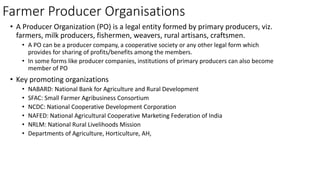
Towards viable
Farmer Producer Organisations
Ramanjaneyulu
Farmer Producer Organisations
• A Producer Organization (PO) is a legal entity formed by primary producers, viz.
farmers, milk producers, fishermen, weavers, rural artisans, craftsmen.
• A PO can be a producer company, a cooperative society or any other legal form which
provides for sharing of profits/benefits among the members.
• In some forms like producer companies, institutions of primary producers can also become
member of PO
• Key promoting organizations
• NABARD: National Bank for Agriculture and Rural Development
• SFAC: Small Farmer Agribusiness Consortium
• NCDC: National Cooperative Development Corporation
• NAFED: National Agricultural Cooperative Marketing Federation of India
• NRLM: National Rural Livelihoods Mission
• Departments of Agriculture, Horticulture, AH,
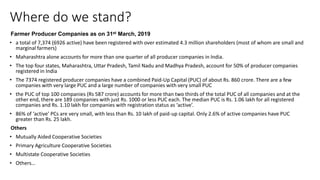
Where do we stand?
Farmer Producer Companies as on 31st March, 2019
• a total of 7,374 (6926 active) have been registered with over estimated 4.3 million shareholders (most of whom are small and
marginal farmers)
• Maharashtra alone accounts for more than one quarter of all producer companies in India.
• The top four states, Maharashtra, Uttar Pradesh, Tamil Nadu and Madhya Pradesh, account for 50% of producer companies
registered in India
• The 7374 registered producer companies have a combined Paid-Up Capital (PUC) of about Rs. 860 crore. There are a few
companies with very large PUC and a large number of companies with very small PUC
• the PUC of top 100 companies (Rs 587 crore) accounts for more than two thirds of the total PUC of all companies and at the
other end, there are 189 companies with just Rs. 1000 or less PUC each. The median PUC is Rs. 1.06 lakh for all registered
companies and Rs. 1.10 lakh for companies with registration status as ‘active’.
• 86% of ‘active’ PCs are very small, with less than Rs. 10 lakh of paid-up capital. Only 2.6% of active companies have PUC
greater than Rs. 25 lakh.
Others
• Mutually Aided Cooperative Societies
• Primary Agriculture Cooperative Societies
• Multistate Cooperative Societies
• Others…
Key challenges
• Access to capital
• Long time to mature
• Lack of infrastructure and human resources
• Meagre support
• Duplication of efforts
• Weak support systems
• No better access to tenant farmers
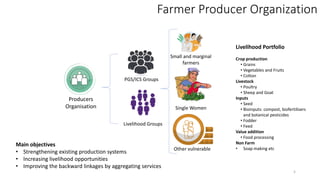
Farmer Producer Organization
5
Small and marginal
farmers
Single Women
Other vulnerable
PGS/ICS Groups
Livelihood Groups
Producers
Organisation
Livelihood Portfolio
Crop production
• Grains
• Vegetables and Fruits
• Cotton
Livestock
• Poultry
• Sheep and Goat
Inputs
• Seed
• Bioinputs: compost, biofertilisers
and botanical pesticides
• Fodder
• Feed
Value addition
• Food processing
Non Farm
• Soap making etc
Main objectives
• Strengthening existing production systems
• Increasing livelihood opportunities
• Improving the backward linkages by aggregating services
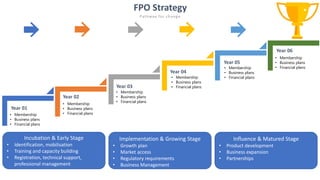
FPO Strategy
Pathway for change
Year 01
Year 02
Year 03
Year 04
Year 05
Year 06
• Membership
• Business plans
• Financial plans
Incubation & Early Stage
• Identification, mobilisation
• Training and capacity building
• Registration, technical support,
professional management
Implementation & Growing Stage
• Growth plan
• Market access
• Regulatory requirements
• Business Management
Influence & Matured Stage
• Product development
• Business expansion
• Partnerships
• Membership
• Business plans
• Financial plans
• Membership
• Business plans
• Financial plans
• Membership
• Business plans
• Financial plans
• Membership
• Business plans
• Financial plans
• Membership
• Business plans
• Financial plans
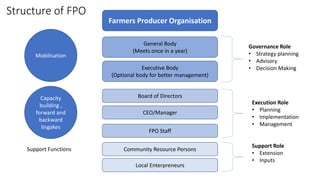
Structure of FPO
Farmers Producer Organisation
General Body
(Meets once in a year)
Executive Body
(Optional body for better management)
Board of Directors
CEO/Manager
Governance Role
• Strategy planning
• Advisory
• Decision Making
Execution Role
• Planning
• Implementation
• Management
FPO Staff
Community Resource Persons
Support Role
• Extension
• Inputs
Local Enterpreneurs
Mobilisation
Capacity
building ,
forward and
backward
lingakes
Support Functions
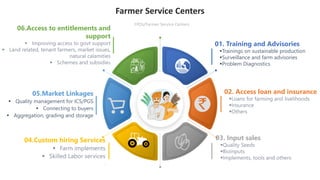
06.Access to entitlements and
support
01. Training and Advisories
▪Trainings on sustainable production
▪Surveillance and farm advisories
▪Problem Diagnostics
04.Custom hiring Services 03. Input sales
02. Access loan and insurance
05.Market Linkages
▪ Quality management for ICS/PGS
▪ Connecting to buyers
▪ Aggregation, grading and storage
Farmer Service Centers
FPOs/Farmer Service Centers
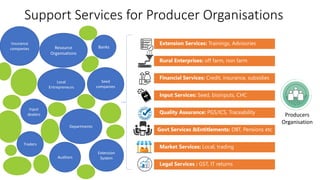
Producers
Organisation
Rural Enterprises: off farm, non farm
Financial Services: Credit, insurance, subsidies
Input Services: Seed, bioinputs, CHC
Quality Assurance: PGS/ICS, Traceability
Market Services: Local, trading
Legal Services : GST, IT returns
Extension Services: Trainings, Advisories
Govt Services &Entitlements: DBT, Pensions etc
Support Services for Producer Organisations
Banks
Insurance
companies
Seed
companies
Input
dealers
Departments
Traders
Extension
System
Auditors
Resource
Organisations
Local
Entrepreneurs
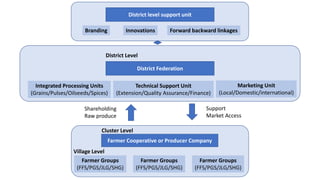
Farmer Cooperative or Producer Company
Farmer Groups
(FFS/PGS/JLG/SHG)
Farmer Groups
(FFS/PGS/JLG/SHG)
Farmer Groups
(FFS/PGS/JLG/SHG)
District Federation
Cluster Level
Village Level
District Level
Integrated Processing Units
(Grains/Pulses/Oilseeds/Spices)
Technical Support Unit
(Extension/Quality Assurance/Finance)
Marketing Unit
(Local/Domestic/international)
Shareholding
Raw produce
Support
Market Access
District level support unit
Branding Innovations Forward backward linkages
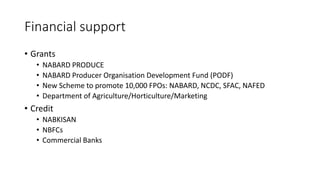
Financial support
• Grants
• NABARD PRODUCE
• NABARD Producer Organisation Development Fund (PODF)
• New Scheme to promote 10,000 FPOs: NABARD, NCDC, SFAC, NAFED
• Department of Agriculture/Horticulture/Marketing
• Credit
• NABKISAN
• NBFCs
• Commercial Banks
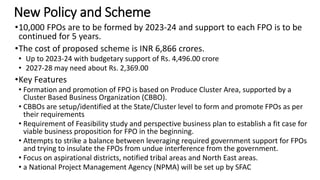
New Policy and Scheme
•10,000 FPOs are to be formed by 2023-24 and support to each FPO is to be
continued for 5 years.
•The cost of proposed scheme is INR 6,866 crores.
• Up to 2023-24 with budgetary support of Rs. 4,496.00 crore
• 2027-28 may need about Rs. 2,369.00
•Key Features
• Formation and promotion of FPO is based on Produce Cluster Area, supported by a
Cluster Based Business Organization (CBBO).
• CBBOs are setup/identified at the State/Cluster level to form and promote FPOs as per
their requirements
• Requirement of Feasibility study and perspective business plan to establish a fit case for
viable business proposition for FPO in the beginning.
• Attempts to strike a balance between leveraging required government support for FPOs
and trying to insulate the FPOs from undue interference from the government.
• Focus on aspirational districts, notified tribal areas and North East areas.
• a National Project Management Agency (NPMA) will be set up by SFAC
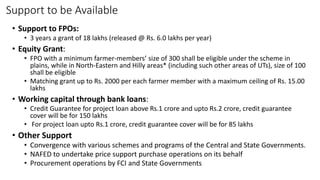
Support to be Available
• Support to FPOs:
• 3 years a grant of 18 lakhs (released @ Rs. 6.0 lakhs per year)
• Equity Grant:
• FPO with a minimum farmer-members’ size of 300 shall be eligible under the scheme in
plains, while in North-Eastern and Hilly areas* (including such other areas of UTs), size of 100
shall be eligible
• Matching grant up to Rs. 2000 per each farmer member with a maximum ceiling of Rs. 15.00
lakhs
• Working capital through bank loans:
• Credit Guarantee for project loan above Rs.1 crore and upto Rs.2 crore, credit guarantee
cover will be for 150 lakhs
• For project loan upto Rs.1 crore, credit guarantee cover will be for 85 lakhs
• Other Support
• Convergence with various schemes and programs of the Central and State Governments.
• NAFED to undertake price support purchase operations on its behalf
• Procurement operations by FCI and State Governments
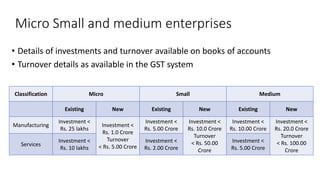
Micro Small and medium enterprises
• Details of investments and turnover available on books of accounts
• Turnover details as available in the GST system
Classification Micro Small Medium
Existing New Existing New Existing New
Manufacturing
Investment <
Rs. 25 lakhs
Investment <
Rs. 1.0 Crore
Turnover
< Rs. 5.00 Crore
Investment <
Rs. 5.00 Crore
Investment <
Rs. 10.0 Crore
Turnover
< Rs. 50.00
Crore
Investment <
Rs. 10.00 Crore
Investment <
Rs. 20.0 Crore
Turnover
< Rs. 100.00
Crore
Services
Investment <
Rs. 10 lakhs
Investment <
Rs. 2.00 Crore
Investment <
Rs. 5.00 Crore
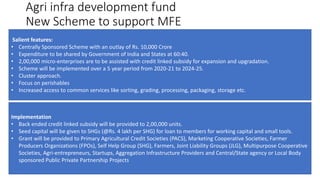
Salient features:
• Centrally Sponsored Scheme with an outlay of Rs. 10,000 Crore
• Expenditure to be shared by Government of India and States at 60:40.
• 2,00,000 micro-enterprises are to be assisted with credit linked subsidy for expansion and upgradation.
• Scheme will be implemented over a 5 year period from 2020-21 to 2024-25.
• Cluster approach.
• Focus on perishables
• Increased access to common services like sorting, grading, processing, packaging, storage etc.
Implementation
• Back ended credit linked subsidy will be provided to 2,00,000 units.
• Seed capital will be given to SHGs (@Rs. 4 lakh per SHG) for loan to members for working capital and small tools.
• Grant will be provided to Primary Agricultural Credit Societies (PACS), Marketing Cooperative Societies, Farmer
Producers Organizations (FPOs), Self Help Group (SHG), Farmers, Joint Liability Groups (JLG), Multipurpose Cooperative
Societies, Agri-entrepreneurs, Startups, Aggregation Infrastructure Providers and Central/State agency or Local Body
sponsored Public Private Partnership Projects
Agri infra development fund
New Scheme to support MFE
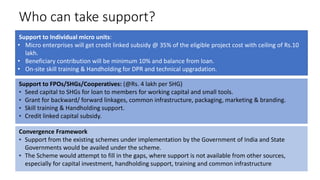
Who can take support?
Support to Individual micro units:
• Micro enterprises will get credit linked subsidy @ 35% of the eligible project cost with ceiling of Rs.10
lakh.
• Beneficiary contribution will be minimum 10% and balance from loan.
• On-site skill training & Handholding for DPR and technical upgradation.
Support to FPOs/SHGs/Cooperatives: (@Rs. 4 lakh per SHG)
▪ Seed capital to SHGs for loan to members for working capital and small tools.
▪ Grant for backward/ forward linkages, common infrastructure, packaging, marketing & branding.
▪ Skill training & Handholding support.
▪ Credit linked capital subsidy.
Convergence Framework
▪ Support from the existing schemes under implementation by the Government of India and State
Governments would be availed under the scheme.
▪ The Scheme would attempt to fill in the gaps, where support is not available from other sources,
especially for capital investment, handholding support, training and common infrastructure
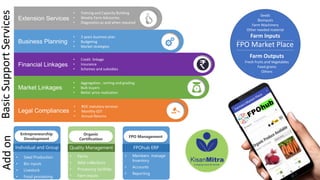
Legal Compliances
Extension Services
Business Planning
Market Linkages
Financial Linkages
• Training and Capacity Building
• Weekly Farm Advisories
• Diagnostics as and when required
• Credit linkage
• Insurance
• Schemes and subsidies
• Aggregation , sorting and grading
• Bulk buyers
• Better price realisation
• 3 years business plan
• Budgeting
• Market strategies
• ROC statutory services
• Monthly GST
• Annual Returns
Basic
Support
Services
FPO Market Place
Seeds
Bioinputs
Farm Machinery
Other needed material
Farm Inputs
Farm Outputs
Fresh fruits and Vegetables
Food grains
Others
Entrepreneurship
Development
Individual and Group
• Seed Production
• Bio inputs
• Livestock
• Food processing
Organic
Certification
Quality Management
• Farms
• Wild collections
• Processing facilities
• Farm Inputs
FPO Management
FPOhub ERP
• Members manage
Inventory
• Accounts
• Reporting
Add
on
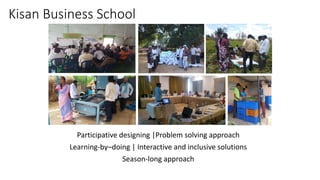
Kisan Business School
Participative designing |Problem solving approach
Learning-by–doing | Interactive and inclusive solutions
Season-long approach
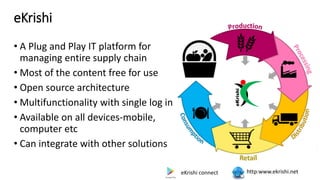
eKrishi
• A Plug and Play IT platform for
managing entire supply chain
• Most of the content free for use
• Open source architecture
• Multifunctionality with single log in
• Available on all devices-mobile,
computer etc
• Can integrate with other solutions
http:www.ekrishi.net
eKrishi connect
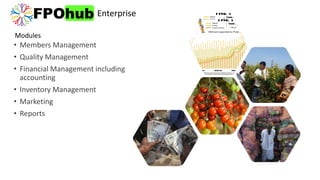
Modules
• Members Management
• Quality Management
• Financial Management including
accounting
• Inventory Management
• Marketing
• Reports
Enterprise
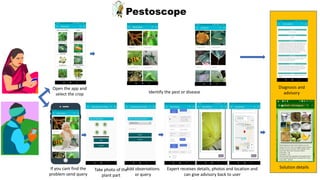
Open the app and
select the crop Identify the pest or disease
Diagnosis and
advisory
Solution details
If you cant find the
problem send query
Take photo of the
plant part
Add observations
or query
Expert receives details, photos and location and
can give advisory back to user
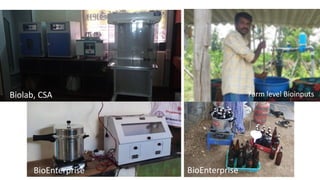
Biolab, CSA Farm level Bioinputs
BioEnterprise BioEnterprise
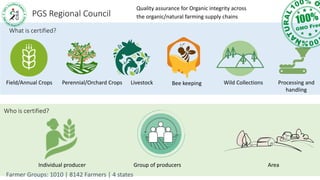
What is certified?
Quality assurance for Organic integrity across
the organic/natural farming supply chains
Field/Annual Crops Wild Collections
Perennial/Orchard Crops Processing and
handling
Livestock Bee keeping
Who is certified?
Individual producer Group of producers Area
Farmer Groups: 1010 | 8142 Farmers | 4 states
PGS Regional Council
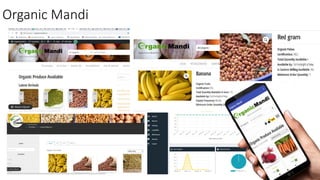
Organic Mandi
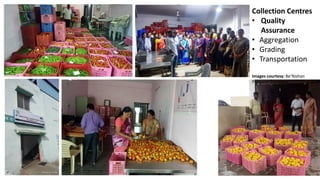
Collection Centres
• Quality
Assurance
• Aggregation
• Grading
• Transportation
Images courtesy: Be’Nishan
Producer Company
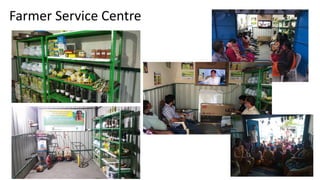
Farmer Service Centre
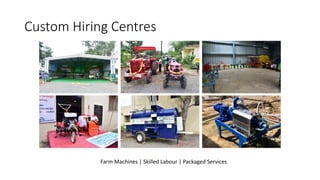
Custom Hiring Centres
Farm Machines | Skilled Labour | Packaged Services
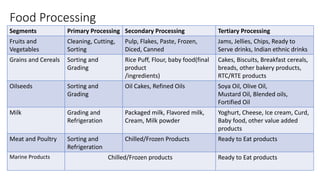
Food Processing
Segments Primary Processing Secondary Processing Tertiary Processing
Fruits and
Vegetables
Cleaning, Cutting,
Sorting
Pulp, Flakes, Paste, Frozen,
Diced, Canned
Jams, Jellies, Chips, Ready to
Serve drinks, Indian ethnic drinks
Grains and Cereals Sorting and
Grading
Rice Puff, Flour, baby food(final
product
/ingredients)
Cakes, Biscuits, Breakfast cereals,
breads, other bakery products,
RTC/RTE products
Oilseeds Sorting and
Grading
Oil Cakes, Refined Oils Soya Oil, Olive Oil,
Mustard Oil, Blended oils,
Fortified Oil
Milk Grading and
Refrigeration
Packaged milk, Flavored milk,
Cream, Milk powder
Yoghurt, Cheese, Ice cream, Curd,
Baby food, other value added
products
Meat and Poultry Sorting and
Refrigeration
Chilled/Frozen Products Ready to Eat products
Marine Products Chilled/Frozen products Ready to Eat products
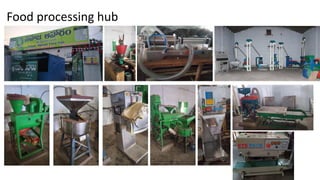
Food processing hub
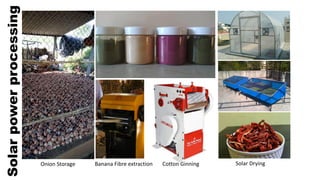
Solar
power
processing
Onion Storage Banana Fibre extraction Cotton Ginning Solar Drying
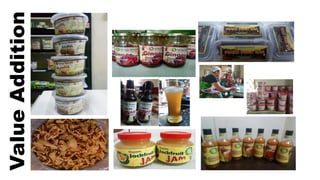
Value
Addition
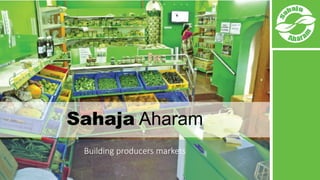
Sahaja Aharam
Building producers markets
33
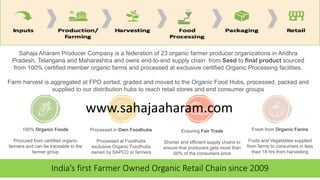
India’s first Farmer Owned Organic Retail Chain since 2009
Sahaja Aharam Producer Company is a federation of 23 organic farmer producer organizations in Andhra
Pradesh, Telangana and Maharashtra and owns end-to-end supply chain from Seed to final product sourced
from 100% certified member organic farms and processed at exclusive certified Organic Processing facilities.
Farm harvest is aggregated at FPO sorted, graded and moved to the Organic Food Hubs, processed, packed and
supplied to our distribution hubs to reach retail stores and end consumer groups
100% Organic Foods
Procured from certified organic
farmers and can be traceable to the
farmer group
Processed in Own Foodhubs
Processed at Foodhubs
exclusive Organic Foodhubs
owned by SAPCO or farmers
Ensuring Fair Trade
Shorter and efficient supply chains to
ensure that producers gets more than
50% of the consumers price
Fresh from Organic Farms
Fruits and Vegetables supplied
from farms to consumers in less
than 18 hrs from harvesting
www.sahajaaharam.com
3
4
Thank you
35
http://www.csa-india.org http://www.sahajaaharam.com http://www.grameenacademy.in
Call on 8500 68 3300
8500 78 3300
8500 98 3300
csa@csa-india.org
pgs@csa-india.org
info@sahajaaharam.in
organicmandi@csa-india.org
grameen@csa-india.org

210123 towards viable FPOs

  • 1.
    Towards viable Farmer ProducerOrganisations Ramanjaneyulu
  • 2.
    Farmer Producer Organisations •A Producer Organization (PO) is a legal entity formed by primary producers, viz. farmers, milk producers, fishermen, weavers, rural artisans, craftsmen. • A PO can be a producer company, a cooperative society or any other legal form which provides for sharing of profits/benefits among the members. • In some forms like producer companies, institutions of primary producers can also become member of PO • Key promoting organizations • NABARD: National Bank for Agriculture and Rural Development • SFAC: Small Farmer Agribusiness Consortium • NCDC: National Cooperative Development Corporation • NAFED: National Agricultural Cooperative Marketing Federation of India • NRLM: National Rural Livelihoods Mission • Departments of Agriculture, Horticulture, AH,
  • 3.
    Where do westand? Farmer Producer Companies as on 31st March, 2019 • a total of 7,374 (6926 active) have been registered with over estimated 4.3 million shareholders (most of whom are small and marginal farmers) • Maharashtra alone accounts for more than one quarter of all producer companies in India. • The top four states, Maharashtra, Uttar Pradesh, Tamil Nadu and Madhya Pradesh, account for 50% of producer companies registered in India • The 7374 registered producer companies have a combined Paid-Up Capital (PUC) of about Rs. 860 crore. There are a few companies with very large PUC and a large number of companies with very small PUC • the PUC of top 100 companies (Rs 587 crore) accounts for more than two thirds of the total PUC of all companies and at the other end, there are 189 companies with just Rs. 1000 or less PUC each. The median PUC is Rs. 1.06 lakh for all registered companies and Rs. 1.10 lakh for companies with registration status as ‘active’. • 86% of ‘active’ PCs are very small, with less than Rs. 10 lakh of paid-up capital. Only 2.6% of active companies have PUC greater than Rs. 25 lakh. Others • Mutually Aided Cooperative Societies • Primary Agriculture Cooperative Societies • Multistate Cooperative Societies • Others…
  • 4.
    Key challenges • Accessto capital • Long time to mature • Lack of infrastructure and human resources • Meagre support • Duplication of efforts • Weak support systems • No better access to tenant farmers
  • 5.
    Farmer Producer Organization 5 Smalland marginal farmers Single Women Other vulnerable PGS/ICS Groups Livelihood Groups Producers Organisation Livelihood Portfolio Crop production • Grains • Vegetables and Fruits • Cotton Livestock • Poultry • Sheep and Goat Inputs • Seed • Bioinputs: compost, biofertilisers and botanical pesticides • Fodder • Feed Value addition • Food processing Non Farm • Soap making etc Main objectives • Strengthening existing production systems • Increasing livelihood opportunities • Improving the backward linkages by aggregating services
  • 6.
    FPO Strategy Pathway forchange Year 01 Year 02 Year 03 Year 04 Year 05 Year 06 • Membership • Business plans • Financial plans Incubation & Early Stage • Identification, mobilisation • Training and capacity building • Registration, technical support, professional management Implementation & Growing Stage • Growth plan • Market access • Regulatory requirements • Business Management Influence & Matured Stage • Product development • Business expansion • Partnerships • Membership • Business plans • Financial plans • Membership • Business plans • Financial plans • Membership • Business plans • Financial plans • Membership • Business plans • Financial plans • Membership • Business plans • Financial plans
  • 7.
    Structure of FPO FarmersProducer Organisation General Body (Meets once in a year) Executive Body (Optional body for better management) Board of Directors CEO/Manager Governance Role • Strategy planning • Advisory • Decision Making Execution Role • Planning • Implementation • Management FPO Staff Community Resource Persons Support Role • Extension • Inputs Local Enterpreneurs Mobilisation Capacity building , forward and backward lingakes Support Functions
  • 8.
    06.Access to entitlementsand support 01. Training and Advisories ▪Trainings on sustainable production ▪Surveillance and farm advisories ▪Problem Diagnostics 04.Custom hiring Services 03. Input sales 02. Access loan and insurance 05.Market Linkages ▪ Quality management for ICS/PGS ▪ Connecting to buyers ▪ Aggregation, grading and storage Farmer Service Centers FPOs/Farmer Service Centers
  • 9.
    Producers Organisation Rural Enterprises: offfarm, non farm Financial Services: Credit, insurance, subsidies Input Services: Seed, bioinputs, CHC Quality Assurance: PGS/ICS, Traceability Market Services: Local, trading Legal Services : GST, IT returns Extension Services: Trainings, Advisories Govt Services &Entitlements: DBT, Pensions etc Support Services for Producer Organisations Banks Insurance companies Seed companies Input dealers Departments Traders Extension System Auditors Resource Organisations Local Entrepreneurs
  • 10.
    Farmer Cooperative orProducer Company Farmer Groups (FFS/PGS/JLG/SHG) Farmer Groups (FFS/PGS/JLG/SHG) Farmer Groups (FFS/PGS/JLG/SHG) District Federation Cluster Level Village Level District Level Integrated Processing Units (Grains/Pulses/Oilseeds/Spices) Technical Support Unit (Extension/Quality Assurance/Finance) Marketing Unit (Local/Domestic/international) Shareholding Raw produce Support Market Access District level support unit Branding Innovations Forward backward linkages
  • 11.
    Financial support • Grants •NABARD PRODUCE • NABARD Producer Organisation Development Fund (PODF) • New Scheme to promote 10,000 FPOs: NABARD, NCDC, SFAC, NAFED • Department of Agriculture/Horticulture/Marketing • Credit • NABKISAN • NBFCs • Commercial Banks
  • 12.
    New Policy andScheme •10,000 FPOs are to be formed by 2023-24 and support to each FPO is to be continued for 5 years. •The cost of proposed scheme is INR 6,866 crores. • Up to 2023-24 with budgetary support of Rs. 4,496.00 crore • 2027-28 may need about Rs. 2,369.00 •Key Features • Formation and promotion of FPO is based on Produce Cluster Area, supported by a Cluster Based Business Organization (CBBO). • CBBOs are setup/identified at the State/Cluster level to form and promote FPOs as per their requirements • Requirement of Feasibility study and perspective business plan to establish a fit case for viable business proposition for FPO in the beginning. • Attempts to strike a balance between leveraging required government support for FPOs and trying to insulate the FPOs from undue interference from the government. • Focus on aspirational districts, notified tribal areas and North East areas. • a National Project Management Agency (NPMA) will be set up by SFAC
  • 13.
    Support to beAvailable • Support to FPOs: • 3 years a grant of 18 lakhs (released @ Rs. 6.0 lakhs per year) • Equity Grant: • FPO with a minimum farmer-members’ size of 300 shall be eligible under the scheme in plains, while in North-Eastern and Hilly areas* (including such other areas of UTs), size of 100 shall be eligible • Matching grant up to Rs. 2000 per each farmer member with a maximum ceiling of Rs. 15.00 lakhs • Working capital through bank loans: • Credit Guarantee for project loan above Rs.1 crore and upto Rs.2 crore, credit guarantee cover will be for 150 lakhs • For project loan upto Rs.1 crore, credit guarantee cover will be for 85 lakhs • Other Support • Convergence with various schemes and programs of the Central and State Governments. • NAFED to undertake price support purchase operations on its behalf • Procurement operations by FCI and State Governments
  • 14.
    Micro Small andmedium enterprises • Details of investments and turnover available on books of accounts • Turnover details as available in the GST system Classification Micro Small Medium Existing New Existing New Existing New Manufacturing Investment < Rs. 25 lakhs Investment < Rs. 1.0 Crore Turnover < Rs. 5.00 Crore Investment < Rs. 5.00 Crore Investment < Rs. 10.0 Crore Turnover < Rs. 50.00 Crore Investment < Rs. 10.00 Crore Investment < Rs. 20.0 Crore Turnover < Rs. 100.00 Crore Services Investment < Rs. 10 lakhs Investment < Rs. 2.00 Crore Investment < Rs. 5.00 Crore
  • 15.
    Salient features: • CentrallySponsored Scheme with an outlay of Rs. 10,000 Crore • Expenditure to be shared by Government of India and States at 60:40. • 2,00,000 micro-enterprises are to be assisted with credit linked subsidy for expansion and upgradation. • Scheme will be implemented over a 5 year period from 2020-21 to 2024-25. • Cluster approach. • Focus on perishables • Increased access to common services like sorting, grading, processing, packaging, storage etc. Implementation • Back ended credit linked subsidy will be provided to 2,00,000 units. • Seed capital will be given to SHGs (@Rs. 4 lakh per SHG) for loan to members for working capital and small tools. • Grant will be provided to Primary Agricultural Credit Societies (PACS), Marketing Cooperative Societies, Farmer Producers Organizations (FPOs), Self Help Group (SHG), Farmers, Joint Liability Groups (JLG), Multipurpose Cooperative Societies, Agri-entrepreneurs, Startups, Aggregation Infrastructure Providers and Central/State agency or Local Body sponsored Public Private Partnership Projects Agri infra development fund New Scheme to support MFE
  • 16.
    Who can takesupport? Support to Individual micro units: • Micro enterprises will get credit linked subsidy @ 35% of the eligible project cost with ceiling of Rs.10 lakh. • Beneficiary contribution will be minimum 10% and balance from loan. • On-site skill training & Handholding for DPR and technical upgradation. Support to FPOs/SHGs/Cooperatives: (@Rs. 4 lakh per SHG) ▪ Seed capital to SHGs for loan to members for working capital and small tools. ▪ Grant for backward/ forward linkages, common infrastructure, packaging, marketing & branding. ▪ Skill training & Handholding support. ▪ Credit linked capital subsidy. Convergence Framework ▪ Support from the existing schemes under implementation by the Government of India and State Governments would be availed under the scheme. ▪ The Scheme would attempt to fill in the gaps, where support is not available from other sources, especially for capital investment, handholding support, training and common infrastructure
  • 17.
    Legal Compliances Extension Services BusinessPlanning Market Linkages Financial Linkages • Training and Capacity Building • Weekly Farm Advisories • Diagnostics as and when required • Credit linkage • Insurance • Schemes and subsidies • Aggregation , sorting and grading • Bulk buyers • Better price realisation • 3 years business plan • Budgeting • Market strategies • ROC statutory services • Monthly GST • Annual Returns Basic Support Services FPO Market Place Seeds Bioinputs Farm Machinery Other needed material Farm Inputs Farm Outputs Fresh fruits and Vegetables Food grains Others Entrepreneurship Development Individual and Group • Seed Production • Bio inputs • Livestock • Food processing Organic Certification Quality Management • Farms • Wild collections • Processing facilities • Farm Inputs FPO Management FPOhub ERP • Members manage Inventory • Accounts • Reporting Add on
  • 18.
    Kisan Business School Participativedesigning |Problem solving approach Learning-by–doing | Interactive and inclusive solutions Season-long approach
  • 19.
    eKrishi • A Plugand Play IT platform for managing entire supply chain • Most of the content free for use • Open source architecture • Multifunctionality with single log in • Available on all devices-mobile, computer etc • Can integrate with other solutions http:www.ekrishi.net eKrishi connect
  • 20.
    Modules • Members Management •Quality Management • Financial Management including accounting • Inventory Management • Marketing • Reports Enterprise
  • 21.
    Open the appand select the crop Identify the pest or disease Diagnosis and advisory Solution details If you cant find the problem send query Take photo of the plant part Add observations or query Expert receives details, photos and location and can give advisory back to user
  • 22.
    Biolab, CSA Farmlevel Bioinputs BioEnterprise BioEnterprise
  • 23.
    What is certified? Qualityassurance for Organic integrity across the organic/natural farming supply chains Field/Annual Crops Wild Collections Perennial/Orchard Crops Processing and handling Livestock Bee keeping Who is certified? Individual producer Group of producers Area Farmer Groups: 1010 | 8142 Farmers | 4 states PGS Regional Council
  • 24.
  • 25.
    Collection Centres • Quality Assurance •Aggregation • Grading • Transportation Images courtesy: Be’Nishan Producer Company
  • 26.
  • 27.
    Custom Hiring Centres FarmMachines | Skilled Labour | Packaged Services
  • 28.
    Food Processing Segments PrimaryProcessing Secondary Processing Tertiary Processing Fruits and Vegetables Cleaning, Cutting, Sorting Pulp, Flakes, Paste, Frozen, Diced, Canned Jams, Jellies, Chips, Ready to Serve drinks, Indian ethnic drinks Grains and Cereals Sorting and Grading Rice Puff, Flour, baby food(final product /ingredients) Cakes, Biscuits, Breakfast cereals, breads, other bakery products, RTC/RTE products Oilseeds Sorting and Grading Oil Cakes, Refined Oils Soya Oil, Olive Oil, Mustard Oil, Blended oils, Fortified Oil Milk Grading and Refrigeration Packaged milk, Flavored milk, Cream, Milk powder Yoghurt, Cheese, Ice cream, Curd, Baby food, other value added products Meat and Poultry Sorting and Refrigeration Chilled/Frozen Products Ready to Eat products Marine Products Chilled/Frozen products Ready to Eat products
  • 29.
  • 30.
    Solar power processing Onion Storage BananaFibre extraction Cotton Ginning Solar Drying
  • 31.
  • 32.
  • 33.
    33 India’s first FarmerOwned Organic Retail Chain since 2009 Sahaja Aharam Producer Company is a federation of 23 organic farmer producer organizations in Andhra Pradesh, Telangana and Maharashtra and owns end-to-end supply chain from Seed to final product sourced from 100% certified member organic farms and processed at exclusive certified Organic Processing facilities. Farm harvest is aggregated at FPO sorted, graded and moved to the Organic Food Hubs, processed, packed and supplied to our distribution hubs to reach retail stores and end consumer groups 100% Organic Foods Procured from certified organic farmers and can be traceable to the farmer group Processed in Own Foodhubs Processed at Foodhubs exclusive Organic Foodhubs owned by SAPCO or farmers Ensuring Fair Trade Shorter and efficient supply chains to ensure that producers gets more than 50% of the consumers price Fresh from Organic Farms Fruits and Vegetables supplied from farms to consumers in less than 18 hrs from harvesting www.sahajaaharam.com
  • 34.
  • 35.
    Thank you 35 http://www.csa-india.org http://www.sahajaaharam.comhttp://www.grameenacademy.in Call on 8500 68 3300 8500 78 3300 8500 98 3300 csa@csa-india.org pgs@csa-india.org info@sahajaaharam.in organicmandi@csa-india.org grameen@csa-india.org