MANEJO de SUELOS y FERTILIDAD Objetivos generales de la materia : Que el alumno comprenda la necesidad de  planificar el uso  y  manejo de los suelos  de acuerdo a sus  potenciales productivos ,  para poder  prevenir y/o corregir   procesos degradatorios  con el fin de obtener la  máxima eficiencia  a través de una  producción sostenible
S U E L O RECURSO NATURAL NO RENOVABLE, PARTE DEL  “CICLO DE LA VIDA”   EN LA TIERRA.
Basic Soil Plant Relationships Mineral Organic Water Air 45% ~5% 50% MATERIAL SÓLIDO (50%) POROUS MEDIA  (50%)
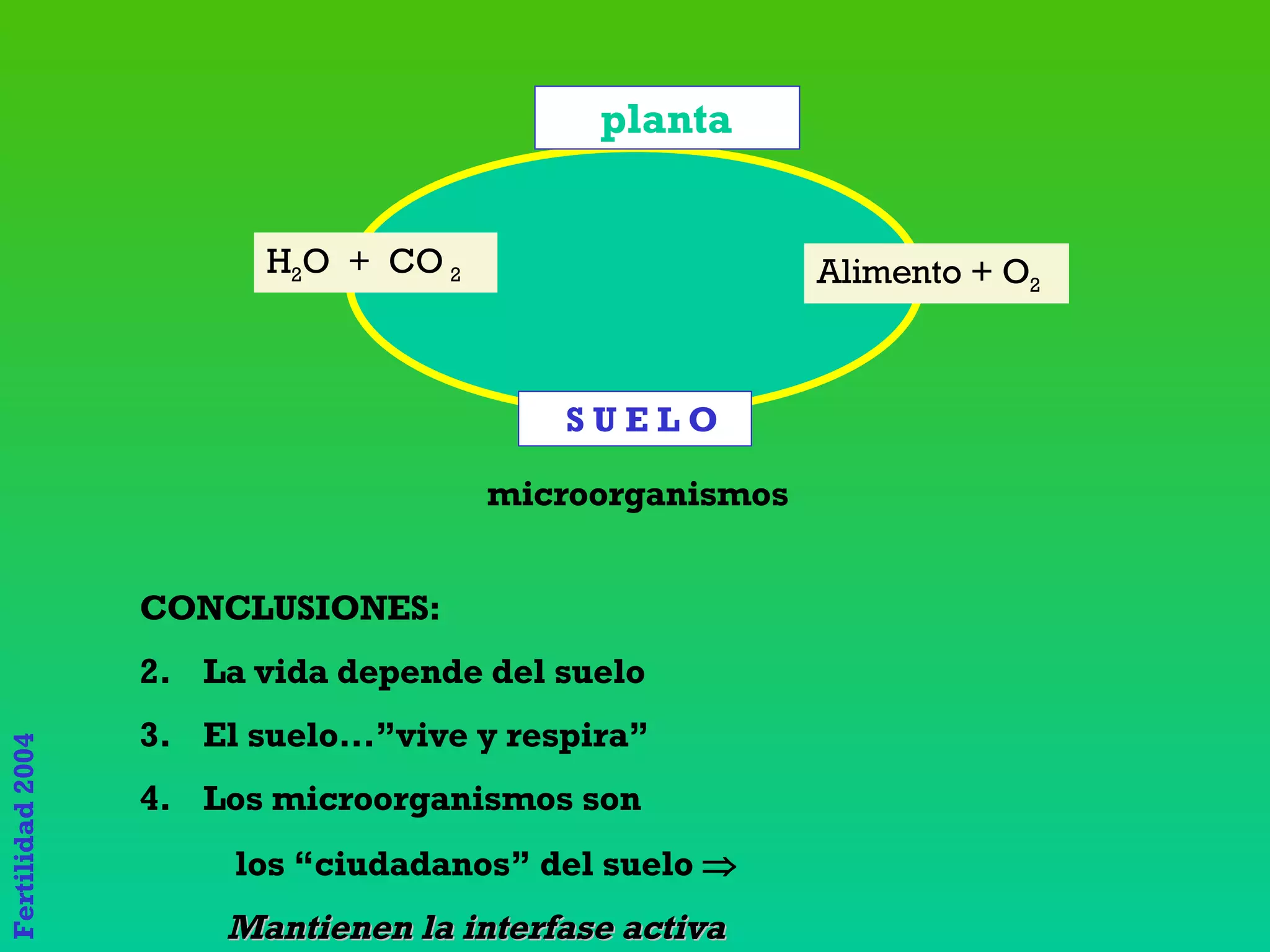
S U E L O planta Alimento + O 2 H 2 O  +  CO  2 microorganismos CONCLUSIONES: La vida depende del suelo El suelo...”vive y respira” Los microorganismos son los “ciudadanos” del suelo   Mantienen la interfase activa
LA AGRICULTURA....  siempre   modifica el funcionamiento natural del suelo: Alteración de los biociclos de los nutrientes Menor retorno de materia orgánica Contínuos stress físicos  (x el laboreo) AGRICULTURA   SOSTENIBLE: conservar  materia orgánica Menor erosión Usar recursos degradables BALANCE PRODUCCIÓN/CONTAMINACIÓN
PRINCIPALES  FUNCIONES DEL SUELO REGULADOR de procesos bióticos (biodiversidad) REGULADOR ciclos y flujos de sustancias y Energía ... Después de numerosos estados retornarán al suelo “ POROUS MEDIA” regula ciclo de agua y el balance calórico REDISTRIBUCIÓN del agua: precipitación ----- infiltración / escorrentía PROTECTOR de la litósfera.
F E R T I L I D A D CAPACIDAD DE PRODUCCIÓN DEL SUELO ( proporcionar a los vegetales los nutrientes para un desarrollo equilibrado) QUE PARA MANIFESTARSE NECESITA LA CONTRIBUCIÓN DE OTROS FACTORES:  -  físicos / -  químicos /  -biológicos  -  fisicoquímicos / -  bioquímicos
F E R T I L I D A D EDÁFICA  (1) CAPACIDAD DEL SUELO PARA SOSTENER Y NUTRIR A LAS PLANTAS ECOLÓGICA  (2) Constituída por los FACTORES EDÁFICOS + EXTRAEDÁFICOS(*) (extrínsecos) (*)  Clima/potencial genético/características del cultivo/acción antrópica, etc...
PRODUCTIVIDAD FACTORES EDÁFICOS + FACT. EXTRAEDÁFICOS CAPACIDAD DE PRODUCCIÓN POR SUPERFICIE CULTIVADA
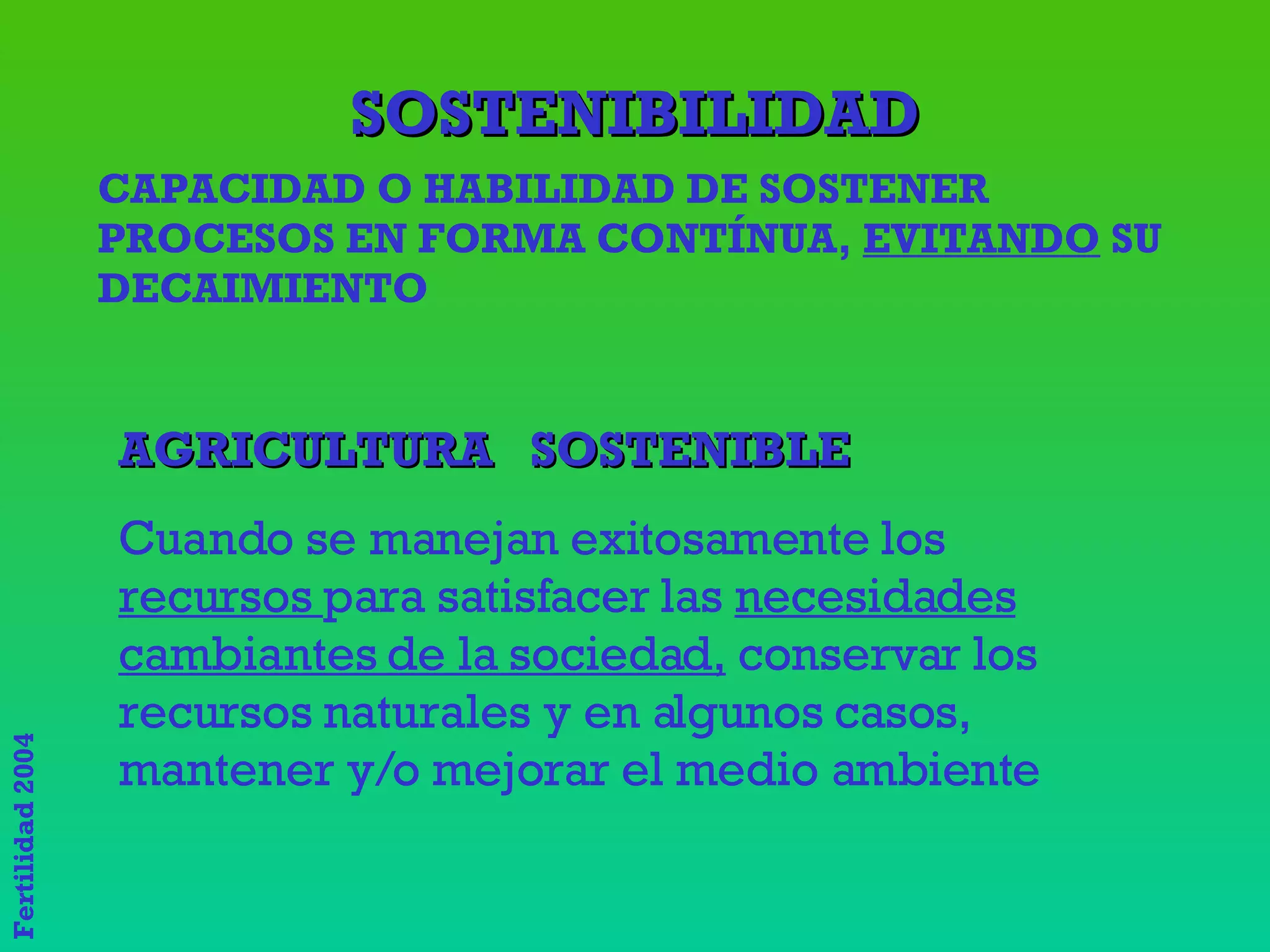
SOSTENIBILIDAD CAPACIDAD O HABILIDAD DE SOSTENER PROCESOS EN FORMA CONTÍNUA,  EVITANDO  SU DECAIMIENTO AGRICULTURA  SOSTENIBLE Cuando se manejan exitosamente los  recursos  para satisfacer las  necesidades cambiantes de la sociedad,  conservar los recursos naturales y en algunos casos, mantener y/o mejorar el medio ambiente
Clasificaciones de la FERTILIDAD EDÁFICA Por su ORIGEN o EVOLUCIÓN Por  su  ASPECTO DINÁMICO
ORIGEN  o  EVOLUCIÓN NATURAL Sobre ella sólo actúan las condiciones de la naturaleza (p.e.: suelos vírgenes) ADQUIRIDA modificada según el manejo, pudiendo ser mayor o menor que la F. Natural (p.e.: suelos cultivados)
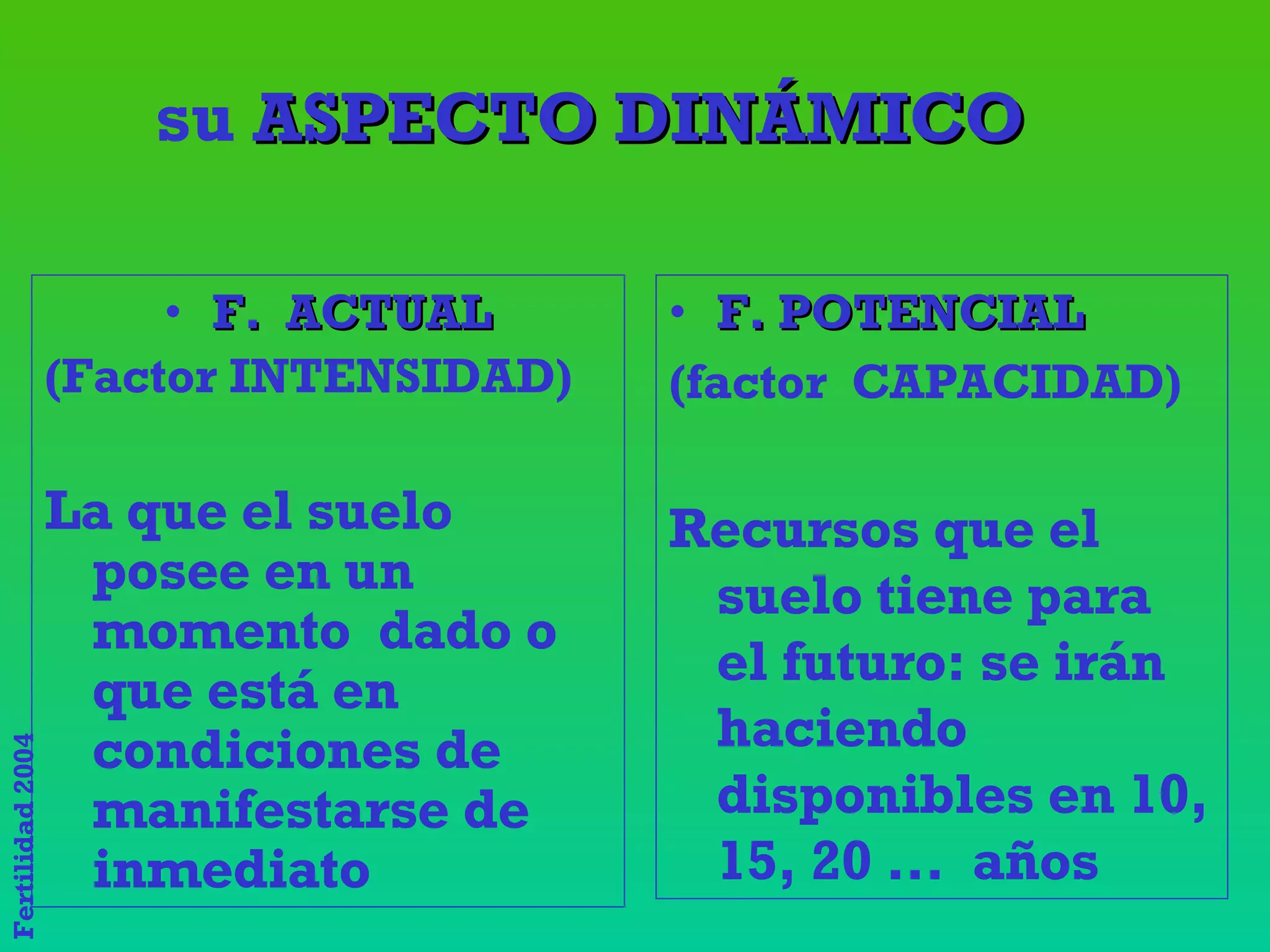
su  ASPECTO DINÁMICO F.  ACTUAL (Factor INTENSIDAD) La que el suelo posee en un momento  dado o que está en condiciones de manifestarse de inmediato F. POTENCIAL (factor  CAPACIDAD) Recursos que el suelo tiene para el futuro: se irán haciendo disponibles en 10, 15, 20 ...  años
1.  Nutrición vegetal??? Tomar los elementos minerales desde el suelo No  se refiere específicamente a la fotosíntesis.
Elementos químicos requeridos por las plantas Esencialmente  requieren  13 elementos minerales para su crecimiento  Estos elementos son necesarios para completar su ciclo y por ello los denominamos  nutrientes vegetales esenciales  Cada uno tendrá una función crítica, y será requerido en cantidades variables.  Estos nutrientes difieren en la forma en que son absorbidos por la planta, por sus funciones en la planta, por su mobilidad en el vegetal (y dentro del suelo) y por los síntomas de deficiencias o toxicidades característicos para cada uno de ellos.
Nombre  % en planta relativo a N  Funciones Macronutrientes (primarios) Nitrogen  N  100  Proteins, amino acids Phosphorus  P  6  Nucleic acids, ATP Potassium  K  25  Catalyst, ion transport Mesonutrientes ( secundarios) Calcium  Ca  12.5  Cell wall component Magnesium  Mg  8  Part of chlorophyll Sulfur  S  3  Amino acids Iron  Fe  0.2  Chlorophyll synthesis Micronutrients  (oligoelementos) Copper  Cu  0.01  Component of enzymes Manganese  Mn  0.1  Activates enzymes Zinc  Zn  0.03  Activates enzymes Boron  B  0.2  Cell wall component Molybdenum  Mo  0.0001  Involved in N fixation Chlorine  Cl  0.3  Photosynthesis reactions
3. Absorción de los minerales desde el suelo Dominant in mineral soils: Dominant in organic soils: A.  Bulk flow:  Uptake in the transpiration stream B.  Mycorrhizae: symbiotic relationship with fungi   Nutrients diffuse to regions of low concentration and roots grow into and proliferate in soil zones with high nutrient concentrations (horse manure in sand). Roots are slow growing but mycorrhizal fungi proliferate and ramify through the soil.  Symbiotic relationship: carbon-nitrogen exchange .
Mineral soils The concentration of dissociated water in freshly-distilled water is  10 -7  M.  This is used to describe acidity-alkalinity, originally called the  pouvoir Hydrogéne,  which we know now as pH.   ACIDEZ DEL SUELO determinará CÓMO estarán disponibles Nutrientes disponibles a través del AGUA DEL SUELO Small quantities of water molecules dissociate : pH = - log [H + ] = - log [10 -7 M] = 7 for fresh distilled water Small values for  acid ,  e.g., the water in Sphagnum bogs can be ~3 Large values for  alkaline ,  e.g., soils on limestone ~8 Suelos Minerales H 2 O   OH -  +  H +
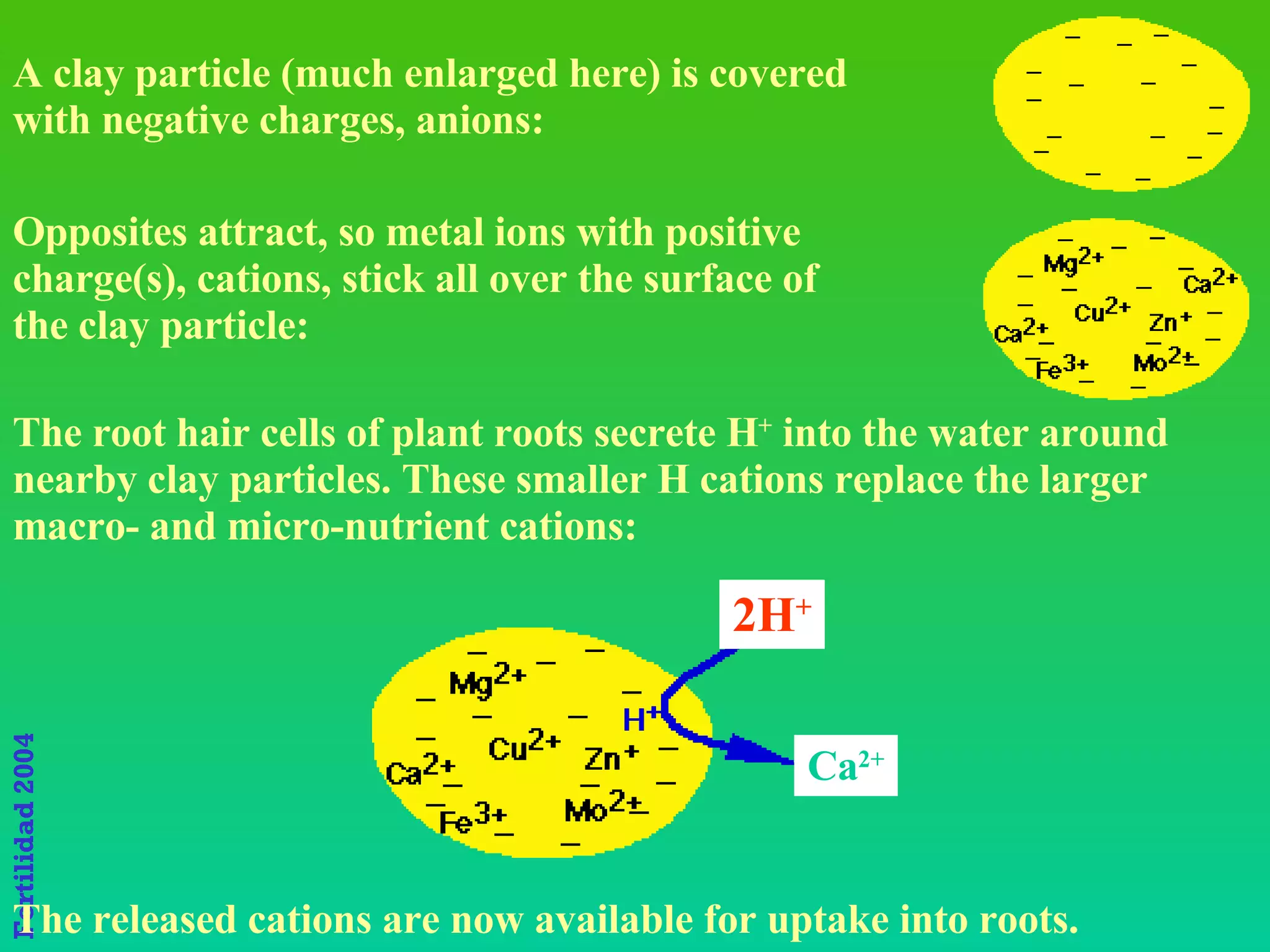
How clay particles provide nutrients The root hair cells of plant roots secrete H +  into the water around nearby clay particles. These smaller H cations replace the larger macro- and micro-nutrient cations:   The released cations are now available for uptake into roots.  A clay particle (much enlarged here) is covered with negative charges, anions:   Opposites attract, so metal ions with positive charge(s), cations, stick all over the surface of the clay particle:  2H + Ca 2+
Summary of soil water chemistry In this summary occurrence of H+ in soil water is shown as the result of respiration of CO 2  and disassociation of carbonic acid H 2 CO 3  that forms Water flow
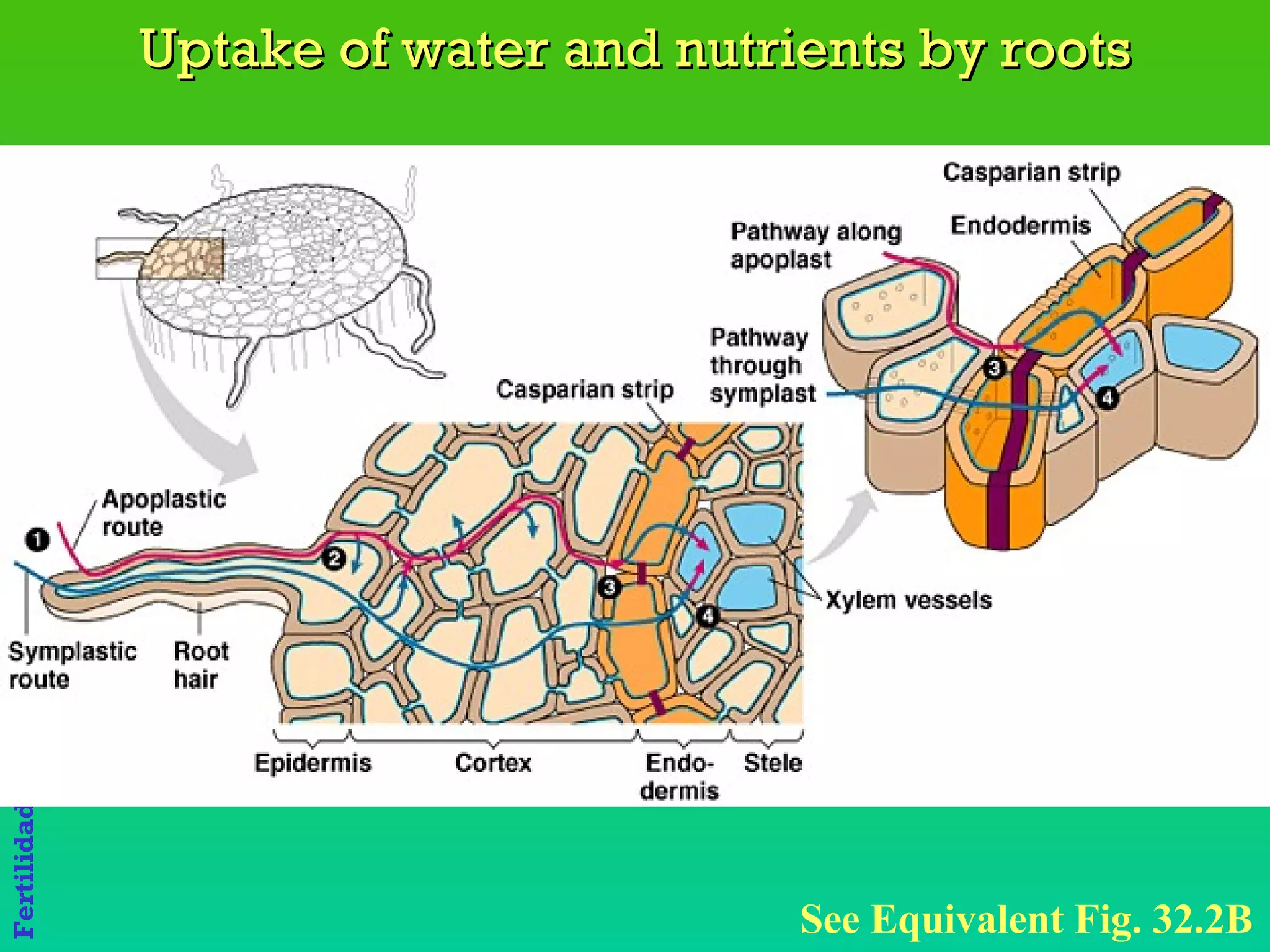
Apoplastic and Symplastic Transport Water and cations can be taken up by roots: apoplastically ,  i.e. through the cell walls and intercellular spaces,  symplastically ,   i.e. from protoplast to protoplast  via  plasmodesmata  However, at the endodermis the apoplastic pathway is blocked by a waxy deposit of the wall called the  Casparian strip .  In some plants is the Casparian strip located in the exodermis so that the apoplastic barrier works sooner.  Recall  transport of sucrose from photosynthesizing cells to phloem
Uptake of water and nutrients by roots See Equivalent Fig. 32.2B
Film clip
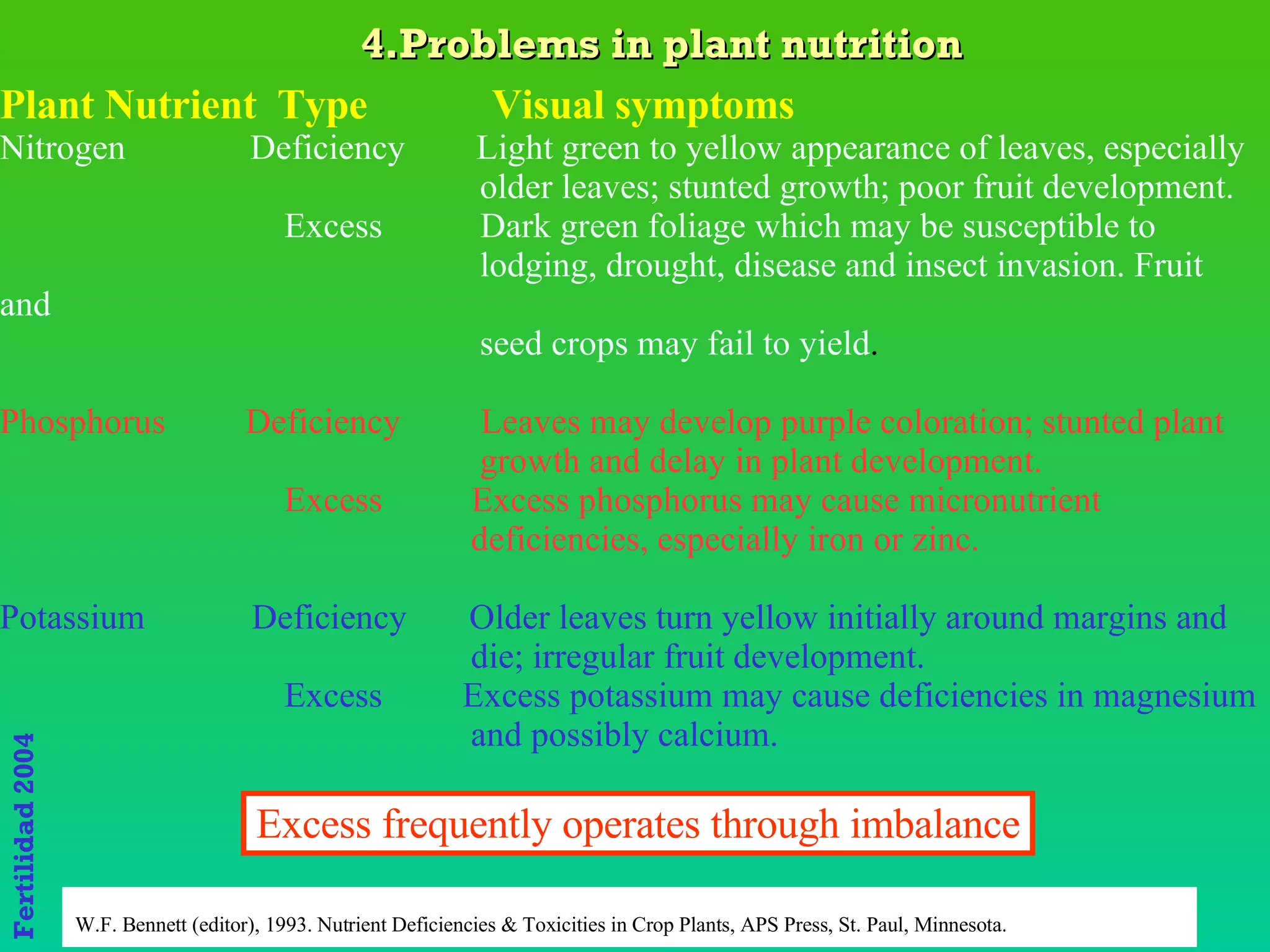
4.Problems in plant nutrition Plant Nutrient  Type  Visual symptoms Nitrogen  Deficiency  Light green to yellow appearance of leaves, especially older leaves; stunted growth; poor fruit development. Excess  Dark green foliage which may be susceptible to  lodging, drought, disease and insect invasion. Fruit and seed crops may fail to yield . Phosphorus  Deficiency  Leaves may develop purple coloration; stunted plant growth and delay in plant development. Excess  Excess phosphorus may cause micronutrient  deficiencies, especially iron or zinc. Potassium  Deficiency  Older leaves turn yellow initially around margins and die; irregular fruit development. Excess  Excess potassium may cause deficiencies in magnesium and possibly calcium. W.F. Bennett (editor), 1993. Nutrient Deficiencies & Toxicities in Crop Plants, APS Press, St. Paul, Minnesota.   Excess frequently operates through imbalance
5.  Nitrogen and the effects of soil organic  matter  on plant nutrition Nitrogen is the element most required by plants, in terms of weight. It is not a product of weathering of soil particles.   There are two sources:  fixation  of atmospheric nitrogen by    bacteria   decomposition  of organic matter,    usually decaying plant material.
N-fixing bacteria Fig. 32.13 Most uptake from the soil is in the form of nitrate
Spodic soil Organic material is important in agricultural soils both as a source of nitrogen and because it can increase water holding capacity, e.g. biosolids application effects A characteristic of non-agricultural soils is accumulation of organic material and acidification of the soil.  Such soils typically develop a very distinct stratification, with organic mater at the top. The organic layers in such soils can have a considerable total quantity of nitrogen but little may be available due to the high acidity, and sometimes lack of oxygen, in the organic layer.
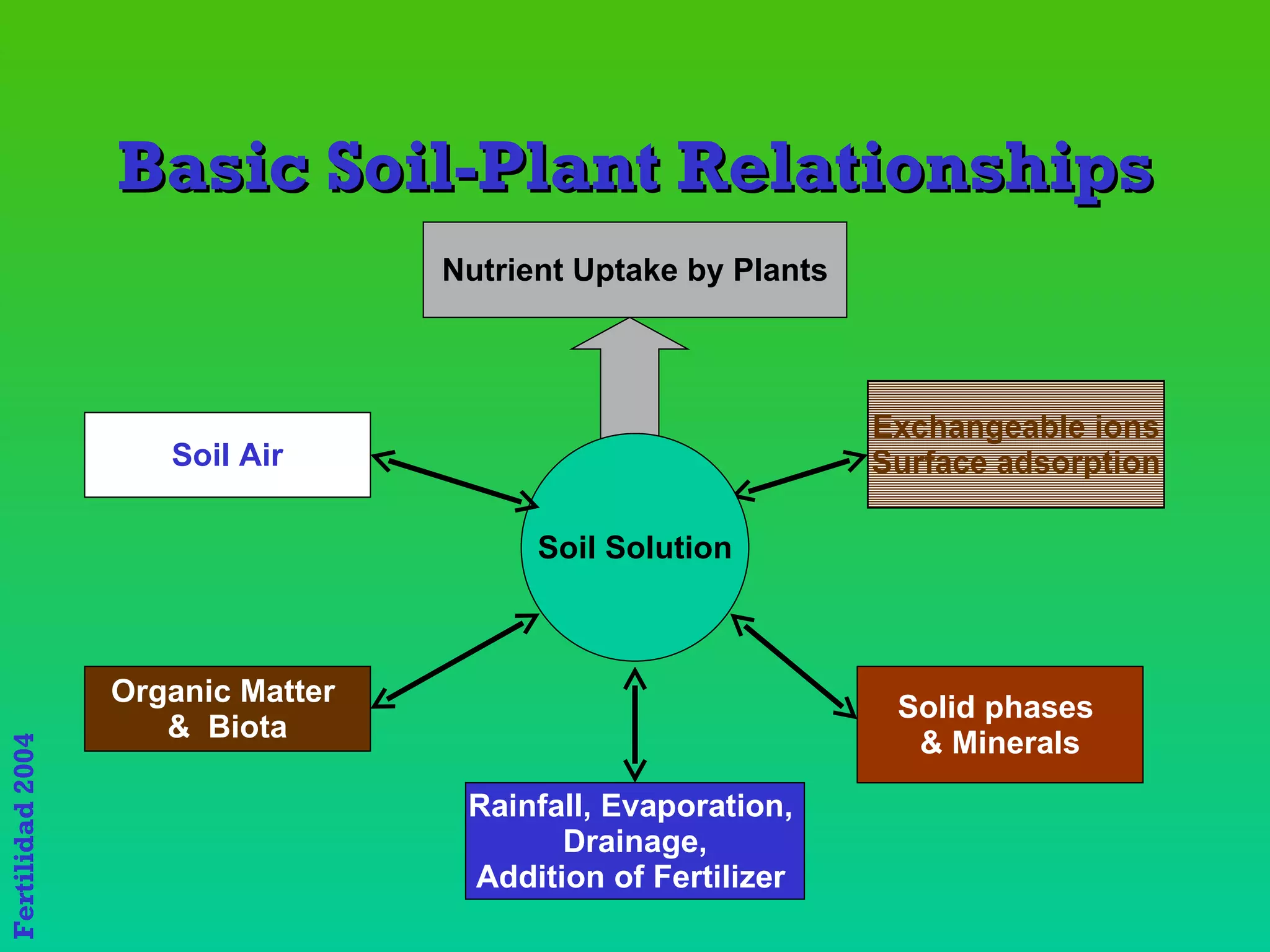
Basic Soil-Plant Relationships Organic Matter  &  Biota Exchangeable ions Surface adsorption Solid phases  & Minerals Nutrient Uptake by Plants Soil Solution Soil Air Rainfall, Evaporation,  Drainage, Addition of Fertilizer
CANTIDAD e INTENSIDAD CANTIDAD (Q) – la cantidad de nutriente en rápido equilibrio con la solución del suelo Intensidad (I) – dada por la actividad o concentración de los iones en solución
CANTIDAD Primary Minerals SiO 2 Fe 2 O 3   Al(OH) 3 CaCO 3  MgCO 3  Mica  (K) Feldspar  (K) Apatite  (P) Secondary Clay Minerals and adsorbed ions Kaolinite Montmorillonite Vermiculite Illite Organic Matter
Cantidad Total – todo lo que hay en el suelo (de  ese  elemento)  Labil – fracción "relativamente" reactiva Soluble – disuelto en la solución del suelo (= Intensidad) Total Labile/ Available Unavailable Available Soluble
Intensidad – Actividad (sn) Dissolved in the soil solution Activity (a)  = effective concentration (C) a =  γ   C  γ  = activity coefficient (0 - 1) A B B B A A Dilute solution  a  ≈ C A  +  B  AB A B B B A A Concentrated solution  a < C A  +  B  AB X X X X X X X X X X Greater the  Ionic Strength  of the solution the lower the activity coefficient
Activity vs Concentration in Soil Solution 0.0085 0.0255 Al 3+ 0.42 0.75 SO 4 2- 4.26 4.98 NH 4 + 2.23 2.60 K + 0.43 0.71 Mg 2+ 0.98 1.68 Ca 2+ mM mM Activity Concentration  Ion
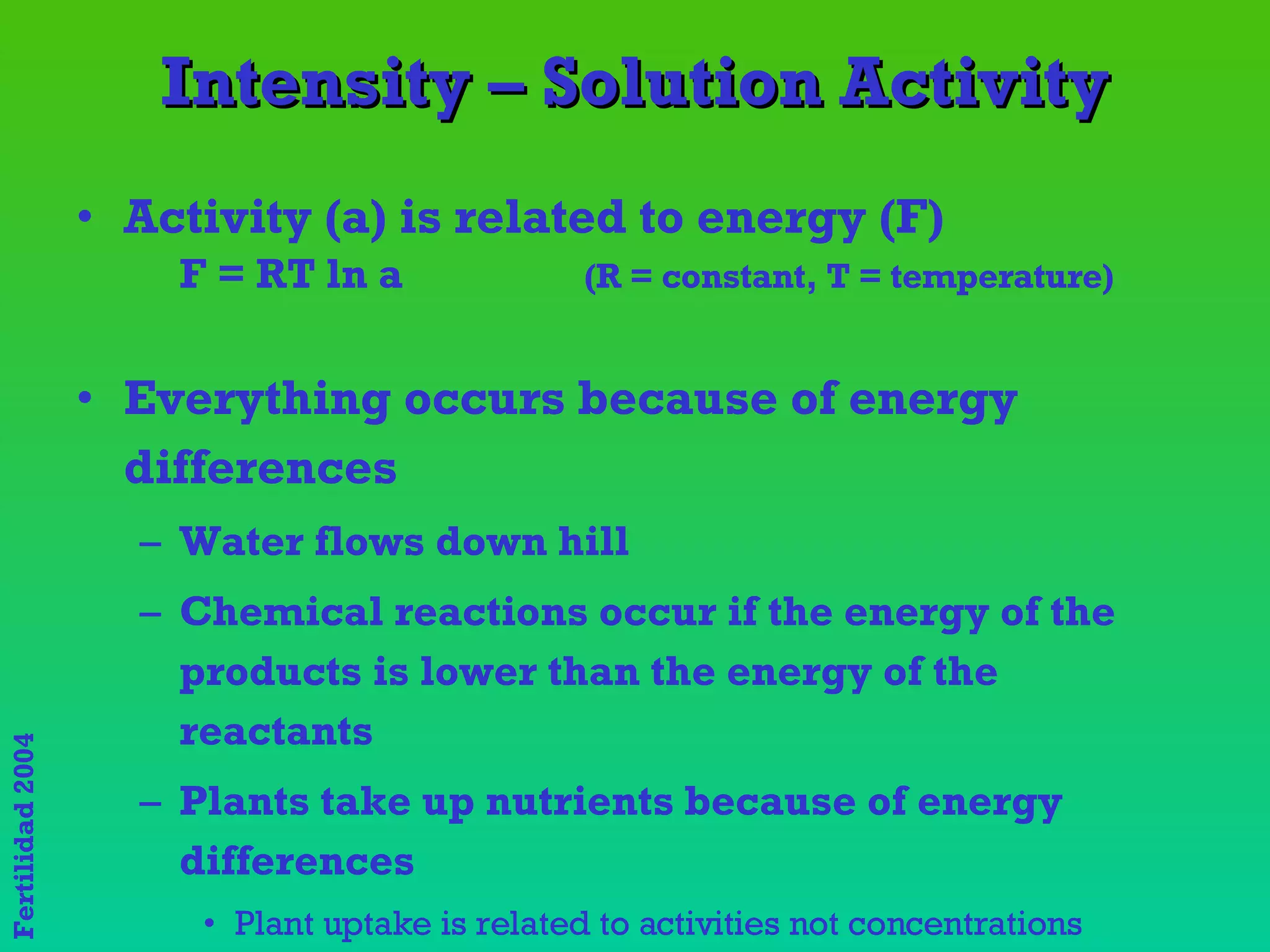
Intensity – Solution Activity Activity (a) is related to energy (F) F = RT ln a  (R = constant, T = temperature) Everything occurs because of energy differences Water flows down hill Chemical reactions occur if the energy of the products is lower than the energy of the reactants Plants take up nutrients because of energy differences  Plant uptake is related to activities not concentrations
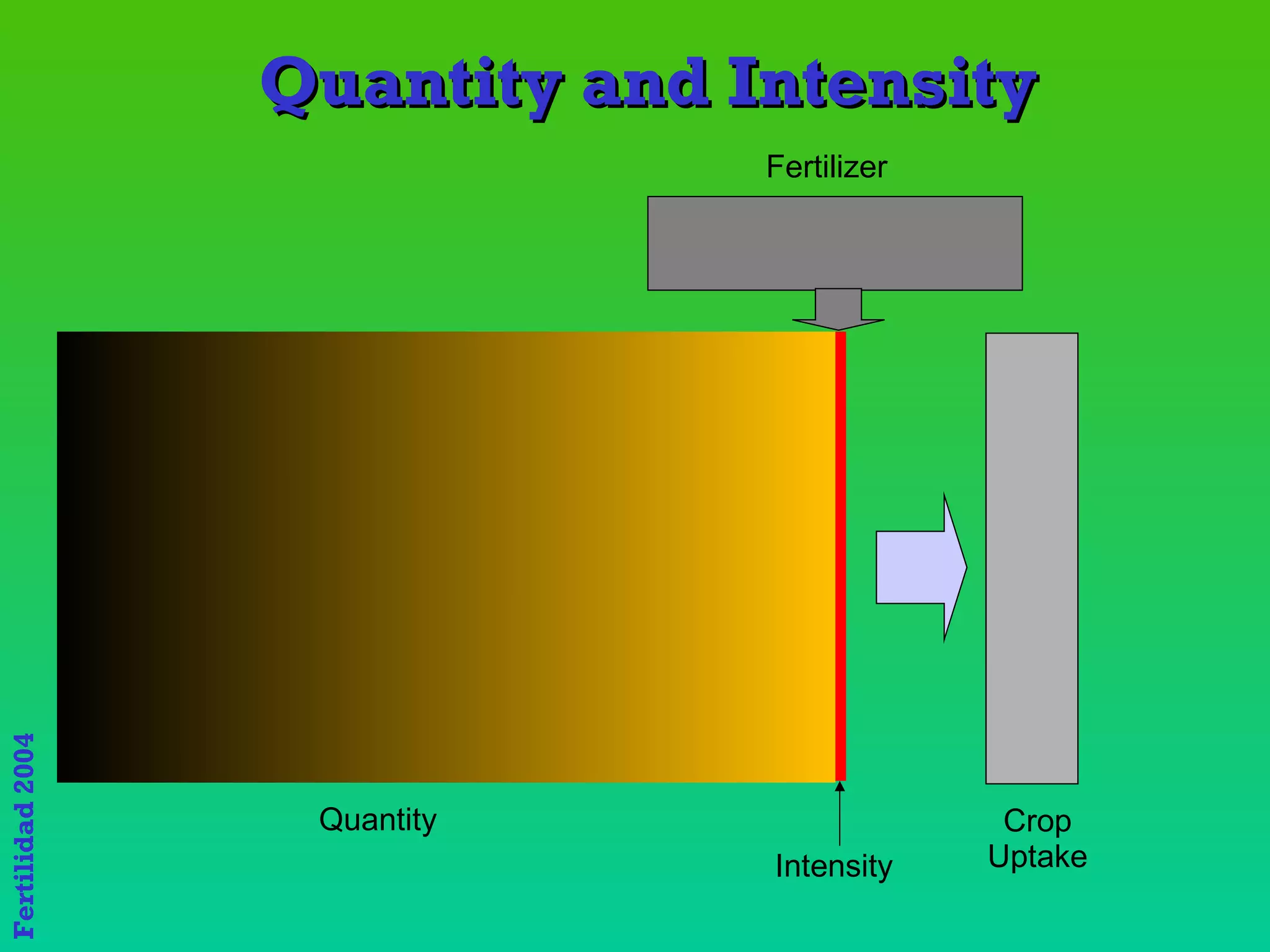
Quantity and Intensity Quantity Intensity Crop Uptake Fertilizer
Buffer Capacity: Chemical reactions occur based on Intensity Plant uptake occurs based on Intensity BUT In a real soil,  Buffer Capacity  determines Intensity because we are not at equilibrium Plants keep removing nutrients and upsetting the equilibrium We keep adding fertilizer and upsetting the equilibrium
Quantity and Intensity >>> Buffer Capacity <<< Quantity Intensity Crop Uptake Fertilizer
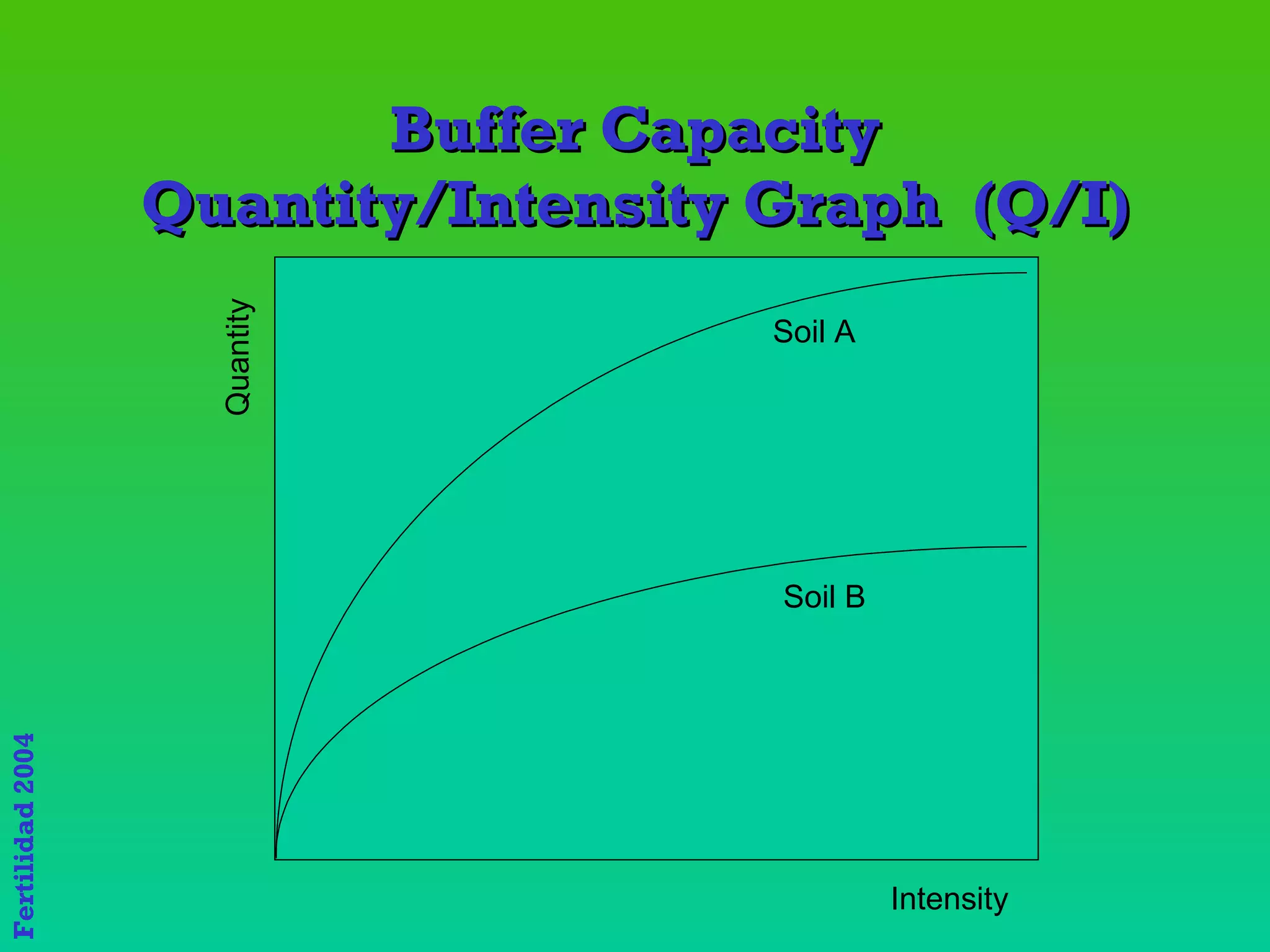
Quantity and Intensity >>> Buffer Capacity <<< Buffer Capacity - Relationship between the quantity and the intensity Buffer capacity  =  ∆ Q /  ∆  I BC ~ 1 little buffering BC >> 1 well buffered
Buffer Capacity Quantity/Intensity Graph  (Q/I) Intensity Quantity Soil A  Soil B
Buffer Capacity Lower Coarse Texture (Sand) Low CEC Low OM Higher Fine Texture (Clay) High CEC High OM Extreme - Fixation P reaction with Fe, Al, Ca K trapped in mica type clays Micronutrient precipitation in high pH soils
Basic Soil-Plant Relationships Organic Matter  &  Biota Exchangeable ions Surface adsorption Solid phases  & Minerals Nutrient Uptake by Plants Soil Solution Soil Air Rainfall, Evaporation,  Drainage, Addition of Fertilizer
The indissoluble link between man and soil is manifest in the very name Adam, derived from Adamiss – a Hebrew noun of feminine gender meaning earth or soil. Adamiss’ name encapsulated ‘maniss,’ meaning origin and destiny: his existence and livelihood derive from the soil to which he is tethered throughout his life and to which he is fated to return at the end of his days. Likewise, the name of Adam’s mate, Hava (rendered ‘Eve’ in translation) literally means ‘living’. Together, therefore, Adam and Eve signify 'Soil and Life.”  from “Out of the Earth: Civilization and the Life of the Soil&quot; by  Dr. Daniel Hillel , professor emeritus of plant, soil, and environmental sciences at the University of Massachusetts, Amherst. existe un vínculo indisoluble y estrecho entre el hombre y el suelo, que se manifiesta en el nombre ADAN, derivado del hebreo ADAMISS(= sustantivo femenino = tierra o suelo);maniss&quot;contenido en Adamiss, significa origen y destino: por lo tanto la vida y existencia del hombre en gral.derivarían del suelo al cual está ligado a traves de su vida y al que está destinado a regresar al final de sus días. De la misma forma, su compañera, HAVA (EVE) literalmente significa vida. De esta forma, ADAN y EVA,---------> SUELO y VIDA SON

P Fertilidad Clase 1 2008

  • 1.
    MANEJO de SUELOSy FERTILIDAD Objetivos generales de la materia : Que el alumno comprenda la necesidad de planificar el uso y manejo de los suelos de acuerdo a sus potenciales productivos , para poder prevenir y/o corregir procesos degradatorios con el fin de obtener la máxima eficiencia a través de una producción sostenible
  • 2.
    S U EL O RECURSO NATURAL NO RENOVABLE, PARTE DEL “CICLO DE LA VIDA” EN LA TIERRA.
  • 3.
    Basic Soil PlantRelationships Mineral Organic Water Air 45% ~5% 50% MATERIAL SÓLIDO (50%) POROUS MEDIA (50%)
  • 4.
    S U EL O planta Alimento + O 2 H 2 O + CO 2 microorganismos CONCLUSIONES: La vida depende del suelo El suelo...”vive y respira” Los microorganismos son los “ciudadanos” del suelo  Mantienen la interfase activa
  • 5.
    LA AGRICULTURA.... siempre modifica el funcionamiento natural del suelo: Alteración de los biociclos de los nutrientes Menor retorno de materia orgánica Contínuos stress físicos (x el laboreo) AGRICULTURA SOSTENIBLE: conservar materia orgánica Menor erosión Usar recursos degradables BALANCE PRODUCCIÓN/CONTAMINACIÓN
  • 6.
    PRINCIPALES FUNCIONESDEL SUELO REGULADOR de procesos bióticos (biodiversidad) REGULADOR ciclos y flujos de sustancias y Energía ... Después de numerosos estados retornarán al suelo “ POROUS MEDIA” regula ciclo de agua y el balance calórico REDISTRIBUCIÓN del agua: precipitación ----- infiltración / escorrentía PROTECTOR de la litósfera.
  • 7.
    F E RT I L I D A D CAPACIDAD DE PRODUCCIÓN DEL SUELO ( proporcionar a los vegetales los nutrientes para un desarrollo equilibrado) QUE PARA MANIFESTARSE NECESITA LA CONTRIBUCIÓN DE OTROS FACTORES: - físicos / - químicos / -biológicos - fisicoquímicos / - bioquímicos
  • 8.
    F E RT I L I D A D EDÁFICA (1) CAPACIDAD DEL SUELO PARA SOSTENER Y NUTRIR A LAS PLANTAS ECOLÓGICA (2) Constituída por los FACTORES EDÁFICOS + EXTRAEDÁFICOS(*) (extrínsecos) (*) Clima/potencial genético/características del cultivo/acción antrópica, etc...
  • 9.
    PRODUCTIVIDAD FACTORES EDÁFICOS+ FACT. EXTRAEDÁFICOS CAPACIDAD DE PRODUCCIÓN POR SUPERFICIE CULTIVADA
  • 10.
    SOSTENIBILIDAD CAPACIDAD OHABILIDAD DE SOSTENER PROCESOS EN FORMA CONTÍNUA, EVITANDO SU DECAIMIENTO AGRICULTURA SOSTENIBLE Cuando se manejan exitosamente los recursos para satisfacer las necesidades cambiantes de la sociedad, conservar los recursos naturales y en algunos casos, mantener y/o mejorar el medio ambiente
  • 11.
    Clasificaciones de laFERTILIDAD EDÁFICA Por su ORIGEN o EVOLUCIÓN Por su ASPECTO DINÁMICO
  • 12.
    ORIGEN o EVOLUCIÓN NATURAL Sobre ella sólo actúan las condiciones de la naturaleza (p.e.: suelos vírgenes) ADQUIRIDA modificada según el manejo, pudiendo ser mayor o menor que la F. Natural (p.e.: suelos cultivados)
  • 13.
    su ASPECTODINÁMICO F. ACTUAL (Factor INTENSIDAD) La que el suelo posee en un momento dado o que está en condiciones de manifestarse de inmediato F. POTENCIAL (factor CAPACIDAD) Recursos que el suelo tiene para el futuro: se irán haciendo disponibles en 10, 15, 20 ... años
  • 14.
    1. Nutriciónvegetal??? Tomar los elementos minerales desde el suelo No se refiere específicamente a la fotosíntesis.
  • 15.
    Elementos químicos requeridospor las plantas Esencialmente requieren 13 elementos minerales para su crecimiento Estos elementos son necesarios para completar su ciclo y por ello los denominamos nutrientes vegetales esenciales Cada uno tendrá una función crítica, y será requerido en cantidades variables. Estos nutrientes difieren en la forma en que son absorbidos por la planta, por sus funciones en la planta, por su mobilidad en el vegetal (y dentro del suelo) y por los síntomas de deficiencias o toxicidades característicos para cada uno de ellos.
  • 16.
    Nombre %en planta relativo a N Funciones Macronutrientes (primarios) Nitrogen N 100 Proteins, amino acids Phosphorus P 6 Nucleic acids, ATP Potassium K 25 Catalyst, ion transport Mesonutrientes ( secundarios) Calcium Ca 12.5 Cell wall component Magnesium Mg 8 Part of chlorophyll Sulfur S 3 Amino acids Iron Fe 0.2 Chlorophyll synthesis Micronutrients (oligoelementos) Copper Cu 0.01 Component of enzymes Manganese Mn 0.1 Activates enzymes Zinc Zn 0.03 Activates enzymes Boron B 0.2 Cell wall component Molybdenum Mo 0.0001 Involved in N fixation Chlorine Cl 0.3 Photosynthesis reactions
  • 17.
    3. Absorción delos minerales desde el suelo Dominant in mineral soils: Dominant in organic soils: A. Bulk flow: Uptake in the transpiration stream B. Mycorrhizae: symbiotic relationship with fungi Nutrients diffuse to regions of low concentration and roots grow into and proliferate in soil zones with high nutrient concentrations (horse manure in sand). Roots are slow growing but mycorrhizal fungi proliferate and ramify through the soil. Symbiotic relationship: carbon-nitrogen exchange .
  • 18.
    Mineral soils Theconcentration of dissociated water in freshly-distilled water is 10 -7 M. This is used to describe acidity-alkalinity, originally called the pouvoir Hydrogéne, which we know now as pH. ACIDEZ DEL SUELO determinará CÓMO estarán disponibles Nutrientes disponibles a través del AGUA DEL SUELO Small quantities of water molecules dissociate : pH = - log [H + ] = - log [10 -7 M] = 7 for fresh distilled water Small values for acid , e.g., the water in Sphagnum bogs can be ~3 Large values for alkaline , e.g., soils on limestone ~8 Suelos Minerales H 2 O OH - + H +
  • 19.
    How clay particlesprovide nutrients The root hair cells of plant roots secrete H + into the water around nearby clay particles. These smaller H cations replace the larger macro- and micro-nutrient cations: The released cations are now available for uptake into roots. A clay particle (much enlarged here) is covered with negative charges, anions: Opposites attract, so metal ions with positive charge(s), cations, stick all over the surface of the clay particle: 2H + Ca 2+
  • 20.
    Summary of soilwater chemistry In this summary occurrence of H+ in soil water is shown as the result of respiration of CO 2 and disassociation of carbonic acid H 2 CO 3 that forms Water flow
  • 21.
    Apoplastic and SymplasticTransport Water and cations can be taken up by roots: apoplastically , i.e. through the cell walls and intercellular spaces, symplastically , i.e. from protoplast to protoplast via plasmodesmata However, at the endodermis the apoplastic pathway is blocked by a waxy deposit of the wall called the Casparian strip . In some plants is the Casparian strip located in the exodermis so that the apoplastic barrier works sooner. Recall transport of sucrose from photosynthesizing cells to phloem
  • 22.
    Uptake of waterand nutrients by roots See Equivalent Fig. 32.2B
  • 23.
  • 24.
    4.Problems in plantnutrition Plant Nutrient Type Visual symptoms Nitrogen Deficiency Light green to yellow appearance of leaves, especially older leaves; stunted growth; poor fruit development. Excess Dark green foliage which may be susceptible to lodging, drought, disease and insect invasion. Fruit and seed crops may fail to yield . Phosphorus Deficiency Leaves may develop purple coloration; stunted plant growth and delay in plant development. Excess Excess phosphorus may cause micronutrient deficiencies, especially iron or zinc. Potassium Deficiency Older leaves turn yellow initially around margins and die; irregular fruit development. Excess Excess potassium may cause deficiencies in magnesium and possibly calcium. W.F. Bennett (editor), 1993. Nutrient Deficiencies & Toxicities in Crop Plants, APS Press, St. Paul, Minnesota. Excess frequently operates through imbalance
  • 25.
    5. Nitrogenand the effects of soil organic matter on plant nutrition Nitrogen is the element most required by plants, in terms of weight. It is not a product of weathering of soil particles. There are two sources: fixation of atmospheric nitrogen by bacteria decomposition of organic matter, usually decaying plant material.
  • 26.
    N-fixing bacteria Fig.32.13 Most uptake from the soil is in the form of nitrate
  • 27.
    Spodic soil Organicmaterial is important in agricultural soils both as a source of nitrogen and because it can increase water holding capacity, e.g. biosolids application effects A characteristic of non-agricultural soils is accumulation of organic material and acidification of the soil. Such soils typically develop a very distinct stratification, with organic mater at the top. The organic layers in such soils can have a considerable total quantity of nitrogen but little may be available due to the high acidity, and sometimes lack of oxygen, in the organic layer.
  • 28.
    Basic Soil-Plant RelationshipsOrganic Matter & Biota Exchangeable ions Surface adsorption Solid phases & Minerals Nutrient Uptake by Plants Soil Solution Soil Air Rainfall, Evaporation, Drainage, Addition of Fertilizer
  • 29.
    CANTIDAD e INTENSIDADCANTIDAD (Q) – la cantidad de nutriente en rápido equilibrio con la solución del suelo Intensidad (I) – dada por la actividad o concentración de los iones en solución
  • 30.
    CANTIDAD Primary MineralsSiO 2 Fe 2 O 3 Al(OH) 3 CaCO 3 MgCO 3 Mica (K) Feldspar (K) Apatite (P) Secondary Clay Minerals and adsorbed ions Kaolinite Montmorillonite Vermiculite Illite Organic Matter
  • 31.
    Cantidad Total –todo lo que hay en el suelo (de ese elemento) Labil – fracción &quot;relativamente&quot; reactiva Soluble – disuelto en la solución del suelo (= Intensidad) Total Labile/ Available Unavailable Available Soluble
  • 32.
    Intensidad – Actividad(sn) Dissolved in the soil solution Activity (a) = effective concentration (C) a = γ C γ = activity coefficient (0 - 1) A B B B A A Dilute solution a ≈ C A + B AB A B B B A A Concentrated solution a < C A + B AB X X X X X X X X X X Greater the Ionic Strength of the solution the lower the activity coefficient
  • 33.
    Activity vs Concentrationin Soil Solution 0.0085 0.0255 Al 3+ 0.42 0.75 SO 4 2- 4.26 4.98 NH 4 + 2.23 2.60 K + 0.43 0.71 Mg 2+ 0.98 1.68 Ca 2+ mM mM Activity Concentration Ion
  • 34.
    Intensity – SolutionActivity Activity (a) is related to energy (F) F = RT ln a (R = constant, T = temperature) Everything occurs because of energy differences Water flows down hill Chemical reactions occur if the energy of the products is lower than the energy of the reactants Plants take up nutrients because of energy differences Plant uptake is related to activities not concentrations
  • 35.
    Quantity and IntensityQuantity Intensity Crop Uptake Fertilizer
  • 36.
    Buffer Capacity: Chemicalreactions occur based on Intensity Plant uptake occurs based on Intensity BUT In a real soil, Buffer Capacity determines Intensity because we are not at equilibrium Plants keep removing nutrients and upsetting the equilibrium We keep adding fertilizer and upsetting the equilibrium
  • 37.
    Quantity and Intensity>>> Buffer Capacity <<< Quantity Intensity Crop Uptake Fertilizer
  • 38.
    Quantity and Intensity>>> Buffer Capacity <<< Buffer Capacity - Relationship between the quantity and the intensity Buffer capacity = ∆ Q / ∆ I BC ~ 1 little buffering BC >> 1 well buffered
  • 39.
    Buffer Capacity Quantity/IntensityGraph (Q/I) Intensity Quantity Soil A Soil B
  • 40.
    Buffer Capacity LowerCoarse Texture (Sand) Low CEC Low OM Higher Fine Texture (Clay) High CEC High OM Extreme - Fixation P reaction with Fe, Al, Ca K trapped in mica type clays Micronutrient precipitation in high pH soils
  • 41.
    Basic Soil-Plant RelationshipsOrganic Matter & Biota Exchangeable ions Surface adsorption Solid phases & Minerals Nutrient Uptake by Plants Soil Solution Soil Air Rainfall, Evaporation, Drainage, Addition of Fertilizer
  • 42.
    The indissoluble linkbetween man and soil is manifest in the very name Adam, derived from Adamiss – a Hebrew noun of feminine gender meaning earth or soil. Adamiss’ name encapsulated ‘maniss,’ meaning origin and destiny: his existence and livelihood derive from the soil to which he is tethered throughout his life and to which he is fated to return at the end of his days. Likewise, the name of Adam’s mate, Hava (rendered ‘Eve’ in translation) literally means ‘living’. Together, therefore, Adam and Eve signify 'Soil and Life.” from “Out of the Earth: Civilization and the Life of the Soil&quot; by Dr. Daniel Hillel , professor emeritus of plant, soil, and environmental sciences at the University of Massachusetts, Amherst. existe un vínculo indisoluble y estrecho entre el hombre y el suelo, que se manifiesta en el nombre ADAN, derivado del hebreo ADAMISS(= sustantivo femenino = tierra o suelo);maniss&quot;contenido en Adamiss, significa origen y destino: por lo tanto la vida y existencia del hombre en gral.derivarían del suelo al cual está ligado a traves de su vida y al que está destinado a regresar al final de sus días. De la misma forma, su compañera, HAVA (EVE) literalmente significa vida. De esta forma, ADAN y EVA,---------> SUELO y VIDA SON